April 20, 1556 (Koji 2) | Nagaragawa River, Mino Province (modern-day Gifu City, Gifu Prefecture)
- The Battle in Three Lines
- The Mainstream Account — The Textbook Version
- Alternative Theories — Exploring Different Perspectives
- A Strategic Analysis
- Famous Sayings and Quotations from the Battle
- Anecdotes and Episodes
- Timeline of the Battle of Nagaragawa
- Key Figures on Both Sides
- Historic Sites Map & Travel Guide
- Related Articles
- References
The Battle in Three Lines
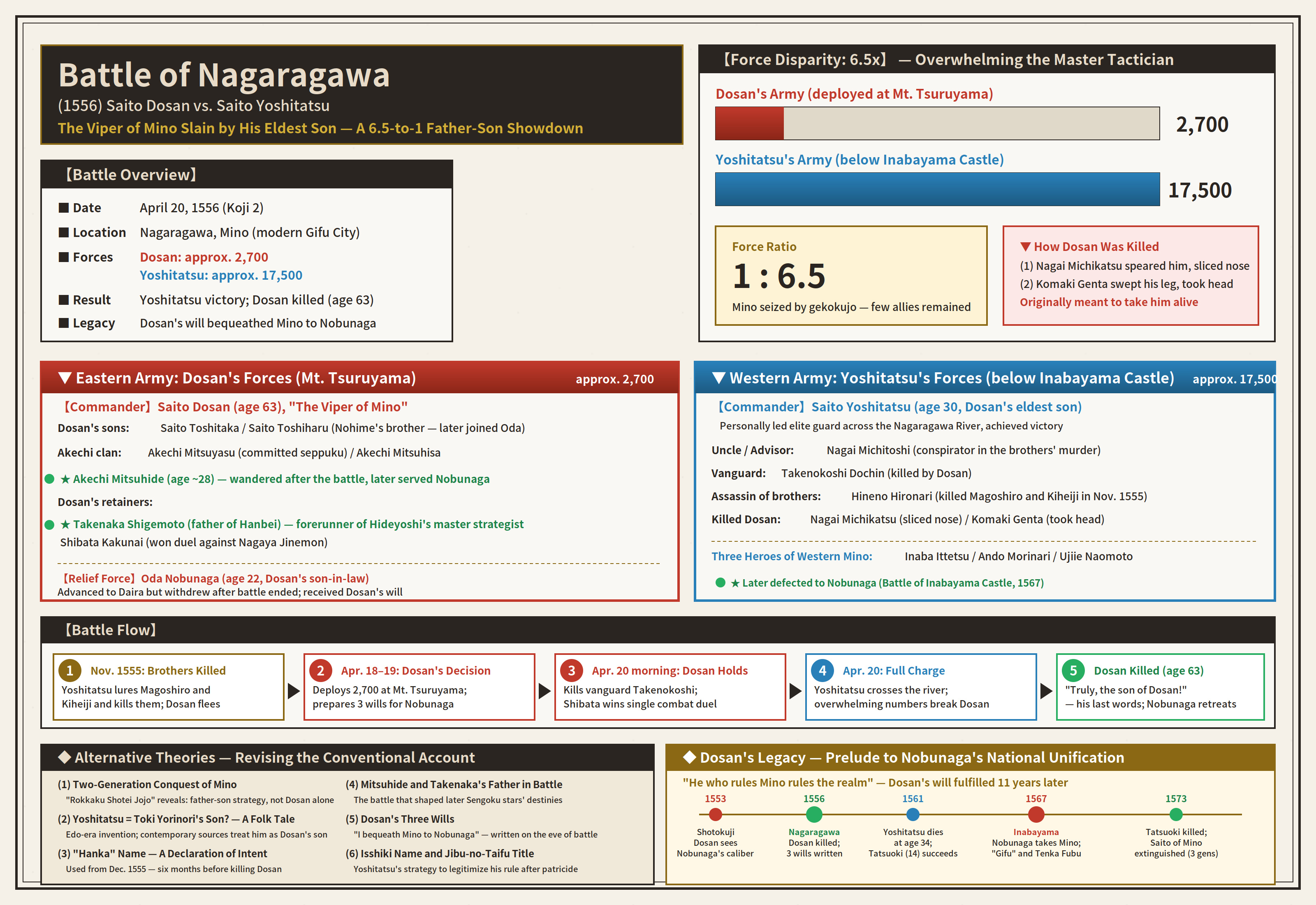
- The Battle of Nagaragawa was a clash between Saito Dosan, known as “the Viper of Mino,” and his eldest son Saito Yoshitatsu, fought for control of Mino Province — one of the most dramatic father-son conflicts of the Sengoku period
- Despite an overwhelming numerical disadvantage (2,500 vs. 17,500), and with reinforcements from his son-in-law Oda Nobunaga arriving too late, Dosan was killed in battle
- Through Dosan’s will, Mino Province was bequeathed to Nobunaga, laying the groundwork for Nobunaga’s later conquest of Mino and his “Tenka Fubu” (rule the realm by force) campaign for national unification
The Mainstream Account — The Textbook Version
Why the Battle Happened
Following the Onin War (1467–1477), Mino Province fell into prolonged chaos as the ruling Toki clan (the provincial governors, or shugo) tore itself apart through internal conflict. Saito Dosan (originally Saito Toshimasa) rose from humble origins — his family had migrated from Kyoto to Mino as commoners — and through a series of calculated maneuvers, he successively usurped the names and positions of the Nagai and Saito clans. In 1542, he expelled the Mino governor Toki Yorinori to Owari Province, seizing the position of provincial lord for himself. He became one of the most notorious embodiments of gekokujo (the lower overthrowing the higher), the defining social phenomenon of the Sengoku era, and was later given the famous epithet “the Viper of Mino.”
Dosan had several sons. His eldest, Saito Yoshitatsu, was born to a concubine named Miyoshino (also recorded as Mihoyono). His second son Magoshiro and third son Kiheiji are believed to have been born to his official wife. In 1554, Dosan handed over the headship of the clan to Yoshitatsu and retired to Sagiyama Castle. On the surface this appeared to be a smooth succession, but tensions between father and son quickly deepened.
According to the chronicles Shincho Koki and Konoki, Dosan came to regard Yoshitatsu as a “feeble-minded old fool” and began plotting to replace him as heir with his second son Magoshiro, whom he considered far more capable. He went further by granting his third son Kiheiji the prestigious court title “Isshiki Uhyoe-no-Taifu,” elevating him to a rank that surpassed Yoshitatsu’s. Emboldened by their father’s favor, the two younger brothers grew arrogant and began openly disrespecting their elder brother. Fearing he would be disinherited entirely, Yoshitatsu resolved to confront his father.
In November 1555, Yoshitatsu feigned illness and summoned his brothers Magoshiro and Kiheiji to his residence, where he had his retainer Hineno Hironari murder them. The assassination was reportedly carried out in collusion with Yoshitatsu’s uncle, Nagai Michitoshi. Shocked by the deaths of his two favored sons, Dosan fled from Inabayama Castle (later renamed Gifu Castle) and took refuge at Ogura Castle in the Yamagata district to the northwest. The father-son rift was now beyond repair, and the two sides waited for the spring thaw to settle matters by force.
Yoshitatsu attracted strong support from the former retainers of the Toki clan. Resentment toward Dosan — who had usurped the Toki position through deceit — ran deep, and many former Toki loyalists rallied behind Yoshitatsu, treating him as a banner for the restoration of the old order. There was also a widespread rumor (discussed in detail in the theories section below) that Yoshitatsu was actually the illegitimate son of the ousted Toki Yorinori, which helped consolidate former Toki retainers around him. Dosan, by contrast, found only a handful of loyalists: the Akechi clan (Akechi Mitsuyasu, Mitsuhisa, and others), Takenaka Shigemoto (father of the famous strategist Takenaka Hanbei), Dosan’s other sons Saito Toshitaka and Saito Toshiharu (younger brothers of Nohime), and the warrior Shibata Kakunai.
Dosan had previously married his daughter Kicho (also known as Nohime) to Oda Nobunaga of Owari Province, forming an alliance with the rising young warlord. Their famous meeting at Shotokuji Temple in 1553 — where Dosan reportedly recognized Nobunaga’s exceptional caliber — sealed the bond between the two men. Realizing that the decisive battle with Yoshitatsu was unavoidable, Dosan called on his son-in-law for reinforcements and prepared a remarkable will: should he fall, Mino Province would pass to Nobunaga. These are the “Three Wills of Dosan” discussed later in this article.
The Course of the Battle
On April 18, 1556, Dosan advanced his army to Mount Tsuruyama, just north of Inabayama Castle. The retainers who rallied to him on Mount Tsuruyama — Saito Toshitaka, Saito Toshiharu, Akechi Mitsuyasu, Akechi Mitsuhisa, and others — numbered only about 2,700 men. Meanwhile, Yoshitatsu had assembled a massive army of approximately 17,500 troops below Inabayama Castle. The disparity was roughly six to one. The verdict on the battlefield seemed foregone before a single arrow was loosed. Since Dosan had already transferred clan headship to Yoshitatsu and had himself acquired Mino through deception, almost no local lords were willing to support him.
Detecting Dosan’s movements, his son-in-law Oda Nobunaga dispatched a relief force, crossing the Kiso and Hida Rivers by boat to advance to Daira (modern-day Hashima City, Gifu) at Toshima and Tozobo. He was still about 10 kilometers from Dosan’s position on Mount Tsuruyama. Though Nobunaga pushed his army with all possible speed, the battle would be decided before he could arrive.
At dawn on April 20, Yoshitatsu’s army crossed the Nagaragawa River and attacked Dosan’s forces. The vanguard was led by Yoshitatsu’s senior retainer Takenokoshi Dochin. Dosan, renowned as a master tactician, repulsed the vanguard skillfully and even killed Takenokoshi Dochin in the engagement. In the opening phase of the battle, Dosan’s forces fought brilliantly despite their overwhelming numerical inferiority.
Seeing his vanguard defeated, Yoshitatsu personally led his elite guard (hatamoto) across the river. At this point, a Yoshitatsu warrior named Nagaya Jinemon issued a formal challenge for single combat — a ritualized duel between champions. Shibata Kakunai of Dosan’s army accepted, and in the ensuing duel, Kakunai killed Nagaya. Once again, Dosan’s outnumbered force had drawn first blood. But Yoshitatsu, realizing that further setbacks could not be tolerated, ordered a full assault. Against such crushing numbers, Dosan’s army finally broke.
According to Shincho Koki, Dosan was killed in the chaos of the rout. The first warrior to thrust a spear into him was Nagai Michikatsu, who sliced off Dosan’s nose. Then Komaki Genta, swept up in the momentum, cut off Dosan’s leg at the shin and took his head. The original plan had been to take Dosan alive, but in the frenzy of the moment things went otherwise; Nagai Michikatsu reportedly took Dosan’s severed nose as evidence of his feat. Dosan was 63 years old at his death. The contemporary chronicle Daikosama Gunki no Uchi records that as Dosan watched his son’s masterful command in his final moments, he exclaimed “Truly, the son of Dosan!” — recognizing at last the abilities of the son he had spent a lifetime dismissing as a fool. It was a poignant final acknowledgment from a father who had been mistaken to the very end about his eldest child.
Upon hearing of Dosan’s death, Nobunaga decided to retreat. Compounding matters, Oda Nobuyasu of the upper four districts of Owari — who had sided with Yoshitatsu — rose in revolt at Iwakura, forcing Nobunaga to abandon any deeper push into Mino (Shincho Koki, Konoki). The Akechi clan’s home castle of Akechi Castle, having sided with Dosan, was attacked by Yoshitatsu’s forces after the battle and fell. Akechi Mitsuhide (who was reportedly Dosan’s retainer at the time) became a ronin and fled Mino, eventually finding refuge with the Asakura clan of Echizen Province.

The Aftermath
With his victory at Nagaragawa, Yoshitatsu became the undisputed lord of Mino. Bearing the burden of patricide, he turned to consolidating internal affairs. He reorganized his retainer corps by incorporating former Toki loyalists, brought temples and shrines under his control, conducted land surveys, and steadily strengthened his position as a daimyo. In 1558, he received the court title “Jibu-no-Taifu” from the imperial court — a position traditionally granted to those of Seiwa Genji lineage — and used it to assert his legitimacy as a “descendant of the Toki clan.” Around the same time, the 13th Ashikaga shogun, Ashikaga Yoshiteru, granted him permission to adopt the prestigious surname of the Isshiki clan, allowing him to claim membership in the Ashikaga family lineage.
Yoshitatsu’s relationship with the Oda clan deteriorated after Dosan’s death. He clashed with Nobunaga over the Mino-Owari border in skirmishes such as the Battles of Shinano and Okusa in 1558, and continual minor engagements followed. Anxious to fortify his defenses before Nobunaga could mount a full invasion, Yoshitatsu accelerated the reorganization of his retainer corps and the strengthening of castle defenses. His administrative abilities were far from mediocre; some historians argue he was an even more effective ruler than his father. Though Yoshitatsu has long been pigeonholed as the “villainous son who killed his father,” he was in reality a capable Sengoku daimyo.
Yoshitatsu’s reign, however, was short-lived. In May 1561, he died suddenly at the age of 34. The cause is officially recorded as illness, though some sources suggest he wasted away from leprosy. His heir, Saito Tatsuoki, was only 14 years old at the time and lacked his father’s capabilities. Unable to control his retainers, he watched as the powerful “Three Heroes of Western Mino” — Inaba Ittetsu, Ujiie Naomoto, and Ando Morinari — defected to Nobunaga, and the Saito power structure began to disintegrate.
In 1567, Nobunaga defeated Tatsuoki at the Battle of Inabayama Castle and finally conquered Mino. Tatsuoki fled to Ise Nagashima and later sought refuge with Asakura Yoshikage in Echizen. In August 1573, Tatsuoki was killed at the Battle of Tonezaka during Nobunaga’s campaign against the Asakura, and the Saito clan of Mino — built by Dosan — was extinguished after only three generations.
The Battle of Nagaragawa was far more than a father-son confrontation. It was a decisive prelude to Nobunaga’s national unification. Dosan’s will, bequeathing Mino to his son-in-law, was fulfilled 11 years later when Nobunaga captured Inabayama Castle. The old Sengoku adage “He who controls Mino controls the realm” might well be said to begin with this very battle.
→ For more details, see the warlord articles “Saito Dosan” and “Saito Yoshitatsu“
Alternative Theories — Exploring Different Perspectives
【Theory 1】The Two-Generation Conquest of Mino — How the “Rokkaku Shotei Jojo Utsushi” Overturned the Old Account
The image of Saito Dosan as “an oil merchant who seized a province” — the “Viper of Mino” — is deeply rooted in popular imagination. Novels such as Shiba Ryotaro’s Kunitori Monogatari and Sakaguchi Ango’s Nobunaga have repeatedly portrayed Dosan as the archetypal symbol of gekokujo. Recent scholarship, however, has substantially rewritten this account.
The Traditional View — “Dosan’s One-Generation Conquest”
Since the war chronicles of the Edo period, Dosan’s life has been told as follows: born as a monk at Myokakuji Temple in Kyoto, he renounced his vows, traveled to Mino as an oil merchant, rose to become a retainer of the Toki clan, and eventually clawed his way to the position of provincial lord. The drama of a single generation rising from commoner to daimyo has been cherished as a quintessential Sengoku narrative.
The New View — “The Two-Generation Conquest” (Yokoyama Sumio, 1983)
This conventional account was overturned by the discovery of a Showa-era document called the “Rokkaku Shotei Jojo Utsushi” (1560). This is a letter written by Rokkaku Shotei (Yoshikata), the governor of Omi Province, to his retainer, explaining the wickedness of the Saito clan in order to call off the engagement between his son and Yoshitatsu’s daughter. Within it, Yoshitatsu’s grandfather (in other words, Dosan’s father) is described as a man who “renounced his vows at Myokakuji Temple and rose to prominence in Mino,” while Yoshitatsu’s father (Dosan) is described as one who “murdered successive heads of the Nagai clan, usurped their offices, and rose to become a member of the Saito clan.”
In his paper “The Two Renunciations of Saito Dosan” (Gifu Shigaku No. 77, 1983), Yokoyama Sumio offered an interpretation of this source. The first half of Dosan’s life as traditionally told — monk at Myokakuji, renunciation of vows, oil merchant, Nagai retainer — was in fact the life of Dosan’s father, Nagai Shinzaemonjo. Dosan’s “seizure of the province” was the result of a long-term strategy spanning two generations.
The Achievements of the Father, Nagai Shinzaemonjo
Nagai Shinzaemonjo (also known as Shogoro) migrated from Kyoto to Mino and entered the service of Nagai Nagahiro. He distinguished himself in the Funada Rebellion of 1495 and gradually rose to become a powerful Nagai retainer, eventually adopting the name “Nagai Bungo-no-Kami.” He intervened in the Toki clan’s succession dispute and succeeded in placing Toki Yorinori on the de facto seat of provincial lord. Shinzaemonjo died around 1533, and his position was inherited by his son Dosan.
Dosan’s own activities begin with this inheritance of the Nagai position after his father’s death. In 1530 he killed his lord Nagai Nagahiro and took the name Nagai Shinkuro Toshimasa; in 1538, with the death from illness of the deputy governor Saito Toshiyoshi, he inherited the Saito surname. In 1542 he completed his ascent by expelling Toki Yorinori to Owari and seizing the lordship of Mino. These were genuinely rapid rises within a single generation — but every one of them was made possible by the foundation his father had laid.
The “Viper” Nickname Is Also Recent
Another intriguing finding: the term “Viper of Mino” cannot be confirmed in any source prior to Sakaguchi Ango’s Nobunaga (1947). The image was popularized by Shiba Ryotaro’s Kunitori Monogatari, but there is no historical evidence that Dosan was actually called “the Viper” during his lifetime. “Viper of Mino” is a modern literary nickname rather than a Sengoku-era epithet.
The true Dosan was not a single-generation strongman who clawed his way up from oil merchant to lord, but rather a man who inherited his father’s foothold — a foothold that had itself been built up by a Kyoto migrant — and parlayed it into provincial lordship. He represents the classic “retainer-style upstart” of the Sengoku period. The “two-generation conquest” theory offers a more accurate picture of how power succession actually worked in the Sengoku era.
【Theory 2】Was Yoshitatsu Really the Illegitimate Son of Toki Yorinori?
The most famous popular explanation for Yoshitatsu’s motive at Nagaragawa is the claim that “Saito Yoshitatsu was the illegitimate son of Toki Yorinori.” Repeatedly told in Edo-period war chronicles, the theory is now generally rejected by historians.
The Popular Account
Early modern texts like Mino-no-Kuni Sho-Kyuki, Noyo Sho-shi Denki, Mino Meisaiki, and Toki Ruidaiki tell roughly this story: Toki Yorinori’s favored mistress, Miyoshino (Mihoyono), was already pregnant with Yorinori’s child when she was given to Dosan; the child born of this pregnancy was Yoshitatsu; upon learning that he was in fact Yorinori’s son, Yoshitatsu resolved to kill the man who was both his stepfather and his father’s enemy. The Battle of Nagaragawa was thus framed as “the dramatic revenge of a son of Toki Yorinori against the man who had stolen his father’s domain.”
Rejection by Contemporary Sources
The trouble is, none of the contemporary primary sources support this story. Early texts such as Ota Gyuichi’s Shincho Koki and Daikosama Gunki no Uchi, Oze Hoan’s Hoan Shincho Ki, Yamaga Soko’s Buke Jiki, and Konoki contain no mention of a woman named Miyoshino or Mihoyono at all. The “Rokkaku Shotei Jojo Utsushi” (1560) makes no mention of Yoshitatsu having a different biological father. On the contrary, Daikosama Gunki no Uchi records Dosan saying at the end “Truly, the son of Dosan!” — Ota Gyuichi clearly treats Yoshitatsu as Dosan’s biological son.
Early modern genealogies are also divided. While Kansei Choshu Shokafu lists Yoshitatsu as Yorinori’s son, the older Kanei Shoka Keizuden contains no such claim. The pattern is consistent: older sources tend to record Yoshitatsu as Dosan’s biological son, while later Edo-period texts increasingly identify him as Yorinori’s illegitimate child.
Why the Theory Was Invented
So why did the “Yorinori illegitimate son” theory emerge? According to scholars like Kinoshita Satoshi, it was “an after-the-fact fabrication invented to justify Yoshitatsu’s patricide.” In the Confucian moral framework of the Edo period, patricide was the gravest of all crimes. If Yoshitatsu had simply killed his real father for political power, he would stand condemned as the worst kind of unfilial son. To rehabilitate his memory, the story was constructed: Dosan was not Yoshitatsu’s real father — Yorinori was — and Yoshitatsu killed Dosan to avenge his true father.
Edo-Period Context
Another contextual factor is that during the late Edo period, retired daimyo frequently returned to political life. In Edo society, the political return of a retired daimyo was unremarkable, which made the Yoshitatsu-Dosan conflict — a retired father killed by his heir — seem inexplicable as a “normal” succession dispute. The dramatic motive of “Yoshitatsu was actually Yorinori’s son” may have been retrofitted to fill this perceived gap.
The Current Scholarly Consensus
Contemporary historians dismiss the Yorinori illegitimacy theory as a folk tale. Yoshitatsu was Dosan’s eldest son by a concubine, and he himself understood this. The father-son conflict was, by current consensus, a straightforward power struggle and succession dispute. Yoshitatsu was not “a hypocritical filial son who masked his patricide with the cloak of revenge,” but rather “a Sengoku realist who killed his father to preserve his own headship and life.”
【Theory 3】The Murder of Yoshitatsu’s Brothers — The Truth Behind November 1555
The direct trigger for the Battle of Nagaragawa was Yoshitatsu’s murder of his brothers in November 1555. Knowing that his father had been increasingly favoring his younger brothers, Yoshitatsu struck preemptively to prevent his own disinheritance.
How the Incident Unfolded
According to Shincho Koki, Yoshitatsu feigned illness and took to his bed. He then summoned his brothers Magoshiro and Kiheiji, saying he wished to see them before he died. The two younger brothers came to Yoshitatsu’s residence having laid down their arms — only to be cut down by Yoshitatsu’s retainer Hineno Hironari (who would later become a powerful figure in the Saito clan), who had been waiting in ambush.
The incident is said to have been planned with the cooperation of Yoshitatsu’s uncle, Nagai Michitoshi. Michitoshi was Dosan’s younger brother (or possibly older brother by a concubine), making him Yoshitatsu’s uncle. Shincho Koki records that he and Yoshitatsu conspired to assassinate the brothers. Nagai Michitoshi would go on to serve as a senior commander on Yoshitatsu’s side at the Battle of Nagaragawa.
What the Incident Meant
The murdered brothers, Magoshiro and Kiheiji, were most likely the sons of Dosan’s official wife, while Yoshitatsu was the son of a concubine — a fragile position as heir. From the moment Dosan began moving to install Magoshiro as the new heir and to grant Kiheiji the prestigious Isshiki surname, Yoshitatsu’s disinheritance seemed only a matter of time. To kill his brothers first was, for Yoshitatsu, a desperate act of self-preservation aimed at protecting both his life and his position.
Receiving news of the killings, Dosan fled Inabayama Castle (later Gifu Castle) and took refuge at Ogura Castle (the old Toki stronghold) in Yamagata district, about 30 km to the northwest. From that point, the conflict between father and son could only be resolved by force. When the winter snows melted the following spring, the decisive Battle of Nagaragawa would follow.
Yoshitatsu’s State of Mind and the Name Change to “Hanka”
Noteworthy is that Yoshitatsu changed his name to “Hanka” during this period. Taikoki claims he adopted the name after seeing Dosan’s severed head, repenting his crime and adopting “Hanka” to expiate the sin. However, the “Mieji Monjo” documents show Yoshitatsu was already using the name “Hanka” in an edict issued from Mieji Temple in December 1555 — six months before he killed his father. The name change, then, was not “remorse after patricide” but rather “a declaration of intent before patricide.”
“Hanka” refers to a figure in Chinese lore said to have “cut off his father’s head and been hailed for filial piety” (though the historicity of this story is unverified). The historian Kuwata Tadachika has interpreted Yoshitatsu’s adoption of the name as expressing the logic that “to cut off the head of his stepfather Dosan was to avenge his real father Toki Yorinori — thus an act of filial piety toward his real father.” But Kuwata’s interpretation presupposes the Yorinori illegitimacy theory, and is therefore viewed skeptically today. A more psychologically plausible reading is that Yoshitatsu was steeling himself for the patricide by aligning his fate with a Chinese precedent — a defiant act of self-justification rather than literal filial piety.
【Theory 4】Akechi Mitsuhide’s Participation and Dosan’s Retainers
One striking feature of the Battle of Nagaragawa is that Akechi Mitsuhide — one of the central figures of late Sengoku history — is said to have fought on Dosan’s side. The battle is therefore seen as a defining moment in Mitsuhide’s life trajectory.
The Akechi Clan on Dosan’s Side
Among the 2,700 men who gathered with Dosan on Mount Tsuruyama were members of the Akechi clan — Akechi Mitsuyasu, Akechi Mitsuhisa, and others. At the time, Mitsuhide was a young member of the Akechi clan based at Akechi Castle (in modern Kani City, Gifu), and reportedly fought alongside his uncle Mitsuyasu. The Akechi were a branch of the Toki clan and might naturally have sided with Yoshitatsu (who was being treated as the banner of Toki restoration). But the Akechi were also bound by marriage ties to Dosan through his daughter Nohime, and thus chose Dosan’s side.
After the battle, Akechi Castle was attacked by Yoshitatsu’s forces and fell. Akechi Mitsuyasu committed seppuku, and the young Mitsuhide escaped Mino as a ronin. He eventually took refuge with Asakura Yoshikage of Echizen and entered upon a long period of wandering. The path that would eventually take Mitsuhide into the service of Ashikaga Yoshiaki, then into Oda Nobunaga’s army, and ultimately to the assassination at Honnoji — all began at the Battle of Nagaragawa.
Takenaka Shigemoto, Father of Takenaka Hanbei
Another noteworthy participant on Dosan’s side was Takenaka Shigemoto, father of the legendary strategist Takenaka Hanbei, who would later serve Toyotomi Hideyoshi. Hanbei himself was only 12 years old at the time, but the strategic acumen and judgment he would later display drew on his family’s deep experience as Sengoku-era retainers.
Other Dosan-Side Retainers
Other warriors who fought valiantly for Dosan included Saito Toshitaka and Saito Toshiharu (Dosan’s sons by another mother — half-brothers of Yoshitatsu), and Shibata Kakunai (who killed Nagaya Jinemon in the single-combat duel). Toshitaka and Toshiharu took refuge with the Oda after the battle and went on to serve Nobunaga. Toshiharu, who was a younger brother of Nohime, effectively continued the Saito of Mino lineage within the Oda household. He died at Nijo Castle during the Honnoji Incident, fighting alongside Oda Nobutada (Nobunaga’s heir).
Though the Battle of Nagaragawa was decided in a single day, it dramatically reshuffled the human networks of the Sengoku era. Akechi Mitsuhide, the Takenaka father-son pair, Saito Toshiharu — many of those who fought for Dosan would go on to become central figures in the Nobunaga and Hideyoshi regimes. As a hinge point of historical causation, the Battle of Nagaragawa occupies a unique place in Sengoku history.
【Theory 5】The Three Wills of Dosan and the Bequest of Mino to Nobunaga
On the eve of the Battle of Nagaragawa, Dosan sent a will to his son-in-law Oda Nobunaga bequeathing Mino Province to him. These documents — known variously as “Dosan’s wills” or “the deeds of cession to Nobunaga” — are among the most important documents of Sengoku history.
Overview of the Wills
Three of Dosan’s wills survive, all dated April 19, 1556 — the day before the decisive battle. Their content states that if Dosan should die in his battle against Yoshitatsu, the province of Mino was to be bequeathed to his son-in-law Oda Nobunaga. One of the three is thought to have been handed to Saito Toshiharu (Dosan’s son and Yoshitatsu’s half-brother), who fought on Dosan’s side at Nagaragawa, and later carried it to the Oda army after the battle, delivering it to Nobunaga.
The reason Dosan prepared such a will on the eve of battle was that he foresaw his defeat. With a sevenfold disadvantage in numbers, even a master tactician like Dosan could see victory was unlikely. The province he ruled was one he had usurped through deception, and almost no local lords were willing to support him. As a last resort, Dosan entrusted Mino to his son-in-law.
The Connection to Nobunaga’s Conquest of Mino
Dosan’s will became the justifying basis for the Oda clan’s subsequent conquest of Mino. After Dosan’s death, Nobunaga waged a long campaign against Yoshitatsu and Tatsuoki, and throughout, he held up the banner of “Mino was bequeathed to me by the late Dosan.” When Nobunaga finally captured Inabayama Castle and conquered Mino in 1567, it was the fulfillment of Dosan’s eleven-year-old will.
After taking Mino, Nobunaga moved his base from Kiyosu in Owari to Inabayama in Mino, and renamed the city “Gifu.” The name derived from the Chinese legend of Mount Qi (Kizan), where King Wen of Zhou established his power before unifying the realm — a clear signal that Nobunaga’s full-scale “Tenka Fubu” (rule the realm by force) campaign was now beginning. The chain of succession that began at Nagaragawa — Dosan to Yoshitatsu to Tatsuoki to Nobunaga — proved to be the decisive prelude to Nobunaga’s national unification.
The Relationship Between Dosan and Nobunaga — The Meeting at Shotokuji
Dosan’s recognition of Nobunaga as a worthy successor did not happen suddenly on the eve of Nagaragawa. In April 1553, Dosan met Nobunaga at Shotokuji Temple in Tomida. At the time, Nobunaga was a young deputy governor of Owari widely dismissed as a “fool” (utsuke), but Dosan saw through to his true caliber. Shincho Koki records that Dosan predicted “All of my sons will end up serving Nobunaga.” The will written on the eve of Nagaragawa was the natural extension of the assessment Dosan had made three years earlier at Shotokuji.
The three Dosan wills are among the most important primary sources of the Sengoku period that have survived to today. Related documents are preserved at multiple sites, including Joinji Temple in Gifu City, and they remain valuable records of how power was actually transferred during the Sengoku era.
【Theory 6】Yoshitatsu’s Adoption of the Isshiki Name and His Claim to Toki Legitimacy
After killing his father, Yoshitatsu adopted the prestigious Isshiki surname — a branch of the Ashikaga family — and styled himself “Isshiki Sakyo-no-Taifu.” This has been read variously as an attempt to wash away the stain of patricide and as a calculated effort to bolster his own authority. It is a classic example of political performance in the Sengoku period.
Significance of the Isshiki Adoption
The Isshiki were one of the four “Shishiki” houses of the Muromachi shogunate (ranking just below the Kanrei houses) and traced their lineage to Seiwa Genji. For a parvenu daimyo in the Sengoku era, adopting the surname of an established noble house was an effective way to legitimize one’s authority. By becoming an “Isshiki,” Yoshitatsu sought to transform his self-image from “the son of the upstart Dosan” to “a legitimate daimyo of Ashikaga lineage.”
There was even a genealogical basis for the claim. According to Mino-no-Kuni Shoka Keifu, Yoshitatsu’s mother Miyoshino was descended from the Isshiki clan — her maternal grandfather was Isshiki Yoshito, the governor of Chita district in Owari (or alternatively, her father may have been Isshiki Yoshikiyo). If Miyoshino was of Isshiki descent, then Yoshitatsu had genuine bloodline justification for taking the Isshiki name.
Kinoshita Satoshi’s Interpretation
Sengoku historian Kinoshita Satoshi offers an interesting interpretation of why Yoshitatsu chose the Isshiki name. At the time, Toki Yorinori was still alive and had taken refuge with the Rokkaku clan. If Yoshitatsu had adopted the Toki name, it would have invited backlash from the Toki clan and possibly forced him to accept Yorinori’s return to Mino. On the other hand, choosing a name that wasn’t certain to provoke opposition (as the Rokkaku of neighboring Omi would have done) — and that ranked above the Toki — made the Isshiki “the politically optimal choice.”
Renaming of Retainers
There is also a theory that Yoshitatsu had his retainers adopt surnames connected to the Isshiki house. Former Toki retainers who had joined Yoshitatsu — the Kuwabara, Ando, Hineno, and Takenokoshi families — are said to have changed their surnames to Nobenaga, Iga, Ujiie, and Naruyoshi, respectively (names connected to Isshiki retainer families). However, the renaming likely took place after Yoshitatsu’s death, under the rule of Tatsuoki from 1561 onward, rather than during Yoshitatsu’s own lifetime.
Court Title
In 1558, Yoshitatsu received the court appointment of “Jibu-no-Taifu” (equivalent to Senior Fifth Rank, Lower Grade) from the imperial court. This title far exceeded Nobunaga’s at the time (Kazusa-no-Suke, Junior Sixth Rank, Upper Grade). The Jibu-no-Taifu position was traditionally granted to those of Seiwa Genji lineage, and Yoshitatsu’s acquisition of it signaled imperial recognition of his legitimacy as a “descendant of the Toki and member of the Isshiki house.”
Yoshitatsu’s adoption of the Isshiki name and acquisition of the Jibu-no-Taifu title are emblematic of Sengoku-era political performance. Far from being the “villainous son who killed his father” of popular imagination, Yoshitatsu was an able Sengoku daimyo who consolidated his rule of Mino through carefully constructed claims to legitimacy.
A Strategic Analysis
Viewed strategically, the Battle of Nagaragawa concentrates the essential dynamics of power succession in the Sengoku period. Four points stand out.
First, the spiral of gekokujo. Dosan seized Mino from the Toki; Yoshitatsu seized Mino from Dosan. Power built through gekokujo is taken away by gekokujo — nowhere is the fragility of Sengoku power structures more vividly demonstrated than in this father-son confrontation. Because Dosan’s own claim to Mino was so weak, the framework of “Yoshitatsu rallies former Toki retainers and overthrows Dosan” became possible. What is gained through gekokujo is lost through gekokujo. Nagaragawa eloquently illustrates the cold logic of the Sengoku era.
Second, the link to Oda Nobunaga. The three wills of Dosan transformed the Battle of Nagaragawa from a private family conflict in Mino into a decisive prelude to Nobunaga’s national unification. For 11 years afterward, Nobunaga held up the justification of “I am Dosan’s appointed successor in Mino,” and finally in 1567 he captured Inabayama Castle and conquered Mino. He renamed the city Gifu and proclaimed “Tenka Fubu” — and the starting point of all of this was the Battle of Nagaragawa. The final flash of Dosan’s strategic vision laid the groundwork for Nobunaga’s unification campaign.
Third, the reassessment of Yoshitatsu. Long pigeonholed as “the villainous patricide” and “a mediocre daimyo,” Yoshitatsu has been undergoing rehabilitation in recent scholarship. He reorganized his retainer corps by absorbing former Toki loyalists, won the court title of Jibu-no-Taifu, legitimized his rule through the adoption of the Isshiki surname, and stabilized internal administration — none of which are accomplishments within reach of a mediocre lord. In just five years on the throne, Yoshitatsu firmly established his position as a Sengoku daimyo. As his father acknowledged with his dying words “Truly, the son of Dosan!” — Yoshitatsu’s abilities were in no way inferior to his father’s.
Fourth, Nagaragawa as the starting point for the careers of Akechi Mitsuhide and the Takenaka father-son pair. Among those who fought on Dosan’s side at Nagaragawa were several future leading figures of late Sengoku history. Akechi Mitsuhide’s exile in Echizen and his eventual meeting with Nobunaga; the rise of Takenaka Hanbei as Hideyoshi’s master strategist; Saito Toshiharu’s incorporation into the Oda army — all of these histories trace back to the Battle of Nagaragawa. As a hinge point in the historical chain, Nagaragawa occupies a unique position in Sengoku history.
In Kunitori Monogatari, Shiba Ryotaro depicted Dosan as “the Viper of Mino” and celebrated his life of gekokujo as the symbol of the Sengoku era. But Dosan’s own end was, with crushing irony, brought about by the very logic of gekokujo he had embodied: he was killed by his own son. “The realm of Saito Dosan was won not at Nagaragawa, but in Nobunaga.” The foundation Dosan built — the province of Mino — passed through his son’s hands and was finally transmuted by his son-in-law Nobunaga into the springboard for national unification. The Battle of Nagaragawa stands as a rare battle that simultaneously demonstrates the cold logic of the Sengoku era and the marvelous chain of historical causation.
Famous Sayings and Quotations from the Battle
“Sasuka tausan ka ko ni te soro”
(Truly, the son of Dosan!)
The last words attributed to Dosan as he watched Yoshitatsu’s command of the battle, moments before he was killed. Recorded in the contemporary chronicle Daikosama Gunki no Uchi by Ota Gyuichi. After a lifetime of dismissing his eldest son as a “feeble-minded old fool,” Dosan finally recognized his abilities on the battlefield. The line has been interpreted both as belated admiration and as regret for having tried to disinherit him. It survives as the tragically dignified final utterance of a father in one of the Sengoku period’s most famous father-son confrontations.
— Source: Ota Gyuichi, Daikosama Gunki no Uchi
“All of my sons will end up holding the reins of Nobunaga’s horse.”
(Waga ko-tachi wa mina, Nobunaga no bazen ni tazuna o toru koto ni naru darou)
The words Dosan reportedly spoke after meeting Nobunaga at Shotokuji Temple in Tomida in April 1553. Nobunaga at the time was a young Owari deputy governor widely dismissed as a “fool” (utsuke), but Dosan saw through to his true caliber and predicted “my sons will end up serving Nobunaga.” Three years later, Dosan died after leaving his deeds of cession to Nobunaga; 11 years later, Nobunaga conquered Mino and raised the banner of “Tenka Fubu.” Frequently cited as evidence of Dosan’s exceptional eye for judging men in the Sengoku period.
— Source: Ota Gyuichi, Shincho Koki
“He who kills his lord and kills his son-in-law will meet his own end / Long ago it was Osada — now it is Yamashiro.”
(Shu o kiri muko o korosu wa mi no owari / Mukashi wa Osada ima wa Yamashiro)
A satirical lampoon recorded in Shincho Koki. The poem reads: “Those who kill their lord and kill their son-in-law are doomed to ruin. In the past it was Osada Tadamune, the man who betrayed Minamoto no Yoshitomo — and now it is Saito Yamashiro-no-Kami (Dosan).” It pokes fun at the suspicion (recorded but unconfirmed) that Dosan poisoned his lord Toki Yorimitsu, who was also his son-in-law. The lampoon captures the cold disdain felt toward Dosan by the broader society of his day. Ironically, just as the poem foretold, Dosan was killed by his own son and met his ruin.
— Source: Ota Gyuichi, Shincho Koki
“He took Lord Jiro as his son-in-law; when Jiro died young, he conspired with Jiro’s younger brother Hachiro, lured him to Inokuchi, contrived some pretext, and had him killed…”
(Jiro-dono o muko ni tori, kare souseisourote nochi, shatei Hachiro-dono e moushiawase, Inokuchi e hikiyose, koto ni souyu o yose, shougai sase moushi)
A passage from the “Rokkaku Shotei Jojo Utsushi” of 1560, in which Rokkaku Shotei (Yoshikata), governor of Omi, listed Dosan’s crimes to his retainer. The passage describes how Dosan married Toki Jiro (Yorimitsu) into his family, then after Jiro’s early death conspired with Jiro’s younger brother Hachiro (Yoritaka), summoning him to Inabayama Castle and forcing him to take his own life — and how Dosan went on to poison and assassinate the rest of the brothers as well. As a contemporary source documenting the brutality of Dosan’s path to power, this document has become invaluable to modern Dosan research.
— Source: “Rokkaku Shotei Jojo Utsushi” (April 8, 1560)
Anecdotes and Episodes
The Meeting at Shotokuji — When Dosan Recognized Nobunaga
In April 1553, Dosan met Nobunaga for the first time at Shotokuji Temple in Tomida. Nobunaga was 19 years old. He was famous as a “fool” — known for his bizarre appearance: tiger-skin hanbakama trousers and flint pouches hanging from his belt. Curious about his son-in-law, Dosan hid in a roadside house to observe Nobunaga’s procession.
What Dosan saw was not the “fool” but a young commander leading a disciplined column of troops. Nobunaga’s force carried 500 matchlocks and 500 long spears — cutting-edge weaponry for the era — and was under tight discipline. Dosan reportedly drew his breath in surprise. When the two men met inside Shotokuji, Nobunaga appeared in formal attire and behaved with impeccable courtesy. Dosan completely revised his assessment.
On the way back, Dosan told his retainers, “All of my sons will end up holding the reins of Nobunaga’s horse.” Three years later, on the eve of Nagaragawa, Dosan prepared his will to Nobunaga. The prediction made three years earlier at Shotokuji — that his sons would all serve Nobunaga — would be realized in exchange for Dosan’s own death.
— Source: Ota Gyuichi, Shincho Koki
The Duel Between Shibata Kakunai and Nagaya Jinemon
The duel between Shibata Kakunai and Nagaya Jinemon symbolized the morale of both armies at Nagaragawa. When Yoshitatsu personally led his elite guard across the Nagaragawa River, his retainer Nagaya Jinemon issued a formal challenge for single combat. Dosan’s warrior Shibata Kakunai accepted.
Single combat (ikki-uchi) was a common feature of Sengoku-era battles, but it was no mere matter of personal honor — it was a ritual that could swing the morale of both armies. Shibata Kakunai dispatched Nagaya Jinemon in fine style, demonstrating the fighting spirit of Dosan’s troops. Against overwhelming odds, the masterful tactician Dosan was winning the local engagements one by one — a fact this duel encapsulates.
But Yoshitatsu, witnessing the duel’s outcome, decided he could no longer afford piecemeal action and ordered a full charge. From that point on, sheer numbers overwhelmed Dosan’s army. The valor of Shibata Kakunai stands in Sengoku history as the last gleam of light from the losing side.
— Source: Shincho Koki, Konoki
Dosan’s End — Nagai Michikatsu’s Spear and Komaki Genta’s Sweep
Shincho Koki records Dosan’s final moments in stark detail. In the chaos of the rout, the first warrior to thrust a spear into Dosan was Nagai Michikatsu, fighting on Yoshitatsu’s side. Michikatsu had intended to capture Dosan alive, and he began by slicing off Dosan’s nose. At the time, “nose-slicing” was a ritual preparatory to capturing an enemy commander alive.
But immediately afterward, Komaki Genta arrived on the scene, swept Dosan’s leg at the shin, and took his head. The outcome was not what had been planned. Nagai Michikatsu carried Dosan’s severed nose back as evidence to be inspected by Yoshitatsu. It was a brutally graphic end for the man who had been feared as “the Viper of Mino.”
Dosan’s body was buried on the south-western side of Joinji Temple on the north bank of the Nagaragawa River. During the Edo period, repeated flooding of the river caused the grave to suffer water damage, and the chief priest of Joinji moved it to its current location at Nagara Fukumitsu in Gifu City. This is the “Dosan Mound” that survives today. The grave of gekokujo‘s symbol has been relocated repeatedly with the floods of the Nagaragawa, surviving to the present.
— Source: Ota Gyuichi, Shincho Koki, Joinji Temple records
Nobunaga’s Relief Arrives Too Late
Upon receiving Dosan’s request for reinforcements, Nobunaga moved his army at once. Crossing the Kiso and Hida Rivers by boat, he advanced to Daira (modern Hashima City, Gifu) at Toshima and Tozobo. It was still 10 kilometers from Dosan’s position on Mount Tsuruyama. Nobunaga rushed to secure a bridgehead and link up with Dosan’s army.
But the battle was already decided before he could arrive. Upon hearing of Dosan’s death, Nobunaga decided to retreat. Oda Nobuyasu of the upper four districts of Owari (Nobunaga’s cousin, lord of Iwakura Castle) had joined Yoshitatsu and risen in revolt at Iwakura, threatening Nobunaga’s home base. To press deeper into Mino now would risk losing Owari entirely. During the retreat, Nobunaga is said to have met Saito Toshiharu (who had fought on Dosan’s side) and received Dosan’s will from him.
By the bare measure of “Mino was lost when Dosan died,” Nobunaga’s relief was a complete failure. But over the longer term, the fact that Nobunaga received Dosan’s will and acquired the justification of “the legitimate successor in Mino” became the spiritual foundation for his eleven-year campaign to conquer the province. The failure at Nagaragawa was, in fact, the starting point of Nobunaga’s national unification project.
— Source: Shincho Koki, Konoki
→ For more details, see the warlord article “Oda Nobunaga“
The Fall of Akechi Castle and the Wanderings of the Young Mitsuhide
Immediately after the Battle of Nagaragawa, Yoshitatsu’s forces attacked the Akechi clan’s home castle at Akechi (modern Kani City, Gifu), which had fought on Dosan’s side. Akechi Mitsuyasu (Mitsuhide’s uncle) defended the castle valiantly but was overwhelmed; he committed seppuku, and the Akechi clan was effectively destroyed.
The young Akechi Mitsuhide (estimated to be about 28 years old at the time, though his year of birth is disputed) barely managed to escape. Driven from Mino, Mitsuhide entered a long period of wandering. He is said to have taken refuge with Asakura Yoshikage in Echizen, but his activities during this period are sparsely documented — historians refer to this as Mitsuhide’s “lost decade.”
It would be more than a decade after Nagaragawa before Mitsuhide entered the service of Ashikaga Yoshiaki and had his fateful meeting with Oda Nobunaga. The rest of Mitsuhide’s life — the assassination of Nobunaga at Honnoji, his defeat by Hideyoshi at Yamazaki, his death — all of it can be said to have begun at the Battle of Nagaragawa. As a hinge point in the chain of history, Nagaragawa was Mitsuhide’s fateful battle as well.
— Source: Akechi Gunki, Todaiki, and others
The Relationship Between Dosan and Oda Nobuhide — From Adversary to Father-in-Law
The relationship between Dosan and Oda Nobuhide (Nobunaga’s father) began as bitter enmity. In 1544, Nobuhide led a large army into Mino, advancing as far as Inabayama Castle. Dosan narrowly escaped catastrophe, but the conflict continued. At the Battle of Kanoguchi in 1547, Dosan defeated Nobuhide’s larger force.
But prolonged conflict carried the risk of mutual destruction. Around 1548, Dosan and Nobuhide moved toward peace. As a token of the truce, Dosan agreed to marry his daughter Kicho (Nohime) to Nobuhide’s heir Nobunaga. With this marriage, Dosan and Nobuhide became relatives by marriage, and the front finally stabilized.
Nobuhide died in March 1552, and Nobunaga inherited the Oda clan. After Nobuhide’s death, Dosan became a supporter of his son-in-law Nobunaga. Nobunaga’s rush to Dosan’s relief at Nagaragawa was a natural extension of this alliance. The long-running enmity between Dosan and Nobuhide eventually became the prelude to “Dosan to Nobunaga” — the line of succession of Mino.
— Source: Shincho Koki, Tosho-gu Goojki
→ For more details, see the warlord article “Oda Nobuhide“
Yoshitatsu’s Early Death — A Reign of Only Five Years
Having killed his father and become lord of Mino, Yoshitatsu turned to stabilizing internal affairs. He incorporated former Toki retainers, reorganized his retainer corps, controlled temples and shrines, and conducted land surveys. He won the court title of Jibu-no-Taifu and bolstered his authority by adopting the Isshiki surname. Contrary to the popular image of “the villainous patricide,” Yoshitatsu was an able Sengoku daimyo who governed Mino effectively.
But his reign was brief. In May 1561, Yoshitatsu died suddenly at the age of 34. The cause is officially recorded as illness, though some sources suggest he wasted away from leprosy. Just five years after killing his father, Yoshitatsu’s “realm” came to a sudden end.
His heir, Saito Tatsuoki, was 14 years old. The sudden death of a daimyo and the accession of a young heir was the gravest of crises for a Sengoku clan. Discipline in the retainer corps loosened, and the powerful “Three Heroes of Western Mino” — Inaba Ittetsu, Ujiie Naomoto, and Ando Morinari — defected to Nobunaga as the Saito power structure fractured. In 1567, Nobunaga defeated Tatsuoki at the Battle of Inabayama Castle and conquered Mino. Had Yoshitatsu lived longer, Nobunaga’s conquest of Mino would have been far more difficult. The “curse of patricide” — a short life followed by the extinction of the Saito clan — illustrates the cold karmic logic of the Sengoku era.
— Source: Shincho Koki, Mino-no-Kuni Sho-Kyuki
→ For more details, see the warlord article “Saito Yoshitatsu“
Timeline of the Battle of Nagaragawa
| Date | Event |
|---|---|
| Daiei 7 (1527) | Birth of Saito Yoshitatsu. His mother was Miyoshino (various accounts) |
| Tenbun 11 (1542) | Dosan expels Toki Yorinori to Owari and seizes the position of provincial lord of Mino |
| c. Tenbun 17 (1548) | Dosan and Oda Nobuhide make peace. Dosan’s daughter Kicho (Nohime) marries Nobunaga |
| Tenbun 17 (1548) | Dosan turns over Inabayama Inokuchi Castle to Yoshitatsu and retires to Sagiyama Castle (de facto succession) |
| Tenbun 22 (1553) April | Dosan and Nobunaga meet at Shotokuji Temple in Tomida. Dosan recognizes Nobunaga’s caliber |
| Tenbun 23 (1554) | Dosan formally cedes clan headship to Yoshitatsu and retires |
| Koji 1 (1555) November | Yoshitatsu feigns illness, lures brothers Magoshiro and Kiheiji to his residence, and has Hineno Hironari kill them. Dosan flees to Ogura Castle |
| Koji 1 (1555) December | Yoshitatsu issues an edict at Mieji Temple under the name “Hanka” (declaration of intent to kill Dosan) |
| Koji 2 (1556) April 18 | Dosan advances his army to Mount Tsuruyama north of Inabayama Castle. About 2,700 local lords rally to him |
| April 19 | Dosan prepares three wills for Nobunaga. He bequeaths Mino Province to Nobunaga |
| April 20, morning | The Battle of Nagaragawa begins. Yoshitatsu’s 17,500-man army crosses the Nagaragawa River to attack |
| April 20 | Opening engagement: Dosan repels Yoshitatsu’s vanguard under Takenokoshi Dochin and kills Takenokoshi |
| April 20 | Yoshitatsu personally leads his elite guard across the river. Single combat between Shibata Kakunai and Nagaya Jinemon |
| April 20 | Yoshitatsu orders a full charge. Dosan’s army collapses. Dosan is killed by Nagai Michikatsu and Komaki Genta. Age 63 |
| April 20, same day | Nobunaga advances to Toshima and Tozobo at Daira to attempt rescue, but retreats upon learning of Dosan’s death |
| Late April | Yoshitatsu’s forces attack Akechi Castle. Akechi Mitsuyasu commits seppuku; young Akechi Mitsuhide escapes into wandering |
| Koji 4 (1558) | Yoshitatsu receives the court title of Jibu-no-Taifu. Adopts the Isshiki surname |
| Eiroku 3 (1560) April 8 | Issuance of the “Rokkaku Shotei Jojo Utsushi,” denouncing the crimes of Dosan and Yoshitatsu |
| Eiroku 4 (1561) May | Yoshitatsu dies suddenly at age 34. His heir Tatsuoki (age 14) succeeds him |
| Eiroku 10 (1567) | Nobunaga defeats Tatsuoki at the Battle of Inabayama Castle. Conquers Mino and renames it “Gifu” |
| Tensho 1 (1573) August | Saito Tatsuoki is killed at the Battle of Tonezaka. The Saito clan of Mino is extinguished (three generations from Dosan) |
* Dates are in the old lunar calendar. Background colors: yellow = major events; red = battles and deaths in combat
Key Figures on Both Sides
Eastern Army (Dosan’s Forces, approx. 2,700)
| Role | Figure | Description |
|---|---|---|
| Commander-in-Chief | Saito Dosan | Age 63. “The Viper of Mino.” Deployed at Mount Tsuruyama. Killed by Nagai Michikatsu and Komaki Genta |
| Dosan’s son | Saito Toshitaka | Dosan’s son (half-brother of Yoshitatsu). Fought with his father on Mount Tsuruyama; later took refuge with the Oda |
| Dosan’s son | Saito Toshiharu | Dosan’s son. Younger brother of Nohime. After the battle inherited the Saito of Mino lineage within the Oda household. Killed at the Honnoji Incident |
| Akechi clan | Akechi Mitsuyasu | Akechi Mitsuhide’s uncle. Lord of Akechi Castle. Fought on Dosan’s side at Nagaragawa; committed seppuku when Akechi Castle fell |
| Akechi clan | Akechi Mitsuhisa | Senior retainer of the Akechi clan. Fought on Dosan’s side |
| Akechi clan | Akechi Mitsuhide | Approximately 28 years old. Fought alongside his uncle Mitsuyasu. After the battle wandered as a ronin before entering Nobunaga’s service |
| Dosan’s retainer | Takenaka Shigemoto | Father of Takenaka Hanbei. Fought on Dosan’s side. Forerunner of the Takenaka clan that would serve Nobunaga and Hideyoshi |
| Dosan’s retainer | Shibata Kakunai | Won the single-combat duel against Nagaya Jinemon of Yoshitatsu’s army. Embodied the fighting spirit of Dosan’s troops |
| Relief force | Oda Nobunaga | Age 22. Dosan’s son-in-law. Advanced to Daira to attempt rescue, but withdrew after the battle ended |
Western Army (Yoshitatsu’s Forces, approx. 17,500)
| Role | Figure | Description |
|---|---|---|
| Commander-in-Chief | Saito Yoshitatsu | Age 30. Dosan’s eldest son. Personally led his elite guard across the river and won. Became lord of Mino after the battle |
| Uncle / Advisor | Nagai Michitoshi | Dosan’s younger brother (or older brother by concubine), Yoshitatsu’s uncle. Conspired with Yoshitatsu in the killing of his brothers |
| Vanguard | Takenokoshi Dochin | Vanguard commander on Yoshitatsu’s side. Led the river crossing; killed by Dosan |
| Yoshitatsu’s retainer | Hineno Hironari | Executed the killing of Yoshitatsu’s brothers in November 1555. Fought on Yoshitatsu’s side |
| Killed Dosan | Nagai Michikatsu | First to thrust a spear into Dosan and slice off his nose. Had intended to capture him alive |
| Killed Dosan | Komaki Genta | Swept Dosan’s leg at the shin and took his head. The outcome differed from the original plan |
| Single combat | Nagaya Jinemon | Issued the formal challenge for single combat from Yoshitatsu’s side; killed by Shibata Kakunai |
| Yoshitatsu’s side | Inaba Ittetsu (Yoshimichi) | One of the Three Heroes of Western Mino. Fought on Yoshitatsu’s side, later defected to Nobunaga during Nobunaga’s conquest of Mino |
| Yoshitatsu’s side | Ando Morinari | One of the Three Heroes of Western Mino. Fought on Yoshitatsu’s side |
| Yoshitatsu’s side | Ujiie Naomoto | One of the Three Heroes of Western Mino. Fought on Yoshitatsu’s side |
Historic Sites Map & Travel Guide
Sites on the Map:
- Dosan Mound (grave) — Tomb of Saito Dosan. Relocated several times due to flooding of the Nagaragawa River; currently at Nagara Fukumitsu in Gifu City
- Joinji Temple (temple) — Family temple of the Saito clan. Houses portraits of Dosan and Yoshitatsu and related historical materials
- Gifu Castle (Inabayama Castle) (castle) — Home base of three generations of the Saito clan: Dosan, Yoshitatsu, and Tatsuoki
- Ogura Castle Ruins (castle) — Castle where Dosan took refuge after the murder of his sons. Old Toki stronghold
- Battlefield of Moribe (battlefield) — Site of the 1561 battle between Nobunaga and Yoshitatsu/Tatsuoki
* This map shows modern roads for reference. Roads and terrain during the Sengoku period would have been different. The exact location of Mount Tsuruyama is disputed in primary sources, but the area around Sofukuji Temple is generally identified as the most likely site.
📍 View route on Google Maps (switchable between car/train)
Model Itinerary — Tracing the Footsteps of Dosan and His Son in One Day
Trip Details
- Duration: Approximately 5–6 hours (by car)
- Walking pace: Approximately 4 km/h; time at each site: 30–60 minutes
- Starting point: Within 10 minutes by car from JR Gifu Station
Itinerary
① Joinji Temple (Approx. 60 minutes)
Family temple of the Saito clan. Portraits of Dosan and Yoshitatsu and edict documents are on display. Admission 200 yen.
– By car: About 10 minutes from JR Gifu Station
② Dosan Mound (Approx. 20 minutes)
Tomb of Saito Dosan. Located in a residential area with limited signage; a 5-minute walk from Joinji.
– On foot: About 5 minutes from Joinji
③ Gifu Castle (Inabayama Castle) (Approx. 90 minutes)
Home base of three generations of the Saito clan. Ropeway access to the summit. The castle includes a museum.
– By car: About 10 minutes from Dosan Mound
④ Mount Tsuruyama area (Sofukuji Temple) (Approx. 30 minutes)
The likely site of Dosan’s battle deployment at Mount Tsuruyama. Sofukuji is also a temple dedicated to Nobunaga and his heir Nobutada.
– By car: About 10 minutes from the Gifu Castle ropeway station
⑤ Ogura Castle Ruins (Approx. 90 minutes, for the hearty)
The castle where Dosan took refuge. Hiking trail to the summit; the observation deck offers a panoramic view of the Mino plain.
– By car: About 40 minutes from Gifu Castle
⑥ Battlefield of Moribe (Approx. 20 minutes, optional)
Site of the 1561 battle five years after Nagaragawa, where Nobunaga fought Yoshitatsu and Tatsuoki. Also known as the battle that launched Maeda Toshiie’s career.
– By car: About 60 minutes south of Ogura Castle
Customize Your Visit
- Two-day trip: Day one in Gifu City (Joinji, Dosan Mound, Gifu Castle, Mount Tsuruyama); day two extending to Yamagata City (Ogura Castle) and Anpachi District (Battlefield of Moribe) — tracing the path of Dosan and his son
- For Dosan fans: The “Life of Dosan” course — Joinji + Dosan Mound + Gifu Castle + Ogura Castle
- For a relaxed visit: Half-day course covering Joinji + Dosan Mound + Gifu Castle
- For Sengoku enthusiasts: Gifu Castle + Battlefield of Moribe + Inabayama Castle (Nobunaga’s conquest of Mino) + Komakiyama Castle — tracing Sengoku history from Mino to Owari
* This itinerary is based on average travel speeds and visit durations and is intended as a general guide. Opening hours, transportation schedules, and crowd levels vary by season and day of the week. Please check the latest information on each facility’s and transit operator’s official website before your visit.
* Admission fees listed are approximate as of the time of writing and may have changed.
* When visiting mountain castle ruins (such as Ogura Castle), please plan according to weather conditions and your own fitness level.
Related Articles
Battle Articles
- Battle of Okehazama (1560) — Four years after Nagaragawa, the battle that launched Nobunaga’s quest to rule the realm
- Battle of Inabayama Castle (1567) — Nobunaga defeats Tatsuoki and conquers Mino — the fulfillment of Dosan’s will
- Battle of Anegawa (1570) — A key battle on Nobunaga’s path to national unification
- Honnoji Incident (1582) — Akechi Mitsuhide strikes down Nobunaga: the destination of the story that began at Nagaragawa
Warlord Articles
- Saito Dosan — “The Viper of Mino.” Killed by his own son Yoshitatsu at Nagaragawa
- Saito Yoshitatsu — Dosan’s eldest son. Killed his father and became lord of Mino but died at age 34
- Oda Nobunaga — Dosan’s son-in-law. Failed to relieve Dosan in time, but later conquered Mino himself
- Oda Nobuhide — Nobunaga’s father. Long an adversary of Dosan before peace made them in-laws
- Akechi Mitsuhide — Fought on Dosan’s side. Wandered after the battle before entering Nobunaga’s service — and the path to Honnoji
- Takenaka Hanbei — His father Shigemoto fought on Dosan’s side. Later became Hideyoshi’s master strategist
References
Primary Sources
- Ota Gyuichi, Shincho Koki — Records Dosan’s death in detail
- Ota Gyuichi, Daikosama Gunki no Uchi — Records Dosan’s final words “Truly, the son of Dosan!”
- Oze Hoan, Hoan Shincho Ki — Early Edo period account, summary of the Nagaragawa engagement
- Konoki — Records the relationship between Yoshitatsu and Dosan
- Mieji Monjo — Edict by Yoshitatsu under the name “Hanka” (December 1555)
- “Rokkaku Shotei Jojo Utsushi” (April 8, 1560) — Contemporary source denouncing the crimes of Dosan and Yoshitatsu
- Three Wills of Dosan (April 19, 1556) — Deeds of cession to Nobunaga
Academic Works
- Yokoyama Sumio, “The Two Renunciations of Saito Dosan,” Gifu Shigaku No. 77, 1983 — Foundation for the two-generation conquest theory
- Maruyama Kotaro, “On the Rokkaku Shotei Jojo of 1560,” Gifu Shigaku No. 72, 1980
- Yokoyama Sumio, “The Documents of Toki Yoritake and His Term as Mino Provincial Governor,” Gifu Shigaku No. 80, 1986
- Kinoshita Satoshi, The Four Generations of the Saito Clan (Studies of Sengoku Daimyo Families), Minerva Shobo, 2020
- Katsumata Shizuo, “The Rise and Fall of the Saito Clan of Mino,” Gifu-ken Shi Tsushi-hen: Primitive, Ancient, and Medieval, Gifu Prefecture, 1980
- Kuwata Tadachika, Saito Dosan, Shinjinbutsu Oraisha
- Taniguchi Katsuhiro, Biographical Dictionary of Nobunaga’s Retainers, Yoshikawa Kobunkan, 2010
- Tsuchiyama Kohito, “A Preliminary Study of the Chronology and Related Sources of Dosan’s Documents,” Special Exhibition: From Dosan to Nobunaga, Gifu City Museum of History, 2006
Published Papers
- Okuda Hisashi, “The Tale of Saito Dosan and Yoshitatsu in the Printed Edition of Tensho Gunki: A Case Study of Narrative Reception and Transformation,” Annual Report of the Department of Asian Studies No. 4, Faculty of International Liberal Arts, Otemon Gakuin University, 2011
- Suzuki Hideo, “The Forgotten Sengoku Culture of Mino: The Refinement of Saito Dosan,” Local Studies of Gifu No. 76, 1997
Public Resources
- Gifu City Museum of History, exhibition catalog “From Dosan to Nobunaga”
- Gifu City official tourism guide, “Historic Sites Related to Saito Dosan and Yoshitatsu”
- Joinji Temple (family temple of the Saito clan) official guide
- Yamagata City official guide, “Ogura Castle Ruins”
- Gifu City, official information on “Gifu Castle and Gifu Park”
* This article is based on the historical sources, academic works, and papers listed above, as well as multiple other references. Historical interpretation is a subject of ongoing scholarly debate, and established views may change as new sources are discovered or research advances.
コメント