Siege of Odani Castle – Azai Nagamasa, a 29-Year Life Devoted to Honor
Tenshō 1 (1573), 8th month, 8th day – 9th month, 1st day | Odani Castle, Azai District, Ōmi Province (present-day Ibe, Kohoku-chō, Nagahama City, Shiga Prefecture)
Contents
- The Battle in Three Lines
- The Mainstream Account – The Standard Textbook Explanation
- Theories – Exploring the Possibilities from Various Angles
- A Strategic Perspective
- Famous Words and Sayings from This Battle
- Anecdotes and Episodes
- Siege of Odani Castle – Timeline
- Siege of Odani Castle – Key Figures of Both Armies
- Related Historic Sites Map & Travel Model Course
- Related Articles
- References
- The Battle in Three Lines
- The Mainstream Account – The Standard Textbook Explanation
- Theories – Exploring the Possibilities from Various Angles
- A Strategic Perspective
- Famous Words and Sayings from This Battle
- Anecdotes and Episodes
- Siege of Odani Castle – Timeline
- Siege of Odani Castle – Key Figures of Both Armies
- Related Historic Sites Map & Travel Model Course
- Related Articles
- References
The Battle in Three Lines
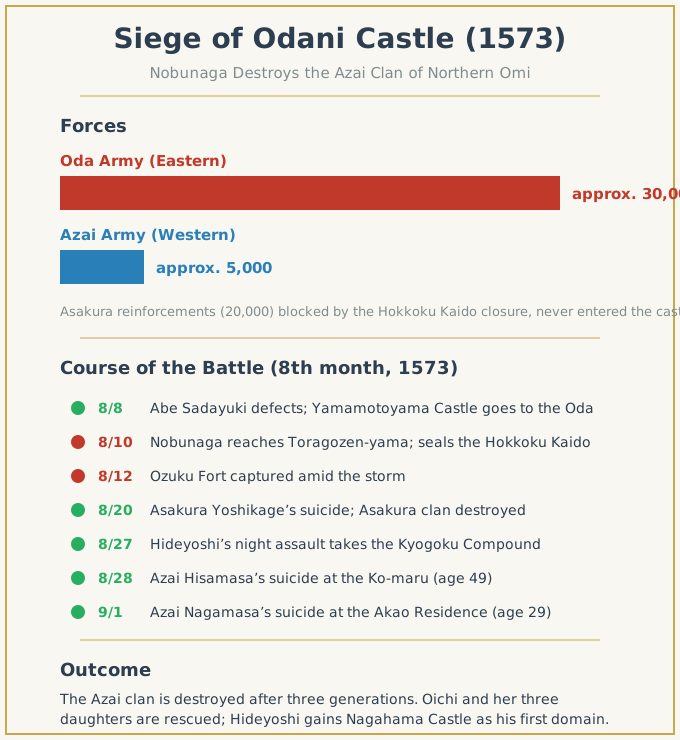
- Oda Nobunaga attacked Odani Castle, the home base of his brother-in-law Azai Nagamasa, in the final decisive battle that destroyed the Azai clan—a Sengoku house of northern Ōmi—after three generations.
- Hashiba Hideyoshi (the later Toyotomi Hideyoshi) launched a night assault on the Kyōgoku Compound, splitting father from son; Azai Hisamasa took his own life at the Ko-maru, and Nagamasa committed suicide at the Akao Residence.
- Nagamasa’s principal wife, Oichi, and their three daughters (Chacha, Hatsu, and Gō) were rescued, and would later move history through their deep ties to the inner circles of the Toyotomi, Kyōgoku, and Tokugawa houses.
The Mainstream Account – The Standard Textbook Explanation
Why the Battle Happened
The Azai, a Sengoku house of northern Ōmi, traced their line through three generations: from their founder Azai Sukemasa, who seized real power from the provincial governor (shugo) Kyōgoku clan in Eishō 14 (1517), to Azai Hisamasa, and then to Azai Nagamasa. Their home base was Odani Castle, a mountain castle built on Mount Odani in Azai District—close to the Hokkoku Kaidō highway and commanding a view over the Kohoku plain, it stood at a strategic crossroads of transport. The way Sukemasa effectively confined the Kyōgoku and stripped them of power closely parallels the way Saitō Dōsan wrested Mino from the Toki clan at the Battle of the Nagara River, a textbook example of the Sengoku principle of the lower overthrowing the higher (gekokujō).
Around Eiroku 10 (1567), Nobunaga sought an alliance with the Azai of northern Ōmi. At that time Nobunaga had only just subdued Mino (the Battle of Inabayama Castle), and he needed to secure the Ōmi road for his advance on the capital. Azai Nagamasa was a young lord eleven years Nobunaga’s junior; Nobunaga married his sister Oichi to Nagamasa to seal a marriage alliance. Nagamasa is said to have been reluctant about the alliance at first, but ultimately accepted it. Nagamasa and Oichi had four children: their heir Manpukumaru, their eldest daughter Chacha (the later Yodo-dono), their second daughter Hatsu (the later Jōkō-in), and their third daughter Gō (the later Sūgen-in). Despite being a political marriage, Nagamasa and Oichi are said to have been a devoted couple.
This alliance, however, collapsed three years later. In the 4th month of Genki 1 (1570), Nobunaga marched out to subdue Asakura Yoshikage of Echizen (the Battle of Kanegasaki). The Azai had bound themselves to the Asakura in a “sworn bond of honor” (gimei) since the time of Azai Sukemasa, and Nobunaga’s decision to attack the Asakura forced Nagamasa into a grave decision: to keep the old bond of honor with the Asakura, or to keep his alliance with Nobunaga and the bond with his sister Oichi. Nagamasa chose honor toward the Asakura and struck at Nobunaga’s rear. Nobunaga, thrown into crisis, barely escaped back to Kyoto (the “Kanegasaki Retreat”). According to the Shinchō Kōki, Nobunaga at first refused to believe it, saying in effect, “The Azai are plainly kin—this must be a false rumor.”
Several interpretations exist regarding Nagamasa’s defection from Nobunaga (discussed in detail in Theory 1 below): the theory that his father Hisamasa led the decision, the theory that it was Nagamasa’s own independent judgment, and the theory that the bond of honor with the Asakura took precedence. Whatever the case, this defection determined the fate of the Azai house. At the Battle of Anegawa in the 6th month of that year, the allied Azai–Asakura forces were defeated by the allied Oda–Tokugawa forces; Yokoyama Castle, the southern stronghold of their home base Odani, was taken, and Kinoshita Hideyoshi (the later Toyotomi Hideyoshi) was installed there as garrison commander to keep watch over the Azai.
Even after the defeat at Anegawa, the Azai continued to resist Nobunaga for about three years. An “anti-Nobunaga encirclement” formed—comprising Enryaku-ji on Mount Hiei, the Hongan-ji, Takeda Shingen, Ashikaga Yoshiaki, and others—and Nagamasa, too, must have held out hope that “one day Nobunaga can be brought down.” But in Genki 4 (1573) the situation changed completely. In the 4th month, Takeda Shingen died of illness in the midst of his westward campaign, and the greatest pillar of the encirclement was lost. In the 7th month, Nobunaga expelled Shōgun Ashikaga Yoshiaki from the capital, effectively ending the Muromachi shogunate. The era name was then changed to “Tenshō” on the 28th day of the 7th month, and Nobunaga set out to subdue the last great figure, Asakura Yoshikage.
On the 8th day of the 8th month of Tenshō 1 (1573), a decisive event occurred. Abe Sadayuki, an Azai senior retainer and lord of Yamamotoyama Castle, was won over by Hashiba Hideyoshi’s overtures and defected to the Oda side (discussed in detail in Theory 2 below). Yamamotoyama Castle, lying to the west of Odani Castle, was a near-impregnable mountain castle that commanded the maritime traffic of Lake Biwa—a strategic key point. With its defection to the Oda, Odani Castle was completely isolated. Every lifeline Nagamasa had counted on was gone.
The Course of the Battle
On the 8th day of the 8th month, upon receiving word of Abe Sadayuki’s defection, Nobunaga set out from Gifu Castle that very night. By the 10th he had arrived in northern Ōmi at the head of a great army of 30,000 and entered his headquarters at Toragozen-yama, a hill 500 meters south of Odani Castle where he had built a fort the previous year. That same day the Oda army sealed off the Hokkoku Kaidō highway running from Echizen to Odani Castle. Asakura Yoshikage was advancing south from Echizen with 20,000 reinforcements, but the road closure prevented him from entering Odani Castle, forcing him to encamp at Yogo and Kinomoto.
That same day, Asami Tsushima-no-kami, who held Yakeo Fort north of Odani Castle, also surrendered. Yakeo lay at the northern foot of Ōzuku Fort, which was connected by ridgeline to Odani Castle—an important position. On the 12th day of the 8th month, a storm struck the Kinai region (September 8 in the Gregorian calendar; damage was recorded in Kyoto and elsewhere), and Nobunaga judged this foul weather to be an opportunity. Guided personally by Asami Tsushima-no-kami, he attacked and captured Ōzuku Fort. Ōzuku was the highest point north of Odani Castle and served as the forward base for the Asakura reinforcements.
The next day, the 13th, the Asakura army of 20,000, judging the situation unfavorable, began to withdraw to Echizen. Nobunaga did not let the chance slip: leaving a detachment under his heir Oda Nobutada to hold the Azai in check, he led his main force in pursuit of the Asakura. From the 13th to the 20th of the 8th month, the Oda army dealt the Asakura a devastating blow at Tonezaka (the Battle of Tonezaka), then drove on into Echizen and captured Ichijōdani Castle. On the 20th day of the 8th month, Asakura Yoshikage was betrayed by his retainer Asakura Kageakira and took his own life. With this the Echizen Asakura clan was destroyed, and the Azai’s last lifeline vanished completely.
Having subdued Echizen, Nobunaga left part of the Oda army behind for the postwar settlement there and turned back toward Odani Castle, returning to his Toragozen-yama headquarters on the 26th day of the 8th month. The next day, the 27th, he ordered the entire army to launch an all-out assault on Odani Castle. Odani Castle had a structure in which multiple enclosures—the main keep (Hon-maru), the Kyōgoku Compound (Kyōgoku-maru), the Ko-maru, the Sannō-maru, Ōzuku, and others—were linked along a north–south ridge. Nagamasa (with 500 troops) held the Hon-maru and his father Hisamasa (with 800 troops) held the Ko-maru, while the Kyōgoku Compound (with 600 troops) lying between the two served as the vital link.
Late on the night of the 27th, Hashiba Hideyoshi led 3,000 troops in a surprise attack on the Kyōgoku Compound. Hideyoshi devised a plan to split father from son by capturing the Kyōgoku Compound, which lay between the Hon-maru and the Ko-maru. There is also a tradition that he climbed up the steep slope of Shimizu-dani and that there was an informer inside the Kyōgoku Compound (discussed in detail in Theory 3 below). The compound’s defenders, Mitamura Sadayori and Kaihō Tsunachika, were killed. The Kyōgoku Compound fell, and the link between the Hon-maru and the Ko-maru was completely severed.
Hearing that the Kyōgoku Compound had fallen, Azai Hisamasa in the Ko-maru judged the situation hopeless. As Hideyoshi’s assault on the Ko-maru intensified, he led his 800 troops in defense, but cornered, on the 28th day of the 8th month (some say late on the night of the 27th) he took his own life at the Ko-maru together with Azai Koreyasu and others. He was 49. Hisamasa had been the central figure of the pro-Asakura faction within the Azai house, the man said to have driven the decision to break the alliance with Nobunaga. His death was the decisive moment in the destruction of the Azai house.
Nagamasa in the Hon-maru (with 500 troops) held out for some time afterward. On the night of the 28th, Nagamasa sent his heir Manpukumaru (age 10) out of the castle with retainers to escort him. He further handed over his principal wife Oichi, along with their three daughters (Chacha, 5; Hatsu, 4; Gō, 1), to the Oda army. Oichi is said to have been resolved to die with Nagamasa, but Nagamasa chose the sparing of his wife and children and their future. Several interpretations exist regarding the circumstances of the rescue of Oichi and the three sisters—Nobunaga’s compassion, political calculation, and others (discussed in detail in Theory 4 below).
On the 1st day of the 9th month, the all-out assault on the Hon-maru began. Nagamasa led roughly 200 troops in a final charge, but outnumbered, he fell back to the Hon-maru. With his retreat completely cut off, Nagamasa took his own life at the Akao Residence in the sode-kuruwa (flanking enclosure) of the Hon-maru, together with his senior retainer Akao Kiyotsuna and his younger brother Azai Masamoto. He was 29. The Azai house, built up over three generations since Sukemasa, was destroyed after a mere 55 years. As for Nagamasa’s suicide, there are two theories—the 1st day of the 9th month and the 28th day of the 8th month—but the principal sources such as the Shinchō Kōki adopt the 9th-month-1st-day account.
The Aftermath of the Battle
Nobunaga’s reprisals against the Azai after the fall of Odani Castle were extreme in their severity, said to be because his resentment over the betrayal at Kanegasaki ran deep. The heads of Azai Hisamasa and Nagamasa, father and son, were carried to the capital and exposed on the prison gibbet. The heir Manpukumaru, who had escaped, was captured by Hideyoshi two months later in the 10th month while hiding in Tsuruga, and was impaled at Sekigahara. It was the execution of a mere ten-year-old. There is also a theory that it was Hideyoshi himself who impaled Manpukumaru. The kinsmen Azai Sukechika and Azai Inori, and the retainer Ōnogi Hidetoshi, were also executed. Asami Tsushima-no-kami, who had defected, was likewise punished.
In the first month of the following year, Tenshō 2 (1574), daimyō from Kyoto and the neighboring provinces visited Nobunaga at Gifu Castle to offer their New Year greetings. After the banquet with them, at a drinking party held only for Nobunaga’s mounted guard (umamawari), what was presented as the entertainment with the sake was the three skulls of Azai Hisamasa, Azai Nagamasa, and Asakura Yoshikage. The three skulls had been worked into hakudami (lacquered and decorated with gold and other coloring). For a long time this “hakudami” incident has been regarded as emblematic of Nobunaga’s cruelty, but in recent years a view re-evaluating it as “an expression of respect for fallen enemy generals” has emerged (discussed in detail in Theory 5 below).
The rescued Oichi and the three Azai sisters were taken into the Oda house. They were at first protected under Nobunaga’s younger brother Oda Nobukane and are said to have later lived in Owari. After Nobunaga fell at the Honnō-ji Incident of Tenshō 10 (1582), Oichi remarried Nobunaga’s senior retainer Shibata Katsuie. But at the Battle of Shizugatake the following year, Tenshō 11 (1583), Katsuie was defeated by Hideyoshi, and Oichi took her own life together with Katsuie at Kitanoshō Castle. She was 37. Having endured the fall of two castles, Oichi’s life became a story emblematic of the tragedy of women in the Sengoku period.
Nagamasa’s surviving daughters, the three Azai sisters, were entrusted to Hideyoshi and each in turn became a figure who moved history. Chacha, ironically, became the concubine of her father’s enemy Hideyoshi; called Yodo-dono, she bore Toyotomi Hideyori. Hatsu became the principal wife of Kyōgoku Takatsugu, lord of the Obama domain in Wakasa (his mother was Kyōgoku Maria, a daughter of Azai Hisamasa). Gō became the principal wife of Tokugawa Hidetada (the second shogun) and the mother of Tokugawa Iemitsu, the third shogun. The blood of Nagamasa and Oichi thus came to run deep within the three greatest houses of the day—the Toyotomi, the Kyōgoku, and the Tokugawa. Nagamasa had two other sons: Manjumaru entered the Buddhist priesthood, and Kihachirō served Nobunaga’s fourth son Hidekatsu and Hideyoshi’s younger brother Hidenaga, his descendants becoming retainers of the Marugame domain. The Azai bloodline was not entirely extinguished.
Odani Castle was granted to Hideyoshi, but its location far from Lake Biwa was disliked, and it was abandoned. Hideyoshi built a new residence—Nagahama Castle—on the lakeshore and was entrusted with rule over the three districts of northern Ōmi (Sakata, Azai, and Ika). Odani Castle was dismantled for building materials for Nagahama Castle, and today only the foundation stonework remains at the Hon-maru site. For Hideyoshi, Odani Castle was at once a “monument to the destruction of the Azai house” and “the starting point of his own career as a daimyō.” Hideyoshi’s road to unifying the realm—through the Battle of Shizugatake and the Battle of Komaki and Nagakute—may all be said to have begun with the fall of Odani.
→ For more, see the warlord articles “Azai Nagamasa” and “Oda Nobunaga.”
Theories – Exploring the Possibilities from Various Angles
[Theory 1] Why Nagamasa Betrayed Nobunaga – The Asakura “Bond of Honor” Theory vs. the Hisamasa-Led Theory vs. the Nagamasa-Initiative Theory
Nagamasa’s defection from Nobunaga at the Battle of Kanegasaki is one of the greatest mysteries of Sengoku history. Several interpretations exist regarding this decision to betray the brother-in-law who had given him his sister Oichi as wife.
The “Bond of Honor with the Asakura” Theory (the conventional view)
The most widely known theory holds that he prioritized the “bond of honor” (gimei) that the Azai and Asakura houses had shared since the previous generation. The Azai had been in an alliance with the Asakura since the time of their founder Sukemasa, who is said to have received Asakura support when he seized real power from the Kyōgoku. In Edo-period war chronicles, there was a secret pact between Nobunaga and Nagamasa that “Nobunaga would give prior notice whenever he attacked the Asakura,” but Nobunaga ignored this and proceeded to subdue the Asakura, so Nagamasa betrayed Nobunaga out of honor.
However, the “secret pact of prior notice” between Nobunaga and Nagamasa has thin documentary support, and in recent years the view that it was an Edo-period fabrication has become dominant. The defection theory based on a “bond of honor” also leaves doubts as a realistic judgment for a Sengoku daimyō.
The “Hisamasa-Led” Theory
Another leading theory holds that Nagamasa’s father Azai Hisamasa led the decision to defect. Hisamasa was the central figure of the pro-Asakura faction within the Azai house and had opposed the very alliance with Nobunaga from the start. Nagamasa’s alliance with Nobunaga had been his own independent move—made after a coup at the time of his succession that forced Hisamasa into retirement—but Hisamasa continued to retain hidden influence within the house thereafter. Just before the Battle of Kanegasaki, it is highly likely that Hisamasa mobilized the corps of retainers and pressed Nagamasa to “side with the Asakura.”
Cited as grounds for this theory are the facts that, in the later Siege of Odani Castle, Hisamasa holed up in the Ko-maru and resisted to the bitter end, and that he refused reconciliation with Nobunaga to the very last. Hisamasa was the leader of the “anti-Nobunaga hardliners” within the Azai house. The gist of this theory is that Nagamasa personally wished to continue the alliance with Nobunaga but could not ignore the will of the house.
The “Nagamasa-Initiative” Theory (a recent re-evaluation)
A third theory emphasizes Nagamasa’s own independent judgment. Nagamasa was a lord who had succeeded to the headship young, and though he was not in a position to ignore the will of the house, the final decision to defect was one that Nagamasa himself made. From northern Ōmi’s geographical position, Nagamasa coolly foresaw that if Nobunaga’s unification of the realm advanced, his own house would lose its independence. The theory holds that, while presenting the “bond of honor with the Asakura” as his ostensible justification, he in fact made the realistic choice to protect his house’s independence.
Nagamasa’s defection from Nobunaga was, for Nagamasa personally, a “choice to protect his house,” but it became, in the end, a “choice that destroyed his house”—a textbook example of the difficulty of a Sengoku daimyō’s decisions. Whether Nagamasa, who took his own life at Odani Castle three years later, regretted to the end that he had not “kept the alliance with Nobunaga,” or felt satisfied that he had “upheld his honor toward the Asakura,” the state of mind in which he closed his 29-year life can now only be surmised.
Conclusion
The three theories each contain a measure of truth and are not mutually exclusive. Nagamasa’s defection from Nobunaga is best seen, by today’s reasonable interpretation, as the result of several overlapping factors: the “bond of honor” with the Asakura, the influence of his father Hisamasa, and Nagamasa’s own realistic judgment. The decision-making of a Sengoku daimyō was a complex tangle of personal emotion, the internal dynamics of the house, and geopolitical calculation.
[Theory 2] Abe Sadayuki’s Defection and Hideyoshi’s Overtures – The Full Picture of Splintering the Azai House
The decisive turning point of the Siege of Odani Castle was the defection of Abe Sadayuki on the 8th day of the 8th month of Tenshō 1 (1573). Behind this event lay meticulous overtures by Nobunaga and Hideyoshi.
Who Was Abe Sadayuki
Abe Sadayuki was an Azai senior retainer and the lord of Yamamotoyama Castle. Yamamotoyama Castle was a mountain castle of about 324 meters in elevation, located roughly 12 km west of Odani Castle, commanding the Hokkoku Kaidō highway and the maritime traffic of Lake Biwa—a strategic key point. Yamamotoyama Castle was deemed impregnable, and the Oda army had been unable to take it for three years. Sadayuki enjoyed Hisamasa’s deep trust and was known as a powerful retainer of the Azai house.
Hideyoshi had become garrison commander of Yokoyama Castle right after the Battle of Anegawa and had continued his overtures toward the Azai retainers for three years. He had won over powerful Azai commanders one after another to the Oda side—Isono Kazumasa (Sawayama Castle), Miyabe Keijun (Miyabe Castle), and others. Hideyoshi’s method was to assess each retainer’s ability and standing and to guarantee his position after submission to Nobunaga. Known himself as a “charmer of men,” Hideyoshi is said to have made shrewd appeals attuned to each retainer’s feelings.
The Strategic Significance of the Defection
Abe Sadayuki’s defection carried decisive strategic meaning. With Yamamotoyama Castle now in Oda hands, the Oda army could completely encircle Odani Castle. More importantly, they could now seal off the Hokkoku Kaidō route from Echizen to Odani Castle, making it impossible for the Asakura reinforcements to enter Odani. This was the move that sealed the fate of the Azai house.
According to the Shinchō Kōki, upon receiving word of Sadayuki’s defection, Nobunaga set out from Gifu Castle that very night—the quick responsiveness so characteristic of a Nobunaga “keen to seize the moment.” By the 10th day of the 8th month he had arrived in northern Ōmi at the head of a great army of 30,000 and begun the encirclement of Odani Castle. The advance in a mere two days from Sadayuki’s defection suggests Nobunaga may have caught wind of the defection in advance and had his preparations in order.
Sadayuki’s Later Fate – The End of a Man Who Piled Betrayal upon Betrayal
After defecting to the Oda, Abe Sadayuki continued to be entrusted with Yamamotoyama Castle and became a vassal of Hideyoshi. He retained a certain standing under Hideyoshi’s regime, but at the time of the Honnō-ji Incident of Tenshō 10 (1582), he sided with Akechi Mitsuhide and attacked Hideyoshi’s own residence, Nagahama Castle. After Hideyoshi defeated Mitsuhide at the Battle of Yamazaki, Sadayuki was captured and executed—an instance illustrating the cold realism of the Sengoku age as “the end of a man who piled betrayal upon betrayal.”
Looking at the full picture of the splintering of the Azai house, Hideyoshi’s overtures were a long-term strategy spanning three years. His method of winning defectors one after another—Isono Kazumasa, Miyabe Keijun, Abe Sadayuki, Asami Tsushima-no-kami—would be repeated in his later work of unifying the realm. The prototype of Hideyoshi’s strategy of “winning by diplomacy” may be said to have been perfected at the Siege of Odani Castle.
[Theory 3] The Reality of Hideyoshi’s Night Assault on the Kyōgoku Compound – The Truth of the Informer and the Steep-Slope Climb
Hideyoshi’s surprise attack on the Kyōgoku Compound late on the night of the 27th day of the 8th month was the decisive blow in the fall of Odani Castle. Several theories exist regarding the specifics of this assault.
The “Climb up the Steep Slope of Shimizu-dani” Theory
Principal sources such as the Shinchō Kōki record that Hideyoshi’s army climbed the steep slope of Shimizu-dani to launch a surprise attack on the Kyōgoku Compound. Shimizu-dani was a steep ravine between the Hon-maru and the Kyōgoku Compound, a place where the defenders had grown complacent, thinking “no one will climb up to attack from here.” Hideyoshi led 3,000 troops, slipping through the darkness of deep night, climbing the steep slope while holding their breath, and struck the Kyōgoku Compound. The defenders Mitamura Sadayori and Kaihō Tsunachika were killed, and a mere 600 defending troops could not hold off Hideyoshi’s 3,000.
In Edo-period war chronicles, Hideyoshi is dramatically depicted as “climbing the mountain paths of Odani Castle with his men in the moonless darkness without making a single sound.” Hachisuka Koroku (the later Hachisuka Masakatsu) is said to have accompanied him. As a dramatic scene of “clever stratagem” and “surprise attack,” it has been retold again and again by later generations.
The “Existence of an Informer” Theory
Another theory holds that there was already an informer for the Nobunaga side inside the Kyōgoku Compound, who opened the castle gate and guided Hideyoshi’s army in. A description that “the emergence of an informer from inside the castle was an utterly unexpected event for Nagamasa” survives in local sources related to Odani Castle. There is also a depiction of “Hideyoshi’s unit entering through a gate opened by a defected commander,” and it has been pointed out that, rather than a steep-slope climb, the fall may have been an anticlimactic one brought about by an informer.
Cited as grounds for this theory is the claim that Hideyoshi’s army “occupied the Kyōgoku Compound with almost no casualties.” Even at 3,000 against 600, it is normally impossible in a siege for the defending side to fall while nearly unscathed. If a gate had been opened by an informer, the outcome makes sense.
The Fusion of the Two Theories – The “Steep-Slope Climb + Informer” Theory
In recent research, an interpretation fusing the two theories is dominant. Hideyoshi’s army did climb the steep slope of Shimizu-dani, but that information had been coordinated in advance with the informer inside the Kyōgoku Compound. The informer opened the castle gate at the appointed hour and drew in the climbing Hideyoshi forces. The combination of “night assault + inside collusion” was the decisive blow in the fall of Odani Castle.
The strategic significance of why the Kyōgoku Compound was chosen is also important. The Kyōgoku Compound lay between the Hon-maru (Nagamasa) and the Ko-maru (Hisamasa), serving as the vital link between the two. By capturing it, the cooperation between father and son was physically severed. Whereas Nagamasa and Hisamasa had adopted a defensive tactic of “catching the enemy in a pincer when they wandered into the trench cuts (horikiri),” Hideyoshi destroyed the premise of that pincer by seizing the middle ground. Bringing down an impregnable mountain castle not by frontal force but by “division” was the prototype of a method Hideyoshi would repeat in his later seizure of the realm.
[Theory 4] The Circumstances of the Rescue of Oichi and the Three Sisters – Nobunaga’s Compassion, or Political Calculation?
The rescue of Oichi and the three sisters (Chacha, Hatsu, and Gō) at the time of Nagamasa’s end is among the most striking scenes in Sengoku history. Several interpretations exist as to why Nobunaga saved his sister and nieces.
The “Nobunaga’s Compassion” Theory
In the conventional view handed down since the Edo period, Nobunaga wished for the rescue out of love for his sister Oichi. Nobunaga loved his sister deeply and held a certain affection even for his hostile brother-in-law Nagamasa. Whereas Oichi was resolved to die together with Nagamasa, Nobunaga forcibly rescued Oichi and the three sisters—this is the gist of the theory. As an anecdote depicting the unexpected image of a “family-loving Nobunaga,” it has been retold again and again by later generations.
According to the Shinchō Kōki and other accounts, the fate of Oichi and the others is said to have been discussed between Nagamasa and Nobunaga even before Odani Castle came under Oda attack. Oichi was resolved to die with Nagamasa, but Nagamasa chose the sparing of his wife and children and their future. On the night of the 28th day of the 8th month, Nagamasa handed his wife and three daughters over to the Oda army. This was Nagamasa’s final decision and, it may be said, proof of his deep love for Oichi.
The “Political Calculation” Theory
Another theory holds that there was political calculation in Nobunaga’s decision. By keeping Oichi and the three sisters alive, they could later be used as tools of political marriage. For a Sengoku daimyō of the day, a woman’s lineage was an important political resource. In fact, Oichi later remarried Shibata Katsuie and played a role in reinforcing the power structure within the Oda house. The three sisters too became tied to the three great houses—Toyotomi, Kyōgoku, and Tokugawa—and became figures who moved the history of the late Sengoku and early Edo periods.
By this theory, Nobunaga’s rescue was not “love for his sister” but “securing a political resource.” For Nobunaga, women were pieces for the sake of the house, and Oichi and the three sisters were no exception.
The “Fusion of the Two” Theory
Nobunaga’s actual decision was likely a complex tangle of compassion and political calculation. Nobunaga loved his sister, yet was at the same time a cold-eyed Sengoku daimyō. Saving Oichi and the three sisters was a choice that satisfied both family love and political calculation. On Nagamasa’s side, too, there was a wish to leave behind his house’s lineage, and entrusting Oichi and the three sisters to Nobunaga was a solution in which the interests of both sides aligned.
Noteworthy is the point that the heir Manpukumaru (age 10) and the three sisters were treated very differently. Manpukumaru was captured by Hideyoshi and impaled, while the girls were rescued. By Sengoku custom, the male children of an enemy general were executed as future sources of trouble, while female children were kept alive as pieces for political marriage. Nobunaga’s choice followed this logic of the Sengoku age. The rescue of Oichi and the three sisters was the joint product of compassion and calculation.
[Theory 5] The Execution of Manpukumaru and the “Hakudami” Incident – Nobunaga’s Cruelty vs. the Recent “Respect” Re-evaluation
Regarding Nobunaga’s conduct after the fall of Odani Castle, what stirred great later debate were the execution of the heir Manpukumaru and the anecdote of the drinking party in the first month of Tenshō 2, where the skulls of Azai Hisamasa, Nagamasa, and Asakura Yoshikage were made into hakudami.
The Severity of Manpukumaru’s Execution
Manpukumaru escaped the castle just before the fall of Odani and hid in the mountains of Tsuruga. Two months later, on the 17th day of the 10th month, he was captured by Hideyoshi’s army and impaled at Sekigahara (present-day Sekigahara-chō, Fuwa District, Gifu Prefecture). It was the execution of a boy of a mere ten years. According to the Shinchō Kōki, there is a theory that it was Hideyoshi himself who impaled Manpukumaru. It is not recorded that “Hideyoshi executed him with relish,” but it reveals the cold side of Hideyoshi as one who “carries out an execution on his lord’s orders,” in keeping with the customs of the Sengoku age.
The reason for Manpukumaru’s execution was the Sengoku logic that “the male child of an enemy general is a future source of trouble.” Oichi was Nobunaga’s sister and is said to have desperately pleaded for Manpukumaru’s life, but Nobunaga did not yield. “Resentment over the betrayal at Kanegasaki” is also cited as a reason for the execution. Nobunaga’s anger toward the Azai house had not healed even after three years.
The Conventional View of the “Hakudami” Incident – Nobunaga’s Cruelty
In the first month of Tenshō 2 (1574), at the New Year drinking party at Gifu Castle, Nobunaga presented the three skulls of Azai Hisamasa, Nagamasa, and Asakura Yoshikage. The three skulls had been worked into hakudami (lacquered and decorated with gold and other coloring). For a long time this “hakudami” incident has been regarded as emblematic of Nobunaga’s cruelty and abnormality. The act of “making the heads of enemy generals into entertainment with sake” certainly exceeds the sensibility of an ordinary person. Seen from the Confucian values of the Edo period, it was the greatest irreverence, and it became grounds for Nobunaga’s “Demon King” image.
The Recent Re-evaluation – The “Expression of Respect” Theory
In recent historical research, however, the evaluation of this “hakudami” incident has been changing. As a practice of the day, preserving the skull of an enemy general as a decorative object did not necessarily signify insult, and was sometimes regarded rather as an expression of respect for the fallen enemy general. Reading the original text of the Shinchō Kōki strictly, there is a description that the skulls were made into hakudami and “served as a relish,” but whether this was for the purpose of “insult” or of “respect” is not clear. At a turning point as the year changed, an interpretation that “Nobunaga mourned the souls of the fallen enemy generals and resolved upon a fresh start” is also possible.
There is also the possibility that “hakudami” was not unique to Nobunaga but a general practice of the Sengoku daimyō of the day. There are various instances of Sengoku daimyō handling the remains of enemy generals and former lords—Takeda Shingen’s treatment of his father Nobutora when he expelled him, Mōri Motonari’s treatment of the bereaved family of Amago Tsunehisa whom he had assassinated, and so on—and not all of them are evaluated as “cruel.” To single out Nobunaga alone may be a prejudice dragged along by the later image of him.
Conclusion
Manpukumaru’s execution was certainly a harsh treatment, but the “execution of an enemy general’s male child” falls within the range of Sengoku custom. The “hakudami” incident has been treated as evidence of Nobunaga’s cruelty, but recent research has also presented the interpretations of “within the range of the practice of the day” and “an expression of respect for the fallen enemy general.” Rather than one-sidedly branding Nobunaga a “Demon King,” the attitude required of modern historiography is to evaluate him within the judgment of a Sengoku daimyō and the cultural context of the day.
[Theory 6] Where Was Odani Castle’s Last Hon-maru? – The Ōzuku Theory and Its Relation to the Present-Day Hon-maru Site
Odani Castle had a structure in which multiple enclosures—the Hon-maru, the Kyōgoku Compound, the Ko-maru, the Sannō-maru, Ōzuku, and others—were linked along a north–south ridge, and there is an interesting debate over the position of its “Hon-maru.”
The Hon-maru at the Time of Construction – The Ōzuku Theory
Odani Castle was a mountain castle built by Azai Sukemasa around Eishō 14 (1517), and the Hon-maru at the time of construction is thought to have been farther north than the present-day Hon-maru site, at Ōzuku (about 495 meters in elevation). Ōzuku is the highest point of Mount Odani and, from the standpoint of defense, the most secure position. In the generations of Sukemasa and Hisamasa, this was the heart of the Azai house.
The Hon-maru in Nagamasa’s Time – The Present-Day Hon-maru Site
By Azai Nagamasa’s generation, however, the Hon-maru is conjectured to have been moved to its present location (about 395 meters in elevation). The reason is not clear, but the convenience of daily life, communication with retainers, and coordination with the residence in Shimizu-dani at the foot of the mountain are conceivable. The Odani Castle of Nagamasa’s time had a structure in which multiple enclosures interlocked—the Hon-maru (Nagamasa), the Ko-maru (Hisamasa), the Kyōgoku Compound (the link), and the Sannō-maru (the rear)—and the present-day Hon-maru site was this “new Hon-maru.”
The Difference from an Ordinary Castle
Noteworthy is the peculiar structure in which Odani Castle’s Hon-maru was not at the castle’s highest point. In an ordinary castle the Hon-maru is at the highest point, serving as the final stronghold of defense. At Odani Castle, however, the Sannō-maru and Ōzuku continued farther north of the Hon-maru, and there were enclosures at positions higher than the Hon-maru. This is thought to be because the Hon-maru of Nagamasa’s time functioned as a “center of administration and communication” rather than a “final defensive stronghold”—a design philosophy in which final defense was borne by Ōzuku.
Indeed, in the fighting of the 8th month of 1573, Ōzuku was first made to fall by Nobunaga’s army (on the 12th day of the 8th month). With this, Odani Castle’s “final defensive stronghold” was lost, leading to the subsequent fall of the Hon-maru, the Kyōgoku Compound, and the Ko-maru. Seen from the logic of castle design, the fate of Odani Castle was already decided at the moment Ōzuku fell.
Nagamasa’s end is also of interest. Nagamasa took his own life not in the Hon-maru but at the “Akao Residence” in the sode-kuruwa (flanking enclosure) of the Hon-maru. The Akao Residence was the residence of his senior retainer Akao Kiyotsuna, located on the east side of the Hon-maru. The leading interpretation is that, because the Oda army had penetrated as far as the Hon-maru in the final fighting, Nagamasa had no choice but to leave the Hon-maru and fall back to the flanking enclosure. Whereas suicide in the Hon-maru is customary in an ordinary castle that treats the Hon-maru as the “last fortress,” the unique structure of Odani Castle made the Akao Residence the place of Nagamasa’s end.
Today, the Hon-maru, the Kyōgoku Compound, the Ko-maru, the Akao Residence site, and others have been restored at the Odani Castle ruins. Walking from the Hon-maru to the Akao Residence, one can feel Nagamasa’s final footsteps. As the “site of the end of Azai Nagamasa, the last Sengoku daimyō,” it has become a must-visit spot for Sengoku enthusiasts.
A Strategic Perspective
Surveying the Siege of Odani Castle strategically, we can see that it was a textbook example of a “strategic victory” in Nobunaga’s process of unifying the realm. There are four points worth noting.
First, the completion of a three-year campaign of overtures. Nobunaga’s conquest of the Azai was a long-term strategy spanning three years from right after the Battle of Anegawa. As garrison commander of Yokoyama Castle, Hideyoshi continued his overtures toward the Azai retainers, winning over powerful retainers one after another—Isono Kazumasa, Miyabe Keijun, Abe Sadayuki, Asami Tsushima-no-kami. It was a battle in which the Nobunaga–Hideyoshi pairing that “wins by diplomacy and overtures” was perfected. The overture strategy Hideyoshi would repeat at the Battle of Shizugatake and the Battle of Komaki and Nagakute had its prototype completed at the Siege of Odani Castle.
Second, Nobunaga’s responsiveness in being “keen to seize the moment.” Nobunaga’s responsiveness in mobilizing a great army of 30,000 from Gifu Castle to Toragozen-yama in a mere two days after receiving word of Abe Sadayuki’s defection was outstanding even among Sengoku daimyō. The death of Takeda Shingen, the expulsion of Ashikaga Yoshiaki, the suicide of Asakura Yoshikage—Nobunaga’s judgment in not letting slip the “moment of heaven” when all the conditions had come together truly marks him a master of strategy. “Waiting until the moment ripens, then moving all at once when it does” was Nobunaga’s way.
Third, the tactical virtuosity of Hideyoshi’s night assault on the Kyōgoku Compound. Hideyoshi’s idea of bringing down the impregnable Odani Castle not by frontal force but by the strategy of “splitting father from son” was the prototype of a method that would be repeated in his later seizure of the realm. Seeing through the weak point of a mountain castle, combining it with an informer, and winning with few casualties—this is the core of the strategic eye Hideyoshi would display in the Great Return from Chūgoku and the Great Return from Mino. Hideyoshi’s strategic thinking of “not the orthodox approach, but striking the opponent’s weak point” may be said to have been perfected at Odani.
Fourth, the rescue of Oichi and the three sisters as the starting point of a “chain of history.” The fall of Odani Castle ended in the destruction of the Azai house, but the rescued Oichi and the three sisters became figures who moved the history of the late Sengoku and early Edo periods. Oichi remarried Shibata Katsuie and shared his fate at Kitanoshō Castle. Chacha became Hideyoshi’s concubine and, as Yodo-dono, bore Toyotomi Hideyori. Hatsu became the principal wife of Kyōgoku Takatsugu. Gō became the principal wife of Tokugawa Hidetada and bore Tokugawa Iemitsu. Toyotomi, Kyōgoku, Tokugawa—the blood of Azai Nagamasa and Oichi came to flow within all three of the great powers from the Sengoku to the early Edo period. By the irony of history, the blood of the Azai house, destroyed by Nobunaga, became the bloodline that moved the realm of the very side that destroyed them.
To borrow from Rai San’yō’s Nihon Gaishi, one might say, “Hideyoshi’s seizure of the realm lay not at Shizugatake, but at Odani.” Hideyoshi, who as garrison commander of Yokoyama Castle continued his overtures toward the Azai retainers, sealed victory with the night assault on the Kyōgoku Compound, was granted Nagahama Castle, and obtained his starting point as a daimyō. Hideyoshi’s seizure of the realm all began at Odani. That Nagamasa, at his very last, entrusted the sparing of his wife and children to Nobunaga gave rise, in the end, to the core of the Toyotomi regime (Yodo-dono) and the bloodline of the Tokugawa shogunate (Iemitsu). Nagamasa’s decision is remembered as the greatest irony of Sengoku history.
Famous Words and Sayings from This Battle
“The Azai are plainly kin—this must be a false rumor.”
Nobunaga’s first reaction in the 4th month of Genki 1 (1570), during the Battle of Kanegasaki, upon receiving word that Azai Nagamasa had betrayed him. The meaning is, “Since the Azai are family, the report that they have raised the banner of revolt must surely be a lie.” The words convey the depth of Nobunaga’s trust in the brother-in-law to whom he had given his sister Oichi in marriage. The reality, however, was defection, and Nobunaga had to flee for his life back to Kyoto. The shock and resentment at being betrayed at this time may be thought to have led to the severe treatment in the attack on Odani Castle three years later.
— Source: Ōta Gyūichi, Shinchō Kōki
“If we take the Kyōgoku Compound, we can split Hisamasa from Nagamasa.”
The heart of the strategy that Hashiba Hideyoshi proposed to Nobunaga when planning the all-out assault on Odani Castle in the 8th month of 1573. Rather than “striking head-on,” the plan was to seize the Kyōgoku Compound between the Hon-maru (Nagamasa) and the Ko-maru (Hisamasa) and split father from son. This idea became the prototype of Hideyoshi’s strategic thinking of “striking the opponent’s weak point,” which would carry through to the later Great Return from Chūgoku and Great Return from Mino. The words are emblematic of Hideyoshi’s strategic eye in reading the structure of a mountain castle and obtaining the greatest effect with the least sacrifice.
— Source: Edo-period war chronicles (the Taikōki and others)
“Then, Father, let us meet again in the next world.”
The words said to have been exchanged by Nagamasa in his last meeting with his father Hisamasa, just after receiving word that the Kyōgoku Compound had fallen. Hisamasa returned to the Ko-maru to prepare for suicide, and Nagamasa began preparing in the Hon-maru to let his wife and children escape. Father and son were each resolved upon their journey into death. Hisamasa, as a leader of the pro-Asakura faction, was also the very man who had thrown the fate of the Azai house into disorder, and his relationship with Nagamasa was complex; yet in the final scene, the bond of father and son is said to have remained. The possibility of embellishment by Edo-period war chronicles cannot be denied, but it has been handed down as a scene emblematic of the last exchange between a Sengoku father and son.
— Source: Edo-period war chronicles
“I shall share my fate with Nagamasa.”
The words Oichi is said to have spoken at the fall of Odani Castle, resolved to die together with Nagamasa. Though the mother of three young daughters (Chacha, 5; Hatsu, 4; Gō, 1), Oichi is said to have wished to share her fate with her husband. Nagamasa, however, chose the sparing of his wife and children and their future, and sent Oichi and the three sisters to Nobunaga. As a scene where Oichi’s resolve and Nagamasa’s decision—the love of both—intersect, it became one of the representative anecdotes of the Sengoku period. Oichi would take her own life ten years later with Shibata Katsuie at Kitanoshō Castle, and in the end lived a life that fulfilled her resolve to “share her fate with her husband.”
— Source: Edo-period war chronicles (a tradition based on accounts in Sengoku History)
Anecdotes and Episodes
Abe Sadayuki’s Defection – Yamamotoyama Castle Goes Over to the Oda
On the 8th day of the 8th month of 1573, the Azai senior retainer Abe Sadayuki suddenly defected to the Oda. Yamamotoyama Castle, an impregnable mountain castle about 12 km west of Odani Castle, was a strategic key point commanding the Hokkoku Kaidō highway and the maritime traffic of Lake Biwa. It was the moment Hideyoshi’s three years of overtures finally bore fruit.
Because Sadayuki had enjoyed Hisamasa’s deep trust, his defection caused great agitation within the Azai house. The shock to Nagamasa, who lost a hereditary retainer and an important strategic stronghold to the Nobunaga side without a fight, is beyond measure. The Azai corps of retainers, which had boasted an ironclad unity at the Battle of Anegawa, had at last begun to crumble from within.
Ironically, Sadayuki afterward became a vassal of Hideyoshi and continued to be entrusted with Yamamotoyama Castle. But at the Honnō-ji Incident of 1582 he sided with Akechi Mitsuhide and attacked Hideyoshi’s Nagahama Castle. After the Battle of Yamazaki, he was captured by Hideyoshi and executed—an instance illustrating the cold realism of the Sengoku age as “the end of a man who piled betrayal upon betrayal.” That Hideyoshi did not forgive Sadayuki may have been because Sadayuki was a presence that recalled to Hideyoshi his own past splintering of the Azai house.
— Source: Shinchō Kōki, Odani Jōki
The Capture of Ōzuku amid the Storm – Nobunaga’s Responsiveness
On the 12th day of the 8th month of 1573, a storm struck the entire Kinai region (September 8 in the Gregorian calendar; damage was recorded in Kyoto and elsewhere). An ordinary Sengoku daimyō would refrain from military action on a stormy day. But Nobunaga judged this foul weather an “opportunity.” He struck at the moment the defenders grew complacent, thinking “surely no one will attack in the midst of a storm.”
Guided by Asami Tsushima-no-kami (the commander who had defected from Yakeo Fort), Nobunaga personally attacked Ōzuku Fort at the mountaintop. Ōzuku was the highest point north of Odani Castle and the forward base for the Asakura reinforcements. In the fierce wind and rain, the Oda army climbed the steep Mount Odani, drove off the Asakura forces defending Ōzuku, and captured it.
The next day, the 13th, the Asakura army of 20,000, judging the situation unfavorable, began to withdraw to Echizen. Nobunaga did not let the chance slip: he pursued the Asakura and dealt them a devastating blow at Tonezaka. He then drove on into Echizen, captured Ichijōdani Castle, and destroyed the Asakura clan (on the 20th day of the 8th month). Nobunaga’s responsiveness and mobility—destroying the Asakura clan in a mere eight days from the capture of Ōzuku amid the storm—were outstanding even among Sengoku daimyō. It was the very essence of a Nobunaga “keen to seize the moment.”
— Source: Shinchō Kōki
The Fate of the Three Azai Sisters – The Bloodline of the Toyotomi, Kyōgoku, and Tokugawa
At the fall of Odani Castle, Oichi was rescued together with the three sisters—Chacha (5), Hatsu (4), and Gō (1). After being taken into the Oda house and living in Owari, the three sisters each came to follow entirely different fates.
The eldest, Chacha, ironically became the concubine of her father’s enemy Toyotomi Hideyoshi and, called “Yodo-dono,” bore Toyotomi Hideyori. Through the Battle of Sekigahara and the Siege of Osaka after Hideyoshi’s death, she took her own life with Hideyori at Osaka Castle in 1615. The second, Hatsu, became the principal wife of Kyōgoku Takatsugu, lord of the Obama domain in Wakasa. Takatsugu’s mother, Kyōgoku Maria, was a daughter of Azai Hisamasa, so for Hatsu it was a marriage between cousins. Though she had no children, she contributed to the stability of the Kyōgoku house. The third, Gō, after three marriages, became the principal wife of Tokugawa Hidetada (the second shogun). She bore the third shogun Tokugawa Iemitsu and Tōfukumon-in (Masako), who became the consort of Emperor Go-Mizunoo, and was deeply involved in the heart of the Tokugawa shogunate.
The blood of the three sisters came to flow within the three great houses of the day—Toyotomi, Kyōgoku, and Tokugawa. That the blood of the Azai house, destroyed by Nobunaga, became the bloodline that moved the realm of the side that destroyed them—this may be called the greatest irony of Sengoku history. That Nagamasa, at his very last, entrusted the sparing of his wife and children to Nobunaga became, in the end, the wellspring that moved the history of the late Sengoku and early Edo periods.
— Source: Tōdaiki, Tōshōgū Gojikki, Ōsaka Monogatari
The Execution of Manpukumaru and the “Hideyoshi Impalement” Theory
Manpukumaru (age 10), Nagamasa’s heir who escaped just before the fall of Odani Castle, was captured by Hideyoshi’s army two months later in the 10th month while hiding in the mountains of Tsuruga. On the 17th day of the 10th month, he was impaled at Sekigahara. It was the execution of a boy of a mere ten years.
In sources including the Shinchō Kōki, Manpukumaru’s execution is said to have been carried out by Hideyoshi. There is also a theory that “Hideyoshi impaled Manpukumaru,” known as an anecdote illustrating the cold realism of the Sengoku age. On the other hand, whether Hideyoshi himself did the deed is not certain, and the view that he ordered a subordinate to carry out the execution is also strong.
The meaning of Manpukumaru’s execution, in Sengoku logic, was the carrying out of the custom that “the male child of an enemy general is a future source of trouble.” Oichi was Nobunaga’s sister and is said to have desperately pleaded for Manpukumaru’s life, but Nobunaga did not yield. His “resentment over the betrayal at Kanegasaki” had not healed even after three years. Sekigahara, where Manpukumaru was executed, would become the stage of the realm-dividing decisive battle 27 years later (1600). As a curious turn of history, Sekigahara would continue to be an important stage of Japanese history thereafter.
— Source: Shinchō Kōki, Sengoku History
The “Hakudami” Incident at Gifu Castle – Nobunaga’s True Intent
In the first month of Tenshō 2 (1574), at Gifu Castle, Nobunaga held a drinking party with the daimyō of Kyoto and the neighboring provinces who had come to offer New Year greetings. Afterward, when a drinking party was held only for Nobunaga’s mounted guard, what was presented as the entertainment with the sake was the three skulls of Azai Hisamasa, Nagamasa, and Asakura Yoshikage. The three skulls had been worked into hakudami, hardened with lacquer and colored with gold and other pigments.
For a long time this “hakudami” incident has been regarded as emblematic of Nobunaga’s cruelty and abnormality. The act of “making the heads of enemy generals into entertainment with sake” exceeds the sensibility of an ordinary person. But in recent research, as a practice of the day, preserving the skull of an enemy general as a decorative object did not necessarily signify insult, and was sometimes interpreted rather as an expression of respect for the fallen enemy general.
Another important point is that Nobunaga presented the “hakudami” not at the official drinking party with the daimyō of Kyoto and the neighboring provinces, but at an intimate drinking party only for his mounted guard. This suggests it may have been not a public political performance, but a setting in which Nobunaga shared his personal sentiments. For Nobunaga, the destruction of the Azai and Asakura houses—his rivals of three years—was a moment of closure that had at last arrived. He may have poured a complex emotion in which “respect for the fallen enemy generals” and “his own sense of achievement” intersected into the hakudami skulls.
An interpretation that, rather than being dragged along by the image of “Nobunaga the Demon King,” takes into account the cultural context and sentiment of the day—this is the attitude required of recent historiography.
— Source: Shinchō Kōki
Siege of Odani Castle – Timeline
| Period | Event |
|---|---|
| Eishō 14 (1517) | Azai Sukemasa seizes real power from the Kyōgoku clan. Construction of Odani Castle begins. |
| Around Eiroku 10 (1567) | The alliance between Nobunaga and Azai Nagamasa is formed. Oichi marries Nagamasa. |
| Genki 1 (1570), 4th month | Battle of Kanegasaki. Nagamasa betrays Nobunaga. |
| Genki 1 (1570), 6th month | Battle of Anegawa. The allied Azai–Asakura forces are defeated by the allied Oda–Tokugawa forces. |
| Genki 1 (1570), 7th month | Yokoyama Castle is taken by the Oda. Kinoshita Hideyoshi becomes garrison commander, watching over the Azai. |
| Genki 3 (1572), 7th month | Nobunaga builds his headquarters at Toragozen-yama, pressuring Odani Castle. |
| Genki 3 (1572), 12th month | The Asakura army withdraws to Echizen. Takeda Shingen also falls ill after the Battle of Mikatagahara. |
| Genki 4 (1573), 4th month | Takeda Shingen dies of illness mid-campaign. A pillar of the anti-Nobunaga encirclement is lost. |
| Genki 4 (1573), 7th month | Nobunaga expels Ashikaga Yoshiaki from the capital (Siege of Makishima Castle). The Muromachi shogunate ends. |
| 7th month, 28th day | The era name is changed from “Genki” to “Tenshō.” |
| Tenshō 1 (1573), 8th month, 8th day | Abe Sadayuki defects to the Oda and surrenders Yamamotoyama Castle. Nobunaga sets out from Gifu Castle. |
| 8th month, 10th day | Nobunaga arrives at Toragozen-yama with 30,000 troops. The Hokkoku Kaidō is sealed off. Asami Tsushima-no-kami also surrenders. |
| 8th month, 12th day | Amid the storm, Nobunaga personally attacks and captures Ōzuku Fort. |
| 8th month, 13th–20th | Battle of Tonezaka, Battle of Ichijōdani. Asakura Yoshikage takes his own life; the Asakura clan is destroyed. |
| 8th month, 26th day | Nobunaga returns from Echizen to Toragozen-yama. He orders the all-out assault on Odani Castle. |
| 8th month, 27th day, late night | Hashiba Hideyoshi makes a night assault on the Kyōgoku Compound with 3,000 troops and occupies it. Mitamura Sadayori and Kaihō Tsunachika are killed. |
| 8th month, 28th day | Azai Hisamasa takes his own life at the Ko-maru. He was 49. |
| 8th month, 28th day, night | Nagamasa lets his heir Manpukumaru escape. He hands Oichi and the three sisters over to the Oda army. |
| 9th month, 1st day | Nagamasa takes his own life at the Akao Residence in the flanking enclosure of the Hon-maru. He was 29. The Azai clan is destroyed after three generations. |
| 9th month | Nobunaga grants the three districts of northern Ōmi—the Azai’s former domain—to Hideyoshi. |
| 10th month, 17th day | The escaped Manpukumaru is captured at Tsuruga and impaled at Sekigahara. He was 10. |
| Tenshō 2 (1574), 1st month | At the drinking party at Gifu Castle, Nobunaga presents the hakudami skulls of Azai Hisamasa, Nagamasa, and Asakura Yoshikage. |
| Tenshō 2–3 | Hideyoshi builds Nagahama Castle and makes it his base. Odani Castle is abandoned. |
| Tenshō 10 (1582) | Honnō-ji Incident. Oichi remarries Shibata Katsuie. |
| Tenshō 11 (1583) | Battle of Shizugatake. Oichi takes her own life with Shibata Katsuie at Kitanoshō Castle. She was 37. |
* Dates are given in the old (lunar) calendar. Row shading: yellow = major events; red = battle- or death-in-battle-related.
Siege of Odani Castle – Key Figures of Both Armies
Eastern Army (Oda Army, approx. 30,000)
| Role | Figure | Summary |
|---|---|---|
| Supreme commander | Oda Nobunaga | Age 39. Headquartered at Toragozen-yama. Personally attacks Ōzuku Fort, destroys the Asakura clan, and brings down Odani Castle. |
| Heir | Oda Nobutada | Age 17. Left behind to hold the Azai in check during Nobunaga’s attack on the Asakura. |
| Night assault on Kyōgoku Compound | Hashiba Hideyoshi | Age 37. Made overtures for three years as garrison commander of Yokoyama Castle. Night-assaults and occupies the Kyōgoku Compound, driving Hisamasa to suicide. Inherits the Azai domain after the battle. |
| Aide | Hachisuka Masakatsu | Hideyoshi’s sworn ally. Accompanies the night assault on the Kyōgoku Compound. |
| Oda senior retainer | Shibata Katsuie | Age 52. Holds one of the main camps at Toragozen-yama. Later remarries Oichi but takes his own life at Shizugatake. |
| Oda senior retainer | Niwa Nagahide | Age 38. In charge of a camp at Toragozen-yama. One of the four elders of the later Kiyosu Conference. |
| Defected commander | Abe Sadayuki | Azai senior retainer and lord of Yamamotoyama Castle. Defects to the Oda on the 8th day of the 8th month, the decisive blow isolating Odani Castle. |
| Defected commander | Asami Tsushima-no-kami | Commander of Yakeo Fort. Defects and guides the way to Ōzuku Fort. |
| Already won over | Isono Kazumasa | Former Azai retainer and lord of Sawayama Castle. Had defected to the Oda three years earlier. |
| Already won over | Miyabe Keijun | Former Azai retainer and lord of Miyabe Castle. Won over to the Oda by Hideyoshi’s overtures. |
Western Army (Azai Army, approx. 5,000)
| Role | Figure | Summary |
|---|---|---|
| Supreme commander | Azai Nagamasa | Age 29. Holds the Hon-maru. Takes his own life at the Akao Residence on the 1st day of the 9th month. The Azai clan is destroyed after three generations. |
| Predecessor / father | Azai Hisamasa | Age 49. Nagamasa’s father. Central figure of the pro-Asakura faction. Holes up in the Ko-maru and takes his own life on the 28th day of the 8th month. |
| Nagamasa’s younger brother | Azai Masamoto | Nagamasa’s younger brother. Takes his own life with his elder brother at the Akao Residence. |
| Senior retainer | Akao Kiyotsuna | Azai senior retainer. Takes his own life with Nagamasa at his residence in the flanking enclosure. |
| Kyōgoku Compound defender | Mitamura Sadayori | Defender of the Kyōgoku Compound. Killed in Hideyoshi’s night assault late on the 27th of the 8th month. |
| Kyōgoku Compound defender | Kaihō Tsunachika | Defender of the Kyōgoku Compound. Killed in Hideyoshi’s night assault. |
| Hisamasa’s retainer | Azai Koreyasu | Takes his own life with Hisamasa at the Ko-maru. |
| Nagamasa’s principal wife | Oichi | Around age 28. Nobunaga’s sister. Resolved to share Nagamasa’s fate, but rescued together with the three sisters. |
| Nagamasa’s heir | Manpukumaru | Age 10. Nagamasa’s heir. Escapes just before the fall but is captured two months later and impaled at Sekigahara. |
| Nagamasa’s eldest daughter | Chacha (the later Yodo-dono) | Age 5. Rescued with her mother Oichi. Later becomes Hideyoshi’s concubine and bears Toyotomi Hideyori. |
| Nagamasa’s second daughter | Hatsu | Age 4. Later becomes the principal wife of Kyōgoku Takatsugu. |
| Nagamasa’s third daughter | Gō | Age 1. Later becomes the principal wife of Tokugawa Hidetada and bears Tokugawa Iemitsu. |
| Reinforcements (failed) | Asakura Yoshikage | Age 41. Advances south with 20,000 reinforcements but cannot enter Odani due to the Hokkoku Kaidō closure. Takes his own life on the 20th of the 8th month. |
Related Historic Sites Map & Travel Model Course
Related Historic Sites Map – Siege of Odani Castle
Spots on the map:
- Odani Castle Ruins (castle) – Home base of the Azai over three generations. The Hon-maru, Kyōgoku Compound, Ko-maru, Akao Residence site, and others remain.
- Odani Castle Sengoku History Museum (museum) – Exhibits on the Siege of Odani Castle. A “Continued 100 Famous Castles of Japan” stamp station.
- Toragozen-yama Castle Ruins (old battlefield) – Nobunaga’s headquarters. The camps of commanders such as Shibata Katsuie and Hashiba Hideyoshi remain.
- Yamamotoyama Castle Ruins (castle) – The strategic key point where Abe Sadayuki defected to the Oda. Overlooks Lake Biwa.
- Tokushō-ji (temple) – The Azai family temple. The graves of Nagamasa, Hisamasa, and Sukemasa are here.
- Nagahama Castle History Museum (castle / museum) – The “success castle” Hideyoshi built after the fall of Odani Castle.
* The map is a reference display based on modern roads. It differs from the roads and terrain of the Sengoku period.
📍 View the route on Google Maps (car / train toggle available)
Travel Model Course – Siege of Odani Castle – A One-Day Course Tracing the Path of the Three Azai Generations
Prerequisites
- Time required: about 6–7 hours (by car)
- Walking speed: about 4 km/h; stay at each spot: 30–60 minutes
- Starting point: Odani Castle Sengoku History Museum (about 20 min on foot from JR Kawake Station / about 5 min by car)
Model Course
(1) Odani Castle Sengoku History Museum (stay: about 60 min)
A museum where you can learn the full picture of the Siege of Odani Castle. A “Continued 100 Famous Castles of Japan” stamp station. Admission 350 yen; closed Tuesdays.
– By car: about 5 min from JR Kawake Station
(2) Odani Castle Ruins (Hon-maru, Kyōgoku Compound, Ko-maru, Akao Residence site) (stay: about 180 min, for the fit)
Home base of the three Azai generations. Drive to the mid-slope, then hike from there to the Hon-maru site. Trace Nagamasa’s final footsteps: Hon-maru → Kyōgoku Compound → Ko-maru → Akao Residence site.
– By car: about 10 min from the museum to the mid-slope parking lot (narrow road; take care)
(3) Toragozen-yama Castle Ruins (stay: about 60 min)
Nobunaga’s headquarters. The camp sites of commanders such as Shibata Katsuie and Hashiba Hideyoshi are scattered about. The Toragozen-yama Park parking lot at the foot is convenient.
– By car: about 15 min from Odani Castle
(4) Yamamotoyama Castle Ruins (stay: about 90 min, for the fit)
The strategic key point where Abe Sadayuki defected. About a 30-min climb from the Asahiyama Shrine parking lot. Lake Biwa can be seen in full from the summit.
– By car: about 20 min from Toragozen-yama
(5) Tokushō-ji (stay: about 30 min)
The Azai family temple. The graves of the three generations—Sukemasa, Hisamasa, and Nagamasa—are here.
– By car: about 25 min from Yamamotoyama Castle
(6) Nagahama Castle History Museum (stay: about 60 min)
The “success castle” Hideyoshi built after the fall of Odani Castle. A mock keep and history exhibits.
– By car: about 5 min from Tokushō-ji
Arrangements by Type of Visitor
- Two-day, one-night course: On the first day, a thorough climb of the Odani Castle ruins and Toragozen-yama; on the second day, Yamamotoyama Castle, Tokushō-ji, and Nagahama Castle, plus a trip out to the Ichijōdani Castle ruins associated with the Asakura—a “path of the destruction of the Azai and Asakura” course.
- For Azai Nagamasa and Oichi fans: The Odani Castle ruins + Tokushō-ji (visiting the graves) + the Kitanoshō Castle ruins (the site of Oichi’s end) + Nagahama Castle—an “Oichi’s life” course.
- For the leisurely: A half-day course of three sites—the Odani Castle Sengoku History Museum + Tokushō-ji + Nagahama Castle. No mountain climbing.
- For castle enthusiasts: A tour of mountain castles—Odani Castle + Yamamotoyama Castle + Toragozen-yama + Genbao Castle (the Shibata headquarters of the Battle of Shizugatake).
* This plan is a reference model created on the basis of general travel speeds and stay times. Facility hours, transport schedules, and crowding vary by season and day of the week. When you go out, please check the latest information on the official websites of each facility and transport operator.
* Entry and admission fees are reference prices as of the time of writing. They may have changed.
* For the climbs of the Odani Castle ruins and Yamamotoyama Castle ruins, please make a plan that does not overtax you, according to the weather and your physical condition. The road to the mid-slope parking lot is narrow with many curves, so please take ample care when driving.
Related Articles
Battle Articles
- Battle of Kanegasaki (1570) – Where Nagamasa betrayed Nobunaga; the origin of the Siege of Odani Castle
- Battle of Anegawa (1570) – The allied Azai–Asakura forces are defeated by the allied Oda–Tokugawa forces
- Battle of Inabayama Castle (1567) – Nobunaga’s conquest of Mino; the premise of the alliance with the Azai
- Honnō-ji Incident (1582) – Nobunaga’s death; the occasion for Oichi’s remarriage to Shibata Katsuie
- Battle of Shizugatake (1583) – Oichi takes her own life with Shibata Katsuie at Kitanoshō Castle
- Battle of Komaki and Nagakute (1584) – Hideyoshi’s road to seizing the realm
- Battle of Sekigahara (1600) – The site of Manpukumaru’s execution becomes the realm-dividing battlefield
Warlord Articles
- Azai Nagamasa – Sengoku daimyō of northern Ōmi; the tragic young lord who took his own life at Odani Castle
- Oda Nobunaga – Destroys his brother-in-law Nagamasa and subdues northern Ōmi
- Toyotomi Hideyoshi – Completes three years of overtures and decides the contest with the night assault on the Kyōgoku Compound
- Shibata Katsuie – Oda senior retainer; later remarries Oichi but takes his own life at Shizugatake
- Asakura Yoshikage – The Azai’s ally; sends reinforcements but is crushed at Tonezaka and takes his own life
References
Primary Sources
- Ōta Gyūichi, Shinchō Kōki – The principal account of the Siege of Odani Castle
- Shinchō Kōki, Volume 6, “The Disturbance in Northern Ōmi and the Deaths of the Azai Father and Son” – Details of the course of the battle
- Tōdaiki – Compiled in the Keichō era; records the movements of Oichi and the three sisters
- Tamon-in Nikki – The diary of the Kōfuku-ji monk Eishun; a contemporary record
- Tokitsugu-kyō Ki – The diary of Yamashina Tokitsugu; records the reaction in Kyoto
Academic Books
- Ōta Hiroshi, Ōmi ga Unda Chishō: Azai Nagamasa, Sunrise Publishing, 2008
- Owada Tetsuo, Azai Nagamasa no Subete, Shin-Jinbutsu-Ōraisha
- Taniguchi Katsuhiro, Nobunaga-gun no Kassen-shi 1560–1582, Yoshikawa Kōbunkan, 2016
- Taniguchi Katsuhiro, Nobunaga Kashin Jinmei Jiten, Yoshikawa Kōbunkan, 2010
- Miyajima Keiichi, Sengoku-ki Shakai no Keisei to Tenkai: Azai-shi kara Tani-shi e, Yoshikawa Kōbunkan
- Nagahama City Nagahama Castle History Museum, ed., Sengoku Daimyō Azai-shi to Kitaōmi, Sunrise Publishing, 2008
Published Papers
- Nagahama City Nagahama Castle History Museum, “Special Exhibition: The Fall of Odani Castle” catalogue
- Nagahama City, Odani-jō Monogatari
- “The Siege of Odani Castle,” in Sengoku Kassen Taizen, Gakken
Public Institution Materials
- Odani Castle Sengoku History Museum official website
- Nagahama City official tourism guide, “Azai / Odani Castle Town Area”
- Nagahama City Nagahama Castle History Museum official website
- Continued 100 Famous Castles of Japan: Odani Castle (Nagahama City, Shiga Prefecture)
- Tokushō-ji (Azai family temple) official guide
* This article is composed on the basis of the above sources, research works, and papers, as well as multiple sources on the web. Interpretations of history differ even among researchers on some points, and established theories may change with the discovery of new sources or the progress of research in the future.
コメント