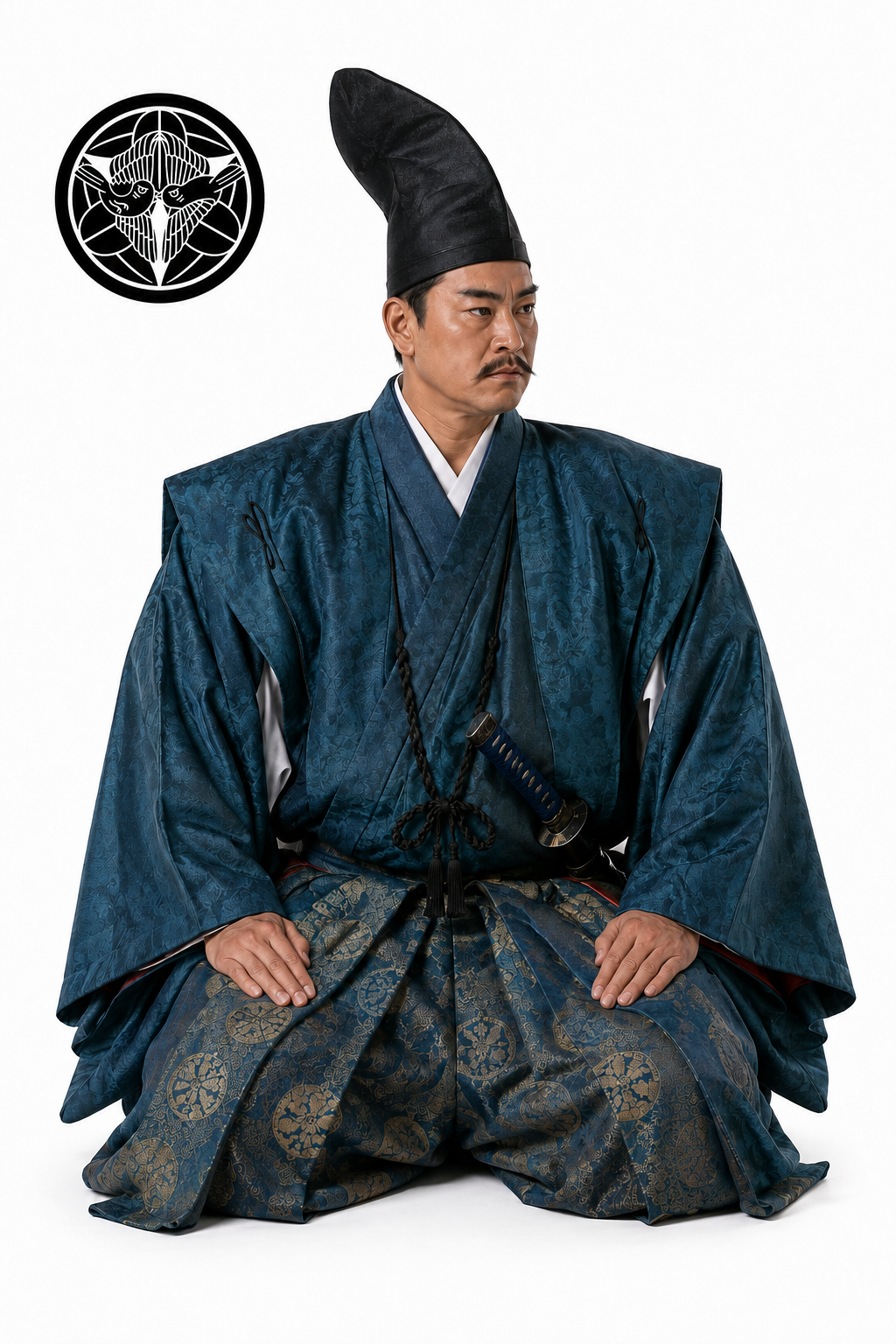
Naoe Kanetsugu — The Wise General of Righteousness Who Raised the “Love” Crest: From the Naoe Letter to the Withdrawal Battle at Hasedō Castle
- Naoe Kanetsugu in 3 Lines
- The Mainstream View — The Established Account Found in Textbooks
- Multiple Theories — Exploring Possibilities from Various Angles
- Viewed Strategically — Kanetsugu's Politics, Military, and Culture
- Famous Words and Sayings of This Warlord
- Anecdotes and Episodes
- Timeline
- Family and Personal Relationships
- Related Historic Site Map / Model Travel Courses
- Related Articles
- References
Naoe Kanetsugu in 3 Lines
- Born the eldest son of the Higuchi family of Uonuma in Echigo, he served from childhood as a page to Uesugi Kagekatsu, the adopted heir of Uesugi Kenshin. He later succeeded the distinguished Naoe house and, as the chief administrator (steward) of the Uesugi house, took sole charge of domestic government, diplomacy, and military affairs — a wise general.
- Widely known for the single character “Love” raised on his helmet crest. Praised by Toyotomi Hideyoshi as “one of those to whom the government of the realm could be entrusted,” he was directly granted the extraordinary holding of Yonezawa, 300,000 koku for a retainer. His “Naoe Letter” of Keichō 5 (1600) is said to have enraged Tokugawa Ieyasu and become the trigger of the Battle of Sekigahara.
- In the Keichō Dewa Campaign (the “Sekigahara of the North”) he fought fiercely with Mogami Yoshiaki; the Hasedō Castle withdrawal battle is called one of the finest withdrawal battles of the Sengoku period. Amid the hardship of being reduced to Yonezawa, 300,000 koku, after Sekigahara, he revived the Uesugi house and devoted himself to developing the castle town, promoting industry, and collecting a national-treasure-class library. He died of illness in Genna 5 (1619) at age 60.
The Mainstream View — The Established Account Found in Textbooks
Born at Sakado Castle in Ueda-no-shō, Echigo
Naoe Kanetsugu was born in Eiroku 3 (1560) in the castle town of Sakado Castle, Ueda-no-shō, Uonuma District, Echigo Province (present-day Minami-Uonuma, Niigata Prefecture). His father was Higuchi Kanetoyo, a retainer of the Ueda Nagao house; his mother is unknown. His childhood name was Yoroku. The Higuchi house is also said to have served as karō of the Ueda Nagao house.
Eiroku 3, the year Kanetsugu was born, was by coincidence the year Imagawa Yoshimoto was struck down by Oda Nobunaga at Okehazama. The Echigo of the time was in the midst of the Sengoku, in a period when Nagao Kagetora (later Uesugi Kenshin) spent his days on Kantō expeditions and the Battles of Kawanakajima.
The head of the Ueda Nagao house, the lord of the Higuchi family, was Nagao Masakage, husband of Kenshin’s elder sister Sentō-in; their heir Kiheiji (later Uesugi Kagekatsu) was five years older than Kanetsugu. Kanetsugu was clever from childhood and came to serve as a page to Kiheiji. Recognized for his talent by Sentō-in, Kanetsugu applied himself to study together with Kiheiji at a temple called Untō-an. In this period the strong lifelong bond between the two was formed.
The Otate Disturbance — Establishing the Uesugi Kagekatsu Regime
In Eiroku 7 (1564), Nagao Masakage met a sudden death (drowning during a pleasure boat outing; there is also an assassination theory). Kiheiji became Kenshin’s adopted son, entered Kasugayama Castle, and took the name Uesugi Kagekatsu. Kanetsugu too went up to Kasugayama Castle following Kagekatsu and continued to serve as a close attendant.
In the 3rd month of Tenshō 6 (1578), Uesugi Kenshin died suddenly at Kasugayama Castle. He was 49. Because he died without clearly naming a successor, a succession dispute broke out between his two adopted sons — Kagekatsu and Uesugi Kagetora (a son of Hōjō Ujiyasu). This is what is called the “Otate Disturbance.”
Kanetsugu commanded troops on the Kagekatsu side and contributed to the victory. In the 3rd month of Tenshō 7 (1579), Kagetora took his own life at Samegao Castle. Kagekatsu succeeded to the Uesugi house. The Otate Disturbance greatly damaged the strength of Echigo, but under the victorious Kagekatsu, Kanetsugu’s position rose dramatically.
Succession to the Naoe House — Marriage to Lady Osen
As an aftereffect of the Otate Disturbance, the Uesugi senior retainer and lord of Yoita Castle, Naoe Nobutsuna, was killed amid the confusion. By this the distinguished Naoe house fell into a crisis of dying out. Uesugi Kagekatsu recommended to Kanetsugu marriage with Nobutsuna’s widow, Lady Osen, and in Tenshō 9 (1581), Kanetsugu married Lady Osen and succeeded the Naoe house. At this time Kanetsugu was 22 and Osen 25.
By this Kanetsugu became lord of Yoita Castle and came to call himself “Naoe Yamashiro-no-kami Kanetsugu.” Lady Osen was a widow who had lost her husband Nobutsuna and was three years older than Kanetsugu, but she became a fine lifelong understanding companion and a great help behind the scenes. Kanetsugu took no concubine his whole life, and the couple is said to have been on good terms.
Having become lord of Yoita Castle, Kanetsugu put effort into the town-building of the castle town — new paddy-field development, the promotion of the smithing industry, road development, and the like. The origin of the traditional craft of the Yoita region, “Echigo Yoita forged blades,” is said to go back to Kanetsugu’s time.
Activity as Chief Administrator of the Uesugi House
After the Honnō-ji Incident of Tenshō 10 (1582), the Uesugi house was incorporated into the Toyotomi Hideyoshi regime. Kagekatsu went up to the capital in Tenshō 14 (1586) and submitted to Hideyoshi, and the Uesugi house became a Toyotomi daimyō. In this process, Kanetsugu established the position of “chief administrator (steward),” handling all of diplomacy and domestic government as Kagekatsu’s right arm.
The subjugation of Sado, the securing of the Shōnai region, mobilization for the invasion of Korea — all the important matters of the Uesugi house were directed by Kanetsugu. Under the Toyotomi regime, Kanetsugu was extremely highly rated by Hideyoshi, and in Bunroku 2 (1593) is said to have been praised as “one of those to whom the government of the realm could be entrusted.” Hideyoshi gave Kanetsugu the extraordinary treatment of granting him the “Toyotomi” surname. Examples of a man of retainer status being granted the Toyotomi surname, on a par with his lord, are extremely rare.
The Transfer to Aizu, 1,200,000 Koku, and Yonezawa, 300,000 Koku
In the first month of Keichō 3 (1598), by Hideyoshi’s order, Uesugi Kagekatsu was transferred from Kasugayama in Echigo, 910,000 koku, to Aizu, 1,200,000 koku. This was a personnel decision placing Kagekatsu, as one of the trusted Five Elders, at the keystone of the Tōhoku.
On the occasion of this transfer, Kanetsugu was directly granted by Hideyoshi the exceptional holding of Yonezawa, 300,000 koku, for a retainer. This was a domain rivaling the class of a mid-ranking daimyō, and among the daimyō of the time those holding 300,000 koku or more could be counted on one’s fingers. Kanetsugu became, in name and in fact, a “retainer on a par with a daimyō,” and came to hold immense power within the Uesugi house.
In the 8th month of the same year, Hideyoshi died at Fushimi Castle. The Toyotomi regime entered an unstable period, and the conflict between the head of the Five Elders, Tokugawa Ieyasu, and the administrators such as Ishida Mitsunari came to the surface.
The Naoe Letter and Sekigahara — A Letter of Challenge to Ieyasu
In Keichō 5 (1600), the Uesugi house, citing the cramped quarters of Aizu Wakamatsu Castle, began the construction of the more spacious Kōzashi Castle. Kanetsugu took supreme command. He further advanced road works within the domain and the recruitment of new retainers, but this, through the slander of the Echigo lord Hori Hideharu, came to draw the suspicion from Tokugawa Ieyasu of “is this not preparation for rebellion?”
Ieyasu sent a letter, through a monk of Shōkoku-ji named Saishō Jōtai, demanding that Kagekatsu come up to the capital and explain himself. The reply Kanetsugu wrote to Saishō Jōtai in response is what is called the “Naoe Letter.” Dated the 14th day of the 4th month of Keichō 5 (1600), this letter coherently refutes Ieyasu’s interrogation and at times shows a bold attitude; it is said to have enraged Ieyasu and made him resolve on the Aizu subjugation.
Ieyasu at once issued the order for the Aizu subjugation and sortied from Ōsaka in the 6th month. But in the 7th month, while Ieyasu was heading north by way of Edo, Ishida Mitsunari raised troops in Ōsaka. Ieyasu broke off the Aizu subjugation, turned west, and defeated Ishida Mitsunari at the main Battle of Sekigahara on the 15th day of the 9th month. By this the Uesugi house came to stand on the Western Army side and became a target of punishment after Sekigahara.
The Keichō Dewa Campaign and the Desperate Fight at Hasedō Castle
After Ieyasu turned west, the Uesugi house decided on an invasion of the Mogami Yoshiaki domain at their rear. On the 8th day of the 9th month of Keichō 5 (1600), Kanetsugu, at the head of a 25,000-strong Uesugi army, began an invasion of the Mogami domain in Dewa Province. This is the “Keichō Dewa Campaign (the “Sekigahara of the North”).”
On the 12th day of the 9th month, the Uesugi army took Hataya Castle in a single day, and on the 14th day besieged the final line of defense, Hasedō Castle. But the Mogami retainer Shimura Mitsuyasu, defending Hasedō Castle, fought valiantly with a small force. He repelled the frontal attack of the 15th day of the 9th month, and in the general assault of the 29th day achieved the feat of killing the Uesugi general Kamiizumi Yasutsuna.
On that same 29th day of the 9th month, word reached Kanetsugu that Ishida Mitsunari had been defeated at Sekigahara. On the 1st day of the 10th month, Kanetsugu resolved to withdraw. Against the withdrawing Uesugi army, the allied forces of Mogami Yoshiaki and Date Masamune launched a persistent pursuit. Kanetsugu himself served as the rear guard, skillfully using his gun corps and bow corps, and succeeded in an orderly withdrawal while fending off the pursuit. This withdrawal battle was handed down to later ages as “one of the finest withdrawal battles of the Sengoku period” and “the withdrawal battle that even demons wept over.” On the 4th day of the 10th month, Kanetsugu returned to Yonezawa Castle.
The Reduction to Yonezawa, 300,000 Koku
After Sekigahara, Ieyasu handed down a severe punishment to the Uesugi house. In the 7th month of Keichō 6 (1601), the Uesugi house was greatly reduced from Aizu, 1,200,000 koku, to Yonezawa, 300,000 koku. The domain shrank to a quarter, but Ieyasu went so far as to allow the survival of the Uesugi house. This is said to have been the result of Kanetsugu’s efforts in negotiation, or of Ieyasu’s sophisticated political judgment.
The transfer to Yonezawa was a chain of hardships for the Uesugi house. Because they moved to Yonezawa bringing along the entire body of 6,000 retainers from the Aizu period, the retainers’ lives fell into extreme distress. Many retainers came to seek to rebuild themselves centered on Kanetsugu’s former territory, Yonezawa.
Building the Foundation of the Yonezawa Domain — Castle-Town Development and Industrial Promotion
While supporting Uesugi Kagekatsu, Kanetsugu devoted himself to building the foundation of the Yonezawa domain. His concrete achievements:
- Development of the Yonezawa castle town: designed the main roads running north–south with Kabutoyama as a landmark, building a planned castle town.
- New paddy-field development: improved the productivity of the Yonezawa Basin through flood control and irrigation development on the Matsukawa (the upper Mogami River).
- Industrial promotion: fostered specialty goods such as aoso (ramie, the raw material for hemp cloth), safflower, lacquerware, and celadon.
- Survival of the body of retainers: introduced measures such as a “half-farmer, half-samurai” system to maintain the finances of 300,000 koku while holding 6,000 retainers.
- Promotion of learning and culture: developed the Zenrin Bunko (later the Kōjōkan) and collected national-treasure-class books such as Song-dynasty editions of the Records of the Grand Historian and the Book of Han.
These foundational developments became the base of the domain reforms of the later 9th lord of the Yonezawa domain, Uesugi Yōzan (Harunori). Much of the urban and industrial structure of present-day Yonezawa City goes back to Kanetsugu’s time.
The Ōsaka Campaign and Late Years
In the Ōsaka campaign of Keichō 19 (1614) to Genna 1 (1615), Kanetsugu joined the Tokugawa side together with Uesugi Kagekatsu. In both the winter and summer campaigns he took charge of rear support and battle command, showing the loyalty needed for the Uesugi house — a loser at Sekigahara — to survive under the Tokugawa shogunate system.
After the Ōsaka campaign, Kanetsugu returned to Yonezawa and concentrated on the finishing of domain administration. An heir, Naoe Kageaki, had been born between him and Lady Osen, but Kageaki died of illness in Keichō 20 / Genna 1 (1615). It was the greatest sorrow for Kanetsugu. With Kageaki’s death, the bloodline of the Naoe house came to be cut off.
On the 19th day of the 12th month of Genna 5 (January 23, 1620), Kanetsugu died of illness at the Uesugi residence in Edo. He was 60. The cause of death is unknown, but it is conjectured that years of grueling duty and mental strain accumulated. The funeral was held at both Edo and Yonezawa, and he was buried at Tokushō-ji in Yonezawa (later Rinsen-ji). His religious name was “Tatsusan Zenchi Koji.”
After Kanetsugu’s death, Lady Osen entered religious life and died six years later, in Genna 8 (1622). Although Kanetsugu and his wife had a son, Kageaki, since he had predeceased them, the Naoe house died out. This is also handed down to have been because Kanetsugu himself wished that “after my death, let the Naoe house be ended.”
Thus closed the life of the wise general Naoe Kanetsugu, who lived by “righteousness” and “love.” The foundation of the Yonezawa domain he built survived, through Uesugi Yōzan’s reforms, until the end of the Edo period, and continued to support the development of Yonezawa after the Meiji Restoration as well. The “Love” crest helmet is now carefully housed at the Keishōden of Uesugi Shrine in Yonezawa City and, as a nationally designated Important Cultural Property, continues to captivate Sengoku fans throughout Japan.
Multiple Theories — Exploring Possibilities from Various Angles
Theory 1: The Meaning of the “Love” Crest
Speaking of Naoe Kanetsugu, the single character “Love” raised on his helmet crest has become his trademark. But debate has continued for years over what this “Love” means, and there is no settled theory. There are three main interpretations.
[Aizen Myōō theory]: The theory that the “Love” on the helmet represents the first character of Aizen Myōō, the Buddhist god of war. The grounds are that there is a cloud-shaped decoration beneath the “Love” ornament. At the time, it is said there was a rule of abbreviating a Buddha’s name by placing a single character of the Buddha above a cloud, so it likely means the “Ai” of “Aizen Myōō.” Aizen Myōō is a wisdom king who transforms desire and worldly passions into enlightenment, taken as a guardian deity by Minamoto no Yoritomo and Lady Oichi as well. The logic is that, under the influence of Uesugi Kenshin’s faith in Bishamonten, Kanetsugu had faith in Aizen Myōō of the same Buddhist lineage.
[Atago Gongen theory]: The theory that “Love” represents Atago Gongen, the Shintō god of war. Atago Gongen is a god of war enshrined at Mount Atago in Kyoto, widely revered by warlords as an object of prayer for victory. Uesugi Kenshin and Uesugi Kagekatsu too are said to have had faith in Atago Gongen, and under that influence Kanetsugu made Atago Gongen his helmet crest. Historians such as Owada Yasutsune support this theory.
[Benevolent-love theory]: The theory that “Love” represents “benevolent love” or “love for the people” in a Confucian sense. A modern interpretation that spread from the Edo period onward, and especially after the NHK Taiga drama Tenchijin (2009) — a romantic reading symbolizing Kanetsugu’s compassion for his domain’s people. An interpretation much used in TV and novels, but the character “Love” of the time did not have a modern meaning like “love,” so it is hard to establish as historical fact.
[The meaning of the character “Love” at the time]: The connotations of “love” and “to cherish” that modern Japanese associate with the character were formed amid the reception of Christianity from the Meiji era onward. The “Love” (rāga) of the Sengoku period was a Buddhist term meaning “intense sexual love that dyes the heart deep red” or “worldly passion.” Seen from this point too, the benevolent-love theory can be called a modern-and-later interpretation.
Many modern researchers think that either the Aizen Myōō theory or the Atago Gongen theory is apt. If anything, judging from the structural feature of the helmet (the arrangement of placing “Love” above a cloud), there is a strong view that the Aizen Myōō theory is more persuasive. However, there is no document in which Kanetsugu himself directly recorded the meaning of “Love,” and it is not settled.
In any case, a warlord who raised a single Chinese character on his Sengoku helmet was extremely rare, and Kanetsugu’s “Love” was a comprehensive symbol of his faith, aesthetic sense, and self-expression. Beyond the debate over what it means, the figure standing on the battlefield raising the single character “Love” still captivates many people as a distinctive aesthetic that bloomed at the close of the Sengoku.
Theory 2: The Authenticity of the Naoe Letter
The “Naoe Letter,” dated the 14th day of the 4th month of Keichō 5 (1600), is Kanetsugu’s famous letter said to have become the trigger of the Battle of Sekigahara. But debate has continued for years among researchers over this letter’s authenticity.
[Forgery theory (the leading recent view)]: No original of the Naoe Letter survives; what is handed down today are all copies. For reasons such as the text being too coherent and polished, the unnaturalness of Kanetsugu using words for an inferior such as “sokomoto” toward Saishō Jōtai (a high-ranking monk), and the writing being premised on a relationship of cooperation between Ōtani Yoshitsugu, Mashita Nagamori, and the Uesugi house even though it was before Sekigahara, the view that it is “an Edo-period fabrication” or “something fabricated in the process of the Uesugi house pushing the postwar responsibility onto Kanetsugu” is the leading recent view. Historians such as Motoyama Kazuki support this view.
[Genuine theory]: Shiramine Jun and others argue that, because copies of the Naoe Letter are included in several Uesugi-house sources such as the Uesugi-ke Onenpu, the Rekidai Koan, and the Kakujōkō Onshoshū, and because in the 7th month of Keichō 5 Tokugawa Hidetada sent Murakami Yorikatsu a letter with a copy of the Naoe Letter attached, a letter recognized as the “Naoe Letter” existed from the time. The possibility that it is not a complete forgery, but that an original document of the time existed and the text was polished in later ages.
[Partly-genuine, partly-fabricated theory]: As an eclectic theory, the view that while it is a fact that Kanetsugu sent some reply to Saishō Jōtai, the text of the surviving “Naoe Letter” was arranged and embellished in the Edo period. That there was a reply from Kanetsugu to Jōtai in the 4th month of Keichō 5 is itself held to be certain from the sources.
[Examination of the “Ieyasu’s rage” theory]: The famous episode that “Ieyasu read the Naoe Letter and was enraged” also has its grounds in Edo-period war chronicles, and is hard to confirm in contemporary sources. The theory that it is more apt to see Ieyasu’s resolve on the Aizu subjugation as a comprehensive judgment on the whole series of Uesugi-house movements — the building of Kōzashi Castle, the recruitment of rōnin, and so on — rather than the influence of the Naoe Letter alone.
[Analysis of the content itself]: Looking at the content of the Naoe Letter, while explaining to Ieyasu’s demand to come up to the capital that “this is not preparation for rebellion,” it shows a bold attitude: “if you absolutely force the visit to the capital, we will not shrink from war either.” If this were genuine, it would be an extremely important source plainly showing Kanetsugu’s nerve and political stance.
The historian Imafuku Tadashi analyzes the Naoe Letter as “not a complete forgery in its entirety, but the surviving text is something arranged in the Edo period.” While acknowledging the fact itself of a reply from Kanetsugu to Jōtai in the 4th month of Keichō 5, the settling point of recent research is that the “Naoe Letter” handed down today is something that underwent Edo-period editing.
Theory 3: Evaluation of Hideyoshi’s “One of Those to Whom the Government of the Realm Could Be Entrusted”
The anecdote that Toyotomi Hideyoshi praised Naoe Kanetsugu as “one of those to whom the government of the realm could be entrusted” and granted him the Toyotomi surname is always quoted in speaking of Kanetsugu. But there are several views on the credibility and meaning of this evaluation.
[Credibility of Hideyoshi’s remark]: The remark “one of those to whom the government of the realm could be entrusted” appears in later compilations and is hard to confirm in contemporary sources. That Hideyoshi rated Kanetsugu highly can itself be confirmed in several sources, but the specific wording of the remark likely includes later embellishment.
[Meaning of the grant of the Toyotomi surname]: That Kanetsugu was granted the Toyotomi surname is documentarily supported. For a man of retainer status to be granted a surname on a par with his lord is extremely exceptional. This is proof that Hideyoshi rated Kanetsugu individually highly, and at the same time is thought to have had the political intent of incorporating the Uesugi house into the axis of the Toyotomi regime.
[Was Yonezawa’s 300,000 koku exceptional?]: The Yonezawa 300,000 koku Kanetsugu was granted directly by Hideyoshi was an exceptional holding for a retainer. Compared with contemporary retainer-daimyō-class figures — Ii Naomasa of the Tokugawa (Takasaki, 120,000 koku), Sanada Masayuki of Ueda (38,000 koku), Katō Kiyomasa (Higo Kumamoto, 250,000 koku), Fukushima Masanori (Kiyosu, 240,000 koku) — Kanetsugu’s 300,000 koku is of the highest class. However, unlike the other retainer-daimyō, Kanetsugu was in the peculiar position of holding a domain equivalent to a daimyō while maintaining the standing of a retainer of the Uesugi house.
[Comparison with the evaluation of Ieyasu]: Hideyoshi held both trust and wariness toward Ieyasu. Toward Kanetsugu, by contrast, he is said to have given a pure high evaluation. Because Hideyoshi himself was a man of humble origin, he had a tendency to evaluate people by ability without regard to origin, and Kanetsugu too was one of the men who suited such an eye of Hideyoshi.
[Comprehensive evaluation of Kanetsugu’s ability]: The reason Kanetsugu was rated highly was not mere military ability but a comprehensive ability that was versed in all of administration, diplomacy, finance, and culture. He was skilled in document business, was a cultured man who enjoyed waka and renga, and was also deeply versed in Confucianism and Buddhism. As a “both pen and sword” type of talent of the late Sengoku and early modern period, Kanetsugu was a typical presence.
The historian Watanabe Daimon analyzes that “Hideyoshi’s evaluation of Kanetsugu was of the highest class for a Sengoku-daimyō retainer. The grant of the Toyotomi surname and Yonezawa’s 300,000 koku are the proof.” On the other hand, he also points out that “whether Hideyoshi thought of Kanetsugu as ‘a man to whom the realm could be entrusted’ is a separate matter, and it likely includes later embellishment.” That Kanetsugu occupied an important position within the Hideyoshi regime is certain, but the view of modern research is that an evaluation up to the “level of governing the realm” may be an overestimate.
Theory 4: Evaluation of the Hasedō Castle Withdrawal Battle
Kanetsugu’s withdrawal battle from Hasedō Castle, beginning on the 1st day of the 10th month of Keichō 5 (1600), is highly rated as one of the finest “withdrawal battles” of the Sengoku period. But there are several views on its reality and evaluation.
[Fine-withdrawal-battle theory (traditional high evaluation)]: Kanetsugu himself served as the rear guard, skillfully using his gun corps and bow corps to fend off the pursuit of the Mogami Yoshiaki and Date Masamune allied forces, and withdrew the 25,000-strong great army to Yonezawa Castle in an orderly manner with minimal losses. To have succeeded in a large-scale withdrawal battle that should ordinarily have caused great losses shows Kanetsugu’s true worth as a commander. It was praised as “the withdrawal battle that even demons wept over.” It is said to have been praised even by Ieyasu and Honda Tadakatsu.
[The pursuit force was small theory]: On the other hand, the theory that the pursuit unit of the Mogami–Date allied forces was in fact not so large, and that Mogami Yoshiaki’s own pursuit had a strong aspect of confirming the result rather than pursuit. The realistic view that, while the evaluation of Kanetsugu’s withdrawal battle is a fact, considering the scale of the pursuit force, it cannot be called a “miraculous withdrawal.”
[Relationship with the evaluation of Mogami Yoshiaki’s pursuit]: Behind Kanetsugu’s fine withdrawal battle is also Mogami Yoshiaki’s pursuit command. It was a fierce battle in which Yoshiaki himself took a bullet to his helmet at the head of his troops, and the pursuing side too was by no means an easy fight. The view that the command ability of the two generals, Kanetsugu and Yoshiaki, was evenly matched is general today.
[The rationality of the strategic withdrawal]: Once word was received that Ishida Mitsunari had been defeated at Sekigahara, the strategic meaning was lost for the Uesugi house even if it took Hasedō Castle. The theory that Kanetsugu’s decision to withdraw was not an emotional defeat but the result of an objective strategic judgment, and should be evaluated not as a “rout” but as a “rational withdrawal.”
[Postwar exchange with Yoshiaki]: After the war, Kanetsugu and Yoshiaki unexpectedly maintained a friendly relationship. When Kanetsugu requested of Yoshiaki, “please return the guns seized on the battlefield,” Yoshiaki is said to have agreed. An episode showing the dignity of warriors who, even as enemy generals, recognized each other’s ability as warriors. Exchanges of waka between Kanetsugu and Yoshiaki are also handed down.
The evaluation of the Hasedō Castle withdrawal battle shows both the true worth and the limits of Kanetsugu as a commander. It was certainly a splendid withdrawal battle, but at the point when the Western Army was defeated at the main Battle of Sekigahara the Uesugi house’s defeat was decided, and both Kanetsugu and Ieyasu calmly moved on to the subsequent punishment negotiations. The splendor of the withdrawal battle was an evaluation on the tactical level, and the modern evaluation is that it did not overturn the Uesugi house’s defeat in the overall strategy.
Theory 5: The Secret Plot with Ishida Mitsunari
The legend that on the eve of Sekigahara there was a secret plot of “pincering Ieyasu” between Kanetsugu and Ishida Mitsunari has been repeatedly depicted in war chronicles, novels, and Taiga dramas. But views are divided among researchers over the real existence of this plot.
[Plot-existence theory (traditional)]: The theory that the Uesugi house faced off against Ieyasu in Aizu, and Ishida Mitsunari raised troops in Ōsaka just as Ieyasu headed for Aizu — that this was an “Ieyasu-pincer” operation arranged in advance between Kanetsugu and Mitsunari. There are records in Edo-period war chronicles such as the Jōzan Kidan, and it was widely depicted in storytelling and novels. In the NHK Taiga drama Tenchijin (2009) too, the secret plot of Kanetsugu and Mitsunari was dramatically depicted.
[Plot-denial theory (the leading recent view)]: Historians such as Watanabe Daimon point out that no contemporary source backs the secret plot of Kanetsugu and Mitsunari, and support the theory that the plot is an Edo-period fabrication. If there had been a plot, Kanetsugu should have moved upon firm word of Mitsunari’s raising of troops, but the actual Kanetsugu did not move from Aizu even after Ieyasu turned west, and shifted to invading the Mogami domain. This is a movement that cannot be said to show an advance plan.
[Results-based concurrence theory]: The eclectic theory that there was no advance plot between Kanetsugu and Mitsunari, but the two were in agreement in their wariness of Ieyasu and as a result took the same action. The conflict between the faction wishing to maintain the Toyotomi regime after Hideyoshi’s death (Mitsunari, Kanetsugu, Ōtani Yoshitsugu, etc.) and the faction wishing for an Ieyasu-led new system was clear, and Kanetsugu and Mitsunari shared interests beyond the presence or absence of a plot.
[Kanetsugu’s independent-action theory]: The view that the actions that drew Ieyasu’s suspicion — the building of Kōzashi Castle, the recruitment of rōnin, and so on — were all led by Kanetsugu. There may have been a part that expected Mitsunari’s raising of troops, but the Uesugi house’s action was basically by Kanetsugu’s independent judgment.
[Strategic examination of the Ieyasu-pincer plan]: Even if there had been a plot, its feasibility was extremely low. The operation of Mitsunari raising troops in Ōsaka while Ieyasu headed for Aizu, pincering Ieyasu from east and west, is hard to establish geographically and temporally. Because Ieyasu went by way of Edo, there was no room for the Uesugi house to move from Aizu to pincer him, and as a strategic conception it was not realistic.
The historian Hongō Kazuto analyzes that “the secret plot of Kanetsugu and Mitsunari is a later narrative embellishment and does not hold as historical fact.” On the other hand, that Kanetsugu and Mitsunari shared interests in anti-Ieyasu is a fact, and a “resulting linkage” certainly existed. The view of modern research is that, even removing the dramatic structure of a “plot,” Kanetsugu and Mitsunari were comrades with the same political orientation.
Theory 6: His Skill in Managing the Yonezawa Domain
Amid the hardship of being reduced to Yonezawa, 300,000 koku, after Sekigahara, Kanetsugu devoted himself to the survival and revival of the Uesugi house. There are several evaluations of this skill in managing the Yonezawa domain too.
[The bold decision to preserve the body of retainers theory]: To move to Yonezawa, 300,000 koku, bringing along the 6,000 retainers of the Aizu 1,200,000-koku period as they were, was an extremely difficult decision financially. Where ordinarily one would greatly downsize the body of retainers, Kanetsugu continued to hold all the retainers through measures such as the half-farmer, half-samurai system. By this the Uesugi house’s human resources were preserved and became the foundation of later domain administration. On the other hand, there is also the negative side that it invited the distress of the retainers’ livelihoods.
[The foresight of castle-town development theory]: Kanetsugu developed the Yonezawa castle town in a planned way. He designed the main roads running north–south with Kabutoyama as a landmark, divided the town layout in an orderly manner, and arranged the merchant quarter and craftsmen’s quarter in a planned way. The urban structure of the central district of present-day Yonezawa City is based on the street plan of Kanetsugu’s time. It is rated as a forerunner of the castle-town model that developed in the Edo period.
[The insight of industrial promotion theory]: Kanetsugu put effort into fostering specialty goods at Yonezawa — aoso (ramie, the raw material for hemp cloth), safflower, lacquerware, celadon, and the like. The aoso cultivation that became the basis of Yonezawa weaving in particular became an important revenue source of the later Yonezawa domain. He also set about mine development (the Shirabu and silver mines), seeking to diversify the financial base. These industrial-promotion measures became the base of the later domain reforms of Uesugi Yōzan.
[The cultural contribution of collecting a national-treasure-class library theory]: Kanetsugu also put effort into the promotion of learning and culture. He developed the Zenrin Bunko (later the Kōjōkan) and collected extremely precious books such as Song-dynasty editions of the Records of the Grand Historian and the Book of Han. Many of these books are now designated National Treasures and are carefully preserved as cultural properties of Yonezawa. Even among Sengoku warlords, a man who collected such academic books is rare.
[The financial limit theory]: On the other hand, there were limits to Kanetsugu’s management of the Yonezawa domain. The structure of holding 6,000 retainers on the finances of 300,000 koku was essentially unreasonable, and the later Uesugi house suffered chronic financial difficulty. By the mid-Edo period the domain finances worsened to the brink of collapse, and the reforms of Uesugi Yōzan (Harunori) became necessary. While Kanetsugu’s measure to preserve the body of retainers is praised as a virtue, there is also criticism that it was lacking in financial rationality.
The historian Imafuku Tadashi analyzes that “Kanetsugu’s management of the Yonezawa domain can be highly rated as the utmost effort in a plight.” On the other hand, he also points out that “the structure of holding 6,000 retainers on 300,000 koku was essentially hard to sustain and continued to trouble the Uesugi house until the later Yōzan reforms.” Kanetsugu’s domain administration was not perfect, but the achievement of saving the Uesugi house from destruction and building the foundation of its revival is certain.
Viewed Strategically — Kanetsugu’s Politics, Military, and Culture
The Unique Position of “Chief Administrator”
Kanetsugu’s greatest characteristic is that, while a “retainer” of a Sengoku daimyō, he established the position of “chief administrator (steward),” which could in effect be called “acting domain lord.” This was an extremely rare standing even among Sengoku-period retainers; equivalent examples include Kobayakawa Takakage (Mōri house), Katakura Kagetsuna (Date house), and Honda Masanobu (Tokugawa house), but a chief administrator who exercised authority in unity with his lord to the degree of Kanetsugu is rare.
His lord Uesugi Kagekatsu was a taciturn man, rated as “a general who did not laugh before his retainers,” but Kanetsugu, by contrast, was eloquent and outgoing. The complementary relationship of the two men’s characters produced great results in both the external policy and the domestic government of the Uesugi house. Toyotomi Hideyoshi is said to have told Kagekatsu, “I envy you for having a retainer like Kanetsugu.”
“Both Pen and Sword” Comprehensive Ability
The characteristic of Kanetsugu’s ability lies in a comprehensiveness versed not only in the military but in all of administration, diplomacy, finance, culture, and learning. Specifically:
- Military: took command in the Otate Disturbance, the subjugation of Sado, the invasion of Korea, the Keichō Dewa Campaign, and so on.
- Diplomacy: building the relationship with the Toyotomi regime, negotiation with Tokugawa Ieyasu, the drafting of the Naoe Letter.
- Administration: the domain governance of the Uesugi house, the foundational development of the Yonezawa domain, the control of the body of retainers.
- Finance: the financial management of Aizu’s 1,200,000 koku and Yonezawa’s 300,000 koku respectively, industrial promotion.
- Culture: a cultured man versed in waka and renga, Chinese poetry, and calligraphy.
- Learning: the development of the Zenrin Bunko, the collection of precious books such as Song-dynasty editions of the Records of the Grand Historian and the Book of Han.
A talent excellent in all of these is rare even among Sengoku daimyō. Kanetsugu was a typical “both pen and sword” type of wise general, rated as a man who embodied the ideal retainer image of the late Sengoku to early modern period.
An Embodiment of Confucian “Righteousness”
Kanetsugu’s spiritual base lies in the thought of “righteousness” inherited from Uesugi Kenshin. Kenshin’s “righteousness” had a strong Buddhist (Bishamonten-faith) character, but Kanetsugu’s “righteousness” took on a more Confucian coloring. Emphasizing the Confucian “Five Constant Virtues (benevolence, righteousness, propriety, wisdom, faith),” he consistently maintained compassion for his domain’s people, a relationship of trust with his retainers, and loyalty to his lord.
At the time of the Uesugi house’s transfer to Yonezawa after Sekigahara, the decision to continue holding 6,000 retainers despite the reduction was the very embodiment of “righteousness.” This attitude of prioritizing the bonds between people over economic rationality moves many people even today.
A Master of Information Warfare and Diplomatic Warfare
Kanetsugu excelled not only in the military but in information warfare and diplomatic warfare. Under the Hideyoshi regime, he took sole charge of the Uesugi house’s negotiations with the central government and maintained a network of communication with other daimyō such as Satake Yoshinobu and Ukita Hideie. His relationship with the administrators such as Ishida Mitsunari and Ōtani Yoshitsugu was also close, and he strove to secure the Uesugi house’s position within the Toyotomi regime.
The drafting of the Naoe Letter too, apart from the authenticity of its content, is an event showing Kanetsugu’s document ability and political judgment. The document, which clearly refutes Ieyasu’s interrogation while asserting the Uesugi house’s legitimacy, shows Kanetsugu’s political nerve.
Strategic Limits — The Uesugi House’s Plight at Sekigahara
Despite possessing such talent, Kanetsugu too could not lead the Uesugi house of the Sekigahara period to victory. The reasons:
- Geographical isolation: the Uesugi house was located in the Tōhoku and Hokuriku, far from the capital region. To advance west in concert with Mitsunari’s raising of troops was effectively impossible.
- Hostile powers all around: Mogami Yoshiaki and Date Masamune sided with the Eastern Army, and the Uesugi house was in a structure of being pincered in the Tōhoku.
- The timing of Mitsunari’s raising of troops: because Mitsunari raised troops while Ieyasu was on the way to the Aizu subjugation, Ieyasu turned west, and the Uesugi house missed the chance for a pincer.
- The structural problem of Aizu’s 1,200,000 koku: the 1,200,000-koku domain was vast, but it was just after the transfer, with internal governance not yet complete.
Kanetsugu did his best under limited conditions, but as a result the Uesugi house was forced into a great reduction from 1,200,000 koku to 300,000 koku. Even so, Kanetsugu’s negotiating ability in winning the survival of the Uesugi house is rated highly.
Famous Words and Sayings of This Warlord
“Love” (the helmet crest)
The single character of the helmet crest that became Kanetsugu’s trademark. There are several interpretations — Aizen Myōō, Atago Gongen, benevolent love — but whichever theory one takes, it is an extremely distinctive self-expression for a Sengoku warlord. It survives at the Keishōden of Uesugi Shrine in Yonezawa City and is carefully preserved as an accessory of the nationally designated Important Cultural Property “armor with a two-piece cuirass laced in pale-blue thread on gold scales.”
The Famous Line of the “Naoe Letter” (conjectural)
“If Kagekatsu harbors treachery, let him await Lord Ieyasu’s own sortie and explain himself openly” — said to be a famous passage of the Naoe Letter. It is said to have refuted Ieyasu’s demand to come up to the capital with a bold attitude. Because the original is absent its authenticity is unknown, but it is widely known as a famous saying symbolizing Kanetsugu’s political stance.
“One of Those to Whom the Government of the Realm Could Be Entrusted” (Hideyoshi’s evaluation)
The words said to be Toyotomi Hideyoshi’s praise of Naoe Kanetsugu. It is quoted as the grounds for Hideyoshi rating Kanetsugu highly and granting him the Toyotomi surname. Confirmation in contemporary sources is difficult, but that Hideyoshi trusted Kanetsugu is certain.
“Righteousness Is the Treasure of the Realm; To Turn Against It Is to Be No Better Than a Beast” (gist)
Handed down as words expressing Kanetsugu’s Confucian thought of “righteousness.” The direct source is an Edo-period compilation, but it is widely quoted as words showing Kanetsugu’s spiritual base. It symbolizes that the thought of “righteousness” inherited from Uesugi Kenshin was, through Kanetsugu, handed down as the domain ethos of the Yonezawa domain.
“Tenchijin”
The title of Hisaka Masashi’s novel Tenchijin (2007) and the NHK Taiga drama Tenchijin (2009). In this work with Naoe Kanetsugu as protagonist, the words of Sunzi — “the time of Heaven, the advantage of Earth, the harmony of Man” — are overlaid on Kanetsugu’s life, forming the modern image of Kanetsugu. The Taiga drama, in which Tsumabuki Satoshi played Kanetsugu, raised Kanetsugu’s name recognition all at once.
Anecdotes and Episodes
The Meeting with Kagekatsu in Childhood
From around age 6, Kanetsugu served as a page to the heir of the Ueda Nagao house, Kiheiji (later Uesugi Kagekatsu). The bond of childhood, learning together with Kagekatsu at a temple called Untō-an, never changed throughout his life. Kanetsugu’s mother — Sentō-in (Kagekatsu’s mother) — is handed down to have seen through to Kanetsugu’s talent and recommended him as a page to her son Kiheiji (Kagekatsu). In later years, Kagekatsu was taciturn and rated as “a general who did not laugh before his retainers,” but before Kanetsugu he is said to have often shown a smile.
Persuading the Kagetora Camp in the Otate Disturbance
In the Otate Disturbance of Tenshō 6–7 (1578–79), Kanetsugu took command on the Kagekatsu side. By one account, Kanetsugu turned leading commanders of the Kagetora camp by subversion and greatly contributed to Kagekatsu’s victory. That he was entrusted with command of a great disturbance at around age 20 tells of Kanetsugu’s precocious ability.
Marriage to Lady Osen
In Tenshō 9 (1581), the 22-year-old Kanetsugu married the 25-year-old Lady Osen and succeeded the Naoe house. Osen, while bearing the sorrow of losing her former husband Naoe Nobutsuna, became a wise wife who supported Kanetsugu. Kanetsugu took no concubine his whole life, and the couple was on good terms. Osen also actively took part in politics and is handed down to have managed the Naoe house in Kanetsugu’s absence. “Osen’s help behind the scenes” is still told of in Yonezawa.
The “Imperial Estates” Affair and the Relationship with Hideyoshi
In the Bunroku era, Kanetsugu came to be entrusted by the imperial court with the management of the “imperial estates” (land directly held by the emperor). This was an expression of Hideyoshi’s trust. Kanetsugu fulfilled this duty and deepened his relationship with the court as well. The grant of the Toyotomi surname was also around this time, a symbol of the period when Kanetsugu held weight in central politics.
The Subjugation of Sado
In Tenshō 17 (1589), the Uesugi house subjugated the Honma clan of Sado. Kanetsugu took command and incorporated Sado into Uesugi territory in only a short time. The gold mine of Sado was to become an important revenue source of the later Uesugi house, but after Sekigahara, owing to the abolition, it became land directly held by the Tokugawa shogunate.
Calm Judgment in the Invasion of Korea
In the Bunroku and Keichō campaigns (1592–1598), the Uesugi house too was scheduled to cross over to Korea, but by Kanetsugu’s judgment the crossing was kept to a minimum. This was a realistic judgment prioritizing the stability of the domain over a reckless overseas expedition. In the same period, other daimyō houses suffered great losses in the expedition, but the Uesugi house held its damage to a minimum.
Exchange with Maeda Keiji
The nephew of Maeda Toshiie, known as a “dandy eccentric,” Maeda Keiji, took refuge with Kanetsugu in Yonezawa in his late years. Kanetsugu loved Keiji’s elegant personality and treated him as a guest. Keiji enjoyed waka and renga in Yonezawa and spent a carefree later life. The friendship of Kanetsugu and Keiji is still told of as an ideal of the elegant men of the close of the Sengoku. Keiji died in Yonezawa, and his grave is at Dōmori Zenkō-ji within Yonezawa City.
Rear-Guard Command in the Hasedō Castle Withdrawal Battle
In the withdrawal battle of the Keichō Dewa Campaign, Kanetsugu himself served as the rear guard. Skillfully using his gun corps and bow corps, he fended off the pursuing Mogami Yoshiaki army and succeeded in an orderly withdrawal. During the withdrawal, Kanetsugu is also handed down to have “resolved on death” on horseback when his own army fell into a plight, but in the end he succeeded in the Uesugi army’s organized withdrawal. This is the reason this withdrawal battle is called one over which “even demons wept.”
Consideration for His Retainers at the Yonezawa Transfer
At the Yonezawa transfer of Keichō 6 (1601), Kanetsugu showed fine consideration for the movement of the retainers from Aizu to Yonezawa. He supported the movement of those with families and devoted himself to the distribution of housing and farmland after arrival in Yonezawa. The retainers cherished Kanetsugu’s character, and despite the plight many followed to Yonezawa. The transfer holding 6,000 retainers was financially harsh, but the judgment to preserve human resources greatly contributed to the later revival of the Uesugi house.
The Zenrin Bunko and the National-Treasure-Class Library
Kanetsugu poured extraordinary passion into the collection of learning and books. He collected many of the extremely precious books called “Song editions,” published in the Song dynasty of China — especially Song editions of the Chinese official histories such as the Records of the Grand Historian, the Book of Han, and the Book of Later Han — and developed them in Yonezawa as the Zenrin Bunko (later the Kōjōkan). These books are still preserved in Yonezawa and are designated National Treasures and Important Cultural Properties. There is almost no other example of a Sengoku warlord collecting a national-treasure-class library.
The Death of His Heir Kageaki
Kanetsugu had an heir, Naoe Kageaki, but he died of illness young in Keichō 20 / Genna 1 (1615). It was the greatest sorrow for Kanetsugu. With Kageaki’s death, the bloodline of the Naoe house came to be cut off. Kanetsugu is handed down to have resolved to end the Naoe house after his own death. It is a decision showing Kanetsugu’s detachment: “I have fulfilled my duty enough in my own generation,” “if there is no one to succeed the Naoe house, it may be ended.”
Timeline
| Japanese Era (Western Year) | Age | Event |
|---|---|---|
| Eiroku 3 (1560) | 1 | Born in the castle town of Sakado Castle, Ueda-no-shō, Uonuma District, Echigo. Father Higuchi Kanetoyo. Childhood name Yoroku. The same year, the Battle of Okehazama. |
| c. Eiroku 7–9 (1564–66) | 5–7 | Becomes a page to Kiheiji (later Uesugi Kagekatsu) of the Ueda Nagao house. Studies together with Kagekatsu at Untō-an. |
| Tenshō 6–7 (1578–79) | 19–20 | Uesugi Kenshin dies; the Otate Disturbance. Takes command on the Kagekatsu side and contributes to the victory. |
| Tenshō 9 (1581) | 22 | Marries Lady Osen and succeeds the Naoe house. Becomes lord of Yoita Castle. Takes the name “Naoe Yamashiro-no-kami Kanetsugu.” |
| Tenshō 14 (1586) | 27 | Uesugi Kagekatsu goes up to the capital and submits to Toyotomi Hideyoshi. Kanetsugu establishes the position of chief administrator, taking supreme command of diplomacy and domestic government. |
| Tenshō 17 (1589) | 30 | Subjugates the Honma clan of Sado, making Sado Uesugi territory. |
| Bunroku 2 (1593) | 34 | Praised by Hideyoshi as “one of those to whom the government of the realm could be entrusted,” and granted the Toyotomi surname. |
| Keichō 3 (1598) | 39 | In the first month, Uesugi Kagekatsu is transferred to Aizu, 1,200,000 koku. Kanetsugu is directly granted Yonezawa, 300,000 koku, by Hideyoshi. In the 8th month, Hideyoshi dies. |
| Keichō 5 (1600) | 41 | Begins building Kōzashi Castle. On the 14th day of the 4th month, the Naoe Letter is sent (authenticity subject to multiple theories). Ieyasu is enraged and issues the Aizu subjugation order. In the 7th month, Ieyasu turns west, toward Sekigahara. From the 8th day of the 9th month to the 1st day of the 10th month, the Keichō Dewa Campaign (the “Sekigahara of the North”). Succeeds in a fine withdrawal in the Hasedō Castle withdrawal battle. On the 15th day of the 9th month, the Western Army is defeated at the main Battle of Sekigahara. |
| Keichō 6 (1601) | 42 | In the 7th month, the Uesugi house is greatly reduced from Aizu, 1,200,000 koku, to Yonezawa, 300,000 koku. Kanetsugu sets about the foundational development of the Yonezawa domain. |
| Keichō 10–18 (1605–13) | 46–54 | Development of the Yonezawa castle town, new paddy-field development, industrial promotion, development of the Zenrin Bunko, collection of precious books such as Song editions of the Records of the Grand Historian and the Book of Han. |
| Keichō 19 – Genna 1 (1614–15) | 55–56 | The Ōsaka campaign (winter and summer). Joins on the Tokugawa side. In Genna 1, the heir Naoe Kageaki dies of illness. The bloodline of the Naoe house is cut off. |
| Genna 5 (1619) | 60 | On the 19th day of the 12th month, dies of illness at the Uesugi residence in Edo at 60. Buried at Tokushō-ji in Yonezawa (later Rinsen-ji). Religious name “Tatsusan Zenchi Koji.” |
| Genna 8 (1622) | — | His wife Lady Osen dies. The Naoe house dies out. |
Family and Personal Relationships
The Naoe House, the Higuchi House, and Family
| Person | Relation | Connection |
|---|---|---|
| Higuchi Kanetoyo | Father | A retainer of the Ueda Nagao house, also said to be of karō rank. Deeply involved in Kanetsugu’s birth. |
| Lady Osen | Legal wife | Widow of Naoe Nobutsuna. Three years older than Kanetsugu. Supported Kanetsugu as a wise wife. He took no concubine his whole life, and the couple was on good terms. |
| Naoe Kageaki | Heir | The only son born between Kanetsugu and Osen. Died of illness in Keichō 20 / Genna 1 (1615). The bloodline of the Naoe house is cut off. |
| Ōkuni Saneyori | Brother | Succeeded the Oguni (Ōkuni) clan. A senior retainer who supported Kanetsugu. |
| Naoe Nobutsuna | Osen’s former husband | Head of the distinguished Naoe house. Killed in the confusion after the Otate Disturbance. By his death, Kanetsugu came to succeed the Naoe house. |
The Lord’s House — The Uesugi
| Person | Position | Connection |
|---|---|---|
| Uesugi Kenshin | Previous head of the Uesugi house | The spiritual pillar of “righteousness” and Bishamonten faith. Gave decisive influence to Kanetsugu’s formation of thought. Died suddenly in 1578. |
| Sentō-in | Kagekatsu’s mother, Kenshin’s elder sister | The benefactor who saw through to Kanetsugu’s talent and recommended him as a page to her son Kiheiji (Kagekatsu). |
| Nagao Masakage | Kagekatsu’s father | Head of the Ueda Nagao house, Kanetsugu’s first lord-line. Drowned during a pleasure boat outing in 1564 (assassination theory exists). |
| Uesugi Kagekatsu | Lord | Kanetsugu’s lifelong lord. A taciturn man who placed absolute trust in Kanetsugu’s support. First lord of the Yonezawa domain. |
| Uesugi Kagetora | Kagekatsu’s rival | A son of Hōjō Ujiyasu and an adopted son of Kenshin. Fought Kagekatsu in the Otate Disturbance and took his own life at Samegao Castle in 1579. |
Allies and Close Companions
| Person | Position | Connection |
|---|---|---|
| Maeda Keiji | Dandy eccentric | Nephew of Maeda Toshiie. Spent his late years with Kanetsugu, enjoying waka and renga in Yonezawa, where he died. |
| Ishida Mitsunari | Toyotomi administrator | Central figure of the Western Army at Sekigahara. The presence or absence of a plot with Kanetsugu is subject to multiple theories. Shared interests in anti-Ieyasu. |
| Ōtani Yoshitsugu | Lord of Tsuruga Castle in Echizen | Joined the Western Army together with Mitsunari. Was on close terms with Kanetsugu too. |
| Saishō Jōtai | Monk of Shōkoku-ji | Mediated the negotiation between Ieyasu and the Uesugi house. The direct addressee of the Naoe Letter. |
Political Associates
| Person | Position | Connection |
|---|---|---|
| Toyotomi Hideyoshi | Ruler of the realm | The benefactor who praised Kanetsugu as “one of those to whom the government of the realm could be entrusted” and granted him the Toyotomi surname and Yonezawa’s 300,000 koku. |
| Tokugawa Ieyasu | Ruler of the realm | Enraged by the Naoe Letter, issued the Aizu subjugation order. After Sekigahara, allowed the Uesugi house’s survival, with the punishment of reduction to Yonezawa, 300,000 koku. |
| Honda Masanobu | Tokugawa retainer | On close terms with Kanetsugu in the punishment negotiations of the Uesugi house after Sekigahara. As the Ieyasu-side liaison, supported the Uesugi house’s survival. |
| Hori Hideharu | New lord of Echigo | The new lord after the Uesugi house’s transfer from Echigo. The man who slandered the Uesugi house to Ieyasu over the rebellion suspicion. |
Enemy Generals of the Keichō Dewa Campaign
| Person | Position | Connection |
|---|---|---|
| Mogami Yoshiaki | Yamagata, 240,000 koku | The main enemy general of the Keichō Dewa Campaign. Fought fiercely in Kanetsugu’s Hasedō Castle withdrawal battle; unexpectedly maintained a friendly relationship after the war. |
| Date Masamune | Lord of Iwadeyama Castle | Yoshiaki’s nephew. Dispatched Rusu Masakage’s 3,000 as Mogami relief, pressing Kanetsugu’s army in the Keichō Dewa Campaign. |
| Shimura Mitsuyasu | Mogami retainer | The Mogami retainer who held Hasedō Castle and repelled Kanetsugu’s 25,000-strong Uesugi army with a small force. |
Related Historic Site Map / Model Travel Courses
A journey tracing the footsteps of Naoe Kanetsugu, from his birthplace of Niigata (Minami-Uonuma, Nagaoka) to the land of his Yonezawa-domain management, Yamagata (Yonezawa), is a wide-area course overlaid with the history of the Uesugi house. Yonezawa in particular is where Kanetsugu-related historic sites are concentrated — the Keishōden of Uesugi Shrine, which preserves the “Love” crest helmet, and the graves of Kanetsugu and his wife Osen.
* For the My Map, please refer to the “Places connected to Naoe Kanetsugu” layer included in the Sengoku Kassenroku historic-site map.
Model Course 1: Niigata “The Land of Kanetsugu’s Birth” Course (1 day)
A course touring the lands of Kanetsugu’s childhood and youth.
- JR Echigo-Yuzawa Station → by JR Jōetsu Line to Muikamachi Station → ruins of Sakado Castle (Kanetsugu’s birthplace; a 1-to-2-hour climb) → Untō-an (the temple where he studied together with Kagekatsu) → return
Model Course 2: Nagaoka “The Land of the Naoe-House Succession” Course (half day)
A course visiting Yoita, where Kanetsugu succeeded the Naoe house in Tenshō 9 (1581).
- JR Nagaoka Station → by bus to Yoita → ruins of Yoita Castle (the land of Kanetsugu’s first full-scale lordship, of new paddy-field development and the forged-blade industry) → ruins of Lady Osen’s birth residence → return
Model Course 3: Yonezawa “The Ground of Kanetsugu’s End and the ‘Love’ Helmet” Course (2 days, 1 night)
The most important course, touring Kanetsugu’s peak and late years and his grave.
- Day 1: JR Yonezawa Station → ruins of Yonezawa Castle (Matsugamisaki Park) → Uesugi Shrine and Keishōden (a must-see; the actual “Love” crest helmet) → Uesugi Museum (materials related to the Yonezawa domain) → overnight in Yonezawa City (savoring local Yonezawa-beef cuisine)
- Day 2: Rinsen-ji (graves of Kanetsugu and Lady Osen, graves of the successive Yonezawa lords) → former Ikka-in, Maeda Keiji’s grave → a stroll through the castle town Kanetsugu developed → return
Model Course 4: Aizu and Dewa “The Battlefield Ruins of Sekigahara” Course (2 days, 1 night)
A course for history enthusiasts touring the footsteps of Kanetsugu of the Sekigahara period.
- Day 1: JR Aizu-Wakamatsu Station → ruins of Kōzashi Castle (the unfinished castle of Kanetsugu’s supreme command) → Aizu-Wakamatsu Castle (Tsuruga Castle) → overnight in Aizu-Wakamatsu
- Day 2: by JR to Yamagata → ruins of Hasedō Castle (the final line of defense of the Sekigahara of the North, the starting point of Kanetsugu’s fine withdrawal battle) → return
Arrangements by Type of Visitor
- History beginners: the Yonezawa course (Model 3) is the most important and the most accessible. To see the “Love” crest helmet in the real thing at the Keishōden of Uesugi Shrine is of great value.
- Taiga drama fans: touring Yonezawa, Yoita, and Sakado Castle as a pilgrimage for the NHK Taiga drama Tenchijin (2009) is recommended.
- Castle fans: Kanetsugu-related castles are varied — Sakado Castle (a mountain castle 634 m above sea level, a climb required), Yoita Castle, Yonezawa Castle, Kōzashi Castle, Hasedō Castle.
- For enthusiasts: places that are plain as tourist sites but historically deep — the ruins of Kōzashi Castle (the phantom unfinished castle), Maeda Keiji’s grave (former Ikka-in) — are also worth visiting.
- Cultural-history fans: at the Zenrin-ji of Yonezawa (the Kōjōkan ruins), the Yonezawa Municipal Library, and elsewhere, there are opportunities to see the Song-edition books Kanetsugu collected (National Treasures such as the Records of the Grand Historian and the Book of Han) in special exhibitions.
Related Articles
Related Warlord Articles
- Uesugi Kagekatsu — Kanetsugu’s lifelong lord, first lord of the Yonezawa domain
- Uesugi Kenshin — Kanetsugu’s spiritual pillar, the source of the thought of “righteousness”
- Maeda Keiji — the dandy-eccentric ally who spent his late years with Kanetsugu in Yonezawa
- Mogami Yoshiaki — the main enemy general of the Keichō Dewa Campaign, unexpectedly friendly after the war
- Ishida Mitsunari — the ally who shared interests in anti-Ieyasu, the center of the Western Army at Sekigahara
- Tokugawa Ieyasu — the one enraged by the Naoe Letter, the ruler of the realm who allowed the Uesugi house’s survival after Sekigahara
- Toyotomi Hideyoshi — the benefactor who called Kanetsugu “one of those to whom the government of the realm could be entrusted” and granted him the Toyotomi surname
- Date Masamune — dispatched Mogami relief in the Keichō Dewa Campaign, pressing Kanetsugu’s army
Related Battle Articles
- Battle of Hasedō Castle (1600) — the stage of Kanetsugu’s fine withdrawal battle
- Keichō Dewa Campaign (1600) — the Sekigahara of the North, the Kanetsugu vs. Mogami Yoshiaki battle
- Battle of Sekigahara (1600) — the main battle led by the Western Army, with which Kanetsugu is said to have been linked
- Ōsaka Campaign (1614–15) — the final decisive battle of the Sengoku, in which Kanetsugu joined on the Tokugawa side
References
Primary Sources
- Uesugi-ke Monjo — a body of contemporary documents related to the Uesugi house. Held in parts at the Yonezawa City Uesugi Museum, the Historiographical Institute of the University of Tokyo, and elsewhere.
- Naoe Letter (copy) — dated the 14th day of the 4th month of Keichō 5. The original is absent; several copies are included in sources related to the Uesugi and Tokugawa houses.
- Uesugi-ke Onenpu, Rekidai Koan, Kakujōkō Onshoshū — a body of Uesugi-house sources compiled in the Edo period.
- Shinchō Kōki — records of the period around the Honnō-ji Incident related to the Uesugi house.
- Tamon-in Nikki — the diary of Eishun of Kōfuku-ji; records the Uesugi house’s movements in central politics.
- Tōdaiki, Keichō Kenmonshū — precious sources recording events of the Keichō era.
- The body of Naoe Kanetsugu letters (held by the Yonezawa City Uesugi Museum, the Niigata Prefectural Museum of History, etc.) — Kanetsugu’s autograph letters, precious material for research on his character.
- The library Kanetsugu collected (held by the Yonezawa Municipal Library, etc.) — many National Treasures and Important Cultural Properties, including Song editions of the Records of the Grand Historian, the Book of Han, and the Book of Later Han.
Compiled Sources
- Dai Nihon Shiryō (compiled by the Historiographical Institute, University of Tokyo) — covers the various sources related to Kanetsugu.
- Sengoku Ibun, various volumes (Tōkyōdō Shuppan) — systematically collects documents of the Sengoku period.
- Niigata Prefectural History, Yamagata Prefectural History, Yonezawa City History — collections of regional sources.
Academic and Research Books
- Motoyama Kazuki, Naoe Kanetsugu: The Life of a Righteous General Who Raced Through the Sengoku (PHP Institute) — a representative work of Kanetsugu research.
- Imafuku Tadashi, Naoe Kanetsugu (Shin-Jinbutsu Ōraisha) — a basic reference of Kanetsugu research.
- Watanabe Daimon, Naoe Kanetsugu and the Battle of Sekigahara — an analysis of the Naoe Letter and Kanetsugu of the Sekigahara period.
- Fukushima Prefectural Culture Promotion Foundation (ed.), Naoe Kanetsugu and Sekigahara — a collection of essays including the authenticity debate over the Naoe Letter.
- Shiramine Jun, The Authenticity of the Naoe Letter and other works — a leading proponent of the genuine theory of the Naoe Letter.
- Kobayashi Seiji, Sengoku Daimyō and Regional Society — an analysis of the relationship between the Uesugi house and the Tōhoku daimyō.
- Hisaka Masashi, Tenchijin (NHK Publishing) — a novel with Kanetsugu as protagonist, the source of the Taiga drama.
Public-Institution Materials and Museums
- Yonezawa City Uesugi Museum (Denkoku no Mori) — a comprehensive museum related to the Uesugi house, holding many Kanetsugu-related sources.
- Keishōden of Uesugi Shrine (Yonezawa City) — houses and exhibits the “Love” crest helmet (armor with a two-piece cuirass laced in pale-blue thread on gold scales; a nationally designated Important Cultural Property).
- Yonezawa Municipal Library — holds the National Treasure and Important Cultural Property library of Song-edition books Kanetsugu collected.
- Rinsen-ji (Yonezawa City) — the graves of Naoe Kanetsugu and Lady Osen, a temple connected to the Uesugi house.
- Niigata Prefectural Museum of History — sources related to Echigo and the Uesugi house.
- Nagaoka City Yoita History and Folklore Museum — materials related to Kanetsugu’s Yoita period.
- Sakado Castle ruins and Untō-an, Minami-Uonuma City — connected to Kanetsugu’s birthplace.
Other Reference Materials
- NHK Taiga drama Tenchijin (2009) — starring Tsumabuki Satoshi; a representative drama depicting Kanetsugu’s life.
- Hisaka Masashi, Tenchijin (novel) — the source of the Taiga drama.
- Dōmon Fuyuji, Naoe Kanetsugu — a discussion of Kanetsugu from a manager’s viewpoint.
- Rekishijin, Rekishi Dokuhon, various issues — features on Kanetsugu and the Naoe Letter.
- Hana no Keiji (original by Ryū Keiichirō, manga by Hara Tetsuo) — a manga with Maeda Keiji as protagonist, in which Kanetsugu also appears as an important figure.
- Yonezawa City official website, Yonezawa Kankō NAVI — information on Kanetsugu-related historic sites.
* This article is based on research findings as of May 2026. Naoe Kanetsugu is a field in which research continues actively even now — “the authenticity of the Naoe Letter,” “the meaning of the Love helmet,” “the evaluation of the management of the Yonezawa domain,” and more. Evaluations may change with the discovery of new sources and the progress of interpretation.
コメント