The Battle of Sekigahara (1600) ― The Realm-Deciding Showdown That Gave Birth to 260 Years of Peace
The 15th day of the 9th month of Keichō 5 (October 21, 1600) | Sekigahara, Fuwa District, Mino Province (present-day Sekigahara, Fuwa District, Gifu Prefecture)
- This Battle in Three Lines
- The Mainstream View ― The Standard Account Found in Textbooks
- Multiple Theories ― Exploring the Possibilities from Various Angles
- Viewed Strategically
- Famous Words from This Battle
- Anecdotes and Episodes
- Chronology of the Battle of Sekigahara
- Key Figures of Both Armies
- Related Historic Sites Map and Travel Model Course
- Related Articles
- References
This Battle in Three Lines
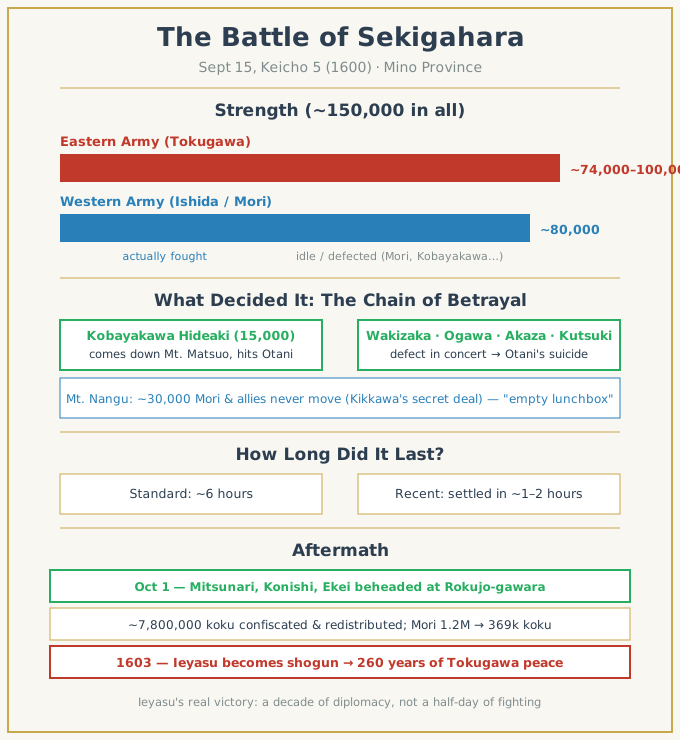
- After the death of Toyotomi Hideyoshi, the Eastern Army led by Tokugawa Ieyasu, pressing toward seizure of the realm, clashed at Sekigahara in Mino with the Western Army of Ishida Mitsunari, Mōri Terumoto, and others, who sought to protect the Toyotomi regime.
- A great host of some 150,000 from east and west faced off, but in a mere half-day the Eastern Army won an overwhelming victory. The betrayal of Kobayakawa Hideaki and others decided the outcome.
- It became the “realm-deciding battle” that established Ieyasu’s hegemony and led, less than three years later, to the founding of the Edo shogunate.
The Mainstream View ― The Standard Account Found in Textbooks
Why the Battle Happened
In the 8th month of Keichō 3 (1598), Toyotomi Hideyoshi died at Fushimi Castle. Anticipating the situation in which his heir Toyotomi Hideyori was only six years old, Hideyoshi had arranged a system of joint rule by the Five Elders ― Tokugawa Ieyasu, Mōri Terumoto, Uesugi Kagekatsu, Maeda Toshiie, and Ukita Hideie ― and the Five Commissioners ― Asano Nagamasa, Maeda Gen’i, Ishida Mitsunari, Mashita Nagamori, and Natsuka Masaie. But this system of joint rule was fragile from the start, and in particular Ieyasu, the chief of the Five Elders, had moved early toward acting on his own, advancing private marriages among daimyō against Hideyoshi’s dying instructions.
In the intercalary 3rd month of Keichō 4 (1599), Maeda Toshiie, who had served as mediator between the civil-administration faction and the military faction, died of illness. The next day, the “incident of the seven generals” (the assault by the seven military-faction generals ― Katō Kiyomasa, Fukushima Masanori, Kuroda Nagamasa, and others) broke out, and Mitsunari withdrew from government and confined himself to his home castle of Sawayama. The civil-administration faction of the Toyotomi regime effectively collapsed, and Ieyasu entered Fushimi Castle and became “the lord of the realm.” Ieyasu then moved his residence to the western enceinte of Osaka Castle and came to manage the government single-handedly.
In the 6th month of Keichō 5 (1600), Ieyasu demanded that Uesugi Kagekatsu of Aizu come up to the capital, but Kagekatsu’s chief retainer Naoe Kanetsugu rejected him in a reply known as the “Naoe Letter.” Ieyasu judged this to be “rebellion,” decided on a campaign against Aizu, and went east at the head of a great army himself. Seizing this chance while Ieyasu was away from the Kinki, Mitsunari decided to raise an army together with Ōtani Yoshitsugu and others. On the 17th of the 7th month, they welcomed Mōri Terumoto into Osaka Castle as supreme commander of the Western Army, and issued the “Articles of the Inner Minister’s Transgressions” (Naifu-chigai no Jōjō) under the joint signatures of three of the Five Commissioners (Mashita Nagamori, Natsuka Masaie, Maeda Gen’i) and three Elders (Mōri Terumoto, Ukita Hideie, Maeda Toshinaga). It enumerated Ieyasu’s offenses and declared the legitimacy of the Western Army.
Thus began the all-out confrontation between Ieyasu (the Eastern Army) and the core of the Toyotomi regime (the Western Army).
The Course of the Battle
Immediately after raising its army, the Western Army first subdued the Ieyasu strongholds in the Kinki. In the attack on Fushimi Castle from the 19th of the 7th month, a great host under Ukita Hideie and Kobayakawa Hideaki assaulted a garrison of only 1,800 under Ieyasu’s retainer Torii Mototada, and the castle fell on the 1st of the 8th month. Torii Mototada died fighting. In parallel, the Western Army captured Tanabe Castle in Tango, Anotsu Castle in Ise, and others, nearly completing its control of the Kinki.
Meanwhile, on the 25th of the 7th month, Ieyasu received word of the Western Army’s mobilization at Oyama in Shimotsuke Province and is said to have held a war council (the Oyama council; its existence is debated in the theories below). It is the scene in which the Toyotomi-beholden generals such as Fukushima Masanori are said to have pledged loyalty to Ieyasu. Ieyasu had the Eastern Army advance westward by the Tōkaidō, while he himself returned to Edo Castle to assess the situation. In late the 8th month, the Eastern Army’s vanguard ― Fukushima Masanori, Ikeda Terumasa, and others ― advanced into Mino and captured Gifu Castle (defended by Oda Hidenobu) in a single day. On the 1st of the 9th month, Ieyasu set out from Edo at the head of 30,000 main troops. Sensing Ieyasu’s movement, the Western Army ― Mitsunari, Ukita Hideie, Shimazu Yoshihiro, and others ― gathered at Ōgaki Castle and prepared to meet the Eastern Army.
On the 14th of the 9th month, Ieyasu arrived at Akasaka in Mino. He is said to have set up his headquarters so close that his golden-fan standard could be seen even from Ōgaki Castle. The Western Army’s sense of crisis deepened, and at midnight it left Ōgaki Castle and moved to Sekigahara. By one account it was a move made in the belief of a rumor that “the Eastern Army would pass by Ōgaki Castle and head toward Sawayama and Osaka,” but it is also said that Ieyasu himself spread such false information to lure the Western Army out. On the same day, Mōri Terumoto, through negotiations conducted via Kuroda Nagamasa and Fukushima Masanori, had secretly made peace with Ieyasu on the condition that his home domains be guaranteed.
→ For details, see the warlord article “Ishida Mitsunari.”
Early on the 15th of the 9th month, Sekigahara was wrapped in deep fog. The Western Army deployed Ishida Mitsunari on Mount Sasao in the north, Shimazu Yoshihiro and Konishi Yukinaga to its south, Ukita Hideie further south, Kobayakawa Hideaki on Mount Matsuo to the southwest, and Mōri Hidemoto, Kikkawa Hiroie, Natsuka Masaie, Ankokuji Ekei, and Chōsokabe Morichika on Mount Nangū to the east. The Eastern Army deployed Ieyasu’s headquarters on Mount Momokubari in the east, with Fukushima Masanori, Kuroda Nagamasa, Hosokawa Tadaoki, Ii Naomasa, Matsudaira Tadayoshi, and others spread out to the west. On the deployment map, the Western Army appeared to be in the advantageous form of encircling the Eastern Army from three directions ― north, west, and south.
Around eight in the morning, the moment the fog lifted, the units of Ii Naomasa and Matsudaira Tadayoshi broke ranks ahead of the others and fired on the Ukita unit, opening the fighting. Fukushima Masanori, Kuroda Nagamasa, Hosokawa Tadaoki, and others attacked the Ishida, Ukita, and Konishi units, and fierce hand-to-hand fighting began in many places. Ishida Mitsunari fired great cannon from Mount Sasao to check the Eastern Army, and Shima Sakon (Kiyooki) led 500 men in a charge into the Kuroda and Hosokawa units, fighting valiantly.
The battle ebbed and flowed, but from around eleven in the morning to noon, the event that decided the outcome occurred. Kobayakawa Hideaki (15,000), deployed on Mount Matsuo, suddenly came down the mountain and fell upon the Western Army’s Ōtani Yoshitsugu unit. In fact Hideaki had been in secret communication with Ieyasu beforehand and was set to betray the Western Army. Irritated by the slowness of Hideaki’s movement, Ieyasu is said to have fired warning shots toward Mount Matsuo (the “inquiring muskets,” toi-deppō). Startled by this, Hideaki at last moved.
In concert with Kobayakawa’s betrayal, Wakizaka Yasuharu, Ogawa Suketada, Akaza Naoyasu, and Kutsuki Mototsuna, deployed nearby, also defected to the Eastern Army and attacked the Ōtani unit from the rear. Ōtani Yoshitsugu fought hard but, outnumbered, took his own life. Next, the adjacent Ukita, Ishida, and Konishi units all broke completely. On Mount Nangū, Mōri Hidemoto, Kikkawa Hiroie, and others did not move a single soldier and looked on at the battle, because Hiroie was in secret communication with Ieyasu (known by the anecdote of “the Counselor’s empty lunchbox,” saishō-dono no kara-bentō).
By around noon the complete collapse of the Western Army became decisive, and the fighting effectively ended. Mitsunari fled toward Mount Ibuki, and Ukita Hideie and Konishi Yukinaga also left the field. The unit of Shimazu Yoshihiro, its line of retreat cut off, charged the very front of the Eastern Army with only 1,500 men, broke through the field while gravely wounding Ii Naomasa and Matsudaira Tadayoshi (the “Shimazu retreat,” Shimazu no nokiguchi).
The main Battle of Sekigahara ended in an overwhelming Eastern victory in a mere half-day (about four to six hours). Though called the “realm-deciding battle,” the outcome came all too quickly.
The Aftermath of the Battle
After the Battle of Sekigahara, the Eastern Army moved to subdue the Western Army’s remnants. On the 17th of the 9th month, Mitsunari’s home castle of Sawayama fell under Eastern attack. Mitsunari’s father Masatsugu, his elder brother Masazumi, his principal wife Kōgetsuin, and others took their own lives. On the same day, Mōri Motoyasu withdrew from Ōtsu Castle, and internal strife also broke out within Ōgaki Castle, which fell. The Western Army lost its capacity for organized resistance.
Around the 21st of the 9th month, Mitsunari was captured at Furuhashi village in Ika district, in the Mount Ibuki range, by the pursuers of Tanaka Yoshimasa. Ukita Hideie fled to Satsuma, and Konishi Yukinaga too was captured. On the 1st of the 10th month, Mitsunari, Konishi Yukinaga, and Ankokuji Ekei were paraded through Osaka and Sakai and then beheaded at Rokujō-gawara in Kyoto. Mitsunari was forty-one.
On the 25th of the 9th month, after peace negotiations with Ieyasu, Mōri Terumoto withdrew from Osaka Castle. But Ieyasu produced letters showing that Terumoto had acted actively as supreme commander of the Western Army, reneged on the promise of “domain guarantee,” and carried out a great reduction of his fief. The Mōri were slashed from 1,200,000 koku to 369,000 koku across the two provinces of Suō and Nagato (the Bōchō reduction). Uesugi Kagekatsu too was reduced from 1,200,000 koku at Aizu to 300,000 koku at Yonezawa, and Satake Yoshinobu was reduced and transferred from 540,000 koku in Hitachi to 200,000 koku in Akita.
In the distribution of rewards, Ieyasu allotted the confiscated domains of about 7,800,000 koku among the Eastern generals, and increased his own direct holdings from 2,500,000 to 4,000,000 koku. Kuroda Nagamasa gained Chikuzen at 520,000 koku, Fukushima Masanori gained Aki Hiroshima at 498,000 koku, and Katō Kiyomasa gained Higo Kumamoto at 520,000 koku ― the Eastern generals were almost all given increases.
In the 2nd month of Keichō 8 (1603), Ieyasu was appointed shogun by the court and opened the Edo shogunate. In less than three years from the Battle of Sekigahara, Ieyasu became ruler of the realm in name and in fact. Toyotomi Hideyori was demoted to a single daimyō of 650,000 koku across the three provinces of Settsu, Kawachi, and Izumi, and would be destroyed fifteen years later in the Siege of Osaka.
Multiple Theories ― Exploring the Possibilities from Various Angles
[Theory 1] Did the Oyama Council Happen?
On the 25th of the 7th month of Keichō 5 (1600), Ieyasu is said to have held a war council at Oyama in Shimotsuke Province (present-day Oyama, Tochigi Prefecture), to have asked the Toyotomi-beholden generals such as Fukushima Masanori about their allegiance, and to have had them pledge loyalty to Ieyasu ― the “Oyama council,” reckoned the very first scene of the Battle of Sekigahara. It has been depicted in many historical novels and dramas, beginning with Shiba Ryōtarō’s novel Sekigahara.
The view that the Oyama council existed (the standard view): Edo-period compilations such as the Sekigahara Shimatsuki and the Keichō Nenchū Bokusaiki record that, at the Oyama council, Ieyasu asked Fukushima Masanori, Kuroda Nagamasa, and others about their allegiance, and because Masanori was first to pledge loyalty to Ieyasu, the other generals followed. The Tokugawa shogunate’s official record, the Tokugawa Jikki, also adopts this account, and it was long considered the standard view.
The view that there was no Oyama council (a new theory): Against this, Shiramine Jun, in papers from 2012 onward, cast doubt on the very existence of the Oyama council. There is no direct description in primary sources that “a war council was held at Oyama on the 25th of the 7th month,” and including such matters as the date Ieyasu returned to Edo, the possibility of a later invention is high. Honda Takashige showed a similar view, and it became a controversy among researchers.
Against this, Kasaya Kazuhiko fully rebutted it in Disputing the Battle of Sekigahara (Shinchō Sensho, 2022). He argues that contemporary letters also contain descriptions suggesting an “Oyama council,” and that the council itself existed. At present the debate continues among researchers, and no conclusion has been reached.
In any case, it is certain that the time and place at which Ieyasu made the decision to send the Eastern Army westward was an important branch point that decided the flow of the Battle of Sekigahara. Whether it was the dramatic scene of the “Oyama council” or a more modest accumulation of decision-making has become a homework problem given to today’s researchers.
[Theory 2] Is the Naoe Letter Genuine or a Forgery?
The “Naoe Letter,” said to be the trigger of the Battle of Sekigahara, is a document in which, against Ieyasu’s demand that Uesugi Kagekatsu come up to the capital, the chief retainer Naoe Kanetsugu sent a reply of rejection. The long letter, full of biting sarcasm and provocation, is said to have enraged Ieyasu and led him to decide on the campaign against Aizu. The “theory of prior collusion between Mitsunari and Kanetsugu” ― that the two conspired in advance to draw out Ieyasu’s campaign ― also derives from this.
The forgery theory: In recent research, only Edo-period copies of the Naoe Letter survive, and there is no original. Honda Takashige and Shiramine Jun point out that some of the vocabulary and phrasing in the text does not match that of the Keichō 5 period, and that there is a high possibility of later additions and alterations. The common view among researchers is that, at the least, the “Naoe Letter” as transmitted today cannot be treated as historical fact as it stands.
The genuine theory (Kasaya Kazuhiko and others): Against this, Kasaya Kazuhiko argues in Disputing the Battle of Sekigahara that the main part of the Naoe Letter is genuine. Content similar to the Naoe Letter is also referred to in contemporary letters and records, so it is not a complete forgery. Even Kasaya, however, acknowledges that the surviving document itself contains later additions.
A reconsideration of the prior-collusion theory: Relatedly, the “prior-collusion theory” ― that Mitsunari and Kanetsugu conspired in advance to lure Ieyasu out to Aizu and that the Western Army raised its army in that opening ― is now also predominantly viewed negatively. As far as analysis of Mitsunari’s letters after raising his army goes, it can be read that Mitsunari hastily decided to raise his army, treating Ieyasu’s going east as “an unexpected opportunity.” Together with the forgery theory of the Naoe Letter, it is highly likely that the drama of the outbreak of Sekigahara was not as orderly a script as has conventionally been told.
[Theory 3] Was the True Ringleader of the Western Army Mitsunari, or Mōri Terumoto?
The Battle of Sekigahara is usually told in the framework of “Tokugawa Ieyasu vs. Ishida Mitsunari.” But in recent research, the view that “the ringleader of the Western Army was not Mitsunari but Mōri Terumoto” has gained strength.
The Mitsunari-ringleader theory (the standard view): Throughout the Edo period, the Battle of Sekigahara was told in the framework of “Ieyasu vs. Mitsunari.” Mitsunari is said to have plotted the overthrow of Ieyasu and raised Mōri Terumoto up as supreme commander of the Western Army. After the war, Terumoto sought to obtain a domain guarantee by explaining that “I was merely raised up by Mitsunari and Ekei,” and because Ieyasu outwardly accepted this, the image of “Terumoto the unwilling supreme commander, Mitsunari the true ringleader” became fixed.
The Mōri-Terumoto-led theory (Mitsunari Junji, Mizuno Goki, and others): Against this, recent research has reappraised Terumoto’s activeness. Mitsunari Junji, in The Eve of Sekigahara: The War of the Western Daimyō (NHK Books, 2009), and Andō Yūichirō argue that Terumoto was the true leader of the Western Army. Terumoto entered the western enceinte of Osaka Castle within just a few days of responding to Mitsunari’s call to arms. This speed would have been quite impossible without advance preparation, suggesting that there had been a careful prior plan among Terumoto, Mitsunari, Ōtani Yoshitsugu, and Ankokuji Ekei.
Furthermore, the “Articles of the Inner Minister’s Transgressions” was issued not by Mitsunari as an individual but under the joint signatures of three Elders (Mōri Terumoto, Ukita Hideie, Maeda Toshinaga) and three Commissioners (Mashita Nagamori, Natsuka Masaie, Maeda Gen’i). Mitsunari had been removed from the Five Commissioners, and at the time the document was issued it was Terumoto and the others who led the “official Western Army.” Terumoto acted actively even during the main Battle of Sekigahara, sending letters to many daimyō urging them to join the Western Army, and dispatching the Mōri army to Shikoku and Kyushu to expand his power.
On the 15th of the 7th month of Keichō 5, Shimazu Yoshihiro informed Uesugi Kagekatsu by letter that “Terumoto and Hideie, together with the Osaka Elders (Natsuka Masaie, Mashita Nagamori, Maeda Gen’i), Ōtani Yoshitsugu, and Ishida Mitsunari, have conferred and wish to act in concert with Kagekatsu for the sake of Hideyori” (the Sappan Kyūki Zatsuroku Kyūhen). The overthrow of Ieyasu was not the ambition of Mitsunari as an individual but a collective decision of the core of the Toyotomi regime.
Then why did history come to remember Mitsunari as the “ringleader”? One reason is the postwar settlement. Terumoto, through Kikkawa Hiroie’s prior inside-collusion maneuvering, was promised a domain guarantee and withdrew from Osaka Castle (the house survived, though it was later greatly reduced), while Mitsunari was executed and bore the stigma of the loser on his own. The “Mitsunari-ringleader theory” was a story convenient for the victorious Tokugawa shogunate ― a political fiction that made Mōri Terumoto’s active involvement “as if it had never happened.”
→ For details, see the warlord articles “Mōri Terumoto” and “Ishida Mitsunari.”
[Theory 4] When Was Kobayakawa Hideaki’s Betrayal? ― The Truth of the “Inquiring Muskets”
The single greatest factor that decided the outcome of the Battle of Sekigahara is cited as Kobayakawa Hideaki’s (15,000) betrayal from Mount Matsuo. By the standard view, around noon when the battle was deadlocked, Ieyasu was irritated by the slowness of Hideaki’s movement and fired warning shots toward Mount Matsuo (the “inquiring muskets”), so that Hideaki, startled, came down the mountain and made a sudden attack on the Ōtani Yoshitsugu unit.
The “inquiring muskets existed” view (the standard view): Edo-period compilations such as the Sekigahara Gunki Taisei and the Kuroda Kafu depict the scene of Ieyasu’s warning shots. The dramatic script ― “Hideaki at first pretended to fight as part of the Western Army, but, showered by Ieyasu’s muskets, hastily defected to the Eastern Army” ― was long handed down as the standard view. Shiba Ryōtarō’s novel also adopts this view.
The “no inquiring muskets” view (Shiramine Jun and others): Against this, Shiramine Jun, in A New Interpretation: The Truth of the Battle of Sekigahara (Miyaobi Shuppansha, 2014), pointed out that the “inquiring muskets” is a later-Edo invention and does not appear at all in primary sources. The primary source “copy of the joint letter of Ishikawa Yasumichi and Hikosaka Motomasa” states that “when the fighting was joined, the four ― Kobayakawa Hideaki, Wakizaka Yasuharu, Ogawa Suketada, and Sukeshige ― took (Ieyasu’s) side and committed betrayal. For this reason the enemy became a defeated army.” That is, the possibility is high that Hideaki had taken part as part of the Eastern Army from the very opening of the battle.
Also, the annual report of Francisco Pasio (a Jesuit missionary) on the day of the battle contains a description that Hideaki acted as part of the Eastern Army from the opening. If these contemporary sources are given weight, the drama of “Ieyasu’s irritation → the inquiring muskets → Hideaki’s wavering → betrayal” was very likely a later invention.
Mizuno Goki shows a similar view, and at present an overwhelming majority of researchers in documentary history take the “no inquiring muskets” view. There is even an interpretation that Hideaki acted as part of the Eastern Army from early in the opening of the battle, and the outcome was decided in about an hour.
That said, Kasaya Kazuhiko takes the position of defending the existence of the inquiring muskets in Disputing the Battle of Sekigahara, and this point too is under dispute. Hideaki is said to have informed Ieyasu, through Asano Nagamasa, that he would defect from the Western Army even before the main battle began, and Okudaira Sadaharu and Ōkubo Inosuke had been dispatched from the Eastern Army as overseers. At the least, it is certain that Hideaki’s betrayal was not “a last-minute change of heart” but had been carefully planned in advance.
[Theory 5] Did the Battle End in Half a Day, or Was It Settled in One Hour?
By the conventional standard view, the main Battle of Sekigahara opened around eight in the morning; the Western Army broke with Kobayakawa’s betrayal around noon; and it ended around two in the afternoon. A fierce battle of about six hours is the textbook understanding.
The long-fierce-battle view (the standard view): The Sekigahara Gunki Taisei and The Military History of Japan: The Sekigahara Campaign (1893, the General Staff Office of the old Japanese Army) depict a fierce, ebbing-and-flowing battle over six hours. The story in which the Toyotomi-beholden generals waged a quagmire of a battle against one another and the outcome was finally settled by Kobayakawa’s betrayal is dramatic and easy to follow.
The short-settlement view (Shiramine Jun and others): Shiramine Jun and others point out that, if primary sources are given weight, the main Battle of Sekigahara may have been settled in a short time. Francisco Pasio’s annual report contains a description to the effect that “the fighting ended in about two hours,” and there is a view that Kobayakawa Hideaki attacked as part of the Eastern Army from the opening and that the Western Army crumbled in a mere one to two hours. The “six-hour fierce battle” is, on this view, an embellishment of the later Edo period.
The historian Naishi Masahiko and others advance a “deployment-revision theory” that reconsiders the very places where the two camps were deployed. It is also pointed out that Mitsunari’s headquarters may have been somewhere other than the Mount Sasao currently identified, and the battle scene of Sekigahara may differ greatly from what has conventionally been depicted.
At present, owing to the scarcity of primary sources, no complete conclusion has been reached, but the view that “Sekigahara ended in a short time” is gathering support among researchers. At the least, the story depicted by the Tokugawa shogunate’s official history ― that “Ieyasu won a come-from-behind victory after a hard fight” ― was very likely a political performance to emphasize Ieyasu’s great achievement.
[Theory 6] Was Kobayakawa Hideaki a “Cowardly Traitor”? ― A Movement Toward Reappraisal
Kobayakawa Hideaki died suddenly two years after the Battle of Sekigahara, in Keichō 7 (1602), at the young age of 21. In Edo-period compilations, Hideaki was thoroughly disparaged as a “traitor,” and anecdotes were created that “he drowned himself in drink and lust and died mad,” and that “on the verge of death he was tormented by the ghost of the Ōtani Yoshitsugu he had killed.” The image of “Kobayakawa Hideaki = the irresolute traitor” was formed by such later embellishment.
The “incompetent traitor” view (the standard view): The Sekigahara Shimatsuki and the Keichō Gunki depict an image of a “coward” who attacked Fushimi Castle as part of the Western Army and yet betrayed at the last moment at Sekigahara. That he did not readily appear even when summoned by Ieyasu, and was late to the celebratory banquet after the war, is also said to be “because he was ashamed of his betrayal.”
The “rational strategist” view (reappraisal): In recent research there is a movement to reconsider Hideaki’s actions. Hideaki was a nephew of Toyotomi Hideyoshi’s principal wife, Kitanomandokoro (Nene), and until Hideyori was born he was the number-two candidate to succeed the Toyotomi house. After Hideyori’s birth, Hideaki was sent out as an adopted heir to the Kobayakawa house and placed in a complex position. For Hideaki, drawing close to Ieyasu was a rational choice for survival.
Hideaki was in secret communication with Ieyasu even before the main battle, and very likely acted as part of the Eastern Army from the opening. This was not a “last-minute betrayal” but “a strategic decision calculated in advance.” Indeed, Hideaki was given Okayama at 570,000 koku after the war, and Ieyasu’s regard for him was high.
As for why Hideaki died young, there are various theories ― a liver disease from excessive drinking, mental disorder from stress, and so on ― but the occult interpretation of “the curse of the betrayal” is no more than an Edo-period popular legend. With Hideaki’s death, the Kobayakawa house ended without an heir.
Reconsideration is also advancing in recent years regarding Kitanomandokoro’s stance at Sekigahara. It was long the standard view that “Kitanomandokoro = pro-Eastern, Yodo-dono = pro-Western,” but recent research increasingly holds that Kitanomandokoro acted in a position close to the Western Army. It is also said that it was Kitanomandokoro’s wish that Hideaki was sent to the Western Army. If so, Hideaki’s action at Sekigahara was an independent act against the wishes of his adoptive mother Kitanomandokoro. The weight of the young Hideaki’s decision may have been more complex than the story handed down to the present.
Viewed Strategically
Surveying the Battle of Sekigahara strategically, it emerges that rather than the military fighting itself, it was the “diplomatic maneuvering” before the battle and the “political performance” after it that were Ieyasu’s true causes of victory.
First, Ieyasu’s thoroughgoing diplomatic maneuvering. Long before the main battle, Ieyasu had been working inside-collusion schemes against the Western generals. He carried out advance inside-collusion ― with Kobayakawa Hideaki through Kuroda Nagamasa and Asano Nagamasa, with Kikkawa Hiroie through Kuroda Nagamasa, and with Wakizaka Yasuharu through Tōdō Takatora. By the stage of the main battle, the six generals ― Kobayakawa, Kikkawa, Wakizaka, Ogawa, Akaza, and Kutsuki ― had already promised to act as part of the Eastern Army. The Western Army’s numerical advantage had already substantially collapsed by the time the battle opened.
Ieyasu’s diplomatic skill reached even inside the Mōri house. After the Kyushu campaign, with the deaths of Kikkawa Motoharu and Kobayakawa Takakage, the powerful men within the Mōri house had split into two factions ― the political monk Ankokuji Ekei and Kikkawa Hiroie. Ekei was close to Hideyoshi and Mitsunari, while Hiroie kept his distance from Hideyoshi. The Ieyasu sympathizer Kuroda Nagamasa won Hiroie over and persuaded him many times that, for the future of the Mōri house, Terumoto should side with Ieyasu. By this, on the 14th of the 9th month, the eve of Sekigahara, Terumoto had secretly made peace with Ieyasu on the condition of a home-domain guarantee. Hidemoto and Ekei were not told of this, and the Mōri forces on Mount Nangū could not move a single soldier owing to Hiroie’s obstruction.
Second, the power to mobilize the Eastern generals. Under the pretext of the campaign against Aizu, Ieyasu gathered the daimyō of the Kantō and diverted that army directly to the suppression of the Western Army. Whether the Aizu campaign was from the start a “trap” to draw out the Western Army’s mobilization, or was in earnest, is debated, but in result Ieyasu was able to commit an unscathed main army to Sekigahara. That he could move the Toyotomi-beholden generals ― Fukushima Masanori, Ikeda Terumasa, Kuroda Nagamasa, Hosokawa Tadaoki, and others ― as part of the Eastern Army is also proof of Ieyasu’s negotiating power.
Third, the hard fighting of the Eastern generals in the battle. Fukushima Masanori’s frontal charge into the Ukita unit, Kuroda Nagamasa and Hosokawa Tadaoki’s attack on the Ishida unit, Ii Naomasa and Matsudaira Tadayoshi’s breaking of ranks, and Honda Tadakatsu‘s handling of troops ― the Eastern generals splendidly fulfilled their roles in actual combat too. The Western Army, on the other hand, had to fight in a state where it had lost 30 to 40 percent of its real combat strength owing to the Mōri and Kikkawa standing idle and the betrayal of Kobayakawa and others. With this, however great its terrain advantage, it could not possibly have won.
Fourth, the political performance in the postwar settlement. After the war, Ieyasu, while reneging on the promise of a “domain guarantee” with Terumoto, nonetheless spared him outright attainder and left a path for the survival of the Mōri house. By this, the Mōri survived through the Edo period as the Chōshū domain. Likewise, toward the Shimazu, Ieyasu gave up subjugation and moved to negotiation, settling with a domain guarantee. Ieyasu’s skillful use of “carrot and stick” smoothed the transition to the postwar shogunal order.
The cause of the Western Army’s defeat, on the other hand, is often attributed to the strategic naivety of Mōri Terumoto’s judgment. Terumoto, though supreme commander of the Western Army, did not leave Osaka Castle and did not take part in the main Battle of Sekigahara. Several reasons are cited ― “to protect Hideyori,” “because he was persuaded by Kikkawa Hiroie,” and so on ― but in result the Western Army became “an army without a lord.” There is praise and blame regarding Mitsunari’s strategic ability, but at the least the ones who effectively commanded the Western Army that made it to the main battle were the four ― Mitsunari, Ukita, Shimazu, and Ōtani ― and despite their hard fighting, it was inevitable that an army lacking a political pillar could not win.
The Battle of Sekigahara is called “realm-deciding,” but its reality was the final reckoning of the political and diplomatic superiority that Ieyasu had built up over more than ten years. Behind the fighting that was settled in half a day lay the careful process of Ieyasu’s seizure of power over the two years since Hideyoshi’s death.
Famous Words from This Battle
“The Articles of the Inner Minister’s Transgressions” (Naifu-chigai no Jōjō)
The declaration of war issued by the Western Army on the 17th of the 7th month of Keichō 5 (1600), enumerating thirteen articles of the offenses of Ieyasu (the “Inner Minister,” naifu = Inner Grand Minister). It specifically accuses Ieyasu’s tyranny ― “violation of Lord Hideyoshi’s dying instructions,” “private marriages with various daimyō,” “treating Fushimi Castle as private property,” and so on. Issued under the joint signatures of the three Elders (Mōri Terumoto, Ukita Hideie, Maeda Toshinaga) and the three Commissioners (Mashita Nagamori, Natsuka Masaie, Maeda Gen’i), it is the document by which the Western Army declared that it fought as “the regular army of the Toyotomi regime.” Its importance is that it was issued under the joint names of the core of the Toyotomi regime, not by Mitsunari as an individual, and it has been given weight in recent years as a primary source for understanding the essence of the Battle of Sekigahara.
― Source: “The Articles of the Inner Minister’s Transgressions” (Documents of Various Houses)
“There are two things too good for Jibu (Mitsunari): Shima Sakon, and the castle of Sawayama.”
A satirical street verse of the time. It means that there are two things excessive (too fine) for Mitsunari ― his retainer Shima Sakon and his home castle of Sawayama. At Sekigahara, Shima Sakon led 500 men in a charge into the Kuroda and Hosokawa units and is said in the Jōzan Kidan to have made the Tokugawa side fear him so that “truly their hair stood on end and the sweat poured out.” In the early Edo period, when old warriors who had served at Sekigahara talked together at Fukuoka Castle about Sakon’s attire, their memories differed down to his banner, surcoat, and armor, and the reason was said to be that “their memories had grown vague from sheer terror.”
― Source: Jōzan Kidan
“The kindness of being raised up by His Highness the Taikō ― in what world could I ever forget it?”
Words said to have been spoken by Ōtani Yoshitsugu to Mitsunari. They mean, “The kindness of being raised up by His Highness the Taikō Hideyoshi ― in no world could I forget it.” On the eve of Sekigahara, Ōtani Yoshitsugu warned his close friend Mitsunari that “even if we fight Ieyasu, the prospect of victory is slim,” but in the end he made up his mind to share Mitsunari’s fate for the reason of “loyalty to the Taikō.” When Yoshitsugu sensed Kobayakawa Hideaki’s betrayal in the main battle, he fought hard and then had his retainer Yuasa Gosuke behead him and took his own life.
― Source: Sekigahara Gunki Taisei and others
“One who cherishes a great cause keeps his life precious to the very moment his head is struck off, ever thinking to accomplish his true purpose.”
Said to be the words Mitsunari threw at a mocking soldier just before his execution, when he refused a dried persimmon offered by a guard, saying “it is bad for the phlegm.” It means, “One who holds a great aspiration keeps his life precious to the very moment his head is struck off, ever thinking to fulfill his cherished purpose.” The source is an Edo-period compilation and its historicity cannot be confirmed, but it has been handed down to the present as a famous saying symbolizing the indomitable spirit of Mitsunari, who never gave up to the end even in defeat.
― Source: Meishō Genkōroku, vol. 36
“The Counselor’s empty lunchbox” (saishō-dono no kara-bentō)
An anecdote that Mōri Hidemoto (the “Counselor,” saishō = Consultant), deployed on Mount Nangū, answered Natsuka Masaie’s request to take the field by saying “I am just now in the midst of my lunch,” refusing to advance. In reality it was because Kikkawa Hiroie was in secret communication with the Eastern Army and held down the movement of the Mōri forces, but in later ages it spread as words mocking “a supreme commander with no will to fight.” During the main battle, the roughly 30,000 Mōri forces on Mount Nangū did not move a single soldier, and this became a decisive factor in the Western Army’s defeat.
― Source: Sekigahara Gunki Taisei and others
Anecdotes and Episodes
The Bond Between Ōtani Yoshitsugu and Mitsunari ― The “Bowl of Pus” and Sekigahara
There is a famous anecdote that, at a tea gathering hosted by Toyotomi Hideyoshi, pus dropped from the face of Ōtani Yoshitsugu, who suffered from Hansen’s disease, and fell into the tea bowl. While the other participants would not take the bowl, Mitsunari said “I am thirsty,” took the bowl, and calmly drained it. Moved by this kindness, Yoshitsugu is said to have resolved, “I will follow this man.”
On the eve of Sekigahara, Yoshitsugu warned Mitsunari that “the prospect of victory in a war against Ieyasu is slim; give up raising an army,” but on learning that Mitsunari’s resolve was firm, he vowed to share his fate. In the main battle he accurately predicted Kobayakawa Hideaki’s betrayal and had stationed 5,000 elite troops against Kobayakawa. But because the four ― Wakizaka, Ogawa, Akaza, and Kutsuki ― who sided with Hideaki also all defected at once, he was outnumbered and, after fighting hard, took his own life. There also remains an anecdote that he had his retainer Yuasa Gosuke bury his face, ravaged by illness, so as not to let it be seen.
― Source: Jōzan Kidan, Sekigahara Gunki Taisei, and others
→ For details, see the warlord article “Ōtani Yoshitsugu.”
The End of Shima Sakon ― The Hard Fighting of “Demon Sakon”
Mitsunari’s right-hand man Shima Sakon (Kiyooki) led 500 men in a charge into the units of Kuroda Nagamasa and Hosokawa Tadaoki at the main Battle of Sekigahara and fought valiantly. In the early Edo period, when old warriors who had served at Sekigahara talked together at Fukuoka Castle about Sakon’s attire, their memories differed down to his banner, surcoat, and armor, and the reason was said to be that “their memories had grown vague from sheer terror” (the Jōzan Kidan).
There are various theories about Sakon’s end ― that he died in battle at Sekigahara, that he fled into the Mount Ibuki range and then vanished, that he fled to Ryūhon-ji in Kyoto and took the tonsure, and so on. There are also several things said to be his grave, and the legend of Sakon has been handed down to the present as one of the foremost mysteries in Sengoku history.
― Source: Jōzan Kidan, Kuroda Kafu
→ For details, see the warlord article “Shima Sakon.”
The Shimazu Retreat ― The Most Harrowing Breakthrough in Sengoku History
Just past noon, when the Western Army’s complete collapse was settled, the unit of Shimazu Yoshihiro (1,500) of Satsuma had its line of retreat cut off. Yoshihiro made the astonishing decision not to retreat in the usual way but to charge toward the very front of the Eastern Army ― toward the direction of Ieyasu’s headquarters. This tactic, called “breaking through the enemy center,” placed Yoshihiro’s nephew Shimazu Toyohisa and others as a “sutegamari” (a tactic of leaving men behind in a death-place to hold off pursuers) and got the main body out.
The Shimazu force, while under pursuit by the Tokugawa side, ran past the flank of Ieyasu’s headquarters and broke through to the south. Ii Naomasa and Matsudaira Tadayoshi pursued the Shimazu force but were wounded by gunfire. Toyohisa died fighting, and in the end only about 80 men are said to have been able to return to Satsuma. Yoshihiro himself miraculously made it back alive to Satsuma and, after postwar negotiations, protected his territory. The “Shimazu retreat” has been handed down to the present as the most harrowing breakthrough of the enemy center in Sengoku history.
― Source: Sekigahara Gunki Taisei, Kanbe Kyūgorō Oboegaki, and others
Fukushima Masanori’s Frontal Charge ― The Anguish of a Toyotomi-Beholden General
The Eastern Army’s vanguard Fukushima Masanori, at the opening of the battle, shouted “I am Fukushima Masanori! Mitsunari, come out!” and charged head-on into the 17,000 of Ukita Hideie’s unit. Masanori waged a fierce battle that overturned a disparity of nearly three to one against the Ukita unit, and the fighting ebbed and flowed. In the end, when the Ukita unit broke with Kobayakawa’s betrayal, Masanori’s unit won a decisive victory.
Masanori was a cousin of Toyotomi Hideyoshi and a typical Toyotomi-beholden general. That he nonetheless sided with the Eastern Army was chiefly due to his personal hatred of Mitsunari. The friction during the Korean campaigns and the incident of the seven generals’ assault made his conflict with Mitsunari decisive. After the war, Masanori was given Aki Hiroshima at 498,000 koku, but was later disliked by Ieyasu and Hidetada and attainted. It is told as “the ironic end of a Toyotomi-beholden general who cooperated with the Ieyasu who toppled the Toyotomi.”
― Source: Sekigahara Gunki Taisei, Kuroda Kafu
→ For details, see the warlord article “Fukushima Masanori.”
Mōri Terumoto’s “Last-Minute Defection”
On the 14th of the 9th month, the day before the main Battle of Sekigahara, Mōri Terumoto, the supreme commander of the Western Army, had secretly made peace with Tokugawa Ieyasu. The mediators were Kuroda Nagamasa and Fukushima Masanori, and the condition was “a guarantee of the Mōri home domains.” Meanwhile, Terumoto’s cousin Kikkawa Hiroie was deployed on Mount Nangū, but he had not told Mōri Hidemoto, Ankokuji Ekei, Chōsokabe Morichika, and the others about Terumoto’s peace.
On the day of the battle, Mōri Hidemoto tried again and again to take the field, but each time Hiroie obstructed him, saying “I am just now in the midst of my lunch” (the “Counselor’s empty lunchbox”). The roughly 30,000 Mōri forces on Mount Nangū ― Hidemoto, Ekei, and Chōsokabe ― saw out the end of the fighting without moving a single soldier. For Mitsunari, there was no betrayal greater than this. After the war, Ieyasu reneged on the promise of a home-domain guarantee and greatly reduced the Mōri from 1,200,000 koku to 369,000 koku. Through Hiroie’s desperate pleading they were spared outright attainder, and the Mōri survived through the Edo period as the Chōshū domain.
― Source: Sekigahara Gunki Taisei, Mōri-ke Monjo
→ For details, see the warlord article “Mōri Terumoto.”
The “Chain of Betrayals” That Occurred at Sekigahara
It was not Kobayakawa Hideaki alone who defected to the Eastern Army at the Battle of Sekigahara. At the same time as Hideaki came down from Mount Matsuo, the four generals deployed nearby ― Wakizaka Yasuharu, Ogawa Suketada, Akaza Naoyasu, and Kutsuki Mototsuna ― all at once fell upon the Ōtani unit. They had been in secret communication with Ieyasu beforehand through Tōdō Takatora, and began their action at the signal of Hideaki’s move.
After the war, the treatment of these “inside-collusion daimyō” diverged. Wakizaka Yasuharu had his domain guaranteed; Ogawa Suketada was attainted; Akaza Naoyasu was guaranteed his domain but then fell into ruin; and Kutsuki Mototsuna had his fief reduced to 9,000 koku and barely carried on. Ieyasu finely adjusted his treatment by assessing the degree of each one’s contribution to the inside-collusion and whether or not that daimyō posed a future threat. One can see Ieyasu’s cold-blooded political judgment ― that being a “traitor” did not mean uniform favorable treatment.
― Source: Sekigahara Gunki Taisei, Kansei Chōshū Shokafu
The All-Too-Early Death of Kobayakawa Hideaki
The year after Sekigahara, in Keichō 6 (1601), Ieyasu gave Kobayakawa Hideaki Okayama at 570,000 koku. But Hideaki, while governing his domain, struggled to control his retainers and is said to have spent his days drowning in drink. In the 10th month of Keichō 7 (1602), Hideaki died suddenly at Okayama Castle, at the young age of 21.
As for the cause of death, there are various theories ― a liver disease from excessive drinking, mental illness from stress, and so on. Edo-period compilations transmit occult interpretations such as “the curse of the traitor” and “the ghost of the Ōtani Yoshitsugu he had killed appeared,” but these are later embellishments. Hideaki had no heir, and the Kobayakawa house ended. The Ikeda house was enfeoffed at Okayama. As an irony of history, the young “traitor” who made the greatest contribution to Ieyasu died young, having tasted almost none of the fruit of that victory.
― Source: Kansei Chōshū Shokafu, History of the Okayama Domain
Ieyasu Carefully Keeps Mitsunari’s Belongings ― A Complex Feeling Toward an Enemy Commander
After Mitsunari’s execution, Ieyasu is said to have carefully kept some of the belongings confiscated from Sawayama Castle. The tea utensils, books, and letters that Mitsunari had possessed were kept as treasures of the Tokugawa house for generations. This is interpreted not as contempt for the defeated Mitsunari but rather as “respect for an enemy commander who kept faith to the end with his lord Hideyoshi.”
There is also an anecdote that, in his later years, Ieyasu said to his successor Hidetada, “I should like to have a loyal retainer like Mitsunari” (the Ochiboshū). There is no confirmation in primary sources, but it is quite possible that Ieyasu held Mitsunari’s “loyalty” and “administrative ability” in high regard. Indeed, in the postwar distribution of rewards, daimyō close to Mitsunari (such as Satake Yoshinobu) had their domains partly reduced but were spared attainder and execution. Ieyasu was a realist who treated “enemy” and “loyal retainer” as distinct.
― Source: Ochiboshū and others
→ For details, see the warlord articles “Ishida Mitsunari” and “Tokugawa Ieyasu.”
Chronology of the Battle of Sekigahara
| Time | Event |
|---|---|
| 8th month, Keichō 3 (1598) | Toyotomi Hideyoshi dies at Fushimi Castle. The Five Elders / Five Commissioners system starts up, but already shows signs of collapse owing to Ieyasu’s tyranny |
| Intercalary 3rd month, Keichō 4 (1599) | Maeda Toshiie dies. The next day, in the incident of the seven generals’ assault, Mitsunari falls from power and confines himself at Sawayama. Ieyasu enters Fushimi Castle and becomes “the lord of the realm” |
| 4th month, Keichō 5 (1600) | Ieyasu demands that Uesugi Kagekatsu come up to the capital. Naoe Kanetsugu’s reply, known as the “Naoe Letter” (possibly altered in later ages) |
| 6/16 | Ieyasu decides on the campaign against Aizu and sets out from Osaka |
| 7/17 | The “Articles of the Inner Minister’s Transgressions” is issued. Ieyasu is impeached under the joint signatures of the three Elders and three Commissioners. The Western Army formally raises its arms |
| 7/19 | Mōri Terumoto enters Osaka Castle as supreme commander of the Western Army. The same day, the attack on Fushimi Castle begins |
| 7/25 | Ieyasu holds a war council at Oyama in Shimotsuke Province. The “Oyama council” (its existence is debated) |
| 8/1 | Fushimi Castle falls. Torii Mototada and Ieyasu’s other retainers die fighting |
| 8/23 | The Eastern vanguard captures Gifu Castle in a single day (Oda Hidenobu surrenders) |
| 9/1 | Ieyasu sets out from Edo at the head of 30,000 main troops |
| 9/14 | Ieyasu arrives at Akasaka in Mino. The same day, Mōri Terumoto secretly makes peace with Ieyasu on the condition of a home-domain guarantee. At night the Western Army leaves Ōgaki Castle and moves to Sekigahara. At the Battle of the Kuise River, Shima Sakon defeats the Eastern Army |
| 9/15 early morning | The Eastern and Western armies face off at Sekigahara. Deep fog |
| 9/15, ~8 a.m. | The main Battle of Sekigahara opens. The fighting is opened by the breaking of ranks of Ii Naomasa and Matsudaira Tadayoshi |
| 9/15, ~noon | Kobayakawa Hideaki’s betrayal. The “inquiring muskets” (debated). Wakizaka, Ogawa, Akaza, and Kutsuki also defect; Ōtani Yoshitsugu takes his own life |
| 9/15, afternoon | The Western Army collapses. Mitsunari, Ukita, and Konishi flee toward Mount Ibuki. Shimazu Yoshihiro breaks through the enemy center to Satsuma. The main battle ends |
| 9/17 | Mitsunari’s home castle of Sawayama falls. His father Masatsugu, brother Masazumi, principal wife, and others take their own lives |
| ~9/21 | Mitsunari is captured at Furuhashi village in Ika district by Tanaka Yoshimasa |
| 9/25 | Mōri Terumoto withdraws from Osaka Castle (later the promise of a home-domain guarantee is reneged and he is greatly reduced) |
| 9/27 | Ieyasu enters Osaka Castle and “makes peace” with Toyotomi Hideyori |
| 10/1 | Ishida Mitsunari, Konishi Yukinaga, and Ankokuji Ekei are beheaded at Rokujō-gawara in Kyoto. Mitsunari, aged 41 |
| Keichō 5–6 | The distribution of rewards. About 7,800,000 koku are confiscated and redistributed. Ieyasu’s direct holdings go from 2,500,000 to 4,000,000 koku. The Mōri are reduced from 1,200,000 to 369,000 koku, the Uesugi from 1,200,000 to 300,000 koku |
| 2nd month, Keichō 8 (1603) | Ieyasu is appointed shogun and opens the Edo shogunate |
* Dates are given in the old (lunar) calendar. Row shading: yellow = major events; red = battle- or execution-related.
Key Figures of Both Armies
The Eastern Army (about 74,000–100,000)
| Role | Person | Outline |
|---|---|---|
| Supreme commander | Tokugawa Ieyasu | Aged 59. Chief of the Five Elders. Set up his headquarters on Mount Momokubari with 30,000 main troops, later moving to the front line |
| Vanguard | Fukushima Masanori | A Toyotomi-beholden general. Charged head-on into the Ukita Hideie unit, fighting fiercely |
| Vanguard | Kuroda Nagamasa | Son of Kuroda Kanbei. Led the attack on the Ishida unit and the inside-collusion work on Kobayakawa Hideaki and Kikkawa Hiroie |
| Tokugawa Four Generals | Ii Naomasa | The Tokugawa retainer of the “red armor.” Opened the fighting by breaking ranks with Matsudaira Tadayoshi. Wounded pursuing the Shimazu force |
| Tokugawa house | Matsudaira Tadayoshi | Ieyasu’s fourth son. Took the lead with Ii Naomasa. Slew Shimazu Toyohisa |
| Tokugawa Four Generals | Honda Tadakatsu | Served as a staff officer and close attendant to Ieyasu. Active more in strategy than in actual combat |
| Warlord | Hosokawa Tadaoki | Took part in the attack on the Ishida unit. His wife Gracia took her own life at Osaka, refusing to be taken hostage (just after the Western Army raised its arms) |
| Warlord | Katō Kiyomasa | Did not take part in the main Battle of Sekigahara; subdued the Western generals in Kyushu |
| Defector | Kobayakawa Hideaki | Aged 20. Deployed on Mount Matsuo and defected to the Eastern Army in the decisive battle. Given Okayama at 570,000 koku after the war, but died at 21 |
| Defectors | Wakizaka Yasuharu, Ogawa Suketada, Akaza Naoyasu, Kutsuki Mototsuna | Attacked the Ōtani unit from the rear in concert with Kobayakawa. In secret communication with Ieyasu beforehand through Tōdō Takatora |
| Inside-collusion handler | Tōdō Takatora | Handled the inside-collusion work on Wakizaka Yasuharu and others. Also took part in actual combat |
The Western Army (about 80,000–85,000, though the effective force was less than half)
| Role | Person | Outline |
|---|---|---|
| Supreme commander | Mōri Terumoto | Aged 48. Stayed in Osaka Castle and did not take part in the main Battle of Sekigahara. Secretly made peace with Ieyasu the day before |
| Effective commander | Ishida Mitsunari | Aged 41. One of the Five Commissioners. Placed his headquarters on Mount Sasao and fought hard with about 6,000 men. Executed after capture |
| Senior commander | Ukita Hideie | Aged 28. One of the Five Elders. Led 17,000 in a fierce battle with the Fukushima Masanori unit. After the war fled to Satsuma and was exiled to Hachijōjima |
| Ally | Ōtani Yoshitsugu | Mitsunari’s ally. Set up against Kobayakawa, but took his own life with the simultaneous defection of the four generals |
| Warlord | Konishi Yukinaga | A Christian daimyō. Fought hard alongside Ishida and Shimazu. Executed with Mitsunari after the war |
| Warlord | Shimazu Yoshihiro | A fierce general of Satsuma. Took part with 1,500 men. Broke through the enemy center in the “Shimazu retreat” after the main defeat |
| Mitsunari’s right hand | Shima Sakon | Mitsunari’s retainer. Charged into the Kuroda and Hosokawa units with 500 men and made the Eastern Army fear him |
| Diplomatic monk | Ankokuji Ekei | The Mōri house’s diplomatic monk. A central figure in forming the Western Army. Deployed on Mount Nangū but could not move; executed after the war |
| Mōri house | Mōri Hidemoto | Terumoto’s adopted heir. Deployed on Mount Nangū but could not move owing to Kikkawa Hiroie’s obstruction (the “Counselor’s empty lunchbox”) |
| Inside-colluder | Kikkawa Hiroie | A senior retainer of the Mōri house. In secret communication with Ieyasu beforehand, kept the Mōri forces on Mount Nangū from moving a single soldier |
| Warlord | Chōsokabe Morichika | A daimyō of Tosa. Deployed on Mount Nangū but could not move owing to Kikkawa Hiroie’s obstruction. Attainted after the war; later took up arms again in the Siege of Osaka and was beheaded |
| Five Commissioners | Natsuka Masaie | One of the Five Commissioners. Deployed on Mount Nangū. Took his own life after the war |
Related Historic Sites Map and Travel Model Course
Related Historic Sites Map ― The Battle of Sekigahara
Spots on the map:
- Gifu Sekigahara Battlefield Memorial Museum (museum) ― A comprehensive exhibition hall on the Battle of Sekigahara. Experience the battle through 4D footage and a floor display
- Sekigahara Town History and Folklore Learning Center (museum) ― Explains the history of the old battlefield and the local culture
- Site of Ishida Mitsunari’s camp (Mount Sasao) (camp site) ― The site of Mitsunari’s headquarters. The horse-fence is restored, and one can see the whole Sekigahara basin
- Site of Shimazu Yoshihiro’s camp (camp site) ― The grounds of Kasuga Shrine. The starting point of the Shimazu retreat
- Site of Ukita Hideie’s camp (Mount Nantenman) (camp site) ― The Western Army’s main force. Fought fiercely with Fukushima Masanori
- Grave and camp site of Ōtani Yoshitsugu (grave / camp site) ― A place to remember the ally Yoshitsugu, who took his own life
- Site of Kobayakawa Hideaki’s camp (Mount Matsuo) (castle / camp site) ― The mountain castle that became the stage of the betrayal. From the summit one can survey all of Sekigahara
- Site of Fukushima Masanori’s camp (camp site) ― The grounds of Kasuga Shrine. The headquarters of the Eastern vanguard
- Site of Tokugawa Ieyasu’s final camp (camp site) ― The headquarters to which Ieyasu advanced in the late stage of the fighting (Jinbano Park)
- Site of Tokugawa Ieyasu’s first camp (Mount Momokubari) (camp site) ― Ieyasu’s headquarters at the opening. Named from the legend of the Jinshin War
- Site of Kikkawa Hiroie’s camp (camp site) ― At the foot of Mount Nangū. In secret communication with Ieyasu, he did not move
- Ōgaki Castle (castle) ― The Western Army’s main sortie base. They moved from here to Sekigahara on the eve of the main battle
- Site of Sawayama Castle (castle) ― Mitsunari’s home castle. Fell two days after the main battle
- Site of the Rokujō-gawara execution ground (execution-ground site) ― The place where Mitsunari, Konishi Yukinaga, and Ankokuji Ekei were beheaded
* The map is a reference display based on present-day roads. It differs from the roads and terrain of the Sengoku period.
📍 View the route on Google Maps (car / train switchable)
Travel Model Course ― The Battle of Sekigahara ― Touring the Realm-Deciding Battlefield in a Day
Conditions
- Time required: about 6–7 hours (by car), or half a day to a full day (on foot / by rental bicycle)
- Walking speed: about 4 km/h; stay at each spot: 20–60 minutes
- Starting point: Gifu Sekigahara Battlefield Memorial Museum
Model Course
(1) Gifu Sekigahara Battlefield Memorial Museum (stay: about 90 min)
Learn the whole picture of the battle through 4D footage and a floor map. From the observation deck one can survey all of Sekigahara.
– By car: about 5 min from JR Sekigahara Station / about 10 min on foot
(2) Site of Tokugawa Ieyasu’s first camp (Mount Momokubari) (stay: about 20 min)
The small hill where Ieyasu set his headquarters at the opening. Experience the viewpoint surveying the Sekigahara basin of the time.
– By car: about 5 min from the museum
(3) Site of Ishida Mitsunari’s camp (Mount Sasao) (stay: about 40 min)
The site of Mitsunari’s headquarters. The horse-fence is restored, and from Mount Sasao one can see all of Sekigahara.
– By car: about 10 min from Mount Momokubari
(4) Site of Shimazu Yoshihiro’s camp (stay: about 20 min)
The grounds of Kasuga Shrine. The starting point of the “Shimazu retreat.”
– On foot / by car: about 5 min from Mount Sasao
(5) Grave and camp site of Ōtani Yoshitsugu (stay: about 40 min)
About a 10-minute climb up a mountain path reaches Yoshitsugu’s grave. The grave of his retainer Yuasa Gosuke is beside it.
– By car: about 10 min from the Shimazu camp site
(6) Site of Kobayakawa Hideaki’s camp (Mount Matsuo) (stay: about 60 min)
The Mount Matsuo castle site. About a 30-minute climb to the summit. Experience the view of Sekigahara that Hideaki looked down upon.
– By car: about 10 min from Ōtani’s grave (to the trailhead)
(7) Site of Tokugawa Ieyasu’s final camp (Jinbano Park) (stay: about 20 min)
The headquarters to which Ieyasu advanced in the late stage of the fighting. Close to the museum as well.
– By car: about 15 min from Mount Matsuo
Arrangements by Visitor Type
- Two-day course: In addition to the above, extend to Ōgaki Castle (the Western sortie base) and the Sawayama Castle site / Mitsunari’s birthplace (Hikone, Nagahama). Then conclude at Rokujō-gawara in Kyoto ― a moving “story of the loser” course
- For the fit: Climb both Mount Matsuo and Mount Nangū (Kikkawa Hiroie’s camp site). A history-buff course to experience the terrain of the “betrayal”
- For the leisurely: A half-day course of three spots ― the Gifu Sekigahara Battlefield Memorial Museum, Mount Sasao, and Ieyasu’s final camp
- For Shimazu fans: A long course extending to Sekigahara (the Shimazu camp site), Kuwana (a waypoint of the Shimazu retreat), and on toward Ise
* This plan is a reference model created on the basis of general travel speeds and stay times. Facility hours, transport timetables, and crowding vary by season and day of the week. When you go out, please confirm the latest information on the official sites of each facility and transport service.
* Entrance and admission fees are reference prices as of writing. They may have changed.
* For climbing mountain-castle sites (Mount Matsuo, Mount Nangū, and so on), please make a reasonable plan according to the weather and your physical condition.
Related Articles
Battle Articles
- The Honnō-ji Incident (1582) ― With Nobunaga’s death, the fates of Ieyasu and Mitsunari begin to move
- The Battle of Yamazaki (1582) ― The starting point of Hideyoshi’s step toward seizing the realm
- The Battle of Shizugatake (1583) ― An important battle of Hideyoshi’s in which Mitsunari was active as an information officer
- The Battle of Komaki and Nagakute (1584) ― The only direct confrontation between Hideyoshi and Ieyasu
- The Battle of Mikatagahara (1572) ― Ieyasu’s only great defeat in his life. The formative experience that made the Ieyasu of Sekigahara
- The Battle of Nagashino (1575) ― The tactical revolution in which the Nobunaga–Ieyasu allied army defeated Takeda Katsuyori
Warlord Articles
- Tokugawa Ieyasu ― Secured his path to ruler of the realm with the victory at Sekigahara
- Ishida Mitsunari ― The effective commander of the Western Army. Kept faith with the Toyotomi house
- Mōri Terumoto ― Supreme commander of the Western Army. In recent years, also held to be the “true ringleader”
- Ōtani Yoshitsugu ― Mitsunari’s ally. Took his own life at Sekigahara
- Shima Sakon ― Mitsunari’s right-hand man. Fought hard at Sekigahara
- Toyotomi Hideyoshi ― Died two years before this battle. His death gave birth to Sekigahara
- Oda Nobunaga ― Ieyasu’s ally. Created the remote cause of the Toyotomi–Tokugawa contest for hegemony
- Akechi Mitsuhide ― Struck down Nobunaga in the Honnō-ji Incident and opened the road to Sekigahara
- Fukushima Masanori ― Fought fiercely with the Ukita unit as the Eastern vanguard
- Katō Kiyomasa ― As part of the Eastern Army, subdued the Western generals in Kyushu
- Kuroda Nagamasa ― Led the inside-collusion work on Kobayakawa and Kikkawa as part of the Eastern Army
- Honda Tadakatsu ― One of the Tokugawa Four Generals. Active in strategy as Ieyasu’s close attendant
- Shibata Katsuie ― The chief elder of the Oda house, defeated by Hideyoshi at Shizugatake. An important figure in the prehistory of Sekigahara
References
Primary Sources
- “The Articles of the Inner Minister’s Transgressions” (Documents of Various Houses) ― the document of impeachment of Ieyasu issued by the Western Army
- “Copy of the joint letter of Ishikawa Yasumichi and Hikosaka Motomasa” ― a source showing Kobayakawa Hideaki’s defection at the opening of the battle
- Tamon’in Nikki ― the diary of the Kōfuku-ji monk Eishun. A contemporary record
- Sappan Kyūki Zatsuroku Kyūhen ― Shimazu house materials. Includes letters showing the coordination of the Western generals
- Mōri-ke Monjo ― a body of letters showing the movements of the Mōri and Kikkawa at the time of Sekigahara
- Keichō Kenbunsho ― a record of events around the time of the Battle of Sekigahara
- Francisco Pasio, “Annual Report on Japan for 1601” (Jesuit report) ― a contemporary outside-observer record on the time the battle opened and its course
Academic Works
- Shiramine Jun, A New Interpretation: The Truth of the Battle of Sekigahara ― The Embellished Realm-Deciding Battle (Miyaobi Shuppansha, 2014) ― a pioneering study reconsidering the standard view
- Shiramine Jun, A New Perspective: The Battle of Sekigahara ― Overturning the Standard View of the Realm-Deciding Battle (Heibonsha, 2019)
- Kasaya Kazuhiko, Disputing the Battle of Sekigahara (Shinchō Sensho, 2022) ― an essential book covering new and standard theories and organizing them around eleven points of dispute
- Kasaya Kazuhiko, The Battle of Sekigahara: Four Hundred Years of Mystery (Shin-Jinbutsu-Ōraisha)
- Watanabe Daimon, Was the Battle of Sekigahara a “Made-Up Story”? ― The Realm-Deciding Battle as Told by Primary Sources (PHP Shinsho, 2024)
- Mitsunari Junji, The Eve of Sekigahara: The War of the Western Daimyō (NHK Books, 2009) ― the representative work of the Mōri-Terumoto-led theory
- Mizuno Goki, Reconstructing the Battle of Sekigahara (Seikaisha Shinsho)
- Honda Takashige, The Definitive Tokugawa Ieyasu (Yoshikawa Kōbunkan, 2010)
- Andō Yūichirō, Ieyasu, General of the Rebel Army: The Untold Truth of Sekigahara (Nikkei Business Bunko)
- Nakano Hitoshi, A Life of Ishida Mitsunari (Yoshikawa Kōbunkan, 2017) ― an analysis of primary sources approaching the true image of Mitsunari
Published Papers
- Shiramine Jun, “A Study of ‘The Articles of the Inner Minister’s Transgressions,'” Bulletin of the Graduate School of Beppu University, no. 14, 2012
- Shiramine Jun, “Examining Mr. Takahashi Yōsuke’s New Theory on the Battle of Sekigahara,” Bulletin of Beppu University, 2015
- Shiramine Jun, “The Toyotomi Seven Generals’ Assault Incident (Intercalary 3rd month, Keichō 4) Was Not an ‘Armed Assault Incident’ but a Mere ‘Litigation Disturbance,'” Shigaku Ronsō, no. 48, 2018
- Mizuno Goki, “The Death of Maeda Toshiie and the Ishida Mitsunari Assault Incident,” Seiji Keizai Shigaku, no. 557, 2013
- Nunoya Yōko, “The Movements of the Mōri on the Eve of Sekigahara,” Nihon Rekishi, 2008
Public Institution Materials
- Gifu Sekigahara Battlefield Memorial Museum (Gifu Prefecture) official site
- Sekigahara Town History and Folklore Learning Center (Sekigahara, Fuwa District, Gifu Prefecture)
- Sekigahara Town Tourism Association official site “Sekigahara Tourism Web”
- National Archives of Japan, “Tokugawa Ieyasu ― His Life as Seen Through the Shogunal Library”
* This article is composed on the basis of the above sources, research works, and papers, and multiple sources on the web. Interpretations of history differ among researchers on some points, and the standard view may change with the discovery of new sources and the advance of research.
コメント