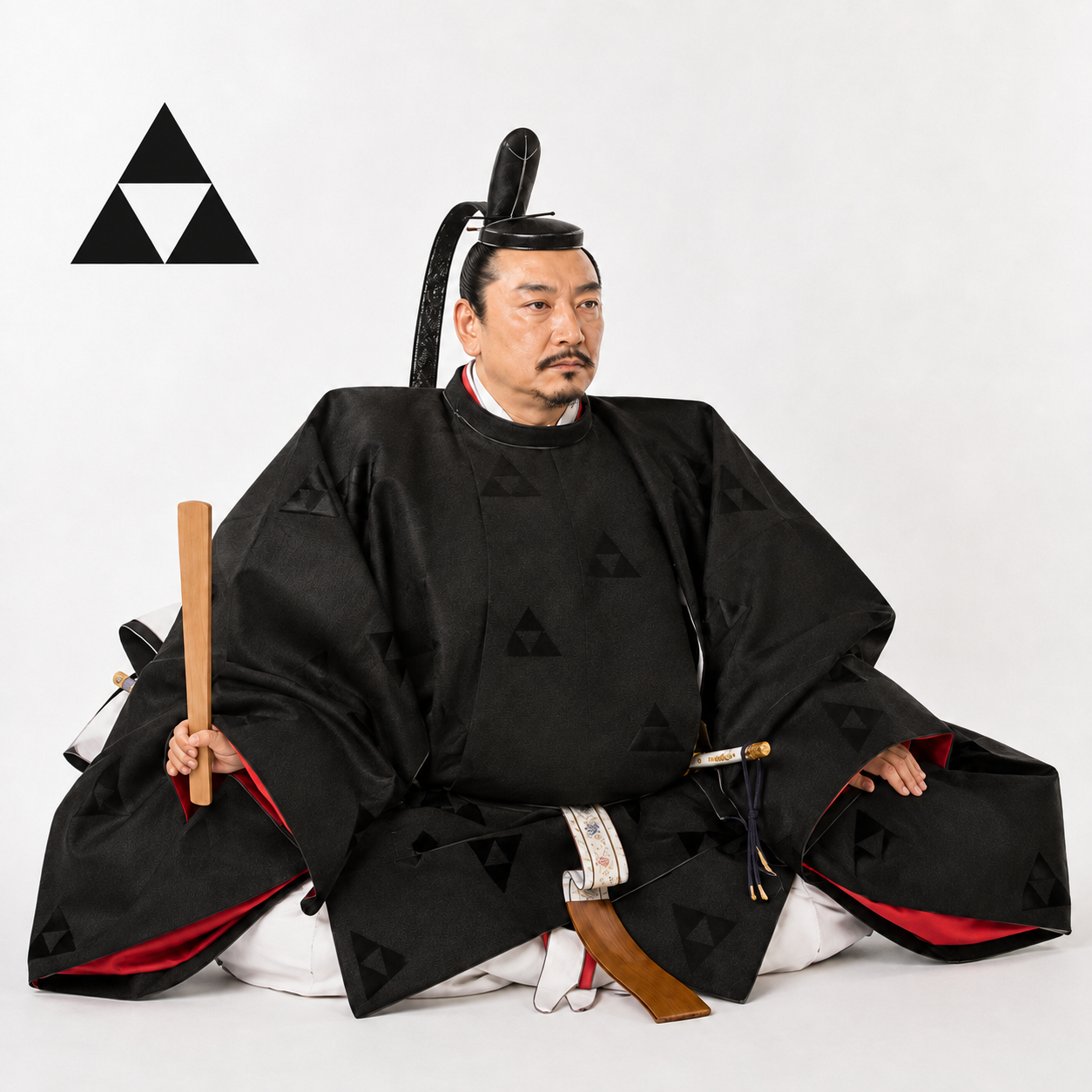
Hōjō Ujimasa — The Fourth Lord of the Later Hōjō Who Overturned His “Foolish” Reputation by Achieving the Clan’s Greatest Domain
Tenbun 7 (1538) – the 11th day, 7th month of Tenshō 18 (1590) | Died at age 52
- Hōjō Ujimasa in 3 Points
- The Mainstream Account — The Standard Story Found in Textbooks
- The Theories — Exploring the Possibilities from Various Angles
- A Strategic View — Ujimasa’s Politics, Military Affairs and Diplomacy
- Famous Words and Sayings of This Warlord
- Anecdotes and Episodes
- Timeline
- Family and Personal Relationships
- Related Historic-Site Map and Travel Model Course
- Related Articles
- Reference Information
Hōjō Ujimasa in 3 Points
- The fourth lord of the Later Hōjō clan. Born the second son of Hōjō Ujiyasu, he inherited the headship in Eiroku 2 (1559). He took as his principal wife Ōbaiin, daughter of Takeda Shingen, and at first expanded his control of the Kantō on the basis of the Kō-Sō Alliance.
- Following the deathbed instruction of his father Ujiyasu, he broke the Etsu-Sō Alliance and allied once more with the Takeda. Contending with formidable rivals such as Uesugi Kenshin, Takeda Katsuyori and Satake Yoshishige, he brought the Later Hōjō domain to its greatest territorial extent. Even after ceding the headship to his heir Hōjō Ujinao in Tenshō 8 (1580), he continued to hold real power as the “Retired Lord.”
- He refused to obey Toyotomi Hideyoshi’s “Sōbuji Decree,” and the Numata-territory dispute brought on the Siege of Odawara in Tenshō 18 (1590). After about three months of siege defense he surrendered, and on the 11th day of the 7th month he committed seppuku together with his younger brother Hōjō Ujiteru. He died at 52. From the Edo period on he was judged “foolish” through anecdotes like the “twice-poured soup” and the “Odawara council,” but in recent years his re-evaluation as a wise ruler has advanced.
The Mainstream Account — The Standard Story Found in Textbooks
Born into the Distinguished Later Hōjō House
Hōjō Ujimasa was born in Tenbun 7 (1538) — or by another account Tenbun 8 (1539) — as the second son of the third lord, Hōjō Ujiyasu, at Odawara Castle in Sagami Province. His mother was Ujiyasu’s principal wife Zuikeiin (a daughter of Imagawa Ujichika and a sister of Imagawa Yoshimoto). His childhood name was Matsuchiyomaru, his common name Shinkurō, and his court titles were Sakyō-no-daibu and Sagami-no-kami. His art-name was Sairyūsai. He was the fourth lord of the Later Hōjō.
Although the Tenbun 7 (1538) theory of Ujimasa’s birth year was long mainstream, the historian Kuroda Motoki has recently proposed that Tenbun 8 (1539) is correct, on the grounds that the Ishikawa Tadafusa Tomegaki records “Ujimasa, the Boar year, 52.” The Boar year corresponds to Tenbun 8, and the reckoning that he died in 1590 at age 52 holds up.
Ujimasa’s mother Zuikeiin was a daughter of Imagawa Ujichika and a sister of Imagawa Yoshimoto — meaning Ujimasa was Yoshimoto’s nephew. From the days of Ujitsuna and Ujiyasu the Later Hōjō pursued a cultivated path of adopting the court culture of Kyoto, and Ujimasa too received instruction in kemari (court football) from the courtier Asukai Masatsuna in Tenbun 18 (1549). He inherited not only the qualities of a warrior but also the grounding of a man of culture.
The Death of His Elder Brother Shinkurō Ujichika and His Rise to Heir
At first, Ujiyasu’s heir was Ujimasa’s elder brother Shinkurō Ujichika (childhood name Seidōmaru). But Ujichika is said to have died young, and Ujimasa, though the second son, became the heir. Just as his father Ujiyasu had been deliberately groomed by Ujitsuna, Ujimasa too was made to apprentice in politics from a young age and was raised as the successor who would carry on the Later Hōjō ideal of “combining wisdom, benevolence and courage.”
Ujimasa’s principal wife was Ōbaiin, daughter of Takeda Shingen. She married Ujimasa — then about 15 or 16 — as a token of the Kō-Sō-Sun Triple Alliance of Tenbun 23 (1554). Ōbaiin was a sister of Takeda Yoshinobu and Takeda Katsuyori. Her relationship with Ujimasa was harmonious, and she bore several children, including the heir Hōjō Ujinao.
Inheriting the Headship and Being Supported by His Father Ujiyasu
On the 23rd day of the 12th month of Eiroku 2 (1559), Ujiyasu retired at age 45, and Ujimasa became the fourth lord of the Later Hōjō, at about 21. This transfer of the headship was a planned generational handover like that from Ujitsuna to Ujiyasu; even after retiring, Ujiyasu retained real power as the “Lord of the Main Keep” while supporting the young Ujimasa.
What Ujimasa tackled immediately after inheriting the headship was famine relief within the domain. The Kantō of the time was struck by severe famine, and the form taken was for Ujiyasu to step down as lord and for recovery to be undertaken under a new lord. Ujimasa issued a debt-cancellation edict (tokusei) to lighten the burden on the populace. This was a measure called the “generational-change tokusei,” a Later Hōjō tradition.
At the same time Ujimasa worked on developing the Hōjō House Register of Holdings (Shoryō Yakuchō). This was a code regulating the holdings and military service of retainers, drawn up by his father Ujiyasu in early Eiroku 2, and it was refined further in Ujimasa’s time.
Uesugi Kenshin’s Kantō Campaign and the Siege of Odawara
In Eiroku 4 (1561), Uesugi Kenshin (then Nagao Kagetora), who had inherited the office of Kantō Kanrei, invaded the Kantō at the head of a coalition army of more than 100,000 and besieged Odawara Castle. For Ujimasa, only just installed as lord, this was his first full-scale military trial.
Ujimasa held the siege in Odawara Castle together with his father Ujiyasu. The impregnable Odawara Castle weathered Kenshin’s encirclement, and in about a month Kenshin lifted the siege and withdrew to Echigo. Ujimasa, while receiving his father’s direction, experienced siege warfare as a young lord. When around the same time the Uesugi army suffered heavy losses at the Fourth Battle of Kawanakajima, Ujimasa, acting in concert with Takeda Shingen, began an invasion of the northern Kantō and recovered the territories the Uesugi side had seized.
The Second Battle of Kōnodai and the Battle of Mimase Pass
In the 1st month of Eiroku 7 (1564), Ujimasa joined the Second Battle of Kōnodai together with his father Ujiyasu, defeating the allied army of Satomi Yoshitaka and his son Yoshihiro and of Ōta Sukemasa. During this period Ujimasa campaigned across the Kantō together with his younger brothers Hōjō Ujiteru and Ujikuni, expanding the Later Hōjō domain.
At the end of Eiroku 11 (1568), Takeda Shingen invaded the Suruga of Imagawa Ujizane, and the Kō-Sō-Sun Triple Alliance collapsed. Because Ujimasa’s younger sister Hayakawa-dono was Imagawa Ujizane’s principal wife, Ujimasa was enraged at Shingen. Shingen further demanded that Ujimasa’s principal wife Ōbaiin (Shingen’s daughter) be returned to her family, but Ujimasa refused. In Eiroku 12 (1569), Ōbaiin was divorced, and after returning to the Takeda house she died young. It is an episode showing that Ujimasa loved Ōbaiin.
In the 10th month of Eiroku 12 (1569), Takeda Shingen pressed close to Odawara, setting fire to the castle town and provoking battle. Ujiyasu and Ujimasa held the siege and did not move, and Shingen withdrew. The Hōjō army, with the brothers Ujiteru and Ujikuni leading the pursuit, fought the Takeda at Mimase Pass in Sagami. In this engagement, called the “Battle of Mimase Pass,” Shingen’s skillful command let the Takeda avoid heavy losses, but the Hōjō army too achieved a certain result.
The Etsu-Sō Alliance and Dealing with the Otate Rebellion
In the intercalary 5th month of Eiroku 12 (1569), his father Ujiyasu concluded the “Etsu-Sō Alliance” with the long-standing enemy Uesugi Kenshin. Ujimasa’s younger brother Hōjō Saburō (the future Uesugi Kagetora) was sent to Echigo as Kenshin’s adopted son. Ujimasa too was deeply involved in the negotiations to build this alliance.
But in the 10th month of Genki 2 (1571), his father Ujiyasu died of illness at Odawara Castle, at 57. On his deathbed Ujiyasu is said to have instructed Ujimasa to “break with Kenshin and ally with Shingen.” Acting on this, Ujimasa broke the Etsu-Sō Alliance with Uesugi Kenshin and allied once more with Takeda Shingen. As a result, Ujimasa’s younger brother Uesugi Kagetora came to be isolated in Echigo.
In the 3rd month of Tenshō 6 (1578), Uesugi Kenshin died suddenly at Kasugayama Castle. Over the succession, the “Otate Rebellion” broke out between Kenshin’s two adopted sons — Uesugi Kagekatsu and Uesugi Kagetora. Ujimasa requested that Takeda Katsuyori send troops to support his own brother Kagetora, and Katsuyori set out. But Katsuyori made peace with the Kagekatsu side along the way, and as a result Kagetora was isolated and took his own life at Samegao Castle in the 3rd month of Tenshō 7 (1579). With his own brother abandoned to death, Ujimasa’s anger toward Takeda Katsuyori mounted, and the Kō-Sō Alliance again moved toward collapse.
The Advance of Kantō Rule and the Greatest Domain
After the Otate Rebellion, Ujimasa accelerated his advance into the northern Kantō. He continued his wars against Satake Yoshishige of Hitachi, the Utsunomiya of Shimotsuke, and the Sanada of Kōzuke. In Ujimasa’s time the Later Hōjō sphere of control reached most of the eight provinces of the Kantō, forming one of the largest domains held by any Sengoku warlord, exceeding two million koku.
According to the research of recent historians such as Kuroda Motoki, it was in Ujimasa’s era that the Later Hōjō territory reached its greatest extent. This is the exact opposite of the judgment, current since the Edo period, that “Ujimasa was foolish and destroyed the Later Hōjō.” It can be said that Ujimasa, while inheriting the line of his father Ujiyasu, built a more meticulous system of domain governance and completed the clan’s rule over the Kantō.
The War with Takeda Katsuyori and Submission to Oda Nobunaga
From Tenshō 7 (1579) onward, Ujimasa continued his struggle with Takeda Katsuyori. In Tenshō 8 (1580) he ceded the headship to his heir Hōjō Ujinao and went into retirement himself, taking the art-name “Sairyūsai.” But because Ujimasa continued to hold real power, this was a formal transfer of the headship only. It was the start of the dual government later embodied in the title “Retired Lord.”
In the 3rd month of Tenshō 10 (1582), Oda Nobunaga destroyed Takeda Katsuyori, and the Takeda house fell. Ujimasa, anticipating Nobunaga’s advance into the Kantō, chose submission to Nobunaga. In the 6th month of that year, when Nobunaga died suddenly in the Honnō-ji Incident, Nobunaga’s retainer Takigawa Kazumasu withdrew from the Kantō, and the Later Hōjō, exploiting the gap left by the Oda forces, advanced into the Kōzuke and Shimotsuke regions. They defeated Takigawa Kazumasu at the Battle of the Kanna River and strengthened their control of the northern Kantō.
The Deepening Conflict with Hashiba Hideyoshi
After the Honnō-ji Incident, Toyotomi Hideyoshi (then Hashiba Hideyoshi) rose rapidly. Through the Shikoku campaign of Tenshō 13 (1585) and the Kyūshū campaign of Tenshō 15 (1587), Hideyoshi entered the final stage of unifying the realm. Hideyoshi issued the “Sōbuji Decree,” forbidding private war among the lords and demanding that all of them come up to the capital and submit.
Ujimasa did not refuse submission to Hideyoshi as such, but took a cautious stance regarding the timing of going up to the capital. He sought to be incorporated into the Hideyoshi regime while preserving the independence of the Later Hōjō. Hideyoshi repeatedly sent envoys to Odawara demanding that Ujimasa and Ujinao come to the capital, but Ujimasa kept putting it off on various pretexts.
The Numata-Territory Dispute and the Break
In Tenshō 17 (1589), the “Numata-territory dispute” arose between the Later Hōjō and the Sanada. Over possession of Numata Castle (present-day Numata City, Gunma Prefecture), Hideyoshi handed down a ruling that divided two-thirds of the Numata territory to the Later Hōjō and one-third to the Sanada. The Later Hōjō were dissatisfied that Nagurumi Castle would become Sanada territory, but on the surface they accepted Hideyoshi’s ruling.
In the 11th month of that same year, however, the Later Hōjō retainer Inomata Kuninori took Nagurumi Castle on his own initiative (the “Nagurumi Castle Incident”). This violated Hideyoshi’s Sōbuji Decree, and Hideyoshi was enraged. Using this as a pretext, in the 2nd month of Tenshō 18 (1590), Hideyoshi decided to issue the order for the Siege of Odawara. Ujimasa and Ujinao sought to the last to resolve matters through negotiation with Hideyoshi, but it finally broke down.
The Siege of Odawara and the Defense
In the 3rd month of Tenshō 18 (1590), Toyotomi Hideyoshi issued the order for the Siege of Odawara at the head of a great army of about 220,000. Tokugawa Ieyasu, Maeda Toshiie, Uesugi Kagekatsu, Date Masamune and others from across the country were also mobilized in Hideyoshi’s train. The Later Hōjō held the siege at Odawara Castle with about 56,000 troops. Beforehand they had built a vast outer rampart (sōgamae) encircling the castle town, turning it into an impregnable fortress.
On the 29th day of the 3rd month, Hideyoshi’s army took Yamanaka Castle (the barrier of Hakone) in a single day. The branch castles across Izu and the Kantō, held by Hōjō Ujikatsu and others, fell one after another. Ujimasa and Ujinao continued the siege defense for about three months at the main keep of Odawara Castle, but were isolated as the branch castles fell. Among the retainers, some turned traitor to Hideyoshi (such as the revolt of Matsuda Norihide).
Within the castle, a prolonged council continued over future policy, and a state of indecision persisted. This is the origin of the anecdote behind the so-called “Odawara council,” which became a byword for a long meeting that reaches no conclusion.
Surrender and Seppuku
On the 5th day of the 7th month of Tenshō 18, the Later Hōjō surrendered. Hideyoshi spared the life of Ujinao but ordered the brothers Ujimasa and Ujiteru to commit seppuku. Because Ujinao’s wife was Tokugawa Ieyasu’s daughter Tokuhime, it is said that Ieyasu interceded to spare Ujinao’s life.
On the 11th day of the 7th month of Tenshō 18 (1590), Ujimasa committed seppuku together with his brother Hōjō Ujiteru within the residence of the physician Tamura Ansei in the castle town of Odawara. He died at 52 (or 53). His second, it is said, was Ujimasa’s retainer — though the Tokugawa retainer Ii Naomasa is also named. His Buddhist name was Jiun-in-den Shōgan-ketsukō-daikoji. Ujimasa’s death poems are transmitted as follows:
The moon, veiled by rain clouds, and the mist within my breast alike — the autumn evening wind has swept them all away.
Blow on, blow on, O wind — bear no grudge: the flowers of spring, like the autumn leaves after them, will fall; it is only the name that is left behind that I would grieve to lose.
“As the autumn evening wind sweeps away the clouds, so it sweeps away the rain clouds and the mist in my breast, and I meet a serene end.” “The blossoms of spring and the autumn leaves alike will scatter; what remains is only one’s name.” — These are fine verses showing a warrior’s final resolve.
The Fall of the Later Hōjō
With Ujimasa’s seppuku, the hundred-year history of the Later Hōjō effectively came to an end. The heir Ujinao was banished to Mount Kōya together with his wife Tokuhime, and died of illness the following year, Tenshō 19 (1591), at 29. With Ujinao’s death, the main line of the Later Hōjō was extinguished.
However, because Ujimasa’s younger brother Hōjō Ujinori had been on close terms with Tokugawa Ieyasu, he received Ieyasu’s intercession and survived as a daimyō of 10,000 koku at Sayama in Kawachi. Ujinori’s line continued as the lords of Sayama domain throughout the Edo period, and the bloodline of the Later Hōjō was preserved until the Meiji Restoration. It was only the main line of the Later Hōjō that perished in Ujimasa’s generation; Ujiyasu’s bloodline was carried on through a separate branch.
In Meiji 13 (1880), 292 years after Ujimasa’s death, the Meiji government formed an association of the descendants of former Later Hōjō retainers, in a form reviving the line of the main Later Hōjō house. Though Ujimasa was judged “foolish,” the legacy of the Later Hōjō — the governing institutions of the Kantō, the castle town of Odawara, and the benevolent rule that cared for the populace — endured through the Tokugawa shogunate and remains today as a foundation of the modern Kantō region.
The Theories — Exploring the Possibilities from Various Angles
Theory 1: Re-examining the “Foolish” Reputation
From the Edo period on, the dominant view of Hōjō Ujimasa was negative: “a foolish, mediocre general who destroyed the Later Hōjō,” “a frog in a well, ignorant of the wider situation.” In recent years, however, research by historians such as Kuroda Motoki has advanced a fundamental reconsideration of Ujimasa’s evaluation.
[The origin of the “foolish” theory]: The judgment of Ujimasa as “foolish” goes back as far as the Kanhasshū Kosenroku (vol. 17, Jinbutsu Ōrai-sha edition), compiled in the mid-eighteenth century. By this time more than a century had passed since the founding of the Tokugawa shogunate, and the Later Hōjō had become a thing of the distant past. The war chronicles and histories of the Edo period, strongly influenced by the Tokugawa view of history, tended to portray the Later Hōjō, destroyed by Hideyoshi, as “a foolish daimyō who could not read the tide of the times.”
[The recent wise-ruler re-evaluation theory]: In Hōjō Ujimasa: Cleaving Heaven and Earth, Returning to the Great Void (Minerva Shobō, 2018), Kuroda Motoki re-evaluates the real Ujimasa as follows:
- It was in Ujimasa’s era that the Later Hōjō territory reached its greatest extent.
- He fought on at least even terms against formidable rivals — Takeda Shingen and Takeda Katsuyori, Uesugi Kenshin, Oda Nobunaga, Satomi Yoshihiro, Satake Yoshishige and others.
- He was an excellent statesman who took pains over the management of his retainers, the populace and the local lords under him.
- In diplomacy too he showed deft skill in the negotiations of the Etsu-Sō Alliance, the Kō-Sō Alliance, and his dealings with the Oda and with Hideyoshi.
- Even after transferring the headship, he continued to manage all diplomacy as “Retired Lord” and to hold real power.
From these facts, Ujimasa is evaluated, far from being “foolish,” as a “capable and accomplished general.”
[Was the conflict with Hideyoshi a “blunder”?]: That Ujimasa perished after confronting Hideyoshi is fact, but whether this can be simply judged as “Ujimasa’s blunder” is debatable. It was ordinary for the powerful daimyō of the day (Date Masamune, Tokugawa Ieyasu, Mōri Terumoto and others) to stand in tension with the central regime, and not a few daimyō clashed early with Hideyoshi (Asakura Yoshikage, Azai Nagamasa and others). That Ujimasa chose “all-out resistance” ended in failure, but under the circumstances of the time it was also a quite rational choice.
[Evaluation of the death poems]: Ujimasa’s death poem — “The moon veiled by rain clouds, and the mist within my breast, the autumn evening wind has swept them away” — has an extremely high literary level for a Sengoku warlord’s farewell verse. From the standpoint that “a foolish, mediocre general could never have composed such a verse,” it is also taken as grounds for re-evaluating Ujimasa’s character and cultivation.
[The reproduction of the “foolish” image]: Ujimasa’s foolish image has been reproduced again and again, combined with three anecdotes — the twice-poured soup, the Odawara council, and the Siege of Odawara. But all of these anecdotes contain elements invented in later ages and are problematic as historical fact (see Theory 2). In historical entertainment the image of the “foolish Ujimasa” is still much used, but academically it is being greatly revised.
Kuroda Motoki sums up: “Ujimasa was a wise ruler no less than his father Ujiyasu. The fall of the Later Hōjō was not the result of Ujimasa’s lack of ability, but the result of the Later Hōjō trying to preserve its independence within the great historical current of Hideyoshi’s unification of the realm.” Ujimasa’s evaluation is being greatly rewritten by modern research.
Theory 2: The Truth of the “Twice-Poured Soup” Anecdote
The anecdote that symbolizes Hōjō Ujimasa’s “foolish” image is the “twice-poured soup.” At a meal, Ujimasa poured soup over his rice once, but the amount was too little, so he poured a second time; seeing this, his father Ujiyasu is said to have sighed, “To eat every day and yet not be able to judge how much soup to pour over one’s rice — will the Hōjō house too end in my generation?” The credibility of this anecdote, however, requires examination.
[Source]: This anecdote appears in the war chronicles and compilations of the Edo period and cannot be confirmed in contemporary sources. The oldest source is unknown, but the theories center on works compiled around the Kanhasshū Kosenroku of the mid-eighteenth century.
[The existence of similar anecdotes]: An anecdote with the same import is also transmitted as a story between Mōri Motonari and Mōri Terumoto (his grandson). The fact that “the same anecdote is transferred to several Sengoku daimyō” suggests that, rather than being a fact peculiar to a specific person, it circulated as a fable carrying a Confucian moral.
[The meaning of father Ujiyasu’s sigh]: Even supposing the anecdote is historical, Ujiyasu’s sigh can be read not so much as disappointment in Ujimasa personally as the expression of a father’s wish and admonition — “I would have you be a general who can pay attention even to trifles.” It is weak as grounds for branding Ujimasa “foolish.”
[Connection to the “green-rice harvest” anecdote]: There is another anecdote showing Ujimasa’s foolishness — that “he thought rice in a green field could be eaten as soon as it was cut.” This is recorded in the Kōyō Gunkan (compiled by the Takeda retainer Obata Kagenori, of doubtful credibility). The Kōyō Gunkan is a war chronicle of strong fictional color centering on the Takeda house, and it has been pointed out that it may have intended to portray Ujimasa, the Takeda’s adversary, as “a mediocre general who was no match for the Takeda.”
[The reproduction mechanism of the “foolish” anecdotes]: The anecdotes showing Ujimasa’s foolishness were very likely formed as after-the-fact explanations, reasoning backward from the “result” of the Later Hōjō’s destruction — “since they were destroyed, he must have been foolish.” There was also the influence of the Tokugawa view of history, which from the standpoint of the historical victor (the Tokugawa shogunate) belittled the defeated Later Hōjō.
[Modern historical entertainment]: The “twice-poured soup” anecdote is frequently cited as Ujimasa’s representative anecdote in modern subculture, such as the Nico Nico Pedia and the game Nobunaga’s Ambition. There is an aspect in which Ujimasa is enjoyed as “the regrettable fourth-generation lord who destroyed the Later Hōjō.” But this is purely a context of entertainment and must be distinguished from historical evaluation.
Kuroda Motoki judges that “the twice-poured-soup anecdote should be seen as a later invention and does not reflect the real Ujimasa.” The direction of modern research is that, to understand Ujimasa’s character, one should refer not to such anecdotes but to empirical study based on contemporary sources.
Theory 3: Evaluating the Strategy of Breaking the Etsu-Sō Alliance and Re-allying with Shingen
After his father Ujiyasu’s death in the 10th month of Genki 2 (1571), Ujimasa broke the Etsu-Sō Alliance and rebuilt the alliance with Takeda Shingen. This strategic shift is said to have followed Ujiyasu’s instruction, but there are several views on how to evaluate it.
[The faithful-execution-of-Ujiyasu’s-will theory]: Ujiyasu is said to have instructed Ujimasa on his deathbed to “break with Kenshin and ally with Shingen.” Ujimasa broke the Etsu-Sō Alliance and re-allied with Shingen exactly as instructed. Ujimasa’s decision can also be seen as the act of a “filial son” faithful to his father’s command. In the Confucian values of the Edo period, this was in part evaluated as a virtue of Ujimasa.
[Ujimasa’s own strategic-judgment theory]: On the other hand, breaking the Etsu-Sō Alliance was also Ujimasa’s own strategic judgment. Uesugi Kenshin had not sent the promised reinforcements and the Etsu-Sō Alliance had fallen into dysfunction; Takeda Shingen desired reconciliation with Ujimasa; and cooperation with the Takeda was realistic for the continued governance of the Kantō. The breaking of the Etsu-Sō Alliance was the result of judging these circumstances comprehensively.
[The sacrifice of his brother Uesugi Kagetora]: By breaking the Etsu-Sō Alliance, Ujimasa’s brother Hōjō Saburō (Uesugi Kagetora) was isolated in Echigo. After Kenshin’s death, Kagetora was defeated in the succession struggle with Uesugi Kagekatsu (the Otate Rebellion, 1578–79) and took his own life. This shows that Ujimasa’s strategic shift was a cold-eyed decision that entailed the sacrifice of his own brother. Ujimasa prioritized strategic rationality even at the cost of abandoning his own brother to death.
[Evaluation of the re-alliance with Shingen]: The Kō-Sō Alliance that Ujimasa rebuilt continued even after Takeda Shingen died in Tenshō 1 (1573) and his son Takeda Katsuyori became lord. But in the Otate Rebellion (1578–79), Katsuyori made peace with the Kagekatsu side and so abandoned Ujimasa’s brother Kagetora to death, and the Kō-Sō Alliance again collapsed. Ujimasa’s strategy succeeded in the short term but, in the long term, brought on the collapse of the Kō-Sō Alliance and the isolation of the Later Hōjō.
[The difficulty of dealing with both Kagekatsu and Kagetora]: Ujimasa’s response in the Otate Rebellion demanded an extremely difficult judgment. To support his brother Kagetora he had to request troops from Takeda Katsuyori, and if Katsuyori made peace with the Kagekatsu side, Kagetora would be isolated — within this complex structure, Ujimasa could not save his own brother. Some see this as “Ujimasa’s strategic failure,” but given the constraints on information and the geographic distance of the time, a rescue may realistically have been difficult.
Kuroda Motoki evaluates that “the breaking of the Etsu-Sō Alliance was Ujimasa’s cold strategic judgment, by no means an emotional decision. The existence of his father’s will also functioned as an element reinforcing Ujimasa’s judgment.” The modern view is that Ujimasa’s diplomatic strategy lay on the extension of the flexible realism inherited from his father Ujiyasu.
Theory 4: Evaluating the “Retired Lord” Dual Government
In Tenshō 8 (1580), Ujimasa ceded the headship to his heir Hōjō Ujinao and retired himself. But Ujimasa continued to hold real power, and a dual-government system called the “Retired Lord” came into being. There are several views on how to evaluate this system.
[The reality of dual government]: Ujimasa transferred the headship at about 42, following the precedent of his father Ujiyasu, who retired at 45. By ceding the headship he aimed to have the next-generation Ujinao gain experience as lord. But Ujimasa did not retire completely; as “Retired Lord” he continued to manage all diplomacy and to lead important political decisions.
[The decision-delay theory (critical view)]: It is pointed out that the dual-government system may have caused delays in decision-making in negotiations with Toyotomi Hideyoshi. Even when Hideyoshi’s envoys came to Odawara, Ujinao alone could not decide and had to seek the judgment of the Retired Lord, Ujimasa. This two-stage decision process is held to have slowed negotiations with the Hideyoshi regime and, as a result, brought on the Siege of Odawara.
[The efficient-support theory (affirmative view)]: On the other hand, the dual government is also evaluated as “an efficient system in which an experienced father supports a young lord.” Ujimasa’s rich experience and diplomatic network supported Ujinao and contributed to the maximization of the Later Hōjō territory. The dual government of father and son also became, in part, the foundation of the Later Hōjō’s stable rule.
[The Later Hōjō tradition of generational change]: The generational-change pattern of the Later Hōjō — Ujitsuna → Ujiyasu (retaining real power after retirement) → Ujimasa (retaining real power after retirement) → Ujinao — followed the same method for three generations. This was an extremely rare planned generational-handover system for a Sengoku daimyō, and one of the root causes of the Later Hōjō’s hundred-year survival.
[The problem of who was responsible for negotiations with Hideyoshi]: In the submission negotiations with Hideyoshi from Tenshō 17 (1589) on, it was ambiguous whether the responsible party was Ujinao or Ujimasa, and this became an obstacle to negotiation. The Hideyoshi side asked “Is the lord who will come up to the capital Ujinao or Ujimasa?,” but the Later Hōjō side’s answer was inconsistent, and this was one cause of Hideyoshi’s distrust. The structural weakness of the dual government surfaced in the final phase.
[Evaluation of Ujinao’s ability]: The heir Ujinao himself was by no means a foolish figure. Ujinao took as his wife Tokugawa Ieyasu’s daughter Tokuhime and held a diplomatic pipeline through his relationship with Ieyasu. In the final phase of the Siege of Odawara, Ujinao led the peace negotiations and also made the decision to accept the seppuku of Ujimasa and Ujiteru in exchange for his own life. To underestimate Ujinao’s ability and lay everything on Ujimasa is not fair.
Kuroda Motoki evaluates that “Ujimasa’s retired-lord system was part of the Later Hōjō tradition of generational change and was not a particularly problematic system. The breakdown of negotiations with Hideyoshi was less a structural problem of dual government than the result of the strategic choice of the Later Hōjō as a whole.” The traditional interpretation that sees the dual government as the main cause of the Siege of Odawara is being revised in recent research.
Theory 5: The Break with Hideyoshi and the Siege of Odawara
The Siege of Odawara of Tenshō 18 (1590) was the event that decided the destruction of the Later Hōjō. There are several views on why Ujimasa could not, in the end, avoid conflict with Toyotomi Hideyoshi.
[The refusal-to-come-to-the-capital theory (traditional)]: The view that, because Ujimasa did not obey Hideyoshi’s order to come up to the capital, Hideyoshi was enraged and launched the Siege of Odawara. This interpretation is common in Edo-period war chronicles and is taken as the basis for Ujimasa’s “frog in a well” image. But in the research of Kuroda Motoki and others, Ujimasa showed a stance of accepting submission to Hideyoshi, and it was not a simple refusal to come to the capital.
[The Numata-dispute-as-direct-trigger theory]: The Numata-territory dispute of Tenshō 17 (1589), and especially the Nagurumi Castle Incident of the 11th month of that year, became the direct trigger of the Siege of Odawara. That the Later Hōjō retainer Inomata Kuninori took Nagurumi Castle — made Sanada territory by Hideyoshi’s ruling — on his own initiative gave Hideyoshi the pretext of a “violation of the Sōbuji Decree.” Ujimasa and Ujinao showed a stance of punishing Inomata, but they were not in time for Hideyoshi’s decision.
[The Hideyoshi-strategic-intent theory]: The view that Hideyoshi too had a strategic intent to destroy the Later Hōjō. For Hideyoshi, who wished to complete the unification of the realm by placing the Kantō directly under his control, the independence of the Later Hōjō was an obstacle. The Numata-territory dispute may have been a pretext for Hideyoshi to gain a “legitimate reason” to attack the Later Hōjō.
[The internal-conflict theory]: Within the Later Hōjō too there was a clash of opinion over the negotiations with Hideyoshi. Ujimasa’s brother Hōjō Ujinori (lord of Nirayama Castle, on close terms with Ieyasu) argued for peace with Hideyoshi, while Ujimasa and Ujiteru supported the hard line — and this conflict of lines within the house complicated negotiations. Ujinori went up to the capital in the 8th month of Tenshō 17 and was received in audience by Hideyoshi, but this was not the decision of the main Later Hōjō house; it was Ujinori’s own personal judgment.
[The strategic logic of choosing “all-out resistance”]: Ujimasa’s final choice of all-out resistance had a certain rationality under the circumstances of the time. Odawara Castle was an impregnable fortress and had weathered the attacks of both Uesugi Kenshin in Eiroku 4 and Takeda Shingen in Eiroku 12. Ujimasa very likely judged that “if the siege is prolonged, Hideyoshi too will compromise.” In fact, maintaining the morale and securing the supply of Hideyoshi’s army was not easy, and there was a structure in which prolongation would also hurt the Hideyoshi side.
[The miscalculation-of-army-size theory]: It is pointed out that Ujimasa may have underestimated the size of Hideyoshi’s army. The actual Hideyoshi army numbered about 220,000 and adopted a strategy of reducing the branch castles of the Kantō in parallel. Ujimasa assumed that “holding the siege at Odawara would draw the war into a long campaign,” but before Hideyoshi’s sheer numbers and strategy the branch castles fell one after another.
Kuroda Motoki evaluates that “Ujimasa’s all-out resistance was not ‘because he was foolish’ but a ‘proactive strategic choice.’ It ended in failure as a result, but under the circumstances of the time it was a sufficiently considered choice.” The view of recent research is that, rather than one-sidedly criticizing Ujimasa’s decision, it should be understood as the proactive strategic judgment of a Sengoku daimyō.
Theory 6: The Truth of the Odawara Council and the Seppuku
The “Odawara council” is known as a byword for a long meeting that reaches no conclusion. This is said to derive from the internal council of the Later Hōjō at the time of the Siege of Odawara. There are also several views on the contrast between Ujimasa’s seppuku and Ujinao’s reprieve after the surrender.
[The reality of the “Odawara council”]: From the 6th month of Tenshō 18, as the branch castles fell and Odawara Castle was isolated, a prolonged council continued within the castle over future policy. Opinion was divided over surrender, all-out resistance, or peace negotiation, and a state of no conclusion persisted. This is said to be the origin of the Japanese idiom “Odawara council = a long meeting that reaches no conclusion.”
[The possibility that the “Odawara council” is an invention]: However, the concrete reality of the “Odawara council” requires source-critical examination. The scenes of the council described in detail in Edo-period war chronicles very likely contain much later embellishment. The actual debate within the castle, though indeed prolonged, was very likely not the “meaningless, comical meeting” the war chronicles depict but a serious strategic discussion responsive to the war situation.
[The contrast of Ujimasa’s seppuku and Ujinao’s reprieve]: After the surrender of the 5th day of the 7th month of Tenshō 18, Hideyoshi spared Ujinao’s life but ordered the brothers Ujimasa and Ujiteru to commit seppuku. There are several explanations for this differential treatment:
- The Ieyasu-intercession theory: because Ujinao’s wife was Tokugawa Ieyasu’s daughter Tokuhime, Ieyasu interceded to spare Ujinao’s life.
- The generational-responsibility theory: Ujimasa, as former lord, was held to bear responsibility for the war, while the current lord Ujinao was young and judged to bear lighter responsibility.
- The removal-of-the-hard-liners theory: Ujimasa and Ujiteru were taken as the hard-liners who led the all-out resistance and were executed as an example by Hideyoshi.
- The extinction-of-the-main-line theory: a political intent to break the authority of the main Later Hōjō house by making Ujimasa commit seppuku, and to reorganize Kantō rule under the Hideyoshi regime.
[The course of the seppuku]: The seppuku of the brothers Ujimasa and Ujiteru was carried out within the residence of the physician Tamura Ansei in the castle town of Odawara. The role of second is said to have been performed by the Tokugawa retainer Ii Naomasa. Ujimasa’s death poem — “The moon veiled by rain clouds, and the mist within my breast, the autumn evening wind has swept them away” — is known as a fine verse showing a warrior’s resolve and resignation. That the “mist in his breast” is “swept away” — the final figure of Ujimasa, judged foolish, was by no means one of disorder.
[The fate of his brother Ujiteru]: Ujimasa’s brother Hōjō Ujiteru was an important figure who commanded branch castles across the Kantō (Takiyama Castle, Hachiōji Castle and others) and a leading representative of the hard-line faction. Ujiteru was ordered to commit seppuku together with Ujimasa and shared his fate. Hachiōji Castle fell on the 23rd day of the 6th month of Tenshō 18, and the tragedy in which many within the castle — even women and children — lost their lives is known as the last tragedy of the Sengoku history of the Kantō.
[Ujinao afterward]: The heir Ujinao was banished to Mount Kōya together with his wife Tokuhime. Spared by Ieyasu’s intercession, Ujinao died of illness the following year, Tenshō 19 (1591), at 29. The cause of death is unknown, but the strain of exile is conjectured to have accumulated. With Ujinao’s death the main line of the Later Hōjō was effectively extinguished. Yet the line of Ujimasa’s brother Ujinori survived as lords of Sayama domain in Kawachi, and the bloodline of the Later Hōjō was preserved until the Meiji Restoration.
Kuroda Motoki evaluates that “the traditional image of the Odawara council is an Edo-period invention, and the actual debate within the castle was a serious strategic discussion. Ujimasa’s seppuku had a strong aspect of political display and is not of a nature to be ascribed to Ujimasa’s personal responsibility.” Ujimasa’s end preserved the dignity of a Sengoku daimyō, and that resolve appears in his death poem.
A Strategic View — Ujimasa’s Politics, Military Affairs and Diplomacy
The Strategic Achievement of “Forming the Greatest Domain”
Hōjō Ujimasa’s greatest strategic achievement was expanding the Later Hōjō territory to its largest scale in history. In Ujiyasu’s time the domain centered on Sagami, Izu, Musashi, southern Kōzuke and southern Shimōsa, but in Ujimasa’s era his control reached most of the eight provinces of the Kantō. He ultimately became a Sengoku daimyō of over two million koku — a scale that, apart from Oda Nobunaga and Toyotomi Hideyoshi, was among the largest.
This was the result of Ujimasa building the following strategies on the foundation laid by his father Ujiyasu:
- The advance into the northern Kantō (Hitachi, Shimotsuke and Kōzuke) after the Otate Rebellion.
- Regional control by his brothers — Hōjō Ujiteru (Takiyama, Hachiōji), Ujikuni (Hachigata) and Ujinori (Nirayama).
- Wars and subversion against powerful local lords such as the Sanada, Utsunomiya and Satake.
- The advance exploiting the gap left by the withdrawal of the Oda forces after the Honnō-ji Incident (the Battle of the Kanna River).
Maintaining a “Neutral Distance” in Diplomacy
A feature of Ujimasa’s diplomatic strategy was the attempt to keep a “neutral distance” from the central regime (Nobunaga, Hideyoshi). He sought to maintain this delicate stance — avoiding complete submission while also avoiding decisive conflict. This was a realist judgment aimed at reconciling the independence of the Later Hōjō with the stable rule of the Kantō.
Concretely:
- Submission to Oda Nobunaga in Tenshō 10 (1582) (after the fall of the Kai Takeda).
- Resistance to Nobunaga’s retainer Takigawa Kazumasu after the Honnō-ji Incident.
- Prolonging the submission negotiations with Hideyoshi (buying time).
- The surface acceptance of Hideyoshi’s ruling in the Numata-territory dispute.
Maintaining such a “delicate distance” in diplomacy requires an extremely high sense for a Sengoku daimyō. Ujimasa displayed the flexible realism inherited from his father Ujiyasu. Ultimately, however, before the great historical current of Hideyoshi’s unification of the realm, the Later Hōjō’s strategy of preserving its independence broke down.
The Inheritance and Development of Domain Governance
Ujimasa inherited his father Ujiyasu’s line of domain governance while building a more meticulous system of rule:
- Refining the Register of Holdings: re-regulating retainers’ holdings and military service and strengthening the organization of the house.
- Generational-change land survey: conducting a survey of the domain at the time of inheriting the headship and updating the tax base.
- Revision of the per-house tax (munebetsu) and the per-house levy (munebetsu-sen): a meticulous tax system distinguishing residences and outbuildings.
- Provincial levy (kuniyaku) and lordly levy (kubōyaku): common taxation on directly held lands and retainer lands.
- The land survey of Nishiura in Izu Province: detailed records existed already at the stage of Tenbun 12 (1543) (inherited from the time of Ujitsuna and Ujiyasu).
- Cash payment of annual tax: a flexible tax system allowing payment in cash, not only in rice and barley.
These governing institutions also influenced the domain governance of the Edo-period Tokugawa shogunate and became forerunners of the tax and governing systems of early-modern Japan. Ujimasa’s skill in civil administration was equal to, if not greater than, his father Ujiyasu’s.
The System of Regional Control by Brothers
Another pillar of Ujimasa’s strategy was the system of regional control by his brothers. Like his father Ujiyasu, Ujimasa placed his brothers in branch castles across the Kantō and had them share regional control:
- Hōjō Ujiteru: lord of Takiyama and Hachiōji Castles, in charge of the Musashi and Shimotsuke directions.
- Hōjō Ujikuni: lord of Hachigata Castle, in charge of northern Musashi and the Kōzuke direction.
- Hōjō Ujinori: lord of Nirayama Castle, in charge of the Izu direction, the diplomatic pipeline with Tokugawa Ieyasu.
- Hōjō Ujitada: in charge of the Ashikaga direction.
This system of “regional division among brothers” was an important mechanism supporting the Later Hōjō’s control of the Kantō. The system, in which each brother held a degree of independence while moving under the command of the main house and Ujimasa, was an extremely advanced one for a Sengoku daimyō.
Strategic Limits — Why He Could Not Beat Hideyoshi
Ujimasa’s strategy nonetheless had limits it could not transcend. Against the great historical current of Hideyoshi’s unification of the realm, why could the Later Hōjō not stand?
- The disparity in numbers: 220,000 in Hideyoshi’s army against 56,000 in the Later Hōjō — overwhelmed in sheer mass.
- The absence of an ally: no other daimyō could resist Hideyoshi’s unification, and the Later Hōjō were isolated.
- The collapse of the branch-castle network: Hideyoshi’s army took a strategy of reducing each branch castle in parallel, and the premise of the siege defense crumbled.
- Retainer treachery: with the revolt of Matsuda Norihide and the like, the cohesion of the house too was not complete.
- The lack of a long-term strategy: the assumption that “if we hold the siege, Hideyoshi will compromise” was naive.
Ujimasa’s strategy was correct within the paradigm of the Sengoku period — the “struggle among individual daimyō.” But it could not cope with the paradigm of the “realm-unifying regime” that Hideyoshi built. This was less a lack of ability on Ujimasa’s part than the structural limit of a Sengoku daimyō confronting the great transition from the Sengoku period to the early-modern age.
Famous Words and Sayings of This Warlord
“The moon veiled by rain clouds, and the mist within my breast — the autumn evening wind has swept them all away.”
The most famous of Ujimasa’s death poems. It means “as the autumn evening wind sweeps away the rain clouds, so the mist in my breast is swept away, and I meet a serene end,” a fine verse showing a warrior’s resolve and resignation. From the standpoint that “a foolish, mediocre general could never have composed such a verse,” it is also taken as grounds for re-evaluating Ujimasa’s character and cultivation.
“Blow on, blow on, O wind, bear no grudge; the flowers of spring and the autumn leaves after them will scatter — it is only the name left behind that I grieve to lose.”
Another of Ujimasa’s death poems. It means “the blossoms of spring and the autumn leaves alike scatter in the wind, but what remains is only one’s name,” showing Ujimasa’s character in valuing a warrior’s honor to the last. It expresses the resolve to fall bearing the hundred-year history of the Later Hōjō.
“The Odawara Council”
A Japanese idiom for “a long meeting that reaches no conclusion,” said to derive from the prolonged internal council of the Later Hōjō at the time of the Siege of Odawara. Though the phrase survives in modern Japanese, the actual reality of the council very likely contains much Edo-period war-chronicle embellishment and is probably a belittling image of the serious strategic discussion within the Later Hōjō house.
“The Retired Lord” (Go-Inkyo-sama)
An honorific for Ujimasa after he transferred the headship. Whereas “Lord of the Main Keep” had been the title for his father Ujiyasu in retirement, Ujimasa was called “the Retired Lord.” It is a title symbolizing the Later Hōjō tradition of dual government, in which one takes the nominal status of a retiree while holding substantial power.
“Sairyūsai”
Ujimasa’s art-name, taken after transferring the headship. Meaning “one who cuts through the current,” it is a name showing a warrior’s decisiveness. It is a name expressing strong will, in keeping with his death poem’s “the mist in my breast has been swept away.”
Anecdotes and Episodes
Instruction in Kemari and the Connection to Kyoto Culture
In Tenbun 18 (1549), the courtier Asukai Masatsuna gave instruction in kemari to Ujiyasu’s sons Seidōmaru (the elder brother Ujichika) and Matsuchiyomaru (Ujimasa). This shows that the Later Hōjō actively adopted the court culture of Kyoto. Ujimasa was raised acquiring the grounding of a man of culture, not only of a warrior. The legitimacy of the Later Hōjō’s rule of the Kantō was supported by such a connection to Kyoto culture.
Conjugal Love with Ōbaiin and the Tragedy of Their Divorce
Ujimasa’s principal wife Ōbaiin was a daughter of Takeda Shingen and bore several children, including Hōjō Ujinao, around Eiroku 7 (1564). Ujimasa and Ōbaiin were on good terms, but with the collapse of the Kō-Sō Alliance through Takeda Shingen’s invasion of Suruga in Eiroku 11 (1568), Ujimasa was forced to divorce Ōbaiin. In Eiroku 12 (1569), Ōbaiin was returned to her family, the Takeda, and died young thereafter. There are several sources showing that Ujimasa loved Ōbaiin deeply, and it is known as a tragedy of politics and love. After Ōbaiin’s death, Ujimasa did not take a formal second wife.
Abandoning His Brother Kagetora to Death in the Otate Rebellion
In the Otate Rebellion of Tenshō 6–7 (1578–79), Ujimasa requested troops from Takeda Katsuyori to support his own brother Uesugi Kagetora. Katsuyori at first responded, but made peace with the Uesugi Kagekatsu side along the way, and Kagetora was isolated and took his own life. Ujimasa deeply regretted that he could not save his own brother, and his anger toward Katsuyori mounted. This “abandoning his brother to death” was one of the greatest regrets of Ujimasa’s life. The Otate Rebellion was an event that greatly shook Ujimasa’s family relations and strategy.
The Battle of the Kanna River and Resistance to Takigawa Kazumasu
In the 6th month of Tenshō 10 (1582), immediately after Oda Nobunaga died suddenly in the Honnō-ji Incident, Ujimasa exploited the wavering of Nobunaga’s Kantō retainer Takigawa Kazumasu and advanced into northern Kōzuke and northern Musashi. On the 18th–19th days of the 6th month, he fought a decisive battle against Takigawa Kazumasu at the Kanna River and defeated him. Kazumasu withdrew to his home base of Nagashima in Ise, and the Later Hōjō achieved the solidification of their control of the Kantō. This battle is a representative example showing Ujimasa’s tactical eye and mobility.
The Tenshō-Jingo Conflict and the Alliance with Tokugawa Ieyasu
After the Honnō-ji Incident, in Tenshō 10 (1582), the “Tenshō-Jingo Conflict” broke out — a three-way struggle among Ujimasa, Tokugawa Ieyasu and Uesugi Kagekatsu over the former Takeda territories (Kai, Shinano, Kōzuke). Ujimasa at first clashed with Ieyasu but ultimately made peace, building an alliance through the marriage of his heir Ujinao to Ieyasu’s daughter Tokuhime. This alliance became the foreshadowing of Ujinao’s reprieve after the later Siege of Odawara.
The Numata-Territory Dispute and the Nagurumi Castle Incident
In the Numata-territory dispute of Tenshō 17 (1589), Toyotomi Hideyoshi handed down a ruling dividing two-thirds of the Numata territory to the Later Hōjō and one-third to the Sanada. The Later Hōjō accepted the ruling on the surface, but in the 11th month of that year the retainer Inomata Kuninori, on his own initiative, took Nagurumi Castle, which had become Sanada territory. Ujimasa and Ujinao explained the matter to Hideyoshi, but Hideyoshi made it the pretext for the Siege of Odawara. It is a tragedy in which Inomata’s independent action became the trigger for the destruction of the Later Hōjō.
Hōjō Ujinori’s Visit to the Capital and the Moves of the Peace Faction
In the 8th month of Tenshō 17 (1589), Ujimasa’s brother Hōjō Ujinori went up to the capital alone and was received in audience by Hideyoshi. Ujinori was on close terms with Tokugawa Ieyasu and functioned as a pipeline for peace negotiations. But owing to the clash of lines between the hard-liners Ujimasa and Ujiteru and the peace faction of Ujinori and others, the Later Hōjō could not take a consistent course, and the break was ultimately brought on. After the Siege of Odawara, Ujinori was spared by Ieyasu’s intercession and survived as a daimyō of 10,000 koku at Sayama in Kawachi.
The Tragedy of Hachiōji Castle
On the 23rd day of the 6th month of Tenshō 18 (1590), Hachiōji Castle, the base of Ujimasa’s brother Hōjō Ujiteru, was attacked by Hideyoshi’s Uesugi Kagekatsu, Maeda Toshiie and others and fell. Within the castle, with Ujiteru absent (he was stationed at Odawara), the wives, children and populace of the retainers held the siege in large numbers, and many of these lost their lives. The tragedy of the “Gōshuden Falls,” where the wives of the garrison threw themselves into the waterfall, is still told today as the last tragedy of the Sengoku history of the Kantō. Ujiteru would commit seppuku at Odawara together with his brother Ujimasa.
The Surrender of Odawara and Ujimasa’s Resolve
In the surrender negotiations of the 5th day of the 7th month of Tenshō 18, Ujimasa accepted his own seppuku in exchange for sparing Ujinao’s life. Ujimasa’s decision — “to leave the honor and bloodline of the main Later Hōjō house, I will take responsibility” — preserved the dignity of a warrior. The Edo-period war chronicles portray Ujimasa as “foolish,” but his actual end was calm and full of resolve. That spirit appears in his death poem.
Ii Naomasa as Second
The seppuku of the brothers Ujimasa and Ujiteru was carried out within the residence of the physician Tamura Ansei in the castle town of Odawara. The role of second is said to have been performed not by an Ujimasa retainer but by the Tokugawa retainer Ii Naomasa. This was an act showing the utmost respect to an enemy general, and shows that Ujimasa was not a mere “loser” but a figure recognized as having the dignity of a Sengoku daimyō. Ii Naomasa would go on to play an important role in the control of the Kantō after the fall of the Later Hōjō.
The Preservation of the Graves of Ujimasa and Ujiteru
After the seppuku, the graves of the brothers Ujimasa and Ujiteru were built at Denshin-an in the castle town of Odawara (later Benzaiten-dōri). Throughout the Edo period, the local people carefully protected this grave site. Today too, the “Grave Site of Lords Hōjō Ujimasa and Ujiteru” remains in the Benzaiten-dōri shopping street of Odawara City, and at the “Odawara Hōjō Godai Festival” held every year on May 3 there are observances honoring the memory of the brothers. Contrary to Ujimasa’s “foolish” image, in his home of Odawara he is still a figure held in reverence.
Timeline
| Japanese Era (Western Year) | Age | Event |
|---|---|---|
| Tenbun 7 or 8 (1538/1539) | 1 | Born at Odawara Castle in Sagami Province. Father Hōjō Ujiyasu, mother Zuikeiin (daughter of Imagawa Ujichika). Childhood name Matsuchiyomaru. |
| Tenbun 18 (1549) | 11/12 | Receives instruction in kemari from the courtier Asukai Masatsuna together with his elder brother Seidōmaru. Acquires the grounding of Kyoto culture. |
| Tenbun 23 (1554) | 16/17 | The Kō-Sō-Sun Triple Alliance is formed. Takes Takeda Shingen’s daughter Ōbaiin as principal wife. |
| Eiroku 2 (1559) | 21/22 | On the 23rd day of the 12th month, becomes the fourth lord of the Later Hōjō upon his father Ujiyasu’s retirement. Issues a generational-change tokusei and begins famine recovery in the domain. Develops the Register of Holdings. |
| Eiroku 4 (1561) | 23/24 | Uesugi Kenshin’s Kantō campaign. A coalition army of over 100,000 besieges Odawara Castle, but together with his father Ujiyasu he repels Kenshin through siege defense. |
| Eiroku 7 (1564) | 26/27 | In the 1st month, the Second Battle of Kōnodai. Together with his father Ujiyasu, defeats the allied army of Satomi Yoshitaka and his son Yoshihiro and of Ōta Sukemasa. |
| Eiroku 11–12 (1568–69) | 30/31–31/32 | The Kō-Sō-Sun Triple Alliance collapses through Takeda Shingen’s invasion of Suruga. Divorces his wife Ōbaiin, returning her to the Takeda. In the 10th month, the Battle of Mimase Pass. In the intercalary 5th month, the Etsu-Sō Alliance is formed. His brother Hōjō Saburō becomes Uesugi Kenshin’s adopted son. |
| Genki 2 (1571) | 33/34 | On the 3rd day of the 10th month, his father Ujiyasu dies. Receiving the instruction to “break with Kenshin and ally with Shingen,” he breaks the Etsu-Sō Alliance and re-allies with Takeda Shingen. |
| Tenshō 6–7 (1578–79) | 40/41–41/42 | The Otate Rebellion. Requests troops from Takeda Katsuyori to support his own brother Uesugi Kagetora, but Katsuyori makes peace with the Kagekatsu side. Kagetora is isolated and takes his own life. The Kō-Sō Alliance moves again toward collapse. |
| Tenshō 8 (1580) | 42/43 | Cedes the headship to his heir Hōjō Ujinao and retires (retaining real power). Takes the art-name “Sairyūsai.” Establishes the dual-government system as “Retired Lord.” |
| Tenshō 10 (1582) | 44/45 | In the 3rd month, Oda Nobunaga destroys Takeda Katsuyori and the Takeda house falls. Ujimasa chooses submission to Nobunaga. In the 6th month, the Honnō-ji Incident. Defeats Takigawa Kazumasu at the Battle of the Kanna River and advances into the northern Kantō. Through the Tenshō-Jingo Conflict, allies with Tokugawa Ieyasu, with the marriage of Ujinao and Tokuhime. |
| Tenshō 13–16 (1585–88) | 47/48–50/51 | Hashiba Hideyoshi pacifies Shikoku and Kyūshū and issues the Sōbuji Decree. Ujimasa prolongs the submission negotiations with Hideyoshi, seeking to preserve the independence of the Later Hōjō. Kantō rule reaches its greatest extent. |
| Tenshō 17 (1589) | 51/52 | In the 8th month, his brother Hōjō Ujinori goes up to the capital alone and is received by Hideyoshi. In the 11th month, the retainer Inomata Kuninori takes Nagurumi Castle on his own initiative, and the Later Hōjō are charged by Hideyoshi with violating the Sōbuji Decree. |
| Tenshō 18 (1590) | 52/53 | In the 3rd month, the Siege of Odawara by Toyotomi Hideyoshi’s great army of 220,000. On the 29th day of the 3rd month, Yamanaka Castle falls. On the 23rd day of the 6th month, Hachiōji Castle falls. After about three months of siege defense (the “Odawara council”), surrenders on the 5th day of the 7th month. On the 11th day of the 7th month, commits seppuku with his brother Hōjō Ujiteru within the residence of Tamura Ansei in the castle town of Odawara. Died at 52 (or 53). His second was Ii Naomasa. |
| Tenshō 19 (1591) | — | His heir Hōjō Ujinao dies of illness at Mount Kōya (at 29). The main line of the Later Hōjō is extinguished. The line of Ujimasa’s brother Ujinori survives as 10,000 koku at Sayama in Kawachi. |
Family and Personal Relationships
The Later Hōjō Clan and Family
| Person | Relation | Relationship |
|---|---|---|
| Hōjō Sōun | Great-grandfather | Founder of the Later Hōjō. Died before Ujimasa was born. |
| Hōjō Ujitsuna | Grandfather | Second lord of the Later Hōjō. First to use the surname “Hōjō.” Died in Tenbun 10 (1541), before Ujimasa was born. |
| Hōjō Ujiyasu | Father | Third lord of the Later Hōjō, the “Lion of Sagami.” Gave Ujimasa a planned successor’s education and retained real power after retirement to support him. Died in 1571 at 57. |
| Zuikeiin | Mother | Daughter of Imagawa Ujichika, sister of Imagawa Yoshimoto. Ujiyasu’s principal wife. A bond of the Triple Alliance. |
| Shinkurō Ujichika | Elder brother | Ujiyasu’s eldest son. Died young, and Ujimasa became the heir. Childhood name Seidōmaru. |
| Ōbaiin | Principal wife | Daughter of Takeda Shingen. Bore Ujinao and several other children around Eiroku 7 (1564). Divorced after the Suruga invasion of Eiroku 12 (1569) and died young. |
| Hōjō Ujinao | Heir | Fifth lord of the Later Hōjō. Wife was Tokugawa Ieyasu’s daughter Tokuhime. After the Siege of Odawara, banished to Mount Kōya and died of illness the next year at 29. The main line extinguished. |
| Hōjō Ujiteru | Younger brother | Lord of Takiyama and Hachiōji Castles. A leading representative of the hard-line faction. Committed seppuku with his brother Ujimasa on the 11th day of the 7th month, 1590. The tragedy of Hachiōji Castle. |
| Hōjō Ujikuni | Younger brother | Lord of Hachigata Castle. In charge of northern Musashi and the Kōzuke direction. Surrendered at the Siege of Odawara and was placed in the custody of Maeda Toshiie. |
| Hōjō Ujinori | Younger brother | Lord of Nirayama Castle. On close terms with Tokugawa Ieyasu, a representative of the peace faction. After the Siege of Odawara, spared by Ieyasu’s intercession and survived as a daimyō of 10,000 koku at Sayama in Kawachi. Preserved the Later Hōjō bloodline until the Meiji Restoration. |
| Uesugi Kagetora (Hōjō Saburō) | Younger brother | Became Uesugi Kenshin’s adopted son as a token of the Etsu-Sō Alliance. Took his own life in the Otate Rebellion (1578–79). A sacrifice of Ujimasa’s strategic shift. |
Alliance and Conflict Relationships
| Person | Position | Relationship |
|---|---|---|
| Takeda Shingen | Warlord of Kai | Father-in-law (father of Ōbaiin). Head of the Kō-Sō Alliance. Alliance broken by the Suruga invasion of 1568, turned hostile. Re-allied after Ujiyasu’s death. Died 1573. |
| Takeda Katsuyori | Shingen’s son | Brother-in-law (Ōbaiin’s younger brother). Lord of the Takeda after Shingen’s death. Made peace with the Kagekatsu side in the Otate Rebellion and abandoned Ujimasa’s brother Kagetora to death. Destroyed by Oda Nobunaga in 1582. |
| Uesugi Kenshin | Warlord of Echigo | Besieged Odawara in the Kantō campaign of 1561. Concluded the Etsu-Sō Alliance in 1569, but Ujimasa broke it after Ujiyasu’s death. Died suddenly in 1578. |
| Uesugi Kagekatsu | Kenshin’s adopted son | Defeated Ujimasa’s brother Kagetora in the Otate Rebellion. Took part on Hideyoshi’s side in the Siege of Odawara and led the reduction of Hachiōji Castle. |
| Imagawa Ujizane | Yoshimoto’s son | Husband of Ujimasa’s sister Hayakawa-dono. Lost his domain in Takeda Shingen’s invasion of Suruga and received the protection of the Later Hōjō. |
| Satomi Yoshitaka | Warlord of Bōsō | The enemy general at the Second Battle of Kōnodai. Opposed the Later Hōjō into Ujimasa’s era. |
| Sanada Masayuki | Warlord of Shinshū | The opposing party in the Numata-territory dispute. A figure behind the Nagurumi Castle Incident. Took part on Hideyoshi’s side in the later Siege of Odawara. |
The Central Regime and the Unifiers
| Person | Position | Relationship |
|---|---|---|
| Oda Nobunaga | Unifier | After the fall of the Takeda house in 1582, Ujimasa chose submission to Nobunaga. When Nobunaga died in the Honnō-ji Incident, accelerated his advance into the Kantō. |
| Toyotomi Hideyoshi | Unifier | Demanded that Ujimasa come to the capital under the Sōbuji Decree. Launched the Siege of Odawara in 1590 and destroyed the Later Hōjō. Ordered Ujimasa and Ujiteru to commit seppuku. |
| Tokugawa Ieyasu | Unifier | Married his daughter Tokuhime to Ujinao, forming an in-law tie. Took part on Hideyoshi’s side in the Siege of Odawara but interceded after the war to spare Ujinao’s life. Held the former Later Hōjō territories in the Kantō transfer. |
| Ii Naomasa | Tokugawa retainer | Performed the role of second at the seppuku of Ujimasa and Ujiteru. Showed the utmost respect to an enemy general. |
Retainers and Local Lords
| Person | Position | Relationship |
|---|---|---|
| Matsuda Norihide | Chief elder | Holding of the highest class among Later Hōjō retainers. Plotted treachery to Hideyoshi in the final phase of the Siege of Odawara; discovered and made to commit seppuku after the war. |
| Inomata Kuninori | Castellan of Numata | Took Nagurumi Castle on his own initiative in the 11th month of Tenshō 17 (1589). This became, as a violation of Hideyoshi’s Sōbuji Decree, the pretext for the Siege of Odawara. |
Related Historic-Site Map and Travel Model Course
A journey tracing Hōjō Ujimasa’s footsteps reaches widely — centered on his home base of Odawara, extending to the battlefield sites of the Siege of Odawara that symbolize the Later Hōjō’s end (Yamanaka Castle, Hachiōji Castle, Nirayama Castle), and on to Mount Kōya, the place of the heir Ujinao’s death. From all across the Kantō to Wakayama, it is a composition that lets you experience three-dimensionally Ujimasa’s life and the end of the Later Hōjō.
Model Course 1: Odawara — “Ujimasa’s Home Base and His End” Course (1 day)
The most important course, touring from Ujimasa’s birth to his seppuku.
- JR Odawara Station → Odawara Castle (the keep, the SAMURAI Hall, the NINJA Hall) → Grave Site of Hōjō Ujimasa and Ujiteru (Benzaiten-dōri shopping street) → Sōun-ji (15 min on foot from Hakone-Yumoto Station; grave site of the five Hōjō lords) → return.
Model Course 2: Siege of Odawara “Battlefield Pilgrimage” Course (2 days, 1 night)
A course for history enthusiasts touring the battlefield sites of Tenshō 18 (1590).
- Day 1: JR Mishima Station → Yamanaka Castle ruins (the preliminary battle of the Siege of Odawara; fell in a day) → Nirayama Castle ruins (the base of Hōjō Ujinori; held out for three months) → stay in Mishima.
- Day 2: JR Mishima Station → Odawara → Odawara Castle and Ujimasa’s grave site → Sōun-ji → return.
Model Course 3: Hōjō Ujiteru and the Tragedy of Hachiōji Castle Course (half day)
A course visiting the base of Ujimasa’s brother Ujiteru and the site of the last tragedy of the Sengoku history of the Kantō.
- JR Hachiōji Station → by bus to the Hachiōji Castle ruins → the Gōshuden Falls (the site of the last tragedy of the Sengoku history of the Kantō) → the Hōjō Ujiteru Museum → return.
Model Course 4: Nagurumi Castle Incident “The Trigger of the Siege of Odawara” Course (1 day)
A course for history enthusiasts visiting the site of the Nagurumi Castle Incident that was the direct trigger of the Siege of Odawara, and the related Numata Castle of the Sanada.
- JR Jōetsu Line / Jōmō-Kōgen Station → Nagurumi Castle ruins (one of the Sequel 100 Famous Castles) → Numata Castle ruins (the base of the Sanada) → return.
Model Course 5: Wakayama “Ujinao’s End” Course (2 days, 1 night)
The ultimate course for enthusiasts, visiting Mount Kōya, the place of the end of the main Later Hōjō house.
- Day 1: Nankai Kōya Line / Kōyasan Station → Okunoin (the place of the end of the main Later Hōjō house; many graves of Sengoku daimyō, including the memorial tower of Oda Nobunaga) → stay in a temple lodging (shōjin cuisine).
- Day 2: Kongōbu-ji → Danjō Garan → return.
Arrangements by Visitor Type
- For history beginners: the Odawara course (Model 1) is the most accessible. About an hour by express from Tokyo, possible as a day trip. The exhibits in the Odawara Castle keep let you learn the history of the five Hōjō lords, including Ujimasa.
- For intermediate history fans: combining Models 1 and 2 lets you experience three-dimensionally Ujimasa’s life and the Siege of Odawara.
- For castle fans: many Sequel-100 and 100 Famous Castles related to the Later Hōjō — Yamanaka Castle (Sequel 100), Hachiōji Castle (100), Nirayama Castle, Hachigata Castle (Sequel 100), Nagurumi Castle (Sequel 100) and others.
- For enthusiasts: extending as far as Okunoin on Mount Kōya (Model 5) lets you experience, in the true sense, the end of the main Later Hōjō house. A precious experience contrasting Ujinao’s end with the graves of Sengoku daimyō such as the memorial tower of Oda Nobunaga.
- For Taiga drama fans: you can relive on-site the end of the Later Hōjō as depicted in Sanada Maru, Dōsuru Ieyasu and the like. Visiting during the Odawara Hōjō Godai Festival (held every year on May 3) is also worthwhile.
Choose a Base for Exploring Sites Connected with Hōjō Ujimasa
Plan accommodation and a rental car around three practical bases: Odawara and Hakone for Ujimasa’s home ground, Mishima for the western battlefield sites of the Siege of Odawara, and Minakami or Numata for the Nagurumi Castle incident.
Stay in Odawara for the castle and Hakone
Use Odawara as the main base for the castle, the grave site of Ujimasa and Ujiteru, the great outer defenses, and Sōun-ji near Hakone-Yumoto.
Key historic sites
- Odawara Castle and its museums
- Grave Site of Hōjō Ujimasa and Ujiteru
- Remains of the Odawara outer defenses
- Sōun-ji and the graves of the five Hōjō lords
Stay in Mishima for Yamanaka and Nirayama
Base yourself around Mishima for a two-day route linking Yamanaka Castle, Nirayama Castle, and Odawara. A car makes the castle-to-castle journey much easier.
Key historic sites
- Yamanaka Castle ruins
- Nirayama Castle ruins
- The Izu battlefield route
- Odawara Castle on the second day
Stay in Minakami or Numata for Nagurumi
Use Jōmō-Kōgen, Minakami, or Numata as a base for Nagurumi Castle and Numata Castle, then combine the history route with a stay in the surrounding hot-spring area.
Key historic sites
- Nagurumi Castle ruins
- Nagurumi Castle Ruins Information Center
- Numata Castle ruins
- Minakami and Sarugakyo hot springs
This section contains affiliate links. Odawara, the Izu battlefield sites, and the Nagurumi–Numata area are best planned as separate regional trips. Hachiōji Castle is generally suitable for a day trip from Tokyo, while Mount Kōya is a separate rail-based journey. A rental car is especially useful for the Yamanaka–Nirayama route and the Nagurumi–Numata route. Check current accommodation prices, availability, rental-car rates, road conditions, and booking terms on the linked Rakuten Travel pages.
Related Articles
Related Warlord Articles
- Hōjō Ujiyasu — Ujimasa’s father, the third lord of the Later Hōjō, the “Lion of Sagami”
- Hōjō Ujitsuna — Ujimasa’s grandfather, the second lord of the Later Hōjō
- Hōjō Sōun — Ujimasa’s great-grandfather, the founder of the Later Hōjō
- Takeda Shingen — Ujimasa’s father-in-law, head of the Kō-Sō Alliance
- Takeda Katsuyori — Ujimasa’s brother-in-law, who abandoned Ujimasa’s brother Kagetora to death in the Otate Rebellion
- Uesugi Kenshin — the sworn enemy who turned hostile in the Kantō campaign and later concluded the Etsu-Sō Alliance
- Satomi Yoshitaka — a warlord of Bōsō, the enemy general at the Second Battle of Kōnodai
- Oda Nobunaga — the unifier to whom Ujimasa temporarily submitted
- Toyotomi Hideyoshi — the unifier who confronted Ujimasa and destroyed the Later Hōjō in the Siege of Odawara
- Tokugawa Ieyasu — father-in-law of Ujimasa’s heir Ujinao, who held the former Later Hōjō territories in the Kantō transfer
Related Battle Articles
- The Siege of Odawara (1590) — Ujimasa’s end, the war of the Later Hōjō’s destruction
- The Battle of Mimase Pass (1569) — the mountain battle with Takeda Shingen
- The Second Battle of Kōnodai (1564) — the confrontation with Satomi Yoshitaka
- The Honnō-ji Incident (1582) — the occasion for the acceleration of Ujimasa’s advance into the Kantō
Reference Information
Primary Sources
- Hōjō-ke Monjo — a group of contemporary documents related to the Later Hōjō. Held in dispersed collections at the Kanagawa Prefectural Museum of Cultural History, the Odawara Castle keep and elsewhere.
- Ishikawa Tadafusa Tomegaki — a compilation of the Edo period. Contains a valuable record concerning Ujimasa’s age.
- Hōjō Godai-ki (compiled in the early Edo period) — a basic source transmitting the deeds of the five Later Hōjō lords.
- Hōjō-ki (compiled in the Edo period) — a representative war chronicle related to the Later Hōjō.
- Kanhasshū Kosenroku (compiled in the mid-eighteenth century) — a compilation recording the battles across the Kantō. The origin of Ujimasa’s “foolish” evaluation.
- Kōyō Gunkan (compiled by the Takeda retainer Obata Kagenori) — the image of Ujimasa seen from the Takeda side; strong fictional color.
- Tōdaiki, Keichō Kenmonshū — sources recording events of the Keichō era.
- Shinchō Kōki — the biography of Oda Nobunaga by his retainer Ōta Gyūichi; contains records related to Ujimasa.
- The group of documents issued by the Hōjō house (held in dispersed collections at the Kanagawa Prefectural Museum of Cultural History, the Odawara Castle keep and elsewhere) — Ujimasa’s autograph letters, signed deeds, tiger-seal documents and the like.
Compiled Sources
- Dai Nihon Shiryō (compiled by the Historiographical Institute of the University of Tokyo) — covers the various sources related to Ujimasa.
- Sengoku Ibun: Go-Hōjō-shi Hen (Tōkyōdō Shuppan) — a collection of documents related to the Later Hōjō.
- Kanagawa Prefectural History, Odawara City History, Hachiōji City History (Tokyo) — collections of regional sources.
Academic and Research Books
- Kuroda Motoki, Hōjō Ujimasa: Cleaving Heaven and Earth, Returning to the Great Void (Minerva Shobō, Minerva Japanese Biographical Selections, 2018) — the first full-scale critical biography of Ujimasa, the representative work of the recent wise-ruler re-evaluation.
- Kuroda Motoki, Encyclopedia of the Sengoku Hōjō Family (Ebisu Kōshō Publication) — a comprehensive study of the Later Hōjō clan.
- Kuroda Motoki, The Five Generations of the Sengoku Hōjō (Seikaisha) — a general history of the five Later Hōjō lords.
- Shimoyama Haruhisa, Sengoku Hōjō-ki (PHP Institute, later retitled True Record: Sengoku Hōjō-ki) — a comprehensive history of the Later Hōjō.
- Sawaki Eichi, Studies of the Later Hōjō Clan (Yoshikawa Kōbunkan) — a classic work of Later Hōjō research.
- Saitō Shin’ichi, The End of the Sengoku Period: The “Hōjō Dream” and Hideyoshi’s Unification of the Realm (Chūō Kōron Shinsha, Chūkō Shinsho) — a structural analysis of the Later Hōjō’s fall.
- Owada Tetsuo, Toyotomi Hideyoshi and the Battle of Odawara (Yoshikawa Kōbunkan) — a comprehensive study of the Siege of Odawara.
Public-Institution Materials and Museums
- The Odawara Castle keep (Odawara City, Kanagawa Prefecture) — a comprehensive museum of the five Later Hōjō lords. Holds many sources related to Ujimasa.
- The Kanagawa Prefectural Museum of Cultural History (Yokohama) — holds sources related to the Later Hōjō.
- Sōun-ji (Hakone Town, Kanagawa Prefecture) — the grave site of the five Hōjō lords, the family temple of the successive Later Hōjō.
- The Grave Site of Hōjō Ujimasa and Ujiteru (Benzaiten-dōri, Odawara City) — the site of the seppuku, the former Denshin-an.
- The Hachiōji Castle Ruins Management Building and Guidance Facility (Hachiōji City, Tokyo) — related to Hōjō Ujiteru and the tragedy of Hachiōji Castle.
- The Yamanaka Castle Ruins Museum, Mishima City (Mishima City, Shizuoka Prefecture) — the battlefield site of the fall of Yamanaka Castle.
- Nagurumi Castle Ruins Park and the Nagurumi Castle Ruins Information Center (Minakami Town, Gunma Prefecture) — related to the Nagurumi Castle Incident.
Other Reference Materials
- NHK Taiga drama Sanada Maru (2016) — Takashima Masanobu’s spirited performance as Ujimasa; the depiction of the Siege of Odawara.
- NHK Taiga drama Dōsuru Ieyasu (2023) — the depiction of the fall of the Later Hōjō.
- The Nobunaga’s Ambition series (Koei Tecmo Games) — Ujimasa’s “mediocre”/“foolish” rating is standard, with re-evaluations reflecting recent research also appearing.
- Rekishi-jin, Rekishi Dokuhon, various issues — features on the Later Hōjō and Ujimasa.
- The Odawara Hōjō Godai Festival (held every year on May 3) — Odawara City’s largest annual history event, with observances honoring the memory of Ujimasa and Ujiteru.
※ This article is based on the research findings as of May 2026. For Hōjō Ujimasa, a great shift from the “foolish” evaluation to a “wise ruler” re-evaluation is in progress; in particular, since Kuroda Motoki’s research (2018), the image of Ujimasa is being greatly rewritten. Evaluations may change with the discovery of new sources or the advance of interpretation.
コメント