Battle of Komaki and Nagakute – Hideyoshi and Ieyasu, Their Only Direct Confrontation
3rd to 11th months, Tenshō 12 (1584) | Komaki and Nagakute, Owari Province (present-day Komaki City and Nagakute City, Aichi Prefecture) and various locations
- This Battle in Three Lines
- The Established Account - The Textbook Version
- Alternative Theories - Exploring Other Angles
- A Strategic View
- Famous Words from This Battle
- Anecdotes and Episodes
- Battle of Komaki and Nagakute - Timeline
- Key Figures of Both Armies
- Historic Sites Map and Model Travel Course
- Related Articles
- References
This Battle in Three Lines
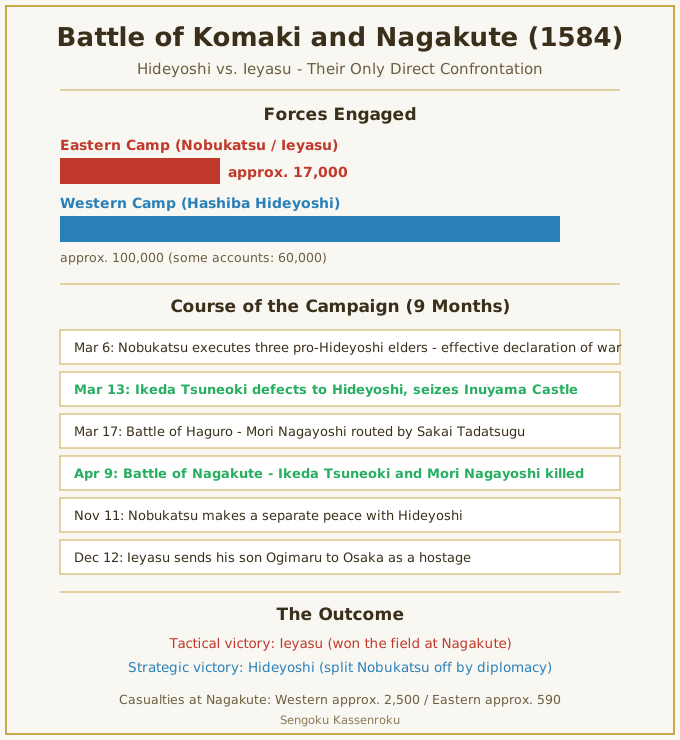
- A nationwide campaign in which Toyotomi Hideyoshi fought the allied forces of Tokugawa Ieyasu and Oda Nobukatsu for nine months over supremacy of the realm.
- In the main battle at Nagakute on the 9th day of the 4th month, Ieyasu crushed Hideyoshi’s army; senior Hideyoshi commanders including Mori Nagayoshi and Ikeda Tsuneoki were killed.
- Ieyasu won on the battlefield, but Hideyoshi – who drew Nobukatsu into a separate peace by diplomacy – became the political victor, and Ieyasu handed over his second son Ogimaru as a hostage.
The Established Account – The Textbook Version
Why the War Broke Out
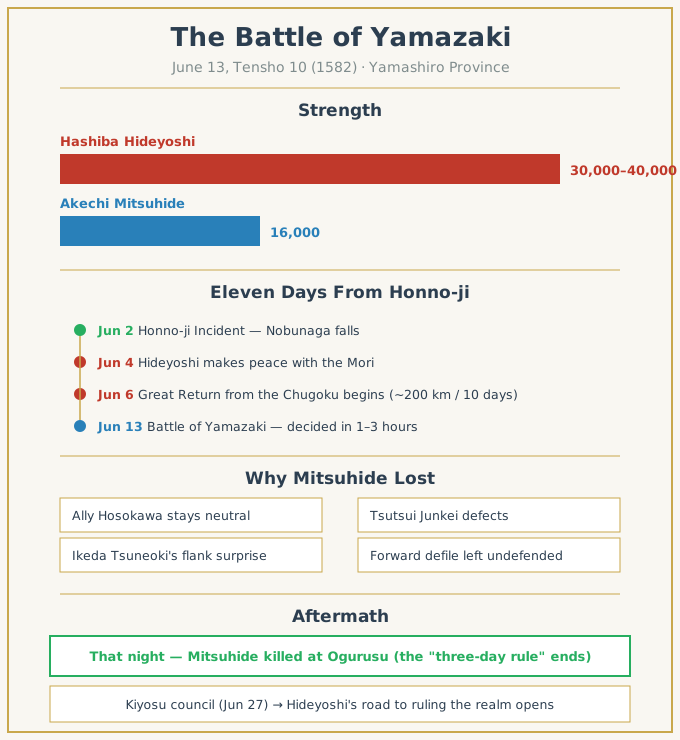
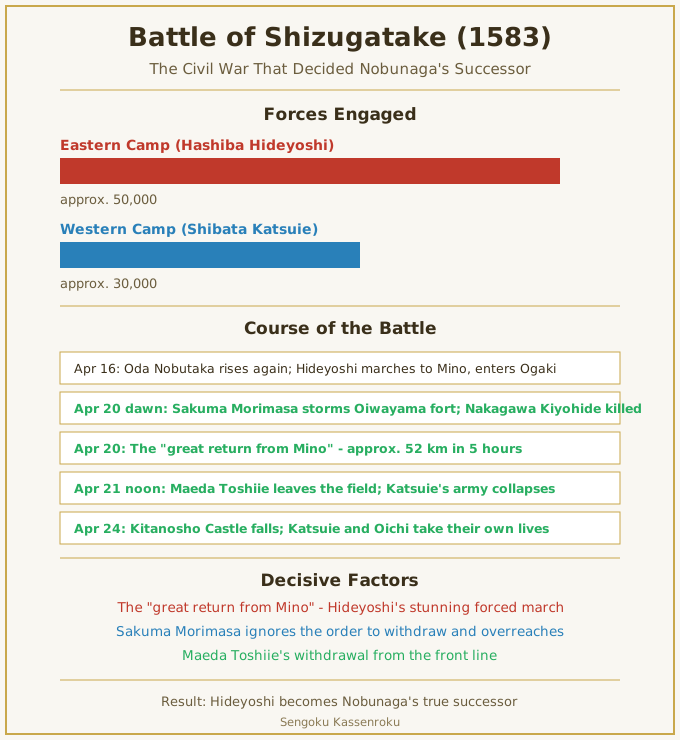
After Oda Nobunaga fell in the Honnō-ji Incident of the 6th month of Tenshō 10 (1582), the struggle over supremacy of the Oda house intensified. Hashiba Hideyoshi (the later Toyotomi Hideyoshi) destroyed Akechi Mitsuhide at the Battle of Yamazaki, and at the Kiyosu Conference he installed Nobunaga’s infant grandson Sanbōshi (the later Oda Hidenobu) as heir. The following year, at the Battle of Shizugatake in Tenshō 11 (1583), he defeated Shibata Katsuie, securing his position as the foremost of Nobunaga’s former retainers.
At first Hideyoshi outwardly served Nobunaga’s second son Oda Nobukatsu as the nominal lord and successor to Nobunaga. But as Hideyoshi’s influence grew with the advance of unification, his relationship with Nobukatsu soured. In Tenshō 11 (1583) Nobukatsu was forced out of Azuchi Castle by Hideyoshi, and the antagonism between them became decisive. Hideyoshi won over three of Nobukatsu’s senior retainers – Tsugawa Yoshifuyu, Okada Shigetaka, and Asai Nagatoki – seeking to break Nobukatsu’s camp apart from within.
In response Nobukatsu allied with Tokugawa Ieyasu, who had been Nobunaga’s sworn ally. On the 6th day of the 3rd month of Tenshō 12 (1584), Nobukatsu summoned the three pro-Hideyoshi elders to Nagashima Castle and had them killed – in effect a declaration of war against Hideyoshi. Enraged, Hideyoshi resolved to subdue Nobukatsu, and so the Battle of Komaki and Nagakute began.
For Ieyasu, confronting Hideyoshi meant far more than simply backing Nobukatsu. During the turmoil after the Honnō-ji Incident, Ieyasu had carved out Shinano and Kai, growing into a great lord holding the five provinces of Mikawa, Tōtōmi, Suruga, Kai, and Shinano. Were Hideyoshi’s unification to advance, the loss of Ieyasu’s own independence would only be a matter of time. For Ieyasu, this was also a war to defend the independence of his house.
The campaign was no mere local fight over a single province of Owari. The Nobukatsu-Ieyasu camp joined with the Saika and Negoro mercenary bands of Kii, Chōsokabe Motochika of Shikoku, Sassa Narimasa of the Hokuriku, and Hōjō Ujimasa of the Kantō, forming an “encirclement of Hideyoshi.” Hideyoshi in turn allied with the Mōri, the Satake, and the Utsunomiya, and the war grew to a nationwide scale. It was for this reason that the General Staff Office of the Meiji era called it the “Komaki campaign” – because it was understood not as a local clash but as a struggle for the whole realm.
The Course of the Battle
On the 13th day of the 3rd month of Tenshō 12 (1584), Ieyasu arrived at Kiyosu Castle leading some 15,000 men and joined Nobukatsu. That same day Ikeda Tsuneoki – a hereditary Oda retainer who had been expected to side with Nobukatsu – suddenly defected to Hideyoshi and seized Inuyama Castle. Detecting Ikeda’s move, Ieyasu entered Komakiyama Castle, south of Inuyama, on the 15th. Komakiyama Castle had once been built by Nobunaga and was a strategic strongpoint overlooking the Nōbi Plain.
On the 16th, Ikeda’s son-in-law Mori Nagayoshi led 3,000 men and encamped at Haguro, north of Komakiyama. Mori’s movement was quickly detected, and at dawn on the 17th, 5,000 of Ieyasu’s men under Matsudaira Ietada and Sakai Tadatsugu launched a surprise attack. Mori’s force was routed with over 300 dead (the Battle of Haguro / Battle of Hachiman-bayashi). For Mori Nagayoshi, feared as the “Demon Musashi,” it was a humiliating defeat in his opening engagement.
On the 21st, Hideyoshi set out from Osaka Castle leading 30,000 men and reached Inuyama on the 27th. On the 28th Ieyasu entered Komakiyama Castle and strengthened his defenses with forts and earthworks all around. On the 29th Hideyoshi made his headquarters at Rakuden Castle near Inuyama and likewise built up earthworks and forts. The disparity in numbers was overwhelming – Hideyoshi’s army of 100,000 (some accounts say 60,000) against the roughly 17,000 of the Nobukatsu-Ieyasu allied force. Yet despite the difference, both sides avoided a decisive engagement and settled into a standoff, and the front lines locked.
On the 4th day of the 4th month, Ikeda Tsuneoki is said to have visited Hideyoshi and proposed a plan to “raid Ieyasu’s home base of Mikawa” (debated below in the alternative theories). The reasoning was that striking Ieyasu’s home base would force him to leave Komakiyama to relieve it, opening a gap to exploit. On the night of the 6th, a detached column of some 20,000 men – a “central insertion” force – set out secretly toward Mikawa, with Hideyoshi’s nephew Hashiba Hidetsugu (the later Toyotomi Hidetsugu) as commander-in-chief and Ikeda Tsuneoki, Mori Nagayoshi, and Hori Hidemasa as deputy commanders. This was the “raid into Mikawa.”
Ieyasu, however, had detected the move early. By the 7th he had learned through local Iga men and farmers that Hidetsugu’s force had bivouacked near Shinoki. On the 8th, Ieyasu dispatched a vanguard of 4,500 under Mizuno Tadashige, Niwa Ujitsugu, Sakakibara Yasumasa, and Ōsuga Yasutaka to Obata Castle, and he himself, together with Nobukatsu, led 9,300 men out of Komakiyama Castle late at night. Arriving at Obata Castle in the dead of night, he held a council of war and resolved on a plan to split the enemy and destroy them piecemeal.
At dawn on the 9th, the decisive battle of Nagakute began. Ikeda Tsuneoki, at the head of the raiding column, attacked the Tokugawa-held Iwasaki Castle (castellan Niwa Ujishige). Ujishige and the Iwasaki garrison resisted fiercely and were killed to the last man, but their roughly three-hour delaying action enabled the Tokugawa pursuit (the Battle of Iwasaki Castle). At about the same time, the Tokugawa vanguard fell on Hashiba Hidetsugu’s unit while it was resting at Hakusanbayashi. Hidetsugu’s unit was shattered, and he barely escaped amid the chaos (the Battle of Hakusanbayashi). Hori Hidemasa’s unit, rushing to relieve Hidetsugu, defeated Sakakibara Yasumasa’s unit at Hinokigane, but on sighting the standards of Ieyasu’s main body decided to withdraw (the Battle of Hinokigane).
Left behind, the units of Ikeda Tsuneoki and Mori Nagayoshi turned their horses about and gave battle to Ieyasu’s main body. The forces were nearly even at 9,000 against 9,300, and at first it was a confused melee. But during the fighting that began around 10 a.m., Mori Nagayoshi was shot through the brow and killed by the gunners of Ii Naomasa’s unit under Ieyasu. Ikeda Tsuneoki then fell to the spear of Nagai Naokatsu, and his eldest son Ikeda Motosuke was cut down by Andō Naotsugu. His second son Ikeda Terumasa left the field at his retainers’ urging. Hideyoshi’s raiding column was annihilated. The fighting ended in about two hours in a great victory for Ieyasu; Hideyoshi’s side is said to have lost over 2,500 dead, the Tokugawa side over 590.
Receiving word of the Nagakute defeat, Hideyoshi rushed to the battlefield from the afternoon with 20,000 men. But Honda Tadakatsu obstructed Ieyasu’s movements with 500 men, and Ieyasu’s main body withdrew swiftly to Obata Castle, returning to Komakiyama Castle the next day. Hideyoshi gave up the pursuit and turned back to Rakuden.
The Aftermath
Having suffered a great defeat at Nagakute, Hideyoshi shifted the front to western Owari and intensified his invasion of Nobukatsu’s domain in Ise. Committing his own younger brother Hashiba Hidenaga and Gamō Ujisato, he steadily broke down Nobukatsu’s Ise holdings. Ieyasu, meanwhile, held Komakiyama Castle while advancing the construction of an encirclement around Hideyoshi and coordinating with anti-Hideyoshi forces in Kii, Shikoku, the Hokuriku, and the Kantō.
In the 6th month, Hideyoshi’s commanders Takigawa Kazumasu and Kuki Yoshitaka took the Tokugawa-held Kanie Castle (Owari), but Ieyasu retook it in only half a month (the Battle of Kanie Castle). In the 8th month Hideyoshi’s side attacked the Tokugawa around Rakuden but could not land a decisive blow (the Battle of Rakuden Castle), and the front lines saw repeated small clashes that swayed back and forth. Over nine months, the number of engagements is said to have reached as many as 36.
Hideyoshi set out from Rakuden Castle on the 1st day of the 5th month and advanced toward Owari, but, blocked by Ieyasu’s solid defenses and unable to force a decisive battle, he changed his strategy. From the 9th month on, Hideyoshi began in earnest to break Nobukatsu away. In Ise, Gamō Ujisato took Matsugashima Castle and laid siege to Toge Castle, and Nobukatsu’s territory was steadily whittled down.
On the 11th day of the 11th month (the 12th by one account), Nobukatsu concluded a separate peace with Hideyoshi on condition that his domain be guaranteed. The terms were that he hand over a hostage and cede Ise and Iga, except for northern Ise. Because Nobukatsu had been the very pretext for “the cause to fight Hideyoshi,” his departure was a bitter blow for Ieyasu. Ieyasu too lost the meaning of continuing the war and returned to Mikawa on the 17th.
On the 12th day of the 12th month, Ieyasu sent his second son Ogimaru (aged 11, the later Yūki Hideyasu) to Osaka as Hideyoshi’s adopted son – in effect a hostage – and peace between the Tokugawa and Hideyoshi was concluded. The natural son of Ieyasu’s senior retainer Ishikawa Kazumasa and others were made to accompany him. The nine-month campaign had thus reached a provisional end.
After making separate peace with both Nobukatsu and Ieyasu, Hideyoshi destroyed the isolated anti-Hideyoshi forces one by one. In the 3rd month of Tenshō 13 (1585) he subdued the Saika and Negoro bands of Kii (the Kii campaign), in the 6th month he forced the surrender of Chōsokabe Motochika of Shikoku (the Shikoku campaign), and Sassa Narimasa of the Hokuriku surrendered the following 8th month. In the 7th month of that year Hideyoshi was appointed Imperial Regent (kanpaku), establishing his position as ruler of the realm in name and substance.
Ieyasu continued to refuse submission to Hideyoshi thereafter, but Hideyoshi pursued an extraordinary policy of conciliation: in Tenshō 14 (1586) he married his younger sister Asahi-hime to Ieyasu, and went so far as to send his own mother, Ōmandokoro, to Ieyasu as a hostage. In the 10th month of that year Ieyasu finally had an audience with Hideyoshi at Osaka Castle and swore to become his vassal. More than four years after the Honnō-ji Incident, the struggle over Nobunaga’s succession had been settled in Hideyoshi’s favor.
Rai San’yō wrote in his Nihon Gaishi: “His Lordship (Ieyasu) won the realm not at Osaka but at Sekigahara, and not at Sekigahara but at Komaki.” For Ieyasu, the Battle of Komaki and Nagakute was the decisive campaign in which he fought Hideyoshi to an even draw, preserved the independence of his house, and laid the foundation for his later seizure of the realm.
→ For details, see the battle article “Battle of Sekigahara.”
Alternative Theories – Exploring Other Angles
[Theory 1] Is the framing “Ieyasu won the field, Hideyoshi won the diplomacy” sound?
In recounting the outcome of the Battle of Komaki and Nagakute, the framing “Ieyasu won the field, Hideyoshi won the diplomacy” has been used almost as a fixed formula. It holds that while Ieyasu achieved a dramatic victory in the main battle at Nagakute, Hideyoshi – who drew Nobukatsu into a separate peace – became the political victor.
The “Ieyasu’s victory” view (the old standard account)
From the fact that many of Hideyoshi’s senior commanders, including Ikeda Tsuneoki and Mori Nagayoshi, were killed at Nagakute while Ieyasu himself returned unharmed, the view that it was a great tactical victory for Ieyasu has long been entrenched. The war tales based on the Edo-period Tokugawa historical outlook strongly emphasized praise of Ieyasu’s valor. Rai San’yō’s Nihon Gaishi, writing that “His Lordship won the realm… not at Sekigahara but at Komaki,” lies in the line of this Ieyasu-victory argument.
The “Hideyoshi’s strategic victory” view
Recent research strongly favors separating tactical victory from strategic victory. Looking at the final peace terms, Nobukatsu ceded Iga and half of Ise and handed over a hostage. Ieyasu too sent his second son Ogimaru to Osaka as Hideyoshi’s adopted son (in effect a hostage). Weighing these one-sided peace terms heavily, an interpretation can be made that this was a defeat for the Oda-Tokugawa allied side. Recent discussions by some historians point out that “many now regard it as a defeat for the Oda-Tokugawa allied side.”
Surveying the campaign as a whole, Hideyoshi’s side had subdued all anti-Hideyoshi forces by the 8th month of Tenshō 13, and Hideyoshi became Imperial Regent in the 7th month of that year. Ieyasu too ultimately submitted to Hideyoshi in Tenshō 14. From the standpoint of long-term strategy, it can only be called Hideyoshi’s complete victory.
The “an even fight” view
On the other hand, there is a view that stresses the fact that, in contrast to Shibata Katsuie who was destroyed at Shizugatake, Ieyasu was able to make peace with Hideyoshi on what could be called “nearly equal” terms. It was two years later, in Tenshō 14, that he submitted directly to Hideyoshi, and in the meantime he maintained his standing as an independent great lord. The foundation that allowed Ieyasu to take the realm at the later Battle of Sekigahara was built precisely on this “peace among equals.”
In conclusion, the framing “Ieyasu won the field, Hideyoshi won the diplomacy” is easy to grasp and contains a measure of truth. But viewing the strategic settlement of the whole campaign, Hideyoshi’s advantage was all but unshaken, and the more realistic assessment may be that Ieyasu was simply “a defeated party that escaped destruction.”
[Theory 2] Who proposed the “raid into Mikawa”?
The originator of the “raid into Mikawa” – the plan to commit a detached column in a surprise attack on Ieyasu’s home base, which became the decisive turning point at Nagakute – has long been debated.
The Ikeda Tsuneoki theory (the standard account since the Edo period)
Since the Taikōki (by Oze Hoan), the raid into Mikawa has been treated as a plan proposed to Hideyoshi by Ikeda Tsuneoki. After his son-in-law Mori Nagayoshi suffered a great defeat at the Battle of Haguro, Ikeda and Mori, seeking to avenge it, are said to have proposed a “surprise raid on Mikawa in Ieyasu’s absence,” which Hideyoshi reluctantly permitted – a dramatic storyline. The Edo-period war tales and the Meiji General Staff Office’s Nihon Senshi adopted this view, and it became the textbook standard.
The Hideyoshi theory (a leading recent view)
In recent years, however, doubts have been raised about the Ikeda theory. The Taikōki is heavily colored by the glorification of Hideyoshi, and casting Hideyoshi himself as one who “reluctantly permitted” the plan served a political purpose: shifting the responsibility for the failure onto Ikeda. A rigorous examination of the primary sources, it is increasingly argued, makes it more natural to think that Hideyoshi himself conceived the surprise raid on Mikawa and put it into action.
According to the military historian Miki Seiichirō, the order of battle (operational plan document) that Hideyoshi drew up for the Battle of Komaki and Nagakute is known as one of the earliest systematic operational documents of the Sengoku period. These orders of battle, preserved in the Maeda family documents and the documents held by Keiō University, show that Hideyoshi was a meticulous planner of operations. It is highly likely that the plan to strike Ieyasu’s home base also arose from Hideyoshi’s own strategic judgment.
There is circumstantial evidence reinforcing the Hideyoshi theory as well. When Hideyoshi set out from Osaka, he had received intelligence that the Negoro band might attack Osaka in his absence. The interpretation is that impatience with the prolonged standoff and wariness of disruption in his rear drove Hideyoshi to gamble on the surprise raid into Mikawa.
That said, the possibility that Ikeda Tsuneoki was involved in the proposal cannot be entirely ruled out. At the time, Ikeda was holding Inuyama Castle for Hideyoshi and was the most familiar with the local geography and situation. Even if the ultimate originator was Hideyoshi, it is entirely possible that Ikeda’s counsel and his concrete proposal of the route formed the framework of the plan.
[Theory 3] Nine months, 36 engagements – “Komaki and Nagakute” was not a one-day battle
When people hear “the Battle of Komaki and Nagakute,” many tend to picture only the main battle at Nagakute on the 9th day of the 4th month. In reality the campaign was a protracted one spanning nine months, from the 3rd to the 11th month of Tenshō 12 (1584), and as many as 36 engagements were recorded across the country.
The principal engagements were as follows.
- Battle of Haguro (3rd month, 17th) – Mori Nagayoshi defeated by Sakai Tadatsugu and others
- The Komaki-Rakuden standoff (late 3rd month to 4th month) – the two armies face off
- Battle of Iwasaki Castle (4th month, 9th) – Ikeda Tsuneoki takes Iwasaki Castle
- Battle of Hakusanbayashi (4th month, 9th) – Hashiba Hidetsugu’s unit surprised and shattered
- Battle of Hinokigane (4th month, 9th) – Hori Hidemasa repels Sakakibara Yasumasa
- Main battle of Nagakute (4th month, 9th) – Ikeda Tsuneoki and Mori Nagayoshi killed
- Battle of Kanie Castle (6th month) – Ieyasu retakes the castle from Hideyoshi’s Takigawa Kazumasu
- Battle of Rakuden Castle (8th month) – skirmishing in Owari
- Battle of Toge Castle (4th to 10th month) – a prolonged struggle in Ise
- Battle of Matsugashima Castle (4th month) – a Hideyoshi victory in Ise
Furthermore, in the Hokuriku there was the fighting between Sassa Narimasa and Maeda Toshiie and Uesugi Kagekatsu; in Shikoku, Chōsokabe Motochika’s pacification of Sanuki (the second Battle of Sogō Castle, 6th month); and in the Kantō, the Battle of Numajiri between Hōjō Ujinao and Satake Yoshishige and Utsunomiya Kunitsuna (5th to 8th month). The campaign reached a nationwide scale. Chōsokabe Motochika received a request from Ieyasu to “attack Awaji, Settsu, and Harima,” and Hideyoshi, fearing the situation in Shikoku, even returned to Osaka during the campaign.
The reason the Meiji General Staff Office called it the “Komaki campaign” is that it was properly a large-scale campaign that should be called “the Tōkai campaign of Tenshō 12.” The name “Battle of Komaki and Nagakute” is, so to speak, a “condensed designation” that arose because the dramatic outcome of the main battle at Nagakute was so strongly remembered.
Whereas the fighting time of the main battle at Nagakute was only about two hours, the campaign as a whole lasted nine months. Without grasping this relationship between “the point and the line,” the true nature of the Battle of Komaki and Nagakute cannot be seen.
[Theory 4] How Mori Nagayoshi and Ikeda Tsuneoki died – folding screens versus primary sources
The deaths of Mori Nagayoshi and Ikeda Tsuneoki in the main battle at Nagakute are among the most famous scenes in the history of Sengoku warfare. Yet the specific circumstances of their deaths differ depending on the source.
The death of Mori Nagayoshi
As for Mori Nagayoshi’s death, the “Folding Screen of the Battle of Komaki and Nagakute” held by the Hakutei Bunko of Inuyama Castle depicts the scene in which he is shot through the brow by Ieyasu’s gunners. Nagayoshi is said to have charged toward Ieyasu’s headquarters wearing dark-blue-laced black-leather armor and a white-and-gold-brocade surcoat, with a helmet bearing deer-antler crests, crying out, “Now is the time to wipe away the shame of the Battle of Haguro. Aim only for Ieyasu’s head” (materials of the Nagakute local history research society).
The marksmen are said to have been the gunners of Ii Naomasa’s unit under Ieyasu. In this battle Ii Naomasa made his first appearance in arms wielding the “red regiment” and is said to have earned the epithet “the Red Demon of Ii.” By contrast, the “Folding Screen of the Battle of Komaki and Nagakute” held by the Nagoya City Museum omits the scene of Mori Nagayoshi being shot through the brow, showing that the scenes depicted were selected according to the editorial policy of each picture scroll.
The death of Ikeda Tsuneoki
Ikeda Tsuneoki is said to have fallen to the spear of Nagai Naokatsu. The “Folding Screen of the Battle of Komaki and Nagakute” (held by the Naruse family) depicts Nagai Denpachi (Nagai Naokatsu), who struck down Ikeda Tsuneoki, stripping off Tsuneoki’s black cape and wrapping the head in it.
Tsuneoki’s eldest son Ikeda Motosuke was cut down by Andō Naotsugu. His second son Ikeda Terumasa (then 23) was told by his retainers that “your father and brother have already left the field” and so departed and survived. Terumasa later became the founder of the Ikeda house of Okayama domain, growing into a lord great enough to be called “the Shogun of the West.” For the Ikeda house, Nagakute was both a defeat in which they lost father and elder son and, at the same time, the turning point at which Terumasa restored the family.
These folding screens are secondary records produced in the Edo period and do not perfectly reproduce the precise combat situation of the time. For instance, whether the gunners who shot Nagayoshi were “Ii’s unit” or “the gunners of Ieyasu’s main body” wavers in expression from source to source. With primary sources scarce, the descriptions in folding screens and war tales must be read with care.
[Theory 5] Was Nobukatsu’s separate peace a “betrayal”?
On the 11th day of the 11th month (the 12th by one account), Nobukatsu made a separate peace with Hideyoshi on condition that his domain be guaranteed. With this, Ieyasu lost “the cause to fight Hideyoshi” and returned to Mikawa on the 17th. For Ieyasu, Nobukatsu’s departure was in effect having the ladder pulled out from under him. This separate peace by Nobukatsu has often been harshly criticized in later ages as “betrayal” and “an act of cowardice.”
The “Nobukatsu the incompetent traitor” view
In assessments based on the Edo-period Tokugawa historical outlook, Nobukatsu is often portrayed as “an incompetent unworthy of being a lord” and “the man who betrayed Ieyasu.” Indeed, though Nobukatsu was the very originator of the war’s pretext, he yielded readily to Hideyoshi’s conciliation and agreed to a separate peace. Within the Tokugawa house, a disposition to scorn Nobukatsu is said to have taken hold after this affair.
The “Nobukatsu’s rational judgment” view (a recent reassessment)
Yet there is also a view that condemning Nobukatsu’s separate peace as “betrayal” is one-sided. At the time, Nobukatsu’s holdings were the three provinces of Ise, Owari, and Iga, but the invasion of Hideyoshi’s army had occupied all of Iga and more than half of Ise. Hideyoshi’s peace terms – ceding Iga and half of Ise out of the occupied lands, the rest guaranteed – could in light of the military situation even be called “relatively lenient.”
From the 9th month, when Nobukatsu’s separate peace took shape, the Ieyasu-Nobukatsu alliance had been forced onto the defensive against Hideyoshi’s army under Gamō Ujisato in Ise. In the 9th-month Battle of Toge Castle, Ieyasu’s relief force and Hideyoshi’s army fought, and Hideyoshi’s army won. Had the war continued, Nobukatsu’s territory would only have been further reduced, and the prospects were poor for Ieyasu as well. Nobukatsu’s judgment was a realist choice that gave top priority to the survival of his house.
Moreover, Ieyasu himself sent his second son Ogimaru to Hideyoshi the following 12th month and concluded a separate peace, so the framing that “only Nobukatsu betrayed” is not accurate. Both men, recognizing the impossibility of continuing the war, drew out the best peace terms each could.
The skill of Hideyoshi’s conciliation
Another important point is the skill of Hideyoshi’s conciliation. Hideyoshi presented Nobukatsu with the comparatively gentle condition of “guaranteeing his domain” and drew him into peace. By this he erased Ieyasu’s pretext for continuing the war, and his strategy of isolating the Tokugawa succeeded brilliantly. It was the very essence of the diplomatic skill called Hideyoshi’s “way of winning people over.”
Rather than simply condemning Nobukatsu as a “traitor,” it is more historically sound to see it as “Nobukatsu making a realistic choice in the face of Hideyoshi’s strategic diplomacy.”
[Theory 6] The hostage Ogimaru (Yūki Hideyasu) – humiliation or strategy?
After the peace, Ieyasu sent his second son Ogimaru (aged 11, the later Yūki Hideyasu) to Osaka as Hideyoshi’s adopted son (in effect a hostage). The natural son of the senior retainer Ishikawa Kazumasa and others were made to accompany him. For a long time, Ogimaru’s being sent as a hostage was spoken of as “Ieyasu’s humiliation” and “proof that he submitted to Hideyoshi.”
The “Ieyasu’s humiliation” view
The fact that Ieyasu, victorious on the field, ended up handing over his second son as a hostage can indeed be called “a symbol of defeat for Ieyasu.” When Hideyoshi took in Ogimaru as his adopted son, he had him take the name “Hashiba Hideyasu.” The character “Hide” was from Hideyoshi and “Yasu” from Ieyasu – a naming that symbolized the relationship between the two houses. Among the hawks of the Tokugawa house, this hostage-giving bred strong dissatisfaction.
The “Ieyasu’s strategic judgment” view
Yet there is also a view that Ieyasu’s decision to give Ogimaru as a hostage was, in light of the situation, eminently rational. First, the moment Nobukatsu made his separate peace, Ieyasu had completely lost his pretext for continuing the war. Second, by proposing reconciliation himself before Hideyoshi set the Tokugawa as his next target, he could forestall an attack. Third, if a formal concession in the form of a hostage would suffice, then the favorable condition was that his domain would be fully guaranteed.
Worth noting is that the one chosen as hostage was neither his heir Nobuyasu (already dead) nor his third son Hidetada (the later second shogun), but his second son Ogimaru. There is a theory that Ogimaru was a child not much favored by Ieyasu (there is even an anecdote that Ieyasu at first would not acknowledge the pregnancy of Ogimaru’s mother, Lady Oman). It is said there was a cold calculation on Ieyasu’s part: “the true heir who will carry the next generation of the Tokugawa house is not sent as a hostage.”
Ogimaru (Yūki Hideyasu) thereafter
Ogimaru was raised in Osaka as Hideyoshi’s adopted son, but when Hideyoshi’s own sons Tsurumatsu (who died young) and Hideyori were born, he was sent out as an adopted son to the Yūki house. Taking the name Yūki Hideyasu, he sided with the Eastern Army under his father Ieyasu at the Battle of Sekigahara and was granted Echizen, worth 670,000 koku, after the war. After Ieyasu’s death he led an ill-starred life, but his descendants survived throughout the Edo period as the Echizen-Matsudaira house. In the end, “Ieyasu’s second son who was given as a hostage” left his family name as one branch of the Tokugawa kin.
For Ieyasu, giving Ogimaru as a hostage was a strategic concession to protect the Tokugawa house. On the surface it was “humiliation,” but seen over the long term, Ieyasu’s judgment was entirely correct. The very reason Ieyasu could take the realm at Sekigahara after Hideyoshi’s death was that he had preserved the strength of the Tokugawa house through this seemingly “humiliating” peace.
A Strategic View
Surveying the Battle of Komaki and Nagakute strategically, one sees a campaign extremely singular even in Sengoku history, in which tactical and strategic victory were neatly separated. There are four points worth noting.
First, the brilliance of Ieyasu’s “defensive strategy.” Ieyasu faced a battle of overwhelming numerical inferiority, pitting an allied force of 10,000 Nobukatsu men plus 15,000 Tokugawa against Hideyoshi’s army of 100,000 (some accounts say 60,000). Even so, Ieyasu built a solid position at Komakiyama Castle and brought matters into a war of endurance without being forced into a decisive engagement. Moreover, against Hideyoshi’s all-or-nothing gamble of the raid into Mikawa, he got ahead of it through an intelligence network using Iga men and farmers, and won a flawless victory at Nagakute. This may be called a battle in which “the sense of unity with retainers and people” learned from Takeda Shingen, and “the lesson of defeat” tasted in his youth at the Battle of Mikatagahara, came to fruition.
Second, the skill of Hideyoshi’s “diplomatic strategy.” The moment Hideyoshi judged that he could not defeat Ieyasu on the field, he shifted the front to Ise and ate away at Nobukatsu’s domain. At the same time, he advanced the breaking-apart and conciliation of Nobukatsu’s house and finally drew Nobukatsu into a separate peace. His skill in isolating the Tokugawa with the single stroke of erasing Ieyasu’s “pretext for continuing the war” was masterful. Through this battle, it may be said, Hideyoshi shifted his strategy from “unification of the realm by force” to “unification of the realm by diplomacy.”
Third, the nationwide interconnection of the campaign. The Battle of Komaki and Nagakute was a campaign of the “encirclement of Hideyoshi” linked across Kii, Shikoku, the Hokuriku, and the Kantō. Ieyasu requested Chōsokabe Motochika to “attack Awaji, Settsu, and Harima” and sought to coordinate with Sassa Narimasa, Hōjō Ujimasa, and others. Hideyoshi in turn allied with the Mōri, the Satake, and the Utsunomiya to hold them in check. Over the nine-month campaign, both camps employed every means of diplomatic war, intelligence war, and economic war. It was also the first campaign in which Hideyoshi’s operational planning documents (orders of battle) were systematically prepared – a turning point at which Hideyoshi’s capacity for organized warfare advanced dramatically.
Fourth, the movements of former Oda retainers such as Ikeda Tsuneoki and Mori Nagayoshi. Ikeda Tsuneoki was a heavyweight among Nobunaga’s former retainers and had been expected to side with Nobukatsu before the war. His defection to Hideyoshi at the last moment and his seizure of Inuyama Castle utterly transformed the structure of the campaign. This was also an answer to the greatest problem after the Honnō-ji Incident – how Hideyoshi was to absorb the former Oda retainers. Hideyoshi succeeded in taking in Nobunaga’s surviving retainers as “pieces for unifying the realm,” but the deaths of leading commanders such as Ikeda and Mori were also a heavy loss. It may be said that the human resources Hideyoshi lost in this campaign were a foreshadowing of the fragility of the later Regent’s regime.
The greatest lesson Ieyasu drew from this battle was the cold recognition that “winning on the field and winning by strategy are different things.” Ieyasu spent the next 16 years as Hideyoshi’s vassal, and during that time he continued to husband his economic and military strength, until at last he took the realm at Sekigahara. Komaki and Nagakute was, for Ieyasu, the battle in which he learned “the art of surviving as a defeated party.” That Rai San’yō wrote, “His Lordship won the realm not at Sekigahara but at Komaki,” is precisely because the “strategy of patience” that Ieyasu acquired at Komaki was the origin of his eventual seizure of the realm.
Famous Words from This Battle
“His Lordship won the realm not at Osaka but at Sekigahara, and not at Sekigahara but at Komaki.”
An assessment of Ieyasu recorded by the late-Edo Confucian scholar Rai San’yō in his Nihon Gaishi. It means that the true starting point of Ieyasu’s seizure of the realm was neither the Siege of Osaka nor Sekigahara, but the Battle of Komaki and Nagakute. The insight is that it was precisely his fighting Hideyoshi – of overwhelmingly greater numbers – to an even draw and defending the independence of his house that was the origin of Ieyasu’s mastery of the realm.
— Source: Rai San’yō, Nihon Gaishi
“Now is the time to wipe away the shame of the Battle of Haguro. Aim only for Ieyasu’s head.”
Words said to have been cried out by Mori Nagayoshi just before charging Ieyasu’s headquarters in the main battle at Nagakute. To clear away the humiliation of his defeat by Sakai Tadatsugu and others at the Battle of Haguro on the 17th of the 3rd month, where he lost over 300 men, Nagayoshi had resolved to aim only for Ieyasu’s head. Charging in dark-blue-laced black-leather armor and a white-and-gold-brocade surcoat, with a helmet bearing deer-antler crests, Nagayoshi was shot through the brow by the gunners of Ii Naomasa’s unit and killed.
— Source: materials of the Nagakute local history research society / “Folding Screen of the Battle of Komaki and Nagakute,” Hakutei Bunko of Inuyama Castle
“The lord of Mikawa, having gained this victory, withdrew to his own castle, but Hashiba at once surrounded him with twenty thousand men.”
A passage from a 1584 letter of Luís Fróis recording the movements of Ieyasu and Hideyoshi after the main battle at Nagakute. Having won a great victory at Nagakute, Ieyasu at once withdrew to Komakiyama Castle, and the pursuing Hideyoshi surrounded it with 20,000 men. It is a valuable contemporary source recording Ieyasu’s swift decision to withdraw, Hideyoshi’s quick response, and the tactical maneuvering of the two.
— Source: Luís Fróis, Letter of 1584
“He feels no responsibility for letting two retainers be killed. He should henceforth use better judgment so as not to pile shame upon shame.”
A passage from a letter of admonition that Hideyoshi sent to his nephew Hashiba Hidetsugu (aged 16) on the 23rd day of the 9th month of Tenshō 12 (1584), half a year after the defeat at Nagakute. To Hidetsugu, who had fled the Battle of Hakusanbayashi and let two retainers be killed, Hideyoshi sent a letter of severe rebuke. He also pointed out his poor everyday conduct, while writing, “When you come to be called a full-grown man, I will advance you” – revealing Hideyoshi’s complex feelings, a mixture of expectation and disappointment toward the upbringing of his heir.
— Source: Letter of admonition by Hideyoshi, dated 9th month, 23rd day, 1584
Anecdotes and Episodes
Ikeda Tsuneoki’s defection – from the Nobukatsu camp to the Hideyoshi camp
Ikeda Tsuneoki was a foster-brother of Oda Nobunaga and a heavyweight hereditary Oda retainer. At the Kiyosu Conference after the Honnō-ji Incident he was one of the “four senior elders,” alongside Shibata Katsuie, Niwa Nagahide, and Hashiba Hideyoshi. Before the war, Ikeda was naturally expected to side with Nobukatsu. Indeed, his holdings were in Settsu and Osaka, and given that he had been granted Mino after the Honnō-ji Incident, his ties to Nobukatsu as a central figure of the Oda house should have been strong.
Yet on the 13th day of the 3rd month of Tenshō 12, the same day Ieyasu arrived at Kiyosu Castle, Ikeda suddenly defected to Hideyoshi and seized Inuyama Castle. With this defection, the Nobukatsu-Ieyasu camp lost almost all of the Mino men early on. Behind Ikeda’s judgment are said to have been the obligation of having been granted Mino province by Hideyoshi, the circumstance that his son-in-law Mori Nagayoshi (the “Demon Musashi”) was active for Hideyoshi, and a realism that coolly assessed Hideyoshi’s momentum after Shizugatake.
Ironically, by this “correct choice” Ikeda took part in the raid into Mikawa as a central figure of the Hideyoshi side and lost his life at Nagakute. Only his second son Ikeda Terumasa survived, later restoring the house as the Ikeda of Okayama domain. It can be called an irony of history.
— Source: Shinchō Kōki, Taikōki, Ikeda Family Documents
Ieyasu’s use of the Iga men – the moment the “Iga crossing” paid off
The detection of the raid into Mikawa was a crystallization of the brilliance of Ieyasu’s intelligence war. Ieyasu had already grasped Hidetsugu’s movements by the 7th day of the 4th month and responded swiftly. The intelligence source that draws attention is the Iga men.
Immediately after the Honnō-ji Incident, when Ieyasu escaped from Sakai to Mikawa, he made his way through the mountains of Iga and returned home by a hair’s breadth (the “Iga crossing of the divine lord”). At that time, it was the rural warriors of Iga who saved Ieyasu. Ieyasu did not forget this obligation; after the incident he took the Iga men into his service as retainers and used them as a covert organization. In the Battle of Komaki and Nagakute, the Iga men reported Hideyoshi’s movements to Ieyasu in detail. Their intelligence network made the early detection of the raid into Mikawa possible.
Ieyasu’s “intelligence war” was not a mere military capability but the result of a long-term personnel strategy that turned past hardship into “human resources.” The hardship of the “Iga crossing” led to the victory at Nagakute only two years later.
— Source: Ietada Nikki, Mikawa Monogatari
Ii Naomasa’s “red regiment” first battle – the birth of the “Red Demon of Ii”
One who rose to fame at once in the Battle of Nagakute was Ii Naomasa (aged 24) under Ieyasu. In this battle Naomasa led former Takeda retainers incorporated into the Tokugawa after the fall of the Takeda house, and reproduced the Takeda tradition of the “red regiment” (a tactic of unifying all arms and armor in vermilion). It was the first battle of the “red regiment of Ii.”
The conspicuous red equipment on the field served as a symbol of the all-out assault of Ieyasu’s forces. It is said that it was the gunners of Naomasa’s unit who shot Mori Nagayoshi through the brow and killed him. From Nagakute on, Naomasa came to be called the “Red Demon of Ii,” a figure held in dread, and he was active as a vanguard at the Battle of Sekigahara as well.
The flamboyant red equipment was originally a tactic begun by Takeda Shingen’s retainer Obu Toramasa, a “visual production” to raise the morale of retainers on the field. By having Ii Naomasa inherit this tradition, Ieyasu both restored the morale of the former Takeda retainers and took the “Takeda legacy” into the Tokugawa army. Nagakute was a battle in which Ieyasu’s personnel strategy and the Takeda combat culture came beautifully to fruition.
— Source: Ii-ke Denki, Kaisei Mikawa Go-Fudoki
Honda Tadakatsu obstructs Hideyoshi’s 20,000 with 500 men
When Hideyoshi, receiving word of the defeat at Nagakute, set out with 20,000 men to pursue Ieyasu, it was Honda Tadakatsu who obstructed them with a mere 500. Tadakatsu took up a position on the line of Hideyoshi’s march and bought time for Ieyasu’s main body to withdraw to Obata Castle and Komakiyama Castle.
Hideyoshi is said to have been moved by Tadakatsu’s resolute conduct, remarking, “Does Ieyasu have such a retainer?” Indeed, Hideyoshi valued Tadakatsu highly, and later, under Hideyoshi’s regime, Tadakatsu continued to be active as a senior Tokugawa retainer. The valor of Tadakatsu, called “the peerless warrior of the east,” was proven at Nagakute.
To stand against the enemy, prepared to be sacrificed in order to protect a retreating lord, at the desperate odds of 500 against 20,000 – this was the very ideal of the Sengoku warrior. Through this battle Tadakatsu established a standing apart even among the Four Heavenly Kings of the Tokugawa.
— Source: Ietada Nikki, Kaisei Mikawa Go-Fudoki
→ For details, see the warlord article “Honda Tadakatsu.”
Niwa Ujishige of Iwasaki Castle – a 16-year-old’s defense to the death
At dawn on the 9th of the 4th month, Ikeda Tsuneoki, at the head of the raid into Mikawa, came up against the Tokugawa-held Iwasaki Castle (in present-day Nisshin City, Aichi Prefecture). The castellan, Niwa Ujishige, was only 16. Ujishige, the younger brother of Niwa Ujitsugu (who was with Ieyasu at Komakiyama Castle), held out for about three hours against Ikeda’s great army.
In the end Iwasaki Castle fell, and Ujishige and all the garrison were killed. But this three-hour delaying action made the Tokugawa pursuit possible. Ikeda and Mori’s raiding column ended up giving decisive battle to Ieyasu’s main body at Nagakute, which in turn led to Ieyasu’s great victory. Had it not been for the fierce resistance at Iwasaki Castle, the raid into Mikawa might have succeeded and Ieyasu might have lost Mikawa.
A young commander of 16 opened the road to Ieyasu’s mastery of the realm in exchange for his own life. The Battle of Iwasaki Castle is a heroic scene that remains in the history of Sengoku warfare. Today, a mock keep stands on the site of Iwasaki Castle, conveying the loyalty and valor of the garrison.
— Source: Iwasaki Jōsenki, Ietada Nikki
Ogimaru (Yūki Hideyasu) – the second son not loved by his father Ieyasu
Ogimaru, sent to Osaka as the hostage of the peace, was Ieyasu’s second son but is known for an ill-starred birth. His mother, Lady Oman, was a lady-in-waiting to Ieyasu’s principal wife Lady Tsukiyama; Ieyasu took up with her while Lady Tsukiyama’s eyes were averted, and she conceived. Ieyasu is said at first to have refused to acknowledge the pregnancy and to have kept Lady Oman at a distance.
Even after Ogimaru was born, Ieyasu long refused to meet his son. Ieyasu is said to have met Ogimaru for the first time when the boy was three, and even then through the mediation of his elder brother Nobuyasu (Ieyasu’s heir). There is even a popular tale that, because Ogimaru’s features were strange – a large mouth and a long face – he was named “Ogimaru” as resembling a fish (gi).
It is precisely because he was such a “second son not loved by his father,” some hold, that Ieyasu could send the 11-year-old Ogimaru as a hostage without hesitation. Ironically, Ogimaru was cherished in Osaka as Hideyoshi’s adopted son almost as if a real child, was granted Echizen worth 670,000 koku as the adopted son of the Yūki house, and his descendants survived throughout the Edo period as the Echizen-Matsudaira house. The boy not loved by Ieyasu ultimately left his family name as a heavyweight of the Tokugawa kin.
— Source: Matsudaira Hideyasu-kō Go-Ichidaiki, Tōdaiki
The will of the “Demon Musashi” Mori Nagayoshi – affection for his sister
Mori Nagayoshi was a fierce commander called the “Demon Musashi,” and also the elder brother of Mori Ranmaru, who died in the Honnō-ji Incident. Before setting out for Nagakute, Nagayoshi left a will to his younger sister Ofuku (the later Myōkō-ni). Its contents gave detailed instructions – “I am resolved not to return alive from this battle. Marry such-and-such a person, and take good care of our mother” – a calm preparation for his journey to death in anticipation of dying in battle.
It is an episode that reveals the unexpected family affection of a fierce commander feared as a “demon.” Nagayoshi did indeed fall at Nagakute, and as in his will his sister married into another house. The Mori house was succeeded by his younger brother Tadamasa and later continued as the lords of Tsuyama domain.
Even a fierce commander of the Sengoku age was, to his family, a father and brother full of humanity. Nagayoshi’s will shows the typical Sengoku warrior with two faces – cruelty on the field and gentleness at home.
— Source: Mori Family Documents, “Will of Mori Nagayoshi”
→ For details, see the warlord article “Mori Nagayoshi.”
Ieyasu has even Ōmandokoro taken hostage after the peace – Hideyoshi’s extraordinary measure
Even after the peace, Ieyasu continued to refuse submission to Hideyoshi. In Tenshō 14 (1586), Hideyoshi forcibly divorced his sister Asahi-hime (aged 44, who already had a husband) and married her to Ieyasu. Yet still Ieyasu did not submit.
At a loss, Hideyoshi finally resorted to the unprecedented measure of sending his own mother, Ōmandokoro (aged 70), to Ieyasu as a hostage. “The ruler of the realm sending his own mother as a hostage to a hostile lord” – this was an extraordinary situation without parallel in Sengoku history. Even Ieyasu yielded at this, and in the 10th month of that year he had an audience with Hideyoshi at Osaka Castle and declared himself a vassal.
If giving up Ogimaru as a hostage had been a humiliation for Ieyasu, then Hideyoshi’s sending his own mother as a hostage was, in a sense, the height of Hideyoshi’s conciliation, staging a “relationship among equals.” It is the very essence of Hideyoshi’s “way of winning people over,” an episode that shows the fine art of the two heroes’ maneuvering.
— Source: Ietada Nikki, Tōdaiki
Battle of Komaki and Nagakute – Timeline
| Date | Event |
|---|---|
| 6th month, Tenshō 10 (1582) | The Honnō-ji Incident. After Nobunaga’s death, the struggle over Oda supremacy begins in earnest |
| 4th month, Tenshō 11 (1583) | Hideyoshi defeats Shibata Katsuie at the Battle of Shizugatake. Hideyoshi’s supremacy is established |
| Tenshō 11 (1583) | Hideyoshi forces Nobukatsu out of Azuchi Castle. Relations between Nobukatsu and Hideyoshi sour |
| 3rd month, 6th, Tenshō 12 (1584) | Nobukatsu executes the three pro-Hideyoshi elders. An effective declaration of war |
| 3rd month, 13th | Ieyasu arrives at Kiyosu Castle and joins Nobukatsu. The same day, Ikeda Tsuneoki defects to Hideyoshi and seizes Inuyama Castle |
| 3rd month, 15th | Ieyasu enters Komakiyama Castle |
| 3rd month, 17th | Battle of Haguro: Sakai Tadatsugu, Matsudaira Ietada, and others surprise and rout Mori Nagayoshi |
| 3rd month, 21st-29th | Hideyoshi sets out from Osaka Castle with 30,000 men and makes his headquarters at Rakuden Castle |
| 4th month, 4th | Hideyoshi’s council of war. The raid into Mikawa is decided |
| Night of 4th month, 6th | Hashiba Hidetsugu, Ikeda Tsuneoki, Mori Nagayoshi, Hori Hidemasa, and others – some 20,000 – set out for Mikawa |
| Dawn, 4th month, 9th | Battle of Iwasaki Castle: Ikeda Tsuneoki takes Iwasaki Castle; castellan Niwa Ujishige and all the garrison killed |
| Dawn, 4th month, 9th | Battle of Hakusanbayashi: Hashiba Hidetsugu’s unit is surprised by the Tokugawa vanguard and shattered |
| Morning, 4th month, 9th | Battle of Hinokigane: Hori Hidemasa repels Sakakibara Yasumasa and others, but withdraws as Ieyasu’s main body approaches |
| 10 a.m., 4th month, 9th | Main battle of Nagakute: Ieyasu’s main body clashes with the Ikeda-Mori units. Mori Nagayoshi, Ikeda Tsuneoki, and Ikeda Motosuke killed |
| Afternoon, 4th month, 9th | Hideyoshi heads to the rescue with 20,000 but is obstructed by Honda Tadakatsu’s 500. Ieyasu withdraws to Obata Castle |
| 4th month, 10th | Ieyasu returns to Komakiyama Castle. Hideyoshi returns to Rakuden |
| 5th to 8th month | Fighting across Owari, Ise, the Hokuriku, Shikoku, and the Kantō links up (the Battle of Numajiri, the second Battle of Sogō Castle, and others) |
| 6th month | Battle of Kanie Castle. Ieyasu retakes the castle from Hideyoshi’s Takigawa Kazumasu within half a month |
| 9th month | At Toge Castle in Ise, Ieyasu’s relief force fights Gamō Ujisato; Hideyoshi’s army wins |
| 10th month, 15th | Hideyoshi is appointed Junior Fifth Rank, Lower Grade, Provisional Lesser Captain of the Left Guards by the court |
| 11th month, 11th | Nobukatsu makes a separate peace with Hideyoshi. Cedes Iga and half of Ise |
| 11th month, 17th | Ieyasu returns to Mikawa |
| 12th month, 12th | Ieyasu sends his second son Ogimaru (aged 11) to Osaka as a hostage. Peace between the Tokugawa and Hideyoshi is concluded |
| 3rd to 8th month, Tenshō 13 (1585) | Hideyoshi destroys anti-Hideyoshi forces piecemeal in the Kii, Shikoku, and Hokuriku campaigns |
| 7th month, Tenshō 13 (1585) | Hideyoshi is appointed Imperial Regent (kanpaku) |
| 10th month, Tenshō 14 (1586) | Ieyasu has an audience with Hideyoshi at Osaka Castle and becomes his vassal. The Toyotomi regime is established |
* Dates are given in the old (lunar) calendar. Row shading: yellow = major events; red = battle- or death-in-battle-related.
Key Figures of Both Armies
Eastern Army (Nobukatsu-Ieyasu allied force, approx. 17,000)
| Role | Figure | Summary |
|---|---|---|
| Commander-in-chief (nominal) | Oda Nobukatsu | Aged 26. Nobunaga’s second son. Allied with Ieyasu over the conflict with Hideyoshi. Ultimately left the front through a separate peace |
| Effective commander | Tokugawa Ieyasu | Aged 43. Made his headquarters at Komakiyama Castle and crushed the Ikeda-Mori units in the main battle at Nagakute |
| Four Heavenly Kings of the Tokugawa | Honda Tadakatsu | Aged 37. Obstructed Hideyoshi’s pursuing 20,000 with 500 men, ensuring Ieyasu’s withdrawal |
| Four Heavenly Kings of the Tokugawa | Sakai Tadatsugu | Aged 58. Routed Mori Nagayoshi at the Battle of Haguro, setting the early flow of the campaign |
| Four Heavenly Kings of the Tokugawa | Ii Naomasa | Aged 24. First battle of the “red regiment.” Shot and killed Mori Nagayoshi. Birth of the “Red Demon of Ii” |
| Four Heavenly Kings of the Tokugawa | Sakakibara Yasumasa | Aged 37. As vanguard, crushed Hashiba Hidetsugu’s unit at the Battle of Hakusanbayashi |
| Senior Tokugawa retainer | Ishikawa Kazumasa | Aged 52. Handled peace negotiations with Hideyoshi. Later defected to Hideyoshi |
| Senior Tokugawa retainer | Ōsuga Yasutaka | Advanced to Obata Castle as part of Ieyasu’s vanguard |
| Senior Tokugawa retainer | Mizuno Tadashige | Advanced to Obata Castle as part of Ieyasu’s vanguard |
| Tokugawa commander | Matsudaira Ietada | Routed Mori Nagayoshi at the Battle of Haguro. Left the diary Ietada Nikki |
| Castellan of Iwasaki | Niwa Ujishige | Aged 16. Fought Ikeda Tsuneoki at Iwasaki Castle and was killed with all his men after about three hours’ defense |
| Tokugawa commander | Nagai Naokatsu | Struck down Ikeda Tsuneoki with his spear in the main battle at Nagakute |
| Tokugawa commander | Andō Naotsugu | Cut down Ikeda Tsuneoki’s eldest son Motosuke in the main battle at Nagakute |
Western Army (Hideyoshi’s army, approx. 100,000; some accounts say 60,000)
| Role | Figure | Summary |
|---|---|---|
| Commander-in-chief | Toyotomi Hideyoshi (Hashiba) | Aged 47. Made his headquarters at Rakuden Castle and committed a great army of 30,000 rising to 100,000. Ultimately won by diplomacy |
| Commander of the raiding column | Hashiba Hidetsugu | Aged 16. Hideyoshi’s nephew. Commander-in-chief of the raid into Mikawa; routed at Hakusanbayashi and later disciplined |
| Senior Hideyoshi retainer | Hashiba Hidenaga | Aged 45. Hideyoshi’s younger brother. Led operations on the Ise front |
| Deputy of the raiding column | Ikeda Tsuneoki | Aged 49. A heavyweight hereditary Oda retainer. After seizing Inuyama Castle, killed at Nagakute |
| Deputy of the raiding column | Mori Nagayoshi | Aged 27. The “Demon Musashi.” Ikeda Tsuneoki’s son-in-law. Killed at Nagakute while seeking to avenge his defeat at Haguro |
| Deputy of the raiding column | Hori Hidemasa | Aged 31. A young commander trusted by Hideyoshi. Repelled Sakakibara Yasumasa at Hinokigane but withdrew on sighting Ieyasu’s main body |
| Raiding column | Ikeda Motosuke | Ikeda Tsuneoki’s eldest son. Killed at Nagakute alongside his father |
| Raiding column | Ikeda Terumasa | Aged 23. Tsuneoki’s second son. Left the field at his retainers’ urging, survived, and later became lord of Okayama domain |
| Ise front | Gamō Ujisato | Aged 29. Took Matsugashima Castle and besieged Toge Castle on the Ise front |
| Hideyoshi commander | Katō Kiyomasa | Aged 23. Took part as one of Hideyoshi’s hand-raised commanders |
| Hideyoshi commander | Kuroda Kanbei | Aged 39. Took part as Hideyoshi’s strategist |
| Hideyoshi commander | Hosokawa Tadaoki | Aged 22. Took part on the Hideyoshi side |
| Kanie front | Takigawa Kazumasu | Aged 60. Briefly seized Kanie Castle but had it retaken by Ieyasu within half a month |
Historic Sites Map and Model Travel Course
Historic Sites Map – Battle of Komaki and Nagakute
Spots on the map:
- Komakiyama Castle ruins (castle) – Ieyasu’s headquarters. He encamped on Mount Komaki, built up by Nobunaga
- Rakuden Castle ruins (castle) – Hideyoshi’s headquarters. Today only a stone monument remains, within the grounds of Rakuden Elementary School
- Inuyama Castle (castle) – the northern strongpoint seized by Ikeda Tsuneoki. One of the twelve surviving original keeps
- Nagakute Old Battlefield Park (old battlefield) – the decisive ground of the main battle on the 9th of the 4th month. Mori Nagayoshi’s grave, the “Musashi mound,” is here
- Iroganeyama Historical Park (old battlefield) – the site where Ieyasu held his council of war. The “camp-stool stone” remains
- Iwasaki Castle ruins (castle) – the castle Niwa Ujishige defended to the death. A mock keep and a history museum stand here
- Obata Castle ruins (castle) – the base where Ieyasu assembled before the main battle. Today only a stone monument remains
- Kiyosu Castle (castle) – the base where Ieyasu and Nobukatsu joined forces. A mock keep stands here
- Gifu Castle (castle) – the base of Ikeda Tsuneoki and Motosuke (after their deaths, succeeded by his son Terumasa)
- Hamamatsu Castle (castle) – Ieyasu’s base. The place from which he set out
* The map is a reference display based on present-day roads. It differs from the roads and terrain of the Sengoku period.
📍 View the route on Google Maps (car / train toggle available)
Model Travel Course – Battle of Komaki and Nagakute – Touring a nine-month campaign in one day
Premises
- Time required: about 6-7 hours (by car)
- Walking speed: about 4 km/h; stay at each spot: 30-60 minutes
- Starting point: Komakiyama Castle ruins (about a 20-minute walk from Meitetsu Komaki Station / about 5 minutes by car)
The Model Course
(1) Komakiyama Castle ruins (stay: about 60 minutes)
Ieyasu’s headquarters. Mount Komaki, built up by Nobunaga and renovated by Ieyasu. Learn the whole picture of the campaign at the Komaki City History Museum.
– By car: about 10 minutes from the Komaki exit of the Nagoya Expressway
(2) Inuyama Castle (stay: about 60 minutes)
The northern strongpoint seized by Ikeda Tsuneoki. One of the twelve surviving original keeps. Designated a National Treasure as the oldest surviving keep.
– By car: about 20 minutes from the Komakiyama Castle ruins
(3) Rakuden Castle ruins (stay: about 20 minutes)
Hideyoshi’s headquarters. Today only a stone monument remains within the grounds of Rakuden Elementary School, but one can sense the location.
– By car: about 15 minutes from Inuyama Castle
(4) Iroganeyama Historical Park (stay: about 40 minutes)
The site where Ieyasu held his council of war. From the “camp-stool stone” and the observation deck, the terrain of Nagakute can be seen at a glance.
– By car: about 40 minutes from the Rakuden Castle ruins
(5) Nagakute Old Battlefield Park (stay: about 60 minutes)
The decisive ground of the main battle on the 9th of the 4th month. Mori Nagayoshi’s grave, the “Musashi mound,” and Ikeda Tsuneoki’s grave are here. The “Nagakute Battle History Museum” is scheduled to open in April 2026.
– By car: about 10 minutes from Iroganeyama Park
(6) Iwasaki Castle ruins (stay: about 60 minutes)
The castle the 16-year-old Niwa Ujishige defended to the death. Detailed exhibits at the mock keep and history museum.
– By car: about 15 minutes from Nagakute Old Battlefield Park
Arrangements by Type of Traveler
- Two-day course: Day one for the Komaki area (Komakiyama Castle, Inuyama Castle, Rakuden Castle), day two for the Nagakute area (Old Battlefield Park, Iroganeyama, Iwasaki Castle). Extending to Kiyosu Castle, Gifu Castle, and Hamamatsu Castle lets you experience the lines of movement of Ieyasu, Nobukatsu, Hideyoshi, and Ikeda all together
- For Ieyasu fans: A “road of Ieyasu” course tracing Hamamatsu Castle (the place of departure) → Kiyosu Castle (joining Nobukatsu) → Komakiyama Castle (headquarters) → Iroganeyama (council of war) → Nagakute → Obata Castle ruins → return to Komakiyama Castle
- For the leisurely: A half-day course at the three sites of Komakiyama Castle, Nagakute Old Battlefield Park, and Iwasaki Castle
- For castle enthusiasts: A tour of famous castles of Owari and Mino – Inuyama Castle (a surviving keep), Komakiyama Castle (Nobunaga’s first full-scale castle), Kiyosu Castle, and Gifu Castle
* This plan is a reference model based on general travel speeds and stay times. Facility hours, transport schedules, and crowding vary by season and day of the week. When you set out, please confirm the latest information on the official websites of each facility and transport operator.
* Admission and entry fees are reference prices as of the time of writing. They may have changed.
* For climbing mountain-castle ruins (such as Komakiyama Castle), please make a reasonable plan according to the weather and your physical condition.
Related Articles
Battle Articles
- Honnō-ji Incident (1582) – Nobunaga’s death sets off the struggle for supremacy among Nobukatsu, Ieyasu, and Hideyoshi
- Battle of Yamazaki (1582) – Hideyoshi destroys Mitsuhide and establishes his voice within the Oda house
- Battle of Shizugatake (1583) – Hideyoshi defeats Shibata Katsuie, the prelude to securing the position of Nobunaga’s successor
- Battle of Mikatagahara (1572) – Ieyasu’s great defeat in his youth. The origin of his cautious way of fighting at Nagakute
- Battle of Nagashino (1575) – the Nobunaga-Ieyasu allied force. The lineage of the “red regiment” that took in former Takeda retainers
- Battle of Sekigahara (1600) – the realm-deciding battle in which Ieyasu’s strategy, acquired at Komaki, came to fruition
Warlord Articles
- Tokugawa Ieyasu – the central figure of Komaki and Nagakute, who won on the field and lost in diplomacy
- Toyotomi Hideyoshi – could not defeat Ieyasu on the field, but drew nearer to unifying the realm through diplomacy
- Oda Nobunaga – the man who first built Komakiyama Castle and prepared the stage of the campaign
- Mori Nagayoshi – the “Demon Musashi”; his defeat at Haguro and death at Nagakute
- Ii Naomasa – the battle of the birth of the “Red Demon of Ii.” Shot down Mori Nagayoshi
- Honda Tadakatsu – the peerless warrior of the east who obstructed Hideyoshi’s 20,000 with 500 men
- Shibata Katsuie – the defeated party of the previous year at Shizugatake. The rise and fall of Nobunaga’s former retainers
- Akechi Mitsuhide – struck down Nobunaga at Honnō-ji and created the cause of the struggle between Nobukatsu and Hideyoshi
References
Primary Sources
- Ietada Nikki – the diary of Matsudaira Ietada. Records the movements around Nagakute contemporaneously
- Luís Fróis, Letter of 1584 – a contemporary record by a Jesuit missionary
- Shinchō Kōki (Ōta Gyūichi) – the circumstances around the Honnō-ji Incident
- Tōdaiki – compiled in the Keichō era; also records the Battle of Nagakute
- Ikeda Family Documents – primary sources concerning Ikeda Tsuneoki and Terumasa
- Maeda Family Documents – Hideyoshi’s order of battle (operational plan document) in the Nagakute campaign
- Documents held by Keiō University – Hideyoshi’s order of battle
- Mori Family Documents – the will of Mori Nagayoshi and others
- “Folding Screen of the Battle of Komaki and Nagakute,” Hakutei Bunko of Inuyama Castle – mid-17th century
- “Folding Screen of the Battle of Komaki and Nagakute,” Nagoya City Museum – material for comparative study with variant versions
Academic Works
- Miki Seiichirō, The Law of the Toyotomi Regime and the Korean Expeditions, Seishi Shuppan, 2012 – a systematic study of Hideyoshi’s orders of battle
- Shiba Hiroyuki, Tokugawa Ieyasu: From Border Lord to Ruler of the Realm, Heibonsha (From the Medieval to the Early Modern), 2017
- Honda Takashige, Definitive Tokugawa Ieyasu, Yoshikawa Kōbunkan, 2010
- Taniguchi Katsuhiro, A History of the Battles of Nobunaga’s Army, 1560-1582, Yoshikawa Kōbunkan, 2016
- Watanabe Daimon, ed., A Record of Tokugawa Ieyasu’s Battles: Poor or Skilled at War?, Seikaisha Shinsho, 2022
- Fujita Tatsuo, Nobunaga’s Revolution: The Shock of the “Azuchi Shogunate”, Kadokawa Sensho, 2010
- Owada Tetsuo, Toyotomi Hideyoshi, Chūōkōron-shinsha (Chūkō Shinsho), 1985
- Aichi Prefectural History Compilation Committee, ed., History of Aichi Prefecture, General History Vol. 10: The Sengoku and Shokuhō Periods, Aichi Prefecture, 2023
Published Papers
- Nagakute Local History Research Society, ed., The Battle of Nagakute and a Chronology Before and After, Nagakute City, 2024
- Asai Shōun, The Battle of Nagakute, Complete (private edition) – a detailed study of the course of the fighting
- Miki Seiichirō, “Toyotomi Hideyoshi’s Orders of Battle,” Research Papers of the Faculty of Letters, Nagoya University
- Mizuno Goki, “The Movements of Nobunaga’s Former Retainers in the Komaki and Nagakute Campaign”
Public Institution Materials
- Nagoya City Museum, “The Battle of Komaki and Nagakute” exhibition and commentary
- Nagakute City Tourism Exchange Association, official site of “Nagakute Old Battlefield Park”
- Nagakute City, The Tale of the Nagakute Old Battlefield
- Komaki City History Museum (within Komakiyama Castle), official site
- Iwasaki Castle History Museum (Nisshin City), official site
- Inuyama City, Inuyama Castle Hakutei Bunko, official site
- National Archives of Japan, “Tokugawa Ieyasu: His Life Seen Through the Shogunal Library”
* This article is composed on the basis of the sources, research works, and papers above, along with multiple sources on the web. Interpretations of history differ among researchers on some points, and the accepted view may change with the discovery of new sources or the progress of research in the future.
コメント