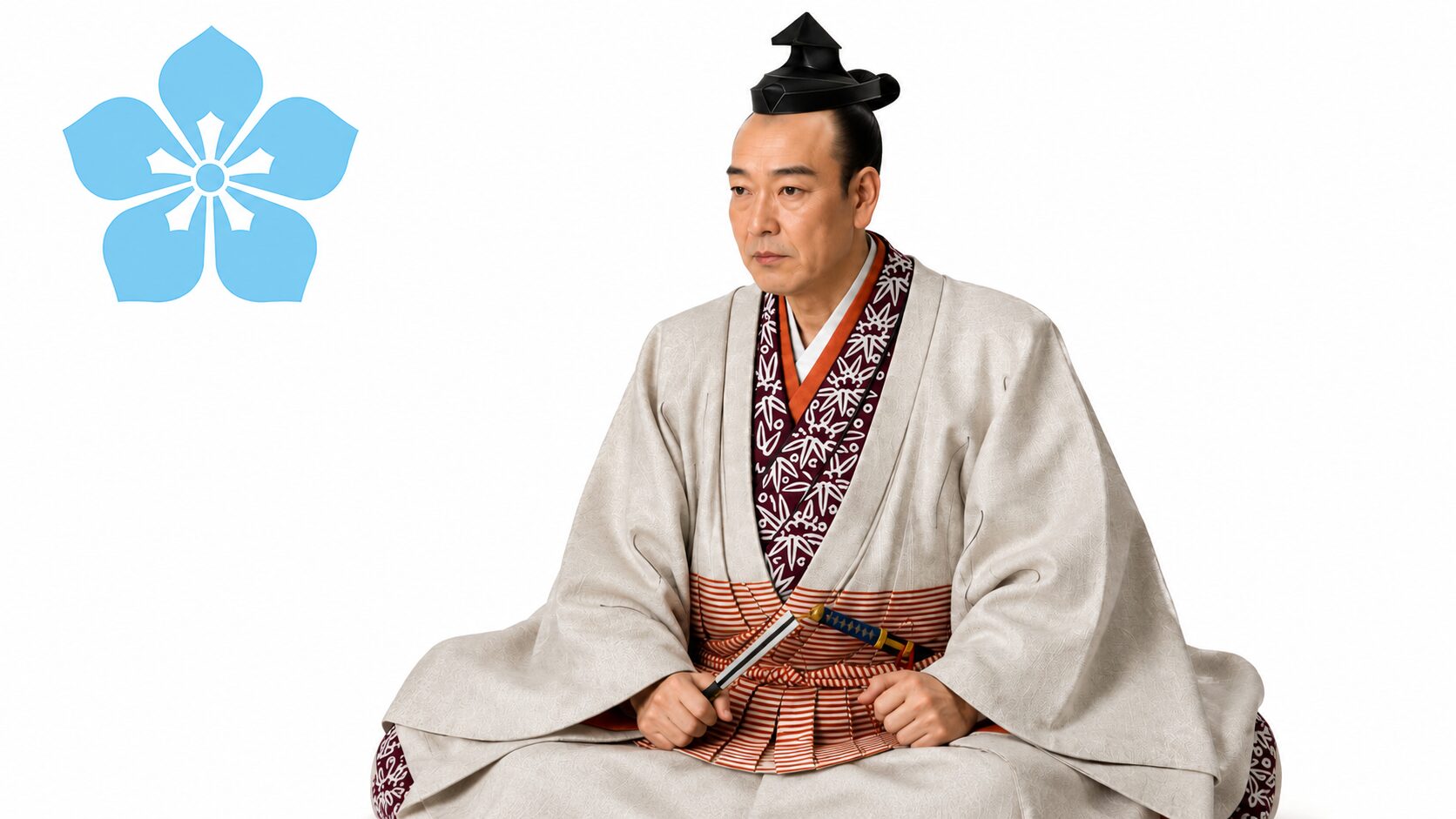
Akechi Mitsuhide — The Enigmatic Strategist Who Brought About the Honnō-ji Incident
Kyōroku 1 (1528)? – 13th day, 6th month of Tenshō 10 (1582) | Died aged 55 (some say 57)
- Akechi Mitsuhide in 3 Points
- The Mainstream Account — The Standard Story Found in Textbooks
- Multiple Theories (Received Views Shaken by the Latest Research)
- A Strategic View — The Historical Significance of the Being Called Mitsuhide
- Notable Sayings and Death Poem
- Anecdotes and Episodes
- Akechi Mitsuhide — Chronology
- Akechi Mitsuhide — Family Tree and Relationship Chart
- Related Historic-Site Map
- Related Articles and Reference Information
Akechi Mitsuhide in 3 Points
- An “enigmatic warlord” whose origins and early life are unclear in the sources, yet who, within just four years of entering Nobunaga’s service, became lord of a province and castle — one of the foremost rising stars within the Oda house.
- He rose from 50,000 koku at Sakamoto in Ōmi to 340,000 koku in Tanba, leaving the record of Sakamoto Castle — praised by Fróis as “the second castle of the realm” — and a Tanba administration in which the people revered him as a “wise ruler.”
- At the Honnō-ji Incident of Tenshō 10 (1582) he struck down Oda Nobunaga, but just 11 days later was defeated by Hashiba Hideyoshi at the Battle of Yamazaki and lost his life. His motive remains the greatest mystery in Japanese history even now.
The Mainstream Account — The Standard Story Found in Textbooks
An Enigmatic Early Life — Of the Mino Akechi Clan?
Few famous Sengoku warlords have an early life as unclear as Akechi Mitsuhide’s. Even his year of birth is not settled; genealogies and war chronicles often give it as Kyōroku 1 (1528), but there are also the theories of Daiei 6 (1526) and Eishō 13 (1516). The name “Akechi Mitsuhide” appears with certainty in historical documents only from the period when he served Asakura Yoshikage; his activity before that lies in the realm of tradition.
By the received view, Mitsuhide was of the “Toki Akechi clan,” a branch of the distinguished Toki clan of Mino Province. The Toki were descendants of the Seiwa Genji, a famous family that inherited the post of shugo of Mino from the period of the Northern and Southern Courts. His father is said to be Akechi Mitsutsuna, but because Mitsutsuna died when Mitsuhide was young, his uncle Akechi Mitsuyasu took on the headship and guardianship. His mother is handed down as being of the Wakasa Takeda (Omaki-no-kata, sister of Takeda Yoshimune), but these too rely on later sources such as the Akechi Clan Miyagi-Family Transmitted Genealogy, and there is no firm proof.
By that genealogy, Mitsuyasu served Saitō Dōsan; as a result of Dōsan’s defeat and death at the hands of his heir Saitō Yoshitatsu at the Battle of Nagaragawa in Kōji 2 (1556), Akechi Castle too was attacked by Yoshitatsu’s forces and fell. Mitsuyasu took his own life, and the young Mitsuhide, hoping to revive the Akechi clan, is said to have escaped the castle and set out on wandering travels through the provinces. That said, some researchers regard this castle-fall drama itself as a later story whose historicity is doubtful.
Wandering in Echizen — Ten Years Before the Gate of Shōnen-ji
After the fall of Akechi Castle, Mitsuhide headed for Ichijōdani, relying on Asakura Yoshikage of Echizen. Even so, he did not immediately take service with the Asakura; he is said to have lived for about ten years before the gate of Shōnen-ji in Nagasaki, Sakai District, Echizen Province. In this period Mitsuhide is said to have acquired medical knowledge, trained in gunnery, and honed his cultivation in renga and courtly precedents. That the missionary Luís Fróis later rated Mitsuhide’s talent, prudence and patience highly in his History of Japan was grounded precisely in the self-cultivation of these wandering years.
After taking service with the Asakura, around Eiroku 9 (1566), when Ashikaga Yoshiaki — who aspired to revive the Muromachi shogunate — stayed in Echizen relying on the Asakura, Mitsuhide, in coordination with Yoshiaki’s close aide Hosokawa Fujitaka (Yūsai), engaged in diplomatic maneuvering to link Yoshiaki and Oda Nobunaga. Mitsuhide came to the fore as a rare talent connected to both the Asakura and the Oda.
Dual Service and Rapid Advancement
In Eiroku 11 (1568), when Nobunaga succeeded in marching on Kyoto bearing Yoshiaki, Mitsuhide came to handle the administration and diplomacy of Kyoto in the “dual” status of serving both the shogunal house and the Oda house. By the Genki era (the early 1570s), Mitsuhide gradually increased his weight within the Oda house, gained Nobunaga’s trust, and advanced rapidly.
His speed of advancement was astonishing. Just three years after becoming an Oda retainer in Eiroku 11, in the 9th month of Genki 2 (1571), he was active as the core of the execution force in Nobunaga’s burning of Mount Hiei. For that merit he was given 50,000 koku in Shiga District, Ōmi, plus 1,000 ryō of gold as castle-building funds, and built his residence castle, Sakamoto Castle, on the shore of Lake Biwa. Among Nobunaga’s senior retainers, Mitsuhide was the earliest to become “lord of a province and castle.” The next, Hashiba Hideyoshi, would hold Nagahama Castle fully three years later.
Sakamoto Castle was a flatland castle facing directly onto Lake Biwa, and Luís Fróis praised it in his History of Japan: “It was, to the Japanese, grand and splendid; next to what Nobunaga built at Azuchi, there was no castle in the realm as famous as this castle of Akechi.” Preceding Azuchi Castle, it had a keep built and used tiles — an extremely advanced castle — and one can sense from this how highly Nobunaga rated Mitsuhide.
The Pacification of Tanba — A Five-Year Struggle and the Birth of a “Wise Ruler”
In Tenshō 3 (1575), Nobunaga ordered Mitsuhide to conquer Tanba (present-day central Kyoto Prefecture to eastern Hyōgo Prefecture). Tanba was mountainous, with provincial lords entrenched in each area, and there were many forces close to Ashikaga Yoshiaki, who had already broken with Nobunaga by then. Moreover, to the west of Tanba waited the Mōri, and subduing Tanba was indispensable to the success of the Mōri campaign as well. In parallel with Hideyoshi handling the Chūgoku campaign, Mitsuhide was charged with the equally important task of pacifying Tanba.
The conquest of Tanba was not easy. In the 1st month of Tenshō 4 (1576), while besieging Kuroi Castle, where Akai Naomasa held out, Hatano Hideharu, lord of Yakami Castle, who should have been an ally, suddenly betrayed him; struck from the rear, Mitsuhide fled in defeat (the First Battle of Kuroi Castle). With this, many Tanba provincial lords defected to the anti-Nobunaga faction, and Mitsuhide’s Tanba campaign returned to square one. In the 11th month of that year, the private tragedy of his principal wife Hiroko dying of illness at Sakamoto Castle also overlapped.
Mitsuhide persistently isolated Yakami Castle with siege-fort tactics and starvation, and by Tenshō 7 (1579) captured Yakami Castle and Kuroi Castle one after another. Hatano Hideharu was sent to Azuchi Castle and crucified. It was a campaign that consumed nearly five years.
In Tenshō 8 (1580), Mitsuhide, granted all of Tanba as an increase by Nobunaga, held a domain exceeding 340,000 koku together with Shiga District in Ōmi. Mitsuhide placed the base of his Tanba administration at Kameyama Castle (present-day Kameoka City, Kyoto Prefecture), entrusted Fukuchiyama Castle to his son-in-law Akechi Hidemitsu (Mitsuharu) and Kuroi Castle to his senior retainer Saitō Toshimitsu. Mitsuhide exempted Tanba’s land tax and, at Fukuchiyama, carried out large-scale flood-control works diverting the flow of the Yura River to the north. Building an embankment called the “Akechi Grove,” he prevented floods. Through these good policies, Mitsuhide was deeply revered by the people of Tanba as a “wise ruler.” The Goryō Shrine in Fukuchiyama still enshrines Mitsuhide as its principal deity, and in Kameoka the “Kameoka Mitsuhide Festival” is held grandly every year. Here is another face of Mitsuhide, apart from the image of “the treacherous retainer who killed his lord.”
“Governor-General of the Kinki Region” — Number Two of the Nobunaga Regime
At the Kyoto horse review in the 2nd month of Tenshō 9 (1581), Mitsuhide served as overall director. This was an event symbolizing the height of Mitsuhide’s standing within the Oda army corps. The historian Takayanagi Mitsutoshi expressed Mitsuhide’s position in this period as “Governor-General of the Kinki region.” With northern Ōmi and Tanba as his home domain, Mitsuhide led the auxiliary warlords — Tango (Hosokawa Fujitaka), Yamato (Tsutsui Junkei), Wakasa and the Settsu forces — into the field; in the Kōshū campaign he handled Nobunaga’s personal guard, and he also served as liaison with the imperial court and as construction magistrate of the Nijō Shinzōsho. Even the Tokugawa house, which had Honda Tadakatsu, did not concentrate tasks across so many fronts on one man.
By the early Tenshō 10 stage, with Takigawa Kazumasu busy in the Kantō, Niwa Nagahide busy preparing for the Shikoku expedition, and Hideyoshi pinned down in Harima and Bitchū in the Chūgoku campaign, Mitsuhide was the only one of Nobunaga’s close aides able to move flexibly. That Mitsuhide alone later had the means and opportunity to attack Honnō-ji was also the flip side of the height of his standing.
And So to Honnō-ji
In the 5th month of Tenshō 10 (1582), Nobunaga, receiving a request for reinforcements from Hideyoshi, who was facing the Mōri in the Chūgoku campaign, resolved to set out himself. Mitsuhide was ordered to its vanguard, and on the 26th day of the 5th month entered Kameyama Castle to begin preparations to set out. Nobunaga, for his part, entered Honnō-ji in Kyoto on the 29th day of the 5th month, leading only a few pages. Late on the night of the 1st day of the 6th month, Mitsuhide’s army, having set out from Kameyama Castle, made as if to advance along the Settan road, then suddenly changed course to the east, and before dawn on the 2nd day of the 6th month surrounded Honnō-ji in Kyoto. “The enemy is at Honnō-ji” — Nobunaga, after fighting hard, set fire to Honnō-ji and took his own life. This is what the world calls the Honnō-ji Incident.
Right after the incident, Mitsuhide subdued Ōmi and took over Azuchi Castle. He advanced maneuvering with the imperial court and moved to establish his own regime. But Hashiba Hideyoshi, who had been flooding Bitchū Takamatsu Castle, on hearing of Nobunaga’s death immediately made peace with the Mōri and, in the so-called “Great Return from the Chūgoku,” covered some 200 km in ten days to return to the central region. On the 13th day of the 6th month, the two armies clashed at Yamazaki in Yamashiro Province (present-day Ōyamazaki Town, Kyoto Prefecture). The difference in force (Hideyoshi’s army of 30,000–40,000 vs. Mitsuhide’s 13,000–16,000) and the failure to gain reinforcements from the Hosokawa Fujitaka and Tsutsui Junkei he had counted on told, and Mitsuhide’s army was defeated in just one to a few hours. After withdrawing to Shōryūji Castle, Mitsuhide, on the way to fleeing toward his home base Sakamoto Castle, met with a local commoners’ hunt for fugitive warriors in a bamboo thicket at Ogurusu in Yamashiro Province (present-day Fushimi Ward, Kyoto City), and is said to have asked his retainer Mizoo Shigetomo to deliver the coup de grâce and taken his own life. This was the end of the “three-day rule.”
Multiple Theories (Received Views Shaken by the Latest Research)
Theory 1: The Mystery of His Origins — Mino vs. Ōmi vs. Wandering the Provinces
As to Mitsuhide’s origins, several theories stand side by side, and no settlement has yet been reached.
1) The Mino Toki Akechi clan theory (the received view): His father is Akechi Mitsutsuna, of the main line of the Toki Akechi clan. His birthplace is either Akechi Castle (Nagayama Castle) in the Akechi estate in Kani City, Gifu Prefecture, or Akechi Castle in Ena City, Gifu Prefecture. Kani City still has the Akechi Castle ruins, and Ena City has traditions connected to Mitsuhide (the well of his first bath, his boyhood place of study). The genealogies adopt this theory, but because the figure “Mitsutsuna” himself does not appear in reliable contemporary sources, many researchers doubt whether he was really of the Akechi main line.
2) The Ōmi Same theory: The theory that he was born at Same in Taga Town, Shiga Prefecture. The Ōmi Onko Roku and the Gōji Kikiden Roku, compiled in the early Edo period, record that a man called Akechi Jūzaemon fled from Toki Shigeyori, came to Ōmi, received the protection of the Ōmi shugo Rokkaku Takayori, settled at Same, and that Mitsuhide was born two or three generations later. In 2019, Inoue Masaru, a Shiga Prefecture official, published it as a paper, and it was widely reported in newspapers. Its weak point, however, is that the source materials are all secondary sources, compilations made about 100 years after Mitsuhide’s death. Inoue himself takes a research-promoting stance, saying “it may even lead to confirming the Mino theory,” and it has not become a decisive proof.
3) The Yamagishi (Shinji) Nobuchika second-son theory: The theory recorded in the Akechi Clan Miyagi-Family Transmitted Genealogy, that Mitsuhide’s original origin was the Yamagishi (Shinji) clan of Mino and that he later became an adopted son of the Akechi house. As a genealogy handed down in the Miyagi family of the clan, it is a collateral tradition but cannot be ignored.
4) The Muromachi-shogunate foot-soldier-corps origin theory: The historian Kinoshita Satoshi points out that, since the name “Akechi” appears in a low ranking among the foot-soldier corps in a source showing the members of the Muromachi shogunate, a man far removed from the main line of the Toki Akechi clan may have come to call himself “Akechi” in later years. This is effectively the view that “Mitsuhide’s origins were almost unknown.”
The historian Taniguchi Kengo, after carefully comparing and examining these theories, holds that the only certainties are the three points “he had some connection with Mino,” “he styled himself of the Toki Akechi clan,” and “his early life was almost unknown and of low status,” and that further detail is impossible to settle in the sources. That Fróis’s History of Japan rated Mitsuhide as “an outsider of low birth” is also consistent with the unknown-origin theory. The image of “born of a distinguished Mino house,” depicted romantically in NHK Taiga dramas and the like, is very likely close to a fiction created by later genealogies.
Theory 2: The Honnō-ji Incident, Theories of Motive — Where the 50-Plus Theories Stand
As to the motive for the Honnō-ji Incident, it is said that more than 50 theories now exist. It is no exaggeration to call it the greatest mystery in Japanese history. Here the main theories are classified and arranged.
1) The grudge theory (the received view since the Edo period, now in decline): the humiliation of being dismissed as the officer entertaining Tokugawa Ieyasu; the humiliation of being ordered by Nobunaga to surrender Tanba and Ōmi and carve out Izumo and Iwami himself; the humiliation of his senior retainer Saitō Toshimitsu nearly being made to commit suicide by Nobunaga; the grudge over Mitsuhide’s mother being crucified (the story at the surrender of Yakami Castle, though not confirmed in good sources); the anecdote of being kicked by Nobunaga (Fróis, History of Japan), and so on. It appears frequently in Edo-period war chronicles, but since Takayanagi Mitsutoshi’s Akechi Mitsuhide (1958) refuted them one by one after the war, it has lost academic support.
2) The ambition theory (Takayanagi Mitsutoshi, 1958): the theory that Mitsuhide sought to take the realm in place of Nobunaga. The grounds are Mitsuhide’s high standing and mobility, the fact that he alone had the chance to attack Honnō-ji, and his active maneuvering with the court after the incident. There is, however, the criticism that Mitsuhide’s actions after the incident (failing to win over Hosokawa Fujitaka and Tsutsui Junkei, the misfire of cooperation with the Mōri, falling in just 11 days) are “too unplanned for one aiming at the realm,” and this too is weak as a sole explanation of motive.
3) The imperial-court mastermind theory (Imatani Akira, Tachibana Kyōko): the theory that, because Nobunaga was pressing Emperor Ōgimachi to abdicate and demanding a calendar reform, applying pressure to the court, the court ordered Mitsuhide to remove Nobunaga. It drew great attention in the 1990s. Its grounds include that Konoe Sakihisa was suspected of involvement and fled after the incident, and that there are traces of tampering before and after the incident in the diary Kanemi-kyō Ki of Yoshida Kanemi, who was the liaison between Mitsuhide and the court. But since the 2000s, the “theory of a combined civil-military kingship” by Hori Shin of Kyōritsu Women’s University and others has become mainstream, and as the understanding spread that Nobunaga and the court were in a relationship of cooperation and dependence rather than conflict, the imperial-court mastermind theory has declined.
4) The Ashikaga Yoshiaki mastermind theory (Fujita Tatsuo): the theory advanced by Fujita Tatsuo, professor at Mie University. It holds that Yoshiaki, who had fled to Tomonoura, instructed Mitsuhide via the Mōri to remove Nobunaga. Fujita himself says it is “not a mastermind theory,” but followers have reinforced it by piling up circumstantial evidence. It is also consistent with the possibility that Mitsuhide’s origins lay in the Muromachi-shogunate foot-soldier corps. But there is little trace of Yoshiaki acting actively after the incident (the Mōri made peace with Hideyoshi), and it lacks a decisive proof.
5) The Shikoku (avoidance-of-subjugation) theory — the strongest theory since 2014: Nobunaga had at first given Chōsokabe Motochika of Tosa a vermilion-seal letter saying “as for the matter of Shikoku, carve it out as Motochika’s own achievement,” permitting the free carving-out of Shikoku. The one who served as liaison with Motochika was Mitsuhide, and Mitsuhide’s senior retainer Saitō Toshimitsu’s elder brother Yoritatsu was the brother-in-law of the elder sister of Motochika’s principal wife (Ishigai Yoritatsu) — an in-law relationship. But Nobunaga changed his Shikoku policy from around Tenshō 8, and in the 1st month of Tenshō 10 issued a new vermilion-seal letter saying “surrender all but one province of Tosa and two districts of southern Awa,” and was about to have a Shikoku subjugation army under Nobutaka as supreme commander cross over the day after the Honnō-ji Incident (the 3rd day of the 6th month). Mitsuhide, as liaison, completely lost face.
In June 2014, through the Ishigai Family Documents made public by the Hayashibara Museum of Art in Okayama Prefecture, a letter (dated the 21st day of the 5th month of Tenshō 10) was discovered in which Chōsokabe Motochika wrote to Saitō Toshimitsu that he would obey Nobunaga’s order. This was written just 11 days before the Honnō-ji Incident and became a primary source backing up the situation in which Mitsuhide and Toshimitsu were caught in a bind over the Shikoku problem. The historians Fujita Tatsuo, Kirino Sakujin and others rated it highly, and the Shikoku theory at once became a strong academic theory.
That said, because the Ishigai Family Documents are not documents directly stating Mitsuhide’s motive, cautious views remain deep-rooted. Whether Mitsuhide’s motive can be explained by “the Shikoku problem alone” is debated, and a composite-motive theory — “the Shikoku problem + danger to Mitsuhide and Toshimitsu + compound dissatisfaction with Nobunaga” — is now the point of compromise.
6) The Mitsuhide solo “righteous uprising” theory: Right after the Honnō-ji Incident, Mitsuhide notified various regions by letter that “the cruelty of Nobunaga and his son is a hindrance to the realm; I have struck them down.” Taking this at face value, the theory holds that Mitsuhide rose up alone to stop Nobunaga’s tyranny. Among the “cruelties” it lists: (1) Nobunaga’s plan to usurp the imperial throne, (2) his meddling in the calendar, (3) his desiring the shogunal post though not of Genji descent, (4) his abusive words to Konoe Sakihisa, (5) the burning to death of Kaisen Jōki, (6) building a main palace at Azuchi Castle from which to look down on the emperor. But there is strong criticism that it idealizes Mitsuhide too much, and this too is weak as a sole motive.
These theories are not mutually exclusive, and the current mainstream is to see Mitsuhide’s motive as formed by an overlap of several factors. The composite-motive theory — “having lost face as liaison over the Shikoku problem, with the累 reaching even Toshimitsu, with rumors of the surrender of Tanba and Ōmi, and a sense of crisis that his role might end once Nobunaga’s unification of the realm was complete” — currently gathers the support of the most researchers.
Theory 3: Mitsuhide’s Whereabouts at the Attack on Honnō-ji — The Toba-Standby Theory
Was Mitsuhide really at the combat scene of the Honnō-ji attack? In fact, there is a new theory that Mitsuhide himself did not go to the attack scene but stood by at Toba, south of Kyoto.
In 2020, the Itsuya no Kakimono (compiled in Kanbun 12, 1672), written by the Kaga-domain samurai Sekiya Masaharu, was re-evaluated, and Hagiwara Daisuke of the Toyama City Folk Museum and others made public a detailed analysis. The book is said to be Sekiya Masaharu’s record of what Saitō Toshimune, the third son of Saitō Toshimitsu who served in the Honnō-ji Incident, told his nephew (Inoue Seizaemon), who had become a Kaga-domain samurai.
According to the Itsuya no Kakimono, of Mitsuhide’s 13,000 men, 2,000 elite troops went to attack Honnō-ji, while the remaining troops were kept standing by at Toba to guard against the direction of the Nijō Shinzōsho. And Mitsuhide himself did not join the Honnō-ji attack but commanded from Toba, while the one who took field command of the Honnō-ji attack was Saitō Toshimitsu. The book is also consistent with the fact that the court noble Yamashina Tokitsune’s diary, the Tokitsune-kyō Ki, records of Saitō Toshimitsu that he was “the foremost in this rebellion,” reinforcing the view that the substantive commander of the Honnō-ji attack was Saitō Toshimitsu.
This theory relies on a source compiled about 90 years after the Honnō-ji Incident, and the possibility of later embellishment cannot be denied. Fukushima Katsuhiko of the Ōyamazaki Town Museum of History and Folklore also points out that the “old man” who related the Itsuya no Kakimono may have confused it with the fact that Mitsuhide was at Toba not at the Honnō-ji Incident but just before the Battle of Yamazaki. Even so, the conventional theory that Mitsuhide himself was at the scene is in fact not certainly backed up by contemporary sources either. The dramatic staging of “the enemy is at Honnō-ji” may also be no more than an image created by later war chronicles.
If this theory is correct, the interpretation can also hold that the Honnō-ji Incident was not the rebellion of the individual Mitsuhide but a retainer-band-led coup, led by the retainer band centered on Toshimitsu over the Shikoku problem. Indeed, Toshimitsu’s presence stands out — in the rewards after the incident and in his deployment at the front at the Battle of Yamazaki (deployed before Mitsuhide’s headquarters at Bōzuka).
Theory 4: The Cause of Defeat at Yamazaki, and the Truth of the “Tennōzan” and “Horagatōge” Legends
As to the cause of Mitsuhide’s defeat at the Battle of Yamazaki, it is often explained in textbook fashion as “because Tennōzan was occupied by Hideyoshi’s army” or “because Tsutsui Junkei sat on the fence at Horagatōge.” But both are very likely later inventions, differing from historical fact.
The struggle for Tennōzan may not have existed: Edo-period war chronicles such as the Taikōki, the Kawasumi Taikōki, the Takemori-ke Ki and the Eigen-shidan Kinenroku dramatically depict Kuroda Yoshitaka advising Hideyoshi of the importance of Tennōzan, Hosokawa Tadaoki occupying Ozaki west of Tennōzan, and so on. But no concrete description of fighting at Tennōzan can be confirmed at all in good primary sources. In the current historical profession, the received view that “the struggle for Tennōzan decided the outcome” is held to be embellishment of the Taikōki, and in recent years it has become common to call it not “the Battle of Tennōzan” but “the Battle of Yamazaki (Yamazaki Kassen).”
Tsutsui Junkei at Horagatōge is also a fiction: The set phrase “to sit on the fence at Horagatōge,” meaning “fence-sitting, watching the situation to side with the favorable side,” derives from the tradition that Tsutsui Junkei watched the battle situation from Horagatōge. But in good sources it cannot be confirmed that Junkei deployed at Horagatōge. The Zōho Tsutsui-ke Ki writes that Junkei deployed at Horagatōge on the advice of Shima Sakon, but that book is rated “a bad text full of errors” and cannot be trusted. In reality, the actual situation is closer to Junkei having decided to defect to the Hideyoshi side and preparing for a siege at his residence castle, Yamato Kōriyama Castle. The Taikōki‘s account that Mitsuhide went out to Horagatōge to meet Junkei but he did not appear is also strongly suspected of being invention.
The true causes of defeat — the prohibition decree at Ōyamazaki, and insufficient force: In fact, the land of Yamazaki is an extremely narrow area sandwiched between Tennōzan and the Yodo River, only about 200 m from the foot of the mountain to the riverbank at its narrowest. Had Mitsuhide deployed here and blocked the defile, he might well have offset the more-than-double difference in force with the terrain. That Mitsuhide nonetheless did not deploy forward was because, the day after the Honnō-ji Incident, he had issued a “prohibition decree” to the town of Ōyamazaki and promised to protect the town from the fires of war. A “prohibition decree” is a document by which a ruler shows prohibitions to temples, shrines and the populace and promises protection, and Mitsuhide effectively gave up tactical advantage for his own political good faith. It symbolizes Mitsuhide’s “righteousness” while also being one cause of his defeat.
Another great cause of defeat was the failure to gather allies. The Hosokawa Fujitaka and Tadaoki, father and son, who should have been sworn friends, went into mourning and did not move troops, and the auxiliary warlord Tsutsui Junkei defected to the Hideyoshi side. That even the Hosokawa house, into which his third daughter Tama-ko (later Hosokawa Gracia) had married, did not move was fatal for Mitsuhide. Against Hideyoshi’s army of 30,000–40,000, Mitsuhide’s army was some 13,000–16,000. Having also split off troops for keeping order in Kyoto and holding the Ōmi front, the force he could concentrate at the decisive ground was limited.
In recent years, moreover, Fujita Tatsuo of Kobe University and others have proposed the theory that “Hideyoshi arrived late at the Battle of Yamazaki, and figures such as Ikeda Tsuneoki were central in deciding the outcome,” and re-examination is proceeding based on the content of letters from Hideyoshi. The course of the battle itself may be greatly rewritten in the future.
Theory 5: Mitsuhide’s End — The Ogurusu-Death Theory vs. the Survival Theory
As to Mitsuhide’s end, the received view is that “on the night of the 13th day of the 6th month, while escaping from Shōryūji Castle toward Sakamoto Castle, he was stabbed in the side with a bamboo spear by the local commoner Nakamura Chōbei in a bamboo thicket at Ogurusu in Yamashiro Province (present-day Fushimi Ward, Kyoto City), and asked his retainer Mizoo Shigetomo for the coup de grâce and took his own life.” That place is now called the “Akechi Grove,” and a historic site remains in Fushimi Ward, Kyoto City.
But here too several doubts remain.
1) The problem of indistinguishable heads: On the 17th day of the 6th month, three heads were delivered to Hideyoshi as Mitsuhide’s head, but in the June heat they had decayed markedly and it could not be told whether they were his. The head said to be Mitsuhide’s was exposed at Honnō-ji, but whether it was the real one could not be confirmed.
2) The body-double theory: There is a tradition that “the one who actually died at Ogurusu was not Mitsuhide but his retainer Araki Yamashiro-no-kami, and Mitsuhide buried his head as a body double and himself fled.” Senshū-in and Shinmei Shrine in Uji, Kyoto, and Hontoku-ji in Kishiwada City, Osaka Prefecture (formerly Toba, Kaizuka City), have traditions of having sheltered Mitsuhide, and Hontoku-ji even hands down a popular song.
3) The Nankōbō Tenkai = Akechi Mitsuhide theory: The theory that Nankōbō Tenkai, the high Tendai priest trusted by three generations of Tokugawa — Ieyasu, Hidetada and Iemitsu — in the early Edo shogunate, was in fact the assumed name of a surviving Mitsuhide. The grounds offered: (1) there is an area in Nikkō called “Akechi-daira,” said to have been named by Tenkai; (2) Saitō Toshimitsu’s daughter Kasuga-no-tsubone was adopted as Iemitsu’s wet nurse, and Mizoo Shigetomo’s granddaughter Misawa-no-tsubone as Ietsuna’s; (3) the Kyōgoku house, which sided with Akechi at the Battle of Yamazaki, was given an increase after Sekigahara, while the hostile Tsutsui house was later attainted; (4) Mitsuhide’s grandson Oda Masazumi, who fought on the Toyotomi side in the Siege of Osaka, was spared. These are no more than an accumulation of circumstantial evidence, no book by a specialist historian has treated it as fact, and its credibility is rated low academically. But having been adopted in fiction, it is widely known and persistently popular.
Why a survival legend arose for the “lord-killer” Mitsuhide: Minamoto no Yoshitsune and Sanada Yukimura were heroes beloved by the common people, so survival legends were told of them; but Mitsuhide was supposed to be “a treacherous retainer who killed his lord.” That a survival legend was nonetheless persistently handed down is thought to be the result of an overlap of factors: (1) the fact that he was revered by the people of Tanba and Ōmi as a “wise ruler”; (2) the mysterious situation of indistinguishable heads; (3) the complex feelings of the populace toward Hideyoshi’s taking of the realm; (4) the re-evaluation, born in part in the Edo period, of “Mitsuhide as a righteous man who rose to stop Nobunaga’s tyranny.” The many-sidedness of the Mitsuhide image may be said to have found expression in the form of a survival legend.
Theory 6: Mitsuhide’s Character — The Two Sides Fróis Saw, and the Evaluations of Retainers and People
As to Mitsuhide’s character, contemporary and later sources, and the testimonies of the enemy side and the friendly side, greatly diverge.
The two-sided evaluation in Luís Fróis’s History of Japan: The missionary Luís Fróis, while highly praising the splendor of Sakamoto Castle, was harsh on Mitsuhide’s character. While rating Mitsuhide’s talent, prudence, patience and castle-building skill highly, he wrote that he “liked betrayal and secret meetings,” “was good at scheming and plotting,” “imposed cruel punishments,” and was “despotic,” and further wrote that “within the house (the Oda) he was an outsider, a foreigner, and was disliked by most.” This is a description from the hostile Christian side and includes resentment at Mitsuhide’s central role in the burning of Mount Hiei and the annihilation of the Ikkō-ikki, but it is important as the testimony of a person who saw Mitsuhide at the time.
Evaluation from retainers — firm cohesion: Mitsuhide was a “mid-career joiner” within the Oda house, but the loyalty from his retainers was deep. Many anecdotes of his concern for retainers remain — a record of offering memorial rice to Saikyō-ji in Ōmi as a memorial for 18 Akechi soldiers killed in the Ikkō-ikki, and many surviving letters of condolence to retainers wounded in battle. That defectors from the Akechi retainer band were extremely few through the Honnō-ji Incident and the Battle of Yamazaki also shows the height of Mitsuhide’s ability to control retainers. Mitsuhide carried out, in a more humane form, a policy in common with Nobunaga’s: “promoting on ability regardless of status or pedigree.”
Evaluation from the people — the wise-ruler legend: In Tanba and Fukuchiyama, good policies are handed down — the construction of the flood-control embankment called the “Akechi Grove,” the permanent exemption of land tax, and a rational village administration through land surveys (a system fixing 1,000 koku as one village with one headman, and one deputy for every 10,000 koku). The Goryō Shrine in Fukuchiyama enshrines Mitsuhide as principal deity, and in Kameoka the “Kameoka Mitsuhide Festival” is held grandly every year. Almost 440 years after the Honnō-ji Incident, there is no other “treacherous retainer” so beloved by local people.
Evaluation from the court and nobility: Mitsuhide had deep connections with the court and nobility — friendship with Yoshida Kanemi and Konoe Sakihisa, diplomatic negotiations with Kajūji Haretoyo — and was deeply versed in court culture. His skill at renga was also first-rate, and his opening verse at the Atago Hyakuin (the renga gathering before the Honnō-ji Incident) in the 5th month of Tenshō 10, “the time is now; the rain falls over all under heaven; the fifth month,” is famous as a verse showing his resolve that “the time for me, of the Toki clan, to govern the realm is now” (though this interpretation itself is also held by some to be a post-incident invention).
Synthesizing these evaluations from multiple angles, the common understanding in the current historical profession is close to this: Mitsuhide was “a bureaucrat-type warlord skilled in cultivation and practical ability, a person combining deep consideration for retainers and people with the two sides of a cold-blooded schemer.” Neither a “simple traitor” nor a “simple righteous man” — it is precisely this complex personality that is the essence of Mitsuhide.
A Strategic View — The Historical Significance of the Being Called Mitsuhide
A Senior Retainer Who Embodied the Structural Weakness of the Nobunaga Regime
Behind Mitsuhide’s being able to strike down Nobunaga lay a structural weakness of the Oda regime. Nobunaga promoted talent by merit and treated hereditary retainers and outsiders alike. This was an innovative system giving chances to men of unknown origin like Mitsuhide, but it was also unstable, because retainers’ loyalty rested not on “the house” but on “evaluation of individual ability.” The height of Mitsuhide’s standing depended on Nobunaga’s personal evaluation, built amid a tension in which it might be overturned at any time.
If he lost face as liaison over the Shikoku problem, rumors arose of the surrender of Tanba and Ōmi, and the problem of his senior retainer Saitō Toshimitsu’s treatment overlapped, Mitsuhide’s anxiety would be maximized. Nobunaga’s meritocracy, while producing rising stars like Mitsuhide, contained the structural danger of cornering that same retainer and driving him to rebellion. The Honnō-ji Incident was both an incident of the individual Mitsuhide and an incident produced by the very nature of the Oda regime itself.
Hideyoshi the “Successor to the Oda Regime” and Ieyasu the “Witness of History”
The Honnō-ji Incident, in the end, gave Hashiba Hideyoshi the chance to unify the realm and promised Tokugawa Ieyasu the position of a long-term winner. Hideyoshi struck down Mitsuhide in the astonishing march of the Great Return from the Chūgoku, and as the victor of the avenging battle for Nobunaga, seized leadership within the Oda house at the Kiyosu Conference. Ieyasu barely escaped to Okazaki with his life in the crossing of Iga, but became the final winner through Komaki-Nagakute, Sekigahara and beyond.
There is no doubt that Mitsuhide pulled the trigger of the vast historical transition that was the end of the Sengoku period. In the sense that “without Mitsuhide there would have been no realm of Hideyoshi and Ieyasu,” Mitsuhide is one of the individuals who moved Japanese history most greatly. Whatever his own intent, as a result Mitsuhide became a catalyst of history, blocking Nobunaga’s despotic unification of the realm and making possible the transition to the more stable Hideyoshi and Tokugawa regimes.
“Traitor” and “Wise Ruler” — A Legacy of Ambivalent Memory
Mitsuhide’s historical memory was thoroughly debased as “a traitor who killed his lord” in the “imperial-nation historiography” from the Meiji era onward. But in his home regions of Tanba and Ōmi he was consistently revered as a “wise ruler,” and the Fukuchiyama Goryō Shrine and the Kameoka Mitsuhide Festival were maintained through the prewar and postwar periods. That Mitsuhide was at last chosen as the protagonist of the 2020 Taiga drama Kirin ga Kuru was the culmination of contemporary Japan’s re-evaluation of Mitsuhide, on the foundation of this long history of ambivalent evaluation.
The being called Mitsuhide reflects the essence of a human swaying between such opposite poles — loyalty and rebellion, righteousness and ambition, violence and good governance, rationality and emotion. Why has the greatest mystery in Japanese history continued to draw people for nearly 500 years? Perhaps it is because we find our own two-sidedness within Mitsuhide.
Notable Sayings and Death Poem
“The enemy is at Honnō-ji.”
The order said to have been issued to Mitsuhide’s army heading for Honnō-ji. In fact it does not appear in clear contemporary sources and is very likely an invention handed down by later war chronicles. Even so, it is one of the most famous lines in Japanese history and lives on as a phrase that distills Mitsuhide’s fate.
“The time is now; the rain falls over all under heaven; the fifth month.”
Mitsuhide’s opening verse at the renga gathering “Atago Hyakuin,” held at the western hall of Atagoyama just before the Honnō-ji Incident, on the 28th day of the 5th month of Tenshō 10 (1582). “The time is now” (toki wa ima) is read as “Toki is now,” that is, as a declaration of resolve that he, of the Toki clan’s blood, “the time to govern the realm is now.” There is, however, a theory that this interpretation is a post-incident reading, and the possibility that it was originally a straightforward verse simply describing the season — “the time is now, the rain-falling fifth month” — also remains.
“The cruelty of Nobunaga and his son is a hindrance to the realm; I have struck them down.”
A passage from the letter Mitsuhide sent to the commanders of the central region the day after the Honnō-ji Incident (the 3rd day of the 6th month). It is the only statement of motive by Mitsuhide himself, positioning his own rebellion as a “righteous uprising.” Some argue the “Mitsuhide-righteous-man theory” by taking this at face value.
“Forward and backward are not two gates; the great way pierces to the source of the heart. The dream of fifty-five years — awakening, it returns to the one.” (death verse)
Meaning: forward and backward are originally one way; the life of fifty-five years was as a dream; on awakening, all returns to one. A Chinese-style poem handed down as Mitsuhide’s death verse, showing a Zen-like state of detachment. But this too may be a later invention (with no backing in contemporary sources). Taking “fifty-five years” would mean he died aged 55, a calculation premised on a birth in Kyōroku 1.
Anecdotes and Episodes
1. The Wife-Selling Legend Before the Gate of Shōnen-ji
In his wandering years in Echizen, Mitsuhide is said to have been in extreme poverty. When he came to host a renga gathering, to raise its cost, his wife Hiroko is said to have sold her own black hair and given it to Mitsuhide. Mitsuhide, deeply moved by his wife’s chastity and resourcefulness, saying “is this too the wife of a samurai,” is said to have never taken a concubine in his life. This is a famous anecdote that the Edo-period haiku poet Matsuo Bashō too composed about. But whether it is historical fact cannot be confirmed, and it is very likely a later invention to idealize Mitsuhide’s character.
2. Astonishing Yoshida Kanemi at the Sakamoto Castle Keep
The state of the priest Yoshida Kanemi’s visit to Sakamoto Castle on the 24th day of the 12th month of Genki 3 (1572) remains in the Kanemi-kyō Ki. Kanemi wrote that he viewed the construction within the castle, including the Sakamoto Castle keep, and “was astonished.” At a stage before the keep of Azuchi Castle was completed, Sakamoto Castle already had an imposing keep built. The fact that Mitsuhide was the earliest in the Oda house to have a “keep,” the pinnacle of early-modern castle architecture, tells how highly Nobunaga rated him.
3. The Saikyō-ji Memorial Rice and Letters Mindful of Retainers
After the burning of Mount Hiei in Genki 2 (1571), Mitsuhide offered memorial rice for 18 retainers killed in battle to Saikyō-ji in Ōmi. Furthermore, several letters of condolence to retainers wounded in battle survive — control of retainers unusually attentive for a warlord of the time. Behind the deep loyalty the “mid-career joiner” Mitsuhide won from his retainers lay an accumulation of such steady consideration. That almost no defectors appeared from the Akechi retainer band even after the defeat at Yamazaki was no doubt owing to this character of Mitsuhide’s.
4. Fukuchiyama Flood Control and the “Akechi Grove”
In Tenshō 8 (1580), after pacifying Tanba, Mitsuhide, because the confluence of the Yura River and the Haze River flowing through the Fukuchiyama castle town repeatedly flooded, carried out large-scale flood-control works greatly diverting the flow of the Yura River to the north. The embankment built is still called the “Akechi Grove” and continues to protect the citizens of Fukuchiyama. It is the most concrete and visible achievement among Mitsuhide’s good policies. In Fukuchiyama, even after the Meiji era, the Goryō Shrine continues to enshrine Mitsuhide as principal deity, and the “Fukuchiyama Goryō Grand Festival” is held grandly every year.
5. The Marriage of Tama-ko (Hosokawa Gracia)
In the 8th month of Tenshō 6 (1578), Mitsuhide’s third daughter Tama-ko (later Gracia) married into the house of Tadaoki, the heir of Hosokawa Fujitaka. The place was Shōryūji Castle, a political marriage based on Nobunaga’s own conception. Mitsuhide and Fujitaka were sworn friends since the installation of Yoshiaki, and the bond between the two houses was to be further strengthened. After the Honnō-ji Incident, however, Tadaoki confined Tama-ko at Midono in Tango. That the supposed sworn friends Fujitaka and Tadaoki did not side with Mitsuhide became a great cause of his defeat at Yamazaki. Tama-ko later converted to Christianity and took the name “Gracia,” meeting a heroic end at the Osaka residence on the eve of the Battle of Sekigahara.
6. The Atagoyama “Fortune Slip” and the Decision for Honnō-ji
On the 27th day of the 5th month of Tenshō 10 (1582), Mitsuhide, about to set out, made a pilgrimage to Atagoyama and is said to have drawn a “fortune slip” at Atago Shrine (Hakuun-ji) and re-drawn it several times. On the third time (or second), “good fortune” at last came out, and this is said to have pushed forward his decision to attack Honnō-ji. The next day, the 28th, he held the “Atago Hyakuin” at the western hall and left the opening verse “the time is now; the rain falls over all under heaven; the fifth month.” It was a few days full of tension, where decision, prayer and the literary arts intersected. But this fortune-slip anecdote too is very likely a later embellishment, and whether it is historical fact is uncertain.
7. The “Great Return from the Chūgoku” and Mitsuhide’s Miscalculation
Mitsuhide’s greatest miscalculation was the speed of Hideyoshi’s Great Return from the Chūgoku. Hideyoshi had been flooding Bitchū Takamatsu Castle, but on receiving the urgent report of the Honnō-ji Incident on the night of the 3rd day of the 6th month, he immediately made peace with the Mōri. He departed Bitchū on the 6th, and through Himeji Castle, Akashi, Amagasaki and Tonda, reached Yamazaki just ten days later, on the 13th — executing the greatest forced march in Sengoku history. The speed of covering some 200 km in ten days completely exceeded the common sense of the time. Mitsuhide had reckoned Hideyoshi’s return as “at least a month away” and spent time on consolidating the central region, but that reading collapsed at its root. Hideyoshi’s movement was so abnormally fast that some even argue “the Great Return from the Chūgoku was prepared in advance = the Hideyoshi mastermind theory.”
8. Indistinguishable Heads and the Bamboo Spear of the “Akechi Grove”
After defeat at the Battle of Yamazaki, Mitsuhide, fleeing toward Sakamoto Castle, met with a local commoners’ hunt for fugitive warriors in the bamboo thicket of Ogurusu. Stabbed in the side with a bamboo spear, Mitsuhide is said to have entrusted his retainer Mizoo Shigetomo with “deliver my head to Lord Nobunaga at Honnō-ji” and taken his own life. Shigetomo brought back Mitsuhide’s head, but the heads later delivered to Hideyoshi’s army as Mitsuhide’s numbered three and, decayed in the heat, were indistinguishable. This situation of “indistinguishable heads” became the soil that bred the later Mitsuhide survival legend and the Tenkai theory. Mitsuhide’s grave is handed down in several places — Saikyō-ji (Ōtsu City, Shiga Prefecture), Kokushō-ji (Kameoka City, Kyoto Prefecture), Hontoku-ji (Kishiwada City, Osaka Prefecture) — and which is genuine is still unsettled.
Akechi Mitsuhide — Chronology
| Year | Date | Event |
|---|---|---|
| Kyōroku 1 (1528)? | — | Born in Mino or Ōmi (origins and birth year disputed). |
| Kōji 2 (1556) | 4th mo. | Saitō Dōsan is defeated and killed at the Battle of Nagaragawa; Akechi Castle falls. Mitsuhide wanders to Echizen. |
| c. Eiroku 9 (1566) | — | Takes service with Asakura Yoshikage; gains the favor of Ashikaga Yoshiaki and Hosokawa Fujitaka. |
| Eiroku 11 (1568) | 9th mo. | Nobunaga marches on Kyoto bearing Yoshiaki. Mitsuhide is in dual service to the shogunal and Oda houses. |
| Genki 2 (1571) | 9th mo., 12th | The burning of Mount Hiei; Mitsuhide is the core of the execution force. |
| Genki 2 (1571) | — | Given 50,000 koku in Shiga District, Ōmi; begins building Sakamoto Castle. |
| Genki 3 (1572) | 12th mo. | The Sakamoto Castle keep is nearly complete; Yoshida Kanemi views it and is astonished. |
| Tenshō 1 (1573) | 8th mo. | Takes part in the capture of Ichijōdani; the Asakura house falls. |
| Tenshō 3 (1575) | — | Ordered by Nobunaga to conquer Tanba. |
| Tenshō 4 (1576) | 1st mo., 15th | Flees in defeat at the First Battle of Kuroi Castle through Hatano Hideharu’s betrayal. |
| Tenshō 4 (1576) | 11th mo., 7th | His principal wife Hiroko dies of illness at Sakamoto Castle. |
| Tenshō 5 (1577) | — | Begins building Kameyama Castle; resumes the Tanba campaign in earnest. |
| Tenshō 6 (1578) | 8th mo. | His third daughter Tama-ko marries Hosokawa Tadaoki (at Shōryūji Castle). |
| Tenshō 7 (1579) | — | Captures Yakami Castle and Kuroi Castle one after another; the pacification of Tanba is complete. |
| Tenshō 8 (1580) | — | Granted all of Tanba, becomes a lord of 340,000 koku. Renovates Fukuchiyama Castle; carries out Yura River flood control. |
| Tenshō 9 (1581) | 2nd mo., 28th | Serves as overall director at the Kyoto horse review; the number-two position in the Oda house. |
| Tenshō 10 (1582) | 5th mo., 17th | Ordered by Nobunaga to the vanguard of the Chūgoku campaign. |
| Tenshō 10 (1582) | 5th mo., 28th | The opening verse “the time is now; the rain falls over all under heaven; the fifth month” at the Atago Hyakuin. |
| Tenshō 10 (1582) | 6th mo., 2nd | The Honnō-ji Incident; strikes down Nobunaga and Nobutada. |
| Tenshō 10 (1582) | 6th mo., 5th | Takes over Azuchi Castle; begins maneuvering with the court. |
| Tenshō 10 (1582) | 6th mo., 13th | Defeated at the Battle of Yamazaki; struck down at Ogurusu by night and takes his own life (aged 55?). |
| Tenshō 10 (1582) | 6th mo., 14th | Sakamoto Castle falls; Akechi Hidemitsu takes his own life after dispatching Mitsuhide’s wife and children. |
| Tenshō 10 (1582) | 6th mo., 17th | Saitō Toshimitsu is captured at Katata and executed at Rokujō-gawara. |
Akechi Mitsuhide — Family Tree and Relationship Chart
Family Tree (the Akechi Clan Line)
| Relation | Person | Note |
|---|---|---|
| Father | Akechi Mitsutsuna | Said to be head of the Mino Akechi clan, but does not appear in contemporary sources. |
| Uncle | Akechi Mitsuyasu | Mitsuhide’s guardian; took his own life at the fall of Akechi Castle (tradition). |
| Mother | Omaki-no-kata | Said to be the sister of Takeda Yoshimune of Wakasa (tradition). |
| Principal wife | Hiroko | Of the Tsumaki clan; died of illness at Sakamoto Castle in Tenshō 4 (1576). |
| Eldest son | Akechi Mitsuyoshi | Took his own life at Kameyama Castle after the defeat at Yamazaki. |
| Third daughter | Tama-ko (Hosokawa Gracia) | Principal wife of Hosokawa Tadaoki; took her own life at Osaka on the eve of Sekigahara. |
| Son-in-law (senior retainer) | Akechi Hidemitsu (Mitsuharu) | Lord of Fukuchiyama Castle; took his own life at the last stand of Sakamoto Castle. |
| Cousin | Nōhime (Kichō)? | Nobunaga’s principal wife, daughter of Saitō Dōsan. Possibly Mitsuhide’s cousin by the genealogy. |
| Grandson | Oda Masazumi | Fought on the Toyotomi side in the Siege of Osaka but was spared. |
Principal Relationship Chart (The People Around Mitsuhide)
| Category | Person | Relationship |
|---|---|---|
| Lord | Ashikaga Yoshiaki | His first lord; the original master house of the dual-service period. |
| Lord | Oda Nobunaga | The promoter of the unification of the realm; struck down in the incident. |
| Sworn friend | Hosokawa Fujitaka (Yūsai) | A sworn friend since the installation of Yoshiaki; father-in-law of his daughter Tama-ko; neutral after the incident. |
| Senior retainer | Saitō Toshimitsu | The foremost Akechi senior retainer; in-law of Chōsokabe Motochika; possibly the substantive commander of the Honnō-ji attack. |
| Liaison partner | Chōsokabe Motochika | A Tosa warlord; the center of the Shikoku problem; Mitsuhide served as his bridge to Nobunaga. |
| Rival | Hashiba Hideyoshi | An advancement rival within the Oda house; defeated Mitsuhide in the Great Return from the Chūgoku. |
| Refused reinforcement | Tsutsui Junkei | An auxiliary warlord of Yamato; defected to the Hideyoshi side after the incident (the Horagatōge legend). |
| Court and nobility | Konoe Sakihisa, Yoshida Kanemi | Liaisons with the court; suspected of involvement after the incident. |
| Contemporary observer | Luís Fróis | A missionary; conveys the two-sidedness of the Mitsuhide image in his History of Japan. |
Related Historic-Site Map
List of Spots on the Map (9 Sites)
| Name | Location | Note |
|---|---|---|
| Site of Akechi Castle | Kani City, Gifu Pref. | A candidate birthplace of Mitsuhide. The center of the Akechi estate; also called Nagayama Castle. |
| Sakamoto Castle Ruins Park | Shimo-Sakamoto, Ōtsu City, Shiga Pref. | The ruins of Mitsuhide’s main castle on Lake Biwa, the “second castle of the realm” praised by Fróis. |
| Site of Tanba Kameyama Castle | Kameoka City, Kyoto Pref. | The base of his Tanba administration; the point of departure for Honnō-ji. |
| Fukuchiyama Castle | Fukuchiyama City, Kyoto Pref. | Renovated after the pacification of Tanba; garrisoned by Akechi Hidemitsu; keep now restored. |
| Site of Kuroi Castle | Tanba City, Hyōgo Pref. | The castle of Akai Naomasa, the formidable foe who long blocked Mitsuhide’s Tanba campaign. |
| Site of Honnō-ji | Takoyakushi-dōri Aburanokōji, Nakagyō Ward, Kyoto City | The scene of the Honnō-ji Incident, the location at the time (the present Honnō-ji is the relocation site). |
| Shōryūji Castle Park | Nagaokakyō City, Kyoto Pref. | The place of Tama-ko and Tadaoki’s marriage; a temporary retreat castle after the Yamazaki defeat. |
| Akechi Grove | Ogurusu, Fushimi Ward, Kyoto City | The site of Mitsuhide’s end; the bamboo thicket where he fell to a local commoner’s bamboo spear. |
| Saikyō-ji | Sakamoto, Ōtsu City, Shiga Pref. | Mitsuhide’s family temple; the temple of the retainer memorial-rice offering; Mitsuhide’s grave. |
※ The map is a reference display based on modern roads. It differs from the roads and terrain of the period.
Related Articles and Reference Information
Related Articles of Sengoku Kassenroku
Battles: The Battle of Nagaragawa (the trigger for the fall of Akechi Castle) / The Retreat at Kanegasaki (Mitsuhide as one of the rearguard) / The Battle of Anegawa / The Battle of Mikatagahara / The Battle of Nagashino / The Honnō-ji Incident / The Battle of Yamazaki
Warlords: Oda Nobunaga / Toyotomi Hideyoshi / Tokugawa Ieyasu / Saitō Dōsan / Asakura Yoshikage / Azai Nagamasa / Ashikaga Yoshiaki / Hosokawa Fujitaka (Yūsai) / Chōsokabe Motochika
Principal References and Sources
- Primary sources: Shinchō Kōki (Ōta Gyūichi), Kanemi-kyō Ki (Yoshida Kanemi), Haretoyo-kō Ki (Kajūji Haretoyo), Tokitsune-kyō Ki (Yamashina Tokitsune), Ishigai Family Documents (held by the Hayashibara Museum of Art), Luís Fróis, History of Japan
- Secondary and later sources: Taikōki, Kawasumi Taikōki, Akechi Gunki, Itsuya no Kakimono, Ōmi Onko Roku, Gōji Kikiden Roku, Akechi Clan Miyagi-Family Transmitted Genealogy
- Recent research works: Takayanagi Mitsutoshi, Akechi Mitsuhide (1958, Yoshikawa Kōbunkan, Jinbutsu Sōsho); Taniguchi Kengo, Akechi Mitsuhide; Fujita Tatsuo, The Figures of the Honnō-ji Incident; Kirino Sakujin, The Mystery of Nobunaga’s Assassination; Fukushima Katsuhiko, Akechi Mitsuhide; Hagiwara Daisuke, The “Itsuya no Kakimono” Tells of the Honnō-ji Incident; Inoue Masaru, “A Study on Akechi Mitsuhide’s Birthplace” (Bulletin of the Lake Biwa Cultural Hall, 2019)
- Taiga drama: NHK, Kirin ga Kuru (2020–2021) — the first Taiga to make Mitsuhide its protagonist; historical supervision by Taniguchi Kengo
※ This article is written on the basis of the state of research as of May 2026. As to the theories of motive for the Honnō-ji Incident, new sources and interpretations continue to appear, and the received view may be further updated in the future.
コメント