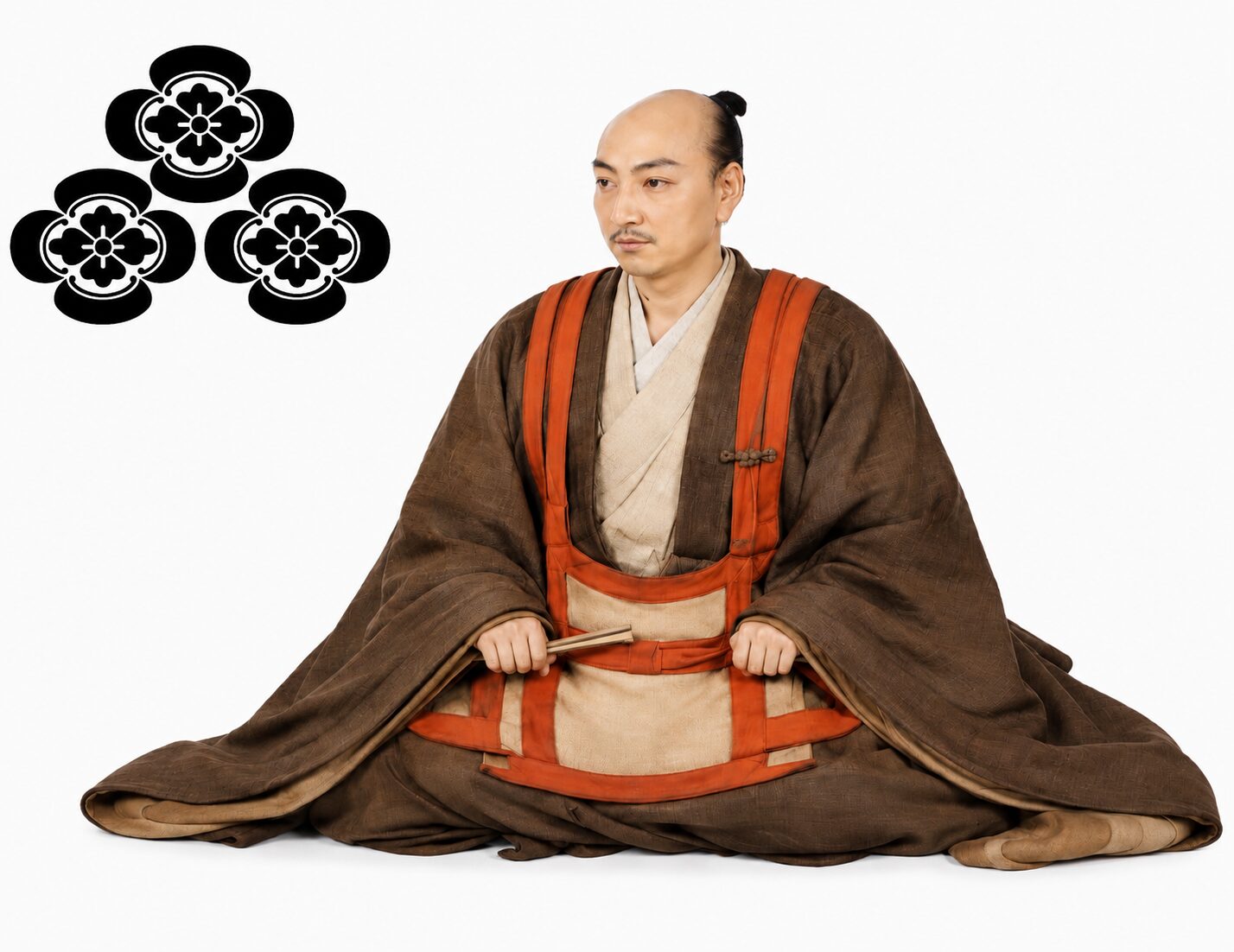
Asakura Yoshikage — The Echizen Noble House That Reached Its Height of Glory at Ichijōdani, Until Its Destruction by Nobunaga
Tenbun 2 (1533) – the 20th day of the 8th month, Tenshō 1 (1573) | Died at age 41
This Figure in Three Lines
- The 11th (and last) head of the Asakura house, which ruled Echizen Province. He built the cultural prosperity of Ichijōdani, called “the Kyoto of the North.”
- At the withdrawal at Kanegasaki, he drove Nobunaga to the very brink of a pincer attack, but his pursuit was inadequate and he let him slip away.
- In Tenshō 1 (1573), Ichijōdani was attacked by Nobunaga, and Yoshikage took his own life through the betrayal of his retainers. The Asakura house perished after five generations spanning about 100 years.
The Mainstream Account — The Standard Story Found in Textbooks
The Prosperity of Ichijōdani
Asakura Yoshikage was born in Tenbun 2 (1533), and in Tenbun 17 (1548), upon the sudden death of his father Asakura Takakage, he succeeded to the headship at the age of 16. Ichijōdani in Echizen Province, which Yoshikage governed, was a cultural city so flourishing that it was called “the Kyoto of the North.” Many court nobles and cultured men who had fled from Kyoto lived there, and Noh theater, linked verse, and the tea ceremony were avidly held. Yoshikage himself was deeply versed in culture and the arts.
Hesitation over the March on Kyoto — Letting a Once-in-a-Lifetime Chance Slip
In Eiroku 11 (1568), Ashikaga Yoshiaki took refuge in Echizen and asked Yoshikage to support a march on Kyoto. But Yoshikage was reluctant, and in the end Yoshiaki left Echizen to rely on Oda Nobunaga. This decision became a fatal blunder. Nobunaga, championing Yoshiaki, accomplished the march on Kyoto and opened his road to mastery of the realm.
The Withdrawal at Kanegasaki (1570)
In the 4th month of Genki 1 (1570), using as a pretext Yoshikage’s failure to obey Yoshiaki’s order to march on Kyoto, Nobunaga invaded Echizen. But when Azai Nagamasa struck at Nobunaga’s rear, Nobunaga fell into the crisis of a pincer attack. This is the withdrawal at Kanegasaki. For Yoshikage it was the greatest chance to bring Nobunaga down, but his pursuit was inadequate and he allowed Nobunaga to escape.
→ For details, see the battle article “The Withdrawal at Kanegasaki.”
The Battle of Anegawa — The Price of Not Taking the Field (1570)
At the Battle of Anegawa in the 6th month of the same year, Yoshikage did not take the field himself but dispatched Asakura Kagetake as his proxy. The Asakura army was defeated by the force of Tokugawa Ieyasu. That Yoshikage did not take the field himself affected his retainers’ morale and brought about a decline in the Asakura house’s cohesive power.
The Fall of Ichijōdani and His End (1573)
In the 8th month of Tenshō 1 (1573), Nobunaga invaded Echizen with a great army. Yoshikage suffered a crushing defeat at the Battle of Tonezaka and withdrew to Ichijōdani, but defections among his retainers were already coming one after another. Yoshikage fled to Ōno relying on his kinsman Asakura Kageakira, but was betrayed by Kageakira and took his own life at Kenshō-ji. He was 41. The Asakura house perished after five generations spanning about 100 years.
The Theories — Exploring the Possibilities from Various Angles
【Theory 1】Was Yoshikage “Foolish”?
Yoshikage has traditionally been assessed as “an indecisive head, militarily incompetent.” In recent years, however, a reassessment has advanced that credits him with his own diplomatic and military judgment — such as his protection of Ashikaga Yoshiaki and his long years of war with the Kaga Ikkō-ikki. There is a view that his giving up on the march on Kyoto was also a rational judgment that prioritized the defense of his domain.
【Theory 2】The Structural Problem of the Asakura House
Yoshikage’s failures lay not only in his personal qualities but also in the organizational structure of the Asakura house. The clansmen had a high degree of autonomy, and it was a system in which the head’s orders were hard to enforce thoroughly. Yoshikage’s failure to take the field at Anegawa, too, can be interpreted less as his own passivity than as the result of being unable to reach agreement with the clansmen.
【Theory 3】Why Was the Pursuit at Kanegasaki Inadequate?
As reasons for letting Nobunaga slip away after driving him to the very brink of a pincer attack, scholars point to confusion in the chain of command within the Asakura house and a lack of coordination with clansmen such as Asakura Kageakira and Kagetake. There was also a structural problem: the Asakura army itself was unaccustomed to aggressive pursuit actions.
A Strategic View
Yoshikage’s greatest blunder was letting Nobunaga slip away at the withdrawal at Kanegasaki. When Nobunaga withdrew via the crossing of Kutsuki, had Yoshikage pursued with all his strength, there is a possibility that Nobunaga’s life would have ended there. This failure to press the pursuit thoroughly resulted in allowing Nobunaga’s subsequent counterattack.
The cultural prosperity and the military stagnation of Ichijōdani were two sides of the same coin. Yoshikage devoted his energies to the stability of his domain and the promotion of culture, but he lacked the flexibility to respond to the rapidly changing Sengoku situation. Against an opponent with innovative strategic thinking like Nobunaga, a stance of unrelenting defense in the old manner could not compete.
Nevertheless, the cultural heritage of Ichijōdani should be justly credited as Yoshikage’s achievement. Today the Ichijōdani Asakura Clan Ruins are designated a Special Historic Site and Special Place of Scenic Beauty of the nation, and have become a precious heritage that conveys the appearance of a Sengoku-period castle town to the present.
Related Historic-Site Map and Travel Model Course
Related Historic-Site Map — Places Associated with Asakura Yoshikage
Spots on the map:
- Ichijōdani Asakura Clan Ruins (castle) — the base of five generations of the Asakura. The reconstructed townscape is a highlight
- Asakura Residence Ruins (residence) — the site of Yoshikage’s residence. Its Chinese-style gate (karamon) still stands
- Ichijōdani Asakura Clan Ruins Museum (museum) — a museum opened in 2022
- Kenshō-ji Ruins (Site of Yoshikage’s Suicide) (historic site) — the ruins of the temple where Yoshikage took his own life. Ōno City
※ The map is a reference display based on present-day roads. It differs from the roads and terrain of the Sengoku period.
📍 See the route on Google Maps (car/train switchable)
Travel Model Course — A One-Day Course Tracing the Rise and Fall of an Echizen Noble House
Prerequisites
- Time required: about 4–5 hours (by car)
- Stay at each spot: 30 minutes to 1 hour 30 minutes
- Starting point: JR Fukui Station
Model Course
① Ichijōdani Asakura Clan Ruins Museum (stay: about 1 hour) — Opened in 2022. Experience the history of the Asakura. About 20 minutes by car from Fukui Station.
② Ichijōdani Asakura Clan Ruins / Asakura Residence Ruins (stay: about 1 hour 30 minutes) — The reconstructed townscape and the Chinese-style gate are highlights. On foot: about 10 minutes from the museum.
③ Kenshō-ji Ruins (Site of Yoshikage’s Suicide) (stay: about 30 minutes) — The place where Yoshikage, betrayed by his retainer, took his own life. Within Yoshikage Park in Ōno City. By car: about 40 minutes from Ichijōdani.
Arrangements by Type of Visitor
- For strong walkers: Climb to the Ichijōdani Castle ruins (the mountaintop stronghold). About 40 minutes each way.
- For a relaxed pace: Make a leisurely half-day course of the museum and the reconstructed townscape.
※ This plan is a reference model based on general travel speeds and stay times. Opening hours, transit schedules, and crowding vary by season and day of the week. Please check the latest information on the official websites of each facility and transport operator before setting out.
Related Battle Articles
Reference Information
- Primary sources: Shinchō Kōki (by Ōta Gyūichi), Asakura Kaki
- Suitō Makoto, Asakura Yoshikage (Yoshikawa Kōbunkan, Jinbutsu Sōsho series, 2000)
- Fukui Prefectural Ichijōdani Asakura Clan Ruins Museum, official materials
※ This article is based on the historical sources, research works, and multiple online sources noted above. Interpretations of history differ even among scholars, and the established view may change with the discovery of new sources or the advance of research.
コメント