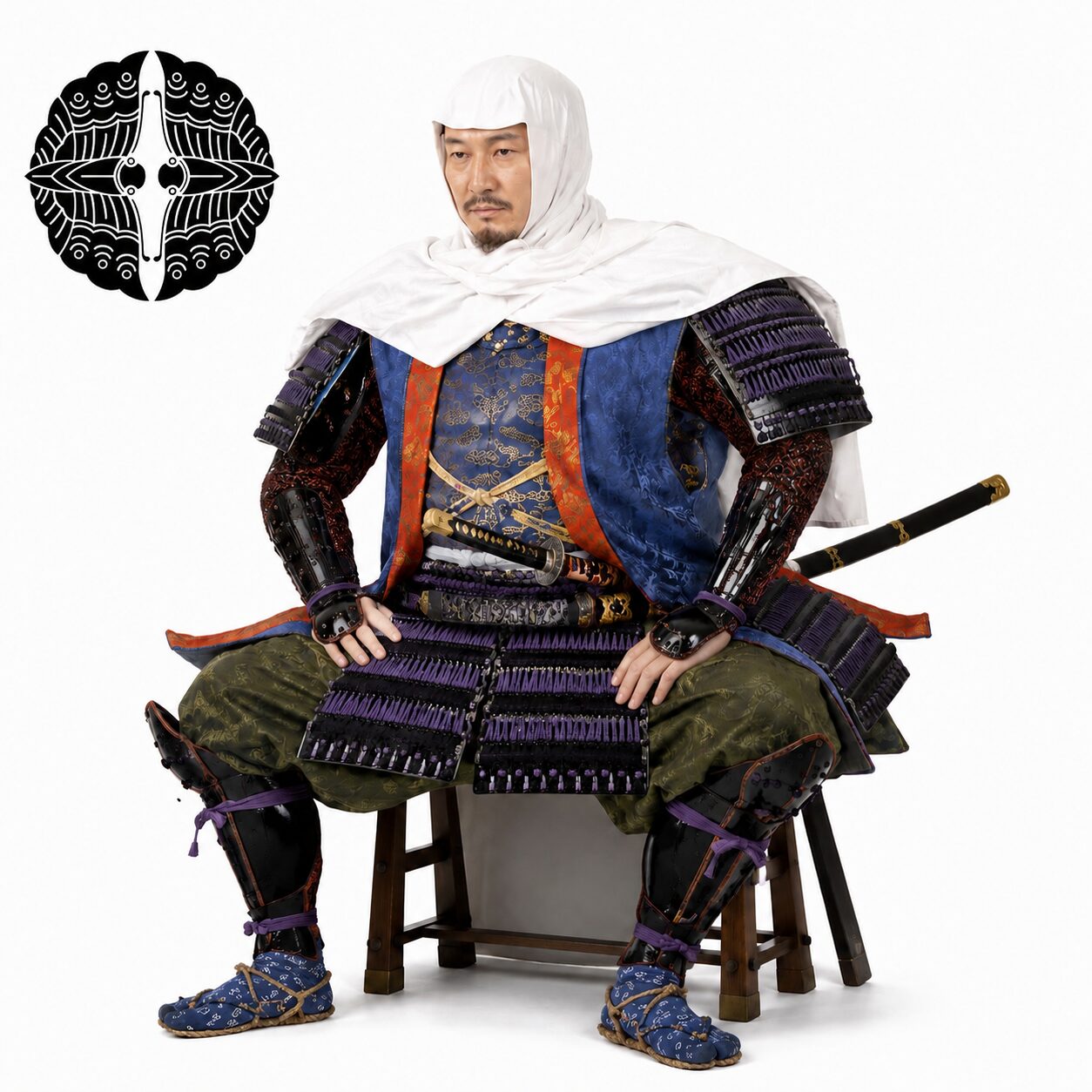
Ōtani Yoshitsugu — The White-Hooded Strategist Who Died for Righteousness, the Warlord of Friendship Who Fell at Sekigahara
- Ōtani Yoshitsugu in 3 Points
- The Mainstream View — The Established Account Found in Textbooks
- Multiple Theories — Exploring Possibilities from Various Angles
- Viewed Strategically
- Famous Words and Sayings of This Warlord
- Anecdotes and Episodes
- Timeline
- Family and Personal Relationships
- Related Historic Site Map / Model Travel Courses
- Related Articles
- References
Ōtani Yoshitsugu in 3 Points
- Serving Toyotomi Hideyoshi from his page days, he supported the Toyotomi regime as a magistrate, army inspector, and lord of Tsuruga at 50,000 koku — a strategist accomplished in both arts of war and letters.
- Afflicted with a “karmic illness” said to be Hansen’s disease and losing even his sight, at the Battle of Sekigahara he commanded from atop a palanquin — a famed general of ill fortune.
- Dying for his friendship with his sworn friend Ishida Mitsunari, he fought hard amid the Western Army’s dark prospects and finally took his own life. A figure symbolizing the “righteousness” of bushidō.
The Mainstream View — The Established Account Found in Textbooks
A Mysterious Origin and Year of Birth (1559 or 1565–)
Ōtani Yoshitsugu’s origin is shrouded in particular mystery even among Sengoku warlords. He has long been said to have been born in Eiroku 2 (1559) in Ōmi Province (present-day Shiga Prefecture), but in recent research the theory of Eiroku 8 (1565) as the year of birth is becoming influential. In this case his age at death is also to be revised from the conventional 42 to 36.
As for his father, the theory that he was Ōtani Moriharu, a retainer of the Ōtomo clan, was long widely known. It is the storyline that Yoshitsugu was born when his father had gone to Bungo Province (present-day Ōita Prefecture) for medical treatment and had become a retainer of the Ōtomo clan in that period. However, it has been pointed out that no Taira-surname Ōtani existed in the Ōtomo house of the time, and at present the theory taking Ōtani Yoshifusa, a former retainer of the Rokkaku clan of Ōmi, as his father is influential (see Theory 1).
As for his mother, it is certain that she was a woman later called “Higashi-dono” who served as the liaison of Hideyoshi’s legal wife Kōdai-in (One). From the connection that his mother was a lady-in-waiting of Kōdai-in, Yoshitsugu’s exceptional advancement is explained (see Theory 1).
His childhood name was Keimatsu. The character “Yoshi” in “Yoshitsugu” is also said to have been granted by Hideyoshi from a character of his own name.
Advancement as Hideyoshi’s Page (c. 1577–)
Yoshitsugu served Toyotomi Hideyoshi from his youth. He is thought to have been working as Hideyoshi’s page and close attendant at least by the time Hideyoshi was attacking the Chūgoku region as a chief retainer of Oda Nobunaga — that is, around the attack on Miki Castle in Harima from Tenshō 5 (1577) on.
Hideyoshi highly rated Yoshitsugu’s cunning and practical ability. As Hideyoshi rapidly expanded his power toward the unification of the realm after the Honnō-ji Incident of Tenshō 10 (1582), Yoshitsugu too rose in step with his lord. He mustered in Hideyoshi’s major campaigns — the Battle of Yamazaki, the Battle of Shizugatake, the Kyushu subjugation, the Odawara Campaign, and others.
Hideyoshi highly rated Yoshitsugu’s talent and in later years is said to have said, “I should like to give Yoshitsugu a million troops and have him command them.” This is exceptional as an evaluation of a Sengoku warlord, showing that Hideyoshi rated Yoshitsugu’s military talent higher than that of Katō Kiyomasa, Fukushima Masanori, and the others of the Seven Spears of Shizugatake.
His Activity as a Magistrate and His Relationship with Ishida Mitsunari
Under the Toyotomi regime, Yoshitsugu often took charge of magistrate duties together with Ishida Mitsunari. When Mitsunari became the Sakai magistrate, Yoshitsugu handled the practical work as his subordinate. The two, both working at the heart of the regime as Hideyoshi’s close aides, naturally built a deep relationship.
The famous “tea-gathering anecdote” — that at a tea gathering at Osaka Castle in 1587 (Tenshō 15), while the warlords around shunned the tea bowl to which Yoshitsugu had put his lips, Mitsunari alone calmly drained it — is widely known as a tale symbolizing the friendship of the two. However, the source of this anecdote is said to be earliest in Fukumoto Nichinan’s On Heroes of the Meiji era, and it does not appear in reliable sources of the Sengoku and Edo periods (see Theory 3).
Even so, several sources survive showing that the two were in a close relationship. The Uno Mondo Nikki records that the two accompanied Hideyoshi on a trip to the Arima hot spring. The Sōtan Nikki preserves an episode in which Mitsunari secretly arranged an occasion for the appreciation of tea utensils for the sake of Yoshitsugu, who had incurred Hideyoshi’s displeasure and was in confinement after the Kyushu subjugation. Whether on the battlefield or in domestic government, the two were always in a relationship of acting in tandem.
Becoming Lord of Tsuruga in Echizen at 50,000 Koku (1589)
In Tenshō 17 (1589), Yoshitsugu was granted Tsuruga District in Echizen Province and became the castellan of Tsuruga. His initial holdings were about 20,000 koku, later increased to about 50,000 koku. Tsuruga was an important base of Sea-of-Japan trade and also a key point of transport connecting Kyoto and Osaka with the Hokuriku. Yoshitsugu devoted himself to the economic development and harbor maintenance of Tsuruga, advancing the improvement of highways and the harbor.
Yoshitsugu is said to have been deeply cherished by the domain’s people for his good government in Tsuruga. Even now Tsuruga City honors Yoshitsugu as a face of the city, and the Tsuruga Castle ruins and Eishō-ji (Yoshitsugu’s family temple) have become tourist attractions.
The Onset of the Karmic Illness and the “White-Hooded” Warlord (c. 1587–)
From around Tenshō 15 (1587), Yoshitsugu is said to have begun to suffer from an illness called a “karmic illness.” A “karmic illness” meant, in the Buddhist view of the time, an illness deriving from the sins of a former life, and was used as a general term for incurable and intractable diseases. In particular, Hansen’s disease (leprosy), which causes marked changes in appearance, was taken until modern times as the representative “karmic illness.”
Regarding Yoshitsugu’s illness, the theory taking it as Hansen’s disease is the most influential, but there are also a syphilis theory and a mere eye-disease theory, and it is not settled (see Theory 2). What is certain is that Yoshitsugu’s facial appearance changed markedly and he gradually lost his sight as well. To hide his face before others, Yoshitsugu came to wear a white hood.
In the “thousand-cuts” (random street-killing) incident that occurred in Osaka in 1587 (Tenshō 15), a rumor circulated suspecting Yoshitsugu as the culprit. The Honganji Nikki (Uno Mondo Nikki) records the rumor that Yoshitsugu, being a “leprosy” patient who needed human liver, had carried out the street killings. The actual culprits were Ukita Jirōkurō and others, and Yoshitsugu was falsely accused, but it is a precious source showing that Yoshitsugu’s illness was already circulating among the public at the time (see Theory 4).
With the progress of his illness, Yoshitsugu gradually withdrew from the central duties as one of Hideyoshi’s close aides and magistrates. He should originally have been ranked among the “Five Commissioners” together with Mitsunari, Mashita Nagamori, Maeda Gen’i, Asano Nagamasa, and Natsuka Masaie, but because of his illness he was not chosen as a formal member of the Five Commissioners.
The Korean Campaign and His Diplomatic Skill (1592–1598)
In the Korean campaign (the Bunroku-Keichō campaigns) from Bunroku 1 (1592), Yoshitsugu took charge as ship magistrate and army inspector, and was also engaged in guiding the various generals and in diplomatic negotiations with the Ming. Sick in body though he was, his practical ability and cunning were exercised on the Korean front.
When Hideyoshi died at Fushimi Castle in the 8th month of Keichō 3 (1598), the Toyotomi regime began rapidly to be thrown into turmoil. In this period Yoshitsugu maintained close relations with Tokugawa Ieyasu as well, and was highly rated by Ieyasu too. Ieyasu at first expected Yoshitsugu to become a powerful ally of the Eastern Army.
The Marriage Tie with the Sanada House
Yoshitsugu’s daughter Chikurin-in married Sanada Yukimura (Nobushige), the second son of Sanada Masayuki. This was through Hideyoshi’s mediation, a marriage joining the Sanada house of Shinshū with the Ōtani house of Ōmi and Echizen. Through this marriage tie, Yoshitsugu was deeply bound to the Sanada house, and is said to have influenced the later joining of the Western Army by the Sanada father and son at Sekigahara (the Parting at Inubushi).
Yukimura’s daughter Oume, who became Yoshitsugu’s step-granddaughter, became the concubine of the Date retainer Katakura Shigenaga after the Siege of Osaka, later becoming his legal wife and conveying the bloodlines of both the Sanada and Ōtani houses to Sendai. Yoshitsugu’s blood was inherited, by way of the Sanada house, into the Date house.
The Ukita Disturbance and Distrust of Ieyasu (1599–1600)
At the end of Keichō 4 (1599), internal strife broke out between Ukita Hideie of the Bizen Okayama Domain and his chief retainers (the Ukita Disturbance). Hideie’s wife Gōhime was Hideyoshi’s adopted daughter, and the Ukita house had a deep marriage tie with the Toyotomi house. Hideie was also one of the Five Elders, and mediating the disturbance was an important task for the Toyotomi regime.
Ieyasu at first entrusted the mediation to the Five Commissioners and Yoshitsugu. Yoshitsugu busied himself with the arbitration between Hideie and his chief retainers and was moving toward a resolution. But in the end Ieyasu himself intervened and resolved the disturbance. It became a form in which Ieyasu snatched away the mediation that had supposedly been entrusted to Yoshitsugu and the others.
Through this affair, Yoshitsugu is said to have harbored distrust of Ieyasu. Yoshitsugu, who had until then maintained good relations with Ieyasu, found a crack arising in his relationship with Ieyasu by the stage of the eve of Sekigahara. Among researchers there is also a view that this very Ukita Disturbance became the foreshadowing of Yoshitsugu’s joining of the Western Army at Sekigahara (see Theory 5).
Mitsunari’s Plan to Raise Arms and Joining the Western Army (1600)
In the 6th month of Keichō 5 (1600), Ieyasu, on the grounds that there was suspicion of rebellion against Uesugi Kagekatsu of Aizu, raised an army to subdue the Uesugi. Yoshitsugu, who was also on intimate terms with Ieyasu, raised troops from his territory of Tsuruga and his deputy-administered lands, and set out from Tsuruga in the 7th month to join the subjugation army.
Around the 10th day of the 7th month, Yoshitsugu stopped at Mitsunari’s castle, Sawayama Castle. There Mitsunari confided to Yoshitsugu his plan to raise arms and topple Ieyasu. The plan was also conveyed to the Mōri-clan diplomatic monk Ankokuji Ekei, who was present.
Yoshitsugu was astonished and remonstrated with Mitsunari. “You have no popular support,” “there is no prospect of beating Ieyasu,” “even those who wish for the security of the Toyotomi house will, if you raise the call, run under the Naifu (Ieyasu)” — Yoshitsugu tried many times to make Mitsunari change his mind.
Even so, Mitsunari’s resolve did not change. In the end Yoshitsugu decided to take part in Mitsunari’s raising of arms. However, Yoshitsugu set a condition. “Set up Mōri Terumoto or Ukita Hideie above, and you yourself keep to the shadows” — by this proposal, Mōri Terumoto served as the Western Army’s supreme commander, and Mitsunari came to act as the substantial commander.
Regarding the motive by which Yoshitsugu decided to join the Western Army, it is said to have been not simple friendship but several factors. Distrust of Ieyasu (the Ukita Disturbance), the high evaluation of himself, gratitude to Hideyoshi, and the long-standing relationship with Mitsunari — the decision was the result of these acting in compound (see Theory 5).
The Main Battle of Sekigahara — Command from Atop a Palanquin (15th Day of the 9th Month, 1600)
In the early morning of the 15th day of the 9th month of Keichō 5 (1600), the Eastern and Western armies clashed at Sekigahara in Mino Province. Yoshitsugu deployed at Yamanaka village (present-day Yamanaka, Sekigahara-chō). His own force was about 2,000, and even including the attached cavalry of Toda Katsushige, Hiratsuka Tamehiro, and others it was about 3,500.
Yoshitsugu was wary of betrayal. This was because the movements of Kobayakawa Hideaki, deployed on Mount Matsuo, were suspicious. Hideaki had been presented with good conditions by both Tokugawa Ieyasu and Ishida Mitsunari, and his allegiance had not been fixed even before the fighting. As a guard against Hideaki, Yoshitsugu had placed the corps of Toda, Hiratsuka, and others on the flank of Mount Matsuo.
The main battle of Sekigahara opened around 8 a.m. when the Eastern Army’s Ii Naomasa fired guns on the army of Ukita Hideie. Yoshitsugu commanded while remaining in his palanquin owing to the influence of his illness. Having lost his sight, he was in a state with no recourse but to judge the situation by the reports of his retainers and by ear.
In the morning, Yoshitsugu fought hard against the Eastern Army’s Tōdō Takatora, Kyōgoku Takatomo, and others. The exchange of attack and defense is said to have reached six or seven times. There is also a view that, few though they were, his force was entrusted as the vanguard of the Western Army, with foot-soldier musketeers from each unit reinforcing the Ōtani corps.
Kobayakawa Hideaki’s Betrayal and the Self-Immolation
Around noon, Kobayakawa Hideaki, deployed on Mount Matsuo, finally moved. He turned traitor to the Eastern Army, raced down the mountain, and fell upon the Ōtani corps. Yoshitsugu, having anticipated the betrayal from before, met them with his 600 direct troops. Further, joining forces with Toda Katsushige and Hiratsuka Tamehiro, who turned back from the front line, he is said to have pushed back the Kobayakawa corps of 15,000 — overwhelmingly superior in strength — two or three times.
Seeing this, Hideaki flew into a rage and, taking command himself, advanced his main body. The Ōtani corps fought hard, but here a decisive incident occurred. In response to Kobayakawa’s betrayal, the four corps of Wakisaka Yasuharu, Kuchiki Mototsuna, Akaza Naoyasu, and Ogawa Suketada, deployed at the foot of Mount Matsuo, all at once turned traitor to the Eastern Army and fell upon the flank of the Ōtani corps.
Yoshitsugu had not predicted as far as this “simultaneous betrayal of four corps.” One corps or two would still be one thing, but with the simultaneous betrayal of four corps, outnumbered, the Ōtani corps was annihilated. Toda Katsushige, Hiratsuka Tamehiro, and others also fell. Yoshitsugu took his own life on the ground of Sekigahara. He was 36 (or 42).
Regarding Yoshitsugu’s end, the Jōzan Kidan conveys the following. His close aide Yuasa Gosuke buried Yoshitsugu’s head at Sekigahara, and it was not discovered by the Eastern Army side. Yuasa Gosuke was thereafter pursued by Tōdō Niemon, a retainer of Tōdō Takatora, and is said to have offered up his own head and fallen on the condition of not revealing the location of Yoshitsugu’s head. Niemon did not utter the place of Yoshitsugu’s head to the last, and is said to have been praised by Ieyasu.
In a variant, it is also said that the retainer Miura Kidayū wrapped Yoshitsugu’s head in a bag, had his nephew, the accompanying monk Yūgen, carry it out of the battlefield, and buried it at Maibara in Ōmi. A head mound has also been built at the site.
→ For details, see the battle article “Battle of Sekigahara.”
Remembered as “the Warlord Who Died for Righteousness”
That Yoshitsugu took his own life at Sekigahara was the result of dying for his friendship with Mitsunari and his loyalty to the Toyotomi house, even while knowing it was a battle without prospect of victory. While many Western Army generals left the battlefield and fled, Yoshitsugu stood his ground on the battlefield to the last. This was not merely that he could not move from his palanquin because of illness, but an expression of his resolve as a warrior.
There is another interpretation of Yoshitsugu’s self-immolation. Hideaki was the nephew of Hideyoshi’s legal wife Kōdai-in, and Yoshitsugu’s mother too had been Kōdai-in’s liaison. There is also a view that, by being killed by Hideaki, he sought to repay his debt to Kōdai-in. Yoshitsugu’s death was not a mere defeat but an end upholding his pride as a warlord beholden to the Toyotomi house.
After Yoshitsugu’s death, the Tokugawa shogunate was established by the Eastern Army’s victory, and the Sengoku age came to an end. The Western Army generals were executed or exiled, but Yoshitsugu alone ended his days as a warrior on the battlefield. That clean end has been deeply cherished in later ages as “the warlord who died for righteousness,” and continues to be depicted to the present in many anecdotes, novels, and Taiga dramas.
Multiple Theories — Exploring Possibilities from Various Angles
Theory 1: Yoshitsugu’s Origin and the “Hideyoshi’s Secret Child” Theory
Ōtani Yoshitsugu’s origin has particularly many mysteries even among Sengoku warlords. There are several theories on all of his year of birth, father, and birthplace, and research continues even now.
Year of birth: the 1559 theory and the 1565 theory
Conventionally he was said to have been born in Eiroku 2 (1559), and his age at his self-immolation at Sekigahara was taken as 42. But in recent research the theory of birth in Eiroku 8 (1565) is becoming influential. In this case his age at death becomes 36.
The grounds for the 1565 theory are based on the treatises of researchers such as Miyamoto Yoshimi and Someya Mitsuhiro. At the history symposium “Approaching the Mysteries of Ōtani Yoshitsugu” (Tsuruga, Plaza Banshō) on September 3, 2000, Miyamoto Yoshimi pointed out the Eiroku 8 theory and reinforced Someya’s theory, by which recognition in the academic world spread. From a scrutiny of the sources and genealogies of the time, there are many points where the 1565 theory is more consistent.
Father: the Ōtani Moriharu theory and the Ōtani Yoshifusa theory
In the conventional view, the father was taken to be Ōtani Moriharu, a retainer of the Ōtomo clan. It is the tale that Yoshitsugu was born when his father had gone to Bungo Province for medical treatment and had for a time become a retainer of the Ōtomo clan.
But in recent research it has become clear that no Taira-surname Ōtani existed in the Ōtomo house of the time. By this the Ōtomo-retainer theory lost support, and the theory taking Ōtani Yoshifusa, a former retainer of the Rokkaku clan of Ōmi, as the father has become influential. This is also consistent with Yoshitsugu’s birthplace being Ōmi, and is the current mainstream theory.
As another theory, from the fact that Yoshitsugu’s name appears in the genealogy of the bōkan Ōtani house in the Kachō Yōryaku, and that the wife of the Honganji bōkan Shimotsuma Yoriaki was Yoshitsugu’s younger sister, there is also a theory taking him as the child of Ōtani Taichin, the bōkan of the Shōren-in monzeki.
The “Hideyoshi’s secret child” theory
From Yoshitsugu’s exceptional advancement and the fact that his mother was the liaison of Hideyoshi’s legal wife Kōdai-in (One), a popular theory of a “secret child of Hideyoshi” had circulated since the Edo period. That he received the character “Yoshi” from Hideyoshi, that Hideyoshi evaluated him with “I should like to give him a million troops,” and that he became lord of Tsuruga at 50,000 koku while young — these facts were taken as material reinforcing the “secret child” theory.
However, in current historiography this theory is said to not go beyond the realm of urban legend. That his mother Higashi-dono was an influential figure attending the inner quarters as Kōdai-in’s liaison, and that by that connection Yoshitsugu was favored by Hideyoshi — these alone are no grounds for concluding “secret child.” Rather, it is natural to think that Yoshitsugu’s own superior cunning and practical ability called forth Hideyoshi’s evaluation and his advancement.
These various theories of origin make stand out the “mystery” and “mystique” of the man Yoshitsugu, and have been made into stories in later literature and performing arts. What is certain is that his mother Higashi-dono was a figure close to Kōdai-in, that Yoshitsugu was favored by Hideyoshi from a young age, and that his connection with the Rokkaku clan of Ōmi was deep.
Theory 2: Yoshitsugu’s Illness — Hansen’s Disease, Syphilis, or Eye Disease
What is unavoidable in speaking of Yoshitsugu is the “karmic illness” he suffered. The figure wearing a white hood and commanding Sekigahara from atop a palanquin is one of the most striking images of a warlord in Japanese history, but the true nature of his illness is not settled even now.
Hansen’s disease (leprosy) theory — the conventional view
The most influential and long-established view is the “Hansen’s disease” theory. A chronic infectious disease affecting the skin and peripheral nerves, it was feared as an incurable disease at the time. Change of appearance (the breaking-down of the facial skin) and loss of sight — these agree with Yoshitsugu’s symptoms.
The Honganji Nikki (Uno Mondo Nikki) records the rumor that Yoshitsugu was a “leprosy” patient. That the word “leprosy” appears in a contemporary source is important, showing that the people of the time recognized Yoshitsugu’s illness as Hansen’s disease.
Since modern times, Yoshitsugu is described even in Wikipedia categories as “a figure who contracted Hansen’s disease,” and he has been a subject of research as a case interesting from the standpoint of medical history.
The syphilis theory
In recent years, a theory has also been presented that it was not Hansen’s disease but syphilis. Syphilis was a new infectious disease that came to Japan in the early 16th century and had spread to warlords as well in the Sengoku period. In severe syphilis (late syphilis), symptoms such as skin lesions, optic-nerve atrophy, and gummas appear, presenting an outward appearance similar to Hansen’s disease.
The grounds for the syphilis theory are that some records of the time describe only “eye disease,” so it cannot necessarily be determined to be Hansen’s disease. Further, from the fact that there were many syphilis patients among the warlords of the Sengoku period, there is an aspect in which it is supported by circumstantial evidence.
The mere eye-disease theory
As the most cautious view, there is also a theory that Yoshitsugu’s illness was a mere severe eye disease and was neither Hansen’s disease nor syphilis. The position is that what is certain in the records of the time is only that he “suffered from his eyes,” “lost his sight,” and “hid his face,” and that identifying a disease name beyond that does not go beyond conjecture.
The point reached by current research:
In the research of historians such as Watanabe Daimon, it is held that “setting aside the identification of a disease name, it is a fact that Yoshitsugu suffered from an eye disease and there was a change in his appearance.” The Hansen’s-disease theory has long been influential, but decisive evidence is scarce. Since the medical records of the time do not correspond one-to-one with modern disease names, the only certain thing is the fact that “by some chronic disease his appearance changed and he lost his sight.”
In any case, the fact that Yoshitsugu continued to command up to Sekigahara despite being sick in body does not change. More than the true nature of the illness, it is precisely his strength of spirit, which overcame it and was active as a warlord, that is the reason he is rated in later ages.
Theory 3: The “Tea-Gathering Anecdote” with Ishida Mitsunari — Historical Fact or Later Fabrication
The most famous episode symbolizing the friendship of Yoshitsugu and Mitsunari is the “tea-gathering anecdote.” At a tea gathering held at Osaka Castle in 1587 (Tenshō 15), when the tea was passed around for drinking from the bowl to which Yoshitsugu had put his lips, the pus from his face dripped into the bowl. The warlords around shunned drinking and, pretending to drink, passed it on to the next, but Mitsunari alone calmly drained the tea and asked for another cup. Deeply moved by this conduct of Mitsunari, Yoshitsugu — and it became the foreshadowing of the later joint fighting at Sekigahara — such is the story.
This anecdote is repeatedly depicted in modern novels, manga, and Taiga dramas, and is widely known as a symbol of the friendship of the two. However—
The source is of later date:
According to the pointing-out of historians such as Hongō Kazuto, the oldest source of this anecdote is the Meiji-era journalist Fukumoto Nichinan’s On Heroes. It was published in 1907 (Meiji 40), a work of an age more than 300 years after the deaths of Yoshitsugu and Mitsunari.
In the reliable primary sources and compilations of the Sengoku and Edo periods, this anecdote does not appear at all. If it were so dramatic an episode, it should normally have been recorded in some form in Edo-period war chronicles, but there is no trace of it.
For this reason, in current historiography the view that “the tea-gathering anecdote is highly likely a Meiji-era fabrication” is mainstream. It is highly likely that Fukumoto Nichinan created it as a tale symbolizing the friendship of the two, or wrote it incorporating folk tradition.
Then is the friendship of the two a lie?
It is not a complete fabrication. That the two were in a deep relationship can be confirmed from several contemporary sources. The Uno Mondo Nikki records that the two accompanied Hideyoshi on a trip to the Arima hot spring, and the Sōtan Nikki records that, after the Kyushu subjugation, Mitsunari secretly arranged an occasion for the appreciation of tea utensils for Yoshitsugu. Whether on the battlefield or in domestic government, the two were always in a relationship of acting in tandem.
In other words, the “tea-gathering anecdote” is not historical fact, but the friendship of the two itself is historical fact. The anecdote is a later fabrication, but the relationship that became the motive for fabricating it certainly existed. Fukumoto Nichinan of the Meiji era likely created it in a form supplementing a tale symbolizing the friendship of the two amid the scattering of sources.
The Keichō Gunki also has a description taking the two as being in a shudō (male-love) relationship, but this too is a secondary source, and its basis is thin. Rather, it is appropriate to understand that the people of later ages tried to explain the long-standing comradely relationship of the two, who had acted together since their page days, through various tales such as “shudō” and the “tea-gathering anecdote.”
Theory 4: Yoshitsugu’s Thousand-Cuts Suspicion — Was It to Cure His Illness?
In the “thousand-cuts (street-killing) incident” that occurred in Osaka in 1587 (Tenshō 15), the rumor that Yoshitsugu was suspected as the culprit is recorded in the contemporary source Honganji Nikki (Uno Mondo Nikki).
Outline of the incident:
Around 1587, a series of street-killing incidents occurred in the city of Osaka, shaking the people. The actual culprits were several people such as Ukita Jirōkurō, who were arrested and executed. Yoshitsugu was falsely accused, but the very fact that suspicion arose needs to be noted.
The description of the Honganji Nikki:
The Honganji Nikki records the rumor that Yoshitsugu was a “leprosy” (Hansen’s-disease) patient who, to cure his illness, needed a certain part of the human body (human liver and the like). This was based on the folk belief of the time that “human liver is effective against all illnesses.”
That this rumor was left in the record shows two important points:
- That Yoshitsugu’s illness was circulating among the public. By the stage of 1587, that Yoshitsugu was suffering from Hansen’s disease (the illness as the people of the time recognized it) was widely known among the people of Osaka and Kyoto.
- The strength of the discriminatory consciousness of the time. It tells that prejudice against Hansen’s-disease patients and belief in a superstitious cure (eating human liver) were strong enough to turn suspicion even on a warlord, Yoshitsugu.
Yoshitsugu’s own response:
The record of how Yoshitsugu himself responded to this suspicion is scarce. Because the actual culprits became known as Ukita Jirōkurō and others, Yoshitsugu’s suspicion should have been cleared, but the public rumor is said not to have completely disappeared.
In the historian Watanabe Daimon’s Yahoo News article “Did Ōtani Yoshitsugu Really Carry Out the Thousand Cuts to Cure His Eye Disease? Exploring the Truth,” he arranges the course of this incident and concludes that “there is no evidence that Yoshitsugu actually carried out the street killings.”
This incident is known as a representative example of the dark rumors surrounding Yoshitsugu, but his own involvement is a false accusation. It can be said to be a precious episode showing that prejudice and discrimination on account of illness weighed heavily on Yoshitsugu’s life.
Theory 5: The Motive for Joining the Western Army — Friendship or Reward-Evaluation
On the eve of Sekigahara in Keichō 5 (1600), Yoshitsugu had at first set out from Tsuruga to join the army subduing the Uesugi under Ieyasu. That, through the meeting with Mitsunari at Sawayama Castle, turned into joining the Western Army. There are still several theories about the motive of this dramatic turn.
Theory A: the friendship theory (the conventional view)
The most commonly told interpretation. The long-standing friendship with Mitsunari, and gratitude for Mitsunari’s character symbolized in the tea-gathering anecdote, turned Yoshitsugu toward the Western Army — such is it. It is a storyline repeatedly adopted from Edo-period war chronicles to modern novels and Taiga dramas.
This interpretation agrees with Yoshitsugu’s image as “the warlord who died for righteousness” and has a narrative quality that appeals to modern people as well. In fact, Yoshitsugu headed for Sekigahara in a state in which he could not even see because of illness, and fought until he took his own life. This is an action impossible without the resolve to “die for friendship.”
Theory B: the “evaluation of himself” theory
An interpretation presented in recent years in history magazines such as Rekishijin. The view that the motive by which Yoshitsugu sided with the Western Army was not simple friendship but was to repay the “high evaluation” from Mitsunari.
According to this view, the warriors of the Sengoku period commonly “fled or turned traitor in pursuit of a high evaluation.” At Sekigahara too, each lord sided with the camp that valued his house highly and would grant rewards. If Yoshitsugu had judged coolly, at first following Ieyasu would have brought greater profit. What overturned this was a response to the fact that Mitsunari treated Yoshitsugu as a true comrade.
Ieyasu rated Yoshitsugu as an “able vassal,” but Mitsunari treated Yoshitsugu as a “comrade and sworn friend.” The interpretation is that this was the decisive factor turning Yoshitsugu toward the Western Army.
Theory C: distrust of Ieyasu through the “Ukita Disturbance”
There is a theory that, in the Ukita Disturbance of the year before Sekigahara, Ieyasu’s intervening and resolving it over the heads of Yoshitsugu and the others — who had supposedly been entrusted with the mediation — generated Yoshitsugu’s distrust of Ieyasu.
Among researchers there are some who point out that this very Ukita Disturbance became the foreshadowing of the conflict between Ieyasu and Yoshitsugu. It is the interpretation that it was the turning point at which Yoshitsugu, who had until then been close, strengthened his wariness of Ieyasu.
Theory D: the gratitude-to-Hideyoshi theory
Yoshitsugu had served Hideyoshi from his page days and had the debt of being granted Tsuruga at 50,000 koku. To protect the Toyotomi house after Hideyoshi’s death, he could not allow Ieyasu’s tyranny — the traditional interpretation. It is the view interpreting “dying for righteousness” most straightforwardly.
Compound motives are the reality:
These theories are not mutually exclusive. It is appropriate to think that, in the background of Yoshitsugu’s decision, friendship, the evaluation of himself, distrust of Ieyasu, and gratitude to Hideyoshi acted in compound. In particular, Yoshitsugu’s decision to side in the end with the Western Army while remonstrating with Mitsunari that “you have no popular support” has a complexity that cannot be explained by a simple theory of motive.
Yoshitsugu, after coolly analyzing the situation, joined the Western Army knowing well that the prospect of victory was thin. This is an extremely rare choice for a Sengoku warlord and is the most important decision in understanding his character.
Theory 6: The Self-Immolation at Sekigahara and the Whereabouts of His Head
After the Ōtani corps was annihilated in the main battle of Sekigahara, Yoshitsugu took his own life on the battlefield. But regarding the subsequent whereabouts of his head, several traditions survive.
The conventional view: burial by Yuasa Gosuke
The best-known tradition is the one based on the Jōzan Kidan. His close aide Yuasa Gosuke, who saw Yoshitsugu’s self-immolation through, buried Yoshitsugu’s head somewhere at Sekigahara and prevented it from being discovered by the Eastern Army side. Thereafter, Gosuke was pursued by Tōdō Niemon, a retainer of Tōdō Takatora.
Gosuke, on the condition of “not uttering the location of Yoshitsugu’s head,” consented to offer up his own head and be slain to Niemon. Niemon kept his promise with Gosuke. Even when asked by Ieyasu, he did not reveal the place of the head. Ieyasu is said to have been impressed by this sincerity and praised Niemon.
For this reason, Yoshitsugu’s head has not been discovered to the present, and is said to rest somewhere at Sekigahara. The grave of Yoshitsugu at Sekigahara-chō is in fact a “memorial pagoda,” and Gosuke’s grave is built beside it at the site. As a historic site showing the bond of lord and retainer, it has become an important spot of Sekigahara tourism.
A variant: the carrying-out of the head to Maibara
In another tradition, the retainer Miura Kidayū wrapped Yoshitsugu’s head in a bag and had Yoshitsugu’s nephew, the accompanying monk Yūgen, carry it out of the battlefield. Yūgen carried the head to Maibara in Ōmi and buried it there. A head mound of Yoshitsugu has been built at the site. Miura Kidayū thereafter cut his belly in death and followed Yoshitsugu. Yuasa Gosuke too is said to have rushed into the Tōdō corps and fallen. The loyalty of his close aides too tells of Yoshitsugu’s character.
The renaming to “Yoshitaka”:
When Yoshitsugu decided to join the Western Army, he is said to have renamed himself “Yoshitaka,” holding that “Yoshitsugu” sounded inauspiciously like (Miyoshi) Yoshitsugu (a figure destroyed by Nobunaga) (Asaka Tanpaku, Resso Seiseki). The memorial pagoda of Yoshitsugu at Sekigahara-chō is now designated a National Historic Site as the “Grave of Ōtani Yoshitaka.” The monument indicating the camp site is also inscribed “Old Site of the Camp of Ōtani Yoshitaka.” The tradition that he renamed himself just before his death is striking as an episode showing Yoshitsugu’s final resolve.
The curse on Kobayakawa Hideaki:
After Yoshitsugu’s death, a tradition spread that he cursed Hideaki to death. In Keichō 7 (1602), two years after Sekigahara, Hideaki died suddenly at the young age of 21. The cause of death is taken to be visceral disease and cirrhosis of the liver from drinking, but at the time it was rumored to be “the curse of Yoshitsugu.” Tsukioka Yoshitoshi’s Kaidai Hyakusensō: Kingo Chūnagon Hideaki depicts Hideaki cowering before Yoshitsugu’s ghost.
Hideaki himself is said to have been tormented by a sense of guilt after Sekigahara. There is also an anecdote that, when the captured Mitsunari shouted at him, “You shameless traitor!,” he could say nothing, and the mental collapse of Hideaki became legendary. The tradition of Yoshitsugu’s curse is not historical fact, but it was handed down to later ages as a tale symbolizing the people of the time’s “loathing of the traitor” and “sympathy for the one who died for righteousness.”
Viewed Strategically
When Ōtani Yoshitsugu is compared with other Sengoku warlords, three points stand out: his “practical ability accomplished in both arts of war and letters,” his “cold-eyed judgment of the situation,” and his “death for righteousness.“
First, the practical ability accomplished in both arts. Yoshitsugu took charge of magistrate duties under the Hideyoshi regime and was a representative of the civil-administration faction, single-handedly undertaking land surveys, finance, and diplomacy. At the same time, he exercised military talent at Shizugatake, the Kyushu subjugation, the Odawara Campaign, and the Korean campaign, and was evaluated by Hideyoshi with “I should like to give him a million troops.” In the Toyotomi regime, where the civil-administration faction and the military faction were at odds, he was an extremely rare talent combining both abilities. Had he not fallen to illness, it is highly likely he would have continued to support the Toyotomi regime as the head of the Five Commissioners.
Second, the cold-eyed judgment of the situation. Yoshitsugu was a warlord who moved by cool analysis rather than emotion. When he heard Mitsunari’s plan to raise arms, he immediately remonstrated, “you have no popular support,” “you cannot beat Ieyasu,” “even those who wish for the security of the Toyotomi house will run to Ieyasu.” This was the reverse side of his affection for Mitsunari, but at the same time it was a cold-eyed strategic analysis. Yoshitsugu understood better than anyone the folly of throwing oneself into a battle without prospect of victory. That he nevertheless sided in the end with the Western Army can be said to be a human choice surpassing cold-eyed calculation.
Third, death for righteousness. Yoshitsugu’s end at Sekigahara was the most “bushidō-like” death even among Sengoku warlords. While many Western Army generals left the battlefield and fled, Yoshitsugu stood his ground on the battlefield to the last and took his own life after a hard fight. There was the physical factor that he could not move from his palanquin because of illness, but more than that, the resolve to “end his days as a warrior on the battlefield” supported him. The tradition of the curse on Hideaki, and the deaths in loyalty of Yuasa Gosuke, Miura Kidayū, and others, tell that Yoshitsugu’s character continued to captivate those around him.
On the other hand, Yoshitsugu’s limits also cannot be ignored. He could not resist the fate of illness. Yoshitsugu’s talent was highly rated by Hideyoshi, and he should originally have been in a position to lead the Toyotomi regime as a core of the Five Commissioners. With the progress of his illness, he gradually withdrew from the center of the regime. The karmic illness, which onset around 1587, cut off Yoshitsugu’s career as a politician midway. While Mitsunari, Mashita Nagamori, and others continued to support the Toyotomi house as the Five Commissioners, Yoshitsugu remained lord of Tsuruga at 50,000 koku and lost his influence in central politics.
Another limit is the strategic limit at Sekigahara. Yoshitsugu was wary of Kobayakawa Hideaki’s betrayal and placed Toda Katsushige, Hiratsuka Tamehiro, and others as a guard on Mount Matsuo. But he could not predict as far as the simultaneous betrayal of four corps. This is less a strategic failure of Yoshitsugu than a result of being unable to cope fully with the fluidity of the whole battlefield of Sekigahara. Sekigahara was a special battlefield settled in a few hours, and Yoshitsugu’s prudent tactics could not keep up with the sudden change of the battlefield.
Even so, the reason Yoshitsugu is remembered as a special presence in Sengoku history is surely that his way of life symbolizes “upholding righteousness rather than winning.” Yoshitsugu, who could have expected a reward of more than Tsuruga at 50,000 koku had he followed Ieyasu, sided with the Western Army without prospect of victory and ended his days at Sekigahara. As “the last ‘warlord of righteousness’ that bloomed at the end of the Sengoku age,” his death became a symbol of the era.
Yoshitsugu’s tale continues to be loved in modern Japan as well, as “a warlord who died for friendship and righteousness.” The honoring at Tsuruga City, the tourism resource at Sekigahara-chō, the acclaimed performances in Taiga dramas — all tell of Yoshitsugu’s appeal as a “beautiful loser.” As one of the warlords who most embodied the ideal of bushidō, Yoshitsugu’s name will surely continue to be handed down.
Famous Words and Sayings of This Warlord
“Even if you raise the call, your habitual arrogance will send even those who wish for the security of the Toyotomi house running under the Naifu.”
Said to be the words Yoshitsugu told Mitsunari in remonstrance when, in the 7th month of Keichō 5 (1600), he was confided the plan to topple Ieyasu at Sawayama Castle. A passage symbolizing the complex state of mind of Yoshitsugu, who, while pointing out straight that “you have no popular support,” in the end decided to side with Mitsunari. It is a Sengoku-warlord-like piece of bravado in which friendship for Mitsunari and a cold-eyed analysis of the situation coexist.
— Source: Jōzan Kidan, etc.
“Set up Aki Chūnagon (Mōri Terumoto) or Bizen Saishō (Ukita Hideie) above, and you yourself keep to the shadows.”
Likewise the continuation of the remonstrance to Mitsunari. A strategic proposal that, rather than Mitsunari leading the Western Army, he should set up the Five Elders’ Mōri Terumoto or Ukita Hideie as supreme commander, and Mitsunari himself should act as a shadow. In fact the Western Army’s supreme commander became Mōri Terumoto, and Mitsunari came to act as the substantial commander. It is known as a famous saying showing Yoshitsugu’s cool strategic eye.
— Source: Jōzan Kidan, etc.
“I will not abandon you; together we shall fight.”
Said to be the words when Yoshitsugu, after several rounds of remonstrance to Mitsunari, finally decided to join the Western Army. A single phrase uttered with the resolve of severing his relationship with Ieyasu and losing his territory of Tsuruga at 50,000 koku. It embodies the warrior’s righteousness of not abandoning a long-standing sworn friend even while knowing that the prospect of victory was thin. A symbolic word of Yoshitsugu’s resolve, repeatedly depicted in later novels and Taiga dramas. However, the source is a later compilation, and its historicity is hard to confirm.
— Source: Jōzan Kidan, Sekigahara Gunki Taisei, etc. (later compilations)
“Gosuke, do not let my head fall into enemy hands.”
Said to be the words told to his close aide Yuasa Gosuke just before he took his own life at Sekigahara. It shows the final pride of a warlord — that he did not wish to expose to the enemy his own head, its appearance changed by illness. Gosuke kept this dying wish, buried Yoshitsugu’s head somewhere at Sekigahara, and was himself pursued by the Tōdō retainer Tōdō Niemon and fell. Yoshitsugu’s head has not been discovered to the present. It is widely known as an anecdote showing the bond of lord and retainer.
— Source: Jōzan Kidan
A waka handed down as his death poem (theories vary).
Several waka are handed down as Yoshitsugu’s death poem, but the reliable source of all is unknown. The best-known is the waka meaning: “Since we are bound by a vow, wait for me at the crossroads of the six realms; upon the lotus of paradise let us speak together again.” This is said to be a reply to a poem sent from his battle companion Hiratsuka Tamehiro. The tradition is that it answered Hiratsuka Tamehiro’s poem, meaning: “For your sake, the life I cast away I shall not regret — thinking that this is a fleeting world that in the end does not endure.” Its historicity is hard to confirm. Even so, the sentiment of parting from a battle companion and wishing for reunion in the next life symbolizes the feelings of the warlords who fell at Sekigahara.
— Source: Sekigahara Gunki Taisei, etc. (later compilations)
Anecdotes and Episodes
Evaluated by Hideyoshi with “I Should Like to Give Him a Million Troops”
Toyotomi Hideyoshi highly rated Yoshitsugu’s cunning and practical ability and is said to have said, “I should like to give Kinosuke (Yoshitsugu) a million troops and have him command them.” This is exceptional as an evaluation of a Sengoku warlord, showing that he rated the accomplished-in-both-arts Yoshitsugu higher than Katō Kiyomasa, Fukushima Masanori, Wakisaka Yasuharu, and the others of the Seven Spears of Shizugatake. Hideyoshi raised Yoshitsugu as a page from his youth and discovered his talent himself. Yoshitsugu, who served from the time of the attack on Miki Castle, won Hideyoshi’s trust in all of domestic government, diplomacy, and the military. After Hideyoshi took the realm, Yoshitsugu was positioned at the center of the Toyotomi regime while still young, from his early twenties to his early thirties. Had he not fallen to illness, it is highly likely he would have continued to support the Toyotomi house as the head of the Five Commissioners.
— Source: Taikōki, Sekigahara Gunki Taisei, etc.
The Tea-Gathering Anecdote — A Symbol of Friendship with Mitsunari
At a tea gathering held at Osaka Castle in 1587 (Tenshō 15), when the warlords were passing around and drinking the tea that Hideyoshi had whisked, the pus from Yoshitsugu’s face dripped from the bowl to which he had put his lips. The warlords around shunned drinking and, pretending to put their lips to it, passed it on to the next. But Mitsunari alone calmly drained that tea and, moreover, asked for another cup. Deeply moved by this conduct of Mitsunari, Yoshitsugu — and it became the foreshadowing of the later joint fighting at Sekigahara. This famous anecdote is repeatedly depicted in modern novels and Taiga dramas and is widely known as a tale symbolizing the friendship of the two. However, the oldest source of this anecdote is Fukumoto Nichinan’s On Heroes of the Meiji era (1907), and it does not appear in reliable sources of the Sengoku and Edo periods. By the pointing-out of Hongō Kazuto and others, it is now held to be highly likely a Meiji-era fabrication. Even so, the friendship of the two itself is a fact that can be confirmed from several contemporary sources, and, fabrication though it is, it is widely loved as a tale close to the reality.
— Source: Fukumoto Nichinan, On Heroes (1907, possibly a Meiji-era fabrication)
The Good Government of Tsuruga at 50,000 Koku
In Tenshō 17 (1589), Yoshitsugu was granted Tsuruga District in Echizen Province and became the castellan of Tsuruga. At Tsuruga, an important base of Sea-of-Japan trade, Yoshitsugu devoted himself to harbor maintenance, highway improvement, and industrial promotion. As a key point of transport connecting the Hokuriku with Kyoto and Osaka, Tsuruga developed greatly in Yoshitsugu’s time. Yoshitsugu was deeply cherished by the people of Tsuruga and is honored even today as a “warlord of righteousness.” Within Tsuruga City survive many historic sites connected to Yoshitsugu — his family temple Eishō-ji, the Tsuruga Castle ruins (present-day Tsuruga Nishi Elementary School), and others. Tsuruga City holds events using a “Lord Ōtani Yoshitsugu character” every year, and he is familiar even today as a pride of the citizens.
— Source: History of Tsuruga City, local tradition
The Thousand-Cuts Suspicion — A Victim of Prejudice from Illness
In 1587 (Tenshō 15), in a series of street-killing incidents that occurred in Osaka, a rumor circulated suspecting Yoshitsugu as the culprit. The Honganji Nikki (Uno Mondo Nikki) records the folk-belief rumor that Yoshitsugu was a “leprosy” (Hansen’s-disease) patient who, to cure his illness, needed a certain part of the human body. The actual culprits were several people such as Ukita Jirōkurō, who were arrested and executed. Yoshitsugu was falsely accused, but the very fact that suspicion arose tells of the strength of the prejudice and discrimination against Hansen’s-disease patients of the time. It was an age in which even a warlord, Yoshitsugu, could have a rumor raised that “he carried out street killings seeking human liver” because of illness. The historian Watanabe Daimon evaluates this incident as “a precious episode showing that prejudice against Yoshitsugu was circulating among the public.” Yoshitsugu cleared his false charge, but the prejudice from illness clung to his life throughout.
— Source: Honganji Nikki (Uno Mondo Nikki)
The Marriage Tie with the Sanada House — His Daughter Chikurin-in
Yoshitsugu’s daughter Chikurin-in married Sanada Yukimura (Nobushige), the second son of Sanada Masayuki. It was through Hideyoshi’s mediation, a marriage joining the Sanada house of Shinshū with the Ōtani house of Ōmi and Echizen. This marriage tie is said to have also influenced the later joining of the Western Army by the Sanada father and son at Sekigahara (the Parting at Inubushi). For the Sanada house, that the father-in-law Yoshitsugu sided with the Western Army was one of the great factors in deciding the house’s policy. The step-granddaughter Oume (Yukimura’s daughter) became the wife of the Date retainer Katakura Shigenaga after the Siege of Osaka and conveyed the bloodlines of both the Sanada and Ōtani houses to Sendai. Yoshitsugu’s blood scattered at the end of the Sengoku, but was inherited, by way of the Sanada house, into the Sendai Date house. The blood of the house was cut off, but the spirit of righteousness was inherited by the next generation.
— Source: Documents of the Sanada Family, Documents of the Date Family
The Mediation of the Ukita Disturbance and Distrust of Ieyasu
At the end of Keichō 4 (1599), the Ukita Disturbance occurred in the Bizen Okayama Domain. It was an internal strife between Ukita Hideie and his chief retainers, a grave situation splitting the house in two. Hideie was one of the Five Elders, and his wife Gōhime was Hideyoshi’s adopted daughter. For the Toyotomi regime, mediation was an important task. Ieyasu at first entrusted the mediation to the Five Commissioners and Yoshitsugu. Yoshitsugu busied himself with the arbitration between Hideie and his chief retainers, but in the end Ieyasu himself intervened and resolved the disturbance. It became a form in which Ieyasu snatched away the mediation that had supposedly been entrusted to Yoshitsugu and the others. Through this affair, Yoshitsugu is said to have harbored distrust of Ieyasu. With Ieyasu, with whom he had until then maintained a close relationship, the intent of Ieyasu to seize the initiative of the regime came to be seen by Yoshitsugu through the Ukita Disturbance. Among researchers there are some who point out that this very event became the foreshadowing of Yoshitsugu’s joining of the Western Army at Sekigahara.
— Source: Tōdaiki, etc.
The Fateful Meeting at Sawayama Castle (7th Month of 1600)
Around the 10th day of the 7th month of Keichō 5 (1600), Yoshitsugu, who had set out from Tsuruga to join Ieyasu’s army subduing the Uesugi, stopped along the way at Ishida Mitsunari’s castle, Sawayama Castle. There Mitsunari confided to him the plan to raise arms and topple Ieyasu. Present was the Mōri-clan diplomatic monk Ankokuji Ekei. Yoshitsugu was astonished and remonstrated with Mitsunari. “You have no popular support,” “you cannot beat Ieyasu,” “even those who wish for the security of the Toyotomi house will, if you raise the call, run under the Naifu (Ieyasu)” — Yoshitsugu tried many times to make Mitsunari change his mind. Mitsunari’s resolve did not change. After remonstrating many times, Yoshitsugu in the end decided to side with Mitsunari. Proposing, “set up Mōri Terumoto or Ukita Hideie above, and you yourself keep to the shadows,” he sought to make up for the weak point of the unpopular Mitsunari by making Mōri Terumoto the Western Army’s supreme commander. This meeting at Sawayama Castle was the moment that determined Yoshitsugu’s fate. It was a decision uttered with the resolve of severing his good relationship with Ieyasu and losing his territory of Tsuruga at 50,000 koku.
— Source: Jōzan Kidan, Sekigahara Gunki Taisei
The Main Battle of Sekigahara — Command from Atop a Palanquin
On the 15th day of the 9th month of Keichō 5 (1600), the main battle of Sekigahara. Yoshitsugu was in a state in which he had lost his sight to illness and could not walk on his own. Even so, Yoshitsugu deployed at Yamanaka village and commanded from atop a palanquin. It was a state with no recourse but to hear his retainers’ reports by ear and judge the situation. Yoshitsugu was wary of the betrayal of Kobayakawa Hideaki, deployed on Mount Matsuo, and placed Toda Katsushige, Hiratsuka Tamehiro, and others as a guard on Mount Matsuo. In the morning, he fought hard against the Eastern Army’s Tōdō Takatora, Kyōgoku Takatomo, and others. The exchange of attack and defense is said to have reached six or seven times. At noon, Hideaki finally turned traitor to the Eastern Army. A great army of 15,000 fell upon the Ōtani corps, but Yoshitsugu, with his prior preparation, is said to have pushed back Hideaki’s main body two or three times. A warlord who could not even see because of illness pushing back five times or more his number twice — this was one of the most dramatic phases in all of Sekigahara. But with the following simultaneous betrayal of the four corps of Wakisaka, Kuchiki, Akaza, and Ogawa, the Ōtani corps was annihilated. Yoshitsugu took his own life on the battlefield. He was 36 (or 42). The figure of “a blind warlord fighting hard atop a palanquin” was repeatedly depicted in later paintings and woodblock prints.
— Source: Sekigahara Gunki Taisei, Jōzan Kidan
The Promise of Yuasa Gosuke and Tōdō Niemon
After Yoshitsugu took his own life at Sekigahara, his close aide Yuasa Gosuke, as his lord’s dying wish had it, buried the head somewhere at Sekigahara and hid it. It was to grant his lord’s wish of not wishing to expose to the enemy the head of Yoshitsugu, its appearance changed by illness. Thereafter, Gosuke was pursued by Tōdō Niemon, a retainer of Tōdō Takatora. Driven into a corner by Niemon, Gosuke consented, on the condition of “not uttering the location of Yoshitsugu’s head,” to offer up his own head and be slain. Niemon kept his promise with Gosuke. Even when asked at the head inspection by Ieyasu, he did not reveal the place of the head. Ieyasu is said to have been impressed by this sincerity and praised Niemon. For this reason, Yoshitsugu’s head has not been discovered to the present. It is said still to rest somewhere at Sekigahara. At Sekigahara-chō, the graves of Yoshitsugu and Gosuke are built side by side, and as a historic site showing the bond of lord and retainer it has become a tourist attraction. As a fine embodiment of a bushidō respected beyond friend and foe, this anecdote was handed down to later ages.
— Source: Jōzan Kidan
The Curse on Kobayakawa Hideaki — A Death at 21, Two Years After Sekigahara
In Keichō 7 (1602), two years after Sekigahara, Kobayakawa Hideaki died suddenly at the young age of 21. Though Hideaki had turned traitor to the Eastern Army at Sekigahara and obtained Bizen Okayama at 510,000 koku, his glory was short. The cause of death is taken to be visceral disease and cirrhosis of the liver from drinking. The people of the time rumored Hideaki’s early death to be “the curse of Yoshitsugu.” Tsukioka Yoshitoshi’s woodblock print Kaidai Hyakusensō: Kingo Chūnagon Hideaki depicts Hideaki cowering before Yoshitsugu’s ghost. Hideaki himself is said to have been tormented by a sense of guilt after Sekigahara. There is also an anecdote that, when he faced the captured Mitsunari, Mitsunari shouted at him, “You shameless traitor!” Hideaki could say nothing and is said to have fled the place. That a person died because of him and that he was resented by many people — this sense of guilt is said to have driven Hideaki into alcohol dependence and led to his early death. The curse of Yoshitsugu is not historical fact. But it was handed down to later ages as a tale symbolizing the people of the time’s “loathing of the traitor” and “sympathy for the one who died for righteousness.”
— Source: Tōdaiki, Tsukioka Yoshitoshi’s Kaidai Hyakusensō
Timeline
| Year | Age | Event |
|---|---|---|
| 1559 or 1565 | 0 | Born in Ōmi Province (or Bungo Province). The theory taking the father as Ōtani Yoshifusa, a former retainer of the Rokkaku clan of Ōmi, is influential. |
| c. 1577 | — | Begins to serve as Hideyoshi’s page. Already active under Hideyoshi by the time of the attack on Miki Castle. |
| 6th month, 1582 | — | The Honnō-ji Incident, the Battle of Yamazaki: serves in Hideyoshi’s major campaigns. |
| 1583 | — | Musters at the Battle of Shizugatake. Contributes to the battle that laid the foundation of Hideyoshi’s unification of the realm. |
| 1587 | — | Serves in the Kyushu subjugation. From around this time the onset of his karmic illness (Hansen’s disease, etc.) is recorded. The thousand-cuts suspicion. |
| 1589 | — | Becomes lord of Tsuruga in Echizen at 20,000 koku (later 50,000 koku). Castellan of Tsuruga. |
| 1590 | — | Musters in the Odawara Campaign. After the Hōjō’s destruction, also engages in the Ōshū Settlement. |
| 1592– | — | In the Korean campaign (Bunroku-Keichō campaigns), takes charge as ship magistrate and army inspector. Also engages in diplomatic negotiations with the Ming. |
| c. 1594 | — | His daughter Chikurin-in marries Sanada Masayuki’s second son Yukimura. Forms a marriage tie with the Sanada house. |
| 8th month, 1598 | — | Toyotomi Hideyoshi dies. The turmoil of the Toyotomi regime begins. |
| End of 1599 | — | Engages in the mediation of the Ukita Disturbance, but it is resolved by Ieyasu’s intervention. Harbors distrust of Ieyasu. |
| 6th month, 1600 | — | Sets out from Tsuruga to join Ieyasu’s army subduing the Uesugi. |
| c. 7th month 10, 1600 | — | Meets Mitsunari at Sawayama Castle. Hears Mitsunari’s plan to raise arms and, after remonstrating many times, decides to join the Western Army. |
| 9th month 15, 1600 | 36 or 42 | The main battle of Sekigahara. Commands atop a palanquin and, after a hard fight, takes his own life. Yuasa Gosuke buries his head at Sekigahara. |
| 1602 | — | Kobayakawa Hideaki dies suddenly at 21. Rumored to be “the curse of Yoshitsugu.” |
| 1614–1615 | — | At the Siege of Osaka, his son-in-law Sanada Yukimura musters as a member of the Osaka side and charges Ieyasu’s command post three times, falling. |
Family and Personal Relationships
Family
| Relation | Person | Overview |
|---|---|---|
| Father | Ōtani Yoshifusa (or Ōtani Moriharu) | The theory of a former retainer of the Rokkaku clan of Ōmi is influential. The Ōtomo-retainer theory is recently being denied. |
| Mother | Higashi-dono | A woman who served as the liaison of Hideyoshi’s legal wife Kōdai-in (One). An influential figure of the inner quarters. |
| Heir | Ōtani Yoshikatsu | Mustered at Sekigahara together with his father. Lost his holdings after the war. |
| Second son | Ōtani Yoritsugu (Kinoshita Yoritsugu) | Mustered at Sekigahara together with his father. His movements after the war are unknown. |
| Daughter | Chikurin-in | Legal wife of Sanada Yukimura. Survived after the Siege of Osaka, wandering various places with her children. |
| Younger sister | Wife of Shimotsuma Yoriaki | Wife of the Honganji bōkan Shimotsuma Yoriaki. Recorded in the Kachō Yōryaku. |
| Step-granddaughter | Oume (Yukimura’s daughter) | After the Siege of Osaka, became the wife of the Date retainer Katakura Shigenaga and conveyed the bloodline to Sendai. |
Lords, Sworn Friends, and Adversaries
| Relation | Person | Overview |
|---|---|---|
| Lord | Toyotomi Hideyoshi | The most important lord, served from his page days. Evaluated him with “I should like to give him a million troops.” Granted him Tsuruga at 50,000 koku. |
| Sworn friend | Ishida Mitsunari | A long-standing comrade who likewise served as Hideyoshi’s magistrate. Shared his fate at Sekigahara. |
| Relative (son-in-law) | Sanada Yukimura | Husband of Yoshitsugu’s daughter Chikurin-in. Styled “the greatest warrior in Japan” at the Siege of Osaka. |
| Relative (son-in-law’s father) | Sanada Masayuki | Yukimura’s father. A schemer called “the double-dealing one.” |
| Western Army supreme commander | Mōri Terumoto | By Yoshitsugu’s proposal, became the Western Army’s supreme commander at Sekigahara. In substance remained at Osaka Castle. |
| Western Army comrade | Ukita Hideie | One of the Five Elders. Yoshitsugu engaged in the mediation of the Ukita Disturbance. Fought hard as a member of the Western Army at Sekigahara. |
| Comrades (fallen) | Hiratsuka Tamehiro, Toda Katsushige | Fought with Yoshitsugu at Sekigahara and fell together. Battle companions who exchanged waka. |
| Loyal retainer | Yuasa Gosuke | Buried Yoshitsugu’s head at Sekigahara and was slain on the condition of not uttering the place of the head to Tōdō Niemon. |
| Greatest enemy | Tokugawa Ieyasu | At first a close relationship. At odds through the Ukita Disturbance and Sekigahara. After Yoshitsugu’s death in battle, took the realm with the Eastern Army’s victory. |
| Traitor | Kobayakawa Hideaki | Turned traitor to the Eastern Army at Sekigahara and annihilated the Ōtani corps. Died suddenly at 21 two years later, rumored to be “the curse of Yoshitsugu.” |
Related Historic Site Map / Model Travel Courses
Related Historic Site Map — Ōtani Yoshitsugu
Spots on the map:
- Tsuruga Castle ruins (castle ruins) — The site of the castle Yoshitsugu built as lord of Tsuruga at 50,000 koku. Tsuruga, Fukui Prefecture.
- Eishō-ji (family temple) — Yoshitsugu’s family temple. A memorial pagoda and Sixteen Arhats statues survive. Tsuruga, Fukui Prefecture.
- Sekigahara old battlefield / Ōtani Yoshitsugu camp site (old battlefield) — Yamanaka village, where Yoshitsugu deployed in the main battle of Sekigahara. Sekigahara-chō, Gifu Prefecture.
- Grave of Ōtani Yoshitsugu / Grave of Yuasa Gosuke (burial site) — The graves of Yoshitsugu and his loyal retainer Gosuke at Sekigahara-chō. A National Historic Site.
- Mount Matsuo Castle ruins (old battlefield) — The place where Kobayakawa Hideaki deployed and carried out his betrayal at Sekigahara. Sekigahara-chō, Gifu Prefecture.
- Sawayama Castle ruins (castle ruins) — Ishida Mitsunari’s castle. The fateful place where, in the 7th month of 1600, Yoshitsugu decided to join the Western Army. Hikone, Shiga Prefecture.
- Maibara / Ōtani Yoshitsugu head mound (head mound) — The place where, in a variant, Yoshitsugu’s head was carried and buried. Maibara, Shiga Prefecture.
- Sekigahara Memorial Museum (museum) — The latest facility run by Gifu Prefecture where you can learn the whole picture of Sekigahara. Sekigahara-chō, Gifu Prefecture.
- Sanada-an (Zenmyōshō-in) (family temple) — The land of Kudoyama where his son-in-law Sanada Yukimura was confined. Kudoyama-chō, Wakayama Prefecture.
* The map is a reference display based on present-day roads. It differs from the roads and terrain of the Sengoku period.
Model Travel Course — Two Days Tracing Yoshitsugu’s Footsteps
Premises
- Time required: 2 days (by car)
- Day 1: Tsuruga (Yoshitsugu’s territory and family temple)
- Day 2: Sawayama and Sekigahara (the fateful meeting and the place of his end)
Day 1: Fukui / Tsuruga — As Lord of 50,000 Koku
(1) Tsuruga Castle ruins (stay: about 60 min.)
The site of the castle Yoshitsugu built as lord of Tsuruga at 50,000 koku. Now the grounds of Tsuruga Nishi Elementary School, with an information board and monument surviving.
– By car: about 15 min. from the Tsuruga I.C. on the Hokuriku Expressway.
(2) Eishō-ji (stay: about 60 min.)
Yoshitsugu’s family temple. In the precincts survive Yoshitsugu’s memorial pagoda and Sixteen Arhats statues. A quiet old temple that gathers the faith of the Tsuruga citizens.
– By car: about 10 min. from the Tsuruga Castle ruins.
(3) A tour of Yoshitsugu-related historic sites within Tsuruga City (stay: about 60 min.)
Tour the areas Yoshitsugu devoted himself to maintaining as lord — Tsuruga Port, Kehi Jingū, and the like. In Tsuruga City, Yoshitsugu is honored even today as a “warlord of righteousness.”
Day 2: Shiga / Gifu — The Fateful Meeting and the Place of the End
(4) Sawayama Castle ruins (stay: about 90 min.)
Ishida Mitsunari’s castle. The fateful place where, in the 7th month of 1600, Yoshitsugu was confided the plan to raise arms by Mitsunari and decided to join the Western Army. A climbing path to the summit is maintained.
– By car: about 60 min. from Tsuruga (Hokuriku Expressway → Meishin Expressway).
(5) Sekigahara old battlefield / Ōtani Yoshitsugu camp site (stay: about 60 min.)
Yamanaka village, where Yoshitsugu deployed in the main battle of Sekigahara. Now a quiet satoyama, with an information board and a monument of the camp site standing.
– By car: about 40 min. from Sawayama Castle.
(6) Grave of Ōtani Yoshitsugu / Grave of Yuasa Gosuke (stay: about 45 min.)
The memorial pagoda of Yoshitsugu at Yamanaka, Sekigahara-chō (designated a National Historic Site as the “Grave of Ōtani Yoshitaka”), and the grave of Yuasa Gosuke right beside it. A historic site showing the bond of lord and retainer.
– On foot: within walking distance of the Yoshitsugu camp site.
(7) Mount Matsuo Castle ruins (stay: about 60 min.)
The place where Kobayakawa Hideaki carried out his betrayal. A climbing path is maintained to the summit at 292 m elevation.
– By car: about 10 min. from Yoshitsugu’s grave.
(8) Sekigahara Memorial Museum (stay: about 90 min.)
The latest facility run by Gifu Prefecture, opened in 2020. You can learn the whole picture of Sekigahara with VR footage and an experiential theater.
– By car: about 10 min. from Mount Matsuo Castle.
Arrangements by Type of Visitor
- For history fans: a 3-day course also visiting the Ōtani Yoshitsugu head mound at Maibara (the burial place of the variant).
- For Sanada fans: also visiting Kudoyama (Sanada-an, Sanada Museum) connected to his son-in-law Sanada Yukimura.
- For the Sekigahara-focused: touring the old battlefields within Sekigahara-chō (the Yoshitsugu camp site, Gosuke’s grave, Mount Matsuo, Mount Sasao, the Memorial Museum) in one day.
- For Tsuruga gourmets: touring the lands connected to Yoshitsugu while enjoying the seafood of Tsuruga Port and the Tsuruga specialties of kombu and mackerel sushi.
* This plan is a reference model created on the basis of general travel speeds and stay times. Facility opening hours, transport timetables, and congestion vary by season and day of the week. When you go out, please confirm the latest information on the official sites of each facility and transport operator.
* Entry and admission fees and the like are reference prices at the time of writing. They may have been changed.
* Because Sawayama Castle and Mount Matsuo Castle are mountain castles, climbing requires appropriate equipment and stamina. Please make a plan without strain according to the weather and your stamina.
Choose a Base for Exploring Sites Connected with Ōtani Yoshitsugu
Select accommodation and a rental car for three major stages of Yoshitsugu’s life: his rule of Tsuruga, the fateful decision at Sawayama Castle, and his final stand at the Battle of Sekigahara.
Stay near Tsuruga Castle and Kehi Jingū
Use central Tsuruga as the base for the castle site, Yoshitsugu’s family temple Eishō-ji, Kehi Jingū, and the port district he helped develop as lord of the domain.
Key historic sites
- Tsuruga Castle ruins
- Eishō-ji
- Kehi Jingū
- Tsuruga Port and the historic city center
Stay near Sawayama Castle and Hikone
Explore Ishida Mitsunari’s castle, where Yoshitsugu heard the plan to raise arms and made the decision that determined his fate, then continue toward Maibara and Sekigahara.
Key historic sites
- Sawayama Castle ruins
- Sawayama Castle trailhead
- Hikone Castle and the castle town
- Maibara and the Yoshitsugu head-mound route
Stay near the Sekigahara battlefield
Focus on Yoshitsugu’s camp site and grave, Yuasa Gosuke’s grave, Mount Matsuo, and the Sekigahara Memorial Museum to reconstruct the collapse of the Western Army.
Key historic sites
- Ōtani Yoshitsugu camp site
- Graves of Ōtani Yoshitsugu and Yuasa Gosuke
- Mount Matsuo Castle ruins
- Sekigahara Memorial Museum
Tsuruga, Hikone, and Sekigahara fit the article’s two-day driving route, although an additional night allows more time for the Maibara head mound and the wider Sekigahara battlefield. Sanada-an in Kudoyama is far from this route and is better planned as a separate Wakayama trip. Sawayama Castle and Mount Matsuo are mountain sites, so allow sufficient time and wear suitable footwear. Check current accommodation prices, availability, rental-car rates, and conditions on the linked Rakuten Travel pages.
Related Articles
- Battle of Sekigahara (1600) — The last battle in which Yoshitsugu died for righteousness and took his own life.
- Ishida Mitsunari — Yoshitsugu’s sworn friend. The other party of the fateful meeting at Sawayama Castle.
- Toyotomi Hideyoshi — The greatest benefactor who raised Yoshitsugu from his page days.
- Tokugawa Ieyasu — At first close, the opponent he finally confronted at Sekigahara.
- Kobayakawa Hideaki — The traitor who turned to the Eastern Army at Sekigahara and annihilated the Ōtani corps.
- Ukita Hideie — One of the Five Elders. The figure in whose Ukita Disturbance Yoshitsugu engaged in mediation.
- Mōri Terumoto — The Elder who became the Western Army’s supreme commander by Yoshitsugu’s proposal.
- Sanada Yukimura — Yoshitsugu’s son-in-law. Styled “the greatest warrior in Japan” at the Siege of Osaka.
- Sanada Masayuki — Yukimura’s father. “The double-dealing one” who formed a marriage tie with Yoshitsugu.
- Battle of Shizugatake (1583) — The battle in which Yoshitsugu mustered as a member of Hideyoshi’s army.
- Battle of Yamazaki (1582) — The first step of Hideyoshi’s taking of the realm. Yoshitsugu too served.
- Siege of Osaka (1614–1615) — The battle in which Yoshitsugu’s son-in-law Yukimura mustered as a member of the Osaka side.
References
Primary and Contemporary Sources
- Honganji Nikki (Uno Mondo Nikki) — A contemporary source conveying Yoshitsugu’s karmic illness and the thousand-cuts suspicion.
- Sōtan Nikki — A record of tea gatherings by Kamiya Sōtan. Conveys episodes of Yoshitsugu and Mitsunari after the Kyushu subjugation.
- Tōdaiki — A chronological source compiled in the early Edo period. Conveys the course of the Ukita Disturbance and Sekigahara.
- The letters of Ōtani Yoshitsugu — Several autograph letters survive.
Edo-Period Compilations (Including Embellishment)
- Jōzan Kidan (Yuasa Jōzan) — The oldest source of Yoshitsugu’s end and the episode of Yuasa Gosuke.
- Sekigahara Gunki Taisei — An Edo-period war chronicle conveying the course of Sekigahara.
- Taikōki (by Oze Hoan) — Conveys Yoshitsugu’s movements under the Hideyoshi regime.
- Keichō Gunki — A secondary source describing the relationship of Yoshitsugu and Mitsunari as “shudō.”
- Asaka Tanpaku, Resso Seiseki — Conveys the renaming to “Yoshitaka.”
- Fukumoto Nichinan, On Heroes (1907) — The oldest source of the “tea-gathering anecdote.”
Academic Works and Papers
- Watanabe Daimon, Ōtani Yoshitsugu: The Life of a Warlord Who Lived for Righteousness — A representative biography of recent Yoshitsugu research.
- Someya Mitsuhiro and Miyamoto Yoshimi — The researchers who proposed the “Eiroku 8 birth theory.”
- Hongō Kazuto — The verification of the source of the “tea-gathering anecdote.”
- Owada Tetsuo (supervisor), Complete Illustrated Account of the Battle of Sekigahara — The whole picture of Sekigahara.
- Mizuno Itsuki, The Road to Sekigahara — The political history on the eve of Sekigahara.
Related Books (Novels and Popular Works)
- Shiba Ryōtarō, Sekigahara, Shinchōsha — The representative historical novel depicting Sekigahara.
- NHK Taiga drama Sanada Maru (2016) — Screenplay by Mitani Kōki, with Kataoka Ainosuke playing Yoshitsugu to acclaim.
- NHK Taiga drama Dō Suru Ieyasu (2023) — Oshinari Shūgo plays Yoshitsugu.
Public Materials and Web
- Eishō-ji, Tsuruga City — Carries on traditional events as Yoshitsugu’s family temple.
- Sekigahara-chō Regional Development Division — The management and honoring of the graves of Ōtani Yoshitsugu and Yuasa Gosuke.
- Sekigahara Memorial Museum (opened 2020) — The latest exhibition facility of Sekigahara.
* This article is composed on the basis of the above sources, research works, and papers, and multiple information sources on the Web. There are parts in the interpretation of history on which views differ even among researchers, and established views may change with the discovery of new sources and the progress of research in the future. In particular, please note that debate continues even now on Yoshitsugu’s year of birth, origin, disease name, the truth of the “tea-gathering anecdote,” the motive for joining the Western Army, and the burial place of his head.
コメント