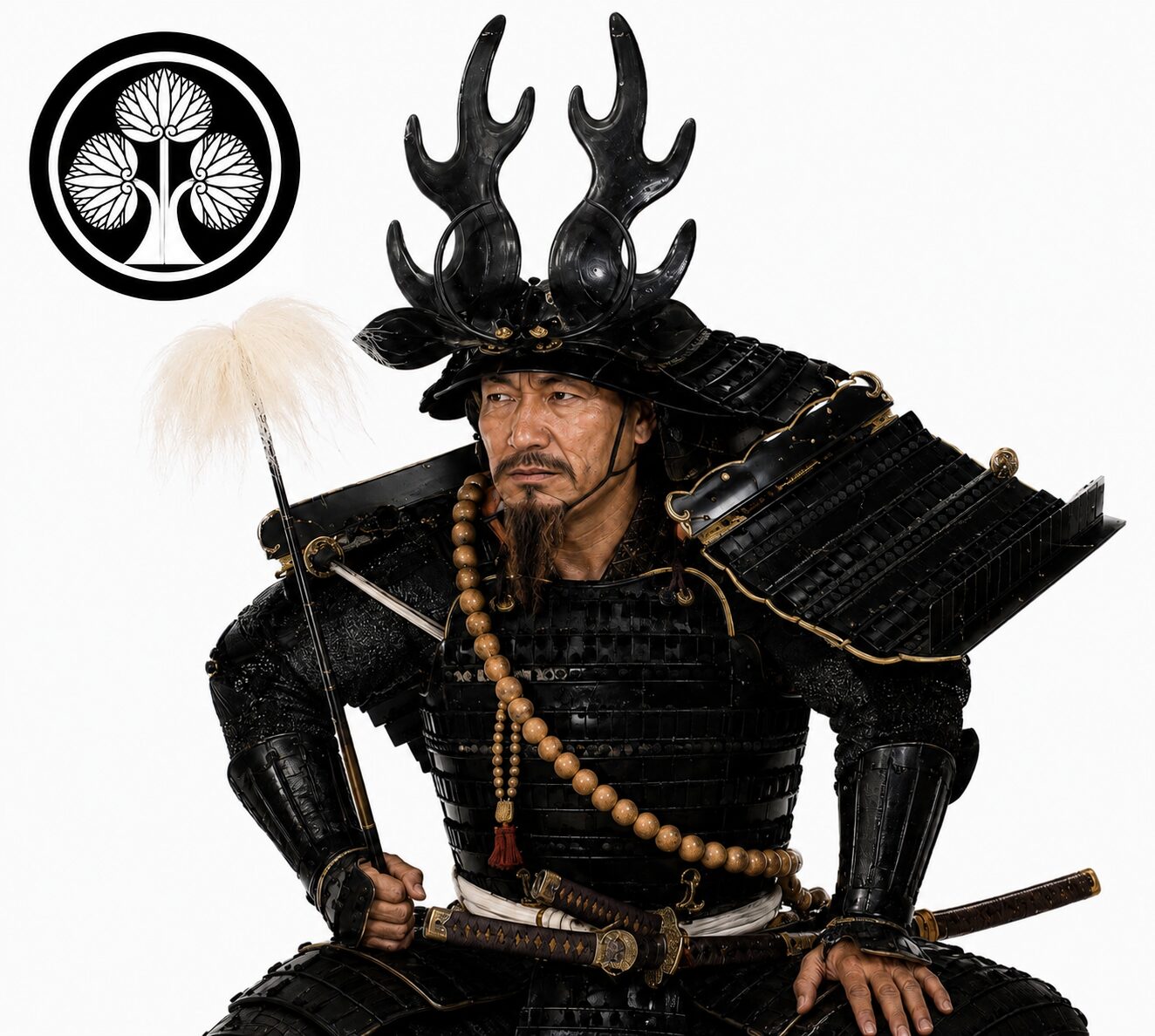
Honda Tadakatsu — Matchless in the East, the Fierce Warrior Unscathed Through 57 Battles
The 8th day of the 2nd month, Tenbun 17 (1548) – the 18th day of the 10th month, Keichō 15 (1610) | Died at age 63
- This Figure in Three Lines
- The Mainstream Account — The Standard Story Found in Textbooks
- The Theories — Exploring the Possibilities from Various Angles
- A Strategic View
- Honda Tadakatsu — Notable Sayings and Death Poem
- Anecdotes and Episodes
- Honda Tadakatsu — Life Timeline
- Honda Tadakatsu — Family and Personal Relationships
- Related Historic-Site Map and Travel Model Course
- Related Battle Articles
- Reference Information
This Figure in Three Lines
- One of the “Four Heavenly Kings of the Tokugawa” who served Tokugawa Ieyasu, the fierce warrior called “Matchless in the East,” who is said never to have suffered even a scratch in 57 battles over his lifetime.
- Bearing his beloved spear Tonbogiri (the “Dragonfly Cutter”), he served in nearly every major battle of the Tokugawa house — Anegawa, Mikatagahara, Nagashino, and Komaki–Nagakute.
- After the Battle of Sekigahara, as the first lord of the 100,000-koku Kuwana domain in Ise, he carried out the “Keichō town planning” and was revered as the wise founder of the Kuwana domain.
The Mainstream Account — The Standard Story Found in Textbooks
Born into a Mikawa Warrior Family (1548–1559)
Honda Tadakatsu was born on the 8th day of the 2nd month, Tenbun 17 (1548), at Kuramae in the Nukata District of Mikawa Province (present-day Nishi-kuramae-chō, Okazaki City, Aichi Prefecture), the eldest son of Honda Tadataka, a hereditary retainer of the Anjō-Matsudaira house (the Tokugawa main line). His childhood name was Nabenosuke, and his common name was Heihachirō.
The Honda were a hereditary military house that had served the Matsudaira for generations. His grandfather Tadatoyo was killed in the Second Battle of Anjō in Tenbun 14 (1545), serving as rear guard in place of Ieyasu’s father, Matsudaira Hirotada. Then, in the Third Battle of Anjō in Tenbun 18 (1549), his father Tadataka too died in battle, leaving behind a Tadakatsu who was only one year old. The death of both father and grandfather for the sake of their lord, two generations running, had a decisive influence on the way Tadakatsu would live. Having lost his father, Tadakatsu was raised sternly under his uncle, Honda Tadazane.
Serving Ieyasu from boyhood, Tadakatsu had his first battle at the age of 13 in Eiroku 3 (1560), at the “provisioning of Ōdaka Castle,” a preliminary engagement of the Battle of Okehazama. At the same time he came of age and is said to have been given the name “Tadakatsu,” meaning “simply to win.” In that first battle he was not yet able to take an enemy head and was nearly cut down by an enemy commander, only to be saved by his uncle Tadazane. When he took his first head the following year, Eiroku 4 (1561), at the attack on Toyane, his uncle Tadazane tried to give him the head of an enemy he himself had pinned down. Tadakatsu replied, “How could I ever call it a feat of arms if I borrowed another’s hand?” — and charged into the enemy ranks to take a head himself, according to the Meishō Genkōroku.
The Mikawa Ikkō-ikki and Promotion to Vanguard of the Bannermen (1563–1569)
In Eiroku 6 (1563), the Mikawa Ikkō-ikki broke out, counted as one of Ieyasu’s three great crises. While many of the Honda clan, as adherents of the Ikkō sect (Jōdo Shinshū), sided with the uprising, Tadakatsu went so far as to change his faith to the Jōdo sect in order to remain on Ieyasu’s side, and threw himself into suppressing the revolt. Changing one’s faith was no easy matter in that age, but Tadakatsu’s loyalty to Ieyasu outweighed it.
Prizing this service highly, in Eiroku 9 (1566) Ieyasu promoted the nineteen-year-old Tadakatsu to his own bodyguard unit, the “vanguard of the bannermen,” entrusting him with 54 attached horsemen. From then on, Tadakatsu always lived in the shadow of Ieyasu’s castle and rode the battlefield as the core of the Tokugawa army.
The Battle of Anegawa — Single Combat with Magara Jūrōzaemon (1570)
In Genki 1 (1570), at the Battle of Anegawa, where the allied Oda–Tokugawa army clashed with the allied army of Azai Nagamasa and Asakura Yoshikage, Tadakatsu fought hard as the vanguard of the Tokugawa force facing the Asakura. When the Tokugawa army was thrown into disarray by Asakura tactics and a crisis came in which the enemy pressed close to Ieyasu’s own headquarters, Tadakatsu carried out a seemingly reckless solo charge. The frantic efforts of the Tokugawa army to save him became, in turn, a counterattack that broke the Asakura.
In this battle Tadakatsu won fame for his single combat with the Asakura champion Magara Jūrōzaemon. In the end he could not bring Jūrōzaemon down (he was later slain by Sakisaka Shikibu and others), but the way he stood toe to toe with him became the occasion that established his renown as “the matchless warrior of the East.”
→ For details, see the battle article “The Battle of Anegawa.”
Rear Guard at Hitokotozaka and Survival at Mikatagahara (1572)
In Genki 3 (1572), Takeda Shingen launched his westward campaign and invaded Tokugawa territory. In the “Battle of Hitokotozaka,” a preliminary engagement to the Battle of Mikatagahara, Tadakatsu’s force, having gone ahead as a reconnaissance party, ran into the Takeda army. Tadakatsu became the rear guard and, despite the unfavorable terrain, fought hard and succeeded in withdrawing Ieyasu’s headquarters safely.
Seeing Tadakatsu’s gallant figure on that occasion, the Takeda retainer Kosugi Sakon is said to have left a piece of graffiti in the form of a comic poem: “Two things are too good for Ieyasu: the Chinese headdress and Honda Heihachi.” The “Chinese headdress” was an expensive helmet decorated with yak tail-hair that was then in fashion among the Tokugawa retainers; the verse meant that both that helmet and Tadakatsu were too fine for Ieyasu — the highest possible praise, and from an enemy commander at that.
In the 12th month of the same year, when the Tokugawa army suffered a crushing defeat at the Battle of Mikatagahara, Ieyasu’s greatest loss, Tadakatsu again fought hard in the retreat and brought Ieyasu safely back to Hamamatsu Castle. At this, Ieyasu is said to have exclaimed, “He is Hachiman Daibosatsu reborn.”
→ For details, see the battle article “The Battle of Mikatagahara.”
Nagashino and the Crossing of Iga — Together with Tonbogiri (1575–1582)
In Tenshō 3 (1575), at the Battle of Nagashino, where the allied Oda–Tokugawa army clashed with Takeda Katsuyori, Tadakatsu again took part as a mainstay of the Tokugawa force. When the Takeda commander Naitō Masatoyo charged toward Ieyasu’s headquarters, Tadakatsu is said to have fended him off with his beloved spear, Tonbogiri. With the destruction of the Takeda cavalry corps at Nagashino, the Takeda threat that had long tormented the Tokugawa house was all but removed.
→ For details, see the battle article “The Battle of Nagashino.”
In the 6th month of Tenshō 10 (1582), the Honnō-ji Incident broke out. At the time Ieyasu was staying in Sakai with only a small retinue, and on learning of Oda Nobunaga’s death he tried to take his own life. It was Tadakatsu who remonstrated with him and changed his mind. Tadakatsu, Tonbogiri in hand, led the party through the mountain roads of Iga and brought them safely back to Mikawa (the “Divine Lord’s Crossing of Iga”). It may fairly be said that Ieyasu’s road to mastery of the realm began here, with his life saved by Tadakatsu.
Komaki–Nagakute — The Man Who Stopped Hideyoshi with 500 Horse (1584)
The Komaki–Nagakute campaign of Tenshō 12 (1584), which arose from the conflict between Oda Nobukatsu and Hashiba Hideyoshi, became Ieyasu’s only direct confrontation with Hideyoshi. When the main Hideyoshi units under Ikeda Tsuneoki and Mori Nagayoshi were annihilated at the main battle of Nagakute, an enraged Hideyoshi took the field himself at the head of a great army of 30,000.
Holding the rear at Komaki at the time, Tadakatsu, on learning that the Tokugawa army was at a disadvantage, shook off his retainers’ attempts to stop him and sortied with only 500 horse. He planted himself in the path of Hideyoshi’s great army about five chō (some 500 meters) ahead, then rode alone into the Ryūsenji River and calmly let his horse’s mouth be washed. Seeing this bold display, Hideyoshi’s army hesitated to advance, and the moment for battle is said to have passed.
Hideyoshi knew Tadakatsu’s valor from the time of Anegawa, and when his men urged that Tadakatsu be cut down, he is said to have forbidden it with tears in his eyes: “He shows his courage with a small force before my great army on purpose, in order to hold back the army and draw Ieyasu away. When we have destroyed the Tokugawa house, we should take him alive and make him one of my own retainers” (Meishō Genkōroku). Later Hideyoshi praised Tadakatsu in the highest terms as “the foremost in Japan, a warrior without peer past or present,” and as “Honda Tadakatsu in the east, Tachibana Muneshige in the west — matchless east and west.”
→ For details, see the battle article “The Battle of Komaki–Nagakute.”
Transfer to the Kantō and Ōtaki, 100,000 Koku (1590)
In Tenshō 14 (1586), when the Tokugawa house came under the Toyotomi regime, Tadakatsu was appointed to the junior fifth rank, lower grade, as Nakatsukasa-no-taifu. Thereafter he was called “Honda Nakatsukasa.” In Tenshō 18 (1590), upon Ieyasu’s transfer to the Kantō, Tadakatsu was granted 100,000 koku at Ōtaki in the Isumi District of Kazusa Province (present-day Ōtaki Town, Isumi District, Chiba Prefecture). This was the second-largest stipend in the retainer corps, after Ii Naomasa’s 120,000 koku.
His placement on the distant Bōsō Peninsula reflected Ieyasu’s policy of “stationing hereditary commanders on the borders where the enemy attacks,” and was said to be a guard against the Satomi clan of Awa. Tadakatsu carried out a major renovation of Ōtaki Castle, transforming it into an early-modern castle complete with a three-tiered, four-story keep.
The Battle of Sekigahara and Kuwana, 100,000 Koku (1600–1601)
At the Battle of Sekigahara in Keichō 5 (1600), Tadakatsu served with Ieyasu’s main army as inspector of the Eastern Army. He entrusted command of the Honda main body to his eldest son Tadamasa, while he himself remained at Ieyasu’s headquarters in charge of operational command. He took part in the preliminary attacks on Takegahana Castle and Gifu Castle, and in the main battle he helped the units of Nakamura Kazuhide and Arima Toyouji withdraw after their defeat by Shima Sakon, the chief retainer of Ishida Mitsunari. He also sent letters jointly signed with Ii Naomasa to various lords such as Kikkawa Hiroie, working to bring them over to the Eastern side. In the main battle he is said to have taken as many as 90 heads with only a small band of his own.
After the battle, together with his son-in-law Sanada Nobuyuki, Tadakatsu petitioned Ieyasu to spare the lives of Sanada Masayuki and his son Nobushige (Yukimura), who had sided with the enemy. Ieyasu and Hidetada — who had arrived late to Sekigahara — at first insisted strongly on death, but through the persistent pleas of Tadakatsu and others, the two were reduced to confinement at Kudoyama in Kii Province. This was an important act that saved the lives of the Sanada father and son, among the finest battle commanders of the Sengoku period.
In Keichō 6 (1601), Tadakatsu was transferred to Kuwana in Ise Province (Kuwana City, Mie Prefecture), 100,000 koku. The stipend was the same, but it was a promotion to land of far greater strategic importance — a check on the key Tōkaidō road and on Osaka and Kyoto. His former territory of Ōtaki was given as a separate house of 50,000 koku to his second son, Tadatomo. By one account, Ieyasu sought to add 50,000 koku to Tadakatsu’s holdings, but Tadakatsu firmly declined, so it was instead divided to his second son.
→ For details, see the battle article “The Battle of Sekigahara.”
Final Years as Lord of Kuwana (1601–1610)
On entering Kuwana, Tadakatsu at once set about laying the foundations of domain governance. He built a magnificent Kuwana Castle with a four-tiered, six-story keep and 51 turrets at the mouth of the Ibi River, rerouted the flow of the Machiya River (present-day Inabe River) to prevent flooding, and transformed Kuwana — a disorderly port town — into a city with four faces: an early-modern castle town, a post town, a port town, and a fishermen’s town. This was the large-scale urban-planning project called the “Keichō town planning.” At the start of construction, his sworn friend Ii Naomasa too is said to have mobilized his retainers to help with the works. Traces of this decade-long undertaking remain in the streets of present-day Kuwana, more than 400 years on.
Tadakatsu also invested large sums in the restoration of Tado Taisha, which had fallen into ruin after Oda Nobunaga’s burning, and devoted himself to maintaining the Tōkaidō post stations. A side of him as an excellent urban planner and administrator — not merely a man of arms — came into flower at Kuwana.
Meanwhile, in the Tokugawa regime after Sekigahara, the civil-administration faction led by Honda Masanobu and his son Masazumi rose to prominence, and Tadakatsu, of the martial faction, was gradually pushed away from the center of shogunal government. Tadakatsu went so far as to revile his kinsman Masanobu, saying, “Though we are both of the Honda clan, I have nothing whatever to do with that fellow,” and “the spineless Sado-no-kami is no warrior.” Their feud was never resolved in his lifetime (Kasshi Yawa).
In Keichō 14 (1609), Tadakatsu handed the headship to his eldest son Tadamasa and retired. The next year, on the 18th day of the 10th month, Keichō 15 (1610), he died of illness at Kuwana Castle. He was 63. From the course of his illness in his last years, the cause is conjectured to have been diabetes. A few days before his death, while carving his name on his belongings with a small knife, his hand slipped and he gave himself a scratch on the left hand. Tadakatsu, who had never once been wounded in battle, is said to have murmured, “When even Honda Tadakatsu takes a wound, he is finished” — and, as those words foretold, he passed away a few days later.
His remains were buried at Jōdo-ji in Kuwana, and later a portion was also interred at Ryōgen-ji in his former territory of Ōtaki.
The Theories — Exploring the Possibilities from Various Angles
【Theory 1】Is the Legend of “57 Battles Unscathed” True?
The tradition that Tadakatsu never suffered even a scratch in 57 battles over his life is recorded widely in many works, beginning with the Edo-period Meishō Genkōroku, and has been handed down as his emblematic episode.
Yet, by common sense, to come through so many fierce engagements completely unharmed would be an extraordinarily difficult feat. Arrows and guns flew across the battlefields of the day, and Tadakatsu in particular often took on the most dangerous roles, such as solo charges and rear-guard duty. There is a strong possibility that exaggeration and legend are mixed in.
In fact, there is also a record that at Sekigahara he was hit by gunfire from the Shimazu force, lost his beloved horse “Mikuni-guro,” fell from the saddle, and was nearly beheaded before being saved by his retainer Kaji Kinpei (in the Meitō Gensō Jiten and elsewhere). Interpretations differ on whether to include this within the category of “unscathed.”
The figure of “57” itself also varies depending on what is counted as a “battle,” so it cannot be called a strict statistic. Even so, it is no doubt true that, through outstanding martial skill, judgment, and crisis management, he kept avoiding fatal wounds. “57 battles unscathed” is best read less for the accuracy of the number than as a character portrait of “a warrior who possessed both the skill and the luck to plunge among the enemy and still return alive.”
【Theory 2】The Origin of Tonbogiri and the Mystery of the Master Smith Fujiwara Masazane
Tadakatsu’s beloved spear “Tonbogiri” had a long blade classed as a “great bamboo-leaf spear” — a point 43.7 cm long, 3.7 cm at its widest, and 1 cm thick — with a shaft that at its longest reached about 6 m (two jō). The body of the blade bore Sanskrit seed-syllables and carvings: the kāṃ of Fudō Myōō, a three-pronged vajra sword, the sa of Shō-Kannon, the hrīḥ of Amida Nyorai, and the ka of Jizō Bosatsu. It is counted among the “Three Great Spears of the Realm,” alongside the Otegine and the Nihongō. Only the point survives today, on deposit at the Sano Art Museum in Shizuoka Prefecture.
There are several theories about the origin of its name. One emphasizes the spear’s keen edge: “a dragonfly that touched the point, trying to alight on it, was sliced clean in two.” Another expresses Tadakatsu’s skill: “Tadakatsu’s handling of the spear was so fine that with a single sweep he would cut down dragonflies in flight.” That the dragonfly was also called the “victory insect,” and was regarded as an auspicious sign for warriors because it only moves forward, is thought to have influenced the choice of name as well.
The maker is said to be the swordsmith Fujiwara Masazane of the Mikawa Monju school, but this Fujiwara Masazane is a figure surrounded by mystery. The Kokon Kaji Bikō lists eight smiths bearing the signature “Masazane,” and there is a theory that “Mikawa Monju Masazane,” “Ise Senju Masazane,” and “Yamato Kanabō Masazane” may be one and the same person. If so, he would be connected by lineage to “Muramasa,” the blade known as a curse upon the Tokugawa house — an ironic tie.
In his later years, around Keichō 6 (1601) after the move to Kuwana, the 54-year-old Tadakatsu, after practicing with the spear by a riverbed, had the shaft of Tonbogiri cut down by three shaku (about 90 cm). When a retainer asked the reason, Tadakatsu replied, “A tool must match the strength of the one who wields it.” This can be read as “an awareness of age,” but also as a declaration of his will to keep wielding the spear himself even in old age. From the fact that the carvings include Sanskrit syllables of the Amida triad, some see in the spear the Jōdo-sect faith to which Tadakatsu had converted, and a prayer for the repose of friend and foe alike.
【Theory 3】Was the “Too Good for Ieyasu” Poem Really Composed by Kosugi Sakon?
The comic poem “Two things are too good for Ieyasu: the Chinese headdress and Honda Heihachi” is one of the most famous anecdotes in the telling of Tadakatsu’s martial fame. It is said to have been left as graffiti by the Takeda retainer Kosugi Sakon, who admired Tadakatsu’s rear-guard work at the Battle of Hitokotozaka.
However, this poem is not directly recorded in primary sources of the time; it appears in later compiled materials. The framing of praise from an enemy commander is ideal material for emphasizing Tokugawa martial prestige, and the possibility of later embellishment or expansion cannot be denied. Whether the actual author was Kosugi Sakon himself is not certain; it may be that something composed by someone in the Takeda house was later organized as Kosugi Sakon’s work.
Still, that Tadakatsu’s performance at Hitokotozaka and Mikatagahara commanded respect even from the Takeda side can be glimpsed from several sources. Setting aside the identification of the poem’s author, the core fact — that Tadakatsu’s martial fame resounded across friend and foe alike — stands firm.
【Theory 4】Hideyoshi’s Highest Praise — A Tokugawa-Side Fabrication?
The episode in which Hideyoshi praised Tadakatsu at Komaki–Nagakute as “the foremost in Japan, a warrior without peer past or present” and “Honda Tadakatsu in the east, Tachibana Muneshige in the west” has been told as the greatest evidence for Tadakatsu’s legend as the strongest of the Sengoku period.
However, these remarks are recorded mainly in Tokugawa-side sources (the Meishō Genkōroku, the Hankanfu, and so on), and there is no corresponding account in contemporaneous Toyotomi-side sources. It has been pointed out that they may be later embellishment to raise Tokugawa martial prestige.
Moreover, the very anecdote of pairing Tadakatsu with Tachibana Muneshige is chronologically unnatural: Muneshige came to be valued by Hideyoshi only after the Kyushu campaign, and at the time of Komaki–Nagakute he was not yet sufficiently well known.
That said, the account that Oda Nobunaga, after the conquest of the Takeda, praised Tadakatsu as “a warrior endowed with both blossom and fruit” appears even in records of Nobunaga’s words and deeds of relatively high reliability, and is regarded as comparatively trustworthy. Even if Hideyoshi’s remarks may be embellished, the fact that Tadakatsu was highly esteemed by both the Oda and Toyotomi camps is itself certain.
【Theory 5】Is the Death Poem Tadakatsu’s, or His Retainer Kaji Kinpei’s?
The death poem — rendered “How I long to live, ah how I long to live, how I long to live — when I think of my lord, to whom I owe so deep a debt” — is widely known as a verse symbolizing Tadakatsu’s loyalty to Ieyasu, and is collected in the Meishō Genkōroku.
However, recent research, such as that on the site Sengoku History, points out that this verse may in fact belong to someone else. The late-Edo miscellany Mimibukuro records a nearly identical verse as the death poem of a man described as “Kaji Kinpei, called a champion among the bannermen, who in the Divine Lord’s day displayed martial distinction several times on the battlefield.” Kaji Kinpei was the retainer who at Sekigahara gave his own horse to Tadakatsu to save him — a man of deep connection with Tadakatsu.
Considering that the Meishō Genkōroku was compiled in the late Edo to Meiji period, there is a strong possibility that the verse handed down as Tadakatsu’s death poem is in fact Kaji Kinpei’s death poem, mistaken for Tadakatsu’s or deliberately transferred to him.
That said, the words held to be Tadakatsu’s last testament — “Even if he takes no enemy head and wins no distinction, the one who does not retreat in the face of danger, who lies down to die side by side with his lord and keeps faith — that is what we call a samurai” (Meishō Genkōroku) — are valued as conveying Tadakatsu’s view of the warrior and of loyalty more plainly, and his true feeling more fully, than the death poem.
【Theory 6】Did He Really “Hope for a Whole Province” After Sekigahara?
On the post-Sekigahara settlement, there is an interesting divergence in the assessment of Tadakatsu. One is the fine tale that “Ieyasu offered an increase of 50,000 koku, but Tadakatsu firmly declined it and asked that it be given to his second son Tadatomo, while he himself moved to Kuwana still at 100,000 koku.” This appears in several sources, such as the Kansei Chōshū Shokafu.
On the other hand, another tradition holds that “Tadakatsu hoped to be granted a whole province after Sekigahara, and even drew up a register of fiefs for his retainers in anticipation; when this was not realized, he later told the story to the senior shogunal official Abe Masatsugu and then burned the register himself.” This appears in the Hankanfu and elsewhere.
These two seem contradictory at first glance, but they can in fact coexist. One can read it as: inwardly, Tadakatsu had hoped for a whole province; when this did not come to pass, the matter was outwardly handled in the form of “declining the 50,000-koku increase and yielding it to his second son.”
Given that, after Sekigahara, Tadakatsu of the martial faction came to be used less and less within the Tokugawa regime, while the civil-administration faction led by Honda Masanobu took over the center of shogunal government, it seems that expectation and disappointment were mingled in Tadakatsu’s heart. The death poem “How I long to live” and the testament “Even if he takes no enemy head…” together convey both the sense of neglect in his later years and his unchanging loyalty to his lord.
【Theory 7】Was “the Strongest of the Sengoku” His Spear-Work, or His Command?
Tadakatsu is often spoken of as “the strongest warrior of the Sengoku period.” But there is debate over what makes one “the strongest.”
One view emphasizes “individual spear-work.” Tadakatsu’s great scenes — the solo charge against the Asakura at Anegawa with Tonbogiri in hand, the fending off of the Takeda assault on the headquarters at Nagashino — are colored by the valor of a man worth a thousand.
Another emphasizes “command.” The Kasshi Yawa contains an intriguing passage: “His spear-work in fighting the enemy on the battlefield was matchless past and present, but his spearmanship in drills and the like was extremely clumsy, so that those who did not know him on the battlefield found it surprising.” That is, rather than skill at textbook spearmanship, his true forte was judgment and command in actual combat. The anecdote that his subordinate commanders praised him, saying “to fight under Tadakatsu’s command is like carrying a shield on one’s back,” supports his powers of command.
Tadakatsu was no mere man of arms; he was also a man of strategy who, when Ieyasu consulted him on a battle, would coolly analyze the situation and answer aptly. A warrior who united all three — individual valor, group command, and judgment of the battle situation — that is why he is called “the strongest of the Sengoku.” His essence lies in a “strength as a total package,” different from sword and spear masters who made their names in the same age, such as Tachibana Muneshige or Kamiizumi Nobutsuna.
A Strategic View
Tadakatsu’s role on the battlefield was centered less on being the spearhead of attack than on guarding Ieyasu, serving as rear guard, and fighting defensive actions. His solo charge at Anegawa was brilliant, yet even that was defensive in intent — “drawing in the enemy who pressed toward Ieyasu’s headquarters in order to create a chance for counterattack.” The retreat at Mikatagahara, the guiding through Iga, the blocking action at Komaki–Nagakute — Tadakatsu showed his true worth at the moments most dangerous to the Tokugawa house. A warrior as the “strongest shield“: that is Tadakatsu’s essence.
The reason Ieyasu placed such immense trust in Tadakatsu was not his valor alone. The key was his unwavering loyalty. In an age when not a few retainers betrayed their lords, Tadakatsu served at Ieyasu’s side without fail — from the hostage days when Ieyasu still bore the name Matsudaira Motoyasu, through the rises and falls of the Tokugawa house: the transfer to the Kantō, Sekigahara, the move to Kuwana. The bloodline of the Honda house, in which his father Tadataka and grandfather Tadatoyo served as rear guard and died as stand-ins for Matsudaira Hirotada, runs through Tadakatsu as well. “One who is prepared to give up his life is strong” — Tadakatsu was the very type of the Mikawa warrior. This is why he is counted, together with Sakai Tadatsugu, Sakakibara Yasumasa, and Ii Naomasa, among the “Four Heavenly Kings of the Tokugawa.”
His strategic eye, too, is worth noting. In Genki 3 (1572), when Takeda Shingen launched his westward campaign, the Tokugawa army of some 8,000 — even with Oda reinforcements only about 11,000 — had to face the Takeda’s 27,000-odd. When Ieyasu consulted him on the battle, Tadakatsu is said to have coolly analyzed the situation and offered apt counsel. On the eve of Sekigahara, too, Tadakatsu issued letters jointly signed with Ii Naomasa to maneuver the various lords, contributing to the Eastern victory not only with 90-odd heads in the main battle but in the realms of strategy and diplomacy.
His feud with his kinsman Honda Masanobu can be read as a typical example of the structural opposition between the martial faction and the civil-administration faction within the Tokugawa house. In an age of war a “strongest shield” like Tadakatsu was needed, but in an age of peace a “man of policy” like Masanobu was needed at the center. Tadakatsu understood this, yet out of a warrior’s pride he went on reviling Masanobu as spineless. This was less a household quarrel than the expression of a larger question — how a man of arms is to live at a turning point of the age.
And the ability he showed as lord of Kuwana in his later years deepens his portrait by a further degree. That a fierce warrior who had spent his life on the battlefield rerouted the Machiya River to prevent flooding and remade a disorderly port town into an early-modern city with four faces — the “Keichō town planning” — shows that Tadakatsu was no mere man of arms, but an administrator who combined the abilities of an urban planner and a ruler. When Nobunaga praised Tadakatsu as “a warrior endowed with both blossom and fruit,” that “fruit” may have meant not only battlefield distinction but also such qualities as a ruler.
The essence of Tadakatsu, called “the strongest of the Sengoku” and “matchless in the East,” lay not in superhuman spear-work itself, but in a “total strength” that combined valor, loyalty, command, and governance at a high level. That, after Ieyasu won the realm, he had a retainer such as Tadakatsu can be said to have borne up one wing of the foundation of the Tokugawa shogunate’s 250 years.
Honda Tadakatsu — Notable Sayings and Death Poem
“How I long to live, ah how I long to live, how I long to live — when I think of my lord, to whom I owe so deep a debt.”
The verse collected in the Meishō Genkōroku as Tadakatsu’s death poem. It means: “I do not want to die, ah, I do not want to die, I do not want to die — when I think of the deep debt of gratitude I owe my lord Ieyasu.” That a fierce warrior who fought through 57 battles in his life should, facing death, repeat “I do not want to die” three times tells — in contrast to his boldness in the field — of the depth of his loyalty to his lord. However, recent research points out that this verse may not be Honda Tadakatsu’s, but the death poem of his retainer Kaji Kinpei, later mistaken for his (→ see Theory 5).
— Source: Meishō Genkōroku (compiled late Edo to Meiji)
“Even if he takes no enemy head and wins no distinction, the one who does not retreat in the face of danger, who lies down to die side by side with his lord and keeps faith — that is what we call a samurai.”
Held to be a passage from the testament Tadakatsu left at his death. It means: “Even if a samurai can win no distinction, to keep faith — not retreating in the face of crisis, lying down to die together with one’s lord — that is what a samurai is.” It declares that the essence of the warrior lies not in feats of arms or the number of heads taken, but in the resolve to share one’s lord’s fate. In light of the Honda bloodline, in which his father Tadataka and grandfather Tadatoyo died as stand-ins for Matsudaira Hirotada, his words carry a special weight. Many scholars regard them as conveying Tadakatsu’s true feelings even more than the death poem.
— Source: Meishō Genkōroku
“How could I ever call it a feat of arms if I borrowed another’s hand?”
Words from the attack on Toyane in Eiroku 4 (1561), when Tadakatsu was 14. His uncle Honda Tadazane, pitying a Tadakatsu who could not manage to take a head, tried to give him an enemy he himself had pinned down; Tadakatsu uttered this and charged into the enemy ranks, taking his own first head. It means, “How could a feat won by borrowing another’s hand ever be called my own?” It is handed down as an anecdote symbolizing the warrior’s pride Tadakatsu held from boyhood.
— Source: Meishō Genkōroku
“A tool must match the strength of the one who wields it.”
Around Keichō 6 (1601), at 54 after the move to Kuwana, Tadakatsu practiced with his spear by a riverbed and, on returning to the castle, had the shaft of Tonbogiri cut down by three shaku (about 90 cm). This was his answer when a retainer asked the reason. The decision to shorten in one stroke the shaft of Tonbogiri, which had been about 6 m, can be read both as a man coolly aware of the decline of his strength with age, and as a declaration of his will to keep fighting himself to the end (the “optimization” of his weapon). It is handed down as an anecdote symbolizing the old age of a fierce warrior.
— Source: Kasshi Yawa and others
“It was not that my command was good — the enemy was simply too weak.”
After the Battle of Sekigahara, when the Eastern Army’s Fukushima Masanori praised Tadakatsu’s valor, Tadakatsu is said to have answered thus. Far from boasting, he denied his own command and ascribed the victory to the enemy’s weakness — words of modesty (or irony) unlike a man of arms. It is known as an anecdote showing that Tadakatsu, praised as the strongest of the Sengoku, never flaunted his own valor.
— Source: Meishō Genkōroku and others
“Two things are too good for Ieyasu: the Chinese headdress and Honda Heihachi.”
This is not Tadakatsu’s own words but a verse by an enemy commander in his praise. It is said to be a comic poem left as graffiti by the Takeda retainer Kosugi Sakon, who admired Tadakatsu’s rear-guard work at the Battle of Hitokotozaka in Genki 3 (1572). The “Chinese headdress” was an expensive helmet adorned with yak hair, then in fashion among the Tokugawa. “There are two things too fine for Ieyasu: the Chinese headdress and Honda Heihachi (Tadakatsu)” — handed down as the highest possible praise, presented by an enemy commander. It is the most famous verse in the telling of Tadakatsu’s martial fame.
— Source: Hankanfu, Meishō Genkōroku, and others
Anecdotes and Episodes
Conversion from the Ikkō Sect to the Jōdo Sect
In Eiroku 6 (1563), the Mikawa Ikkō-ikki, one of Ieyasu’s three great crises, broke out. At the time many Mikawa warriors, the Honda included, were devout adherents of the Ikkō sect (Jōdo Shinshū), and many turned against Ieyasu out of faith. While many of the Honda clan too sided with the uprising, Tadakatsu, at only 16, went so far as to change his faith to the Jōdo sect to remain on Ieyasu’s side, and threw himself into suppressing the revolt.
In that age, changing one’s faith was a decision that cut to the bone. Tadakatsu’s stance — choosing his lord over the choice of “gods and buddhas or lord” — made a strong impression on Ieyasu and led directly to his promotion to vanguard of the bannermen three years later. That the body of Tonbogiri is inscribed with Sanskrit syllables of the Amida triad (Amida Nyorai, Shō-Kannon, Jizō Bosatsu) shows that Tadakatsu kept his Jōdo-sect faith all his life even after the conversion, and some see in the spear a prayer for the repose of friend and foe.
Guarding Ieyasu at 14 — A Show of Force at the Kiyosu Meeting
In Eiroku 5 (1562), when Ieyasu went to Kiyosu Castle in Owari to conclude an alliance with Oda Nobunaga, a crowd of curious onlookers pressed in and there was uproar. At this, Tadakatsu, though only 14, stepped forward before Ieyasu, spear in hand, and rebuked them: “My lord has come here only to meet with Lord Nobunaga. You are insolent!” — and is said to have quieted the throng. Later, when Nobunaga heard the tale, he is said to have been deeply impressed by Tadakatsu’s spirit and loyalty despite his youth. From boyhood, Tadakatsu’s dignified bearing stood out.
The Deer-Antler Helmet and the Black-Laced Armor — A Striking Figure on the Battlefield
Tadakatsu’s battle dress was conspicuous even among Sengoku warriors. On his head, a “deer-antler side-crest helmet” modeled on a deer’s antlers; on his body, jet-black “black-laced dōmaru armor”; from his shoulder, great prayer beads slung diagonally for the repose of friend and foe; and in his hand, the long Tonbogiri. Against Tadakatsu, who fought head-on always in black-laced armor and a deer-antler helmet, the Takeda officers and men are said to have composed: “When the dragonfly appears, they scatter like spiderlings. A dragonfly in his hand, the fearsome antlers on his head. Demon or man — a helmet one cannot rightly tell.” The whole get-up of deer-antler helmet, black armor, prayer beads, and Tonbogiri was a complete “brand” that gave visual form to Tadakatsu’s martial prestige.
Anegawa — Challenging the Asakura with a Solo Charge
At the Battle of Anegawa in Genki 1 (1570), against the 10,000 of the Asakura pressing toward Ieyasu’s headquarters, Tadakatsu, leading only a small band, carried out a seemingly reckless solo charge. The Tokugawa army, frantic to save him, turned to counterattack and as a result broke the Asakura. In this battle Tadakatsu crossed blades in single combat with the Asakura champion Magara Jūrōzaemon. In the end he could not bring Jūrōzaemon down — Sakisaka Shikibu and others are said to have slain him later — but the martial fame of a Tadakatsu who returned unscathed thundered across the whole country after this battle.
Nagashino — Picking Up the Discarded Takeda Banners
At the Battle of Nagashino in Tenshō 3 (1575), when the Takeda cavalry corps was destroyed before the guns of the allied Oda–Tokugawa army, the Takeda soldiers are said to have thrown away their banners and fled as they routed. Tadakatsu picked up those banners and is said to have jeered, “To cast away your battle standards — what is this?” It is handed down as a scene symbolizing the fall of the Takeda, sung as “the strongest” since Takeda Shingen’s day, and as an anecdote showing Tadakatsu’s pride as a warrior.
The Crossing of Iga — Guiding Ieyasu with Tonbogiri
In the 6th month of Tenshō 10 (1582), on receiving word of the Honnō-ji Incident, Ieyasu was staying in Sakai with only a small retinue. Shaken, Ieyasu spoke of taking his own life, but Tadakatsu remonstrated and changed his mind. He is said to have urged, “To die here would be a disgrace as a retainer of the Oda; we must return to Mikawa and strike down Mitsuhide.” Tadakatsu, Tonbogiri in hand, took the lead of the party and brought them safely through the mountain roads of Iga to Mikawa. This “Divine Lord’s Crossing of Iga,” which saved the Tokugawa house’s greatest crisis, could not have come off without Tadakatsu. Ieyasu’s mastery of the realm can be said to have begun at the moment his life was saved by Tadakatsu.
Komaki–Nagakute — The Boldness of Washing a Horse’s Mouth
At the Battle of Komaki–Nagakute in Tenshō 12 (1584), Tadakatsu planted himself with only 500 horse before the great army of 30,000 led by Hideyoshi himself. He even rode alone into the Ryūsenji River and calmly let his horse’s mouth be washed. Seeing this bold display, Hideyoshi’s army fell into suspicion — “for him to be so calm with such a small force, he must have some plan” — and hesitated to advance. His subordinates Katō Kiyomasa and Fukushima Masanori urged that Tadakatsu be cut down, but Hideyoshi, who knew of Tadakatsu’s solo charge at Anegawa, is said to have forbidden it with tears in his eyes: “When we have destroyed the Tokugawa house, we should take him alive and make him one of my own retainers.“
After the war, Hideyoshi, who had subdued the Hōjō and completed the unification of the realm, is said to have summoned Tadakatsu before him at a gathering of the lords, given him the armor of Minamoto no Yoshitsune’s retainer Satō Shirō, and praised him before the lords of the whole country: “Shirō was a true man of valor. There is no man of valor to surpass this Shirō but Honda Tadakatsu.”
His Beloved Horse “Mikuni-guro” and the Peril at Sekigahara
Tadakatsu’s beloved horse was called “Mikuni-guro,” a fine horse given to him by the later second shogun, Tokugawa Hidetada. At the Battle of Sekigahara in Keichō 5 (1600), Tadakatsu took gunfire from the force of Shimazu Yoshihiro, who had sided with Ishida Mitsunari, and fell from his horse; Mikuni-guro was shot and killed. Tadakatsu too was nearly beheaded, but his retainer Kaji Kinpei offered his own horse and saved him. Even Tadakatsu, who boasted a legend of lifelong invulnerability, faced such a crisis at Sekigahara. The death of Mikuni-guro must have been a pain to Tadakatsu like the loss of a comrade-in-arms.
The Feud with Honda Masanobu — “The Spineless Sado-no-kami Is No Warrior”
Honda Masanobu (Sado-no-kami), Tadakatsu’s kinsman, was a senior retainer of the civil-administration faction so deeply trusted by Ieyasu that their relationship was likened to “fish and water,” yet he and Tadakatsu never got along all their lives. Tadakatsu is said to have reviled Masanobu, saying, “A spineless ex-falconer like that is no warrior,” and “Though we are both of the Honda clan, I have nothing whatever to do with that fellow” (Kasshi Yawa).
Masanobu was a man who had once left Ieyasu’s side, siding with the uprising during the Mikawa Ikkō-ikki, and returned after wandering. His career stands in contrast to that of Tadakatsu, who remained on Ieyasu’s side even by converting during the Mikawa Ikkō-ikki. The feud of these two heroes — martial faction and civil faction, age of war and age of peace, each embodying its own virtue — tells of the typical structure of opposition within the Tokugawa house. Ieyasu skillfully used both and went on drawing out the strengths of each.
Komatsu-hime — A “Warrior’s Wife” Who Took After Her Father
Tadakatsu’s eldest daughter, Komatsu-hime (Ina-hime), married Sanada Nobuyuki, eldest son of Sanada Masayuki, as Ieyasu’s adopted daughter. It was a political marriage to reconcile the Tokugawa and Sanada houses, but Komatsu-hime was a heroine who strongly inherited her father Tadakatsu’s temperament.
Before the Battle of Sekigahara, the Sanada father and son split between the Eastern and Western armies at the “parting at Inubushi.” When Masayuki, who had joined the Western Army, stopped by the unguarded Numata Castle to see his grandchild’s face, Komatsu-hime appeared in armor and refused him, barring the gate: “This is my husband’s castle; even though you are my father-in-law, now that you have become the enemy, I cannot let you pass.” Seeing this, Masayuki is said to have admired her: “Look at that. She is truly the daughter of Honda Tadakatsu, the foremost in Japan.” Later, Komatsu-hime secretly sent a lady-in-waiting to guide Masayuki to a nearby temple and let him meet his grandchild. Komatsu-hime’s bearing, uniting martial spirit and feeling, was the fruit of Tadakatsu’s upbringing.
That Tadakatsu moved to petition for the lives of Sanada Masayuki and Yukimura after Sekigahara was partly to protect his son-in-law Nobuyuki, and partly, it may be said, because of Komatsu-hime.
Becoming an Urban Planner at Kuwana — The Keichō Town Planning
After Sekigahara, the fierce warrior who had spent his life on the battlefield showed an unexpected face at Kuwana. Transferred to Kuwana in Ise, 100,000 koku, in Keichō 6 (1601), Tadakatsu at once set about establishing domain governance. He built a magnificent Kuwana Castle with a four-tiered, six-story keep and 51 turrets at the mouth of the Ibi River, rerouted the flow of the Machiya River (present-day Inabe River) southward to empty into Ise Bay, and utterly transformed a town that had been prone to flooding. This great project, which remade the disorderly port town of Kuwana into an early-modern city with four faces — castle town, post town, port town, and fishermen’s town — was called the “Keichō town planning,” and took a decade. More than 400 years on, traces of this planning remain in the streets of Kuwana.
He also invested large sums in restoring Tado Taisha, which had fallen into ruin after Oda Nobunaga’s burning, and devoted himself to maintaining the Tōkaidō post stations. The ability of a Tadakatsu called “the wise founder of the Kuwana domain” overturned any assessment of him as merely a man of arms.
The Final Scratch — “When Even Tadakatsu Takes a Wound, He Is Finished”
In the 10th month of Keichō 15 (1610), Tadakatsu, lying ill at Kuwana Castle, was carving his name on his belongings with a small knife a few days before his death. His hand slipped and he gave himself a scratch on the left hand. Tadakatsu, who had never once been wounded in 57 battles over his life, is said to have murmured, “When even Honda Tadakatsu takes a wound, he is finished.” As those words foretold, Tadakatsu passed away a few days later, on the 18th day of the 10th month. He was 63.
Because this anecdote has the perfect structure of tying together the “legend of invulnerability” and an “omen of death,” later embellishment is also suspected. Yet, since it is recorded in several sources, it is thought to reflect some fact. The gentle end — so unlike the fierce warrior who rode the battlefield wielding Tonbogiri — seems to symbolize the close of the Sengoku and the beginning of an age of peace.
Honda Tadakatsu — Life Timeline
| Year | Age | Event |
|---|---|---|
| 1548 | 0 | Born at Kuramae in the Nukata District of Mikawa, eldest son of Honda Tadataka, a hereditary retainer of the Matsudaira. Childhood name Nabenosuke |
| 1549 | 1 | His father Tadataka dies in the Third Battle of Anjō. Raised under his uncle Honda Tadazane |
| 1560 | 13 | First battle at the provisioning of Ōdaka Castle. Comes of age at the same time and takes the name “Tadakatsu” (simply to win) |
| 1561 | 14 | First head at the attack on Toyane. “How could I borrow another’s hand to win a feat of arms?” |
| 1563 | 16 | The Mikawa Ikkō-ikki breaks out. Converts from the Ikkō sect to the Jōdo sect to remain on Ieyasu’s side; fights hard in suppressing the uprising |
| 1566 | 19 | Promoted to vanguard of the bannermen, entrusted with 54 attached horsemen. Becomes the core of the Tokugawa army |
| 1570 | 23 | Battle of Anegawa: carries out a solo charge against the Asakura. Single combat with Magara Jūrōzaemon |
| 1572 | 25 | Battle of Hitokotozaka and Battle of Mikatagahara: the comic poem “too good for Ieyasu…” is composed. Withdraws Ieyasu to Hamamatsu Castle |
| 1573 | 26 | His eldest daughter Komatsu-hime (later wife of Sanada Nobuyuki) is born |
| 1575 | 28 | Battle of Nagashino: fends off the Takeda commander Naitō Masatoyo’s assault on Ieyasu’s headquarters with Tonbogiri |
| 1579 | 32 | His eldest son Honda Tadamasa is born |
| 1582 | 35 | Honnō-ji Incident and the Crossing of Iga: remonstrates with Ieyasu, who had spoken of suicide, guides with Tonbogiri, and returns safely to Mikawa |
| 1584 | 37 | Battle of Komaki–Nagakute: faces Hideyoshi’s 30,000 with 500 horse. His boldness in washing his horse’s mouth in the Ryūsenji River makes Hideyoshi’s army hesitate to advance |
| 1586 | 39 | Appointed junior fifth rank, lower grade, Nakatsukasa-no-taifu. Thereafter called “Honda Nakatsukasa” |
| 1590 | 43 | Upon Ieyasu’s transfer to the Kantō, granted Ōtaki in Kazusa, 100,000 koku. The second-largest stipend in the retainer corps |
| c. 1591 | 44 | Greatly renovates Ōtaki Castle, building a three-tiered, four-story keep. Develops the castle town |
| c. 1589–90 | 42–43 | His eldest daughter Komatsu-hime marries Sanada Nobuyuki as Ieyasu’s adopted daughter (theories differ on the timing) |
| 1600 | 53 | Battle of Sekigahara: directs operations at Ieyasu’s headquarters as inspector of the Eastern Army. Maneuvers the lords; 90-odd heads in the main battle. Loses his beloved horse “Mikuni-guro” to Shimazu gunfire |
| 1600 | 53 | Together with his son-in-law Sanada Nobuyuki, petitions to spare Sanada Masayuki and Yukimura, getting them reduced to confinement at Kudoyama |
| 1601 | 54 | Transferred to Kuwana in Ise, 100,000 koku. Begins building Kuwana Castle and the “Keichō town planning.” Ōtaki, 50,000 koku, is divided to his second son Tadatomo |
| c. 1601 | 54 | Has the shaft of Tonbogiri cut down by three shaku. “A tool must match the strength of the one who wields it” |
| c. 1604 | 57 | Becomes prone to illness and begins to withdraw from the center of shogunal government |
| 1609 | 62 | Hands the headship to his eldest son Tadamasa and retires |
| 1610 | 63 | On the 18th day of the 10th month, dies of illness at Kuwana Castle. Aged 63. A few days before, a scratch on the left hand from a small knife. Buried at Jōdo-ji in Kuwana (a portion later interred at Ryōgen-ji in Ōtaki) |
Honda Tadakatsu — Family and Personal Relationships
Family
| Relation | Person | Summary |
|---|---|---|
| Grandfather | Honda Tadatoyo | Killed in the Second Battle of Anjō (1545), serving as rear guard in place of Ieyasu’s father Matsudaira Hirotada |
| Father | Honda Tadataka | Killed in the Third Battle of Anjō (1549). Tadakatsu was only one year old |
| Mother | Saya (daughter of Uemura Shinrokurō Ujiyoshi) | Tadataka’s principal wife. After her husband’s death in battle, she took refuge with Tadakatsu under his uncle Tadazane |
| Uncle | Honda Tadazane | Guardian of the fatherless Tadakatsu. Killed serving as rear guard at the Battle of Mikatagahara. Taught Tadakatsu the way of the warrior sternly |
| Principal wife | Lady Ohisa (said to be a daughter of Matsudaira Gentetsu) | Tadakatsu’s wife. Bore Komatsu-hime, Tadamasa, Tadatomo, and others |
| Eldest daughter | Komatsu-hime (Ina-hime) | Marries Sanada Nobuyuki as Ieyasu’s adopted daughter. A heroine known for the anecdote “would not let even her father pass into the castle entrusted by her husband” |
| Second daughter | Mori-hime | Marries Okudaira Iemasa (eldest son of Okudaira Nobumasa, Ieyasu’s son-in-law) |
| Eldest son | Honda Tadamasa | Second lord of Kuwana, later Himeji in Harima, 150,000 koku. Distinguished in the Siege of Osaka. His eldest son Tadatoki married Ieyasu’s granddaughter Sen-hime |
| Second son | Honda Tadatomo | Inherits Ōtaki, 50,000 koku. Killed at the Summer Siege of Osaka. Known for the anecdote that, having committed a blunder said to be from drinking and been rebuked by Tadakatsu, he set out resolved to die |
| Son-in-law | Sanada Nobuyuki | Eldest son of Sanada Masayuki, elder brother of Sanada Yukimura. Husband of Komatsu-hime. Sided with the Eastern Army at Sekigahara; as first lord of the Ueda and Matsushiro domains, laid the foundation of a Sanada house that lasted into the Meiji era |
Principal Retainers, Allies, and Adversaries
| Relation | Person | Summary |
|---|---|---|
| Lord | Tokugawa Ieyasu | The lord he served consistently from the hostage days to his final years. Praised Tadakatsu as “Hachiman Daibosatsu reborn” |
| Four Heavenly Kings | Sakai Tadatsugu | The most senior of Ieyasu’s hereditary retainers, foremost of the Four Heavenly Kings. Twenty years older than Tadakatsu |
| Four Heavenly Kings | Sakakibara Yasumasa | A sworn friend of the same age. At the Kantō transfer, Tatebayashi in Kōzuke, 100,000 koku. Counted with Tadakatsu as a member of the martial faction |
| Four Heavenly Kings | Ii Naomasa | The rising young star known for the “Red Devils of Ii.” First in the retainer corps at 120,000 koku. Supported the building of Kuwana Castle by mobilizing his retainers. Co-signed the maneuvering of lords with Tadakatsu at Sekigahara |
| Kinsman (estranged) | Honda Masanobu | Ieyasu’s strategist, pillar of the civil-administration faction. So trusted by Ieyasu that they were likened to “fish and water,” yet Tadakatsu reviled him as “spineless” |
| Kinsman | Honda Hirotaka | Lord of Tahara Castle in Mikawa. As Fujiwara Masazane, who forged Tonbogiri, was of the Tahara Monju school, he is regarded as the man who linked Tadakatsu and Fujiwara Masazane |
| Retainer (chief retainer) | Kaji Kinpei (Katsutada) | Of the Nōmi-Matsudaira line. A horseman attached to Tadakatsu. At Sekigahara, gave his own horse to save Tadakatsu, who had lost Mikuni-guro. There is a theory that the death poem “How I long to live” is in fact his |
| Retainer (chief retainer) | Tsuzuki Matagorō | One of the 50 attached horsemen at Tadakatsu’s promotion to vanguard of the bannermen. Supported the Honda house as chief retainer for generations |
| Attached chief retainer | Oda Tadahiro (Nobunaga’s younger half-brother) | Assigned around Tenshō 19 by Ieyasu as Tadakatsu’s attached chief retainer. Later followed Tadakatsu in death upon his passing |
| Worthy rival of the age | Toyotomi Hideyoshi | The arch-rival he faced at Komaki–Nagakute, and the hero who praised Tadakatsu as “the foremost in Japan, a warrior without peer past or present” |
| Enemy commander (praise) | Oda Nobunaga | After the conquest of the Takeda, praised Tadakatsu as “a warrior endowed with both blossom and fruit.” As an ally, was bound up with the Tokugawa house for 20 years |
| Enemy commander (praise) | Kosugi Sakon | An attendant of Takeda Shingen. Said to have left the comic poem “too good for Ieyasu…” on seeing Tadakatsu’s rear-guard work at the Battle of Hitokotozaka |
| Enemy commander (single combat) | Magara Jūrōzaemon | Known as an Asakura champion at the Battle of Anegawa, he crossed blades with Tadakatsu in single combat |
| Principal enemy | Takeda Shingen and Takeda Katsuyori | The arch-foes on whom Tadakatsu spent most of his career — Mikatagahara, Nagashino, Takatenjin, and more |
| Principal enemy | Azai Nagamasa and Asakura Yoshikage | Faced at the Battle of Anegawa. Here Tadakatsu established his martial fame as “matchless in the East” |
| Western Army at Sekigahara | Ishida Mitsunari, Shima Sakon, Shimazu Yoshihiro | Faced in the main battle at Sekigahara. Helped the Eastern units defeated by Shima Sakon withdraw, and lost his beloved horse Mikuni-guro to Shimazu gunfire |
Related Historic-Site Map and Travel Model Course
Related Historic-Site Map — Honda Tadakatsu
Spots on the map:
- Okazaki Castle / Statue of Honda Tadakatsu (castle / statue) — the heart of Mikawa, where Tadakatsu was born and raised. An equestrian statue in the deer-antler side-crest helmet stands in Okazaki Park
- Daiju-ji (family temple) — the family temple of the Matsudaira and Tokugawa for generations. A spiritual anchor of the Mikawa warriors
- Anegawa Battlefield (old battlefield) — where the 23-year-old Tadakatsu established his fame with a solo charge (Nagahama City, Shiga Prefecture)
- Mikatagahara Battlefield / Saigagake (old battlefield) — the place where Tadakatsu served as rear guard in Ieyasu’s greatest defeat (Hamamatsu City, Shizuoka Prefecture)
- Nagashino Battlefield (old battlefield) — the field where he fended off the Takeda assault on the headquarters with Tonbogiri (Shinshiro City, Aichi Prefecture)
- Ōtaki Castle Ruins (castle) — the 100,000-koku residence-castle of Kazusa where Tadakatsu first served as lord after the Kantō transfer (Ōtaki Town, Isumi District, Chiba Prefecture)
- Nagakute Battlefield (old battlefield) — the field of Komaki–Nagakute where he faced Hideyoshi’s army with 500 horse (Nagakute City, Aichi Prefecture)
- Sekigahara Battlefield / Honda Tadakatsu Camp Site (old battlefield / camp site) — the decisive ground where the 53-year-old Tadakatsu served as inspector of the Eastern Army (Sekigahara Town, Fuwa District, Gifu Prefecture)
- Kuwana Castle Ruins (Kyūka Park) / Statue of Honda Tadakatsu (castle / statue) — the castle ruins of the Kuwana domain where Tadakatsu was first lord. An equestrian statue stands at Kashiyasu Community Park on the site of the third bailey
- Site of the Shichiri-no-watashi (post-town site) — an emblematic historic site of Kuwana-juku, the 42nd post station of the Tōkaidō that Tadakatsu maintained
- Tado Taisha (shrine) — restored by Tadakatsu after falling into ruin in Nobunaga’s burning (Tado-chō, Kuwana City, Mie Prefecture)
- Jōdo-ji (family temple) — the mausoleum of Honda Tadakatsu in Kuwana. Relocated to its present site in the Keichō town planning (Shimizu-chō, Kuwana City, Mie Prefecture)
- Ryōgen-ji (grave site) — the grave site holding a portion of Honda Tadakatsu’s remains in Ōtaki (Ōtaki Town, Isumi District, Chiba Prefecture)
- Sano Art Museum (museum) — the museum where the point of Tonbogiri is on deposit and exhibited (Mishima City, Shizuoka Prefecture)
※ The map is a reference display based on present-day roads. It differs from the roads and terrain of the Sengoku period.
Travel Model Course — Two Days Tracing the Footsteps of the Matchless Warrior of the East
Prerequisites
- Time required: 2 days (by car)
- Day 1: Mikawa and Owari (Tadakatsu’s starting point and the places of his youthful fame)
- Day 2: Ise and Kuwana (the place of his later years as a domain lord)
- Stay at each spot: roughly 30 minutes to 2 hours
Day 1: Visiting Tadakatsu’s Starting Point
① Okazaki Castle / Statue of Honda Tadakatsu (stay: about 90 minutes)
Tadakatsu’s home base in Mikawa, where he was born and raised. An equestrian statue wearing the deer-antler side-crest helmet stands in Okazaki Park, conveying his martial prestige to this day. At the Ieyasu Museum you can learn the history of the Mikawa warrior band.
– Starting point: about 15 minutes by bus from JR Okazaki Station
② Daiju-ji (stay: about 30 minutes)
The family temple of the Matsudaira and Tokugawa for generations. Also known as the temple into which Ieyasu fled, resolved on suicide, after the defeat at Okehazama. Here you can touch the wellspring of the Mikawa warrior spirit.
– By car: about 15 minutes from Okazaki Castle
③ Nagakute Battlefield Park (stay: about 60 minutes)
The field where, in Tenshō 12 (1584), Tadakatsu faced Hideyoshi’s 30,000 with 500 horse. Recall the boldness of the Tadakatsu whom Hideyoshi praised as “the foremost in Japan.”
– By car: about 60 minutes from Okazaki
④ Nagashino Battlefield / Shitaragahara (stay: about 90 minutes)
The field where, in Tenshō 3 (1575), he fended off the Takeda assault on the headquarters with Tonbogiri. The horse-barricade fences have been reconstructed, and you can experience the look of one of the largest battles of the Sengoku period. The Shitaragahara History Museum is also attached.
– By car: about 100 minutes from Nagakute
Day 2: Tracing the Places of His Later Years as a Domain Lord
⑤ Kuwana Castle Ruins (Kyūka Park) / Statue of Honda Tadakatsu (stay: about 60 minutes)
The Kuwana Castle that Tadakatsu built as first lord over a decade. The main and second bailey sites are laid out as Kyūka Park. An equestrian statue in the deer-antler side-crest helmet stands at Kashiyasu Community Park on the site of the third bailey.
– By car: about 120 minutes from Nagashino (or about 100 minutes from Nagakute)
⑥ Site of the Shichiri-no-watashi (stay: about 30 minutes)
An emblem of Kuwana-juku, which Tadakatsu maintained. A hazardous point on the Tōkaidō, depicted even in Utagawa Hiroshige’s prints.
– On foot: about 10 minutes from Kyūka Park
⑦ Jōdo-ji (Mausoleum of Honda Tadakatsu) (stay: about 30 minutes)
Tadakatsu’s grave site. The family temple of the Honda lords of Kuwana, relocated to its present site in the Keichō town planning.
– On foot: about 15 minutes from the Shichiri-no-watashi
⑧ Tado Taisha (stay: about 60 minutes)
The shrine Tadakatsu restored at his own expense. An ancient shrine known for the “Ageuma Shinji” (rising-horse ritual) — a fitting endowment for Tadakatsu, a man of arms deeply connected with horses.
– By car: about 20 minutes from Jōdo-ji
Arrangements by Type of Visitor
- For strong walkers: Add the Ōtaki Castle ruins (Chiba Prefecture) and Ryōgen-ji for a three-day course that conquers all of Tadakatsu’s residence-castles. At Daiju-ji you can also follow Ieyasu’s footsteps.
- For a relaxed pace: A one-day course narrowed to two spots, Okazaki Castle and the Kuwana Castle ruins. There is a “Statue of Honda Tadakatsu” at each, so comparing them is fun.
- For Tonbogiri seekers: A half-day course touring Nagashino and Mikatagahara after viewing the point of Tonbogiri (the original) at the Sano Art Museum in Mishima City, Shizuoka Prefecture.
- For Komatsu-hime seekers: From Kuwana, visit Ueda City and Matsushiro in Shinshū to tour the grave of his daughter Komatsu-hime and the historic sites of Sanada Nobuyuki and the Matsushiro domain.
※ This plan is a reference model based on general travel speeds and stay times. Opening hours, transit schedules, and crowding vary by season and day of the week. Please check the latest information on the official websites of each facility and transport operator before setting out.
※ Entry and admission fees are reference prices as of writing and may have changed.
※ Tonbogiri is not on permanent display; it is shown only during special exhibitions at the Sano Art Museum. Please be sure to check exhibition information before visiting.
Related Battle Articles
- The Battle of Anegawa (1570) — the 23-year-old Tadakatsu’s solo charge and single combat with Magara Jūrōzaemon, establishing his fame as “matchless in the East”
- The Battle of Mikatagahara (1572) — serving as rear guard in Ieyasu’s greatest defeat and withdrawing his lord to Hamamatsu Castle
- The Battle of Nagashino (1575) — fending off Naitō Masatoyo’s assault on Ieyasu’s headquarters with Tonbogiri
- The Battle of Takatenjin Castle (1581) — taking part as one phase of the Tokugawa carving up of Takeda territory
- The Honnō-ji Incident (1582) — in the immediate aftermath, during the Crossing of Iga, remonstrating with Ieyasu, who had tried to take his own life, and guiding him to Mikawa, Tonbogiri in hand
- The Battle of Komaki–Nagakute (1584) — facing Hideyoshi’s 30,000 with 500 horse; his boldness in washing his horse’s mouth in the Ryūsenji River brought Hideyoshi to tears
- The Battle of Sekigahara (1600) — directing operations as inspector of the Eastern Army; maneuvering the lords and taking 90-odd heads in the main battle. Loses his beloved horse “Mikuni-guro”
Reference Information
Primary and Semi-Primary Sources
- Ōta Gyūichi, Shinchō Kōki — a reliable contemporaneous record documenting Tadakatsu’s exploits at Hitokotozaka, Mikatagahara, Nagashino, and elsewhere
- Ōkubo Hikozaemon Tadataka, Mikawa Monogatari — a primary source recording the founding period of the Tokugawa house from the viewpoint of the Mikawa warrior band
- Matsudaira Ietada, Ietada Nikki — the diary of Matsudaira Ietada, a Mikawa hereditary retainer, conveying movements within the Tokugawa house
- Kaisei Mikawa Go-Fudoki — completed in the late Edo period. Collects many anecdotes of the Mikawa warrior band
- Tōdaiki — completed in the early Edo period. Records the state of the Tokugawa house around Sekigahara
Semi-Sources and Compiled Materials
- Arai Hakuseki, Hankanfu (completed 1702) — a compendium of the origins and genealogies of daimyo houses. Includes Tadakatsu-related accounts, such as the description of Tonbogiri’s shaft
- Okaya Shigezane, Meishō Genkōroku (compiled late Edo to early Meiji) — the chief source for Tadakatsu’s words and anecdotes. The death poem and testament are collected here (though, being a later compilation, it requires care in handling)
- Kansei Chōshū Shokafu (completed 1812) — a collection of daimyo and bannerman genealogies compiled by the Edo shogunate. Records the Honda genealogy and changes in holdings
- Matsura Seizan, Kasshi Yawa — a late-Edo miscellany. Records the feud between Tadakatsu and Honda Masanobu, and the difference between his drill and combat spearmanship
- Mimibukuro — a late-Edo collection of miscellaneous tales. Records the verse “How I long to live” as belonging to the retainer Kaji Kinpei
Academic Works
- Honda Takashige, Tokugawa Ieyasu and the Battle of Sekigahara, Yoshikawa Kōbunkan (Rereading Japanese History), 2021 — the composition of Ieyasu’s army at Sekigahara and Tadakatsu’s role
- Shiba Hiroyuki, Tokugawa Ieyasu: From Border Lord to Ruler of the Realm, Heibonsha (From the Medieval to the Early Modern), 2017 — Tadakatsu’s positioning within the Tokugawa house
- Iramoto Masuo, Encyclopedia of Tokugawa Ieyasu’s Retainer Corps, Tōkyōdō Shuppan, 2015 — an overview of the Four Heavenly Kings and the Sixteen Divine Generals
- Hirayama Yū, Sanada Nobuyuki: The Life of the Man Who Inherited the Sanada House, PHP Shinsho, 2016 — the course of the tie between Komatsu-hime and the Sanada house
- Kuroda Motoki, Reading the Letters of Sanada Nobushige, Seikaisha Shinsho, 2016 — the Sanada–Honda relationship around Sekigahara
- Numata Kenji, [Reprint] Famous Spears of Japan, Yūzankaku, 2021 — a comprehensive study of the forging technique and surviving state of Tonbogiri
Published Papers and Public Materials
- Mizuno Itsuki, “The Sekigahara Campaign and Honda Tadakatsu,” Kenkyū Ronshū: Rekishi to Bunka No. 6, 2020 — the latest research on Tadakatsu’s role at Sekigahara
- Kuroda Satoshi, “The Helmet of Honda Heihachirō,” Minshūshi Kenkyū No. 89, 2015 — a study of the design and meaning of the deer-antler side-crest helmet
- Kuwana City Merchants’ Association Youth Division, Kuwana Castle Research Committee Survey Report, 2018 — basic materials on Kuwana Castle and the Keichō town planning
- Kuwana City official website, “The History of Kuwana City — Honda Tadakatsu” — a public document summarizing Tadakatsu’s deeds in Kuwana
- National Diet Library Digital Collection, Okazaki City History — descriptions concerning Tonbogiri
※ This article is based on the historical sources, research works, papers, and multiple online sources noted above. Interpretations of history differ even among scholars, and the established view may change with the discovery of new sources or the advance of research. Many of the symbolic anecdotes surrounding Tadakatsu — such as “57 battles unscathed” and the death poem “How I long to live” — rest on compiled materials from the Edo period onward; this article respects them as tradition while also noting the doubts raised in recent research.
コメント