Maeda Keiji — Who Was the Realm-Licensed Kabukimono? The Identity of Toshimasu, Toshitaka, and Keijirō, and the Theories
Contents
- Maeda Keiji in Three Points
- The Mainstream Account — The Standard Story Found in Textbooks
- The Theories — Exploring the Possibilities from Various Angles
- A Strategic View — Maeda Keiji’s Way of Living, Martial Skill, and Literary Arts
- Famous Words and Sayings of This Warlord
- Anecdotes and Episodes
- Timeline
- Family and Personal Relationships
- Related Historic-Site Map and Travel Model Course
- Related Articles
- Reference Information
- Maeda Keiji in Three Points
- The Mainstream Account — The Standard Story Found in Textbooks
- The Theories — Exploring the Possibilities from Various Angles
- A Strategic View — Maeda Keiji's Way of Living, Martial Skill, and Literary Arts
- Famous Words and Sayings of This Warlord
- Anecdotes and Episodes
- Timeline
- Family and Personal Relationships
- Related Historic-Site Map and Travel Model Course
- Related Articles
- Reference Information
Maeda Keiji in Three Points
- A martial man of the late Warring States period called “the kabukimono licensed by the realm.” The adopted son of Maeda Toshihisa, lord of Arako Castle in Owari. Much about him — his year of birth, his real name, his natural father — is wrapped in theories, and while primary sources corroborating the historical facts are scant, only anecdotes of his eccentric conduct and martial valor have been handed down in great number. His real name is transmitted as both Toshimasu and Toshitaka, and several given names stand side by side in the sources.
- He fled the Maeda house, and in his late years went down to Yonezawa as a retainer of Uesugi Kagekatsu. Because his adoptive father Toshihisa, by order of Oda Nobunaga, ceded the headship to his younger brother Maeda Toshiie, the path to succession was cut off, and after serving for a time under Toshiie he fled the Maeda house. Following a rōnin’s life in Kyoto and Fushimi, he took service with Uesugi Kagekatsu around Keichō 3 (1598).
- He made his name in the withdrawal battle at Hasedō Castle in the Keichō Dewa Campaign. In the Keichō Dewa Campaign, which was linked to Sekigahara, he took part in the Battle of Hasedō Castle as a subordinate of Naoe Kanetsugu. He is said to have supported the rear guard in the withdrawal battle upon word of the Western Army’s defeat. After the war, following the Uesugi house’s reduction, he moved to Yonezawa and spent his late years at the Mukuan hermitage in Dōmori.
The Mainstream Account — The Standard Story Found in Textbooks
Origins and Adoption — The Bloodlines of Takigawa and Maeda
Concerning Maeda Keiji’s origins, discrepancies are many among the various records composed in later times, and it is hard to call them established historical fact. What is told with comparative strength is the theory that Keiji was of the family of Takigawa Kazumasu, a senior retainer of Oda Nobunaga, and thereafter became the adopted son of Maeda Toshihisa, lord of Arako Castle in Owari. As for his father, several traditions stand side by side — Kazumasu’s younger brother, son, or nephew (Takigawa Masuuji or Masushige) — and all are scant in well-corroborated primary sources.
The various works cited in the Kaga-han Shiryō — the Kōkyo Tekiroku, the Sōka Jien, the Kaga-han Rekifu, the Maeda-shi Keifu, and others — all convey a tie with the Takigawa clan, but the kinship relation differs among the works. It must be noted that these sources are largely Edo-period compilations and none are records from Keiji’s own lifetime.
His adoptive father, Maeda Toshihisa, was the eldest son of Maeda Toshiharu, lord of Arako Castle in Owari, and the figure who succeeded to that line after Toshiharu’s death to become lord of Arako Castle. Because Toshihisa had no natural son, it is transmitted both that he welcomed Keiji as adopted son from the Takigawa clan, which was connected to his wife’s birth family, and that, because Keiji’s natural mother became Toshihisa’s second wife, Keiji became an adopted son as a child brought into the marriage. In any case, Keiji was raised at Arako Castle as Toshihisa’s adopted son, married Toshihisa’s niece, and became a candidate to succeed to the headship of the Maeda house.
The Frustration of Succession — Nobunaga’s Order and the Transfer of Headship to Toshiie
Had things gone smoothly, Keiji should have inherited the position of lord of Arako Castle from his adoptive father Toshihisa. But his fate was greatly thrown off by a single word from Oda Nobunaga. Around the end of the Eiroku era, Nobunaga ordered that the headship of the Maeda house be inherited not by Toshihisa but by his younger brother Matazaemon (the later Maeda Toshiie). As to Nobunaga’s intent at this time, there are various theories — that Toshihisa was sickly, or that Nobunaga highly valued Toshiie as a martial man — but in any case Toshihisa was forced into retirement, and the headship and Arako Castle passed into Toshiie’s hands.
With his adoptive father Toshihisa’s fall, Keiji too had his future within the Maeda house cut off. Toshihisa is said to have spent days of hardship in Kyoto and Owari after his retirement. What Keiji was doing and where during this period is almost entirely sunk in the darkness of the sources. By one account he wandered various regions together with his adoptive father, or accumulated training in swordsmanship and waka, but all of this does not go beyond the realm of later tradition.
Return to Maeda Toshiie and Suemori Castle, Ao Castle
After Nobunaga fell in the Honnō-ji Incident, Maeda Toshiie extended his power while maneuvering between Shibata Katsuie and Hashiba Hideyoshi, and ultimately became a great daimyō ruling Noto and Kaga as a Hideyoshi-side man. Accordingly, Toshiie is said to have called his elder brother Toshihisa, who was in disappointment, and his adopted son Keiji back to the Maeda house. Keiji is said to have placed himself in the Maeda house not as Toshiie’s retainer but in a “guest-general”-like position, and to have been granted 5,000 koku, but reliable corroborating sources for this stipend yield too are scant.
In Tenshō 12 (1584), the various works convey that Keiji too took part, following Maeda Toshiie’s army, in the Battle of Suemori Castle, which broke out in the Hokuriku linked to the Komaki–Nagakute Campaign. When Sassa Narimasa besieged Suemori Castle, Toshiie himself led a relief army north and, together with Okumura Nagatomi (Sukeemon), who defended the castle, repelled Narimasa’s army. This battle was an important engagement that determined the survival of the Maeda house.
The following year, Tenshō 13 (1585), at Ao Castle, which stood at a key point of Noto’s maritime traffic, an incident occurred in which the castle lord Kikuchi Takekatsu defected from Sassa Narimasa and joined the Maeda side. After Toshiie took over Ao Castle, Keiji was entrusted with the post of castle warden of that castle, and is transmitted to have repelled the attack of Jinbō Ujiharu of the Sassa Narimasa side in cooperation with the relief force of Murai Nagayori. After serving as castle warden of Ao Castle for about three months, he is said to have returned to Kaga.
Flight from the Maeda House — A Mystery within Silence
One of the greatest mysteries even within Keiji’s life is the circumstances of his flight from the Maeda house. In the widely circulated tradition, Keiji invited Toshiie to a bath, doused him with cold water to humiliate him, and then fled, seizing Toshiie’s beloved horse “Matsukaze” (or “Tanikaze”). But this anecdote of the cold-water bath and the seizing of Matsukaze is, in both parts, a tale-like account found in popular books of later times, and has no corroboration by primary sources.
The early-modern local historian Ikeda Kōichi attaches importance to the very fact that the circumstances of Keiji’s flight scarcely appear in the formal sources related to the Maeda house, and points out: “One may well say that the sources concerning Keijirō were, as a taboo of the Maeda house, buried in darkness as early as just after his flight.” There is debate over how far one can say so empirically, but the fact that the body of official Maeda-house sources scarcely speaks of Keiji’s flight is worthy of note.
What can be said with certainty is that the post-flight Keiji lived as a rōnin centered on Kyoto and Fushimi, broadening his literati friendships in waka, renga, and calligraphy and painting. His experience of placing himself in the elegant world of the capital became an important background that shaped Keiji’s later character.
Taking Service with Uesugi Kagekatsu
In Keichō 3 (1598), Uesugi Kagekatsu received a great increase and transfer from Echigo to Aizu’s 1,200,000 koku. To begin in earnest the management of the new domain, the Uesugi house actively took on former Gamō retainers and rōnin from the Kamigata region. It is transmitted that Maeda Keiji took service with Kagekatsu through Naoe Kanetsugu around this time.
The historical works of the Yonezawa domain convey Keiji’s appearance at his first audience with Kagekatsu. They record both that, calling himself “Kokuzōin Hyottosai,” he made Kagekatsu laugh with eccentric behavior, and that he appeared deliberately in an outlandish guise. The details of these anecdotes differ by source, but the perception that Keiji took service not as a mere rōnin in silence but was welcomed by Kagekatsu by putting his own “kabuki” to the fore has long been shared in the Yonezawa area.
The one who bridged the way to service was the Uesugi house administrator Naoe Kanetsugu, said to have been an old acquaintance from literati society in the capital. Kanetsugu too was a man versed in both arms and letters, known to have been bright in Japanese and Chinese learning and to have favored such works as the Wen Xuan and the Records of the Grand Historian. The friendship between Keiji and Kanetsugu remains strongly in later tradition as a spiritual bond surpassing the mere extension of a lord-vassal tie.
The Keichō Dewa Campaign — The Withdrawal Battle of Hasedō Castle
In Keichō 5 (1600), linked to the Battle of Sekigahara, the Keichō Dewa Campaign (the “Sekigahara of the North”) broke out in the Tōhoku. Against Tokugawa Ieyasu’s subjugation of the Uesugi, Uesugi Kagekatsu and Naoe Kanetsugu invaded the territory of Mogami Yoshiaki in Dewa, and on the 15th of the 9th month the Battle of Hasedō Castle began. Maeda Keiji too took part in this front.
Hasedō Castle was a stronghold in which only about a thousand troops under Shimura Akiyasu were holed up, but it held out well with its small force and repelled the Uesugi side’s frontal assaults. On the 29th of the 9th month (or the next day), word of the Western Army’s defeat at Sekigahara reached Naoe Kanetsugu. The Uesugi army turned to withdrawal and came under pursuit by the Mogami and Date forces that sallied from Hasedō Castle.
In this withdrawal battle, the various works convey that Keiji, together with Suibara Chikanori and others, served as rear guard and held off the pursuing Mogami army. In the midst of the withdrawal battle, it became a fierce fight in which Mogami Yoshiaki himself took a bullet to the head, and the Uesugi side too suffered losses such as the death in battle of Kamiizumi Yasutsuna, but the retreat of the main body toward Yonezawa was accomplished. Alongside Naoe Kanetsugu’s “splendid retreat,” it is one of the few clear records conveying Keiji’s work on the battlefield.
The Descent to Yonezawa and the Maeda Keiji Dōchū Nikki
As part of the postwar settlement of Sekigahara, in Keichō 6 (1601), the Uesugi house was greatly reduced from Aizu’s 1,200,000 koku to Yonezawa’s 300,000 koku. The greater part of the retainer corps accompanied the move to Yonezawa while accepting the stipend cuts. Maeda Keiji too vacated his residence in Kyoto and Fushimi and chose the road down to Yonezawa.
The record of this journey is the Maeda Keiji Dōchū Nikki (Travel Diary of Maeda Keiji), handed down to the present (held by the Yonezawa City Library; a Yonezawa City designated cultural property). It is a diary recording from his departure from Kyoto on the 24th day of the 10th month of Keichō 6 (1601) to his arrival in Yonezawa on the 19th day of the 11th month of the same year, and into the text are inserted haiku and waka he himself composed. The hand that calmly set down the 26-day road from Fushimi via Mino, the Kiso Road, Shinano, Kōzuke, Musashi, Shimotsuke, and the Ōshū Highway to Yonezawa along the medieval Tōsandō — interweaving kanji, hiragana, and katakana — lets one glimpse another face of Keiji, differing from the flashy image of the “kabukimono.”
His Late Years at Dōmori and the Mukuan Hermitage
Keiji, having gone down to Yonezawa, is transmitted to have built a hermitage in Dōmori, Bansei Town, away to the south of the castle town (present-day Dōmori, Bansei Town, Yonezawa City), named it the “Mukuan” (Hermitage Without Suffering), and spent his late years there. Near the hermitage, associated historic sites are still scattered about — the spring water “Keiji-shimizu,” the “Keiji-no-chikaraishi” (Keiji’s Strength Stone) said to have been used for tests of strength, and the Dōmori Zenkō-ji (Dewa Zenkō-ji), where a memorial pagoda for Keiji was built.
In the “Mukuan-ki,” said to be by Keiji’s own hand, the state of mind of a hermit who passes his days unbound by the cares of the world, with poetry and nature as his friends, is set down in the style of a playful prose. His posture — not bound by children, shaving off his topknot from the bother of dressing his hair, free of illness, living with the moon and flowers as his friends — called forth various interpretations in later times as one state of mind he reached in his late years.
His year and place of death differ greatly by source. In the Kaga-han Shiryō it is given as “On the 9th day of the 11th month of Keichō 10, Maeda Keiji Toshitaka died. He was then 73 years old,” and following this he died on the 9th day of the 11th month of Keichō 10 (1605) at age 73. On the other hand, the Yonezawa local source Yonezawa Rijin-dan records death by illness on the 4th day of the 6th month of Keichō 18 (1613), and the Yonezawa Koshi Ruisan records that he died at Dōmori on the 4th day of the 6th month of Keichō 17 (1612). Following the latter theory, a memorial service is still held in Yonezawa every year on the 4th of the 6th month.
The Theories — Exploring the Possibilities from Various Angles
【Theory 1】How Old Was He at Birth?
The point at issue: Maeda Keiji’s year of birth has a span of more than 30 years among the sources, and this greatly sways the interpretation surrounding his character.
[Tenbun 2 (1533) Theory]: A theory reckoned backward from the various works cited in the Kaga-han Shiryō. It is reckoned backward from the account that he died at age 73 in Keichō 10 (1605), making it the earliest year of birth. Following this, he would be one year older than Nobunaga and only slightly younger than his adoptive father Toshihisa.
[Tenbun 10 (1541) Theory]: The Yonezawa local history Yonezawa Shidan holds that Keiji “was born around Tenbun 10 at Arako in Kaitō District of Bishū.” He would be about three years younger than Maeda Toshiie (born Tenbun 7), a natural age difference even as an uncle-nephew relation.
[Tenbun 12 (1543) Theory]: A theory often adopted in recent popular introductions. It is a date taking something like the midpoint between the Yonezawa-domain source lineage and the Kaga-domain source lineage.
[Kōji–Eiroku Era (1550s) Theory]: A position that estimates Keiji’s age comparatively young. It is consistent if one regards his vigorous movements during his flight, rōnin years, and Uesugi service as those of a young man, but the corroborating sources are weak.
In the end, no contemporary source directly recording Keiji’s own year of birth exists. Each theory is a backward reckoning from later compiled sources, and at present several theories stand side by side.
【Theory 2】Who Was His Natural Father?
The point at issue: as for Keiji’s natural father, while a connection with the Takigawa clan is common to many sources, the kinship relation to Takigawa Kazumasu differs by source.
The Kōkyo Tekiroku cited in the Kaga-han Shiryō makes him Takigawa Kazumasu’s younger brother; the Sankoki makes him Kazumasu’s son; the Sōka Jien, Kaga-han Rekifu, and Maeda-shi Keifu make him the son of Kazumasu’s nephew Takigawa Gidayū (Masuuji or Masushige); and the Jūshū Zōdan makes him of the Takigawa clan but with the kinship relation unknown.
[Son of Kazumasu’s Nephew Masuuji (Masushige) Theory]: The theory supported by the most compiled sources. It would make him a relation close to Kazumasu by blood but not a direct parent-child one. The Yonezawa local sources are close to this theory.
[Son of Takigawa Kazumasu Theory]: The theory conveyed by the Sankoki. Following this, Keiji would have origins close to the main line of one of Oda Nobunaga’s senior retainers, but its consistency with other sources is low.
[Younger Brother of Takigawa Kazumasu Theory]: The theory conveyed by the Kōkyo Tekiroku. Because it does not hold if Kazumasu was clearly younger than Keiji, it has difficulty in consistency with chronological argument.
[Son of Kagai Shigemochi Theory]: A theory found in some records. Firm circumstantial evidence showing a connection with the Kagai clan is scant.
Every theory relies on compiled sources composed in the Edo period, and no corroboration by contemporary sources has been found. Because Keiji himself was in the position of an adopted son of the Maeda house, the records of his natural-father lineage were not actively kept either in the Maeda house or the Takigawa house — this is thought to be the principal cause of his unknown origins.
【Theory 3】The Circumstances of His Flight from the Maeda House and the “Cold-Water Bath / Matsukaze” Tradition
The point at issue: as for the circumstances of Keiji’s flight from the Maeda house, the famous anecdotes of the “cold-water bath incident” and the “seizing of the beloved horse Matsukaze” are widely circulated, but there is strong doubt about the historicity of these traditions.
[Cold-Water Bath / Seizing of Matsukaze Theory]: The theory that Keiji invited his uncle Toshiie to a bath, doused him with cold water under the pretense of warm water to humiliate him, and in that moment fled, seizing Toshiie’s beloved horse “Matsukaze” (or “Tanikaze”). It is a tale-like account found in Edo-period popular books and martial anecdotes, and is regarded as heavily colored by early-modern narrative embellishment.
[Maeda-House Silence Theory]: The early-modern local historian Ikeda Kōichi attaches importance to the very fact that the circumstances of Keiji’s flight scarcely appear in the formal sources related to the Maeda house, and suggests the possibility that there was some “kabuki”-like action that incurred Toshiie’s anger, and that the records were deliberately erased on the Maeda house’s side. This is a perspective differing from the highly tale-like cold-water-bath theory.
[Action with Toshihisa Theory]: The view that Keiji did not flee alone, but left the Maeda house after his adoptive father Toshihisa’s death, or in the course of settling his relationship with Toshihisa. It is an interpretation considering it together with the circumstances of Toshihisa’s cold treatment within the Maeda house.
[Natural Departure Theory]: The view that there was no dramatic flight incident, and that Keiji, who was in a guest-general-like position, quietly left the Maeda house for reasons of a change in his relationship with Toshiie or a change in his own aims. The fact that Keiji continued to use the “Maeda” surname and the Maeda house’s plum-blossom crest even after Toshiie’s death can also be interpreted as suggesting circumstances differing from a decisive rupture.
The anecdote of the cold-water bath and Matsukaze is vivid as a tale, but caution is required in discussing it as historical fact.
【Theory 4】The Audience with Toyotomi Hideyoshi and the Title “Realm-Licensed Kabukimono”
The point at issue: the anecdote that Keiji had an audience with Toyotomi Hideyoshi and was permitted the title “the kabukimono licensed by the realm” is widely known, but there is debate about its historicity too.
[Hideyoshi Audience / Outlandish Attendance Theory]: A tradition said to rely on the Kaga-han Shikō. Hearing a rumor that Keiji, who was in Kyoto attending Maeda Toshiie, was an eccentric, Hideyoshi ordered him to “make a point of showing your outlandishness and attend,” and Keiji, answering this, attended in a guise that defied all convention. Hideyoshi was greatly delighted by this, called him “the kabukimono licensed by the realm,” and permitted his eccentric conduct thereafter, so it is transmitted.
[Fushimi Castle Banquet Theory]: A theory found in the Yonezawa Koshi Ruisan and the Yonezawa Shidan. It is a tradition telling a more ceremonial scene — when Hideyoshi held a banquet at Fushimi Castle (or Osaka Castle) gathering the renowned daimyō, Keiji came forward from the lowest seat and poured drinks for the various daimyō.
[Heavily Later-Invented Coloring Theory]: The very phrase “licensed by the realm” strongly bears a playful-fiction worldview of the early-modern period and later, and it is hard to think Hideyoshi gave it as an official title. The position that it should be seen as a tale that swelled within martial anecdotes and war chronicles.
Even if there were scenes in which Keiji had dealings with Hideyoshi, careful examination is required as to whether their content matches the later tales.
【Theory 5】Was His Real Name (Imina) “Toshimasu” or “Toshitaka”?
The point at issue: though he is often called by the common name “Maeda Keiji,” differing notations of his imina (real name) appear by source.
[Toshimasu Theory]: The notation most widely adopted even in present-day historical and biographical dictionaries. Wikipedia and the like also use this reading as the entry name.
[Toshitaka Theory]: The notation used by Kaga-domain compiled sources such as the Kaga-han Shiryō. The account “On the 9th day of the 11th month of Keichō 10, Maeda Keiji Toshitaka died” is a representative example.
[Toshihiro / Toshioki Theory]: A notation found in some genealogies.
[Toshisada Theory]: A notation found in historical popular reading.
[Toshitaka (written with another character) Theory]: A notation found in some compiled sources.
That so many imina are handed down for one and the same person is thought to be due to a compound interplay of the possibility that Keiji himself used several names selectively, or the possibility that later compilers assigned differing phonetic notations. Including the common names “Keijirō,” “Sōbei,” and “Keijirō” (written differently), Keiji’s names are multilayered, and this too is one element strengthening the “uncertainty” of his character.
【Theory 6】Year and Place of Death
The point at issue: Keiji’s year and place of death also differ greatly between the Kaga-domain lineage and the Yonezawa-domain lineage.
[Kaga-Domain Source Lineage: Keichō 10 (1605) / Karifu in Yamato Province Theory]: In the Kaga-han Shiryō it is given as “On the 9th day of the 11th month of Keichō 10, Maeda Keiji Toshitaka died. He was then 73 years old.” Some traditions convey that, by the order of the Kaga domain lord Maeda Toshinaga (or the urging of Maeda Toshimasa), he retired into seclusion at Karifu in Yamato Province, took the name “Ryūsaiken Fubensai,” and died there.
[Yonezawa-Domain Source Lineage: Keichō 17 (1612) / Dōmori Theory]: In the Yonezawa Koshi Ruisan it is given as “died at Dōmori on the 4th day of the 6th month of Keichō 17.” It is consistent with the tradition that Keiji spent his late years at the Mukuan hermitage in Dōmori and died at the house of a village headman.
[Yonezawa-Domain Source Lineage: Keichō 18 (1613) / Dōmori Theory]: The Yonezawa Rijin-dan gives death by illness on this day. Even within the Yonezawa-domain lineage there is a one-year difference in the year.
In Yonezawa, the 4th of the 6th month is still observed as his death anniversary, with a memorial service held every year at the Dōmori Zenkō-ji. On the other hand, the Kaga-domain-lineage Keichō 10 death theory is plainly stated in the Kaga-han Shiryō, and the account, with the age of 73, has high specificity as a Kaga-domain-lineage tradition.
The situation in which the year of death of one and the same person diverges by more than seven years shows how limited the sources conveying the true picture of a provincial warrior house in the early early-modern period were, and tells how Keiji’s very existence half melted into legend.
A Strategic View — Maeda Keiji’s Way of Living, Martial Skill, and Literary Arts
Way of Living — The Life of a “Guest General”
If one reads Maeda Keiji’s life as a theory of conduct in the Warring States period, its core lies in his mastery of the standing of a “guest general.” In both the Maeda house and the Uesugi house, Keiji is said to have been welcomed in a position closer to guest or guest general than incorporated into the house’s order of rank as a hereditary retainer. This was likely due both to the peculiarity of his origins (an adopted son of the Maeda house, of Takigawa-lineage blood) and to his own temperament.
Hereditary retainers are bound by the reckoning of merit within the house, and the longer they serve, the more they are incorporated into the order of rank — such was the norm of a warlord house. Keiji avoided this and chose the road of presenting his own martial skill, literary arts, and personal connections to his lord as a “value he brought in.” Precisely for this reason he was able to insert a rōnin’s life in Kyoto and Fushimi between his flight and his service. The standing of stepping half a pace away from the order of rank of a house produced a flexibility to move to another lord at any time, while also producing the need to constantly polish the ability and reputation enough to sell himself.
Martial Skill — The Value of “Work” on the Battlefield
The end of the Warring States period was approaching the end of an age in which one could make one’s name through the work of a single spear. Within the establishment of the Toyotomi regime and the Tokugawa rule after Sekigahara, the value of a warrior shifted rapidly to “loyal service as a retainer” and “ability as a practical administrator.” Keiji, living at this turning point, was a man who made “work” on the battlefield his proof of existence to the last.
In particular, the withdrawal battle of Hasedō Castle in the Keichō Dewa Campaign is the scene that determined his evaluation as a martial man. A withdrawal battle is of higher difficulty than a castle defense or a siege, and to secure the safety of the main body, the one serving as rear guard must be prepared for sacrifice. The tradition that Keiji joined the rear guard under Kanetsugu in this situation shows that he was not a mere man of eccentricity but was given heavy responsibility, his value on the battlefield understood.
Literary Arts — The Last Generation to Combine the Martial and the Refined
Another great characteristic of Keiji was that, while a martial man, he was a literatus versed in waka, renga, calligraphy and painting, and the classics. The cultivation he fostered in his rōnin life in Kyoto and Fushimi made possible his friendships with literati-type warriors such as Naoe Kanetsugu within the Uesugi house, and crystallized in the Maeda Keiji Dōchū Nikki of his late years.
In the travel diary, one finds scattered impressions backed by classical cultivation toward famous spots and old sites in each region, and waka and haiku composed on the spot. Beneath the flashy surface of the kabukimono lay a classically educated layer — one who knew the Tales of Ise and the Kokin Wakashū by heart and was versed in Onmyōdō and Buddhist tales. The figure of him as the last generation to combine the martial and the refined conveys a cultural depth distinctive to the late Warring States period, differing from the image of the “warrior” of the early-modern period and after.
Famous Words and Sayings of This Warlord
“In the Mukuan there is no parent I must dutifully honor, nor child I must pity.”
“In the first place, in this Mukuan there is no parent I must dutifully honor, and no child I must pity.”
— from the “Mukuan-ki”
The opening passage of the “Mukuan-ki,” said to have been set down by Keiji in his late years at the hermitage in Dōmori. He speaks of the circumstance of having neither a parent to protect nor a child to cherish, not as self-mockery but rather with a refreshing sense of liberation. He goes on to count up, one by one, his freedoms from bother: “Though my heart is not dyed with ink, from the difficulty of dressing my hair I have shaved my head,” and “Having no seven-year illness, I use no three-year mugwort.” It is a single passage condensing, in the style of playful prose, the view of life of Keiji, who lived as a kabukimono and closed as a hermit.
“That the clouds, mindless, drift forth from the mountain caves — that, too, is delightful.”
“That the clouds, mindless, drift forth from the mountain caves — that, too, is delightful.”
— from the “Mukuan-ki”
An expression based on a line of Tao Yuanming’s “Returning Home” — “The clouds, mindless, drift forth from the mountain caves.” He speaks, together with his Chinese-classics cultivation, of the state of mind of his late years: that if one delves too deep into poetry even the moon and flowers become a torment, but to pass one’s days with a freedom like clouds drifting forth from the mountain shade, without attachment, is also good. That it is, though the words of a martial man, also the words of a literatus backed by cultivation in Chinese poetry and prose, shows the duality of Keiji’s life.
“My lord is Uesugi Kagekatsu, and he alone.”
“My lord is Uesugi Kagekatsu, and he alone.”
— a later tradition
Words said to have been spoken by Keiji, declining solicitations over his allegiance from those around him, when the Uesugi house received a great reduction after the Battle of Sekigahara and many retainers scattered. The source is hard to specify strictly, and it strongly bears the character of a tradition handed down in the early-modern period and later. On the other hand, it is consistent with the historical fact that Keiji did accompany the move to Yonezawa and spent his late years at Dōmori, and it is spoken to this day as a symbolic phrase of his loyal service to Uesugi Kagekatsu.
Anecdotes and Episodes
He Fled the Maeda House, Seizing the Beloved Horse “Matsukaze”
The anecdote that Keiji, after entrapping Maeda Toshiie in a cold-water bath, fled the Maeda house seizing Toshiie’s beloved horse “Matsukaze” is the most widely known. By one account the horse’s name is also transmitted as “Tanikaze.” The figure of Keiji racing toward the capital with his beloved horse forms the core of the kabukimono image, but the original sources of these anecdotes are largely in popular books of the early-modern period and after, and careful handling is required regarding their historicity.
He Had an Audience with Uesugi Kagekatsu Calling Himself “Kokuzōin Hyottosai”
In Keichō 3 (1598), at his first audience with Uesugi Kagekatsu, the Yonezawa-lineage sources convey that Keiji called himself by the eccentric sobriquet “Kokuzōin Hyottosai.” That he deliberately used a clownish name at the formal occasion of taking service is told as an episode showing that Keiji sold himself with “kabuki” as his banner. It is also said that Kagekatsu did not reproach this and welcomed him with a laugh.
The “Daifuhen-mono” Flag-Standard
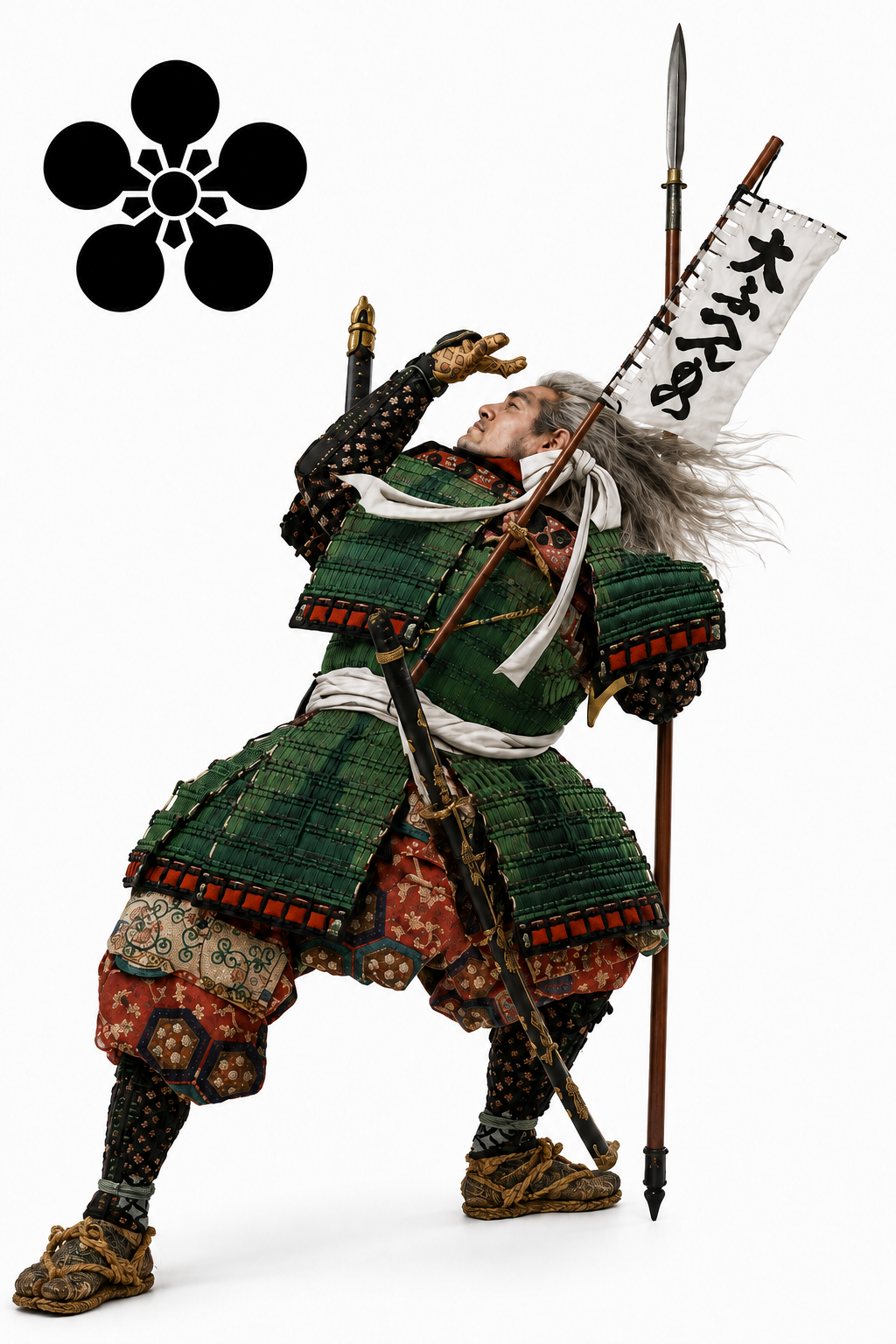
On the occasion of the Keichō Dewa Campaign, Keiji is transmitted to have taken the field raising a flag-standard inscribed “Daifuhen-mono.” Whether it meant “great martial master” (a master of arms) or “greatly inconvenienced man” was a matter on which opinion divided even within the Uesugi house, and it is said to have become a dispute. It is said both that Keiji answered with a laugh, “Either meaning is fine,” and that in the end he never made clear which meaning it was. It is an episode conveying Keiji’s characteristic conduct of making martial skill and humor hold true at the same time.
The Vermilion-Hafted Spear and Vermilion-Lacquered Armor
At the Miyasaka Archaeological Museum in Yonezawa is exhibited a “vermilion-lacquered, purple-laced, five-plate cuirass with Nanban-hat style,” transmitted as having been used by Maeda Keiji. Vermilion was a color that stood out in the Warring States period, often used by martial men, and was spoken of into later times as a symbol of Keiji’s love of flashiness and his martial valor. Together with the tradition that he wielded a vermilion-hafted long spear, it forms the image of Keiji as a martial man.
The True Face of a Literatus Seen in the Maeda Keiji Dōchū Nikki
The Maeda Keiji Dōchū Nikki, which sets down the 26-day journey from Kyoto and Fushimi to Yonezawa in Keichō 6 (1601), is a precious source held by the Yonezawa City Library, said to be in Keiji’s own hand. Contrary to the kabukimono image, the text interweaves attention to the lore of place-names, shrines, and temples, waka and haiku, and Onmyōdō-like accounts, conveying the aspect of travel and literati society at the end of the Warring States period. It is precious as a travel diary of a contemporary warrior as well, and is designated a Yonezawa City cultural property.
His Hermit Life at Dōmori and the Mukuan, and “Keiji-shimizu”
In his late years, Keiji is transmitted to have built the Mukuan in the mountain recesses of Dōmori, Bansei Town, away from the Yonezawa castle town, and to have spent his days mingling with the nearby villagers. Near the hermitage remain the spring water “Keiji-shimizu” and the “Keiji-no-chikaraishi” said to have been used for tests of strength. A memorial pagoda was built within the grounds of the Dōmori Zenkō-ji, and a memorial service is held every year on the 4th of the 6th month. The image of the late Keiji, transformed from kabukimono into hermit, is a living memory in the Yonezawa region even now.
The Sword Offering to Atsuta Shrine
At the treasure hall of Atsuta Shrine in Nagoya, a record is said to be handed down that, in the 6th month of Tenshō 9 (1581), “Maeda Keiji, resident of Arako,” offered a sword bearing the inscription “Sueguchi.” It draws attention as one of the few traces near-contemporary that show Keiji’s real existence. The fact that, during his time on the Maeda house roster, he offered a sword as a “resident of Arako” suggests that Keiji held a certain standing within the Maeda house.
Timeline
※ Ages provisionally adopt the theory based on the Kaga-han Shiryō — born Tenbun 2 (1533), died Keichō 10 (1605), died at age 73 (by the traditional count). There are also several other theories for his years of birth and death.
| Japanese era (CE) | Age | Event |
|---|---|---|
| Tenbun 2 (1533) | 1 | Born in Owari (the Kaga-han Shiryō-lineage birth-year theory). His natural father is transmitted as of the Takigawa Kazumasu family, but the kinship relation has various theories. |
| Around Tenbun 10–12 (1541–43) | 9–11 | The Yonezawa-lineage sources and popular introductions also have a theory making this the year of birth. The age differs by about ten years from this table. |
| Latter half of the Eiroku era (around the latter 1560s) | Late 30s? | His adoptive father Maeda Toshihisa, by order of Oda Nobunaga, cedes the headship to his younger brother Maeda Toshiie and retires. Keiji too loses his future within the Maeda house. |
| Tenshō 9 (1581) | 49 | Offers a sword to Atsuta Shrine under the name “Maeda Keiji, resident of Arako” (shrine tradition). Held to be a trace showing a certain standing within the Maeda house. |
| Tenshō 10 (1582) | 50 | The Honnō-ji Incident. Maeda Toshiie becomes lord of Noto Province. |
| Tenshō 12 (1584) | 52 | Transmitted to have taken part as part of Maeda Toshiie’s army in the Battle of Suemori Castle, linked to the Komaki–Nagakute Campaign. |
| Tenshō 13 (1585) | 53 | Transmitted to have served as castle warden at Ao Castle in Noto and repelled the attack of Jinbō Ujiharu of the Sassa Narimasa side. |
| End of Tenshō – Bunroku era | Late 50s – early 60s | Flees the Maeda house and lives as a rōnin based in Kyoto and Fushimi. Transmitted as the period when he broadened literati society in the world of waka and renga. |
| Keichō 3 (1598) | 66 | Uesugi Kagekatsu is transferred to Aizu’s 1,200,000 koku. Transmitted that Keiji took service with Uesugi Kagekatsu through the mediation of Naoe Kanetsugu. |
| 9th month of Keichō 5 (1600) | 68 | The Keichō Dewa Campaign breaks out. Takes part in the Battle of Hasedō Castle as a subordinate of Naoe Kanetsugu. |
| End of the 9th month – 10th month of Keichō 5 (1600) | 68 | Upon word of the Western Army’s defeat at Sekigahara, the Uesugi army turns to withdrawal. Keiji is transmitted to have supported the rear guard together with Suibara Chikanori and others. |
| Keichō 6 (1601) | 69 | The Uesugi house is reduced to Yonezawa’s 300,000 koku. Keiji sets out from Kyoto on the 24th of the 10th month and arrives in Yonezawa on the 19th of the 11th month. Writes the Maeda Keiji Dōchū Nikki. |
| From the Keichō 10s onward | 70s | Transmitted to have built a hermitage (the Mukuan) at Dōmori, Bansei Town, Yonezawa, and spent his late years as a hermit. Said to have written the “Mukuan-ki.” |
| 9th day of the 11th month of Keichō 10 (1605) | 73 | The year and age of death based on the Kaga-han Shiryō. By one account he died at Karifu in Yamato Province. |
| 4th day of the 6th month of Keichō 17 (1612) | 80? | The date on which, per the Yonezawa Koshi Ruisan, he is said to have died at Dōmori. In Yonezawa a memorial service is held every year on the 4th of the 6th month based on this theory. |
| 4th day of the 6th month of Keichō 18 (1613) | 81? | The Yonezawa Rijin-dan gives death by illness on this day. Even within the Yonezawa-lineage sources there is a one-year difference. |
Family and Personal Relationships
Family
| Person | Relation | Connection |
|---|---|---|
| The Takigawa clan (Kazumasu’s family) | Natural-father line | The kinship relation of his natural father has various theories — younger brother, son, or son of a nephew (Masuuji / Masushige) of Takigawa Kazumasu — and is not established. |
| Maeda Toshihisa | Adoptive father | Eldest son of Maeda Toshiharu and lord of Arako Castle in Owari. Welcomed Keiji as adopted son but, by order of Oda Nobunaga, ceded the headship to his younger brother Toshiie and retired. |
| Niece of Maeda Toshihisa | Wife | Transmitted to have married the niece of his adoptive father Toshihisa. A specific name is scant in the sources. |
| Maeda Masatora (Yasudayū) | Heir | Served Maeda Toshitsune, the third Kaga domain lord, and is also known as a calligrapher skilled in writing. Transmitted to have died at Nanao without a child. |
| Eldest daughter, Hana | Daughter | Wife of the Kaga domain retainer Aruga Sakyō. Later became the wife of the Daishōji domain retainer Yamamoto Yaemon. |
| Second daughter | Daughter | Transmitted to have become the concubine of Hōjō Ujikuni, who was in Maeda Toshiie’s keeping (by one account, the wife of Ujikuni’s fourth son Shōzaburō). |
Lords and Relatives by Marriage
| Person | Position | Connection |
|---|---|---|
| Maeda Toshiie | Uncle / head of the Maeda house | Younger brother of his adoptive father Toshihisa. By Nobunaga’s order he inherited the Maeda headship and Arako Castle and became the founder of Kaga’s million koku. Keiji served for a time under Toshiie, then fled. |
| Oda Nobunaga | Lord of his adoptive father | The ruler of the realm who ordered that the Maeda headship be inherited by Toshiie rather than Toshihisa. Also the figure who cut off Keiji’s path to succession. |
| Toyotomi Hideyoshi | Ruler of the realm | Transmitted to have permitted Keiji the title “the kabukimono licensed by the realm” (heavily colored by later tradition). |
| Uesugi Kagekatsu | Lord | The lord Keiji served around Keichō 3 (1598) through the mediation of Naoe Kanetsugu. Keiji followed Kagekatsu even after the transfer to Yonezawa. |
| Naoe Kanetsugu | Uesugi house administrator / sworn friend | The one who mediated Keiji’s Uesugi service, and a friend since literati society in the capital. In the Keichō Dewa Campaign, Keiji took part in the Battle of Hasedō Castle under Kanetsugu’s command. |
Opposing and Related Powers
| Person / Power | Position | Connection |
|---|---|---|
| Takigawa Kazumasu | Main line of his natural-father lineage | A senior retainer of Oda Nobunaga, held to be the main line of Keiji’s natural-father lineage, but the kinship relation has various theories. |
| Okumura Nagatomi (Sukeemon) | Maeda house retainer / Suemori castle general | A retainer of his adoptive father Toshihisa, who often appears in later tales as Keiji’s close comrade-like figure. Held the castle through the siege in the Battle of Suemori Castle. |
| Kikuchi Takekatsu | Lord of Ao Castle in Noto | Defected from Sassa Narimasa and joined the Maeda side. Keiji was in residence for a time as castle warden of Ao Castle. |
| Sassa Narimasa | Adversarial daimyō of Etchū | A figure who fiercely contended with Maeda Toshiie in the Hokuriku. In the Battle of Suemori Castle and the defense of Ao Castle, Keiji directly faced the Narimasa side. |
| Mogami Yoshiaki | Enemy general of the Keichō Dewa Campaign | The supreme commander of the Eastern-Army side who upheld Hasedō Castle. In the withdrawal battle it became a fierce fight in which he took a bullet to the head. |
| Date Masamune | Enemy general of the Keichō Dewa Campaign | A daimyō of Ōu who, in response to Yoshiaki, threatened the north of the Uesugi domain. A principal Eastern-Army-side power of the Keichō Dewa Campaign. |
Related Historic-Site Map and Travel Model Course
The places associated with Maeda Keiji spread from Arako in Owari (present-day Nagoya City), transmitted as his birthplace, through the Noto Peninsula, the stage of his battle work in his youth, Kyoto and Fushimi, his base of activity after his flight, and on to Yonezawa in Dewa, where he spent his late years. In particular, at Dōmori, Bansei Town, Yonezawa City, associated historic sites are concentrated — the Mukuan ruins, transmitted as where Keiji spent his late years, Keiji-shimizu, the memorial pagoda of the Dōmori Zenkō-ji, and others — and a memorial service is held every year on the 4th of the 6th month.
Model Course ①: The Birthplace, Owari Arako Course (half day)
A course visiting the Arako Castle ruins in Owari, transmitted as where Keiji was raised, and touring the historic sites associated with the Maeda house within Nagoya City.
- Subway Takabata Station → Arako Castle Ruins (Fuji-Gongen Tenmansha) (the castle ruins where Maeda Toshiie and Keiji were raised) → Arako Kannon-ji (an ancient temple associated with the Maeda house) → Atsuta Shrine Treasure Hall (the holding place of the sword “Sueguchi,” transmitted as Keiji’s offering) → return.
Model Course ②: The Hokuriku, Maeda House Front Course (1 day)
A course touring Suemori Castle and Ao Castle, where Keiji fought on the Noto Peninsula, to feel the Hokuriku front of the Maeda house and Sassa Narimasa.
- Kanazawa Station → Suemori Castle Ruins (Hōdatsushimizu Town, Hakui District, Ishikawa Prefecture) (the stage of the Hokuriku battle linked to Komaki–Nagakute) → Ao Castle Ruins (Himi City, Toyama Prefecture) (the sea castle where Keiji served as warden) → overnight in Toyama City or Kanazawa City.
Model Course ③: The Yonezawa, Maeda Keiji Seclusion Site Course (1 day)
A course centered on Dōmori, Bansei Town, Yonezawa, where the late Keiji lived, intensively touring the historic sites associated with Keiji.
- JR Yonezawa Station → Dōmori Zenkō-ji (Dewa Zenkō-ji) (Keiji’s memorial pagoda; Keiji’s Strength Stone) → Keiji-shimizu (the spring water transmitted as used by Keiji for drinking) → Mukuan Ruins (the ruins of his late-years hermitage) → Miyasaka Archaeological Museum (exhibits the armor used by Maeda Keiji and the armor used by Uesugi Kagekatsu and Naoe Kanetsugu) → Yonezawa City Library (holds the Maeda Keiji Dōchū Nikki) → return.
Model Course ④: The Wide-Area Course Tracing the Maeda Keiji Dōchū Nikki (2 nights, 3 days and up)
A wide-area course tracing, by modern means of transport, the road Keiji walked from Kyoto and Fushimi to Yonezawa in Keichō 6.
- Day 1: Kyoto (Fushimi) → toward Mino → the Nakasendō post-town group (Magome, Tsumago, and others) → overnight toward Shinano.
- Day 2: Shinano → Kōzuke, Musashi → the Shirakawa-no-seki Ruins (the gateway to Ōshū) → overnight within Fukushima Prefecture.
- Day 3: The Ōshū Highway → Yonezawa → historic sites associated with Dōmori → return.
Arrangements by Type of Visitor
- History beginners: The Yonezawa half-day plan of Model Course ③. At the Dōmori Zenkō-ji and the Miyasaka Archaeological Museum, one can grasp the whole picture of Keiji at once.
- Fans of Hana no Keiji: The royal road is a route tracing Keiji’s life all the way through, combining the three stages of Owari Arako (birthplace) → Hokuriku (Suemori, Ao) → Yonezawa (late years).
- Castle fans: A Hokuriku castle course connecting the Arako Castle Ruins, Suemori Castle Ruins, and Ao Castle Ruins. One can confirm on the ground the vertical flow of the Maeda house’s Hokuriku management.
- Travel-diary enthusiasts: The wide-area course of Model Course ④. One can enjoy matching the accounts of the travel diary against the actual sites while walking the post towns of the Nakasendō and the Ōshū Highway.
- The hot-spring inclined: Yonezawa has many hot-spring areas associated with the Uesugi house — Onogawa Onsen, Shirabu Onsen, Akayu Onsen, and others. Combined with touring the historic sites associated with Keiji, one can balance historic sites with a hot-spring cure.
Related Articles
Related Warlord Articles
- Uesugi Kagekatsu — The lord Keiji served in his late years. They experienced together the reduction from Aizu’s 1,200,000 koku to Yonezawa’s 300,000 koku.
- Naoe Kanetsugu — The Uesugi house administrator and Keiji’s sworn friend. In the Keichō Dewa Campaign he took direct command as Keiji’s superior.
- Maeda Toshiie — Keiji’s uncle and the founder of Kaga’s million koku. The central figure in the relationship between Keiji and the Maeda house.
- Takigawa Kazumasu — The main line of Keiji’s natural-father lineage. The kinship relation has various theories.
- Oda Nobunaga — The ruler of the realm who had the Maeda headship inherited by Toshiie and cut off Keiji’s path to succession.
- Toyotomi Hideyoshi — The ruler of the realm transmitted to have permitted Keiji the title “the kabukimono licensed by the realm.”
Related Battle Articles
- The Keichō Dewa Campaign (1600) — The “Sekigahara of the North,” in which Keiji took part under Naoe Kanetsugu.
- The Battle of Hasedō Castle (1600) — The main battlefield of the Keichō Dewa Campaign. Keiji is transmitted to have supported the rear guard in the withdrawal battle.
Reference Information
Primary and Semi-Primary Sources
- Maeda Keiji Dōchū Nikki (held by the Yonezawa City Library; a Yonezawa City designated cultural property) — A diary transmitted to have been recorded by Keiji himself, of the journey from Kyoto and Fushimi to Yonezawa from the 24th of the 10th month to the 19th of the 11th month of Keichō 6 (1601). A precious source conveying the image of Keiji as a literatus and lover of the classics.
- “Mukuan-ki” — A playful prose said to have been set down by the late Keiji at the hermitage in Dōmori. Conveys his philosophy of life and the state of mind of a hermit.
- Atsuta Shrine tradition (the record of the offering of the sword “Sueguchi” in Tenshō 9) — One of the few near-contemporary traces conveying Keiji’s activity during his time on the Maeda house roster.
Compiled Sources
- Kaga-han Shiryō (ed. Maeda Ikutoku-kai) — A compilation systematically collecting sources related to the Kaga domain. It cites the various works concerning Keiji — the Kōkyo Tekiroku, Sōka Jien, Kaga-han Rekifu, Maeda-shi Keifu, Jūshū Zōdan, and others.
- Kaga-han Shikō — A domain history compiled by the Kaga domain. Conveys the tradition of Keiji’s audience with Hideyoshi and the like.
- “Maeda Keiji-dono Den” (collected in Hikyū Sōsho 19 held by the Ishikawa Prefectural Library; an excerpt is also collected in the Kōkyo Tekiroku held by the Early-Modern Historical Materials Hall of the Kanazawa City Tamagawa Library) — Conveys the Kaga-domain-lineage Keiji tradition.
- Yonezawa Rijin-dan (composed in the early 19th century) — A Yonezawa local source. Gives Keiji’s year of death as the 4th of the 6th month of Keichō 18.
- Yonezawa Koshi Ruisan — A compilation of Yonezawa local sources. Gives Keiji’s year of death as Dōmori, the 4th of the 6th month of Keichō 17.
- Yonezawa Shidan — Yonezawa historical popular reading. Gives Keiji’s year of birth as around Tenbun 10.
- Yonezawa Jinkoku-ki — A biography of figures of Yonezawa. Conveys the tradition of Keiji’s Kyoto life.
- Sankoki and Jūshū Zōdan — Edo-period compiled sources conveying differing traditions on the kinship relation of Keiji’s natural-father lineage.
Academic and Research Works
- Imafuku Tadashi, Maeda Keiji (Shin-Jinbutsu-Ōrai-sha / shinsho edition) — A representative research work of Keiji biography, founded on source criticism. It organizes the Yonezawa-lineage and Kaga-lineage traditions and shows the boundary between historical fact and tradition.
- The Keiji studies of Ikeda Kōichi — Present a perspective reading the “taboo” character of Keiji from the silence of the Maeda-house-related sources.
- Studies in Oda–Toyotomi Daimyō, Vol. 11: Sassa Narimasa (by Hagihara Daisuke, Ebisu Kōshō Publication, 2023) — A recent research work treating the background of the Battle of Suemori Castle, useful for understanding the context of the Hokuriku front in which Keiji took part.
- Abe Akito (ed.), Uesugi Kagekatsu (Ebisu Kōshō Publication, Studies in Oda–Toyotomi Daimyō series 16, May 2025) — A compilation of papers including research on Uesugi Kagekatsu’s retainer corps. Referred to for understanding the background of Keiji’s service.
- Imafuku Tadashi, “The Hero of the Eastern Provinces” Uesugi Kagekatsu (Kadokawa Shinsho) — A general-readership work surveying the life of Kagekatsu, whom Keiji served.
Public-Institution Materials and Museums
- Yonezawa City Library (Yonezawa City, Yamagata Prefecture) — Holds the Maeda Keiji Dōchū Nikki. A Yonezawa City designated cultural property.
- Miyasaka Archaeological Museum (Yonezawa City, Yamagata Prefecture) — Holds and exhibits about 700 items of Yonezawa-domain-related materials, including the “vermilion-lacquered, purple-laced, five-plate cuirass with Nanban-hat style” transmitted as used by Maeda Keiji, and the armor used by Uesugi Kagekatsu and Naoe Kanetsugu.
- Dōmori Zenkō-ji (Dewa Zenkō-ji, Dōmori, Bansei Town, Yonezawa City, Yamagata Prefecture) — Holds Maeda Keiji’s memorial pagoda and conducts a memorial service every year on the 4th of the 6th month.
- Yonezawa City Tourism Association and the Yonezawa Maeda Keiji Society — The center of the Keiji-commemoration activities in Yonezawa. They disseminate information related to the travel diary.
- Atsuta Shrine Treasure Hall (Nagoya City, Aichi Prefecture) — Said to be the holding place of the sword “Sueguchi,” transmitted to have been offered by “Maeda Keiji, resident of Arako” in the 6th month of Tenshō 9.
- Ishikawa Prefectural Library and the Early-Modern Historical Materials Hall of the Kanazawa City Tamagawa Library — Hold Kaga-domain-lineage Keiji-related sources such as “Maeda Keiji-dono Den” and the Kōkyo Tekiroku.
Other Reference Materials
- The entries for “Maeda Toshimasu,” “Maeda Keiji,” and “kabukimono” in various encyclopedias and databases (the Kokushi Daijiten, the Nihonshi Kōjiten, and others).
- The Yamagata, Ishikawa, and Aichi Prefecture volumes of the Nihon Rekishi Chimei Taikei — Explanations of the place-names and historic sites associated with Keiji.
- Ryū Keiichirō, Ichimuan Fūryūki (novel, Shinchōsha) — A representative modern novel that renewed the image of Keiji. The original of Hara Tetsuo’s Hana no Keiji.
- Hara Tetsuo, Hana no Keiji — Kumo no Kanata ni (manga, Shūeisha) — A manga work based on Ryū Keiichirō’s novel, which played a decisive role in spreading the modern image of Keiji.
- NHK Thursday Period Drama Kabukimono Keiji (2015) — A period-drama series with Keiji as protagonist.
※ This article is based on the state of research and the various sources as of May 2026. Maeda Keiji is scant in contemporary sources, and theories stand side by side on many basic matters — his years of birth and death, natural father, the circumstances of his flight, and his place of death — and this article presents each theory together with its source. It must also be noted that much of the image of Keiji handed down to the present is strongly influenced by Ryū Keiichirō’s Ichimuan Fūryūki and Hara Tetsuo’s Hana no Keiji. Evaluations may change with the discovery of new sources and the advance of research.
コメント