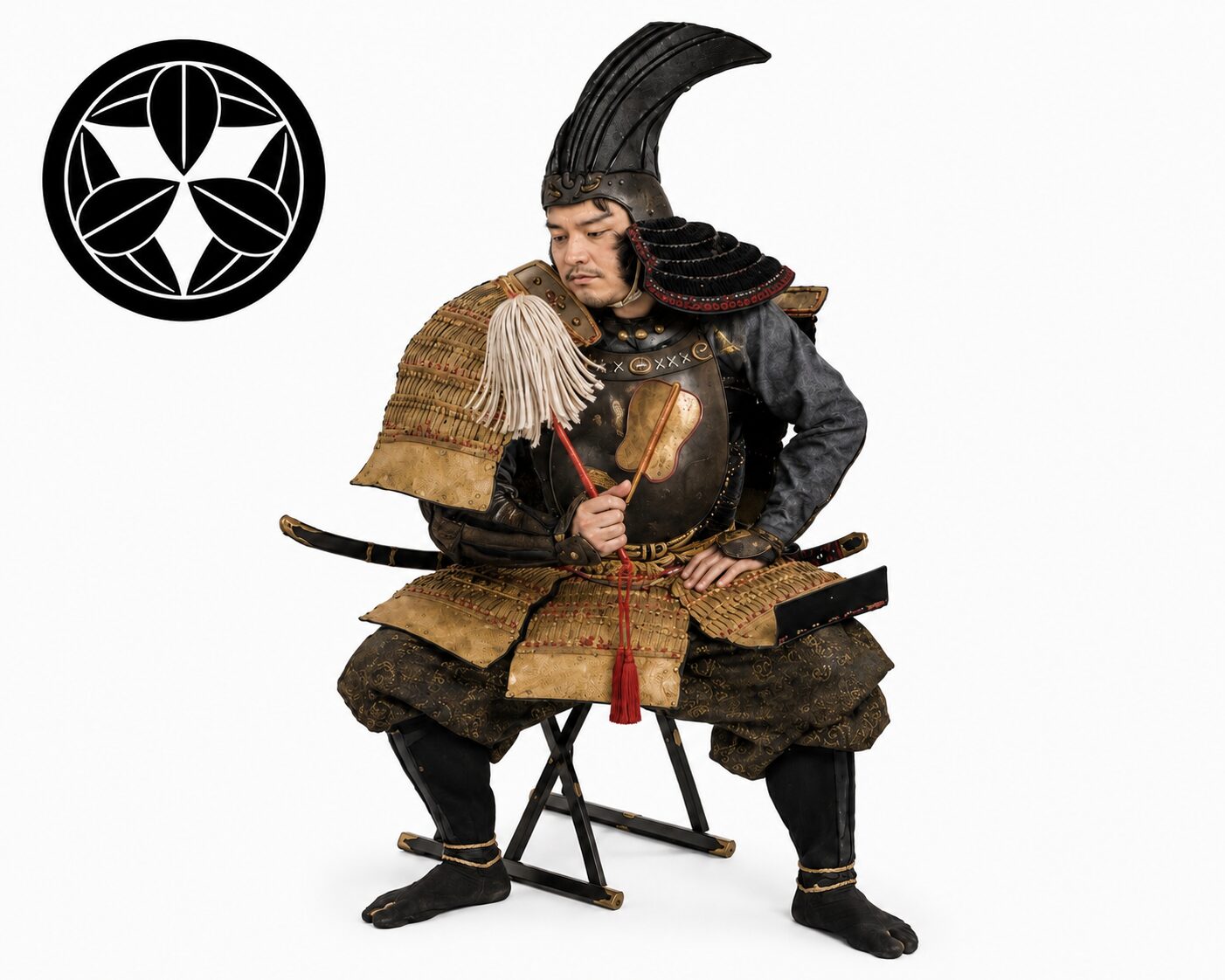
Takenaka Hanbee — The Genius Strategist Who Seized a Castle with a Dozen Men: A Short Life of 36 Years
Tenbun 13 (1544) – the 13th day of the 6th month, Tenshō 7 (1579) | Died at age 36 (by the traditional count)
This Figure in Three Lines
- He became famous for an unprecedented act: seizing Inabayama Castle with only a dozen or so men.
- Serving as a strategist for Hashiba Hideyoshi, he took part in the Chūgoku campaign and succeeded in capturing many castles through stratagem and negotiation.
- In Tenshō 7 (1579) he died of illness in camp during the siege of Miki Castle. The wise general hailed as the “present-day Kongming” left this world at the age of 36.
The Mainstream Account — The Standard Story Found in Textbooks
Origins and Early Years
Takenaka Hanbee (Takenaka Shigeharu) was born in Tenbun 13 (1544) as the eldest son of Takenaka Shigemoto, a local lord of Mino Province. The Takenaka were kokujin landholders based at Bodaisan Castle in the Fuwa District of Mino, and they had served the Saitō house since the time of Saitō Dōsan.
The Seizure of Inabayama Castle (1564)
In Eiroku 7 (1564), Hanbee gave up on the dissolute rule of the Saitō head, Saitō Tatsuoki, and together with his father-in-law Andō Morinari carried out the astonishing act of taking Inabayama Castle by surprise with only a dozen or so men. Tatsuoki is said to have fled the castle in his nightclothes.
After occupying the castle for about half a year, Hanbee returned it to Tatsuoki and departed. The most widely held view is that his true purpose was “to admonish his lord,” but the truth remains uncertain. Oda Nobunaga sounded out Hanbee about handing over the castle, but Hanbee refused.
Hideyoshi’s “Three Visits”
After Mino was pacified, Nobunaga sent Hashiba Hideyoshi as an envoy to recruit Hanbee. Hideyoshi is said to have visited Hanbee three times, recognizing his talent and asking him to enter his service (the so-called “courtesy of three visits”). Moved by Hideyoshi’s character, Hanbee became his retainer.
→ For details, see the battle article “The Battle of Inabayama Castle.”
As Hideyoshi’s Strategist
As Hideyoshi’s adviser, Hanbee served in the Battle of Nagashino and in the campaigns of the Chūgoku region. In the pacification of Harima and Tajima in particular, he succeeded in capturing numerous castles not by force of arms but through negotiation and stratagem.
It is also said that when Hideyoshi was ordered by Nobunaga to execute Shōjumaru — the eldest son of Kuroda Kanbei, later Kuroda Nagamasa — Hanbee, on his own judgment, hid Shōjumaru and saved his life. The episode is well known as a sign of Hanbee’s loyalty to Hideyoshi and of a character that valued human life.
Falling in Camp
In the 6th month of Tenshō 7 (1579), Hanbee died of illness in camp during the siege of Miki Castle (the Miki campaign). He was 36. The illness is said to have been tuberculosis. His death was a great loss for Hideyoshi, and thereafter Kuroda Kanbei took over the role of Hideyoshi’s principal military adviser.
The Theories — Exploring the Possibilities from Various Angles
【Theory 1】How Much of the “Genius Strategist” Image Is Historical Fact?
Takenaka Hanbee’s image as a “genius strategist” was greatly embellished by the war tales and storytelling of the Edo period. In reality, Hanbee was probably less a “strategist” for Hideyoshi than an adviser who handled negotiation, intrigue, and intelligence gathering. There is also a view that, since no formal post of “strategist” existed in the Sengoku period, Hanbee’s actual role was closer to that of a chief retainer (karō) or an attached officer (yoriki).
【Theory 2】Is the “Courtesy of Three Visits” Historical Fact?
The anecdote that Hideyoshi visited Hanbee three times — the “courtesy of three visits” — may have been created in later ages in imitation of the Chinese tale of Liu Bei and Zhuge Liang in the Records of the Three Kingdoms. That Hanbee came to serve Hideyoshi is itself historical fact, but no primary source confirming the specific episode of three visits has been found.
【Theory 3】The Motive for Seizing Inabayama Castle
There are several theories about Hanbee’s motive for seizing Inabayama Castle. Besides the “admonishing his lord” theory, some see it as a bid for power in collusion with his father-in-law Andō Morinari, while others suspect secret communication with Nobunaga; reliable sources are scarce. The fact that Hanbee returned the castle half a year later is one piece of evidence supporting the “admonition” theory.
A Strategic View
Hanbee’s greatest achievement was succeeding, again and again, in capturing castles without the use of force. His skill in winning over the kokujin of Harima and Tajima through negotiation greatly accelerated Hideyoshi’s advance into the Chūgoku region. Among the many Sengoku lords who relied solely on military force, he was a rare commander who put into practice the principle of “winning without fighting.”
After Hanbee’s death, Hideyoshi gained a new source of wisdom in Kuroda Kanbei, but Hanbee and Kanbei are said to have been contrasting types, one of “attack” and one of “defense.” If Hanbee was a “still” strategist skilled in negotiation and defense, Kanbei was a “moving” strategist skilled in offense and decisive action. That Hideyoshi gained these two men in succession was a great stroke of fortune on his road to becoming the ruler of the realm.
Moreover, the unprecedented seizure of Inabayama Castle is noteworthy in the history of tactics as a case that proved a castle could be taken even without a large army. The capture of a castle by a dozen or so men showed that it was possible when the elements of intelligence, surprise, and a grasp of internal circumstances all came together.
Related Historic-Site Map and Travel Model Course
Related Historic-Site Map — Places Associated with Takenaka Hanbee
Spots on the map:
- Bodaisan Castle Ruins (castle) — Hanbee’s residence-castle
- Takenaka Clan Jin’ya Ruins (residence) — a fortified residence built by Hanbee’s son Shigekado. Its white-walled turret gate still stands
- Zendō-ji (Grave of Takenaka Hanbee) (temple) — Hanbee’s family temple, in Tarui Town
- Miki Castle Ruins (castle) — the site of the Miki campaign, where Hanbee died of illness in camp
- Grave of Takenaka Hanbee (Hirai) (grave/monument) — the grave of Hanbee, who died of illness in camp during the siege of Miki Castle
※ The map is a reference display based on present-day roads. It differs from the roads and terrain of the Sengoku period.
📍 See the route on Google Maps (car/train switchable)
Travel Model Course — A One-Day Course Tracing the Short Life of a Genius Strategist
Prerequisites
- Time required: about 5–6 hours (by car; Tarui → Miki)
- Stay at each spot: 20 minutes to 1 hour
- Starting point: JR Tarui Station
Model Course
① Takenaka Clan Jin’ya Ruins (stay: about 30 minutes) — Its white-walled turret gate still stands. About 10 minutes by car from Tarui Station.
② Zendō-ji (stay: about 20 minutes) — Hanbee’s family temple, with the graves of generations of the Takenaka family. On foot: about 10 minutes from the Jin’ya ruins.
③ Bodaisan Castle Ruins (stay: about 1 hour) — Hanbee’s residence-castle. A sweeping view of the Mino plain from the summit. On foot: about 10 minutes from Zendō-ji to the trailhead, then about 30 minutes to the summit.
④ Miki Castle Ruins (stay: about 40 minutes) — the stage of Hideyoshi’s “starving siege of Miki,” where Hanbee died of illness in camp. By car: about 1 hour 30 minutes from Tarui.
Arrangements by Type of Visitor
- For strong walkers: Climb all the way to the summit of Bodaisan Castle and experience a strategist’s vista.
- For a relaxed pace: Make a half-day course of the Takenaka Clan Jin’ya ruins and Zendō-ji within Tarui Town.
※ This plan is a reference model based on general travel speeds and stay times. Opening hours, transit schedules, and crowding vary by season and day of the week. Please check the latest information on the official websites of each facility and transport operator before setting out.
※ Please plan mountain-castle climbs sensibly, according to the weather and your own stamina.
Choose a Base for Exploring Sites Connected with Takenaka Hanbee
Select accommodation and a rental car for three major stages of Hanbee’s short life: his home territory at Tarui and Bodaisan Castle, his legendary seizure of Inabayama Castle, and his final campaign at Miki Castle.
Stay in Tarui near Bodaisan Castle
Use Tarui as the main base for the Takenaka Clan Jin’ya ruins, Zendō-ji and the Takenaka family graves, and the mountain castle where Hanbee lived.
Key historic sites
- Takenaka Clan Jin’ya ruins
- Zendō-ji and the Takenaka family graves
- Bodaisan Castle ruins
- Tarui-juku and the historic townscape
Stay near Gifu Castle and the Nagara River
Explore the former Inabayama Castle, where Hanbee’s surprise seizure created his legendary reputation, together with Gifu Park and the castle-town heritage below Mount Kinka.
Key historic sites
- Gifu Castle, formerly Inabayama Castle
- Mount Kinka and the ropeway
- Gifu Park
- Oda Nobunaga’s residence ruins
Stay near Miki Castle
Visit the ruins of Miki Castle, where Hanbee died of illness during Hideyoshi’s campaign, and the grave at Hirai that preserves his memory near the battlefield.
Key historic sites
- Miki Castle ruins
- Grave of Takenaka Hanbee at Hirai
- Sites connected with the siege of Miki
- Historic central Miki
The article’s one-day route runs from Tarui to Miki in about five to six hours by car, but staying overnight near either Tarui or Miki allows more time for Bodaisan Castle and the Miki battlefield. Gifu Castle is a separate extension connected with Hanbee’s most famous exploit. Bodaisan Castle requires a mountain climb, so allow sufficient time and wear suitable footwear. Check current accommodation prices, availability, rental-car rates, and conditions on the linked Rakuten Travel pages.
Related Battle Articles
- The Battle of Inabayama Castle (1567)
- The Battle of Nagashino (1575)
- The Battle of Kōzuki Castle (1578)
Reference Information
- Primary source: Shinchō Kōki (by Ōta Gyūichi)
- Taniguchi Katsuhiro, Biographical Dictionary of Oda Nobunaga’s Retainers, 2nd ed. (Yoshikawa Kōbunkan, 2010)
- Owada Tetsuo, Takenaka Hanbee and Kuroda Kanbei (PHP Bunko, 2013)
※ This article is based on the historical sources, research works, and multiple online sources noted above. Interpretations of history differ even among scholars, and the established view may change with the discovery of new sources or the advance of research.
コメント