The Battle of Yamazaki (1582) ― Eleven Days After Honnō-ji, Hideyoshi Defeats Mitsuhide at Tennōzan
The 13th day of the 6th month of Tenshō 10 (July 2, 1582) | Yamazaki, Otokuni District, Yamashiro Province (present-day Ōyamazaki, Otokuni District, Kyoto Prefecture)
- The Battle of Yamazaki in Three Lines
- The Mainstream View ― The Standard Account Found in Textbooks
- Multiple Theories ― Where the Standard Account Wavers in Recent Research
- Viewed Strategically ― What the Battle of Yamazaki Brought to Japanese History
- Famous Words from This Battle
- Anecdotes and Episodes
- Chronology of the Battle of Yamazaki
- Key Figures of Both Sides
- Related Historic Sites Map
- Related Articles and References
The Battle of Yamazaki in Three Lines
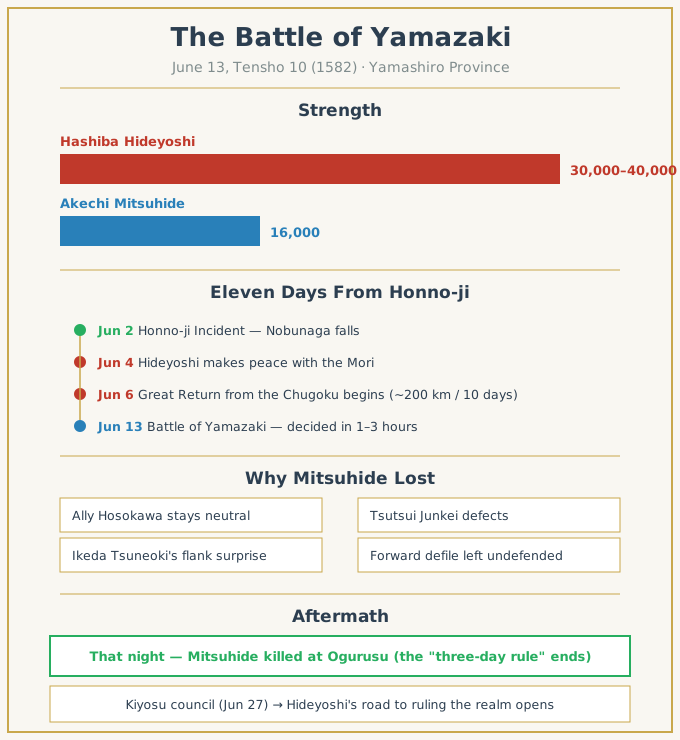
- Only eleven days after the Honnō-ji Incident, the army of Hashiba Hideyoshi ― 30,000 to 40,000 strong, returned from Bitchū Takamatsu Castle by the “Great Return from the Chūgoku” ― clashed with the 16,000 of Akechi Mitsuhide between Mount Tennōzan and the Yodo River, in one of the greatest speed-decided battles of the Sengoku period.
- The fighting was settled in a mere one to three hours. Mitsuhide’s ally Hosokawa Fujitaka went into mourning, his hoped-for Tsutsui Junkei defected, and the isolated Akechi army collapsed under a surprise attack by Ikeda Tsuneoki and others.
- The routed Mitsuhide was set upon by peasant straggler-hunters in a bamboo thicket at Ogurusu that night and took his own life. The “three-day rule” ended, and the road to Hideyoshi’s seizure of the realm was decisively opened ― a turning point of history.
The Mainstream View ― The Standard Account Found in Textbooks
The Eleven Days After the Honnō-ji Incident ― Mitsuhide’s Conquest of the Kinki and His Isolation
Early on the 2nd day of the 6th month of Tenshō 10 (1582), Akechi Mitsuhide struck down his lord Oda Nobunaga at Honnō-ji in Kyoto and drove the heir Nobutada to suicide at the Nijō New Palace. That evening Mitsuhide went down the Ōtsu road from Awataguchi toward Ōmi and returned to Sakamoto Castle. On the 3rd and 4th he remained at Sakamoto and sent out letters requesting the cooperation of the warrior houses of Ōmi and Mino. On the 4th he sent Takeda Motoaki and Kyōgoku Takatsugu into Ōmi and took control of most of the province that day. On the 5th he took over Nobunaga’s base, Azuchi Castle, and pressed his maneuvering with the court.
In the immediate aftermath of the incident, the leading Oda retainers were unable to move. Shibata Katsuie was facing Uesugi Kagekatsu in the Hokuriku, in the midst of capturing Uozu Castle; Takigawa Kazumasu faced the Hōjō in the Kantō; Niwa Nagahide was in the Kinki preparing to cross to Shikoku but had only some 3,000 men of his own; Tokugawa Ieyasu was sightseeing in Sakai and could do no more than escape to Okazaki across Iga. And Hashiba Hideyoshi was facing the Mōri in the Chūgoku region. Mitsuhide reckoned he had a month’s grace ― and this estimate became a fatal miscalculation.
Mitsuhide asked his trusted ally Hosokawa Fujitaka (Yūsai) to take his side. Because Mitsuhide’s third daughter Tama was married to Fujitaka’s heir Tadaoki, the Hosokawa were his greatest hope. But Fujitaka at once shaved his head and went into mourning, and Tadaoki confined Tama at Mitono in Tango. On the 9th of the 6th month Mitsuhide sent another letter, promising exceptional rewards ― “I will give you the whole province of Settsu, and Tajima or Wakasa too if you wish,” and “within fifty or a hundred days I will pacify the nearby provinces, and after that I will hand over the government and retire” ― but Fujitaka again held to neutrality. Fujita Tatsuo notes that “by the 8th of the 6th month at the latest, an envoy of Hideyoshi had made contact with Fujitaka.” Mitsuhide’s network was collapsing rapidly where he could not see it.
The Great Return from the Chūgoku ― Hideyoshi’s Abnormal Speed
Hashiba Hideyoshi, who was conducting the water attack on Bitchū Takamatsu Castle, received the report that “Nobunaga has fallen” between the night of the 3rd and the dawn of the 4th of the 6th month. The source is variously told: the Taikōki says Mitsuhide’s secret messenger to the Mōri was captured; the Jōzan Kidan says spies Hideyoshi had stationed at Bitchū Niwase caught a suspicious courier, or that he was informed by Nobunaga’s close attendant Hasegawa Sōnin. In any case, Hideyoshi grasped the situation the day after the incident.
Hideyoshi’s response was astonishingly fast. Within the 4th of the 6th month he proposed to the Mōri the conditions of “ceding three provinces and the suicide of Shimizu Muneharu.” With Bitchū Takamatsu Castle out of provisions, the Mōri accepted these terms, and that evening Muneharu took his own life and the peace was concluded. In fact the Mōri learned of Nobunaga’s death only on the evening of the 4th, so the peace was settled by a narrow margin first. Kikkawa Motoharu and others argued for pursuit, but they gave priority to defending their own territory and did not move, missing the chance to threaten Hideyoshi’s rear.
On the 6th of the 6th month (theories vary), Hideyoshi’s army left Bitchū Takamatsu and began the “Great Return from the Chūgoku.” Covering some 200 kilometers in ten days, it arrived at Tonda in Settsu (Takatsuki, Osaka Prefecture) on the 12th. Along the way the Settsu forces of various places ― Ikeda Tsuneoki, Nakagawa Kiyohide, Takayama Ukon ― joined one after another. Hideyoshi spread the false information “Nobunaga is alive” to Nakagawa Kiyohide to prevent his going over to the Akechi side. Further, the forces under Oda Nobutaka and Niwa Nagahide, who had been preparing in Settsu to cross to Shikoku, also joined, and Hideyoshi’s army finally swelled to 30,000–40,000. The fact that “Hideyoshi, commander of the Chūgoku front, had returned unscathed at the head of a great army” drew the wavering forces of the Kinki at once to Hideyoshi’s side.
The 12th of the 6th Month ― The Two Armies Face Off Across the Enmyōji River
On the 10th of the 6th month, Mitsuhide tried to wait for and unite with Tsutsui Junkei of Yamato, but Junkei did not appear. Junkei was a subordinate daimyō under Mitsuhide’s command, the leading warlord of Yamato after Mitsuhide himself. But Junkei had already decided to defect to Hideyoshi and was preparing to fortify Yamato Kōriyama Castle. Mitsuhide’s hope was utterly betrayed.
From around the 12th of the 6th month, the two armies faced off across the Enmyōji River (present-day Koizumi River). Hideyoshi’s army had its Settsu forces occupy the village of Yamazaki from the previous night and take the front line. Takayama Ukon and Nakagawa Kiyohide were in the center; Ikeda Tsuneoki and his son Motosuke with Katō Mitsuyasu on the right wing (the river side); and Kuroda Kanbei, Hashiba Hidenaga, and Mikoda Masaharu on the left wing (the old Saigoku road at the foot of Mount Tennōzan). Hideyoshi’s headquarters were placed at Hōshaku-ji on Mount Tennōzan.
The Akechi army drew its defensive line east and west before the headquarters at Gobōzuka, with Saitō Toshimitsu, Abe Sadayuki, the Kawachi forces, and the old shogunal forces. The vanguard was the Akechi chief elder Saitō Toshimitsu and the Ōmi forces. Mitsuhide adopted the plan of “successively destroying Hideyoshi’s army as it advanced in a long, drawn-out formation along the narrow road of Yamazaki, hemmed in between the Yodo River and Mount Tennōzan,” with Yodo Castle as his left wing and the line along the Enmyōji River as his right. The Akechi army was about 16,000, Hideyoshi’s about 30,000–40,000 ― a tactic of offsetting an overwhelming numerical disparity with terrain.
The 13th of the 6th Month ― A Battle Decided in One to Three Hours
The 13th of the 6th month is said to have been rainy. The two armies continued to face off all day, but the fighting opened around four in the afternoon. It began when Hideyoshi’s Nakagawa Kiyohide unit, moving along the foot of Mount Tennōzan to take position beside Takayama Ukon’s unit, was set upon by Akechi’s Ise Sadaoki unit. In response, Akechi’s Saitō Toshimitsu unit also began an attack on Takayama Ukon’s unit.
In the opening phase the Akechi army held the advantage. The Nakagawa and Takayama units fell into difficulty, but Hori Hidemasa’s force rushed up as a reserve from Hideyoshi’s main body and held the line. The units of Kuroda Kanbei, Hashiba Hidenaga, and Mikoda, deployed at the foot of Mount Tennōzan, advanced and fought the Akechi units of Matsuda Masachika and Namikawa Yasuie on the mid-slope of Tennōzan, and the struggle continued.
The situation shifted greatly about an hour after the fighting began. The force led by Ikeda Tsuneoki and his son Motosuke and by Katō Mitsuyasu, advancing north along the old course of the Yodo River, secretly crossed the Enmyōji River and surprised Akechi’s Tsuda Nobuharu unit. Attacked from three sides, the Tsuda unit collapsed. With this, the right wing of the Akechi army crumbled, and wavering spread through the headquarters. The Nakagawa and Takayama units pushed back all at once, and the Akechi army broke completely. The duration of the fighting differs by record, but it was about one and a half to three hours. When the vanguard commanders Matsuda Masachika and Ise Sadaoki died fighting and the main Saitō Toshimitsu unit was driven back, the Akechi army lost all organized resistance.
The Retreat to Shōryūji Castle and the End at Ogurusu
Mitsuhide fell back from Gobōzuka to Shōryūji Castle (present-day Nagaokakyō, Kyoto Prefecture). But Shōryūji was a flatland castle that could not hold a large army, and the Akechi force had dwindled to little more than 700. That night Mitsuhide secretly slipped out of Shōryūji Castle and fled toward his base, Sakamoto Castle. His companions were only a few to a dozen-odd riders. He made for Sakamoto to secure the safety of his family (his wife Hiroko had already died of illness; his sons and daughters remained).
But in a bamboo thicket at Ogurusu in Yamashiro Province (present-day Fushimi Ward, Kyoto City), Mitsuhide met peasant straggler-hunters. By the account in the Shinchō Kōki, the farmer Nakamura Chōbei stabbed him in the side with a bamboo spear, gravely wounding him, and he asked his retainer Mizoo Shigetomo to behead him and took his own life. Fróis’s History of Japan depicts it more vividly: “Mitsuhide gave the farmers a bar of gold and asked them to guide him to Sakamoto Castle, but they took it and, seized with the desire to seize his swords as well, stabbed him to death and cut off his head.” His age is given as either 55 or 67. It was an anticlimactic end for the man who had caused the greatest mystery in Japanese history.
About three heads said to be Mitsuhide’s were delivered to Hideyoshi’s army, but they were said to be unidentifiable in the heat. On the 14th of the 6th month Shōryūji Castle fell; Akechi Hidemitsu moved from Azuchi Castle to Sakamoto Castle, beheaded Mitsuhide’s wife and children, and then took his own life. Sakamoto Castle burned. Kameyama Castle also fell with the suicide of Akechi Mitsuyoshi (Mitsuhide’s heir). The Akechi house was effectively destroyed. On the 17th of the 6th month, Saitō Toshimitsu, who had been hiding at Katata, was captured and beheaded and crucified at Rokujō-gawara.
On the 27th of the 6th month, Hideyoshi held the Kiyosu council and took the lead on Nobunaga’s succession and the redistribution of territory. By making Sanbōshi (Nobutada’s surviving son) the successor, he seized leadership within the Oda house and brought the whole Kinki, including the Akechi domains, under his sway. The victory at the Battle of Yamazaki became the decisive stairway to Hideyoshi’s seizure of the realm. Mitsuhide’s “eleven-to-twelve-day rule” ended, and the Sengoku period advanced to a new stage.
Multiple Theories ― Where the Standard Account Wavers in Recent Research
Theory 1: The “Struggle for Tennōzan” Never Happened ― Deconstructing the Standard View
The set phrase “the realm-deciding Tennōzan” is one of the most famous expressions in Japan derived from the Battle of Yamazaki. The standard view held that Hideyoshi gained the advantage and defeated Mitsuhide by occupying Mount Tennōzan. In recent research, however, it is considered highly likely that this “struggle for Tennōzan” itself was a later invention.
A probable invention of the war tales: Edo-period war tales such as the Taikōki, the Kawasumi Taikōki, the Takemori Kaki, and the Eigenshidan Kinenroku dramatically depict Kuroda Yoshitaka (Kanbei) advising Hideyoshi of the importance of Tennōzan, Hosokawa Tadaoki occupying Ozaki west of Tennōzan, and even people who did not take part in the fighting as having been involved in the struggle for Tennōzan. But no concrete account of fighting at Tennōzan can be confirmed in good-quality primary sources. The contemporary sources that record the Battle of Yamazaki (the Kanemi-kyō Ki, the Tamon’in Nikki, the Tokitsune-kyō Ki, and others) note only the fighting itself briefly, and do not write that Tennōzan was a decisive point of contention.
The change of name: “The Battle of Tennōzan,” once widely used, is now generally called “the Battle of Yamazaki (the Yamazaki engagement)” in the present-day historical world. This reflects the recognition that the standard view ― that “the struggle for Tennōzan decided the outcome” ― differs from historical fact. There is a consensus among researchers that calling it “the Battle of Tennōzan” is a name based on a fabricated story, and that the objective place-name “Yamazaki” should be used.
So what was the role of “Tennōzan”?: Hideyoshi’s left wing (Kuroda Kanbei, Hashiba Hidenaga, Mikoda Masaharu, and others) was in fact deployed at Tennōzan, so it was not without strategic significance as a position. Hideyoshi’s headquarters at Hōshaku-ji were on Mount Tennōzan. But rather than the simple causal relation “they won because they occupied Tennōzan,” the modern understanding is that “a compound deployment that made use of the geography, including Tennōzan,” supported Hideyoshi’s victory. There is a record that the Akechi units of Matsuda Masachika and Namikawa Yasuie fought Hideyoshi’s army on the mid-slope of Tennōzan, but this too was only one local engagement, not a battle that decided the whole situation.
The true origin of the phrase “the realm-deciding Tennōzan”: In fact the expression “the realm-deciding Tennōzan” did not exist at the time of the Battle of Yamazaki and is said to have been spread by Edo-period war tales. The symbolism of Yamazaki as the starting point of Hideyoshi’s seizure of the realm was later tied to the concrete terrain of “Tennōzan” and turned into a set phrase. Today the word “Tennōzan,” meaning “the crucial juncture that decides victory or defeat,” is a phrase in which symbolism preceded historical fact. Likewise, “to settle into Horagatōge” (discussed below) and “three-day rule” are also set phrases born of the Battle of Yamazaki, but all of them contain a gap from historical fact.
Theory 2: The Possibility That “Hideyoshi Did Not Make It in Time” ― A Newly Discovered 2024 Letter
In 2024, a newly discovered letter of Hideyoshi, purchased by Chukyo University, was analyzed by Professor Mabe Takahiro (medieval Japanese history), who announced a startling conclusion: the theory that “Toyotomi Hideyoshi very likely did not in fact make it in time for the Battle of Yamazaki.”
The content of the letter: The letter, which Professor Mabe judged to be Hideyoshi’s from the handwriting and form, recorded Hideyoshi’s movements on the day of the battle. According to it, when full-scale fighting began at Yamazaki on the evening of the 13th of the 6th month, Hideyoshi was at a point about 12 kilometers from the main battlefield (Tonda or Amagasaki), showing a relaxed posture of “I will go to the front the next day.”
What it means: If this interpretation is correct, then those who clashed with the Akechi army at the front in the Battle of Yamazaki were not Hideyoshi’s main army, exhausted by the Great Return from the Chūgoku, but the Settsu forces on Hideyoshi’s side who had been in the northern part of present-day Osaka from the start ― Ikeda Tsuneoki and his son Motosuke, Nakagawa Kiyohide, Takayama Ukon, Katō Mitsuyasu, and others. Rather than Hideyoshi “commanding as supreme commander,” the reality may be closer to “holding the title of supreme commander while leaving the actual fighting to the Settsu forces.”
The impact on the conventional view: This is a grave point that casts doubt on the very image of Hideyoshi’s “genius command in battle.” The Battle of Yamazaki has been told as the dramatic story that “Hideyoshi defeated Mitsuhide immediately after the Great Return from the Chūgoku,” but the reality may have been more modest: “Hideyoshi returned to the Kinki by the Great Return, and the Settsu forces who had already prepared defeated the Akechi army at the front,” while “Hideyoshi himself kept the title of supreme commander at Tonda or Amagasaki and arrived after the fighting ended.”
Other grounds for the “Hideyoshi arrived late” theory: In fact the theory that “Hideyoshi was late for the battle” had been advanced sporadically before the Mabe letter. Among the letters Hideyoshi issued in later years are ones that describe the course of the battle in detail, and close examination of their content is said to contain descriptions that can only be explained if Hideyoshi himself was not at the front. Also, from the fact that the fighting ended in a mere one to three hours, and that the Akechi side is recorded as “defeated at once,” there is a view that the outcome was decided not by a battle in which Hideyoshi fully controlled the chain of command, but by the mobile fighting of the Settsu forces on the spot.
Watanabe Daimon, taking this new theory into account, notes that “Hideyoshi’s army may have been exhausted by the Great Return from the Chūgoku, and the activity of the Settsu forces was the cause of victory.” The Battle of Yamazaki was not “Hideyoshi’s battle” but “the Settsu forces’ battle” ― this understanding holds the potential to update the very conception of Sengoku-period warfare. There is also the possibility that the course of the battle itself may be greatly rewritten in the future.
Theory 3: Ikeda Tsuneoki’s Surprise Attack Decided the Outcome ― Who Was the True Hero?
Related to the “Hideyoshi-arrived-late theory” touched on in Theory 2, who actually decided the outcome of the Battle of Yamazaki? In place of the standard “occupation of Tennōzan theory” and “Hideyoshi’s generalship theory,” the view that the surprise attack by Ikeda Tsuneoki was decisive has become strong in recent research.
What was Ikeda Tsuneoki’s surprise attack?: About an hour after the fighting began, the right-wing force of Ikeda Tsuneoki and his son Motosuke and of Katō Mitsuyasu advanced north along the old course of the Yodo River and secretly crossed the Enmyōji River. They then surprised, from the rear, the Tsuda Nobuharu unit that held the Akechi right wing. Attacked from front, flank, and rear, the Tsuda unit collapsed. With this the whole right wing of the Akechi army crumbled, and the outcome was decided.
Hideyoshi himself acknowledges it: In fact Hideyoshi himself, in a later letter (the Kanai Documents), records the course of the battle as follows: “Along the road they were broken by Takayama Ukon, Nakagawa Kiyohide, and Hori Hidemasa. On the southern side they were broken by Ikeda Tsuneoki, and by our men Katō Mitsuyasu, Kimura Shigekore, and Nakamura Kazuuji. On the mountain side they were broken by Hashiba Hidenaga, Kuroda Kanbei, Mikoda Masaharu, Maeno Nagayasu, Kinoshita Kageyu, and the rest of the forces.” In this account, Hideyoshi does not write that he “commanded,” but acknowledges that each unit broke the Akechi army on its own. Some research interprets this as “Hideyoshi arrived late for the battle, and Ikeda Tsuneoki was central in deciding the outcome.”
The figure of Ikeda Tsuneoki: Ikeda Tsuneoki (1536–1584) was one of the warlords most trusted by Nobunaga as his foster-brother. Just before the Honnō-ji Incident he was lord of Settsu Hyōgo Castle (present-day Kobe City), and on receiving the urgent report of the incident he immediately decided to join Hideyoshi. At the Battle of Yamazaki he was entrusted with the right wing and conceived and carried out the surprise attack on the spot. He fought on Hideyoshi’s side at the Battle of Shizugatake and died in battle at the Battle of Komaki and Nagakute. The Battle of Yamazaki was the greatest exploit of Tsuneoki’s life.
From “Hideyoshi’s battle” to “the Settsu forces’ battle”: The Settsu forces ― Ikeda Tsuneoki, Nakagawa Kiyohide, Takayama Ukon ― were well acquainted with the local geography and had direct combat experience against the Akechi side. It is highly likely that the reality of the Battle of Yamazaki is closer to “the local Settsu forces” bearing the actual fighting than “Hideyoshi’s main army, exhausted by the Great Return from the Chūgoku.” Hideyoshi’s political and strategic achievements ― “sending a deceptive letter to Nakagawa Kiyohide as supreme commander to prevent his going over to the Akechi,” “organizing the Settsu forces” ― were great, but the protagonists of the tactical victory were the Settsu forces. This is the point that the latest research has reached.
Theory 4: The “Impossible Speed” of the Great Return from the Chūgoku and Where the Hideyoshi-Mastermind Theory Stands
The “Great Return from the Chūgoku” ― Hideyoshi’s forced march covering some 200 kilometers from Bitchū Takamatsu to Yamazaki in ten days ― has been handed down as one of the finest feats in Japanese military history. But its “impossible speed” is the greatest ground for the Honnō-ji Incident Hideyoshi-mastermind theory ― the idea that “Hideyoshi knew of the Honnō-ji Incident in advance.”
Scientific verification ― Harita Yasuhiro’s The Science of Japanese History: The shipbuilding engineer Harita Yasuhiro quantified the difficulty of the Great Return from the Chūgoku. For an army of 20,000 to keep walking 30 kilometers a day for eight days requires food equivalent to 400,000 rice balls a day. Furthermore, 150 tons of human and animal waste are produced daily. Camping in the rainy season allows no proper rest, and combat strength falls markedly with worsening sanitation. Harita concludes that “however much the realm dangled before his eyes, it was a military operation that carried considerable risk,” and that “without advance preparation, the Great Return from the Chūgoku would have been impossible.”
Fujita Tatsuo’s “anticipation theory”: Professor Fujita Tatsuo of Mie University points out that “the feat of securing, in an emergency, an information route of more than 300 kilometers different from the regular route of the Saigoku road linking the capital and Bitchū would have been impossible without preparing it in advance.” Fujita takes the position that “I would not go so far as to say Hideyoshi knew of the Honnō-ji Incident in advance, but he anticipated Mitsuhide’s rebellion, spread a network of information, and made preparations against the worst.” Since Hideyoshi and Mitsuhide were in conflict over Shikoku policy, it was natural for Hideyoshi to keep a close watch on Mitsuhide’s movements.
Watanabe Daimon’s rebuttal: The Sengoku historian Watanabe Daimon is cautious: “There is no primary source that Hideyoshi knew in advance.” He holds that “he merely traced his supply line in reverse, which is nothing particularly strange,” noting that Bizen was the domain of the Ukita under Hideyoshi’s command, and that provisions were stockpiled at Himeji Castle. As crisis management, securing a line of retreat is only natural for a Sengoku warlord. Associate Professor Goza Yūichi of the International Research Center for Japanese Studies agrees, holding that “the conventional theory of departing Takamatsu Castle on the 6th of the 6th month is mistaken, and Hideyoshi’s move to Himeji is better understood as a realistic march taking three days.”
The new “sea-route theory”: In recent years Harita Yasuhiro and others have advanced a “sea-route theory.” It holds that Hideyoshi and his direct cavalry and close attendants alone moved by ship from the port of “Katakami” (a shipping port for Bizen ware, under Ukita control) a little east of Numa on the San’yō road, to Akō, and entered Himeji Castle. The Inland Sea was then under the power of the Mōri navy, but since Hideyoshi had won over the Kojima and Kurushima navies, the use of the sea route was possible. If “Hideyoshi himself and his elite went ahead by ship while the main body marched by land,” both the “impossible speed” and the “provisioning problem for 20,000 men” are solved. Watanabe Daimon criticizes this theory as “lacking historical perspective,” but its military and geographical rationality cannot be ignored.
Watanabe’s “going ahead by horse theory”: Watanabe Daimon himself agrees with the theory that “Hideyoshi alone went ahead with a few close attendants.” Based on the “Bairin-ji Documents,” it holds that Hideyoshi arrived ahead at Numa Castle on horseback. There is a difference of sea route or land route, but on the point that “Hideyoshi himself returned ahead of the main army,” there is a degree of consensus among researchers.
Where the Hideyoshi-mastermind theory stands: The “knew-in-advance theory” lacks decisive grounds in academia and remains a minority view. But the more moderate view that “Hideyoshi kept a close watch on Mitsuhide’s movements and prepared against the worst” has been spreading in recent years. That Hideyoshi was the greatest beneficiary of the Honnō-ji Incident, the abnormal speed of the Great Return from the Chūgoku, the skillful maneuvering at the Kiyosu council ― in terms of outcome, all of it matches up perfectly. Whether “a coincidence of genius crisis-management and good fortune” or “a plan prepared in advance,” the truth lies in the darkness of 440 years ago.
Theory 5: Tsutsui Junkei’s “Horagatōge” Legend and the Neutralization of Hosokawa Fujitaka
There is a Japanese set phrase, “the fence-sitting Junkei” and “to settle into Horagatōge.” It means “to side with whichever side is advantageous after watching the situation” or “to sit on the fence,” and derives from the tradition that Tsutsui Junkei deployed at Horagatōge (the border of Kyoto and Yamato) just before the Battle of Yamazaki and watched the situation. But it is highly likely that the very origin of this phrase differs from historical fact.
Junkei’s actual movements: In good-quality primary sources, the fact that Junkei deployed at Horagatōge cannot be confirmed. From the start Junkei was preparing to fortify Yamato Kōriyama Castle and had decided to defect to Hideyoshi. The story that Mitsuhide went out to Horagatōge to meet Junkei but he did not appear is also very likely an invention of war tales such as the Taikōki. The Zōho Tsutsui Kaki writes that, on Shima Sakon’s advice, Junkei deployed at Horagatōge, but that work is rated “an inferior book full of errors” and cannot be trusted.
Why did Junkei betray Mitsuhide?: Junkei had been entrusted with Yamato as Mitsuhide’s subordinate daimyō. He must have had a deep bond as Mitsuhide’s subordinate, but his movements after the Honnō-ji Incident were swift. The reasons noted are (1) aversion to the Akechi side that had struck down Nobunaga; (2) the fact that Oda Nobutaka, Niwa Nagahide, Ikeda Tsuneoki, and others on Hideyoshi’s side were already moving; and (3) the discernment, given the character of Yamato (where Nobunaga’s vassal Matsunaga Hisahide had rebelled in the past), to read the trend within the Oda house. Junkei had in effect accepted the conciliatory overtures from the Hideyoshi side.
The origin of the “fence-sitting Junkei” phrase: The phrase “fence-sitting Junkei” itself is said to have been coined in the Edo period and after, and the Horagatōge deployment that gave rise to it is also an invention, but it became established quite early as an expression of Junkei’s attitude. This is probably because the very fact that Junkei “did not side with Mitsuhide although he was Mitsuhide’s subordinate daimyō” appeared as “betrayal” in the eyes of people of the Sengoku period. The reality was “he had decided but did not make his attitude clear,” but outwardly it looked like “fence-sitting” ― this is why it remained as a set phrase.
The neutralization of Hosokawa Fujitaka was more serious: More fatal to Mitsuhide than Junkei was the neutralization of his greatest ally, Hosokawa Fujitaka. Fujitaka had been an ally since the days of installing Yoshiaki, and Mitsuhide’s third daughter Tama (the later Hosokawa Gracia) was married to Fujitaka’s heir Tadaoki. The two houses ought to have been firmly bound by a political marriage.
But after the Honnō-ji Incident, Fujitaka at once shaved his head and went into mourning, and Tadaoki confined Tama at Mitono in Tango. On the 9th of the 6th month Mitsuhide again sent a letter promising exceptional rewards ― “the whole province of Settsu, and Tajima or Wakasa too if you wish,” and “within fifty or a hundred days I will pacify the nearby provinces and then hand over the government and retire” ― but Fujitaka again held to neutrality. Fujita Tatsuo notes that “by the 8th of the 6th month at the latest, an envoy of Hideyoshi had made contact with Fujitaka,” suggesting that Fujitaka’s neutralization may have been the result of Hideyoshi’s advance maneuvering.
Hideyoshi’s invisible hand: After the Battle of Yamazaki, in a letter dated the 11th of the 7th month, Hideyoshi expressed to Fujitaka “gratitude for his full cooperation” and issued a written oath guaranteeing the future treatment of the Hosokawa. It is collateral evidence that the outwardly neutral Fujitaka had in fact cooperated with Hideyoshi behind the scenes. The collapse of Mitsuhide’s network was advancing, where he himself did not notice, by Hideyoshi’s invisible hand.
Theory 6: Mitsuhide’s Tactical Failure ― Why Did He Not Defend at the Ōyamazaki Defile?
Yamazaki is a defile some 200 meters wide at its narrowest, hemmed between Mount Tennōzan and the Yodo River. Had Mitsuhide deployed forward here and blocked the defile, he could very likely have offset the more-than-twofold disparity of forces with the terrain. “Successively destroying Hideyoshi’s army as it advanced in a long, drawn-out formation along the narrow road” should have been Mitsuhide’s plan, but his actual deployment placed his headquarters at Gobōzuka (somewhat to the rear) and took a defensive stance with his back to Shōryūji Castle. Why did Mitsuhide not make the most of his terrain advantage?
1) The Ōyamazaki injunction theory: The day after the Honnō-ji Incident (the 3rd of the 6th month), Mitsuhide had issued an “injunction” (kinzei) to the town of Ōyamazaki. An injunction was a document in which a ruler set out prohibitions to temples, shrines, and the populace and promised protection ― a statement of political good faith to protect a town from the flames of war. The town of Ōyamazaki was at the narrowest point of Yamazaki, and to deploy forward here would draw the town into the fighting. The leading theory is that Mitsuhide abandoned his tactical advantage to keep faith with the injunction. This is consistent with the image of Mitsuhide as a “righteous lord.”
2) The Shimotoba headquarters theory: Mitsuhide’s headquarters remained at Shimotoba (Fushimi Ward, Kyoto City) even as of the 12th. This shows that it was not yet clear whether Hideyoshi’s army would come by way of Yamazaki or attack Kyoto directly by another route. Shimotoba was the southern gateway to Kyoto, a position able to respond to several attack routes. Mitsuhide ultimately decided on a decisive battle at Yamazaki, but may not have had the time to advance his headquarters. This shows Mitsuhide’s hesitation in his operational planning.
3) The shortage-of-troops theory: Mitsuhide’s mobilizing strength was about 16,000. Because he had to allot troops to keep order in the capital and to hold the Ōmi quarter, the strength he could concentrate at Yamazaki was limited. To block the defile with a forward deployment against Hideyoshi’s 30,000–40,000 required maintaining a long defensive line, which dispersed his forces. He may have judged that placing his headquarters to the rear and shortening the defensive line would use his limited troops more efficiently.
4) The Saitō Toshimitsu advice theory: Before the battle, the Akechi chief elder Saitō Toshimitsu is said to have argued: “With the hoped-for Hosokawa Fujitaka and Tadaoki absent and Tsutsui Junkei not joining, before this overwhelming disparity of forces we should give up this moment, fall back to Sakamoto or Kameyama Castle, and fight there.” Toshimitsu’s advice was to withdraw, but Mitsuhide did not heed it and chose a decisive battle at Yamazaki. The half-measure deployment with his headquarters at Gobōzuka may also have been a compromise between Toshimitsu’s withdrawal argument and Mitsuhide’s argument for a decisive battle.
Conclusion: “Political good faith” made him abandon his tactical advantage: These factors were likely compounded, but the most Mitsuhide-like reason is probably that “he kept faith with the Ōyamazaki injunction and protected the town from the flames of war.” Mitsuhide was a lord of good government, beloved by his people as a “righteous lord” in Tanba and Fukuchiyama. The same values worked at Yamazaki, prioritizing “the protection of the town” over “military victory.” This was an unusual choice for a Sengoku warlord, but it was also a decision that symbolized Mitsuhide’s “righteousness.”
That the “man of righteousness” Mitsuhide abandoned military rationality and was defeated ― this irony connects with the duality of the Mitsuhide who became a “lord-killer” in the Honnō-ji Incident. Mitsuhide was a cold-blooded schemer and at the same time a man of good faith. The tactical failure at the Battle of Yamazaki can also be read as a consequence of the essential complexity of the man Mitsuhide.
Viewed Strategically ― What the Battle of Yamazaki Brought to Japanese History
The Starting Point of Hideyoshi’s Seizure of the Realm
The Battle of Yamazaki, in result, gave Hashiba Hideyoshi the decisive stairway to seizing the realm. In a situation where Nobunaga and his son Nobutada had died in the Honnō-ji Incident and a problem of Oda succession had arisen, Hideyoshi, who most brilliantly accomplished “avenging Nobunaga,” gained overwhelming political superiority within the Oda house. At the Kiyosu council of the 27th of the 6th month, by making Sanbōshi (Nobutada’s young surviving son) the successor, he seized effective control and brought the Kinki, including the Akechi domains, under his sway.
At the Battle of Shizugatake in 1583 he defeated Shibata Katsuie; at the Battle of Komaki and Nagakute in 1584 he brought the war with Ieyasu to a draw and made him submit; and only eight years later, in 1590, he completed the unification of the realm with the Odawara campaign. Hideyoshi’s seizure of the realm began with the Battle of Yamazaki. Without the “Great Return from the Chūgoku” and the “Battle of Yamazaki,” the Oda successor would have been Nobukatsu or Nobutaka, and subsequent history would very likely have followed an entirely different course.
The Importance of the “Settsu Forces” as a Local Power
As discussed in Theories 2 and 3, the actual fighting at the Battle of Yamazaki was borne less by Hideyoshi’s main army than by the Settsu forces ― Ikeda Tsuneoki, Nakagawa Kiyohide, Takayama Ukon, and others. This shows the fact that Sengoku-period battles were often decided more by “the mobile judgment of powerful local warlords” than by “the generalship of the supreme commander.” Hideyoshi organized the Settsu forces, left the actual fighting to them, and won. That “the talent for using men” surpassed “the talent for fighting oneself” is the essence of Hideyoshi’s seizure of the realm.
This “Hideyoshi who uses men” style is seen consistently in his later seizure of the realm. At the Battle of Shizugatake too, the actual fighting was borne by the “Seven Spears” ― Katō Kiyomasa, Fukushima Masanori, and others ― and the Odawara campaign was a coalition operation mobilizing daimyō from various regions. Hideyoshi himself commanded the whole from the center. Nobunaga, by contrast, was a warlord who took up the spear and fought at the front; Mitsuhide too was a warlord who directed from his own headquarters. Hideyoshi’s style of “a general who only commands” may be said to have changed the very nature of the Sengoku “warlord.”
A Symbolic Battle That Gave Birth to Set Phrases
The Battle of Yamazaki left several set phrases in the Japanese language. “The realm-deciding Tennōzan,” “to settle into Horagatōge,” “three-day rule” ― all are idioms still often used today. “The realm-deciding Tennōzan” means “the crucial juncture” on the eve of an exam or in a business presentation. “To settle into Horagatōge” means “to sit on the fence.” “Three-day rule” means “short-lived power.” All of these derive from the Battle of Yamazaki.
As discussed in Theories 1 and 5, all of these phrases contain some gap from historical fact. The struggle for Tennōzan very likely never happened, Tsutsui Junkei very likely did not in fact deploy at Horagatōge, and Mitsuhide’s rule was in fact eleven to twelve days. Nevertheless, behind the establishment of these phrases lies the “symbolic power” of the event that was the Battle of Yamazaki. A symbolism beyond fact lives on within the Japanese language ― this too is one of the legacies the Battle of Yamazaki left to Japanese history.
A Symbol of the End of the Sengoku
The Battle of Yamazaki became, in result, an important turning point of the “end of the Sengoku period.” Nobunaga’s unification of the realm was thwarted by the Honnō-ji Incident, but only eleven days later the “restoration of order” was swiftly achieved at the Battle of Yamazaki. In place of Nobunaga’s cold-blooded unification, Hideyoshi’s more flexible unification began, leading to the subsequent stabilization under Ieyasu. Without the Battle of Yamazaki, the confusion from the Honnō-ji Incident would have lasted longer, and the Sengoku period might have been extended by years or even a decade.
The structure by which the “lord-killer” Mitsuhide was subdued in eleven days and Hideyoshi took on the succession of the Oda regime symbolizes both the fluidity of the Sengoku period and the transition to an early-modern state. The Battle of Yamazaki stands at the turning point from “the Sengoku period, in which striking down one’s lord held a degree of legitimacy as gekokujō,” to “an age in which lord-killing is judged as an absolute evil.” The tragic end of Akechi Mitsuhide was also an event marking the starting point of the political ethics of early-modern Japan, as the last “failed case of gekokujō” of the Sengoku period.
Famous Words from This Battle
“The realm-deciding Tennōzan.”
A set phrase derived from the Battle of Yamazaki, meaning “the crucial juncture that decides the outcome of a matter.” It is said to derive from Hideyoshi’s occupying Mount Tennōzan and turning the battle to his advantage, but in fact there is no concrete account of a struggle for Tennōzan in good-quality primary sources. A symbolic expression spread by Edo-period war tales became established as a set phrase. Even today it is used, on the eve of an exam or in the real moment of a presentation, as “this is the Tennōzan.”
“To settle into Horagatōge.”
A set phrase meaning “to side with whichever side is advantageous after watching the situation,” “to sit on the fence.” It derives from the tradition that Tsutsui Junkei deployed at Horagatōge (the border of Kyoto and Yamato) just before the Battle of Yamazaki and watched the situation. But in good-quality sources the fact that Junkei deployed at Horagatōge cannot be confirmed. The reality was that Junkei prepared to fortify Yamato Kōriyama Castle and had decided to defect to Hideyoshi, but because it outwardly looked like “fence-sitting,” it remained as a set phrase.
“Three-day rule.”
A set phrase meaning “to hold power only for a short time.” It refers to the period from Mitsuhide’s striking down Nobunaga in the Honnō-ji Incident to his defeat and death at the Battle of Yamazaki. In fact it was the eleven to twelve days from the 2nd to the 13th of the 6th month, and “three days” is not literally three days but means “a very short period.” It has been used from the Sengoku period to the present as a phrase symbolizing the fleetingness of Mitsuhide’s seizure of the realm.
“The Great Return from the Chūgoku.”
The term for the forced march by which Hideyoshi, on receiving the urgent report of the Honnō-ji Incident, covered some 200 kilometers from Bitchū Takamatsu Castle to the Kinki in ten days. It is handed down as one of the finest feats in Japanese military history. As a byword for “lightning mobility” and “the drive to turn crisis into opportunity,” it is quoted even today in business and military contexts. At the same time, its abnormal speed also became a cause of the “Hideyoshi-mastermind theory.”
“His Lordship is safe” (“His Lordship and the young lord have both broken out safely”).
The scheming letter Hideyoshi sent during the Great Return from the Chūgoku to the Settsu forces ― Ikeda Tsuneoki, Nakagawa Kiyohide, and others ― who were close to Mitsuhide. By spreading the false information that “Nobunaga and his son Nobutada escaped safely from Honnō-ji and the Nijō New Palace,” he induced wavering on the Akechi side. A splendid case of information warfare that turned the fact of Nobunaga’s undiscovered body to advantage. Hosokawa Fujitaka, Tsutsui Junkei, and others, receiving this letter, hesitated to side with Mitsuhide.
Anecdotes and Episodes
1. Hideyoshi’s Scheming Letter to Nakagawa Kiyohide
Before beginning the Great Return from the Chūgoku, Hideyoshi sent a letter saying “Nobunaga is alive” to Nakagawa Kiyohide, who was close to Mitsuhide, to prevent Kiyohide from joining the Akechi side. Nakagawa Kiyohide was lord of Settsu Ibaraki Castle and had a history as a subordinate daimyō of Araki Murashige. He had a deep connection with Mitsuhide and was highly likely to side with the Akechi right after the incident. Through Hideyoshi’s splendid information warfare, Kiyohide chose to join Hideyoshi and would fight at the very front in the Battle of Yamazaki. Hideyoshi’s political maneuvering, combining “the just cause of an avenging battle” with “false information of Nobunaga’s survival,” was an important groundwork for victory at Yamazaki.
2. The Ōyamazaki Injunction ― A Cause of Defeat Brought On by Mitsuhide’s Good Faith
The day after the Honnō-ji Incident (the 3rd of the 6th month), Mitsuhide issued an “injunction” to the town of Ōyamazaki. An injunction was a document in which a ruler set out prohibitions to temples, shrines, and the populace and promised protection ― a statement of political good faith to protect a town from the flames of war. Ōyamazaki was at the narrowest point of Yamazaki, and to deploy forward here would draw the town into the fighting. Mitsuhide abandoned his tactical advantage to keep faith with the injunction. It was a judgment in the line of the good government for which Mitsuhide was beloved as a “righteous lord” in Tanba and Fukuchiyama, but it became one of the causes of his defeat at the Battle of Yamazaki ― the tragedy of Mitsuhide the “man of righteousness.”
3. Tsutsui Junkei’s Fortification of Kōriyama Castle
On the 10th of the 6th month, Mitsuhide tried to wait for and unite with Tsutsui Junkei, but Junkei did not appear. Junkei was a man who had been entrusted with Yamato as Mitsuhide’s subordinate daimyō. Just after the Honnō-ji Incident it seemed he might move to Mitsuhide’s side, but on learning that Oda Nobutaka, Niwa Nagahide, and others on Hideyoshi’s side were already moving, he changed his judgment. Junkei prepared to fortify Yamato Kōriyama Castle and had effectively decided to defect to Hideyoshi. It is the event that gave rise to the tradition of “the fence-sitting Junkei,” but the reality was “a judgment that calmly read the situation.” Junkei’s choice symbolizes the collapse of Mitsuhide’s subordinate-daimyō structure.
4. The Confinement of Tama (Hosokawa Gracia)
Mitsuhide’s third daughter Tama had lived peacefully as the principal wife of Hosokawa Fujitaka’s heir Tadaoki at Tango Miyazu Castle until just before the Honnō-ji Incident. But after the incident, Tadaoki confined Tama as “the daughter of a traitor” at Mitono in Tango (present-day Kyōtango, Kyoto Prefecture). This was also a political performance by which the Hosokawa drew a line between themselves and the Akechi side. Tama spent about two years in confinement and later converted to Christianity, taking the name “Gracia.” On the eve of the Battle of Sekigahara in 1600, she met a tragic end at the Osaka residence, refusing Ishida Mitsunari’s demand to take her hostage. Tama’s fate symbolizes the relationship between the Hosokawa and Akechi houses that began with the Battle of Yamazaki.
5. The Two Appearances of Satomura Jōha
The linked-verse master Satomura Jōha appears twice in decisive roles around the time of the Honnō-ji Incident. The first was on the 28th of the 5th month, just before the incident, when he attended the “Atago Hyakuin” hosted by Mitsuhide and heard Mitsuhide’s opening verse, “Now is the time ― in the rainy fifth month, the realm comes under heaven’s rule.” The second was on the day of the incident, when Prince Sanehito and his family, who had escaped the Nijō New Palace, stood at a loss in the street, and Jōha brought a humble palanquin and carried them to the palace. In two contrasting scenes ― the literary forewarning of Mitsuhide’s rebellion and the protection of the imperial family ― Jōha became an important witness of the Honnō-ji Incident. After the Battle of Yamazaki, Jōha was also favored by Hideyoshi and played a role in carrying the tradition of linked verse into the Edo period.
6. Mitsuhide’s Headquarters at Gobōzuka and Saitō Toshimitsu’s Advice
Mitsuhide’s headquarters in the Battle of Yamazaki were placed at Gobōzuka (present-day Shimoueno, Ōyamazaki Town). It is said to have been a strategic height making use of the top of a burial mound. Before the battle, the Akechi chief elder Saitō Toshimitsu is said to have argued: “With the hoped-for Hosokawa Fujitaka and Tadaoki absent and Tsutsui Junkei not joining, before this overwhelming disparity of forces we should give up this moment, fall back to Sakamoto or Kameyama Castle, and fight there.” Toshimitsu’s advice was to withdraw, but Mitsuhide did not heed it and chose a decisive battle at Yamazaki. Toshimitsu was also the field commander of the Honnō-ji Incident (per the Itsuya no Kakimono) and remained loyal to Mitsuhide to the end. After the defeat at Yamazaki, Toshimitsu hid at Katata but was captured on the 17th of the 6th month and beheaded and crucified at Rokujō-gawara.
7. The Truth of Ikeda Tsuneoki’s Surprise Attack
Ikeda Tsuneoki was one of the warlords most trusted by Nobunaga as his foster-brother, and just before the Honnō-ji Incident he was lord of Settsu Hyōgo Castle. On receiving the urgent report of the incident he immediately decided to join Hideyoshi, and at the Battle of Yamazaki he was entrusted with the right wing. About an hour after the fighting began, Tsuneoki, with Motosuke, Katō Mitsuyasu, and others, advanced north along the old course of the Yodo River, secretly crossed the Enmyōji River, and surprised Akechi’s Tsuda Nobuharu unit. The Tsuda unit, attacked from three sides, collapsed, and the right wing of the Akechi army crumbled. This was the moment that decisively changed the situation. Tsuneoki died in battle at the Battle of Komaki and Nagakute in 1584, but the Battle of Yamazaki was the greatest exploit of his life ― one of the grounds for the recent research view that “the true hero was not Hideyoshi but Tsuneoki.”
8. Mitsuhide’s End at Ogurusu ― Various Accounts
Having escaped Shōryūji Castle, Mitsuhide made for Sakamoto Castle with only a few to a dozen-odd riders, but met peasant straggler-hunters in a bamboo thicket at Ogurusu in Yamashiro Province (present-day Fushimi Ward, Kyoto City). There are several traditions about Mitsuhide’s end. The Shinchō Kōki has the farmer Nakamura Chōbei stab him in the side with a bamboo spear, gravely wounding him, after which he asked his retainer Mizoo Shigetomo to behead him and took his own life. Fróis’s History of Japan depicts it more vividly: “He gave the farmers a bar of gold and asked to be guided to Sakamoto Castle, but they took it and, seized with the desire to seize his swords as well, stabbed him to death and cut off his head.” The Tamon’in Nikki, the Tokitsune-kyō Ki, and the Kanemi-kyō Ki each have slight variations. About three heads said to be Mitsuhide’s were delivered to Hideyoshi’s army, but because they were unidentifiable in the heat, it later became the soil for survival legends such as the “Tenkai = Mitsuhide survival theory” and the “Nankōbō Tenkai theory.”
Chronology of the Battle of Yamazaki
| Year | Date | Event |
|---|---|---|
| Tenshō 10 (1582) | 6/2 early morning | The Honnō-ji Incident; Oda Nobunaga and his son Nobutada are struck down |
| Tenshō 10 (1582) | 6/2 evening | Mitsuhide returns to Sakamoto Castle and sends out letters requesting cooperation |
| Tenshō 10 (1582) | 6/3 | Mitsuhide issues an injunction to the town of Ōyamazaki. Hideyoshi receives the urgent report at Takamatsu Castle (at night) |
| Tenshō 10 (1582) | 6/4 | Hideyoshi makes peace with the Mōri; Shimizu Muneharu takes his own life. Mitsuhide takes control of most of Ōmi |
| Tenshō 10 (1582) | 6/5 | Mitsuhide takes over Azuchi Castle and begins maneuvering with the court |
| Tenshō 10 (1582) | 6/6 (theories vary) | Hideyoshi’s army leaves Bitchū Takamatsu and begins the Great Return from the Chūgoku |
| Tenshō 10 (1582) | 6/7 | Hideyoshi arrives at Himeji Castle. Mitsuhide requests Nakagawa Kiyohide’s support by letter, but Hideyoshi’s deceptive letter has come first |
| Tenshō 10 (1582) | 6/8 | An envoy of Hideyoshi is said to have made contact with Hosokawa Fujitaka (Fujita Tatsuo’s theory) |
| Tenshō 10 (1582) | 6/9 | Mitsuhide again sends Hosokawa Fujitaka a letter promising “the cession of all Settsu,” but Fujitaka holds to neutrality |
| Tenshō 10 (1582) | 6/10 | Mitsuhide waits for Tsutsui Junkei, but Junkei does not appear and prepares to fortify Kōriyama Castle |
| Tenshō 10 (1582) | 6/11 | Hideyoshi’s army arrives at Amagasaki and joins the Settsu forces ― Ikeda Tsuneoki, Nakagawa Kiyohide, Takayama Ukon, and others |
| Tenshō 10 (1582) | 6/12 | Hideyoshi’s army arrives at Settsu Tonda; at the war council Hideyoshi is made supreme commander. The two armies begin to face off across the Enmyōji River |
| Tenshō 10 (1582) | 6/13 day | Hideyoshi’s army leaves Tonda and joins the Yamazaki and Nobutaka armies |
| Tenshō 10 (1582) | 6/13, 4 p.m. | The Battle of Yamazaki begins. Akechi’s Ise Sadaoki unit attacks Hideyoshi’s Nakagawa Kiyohide unit |
| Tenshō 10 (1582) | 6/13, ~5 p.m. | Ikeda Tsuneoki crosses the Enmyōji River and surprises the Tsuda Nobuharu unit; the Akechi right wing collapses |
| Tenshō 10 (1582) | 6/13 night | The Akechi army breaks completely; Mitsuhide retreats to Shōryūji Castle, slips out at night, and is struck down at Ogurusu, taking his own life (aged 55?) |
| Tenshō 10 (1582) | 6/14 | Shōryūji Castle falls; Akechi Hidemitsu, defeated at the Uchide beach, takes his own life at Sakamoto Castle. Mitsuhide’s wife and children are killed |
| Tenshō 10 (1582) | 6/15 | Sakamoto Castle burns; Akechi Mitsuyoshi (Mitsuhide’s heir) takes his own life at Kameyama Castle |
| Tenshō 10 (1582) | 6/17 | Saitō Toshimitsu is captured at Katata and beheaded and crucified at Rokujō-gawara. Mitsuhide’s head is exposed at Honnō-ji |
| Tenshō 10 (1582) | 6/27 | The Kiyosu council. Hideyoshi seizes real power over the Oda succession question |
| Tenshō 10 (1582) | 7th month | Hideyoshi builds Yamazaki Castle (Takara-dera Castle) on Mount Tennōzan, using it as his base until the building of Osaka Castle |
| Tenshō 10 (1582) | 7/11 | Hideyoshi issues a written oath to Hosokawa Fujitaka expressing “gratitude for his full cooperation” |
* Dates are given in the old (lunar) calendar.
Key Figures of Both Sides
The Hashiba Side (Hideyoshi’s Army, 30,000–40,000)
| Role | Person | Part Played |
|---|---|---|
| Supreme commander | Hashiba Hideyoshi | Returned to the Kinki by the Great Return from the Chūgoku and took overall command. Headquarters at Hōshaku-ji. By the Mabe letter, he may have been at Tonda or Amagasaki on the day of the battle |
| Nominal supreme commander | Oda Nobutaka | Nobunaga’s third son, joined with the force that had been due to cross to Shikoku. Formally the host of the battle to avenge Nobunaga |
| Right wing, surprise attack | Ikeda Tsuneoki and Motosuke | Lord of Settsu Hyōgo Castle. Destroyed the Tsuda Nobuharu unit with a surprise attack along the Yodo River, deciding the outcome |
| Center vanguard | Nakagawa Kiyohide | Lord of Settsu Ibaraki Castle, fought hard at the front. Won over by Hideyoshi’s deceptive letter |
| Center vanguard | Takayama Ukon | Lord of Settsu Takatsuki Castle, a Christian daimyō. Commanded the front alongside Nakagawa |
| Center reserve | Hori Hidemasa | A reserve dispatched from Hideyoshi’s main body; relieved the Nakagawa and Takayama units |
| Left wing | Kuroda Kanbei | Hideyoshi’s strategist, deployed at the foot of Mount Tennōzan. Planner of the strategy of the Great Return from the Chūgoku |
| Left wing | Hashiba Hidenaga | Hideyoshi’s younger brother, deployed at the foot of Mount Tennōzan |
| Right wing | Katō Mitsuyasu | Took part in the Yodo River surprise attack with the Ikeda unit |
The Akechi Side (Mitsuhide’s Army, 16,000)
| Role | Person | Part Played |
|---|---|---|
| Supreme commander | Akechi Mitsuhide | Headquarters at Gobōzuka. After retreating, met peasant straggler-hunters at Ogurusu and took his own life |
| Chief of the vanguard | Saitō Toshimitsu | Akechi chief elder, commanded the defensive line before the headquarters. Captured at Katata after the defeat and executed at Rokujō-gawara |
| Vanguard | Ise Sadaoki | Of the old Ashikaga shogunal forces, led the very first attack that opened the fighting; died fighting |
| Vanguard | Abe Sadayuki (Sadahide) | Of the Ōmi forces, held the defensive line before the headquarters |
| Right wing | Tsuda Nobuharu | Held the Akechi right wing; annihilated as the victim of Ikeda Tsuneoki’s surprise attack |
| Central force | Matsuda Masachika, Namikawa Yasuie | Fought Hideyoshi’s left wing on the mid-slope of Tennōzan; Matsuda Masachika died fighting |
| Reserve | Akechi Hidemitsu (Mitsuharu) | Mitsuhide’s son-in-law, held Azuchi Castle. Took his own life at Sakamoto Castle after the defeat at Yamazaki |
Mitsuhide’s Former Allies Who Defected or Stayed Neutral
| Category | Person | Connection |
|---|---|---|
| Neutralized | Hosokawa Fujitaka (Yūsai) | Mitsuhide’s greatest ally and father-in-law of his daughter Gracia. Went into mourning and stayed neutral; cooperated with Hideyoshi after the battle |
| Defected to Hideyoshi | Tsutsui Junkei | Mitsuhide’s subordinate daimyō, prepared to fortify Yamato Kōriyama Castle. The figure behind the phrases “fence-sitting Junkei” and “Horagatōge” |
| Uninvolved | Tokugawa Ieyasu | After returning to Okazaki across Iga, did not take part in the Battle of Yamazaki |
Related Historic Sites Map
List of Spots on the Map (9 sites)
| Name | Location | Description |
|---|---|---|
| Mount Tennōzan (Hatatatematsu Lookout) | Ōyamazaki, Otokuni District, Kyoto Pref. | Elevation 270 m; the traditional site of the pine where Hideyoshi is said to have raised his banner. A lookout overlooking the Yodo River and the Yamazaki main battlefield. A monument to the Battle of Yamazaki stands here |
| Hōshaku-ji (Takara-dera) | Ōyamazaki, Otokuni District, Kyoto Pref. | The site of Hideyoshi’s headquarters. An old temple founded by Gyōki in 724 by imperial vow of Emperor Shōmu. The place where Hideyoshi built Yamazaki Castle after the battle |
| Shōryūji Castle Park | 12-1 Shōryūji, Nagaokakyō, Kyoto Pref. | Mitsuhide’s temporary retreat castle after the defeat at Yamazaki. The same castle where, in 1578, Mitsuhide’s daughter Tama married Hosokawa Tadaoki |
| Koizumi River (old Enmyōji River) | Ōyamazaki, Otokuni District, Kyoto Pref. | The river across which the two armies faced off, the central stage of the fighting. Ikeda Tsuneoki crossed here for his surprise attack |
| Site of Akechi Mitsuhide’s headquarters (Gobōzuka) | Shimoueno, Ōyamazaki, Otokuni District, Kyoto Pref. | The site of Mitsuhide’s headquarters. A strategic height using the top of the Sakaino No. 1 burial mound. A stone monument was erected in 2017 |
| Ōyamazaki Town History Museum | Ōyamazaki, Otokuni District, Kyoto Pref. | A museum explaining and exhibiting the Battle of Yamazaki. Director Fukushima Katsuhiko and others present the latest research |
| Site of Yamazaki Castle | Ōyamazaki, Otokuni District, Kyoto Pref. | After the Battle of Yamazaki, Hideyoshi built a castle on the summit of Mount Tennōzan. It was Hideyoshi’s base until the building of Osaka Castle ― “Hideyoshi’s fighting keep” |
| Akechi Thicket | Ogurusu Kosaka-chō, Fushimi Ward, Kyoto City | The place of Mitsuhide’s end. The bamboo thicket where Mitsuhide, fleeing toward Sakamoto Castle after the defeat, fell to peasants’ bamboo spears |
| Sakamoto Castle Site Park | Shimosakamoto, Ōtsu, Shiga Pref. | Mitsuhide’s main castle, the last castle he made for. The place where Akechi Hidemitsu beheaded his wife and children and took his own life |
* The map is a reference display based on present-day roads. It differs from the routes and terrain of the time.
📍 View the route on Google Maps (car / train switchable)
Related Articles and References
Related Articles in Sengoku Kassenroku
- Battles: The Honnō-ji Incident (the preceding event eleven days earlier) / The Battle of Shizugatake (the next year, Hideyoshi vs. Katsuie) / The Siege of Kozuki Castle (the background of Hideyoshi’s Chūgoku campaign)
- Warlords (Hashiba side): Hashiba Hideyoshi / Ikeda Tsuneoki / Takayama Ukon / Kuroda Kanbei / Tsutsui Junkei
- Warlords (Akechi side): Akechi Mitsuhide / Hosokawa Fujitaka (Yūsai)
- Warlords (the slain Nobunaga): Oda Nobunaga / Tokugawa Ieyasu
Principal References and Sources
- Primary sources: Shinchō Kōki (Ōta Gyūichi), Kanemi-kyō Ki (Yoshida Kanemi), Tamon’in Nikki, Tokitsune-kyō Ki, the letters of Hideyoshi (the Kanai Documents, the Asano Family Documents), the Mōri-ke Monjo, Luís Fróis’s History of Japan, the Jesuit annual reports from Japan
- Secondary and later sources: Taikōki, Kawasumi Taikōki, Takemori Kaki, Zōho Tsutsui Kaki, Jōzan Kidan, Koretō Taiji Ki, Tōdaiki
- Recent studies: Takayanagi Mitsutoshi, Akechi Mitsuhide (Yoshikawa Kōbunkan, 1958); Fujita Tatsuo, The Honnō-ji Incident (Kōdansha Gakujutsu Bunko); Watanabe Daimon, Mitsuhide and Nobunaga: Was There a Mastermind Behind the Honnō-ji Incident? (Sōshisha); Harita Yasuhiro, The Science of Japanese History (Kōdansha Blue Backs); Fukushima Katsuhiko, Akechi Mitsuhide; Mabe Takahiro, Newly Discovered Material on Hideyoshi’s Letters Around the Battle of Yamazaki (2024, Chukyo University)
- Regional studies: the research and exhibitions of the Ōyamazaki Town History Museum (Director Fukushima Katsuhiko); materials of Shōryūji Castle Park, Nagaokakyō City
* This article is written in light of the state of research as of May 2026. In particular, the “Hideyoshi arrived late” theory based on the Hideyoshi letter analyzed by Mabe Takahiro and discovered in 2024, and the reappraisal that takes Ikeda Tsuneoki’s surprise attack as the cause of victory, may further update the standard view as research advances.
コメント