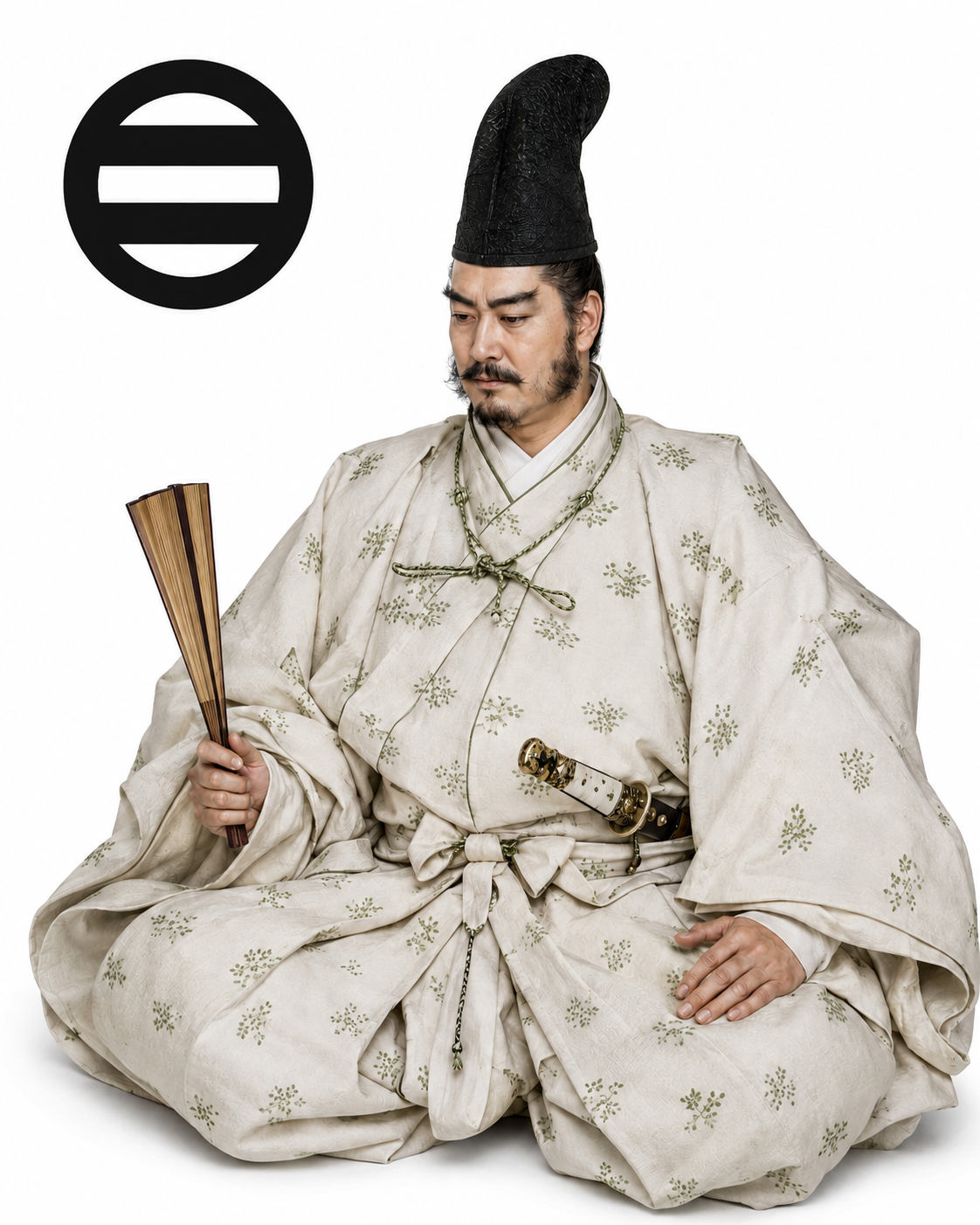
Mogami Yoshiaki — The Schemer of Dewa and the “Ieyasu of the North”: The Tragedy of Komahime and the Desperate Fight at Hasedō Castle
- Mogami Yoshiaki in 3 Points
- The Mainstream View — The Established Account Found in Textbooks
- Multiple Theories — Exploring Possibilities from Various Angles
- Viewed Strategically — Yoshiaki's Politics, Military, and Domain Governance
- Famous Words and Sayings of This Warlord
- Anecdotes and Episodes
- Timeline
- Family and Personal Relationships
- Related Historic Site Map / Model Travel Courses
- Related Articles
- References
Mogami Yoshiaki in 3 Points
- The 11th head of the Mogami clan, based at Yamagata in Dewa Province, and the first lord of the Yamagata domain. He was the uncle of Date Masamune. Beginning from a succession dispute with his father Yoshimori, he pacified southern Ushū through subversion and military force, and at his peak became a great daimyō among the foremost of the Tōhoku region, holding 570,000 koku.
- In the Keichō Dewa Campaign (the “Sekigahara of the North”) of Keichō 5 (1600), he met with a small force the 25,000-strong Uesugi army of Uesugi Kagekatsu, led by Naoe Kanetsugu, and repelled it after the desperate fight at Hasedō Castle. A famed general whom Tokugawa Ieyasu praised even as “the Ieyasu of the North” and “without Yoshiaki there would have been no victory at Sekigahara.”
- Though struck by the tragedy of losing his beloved daughter Komahime in the Hidetsugu Affair, he cast off his loyalty to Toyotomi Hideyoshi and inclined toward Ieyasu. He died of illness in Keichō 19 (1614) at age 69. A multifaceted figure: loved as “Lord Salmon” for binding his retainers with salmon, yet depicted as a “schemer” in Edo-period war chronicles.
The Mainstream View — The Established Account Found in Textbooks
Born to a Distinguished House of the Ushū Tandai
Mogami Yoshiaki was born on the 1st day of the 1st month of Tenbun 15 (February 1, 1546) at Yamagata Castle in Dewa Province. His father was the 10th head of the Mogami house, Mogami Yoshimori, and his mother was a daughter of Ono Shōshō. His childhood name was Hakujumaru, and his common names were Gengorō and Jirōtarō. At age 15, in Eiroku 3 (1560), he received a granted character of a name (henki) from Ashikaga Yoshiteru, the 13th shogun of the Muromachi shogunate, and took the name “Yoshiaki.”
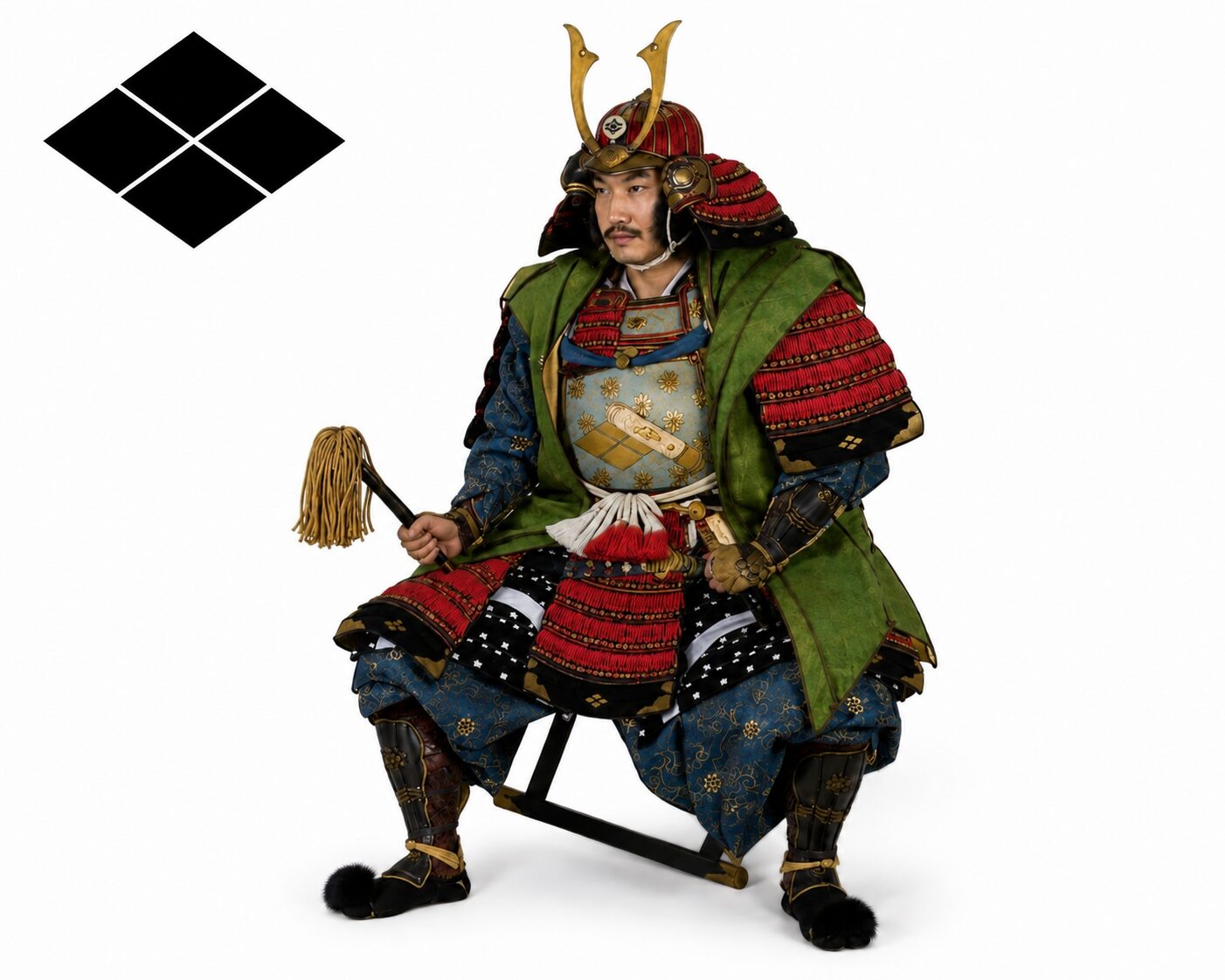
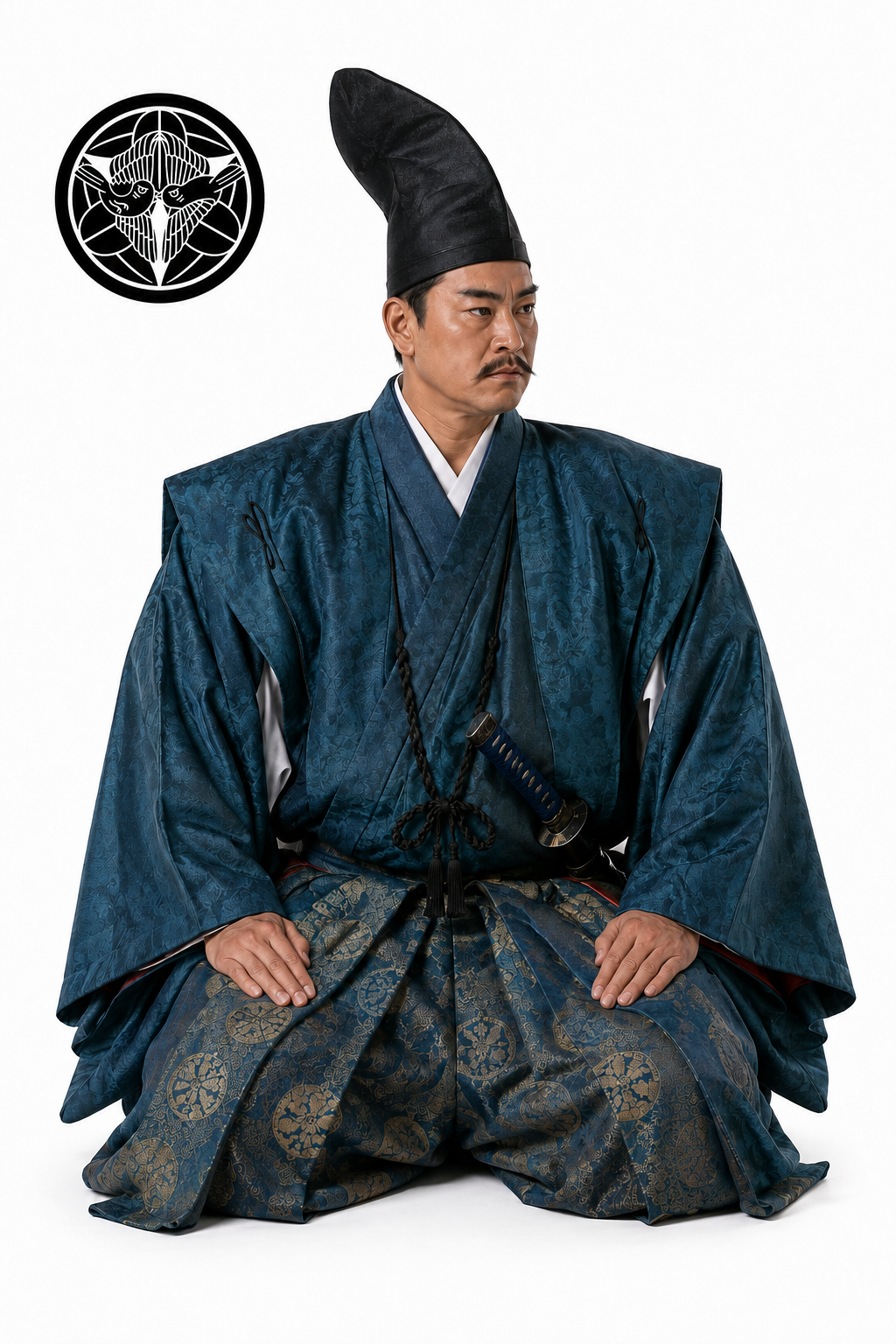
The Mogami clan was a branch of the Shiba clan, itself a branch of the Ashikaga. As the Ushū Tandai of the Muromachi shogunate, it was a house that oversaw the military and civil administration of Dewa Province; based at Yamagata Castle, it was a distinguished house permitted by the shogunate to style itself “Mogami Yakata.” Its crest was the Futabiki-ryō.
However, since Eishō 11 (1514), when the 9th head Mogami Yoshisada was crushingly defeated by Date Tanemune of Mutsu and lost Yamagata Castle, the Mogami house had been incorporated under the umbrella of the Date clan, and the Mogami kinsmen and local lords had strengthened their tendency toward independence. At the point when Yoshiaki inherited the headship, the Mogami house’s effective control was limited to the area around Yamagata Castle, and the confederation of branch-line local lords called the “Mogami Yatate” had come to hold power rivaling the head family.
First Battle and the Tenshō Mogami Disturbance — The Succession Dispute with His Father
In the 3rd month of Eiroku 3 (1560), Yoshiaki had his first battle in an attack on Sagae Castle. But this battle ended in failure. Although his father Yoshimori strove to recover independence from the Date clan, with the resistance of the clan and the intervention of outside powers, the Mogami house entered an age of turmoil.
From around Genki 1 (1570), the Mogami house split in two. Yoshimori favored his second son Mogami Yoshitoki and sought to pass the headship to him, coming into conflict with his eldest son Yoshiaki. By Genki 2 (1571), Yoshimori took the tonsure and passed the headship to Yoshiaki, but the faction backing Yoshitoki still remained.
This was the internal strife called the “Tenshō Mogami Disturbance,” in which Yoshiaki was forced into a battle surrounded on all sides — against his brother Yoshitoki, the kinsmen and local lords who supported his father, and Date Terumune (Masamune’s father), the husband of Yoshiaki’s younger sister Yoshihime (later Hoshun-in). Yoshiaki fought on tenaciously despite his small force, and in the end destroyed his brother Yoshitoki and seized control of the clan. This internal strife made the difficulty of governing the clan sink into Yoshiaki’s bones and became the soil for honing his later coolly calculating skill at subversion.
Kaminoyama and Tendō — The Road to the Unification of Southern Ushū
Having pacified the clan, Yoshiaki moved to battle with the local-lord powers around the Mogami domain. In Tenshō 6 (1578), he fought Kaminoyama Mitsukane at Kashiwagiyama — Mitsukane having invaded the Mogami domain with the support of Date Terumune — and repelled him. Two years later, in Tenshō 8 (1580), he turned Mitsukane’s retainers by subversion, had Mitsukane killed, and seized Kaminoyama Castle. It was a battle in which the true mettle of Yoshiaki’s subversive diplomacy appeared.
In Tenshō 12 (1584), he attacked the Maizuru Castle of Tendō Yorizumi, a Mogami branch family that held power rivaling the head family. But he was repulsed by the valiant fighting of Nobesawa Mitsunobu, one of the “Mogami Yatate.” Here Yoshiaki resorted not to force but to subversion, marrying his second daughter to Mitsunobu’s son Mitsumasa to form a kinship tie. With his greatest enemy drawn in through a marriage tie, Tendō Yorizumi was isolated. He fled from the castle, and with this the “Mogami Yatate” collapsed. Yoshiaki took the whole of Mogami District into his hands.
In Tenshō 14 (1586) he captured Oguni Castle, and in Tenshō 15 (1587) Sakenobe Castle. In the same year, while skillfully mediating friction with Tozawa Moriyasu and others in the northern part of Dewa Province, he expanded his sphere of power. The lord of Sakenobe Castle, Sakenobe Hidetsuna, was eventually received as Yoshiaki’s retainer and became a senior retainer who was active in the Keichō Dewa Campaign as well.
The Ōsaki Battle and His Sister Yoshihime’s “Palanquin Ceasefire”
In Tenshō 16 (1588), his nephew Date Masamune attacked Yoshiaki’s brother-in-law Ōsaki Yoshitaka (a kinship relation separate from Date Terumune, the husband of his sister Yoshihime). Yoshiaki dispatched a relief force to the Ōsaki and defeated the Date army. With the Mogami forces’ intervention, the Date army fell to a disadvantage, and the two armies came to face off at Nakayama (present-day Kaminoyama, Yamagata Prefecture).
At this time, Yoshiaki’s sister and Masamune’s mother, Yoshihime (later Hoshun-in), set her palanquin between the two armies herself to stop the war between her brother and her son and mediate a ceasefire. She is said to have stayed inside the palanquin for as long as 80 days, ultimately leading the two armies to a ceasefire. This is what is called the “palanquin ceasefire” or “Yoshihime’s mediation of the bridal entry.”
During this battle, Yoshiaki confided his dejection in a letter to Yoshihime, writing that “(because there is Date censorship, I cannot write my true feelings) — I cannot bring myself to write a letter to Yoshihime,” and after the ceasefire wrote, “peace is a disgrace, but thinking of you, it could not be helped.” The sibling love between Yoshiaki and Yoshihime was of an unusual depth for a warlord of the time, and is an important element in considering Yoshiaki’s character.
The Mogami Under the Toyotomi Regime — Joining at Odawara and the Confirmation of 240,000 Koku
In Tenshō 18 (1590), at Toyotomi Hideyoshi’s Odawara campaign, Yoshiaki applied to submit to Hideyoshi through Tokugawa Ieyasu and joined the campaign. By this the Mogami house entered the umbrella of the Toyotomi regime and obtained confirmation of its home territory of 240,000 koku (Yamagata in Dewa). On the other hand, the daimyō of Ōu who did not join the campaign were stripped of their domains or reduced in the Ōshū Settlement, so Yoshiaki’s judgment was a wise choice that saved the survival of the Mogami house.
Under the Toyotomi regime, Yoshiaki, while following the central government’s policies such as land surveys and the sword hunt, steadily advanced the governance of his domain. He devoted himself to developing river transport on the Mogami River, the construction of the Yamagata castle town, the promotion of commerce, and the like, realizing the stability and development of his domain.
The Tragedy of Komahime — The Hidetsugu Affair
In Bunroku 2 (1593), when the regent Toyotomi Hidetsugu made an inspection tour of the Ōshū Settlement, he stopped at Yamagata Castle and was taken with Yoshiaki’s second daughter, Komahime. Komahime was a beauty rated as “the foremost beauty of the eastern provinces,” and Hidetsugu strongly desired her as a concubine. Yoshiaki at first firmly declined, but pressed by Hidetsugu’s strong wishes, he promised to send her out once Komahime turned 15.
In the 7th month of Bunroku 4 (1595), Hidetsugu, suspected by Hideyoshi of rebellion, was driven to seppuku on Mount Kōya. This is what is called the “Hidetsugu Affair.” Hideyoshi handed down the harsh punishment of executing Hidetsugu’s wives, concubines, and children down to the whole clan and retainers. Komahime was on her very journey up to the capital to become a concubine, and met the fate of being dragged out to Sanjō-gawara in Kyoto.
Yoshiaki desperately pleaded for Komahime’s life through Tokugawa Ieyasu. Ieyasu too exerted himself, and at the last sent an envoy with a pardon on the day of execution, but it was not in time. Hideyoshi’s reply was cold: “If the punishment changes according to the rank of the father, the rule of government cannot stand.” Komahime was beheaded at Sanjō-gawara at just 15. It was the 2nd day of the 8th month of Bunroku 4 (1595).
Komahime’s mother (Yoshiaki’s legal wife, Lady Ōsaki) too died of illness that same month from her grief. Yoshiaki’s sorrow and hatred of Hideyoshi ran deep, and from then on Yoshiaki’s heart departed completely from the Toyotomi house and strengthened his inclination toward Tokugawa Ieyasu. Yoshiaki built a memorial pagoda for his daughter at Sanjō-gawara and also built a temple in the Yamagata castle town to mourn Komahime’s soul (Senshō-ji).
The Keichō Dewa Campaign (the “Sekigahara of the North”) — The Desperate Fight at Hasedō Castle
After Hideyoshi’s death in Keichō 3 (1598), the conflict between Ieyasu and Ishida Mitsunari came to the surface. In the 6th month of Keichō 5 (1600), when Ieyasu issued the order to subjugate Uesugi Kagekatsu of Aizu, Yoshiaki declared his participation in the Eastern Army without hesitation. Yoshiaki sent his heir Mogami Yoshiyasu to Ieyasu and took on the front line against the Uesugi.
In the 7th month of the same year, when Ieyasu canceled the Aizu subjugation owing to Mitsunari’s raising of troops and turned west to campaign, the 25,000-strong Uesugi army led by Uesugi Kagekatsu’s senior retainer Naoe Kanetsugu began an invasion of the Mogami domain in Dewa. Against them, the Mogami army numbered about 7,000, moreover dispersed among several castles such as Yamagata, Hataya, and Hasedō, with a main force of only about 4,000. It was an overwhelming difference in strength.
On the 12th day of the 9th month, the Uesugi army besieged the frontmost Hataya Castle. The castle commander Eguchi Mitsukiyo refused Yoshiaki’s order to withdraw and, resolved on annihilation, fought and perished together with 500 castle troops. Then, on the 14th day of the 9th month, the Uesugi army besieged the final line of defense, Hasedō Castle. The distance to Yamagata Castle was only 8 km, and it was a crisis in which, if this were broken, Yamagata would fall.
Defending Hasedō Castle was Yoshiaki’s senior retainer Shimura Mitsuyasu. With only 1,000 troops, he met the 25,000-strong Uesugi army. Repelling the Uesugi army in a frontal attack on the 15th day of the 9th month, the next day, the 16th, he launched a night raid with a death-defying band of 200 men and achieved the feat of provoking friendly-fire confusion in the Uesugi forces. On the 18th day of the 9th month, the deputy commander Sakenobe Hidetsuna drove back the Uesugi army with 100 mounted men and a gun corps.
On the 21st day of the 9th month, at the repeated urging of Yoshiaki’s sister Yoshihime (Hoshun-in), his nephew Date Masamune dispatched a relief force of 3,000 led by Rusu Masakage. On the 25th day of the 9th month, Yoshiaki himself sortied from Yamagata Castle and took position at Inarizuka. On the 29th day of the 9th month, the Uesugi army carried out a general assault, but Hasedō Castle did not fall. Shimura Mitsuyasu achieved the great feat of killing the Uesugi general Kamiizumi Yasutsuna.
On the same day (the 29th day of the 9th month), word reached Naoe Kanetsugu that Ishida Mitsunari had been defeated at Sekigahara. On the 1st day of the 10th month, Kanetsugu decided to withdraw. Yoshiaki persistently pursued the withdrawing Uesugi army and inflicted great losses upon it. It was a fierce battle in which Yoshiaki himself, at the head of his troops, took a bullet to his helmet (that helmet survives and is preserved at the Mogami Yoshiaki Museum of History in Yamagata City).
The Increase to 570,000 Koku — The Mogami House’s Zenith
For his service in the Keichō Dewa Campaign, Yoshiaki was granted by Ieyasu 570,000 koku, including the three districts of Shōnai in Dewa and Yuri District. This was one of the largest increases at Sekigahara, and the Mogami house became a great daimyō among the foremost of the Tōhoku. Ieyasu praised Yoshiaki as the “Ieyasu of the North” and gave him the highest evaluation: “if Yoshiaki had not held off Naoe, there would have been no victory at Sekigahara either.”
Having become lord of 570,000 koku, Yoshiaki set about a great renovation of his base, Yamagata Castle. He expanded it into one of the largest castle complexes in the Tōhoku, equipped down to the third enclosure. In the castle town he developed commerce making use of river transport on the Mogami River, and developed Yamagata as a center of safflower production. Yoshiaki was also enthusiastic about protecting the shrines and temples of his domain, and his faith in the Three Mountains of Dewa (Mount Gassan, Mount Haguro, Mount Yudono) was deep.
The Tragedy of His Heir Yoshiyasu and the Succession Problem
What became the greatest tragedy of Yoshiaki’s late years was the death of his heir Mogami Yoshiyasu. In the 8th month of Keichō 8 (1603), Yoshiyasu was assassinated by someone. He was 28. Behind it is said to have been a factional struggle within the body of retainers, between those backing Yoshiaki’s eldest son (Yoshiyasu) and his second son (Iechika). From his career as a hostage of Hideyoshi, Yoshiyasu was seen as of the Toyotomi faction, while Iechika, with his career as a hostage of Ieyasu, was seen as of the Tokugawa faction.
The truth of Yoshiyasu’s assassination is still subject to multiple theories, ranging from assassination by the Iechika faction to the theory that Yoshiaki himself carried it out over the succession problem (see Theory 5). Yoshiaki’s sorrow was deep, and his thoughts of Yoshiyasu are recorded repeatedly even in his later letters. In the end the headship was decided on the second son, Mogami Iechika, but this became a remote cause of the later abolition of the Mogami house.
Late Years and Death
In Keichō 18 (1613), Yoshiaki retired and passed the headship to Iechika. The next year, on the 18th day of the 1st month of Keichō 19 (February 26, 1614), Yoshiaki died of illness at Yamagata Castle. He was 69. The cause of death is not clearly recorded, but a long period of ill health is recorded, and it is conjectured that mental strain and the worsening of a chronic ailment acted in combination.
The funeral was held at Kōzen-ji in the Yamagata castle town, and Yoshiaki was buried at that temple. Kōzen-ji still exists today within Yamagata City and is known as the grave site of Mogami Yoshiaki.
After Yoshiaki’s death, the Mogami house rapidly walked the road to collapse. It was not in time for the Ōsaka campaign of Keichō 20 (1615), but after Iechika succeeded, Iechika died suddenly in Genna 3 (1617). Further, the grandson Mogami Yoshitoshi succeeded to the headship while still a child, and the factional struggle of the body of retainers intensified. In Genna 8 (1622), the Tokugawa shogunate handed down a sentence of abolition against the Mogami house, and the great 570,000-koku daimyō Mogami house was destroyed only eight years after Yoshiaki’s death. This is what is called the “Mogami Disturbance.”
Thus the 570,000-koku domain left by the famed general Mogami Yoshiaki was lost. But the streets of the Yamagata castle town that Yoshiaki built, the economic base of Mogami River transport, and the promotion of the safflower industry supported Yamagata’s prosperity throughout the Edo period and became the foundation of the urban structure of present-day Yamagata City.
Multiple Theories — Exploring Possibilities from Various Angles
Theory 1: The Two Faces of “Lord Salmon” and the “Schemer”
Mogami Yoshiaki’s character has two contrasting faces: the “coolly calculating schemer” depicted by Edo-period war chronicles, and the affectionate figure called “Lord Salmon,” beloved by his retainers and kinsmen. There are several views on the interpretation of this duality.
[Basis of the “schemer” image]: War chronicles compiled in the Edo period, such as the Ōu Eikei Gunki and the Tōgoku Taiheiki, depict Yoshiaki as a “schemer of peerless cruelty.” The episodes cited as concrete grounds are:
- The purge of his brother Mogami Yoshitoki (the Tenshō Mogami Disturbance)
- The subversion that isolated Tendō Yorizumi through marriage
- The stratagem of having Kaminoyama Mitsukane killed by subverting a retainer
- The theory of his involvement in the assassination of his heir Yoshiyasu (Theory 5)
These are indeed examples of scheming intrigue and show that Yoshiaki was a man capable of cool political judgment.
[The real image of the “Lord Salmon” episodes]: On the other hand, Yoshiaki was fond of salmon and had a habit of frequently giving salmon to his retainers, family, kinsmen, and even political enemies. He is said to have been called “Lord Salmon” by his retainers with affection. There is even an anecdote that when Yoshiaki gained the Shōnai region in the war with the Daihōji clan, he rejoiced, “now we can catch salmon in great quantity.” He continued to give salmon to Tokugawa Ieyasu and Date Masamune as well, and this helped maintain his relations with both.
[A side as a cultured man]: Yoshiaki was also a cultured man who enjoyed waka and renga. The exchange of waka with his sister Yoshihime, the waka exchange with Masamune at Komahime’s birth, and so on — he had high cultural cultivation for a warlord. He had exchanges with Kyoto court nobles as well, and was a man connected to central culture rather than a rustic daimyō of Dewa.
[The image of an affectionate father]: Yoshiaki’s wailing after Komahime’s execution, his deep love for his heir Yoshiyasu, his attentiveness to his retainers — these are the very opposite of the image of a “cold-hearted schemer.” Analyzing Yoshiaki’s letters, deep affection for his children, his retainers, and his sister seeps through everywhere, showing that in character he was a man of warmth.
The historian Katagiri Shigeo (former director of the Mogami Yoshiaki Museum of History) analyzes that “Yoshiaki’s ‘schemer’ image was formed by the embellishment of Edo-period war chronicles, and his real image was that of a warlord who had cultural cultivation and deeply loved his family and retainers.” A man who possessed the subversion and coolness necessary as a Sengoku daimyō, yet was warm in character — this is the view of modern research. “Lord Salmon” and the “schemer” do not contradict each other but should be understood as showing the many sides of a Sengoku daimyō.
Theory 2: The Truth of the Tenshō Mogami Disturbance and the Purge of His Brother Yoshitoki
There are several interpretations of the “Tenshō Mogami Disturbance” (Genki to early Tenshō), the greatest ordeal in the process by which Yoshiaki established the headship, and its outcome, the purge of his brother Mogami Yoshitoki.
[Succession-dispute view (traditional)]: Father Mogami Yoshimori favored his second son Yoshitoki and sought to pass the headship to him, coming into conflict with Yoshiaki. Yoshiaki won through the internal war, killed Yoshitoki, and established the headship. The most standard interpretation, understood as a typical internal strife over Sengoku-period succession.
[Date Terumune intervention view]: The theory that Date Terumune, husband of Yoshiaki’s sister Yoshihime, took the side of the Yoshitoki faction in order to weaken the Mogami house. At the time, the Date had the intention of keeping the Mogami house under the Date umbrella and were wary of Yoshiaki’s tendency toward independence. In this case, the Tenshō Mogami Disturbance was not a mere internal clan problem but had the aspect of a proxy war of the Date vs. the Mogami.
[Mogami Yatate / local-lord initiative view]: The theory that the main body of the Yoshitoki faction was the Mogami Yatate and local lords who wished the weakening of the head family. Yoshimori and Yoshitoki were rather in the position of being propped up, and Yoshiaki’s establishment of the headship had a large aspect of “victory over the Mogami Yatate.” In this view, the Tenshō Mogami Disturbance was a fundamental reorganization of the power structure within the Mogami house.
[Reappraisal of Yoshimori’s role view]: It is also pointed out that father Yoshimori may not simply have doted on his second son, but, worried about Yoshiaki’s tendency toward independence and the deepening conflict with the Date, backed the more moderate Yoshitoki. Yoshimori retained influence even after retirement and did not fully retire even after Yoshiaki inherited the headship. The relationship between father and son may not have been a mere quarrel but a clash of lines over the Mogami house’s external strategy.
[Dispute over the timing of Yoshitoki’s purge]: Regarding the timing of Yoshitoki’s death, sources record differently. The Genki-era theory, the Tenshō-era theory, and even the theory that he reconciled with Yoshiaki and later died of illness — it is not settled. The image of Yoshiaki as “a cold-hearted elder brother who killed his own younger brother” may have been amplified in later war chronicles.
Historians such as Endō Yuriko (Tōhoku University) position the Tenshō Mogami Disturbance as “a standard internal strife as a Sengoku daimyō’s succession process” and reject the view of singling out Yoshiaki’s “fratricide” as especially cold-hearted. The view of modern research is that, compared with contemporary Sengoku daimyō (Takeda Shingen’s expulsion of Nobutora, Mōri Motonari’s purge of Aimochi Motozuna, etc.), Yoshiaki’s response cannot be called outstandingly cruel.
Theory 3: The Impact of the Komahime Execution
The execution of Komahime in Bunroku 4 (1595) was the greatest tragedy of Yoshiaki’s life and at the same time an important turning point that determined the Mogami house’s political line. There are several interpretations of this event’s historical impact.
[Hatred of Hideyoshi → decision to join the Eastern Army view (conventional)]: The most widely known interpretation, that through Komahime’s execution Yoshiaki came to hate Hideyoshi and sided with the Eastern Army at Sekigahara without hesitation. It holds that Yoshiaki deepened his trust in Ieyasu through the plea for Komahime’s life, and that his approach to Ieyasu after Hideyoshi’s death became decisive. The Mogami house’s joining of the Eastern Army at Sekigahara was an inevitable choice in the extension of the Komahime affair.
[Political-realism view]: The theory that, while the Komahime affair certainly left Yoshiaki a deep wound, the main cause of joining the Eastern Army at Sekigahara was not only that, but compound factors — the conflict with Uesugi Kagekatsu, the geopolitical approach owing to Ieyasu’s transfer to the Kantō, and a realistic judgment aimed at the security of the Mogami domain. The Komahime affair determined Yoshiaki’s feelings, but joining the Eastern Army itself was a rational judgment as a Sengoku daimyō.
[The meaning of Yoshiaki’s silence]: Immediately after Komahime’s execution, Yoshiaki took no overt protest or anti-Hideyoshi action. This was a calm judgment that prioritized the survival of the Mogami house. While Hideyoshi lived, he feigned obedience on the surface, and while harboring deep resentment within, he cautiously deepened his relationship with Ieyasu. The view that this very “silent protest” shows Yoshiaki’s political maturity.
[Impact on the body of retainers and the clan]: Komahime’s execution gave a deep shock to the Mogami clan as well. An air of doubting loyalty to the Toyotomi house under the Toyotomi regime spread, and the inclination toward Ieyasu became the choice not only of Yoshiaki but of the whole clan. In this sense, the Komahime affair, beyond “an individual tragedy,” was an event that determined the political identity of the whole Mogami house.
[Modern Komahime devotion]: Temples enshrining Komahime, such as Senshō-ji in Yamagata City and Zuisen-ji in Kyoto, still gather many worshippers. The tragedy of a beautiful girl who perished at 15 continues to gather people’s sympathy even 400 years on. The memory of Yoshiaki devoting his whole life and heart to his daughter’s memorial is handed down as a regional culture of Yamagata.
Historians such as Kobayashi Seiji evaluate that “the Komahime affair became a decisive turning point both for Yoshiaki individually and for the whole Mogami house.” There is no doubt that, in the whole chain of the meaning of the silence right after the affair, the formation of trust in Ieyasu, and the joining of the Eastern Army at Sekigahara, the Komahime affair was a grave event that determined the history of the Mogami house.
Theory 4: The Truth of the Battle of Hasedō Castle and Naoe Kanetsugu’s Withdrawal
The Battle of Hasedō Castle in the 9th month of Keichō 5 (1600) and the subsequent withdrawal of Naoe Kanetsugu are known as the greatest military feat of Mogami Yoshiaki’s life. But there are several views on the reasons for the Uesugi army’s withdrawal and the reality of the fighting.
[Withdrawal owing to the Mogami army’s valiant fighting view (traditional)]: The view that, owing to the heroic valiant fighting of the Mogami body of retainers, beginning with Shimura Mitsuyasu who defended Hasedō Castle, the Uesugi army took unexpected losses and gave up the conquest and withdrew. The feats — Eguchi Mitsukiyo’s annihilation at Hataya Castle, the 200-man death-band night raid at Hasedō Castle, the killing of Kamiizumi Yasutsuna — are taken as showing the Mogami army’s good fight. In the Mogami house’s traditional historical narrative, this interpretation is central.
[Withdrawal owing to the Sekigahara report view (the leading modern view)]: The theory that on the 29th day of the 9th month, word reached Naoe Kanetsugu that Ishida Mitsunari had been defeated at Sekigahara, and the Uesugi army, having lost its strategic objective, decided to withdraw. Hasedō Castle did resist stubbornly, but against the 25,000-strong Uesugi army the Mogami were a small force, and there is a high possibility that, had the fighting continued, Hasedō would have fallen. The decisive factor in the withdrawal was less the Mogami army’s valiant fighting than the change in the strategic environment. Historians such as Hongō Kazuto support this view.
[Synthesis of both views]: It is apt to see that in fact both factors combined. Owing to the Mogami army’s valiant fighting, the Uesugi army could not advance as planned and wasted time at Hasedō, and in that interval Sekigahara was decided and they were forced to withdraw. Without the valiant fighting of Shimura Mitsuyasu and others, there is a high possibility that Yamagata Castle would have fallen before the Sekigahara report arrived. The eclectic view that the Mogami army’s feats held decisive significance.
[Evaluation of Yoshiaki’s pursuit]: Against the withdrawing Uesugi army, Yoshiaki carried out a persistent pursuit. It was a fierce battle in which Yoshiaki himself, at the head of his troops, took a bullet to his helmet. In this pursuit the Uesugi army took yet greater losses. On the other hand, Naoe Kanetsugu’s withdrawal command as a “master of the rear guard” is also rated highly, and the Uesugi army escaped annihilation. It was a battle in which the two commanders’ ability was evenly matched.
[The reason it was called “the withdrawal battle that even demons wept over”]: Naoe Kanetsugu’s Hasedō withdrawal battle was handed down to later ages as one of the finest withdrawal battles of the Sengoku period. Kanetsugu’s command ability, succeeding in a large-scale withdrawal that should ordinarily have caused great losses with minimal losses, is said to have been praised even by Ieyasu and Honda Tadakatsu. Yoshiaki’s pursuit too was extremely persistent, but with Kanetsugu’s splendid command the Uesugi army maintained an organized withdrawal.
[The postwar relationship of Yoshiaki and Kanetsugu]: After the war, Yoshiaki and Kanetsugu unexpectedly maintained a friendly relationship. There is the episode that Yoshiaki agreed to Kanetsugu’s request to “please return the guns,” and exchanges of waka between the two are handed down. It is taken as showing the dignity of warriors who, while enemy generals, recognized each other’s ability.
The Battle of Hasedō Castle was, for Yoshiaki, the greatest ordeal and the greatest victory of his life. This battle, in which he repelled a great army with a small force, controlled the Sekigahara of the Tōhoku, and which became the driving force for gaining 570,000 koku, was the event that showed the world Yoshiaki’s true worth as a Sengoku warlord.
Theory 5: Theories on the Assassination of His Heir Yoshiyasu
The assassination of Yoshiaki’s heir Mogami Yoshiyasu at the young age of 28 in the 8th month of Keichō 8 (1603) is one of the greatest mysteries of the Mogami house. There are multiple theories about the perpetrator and the mastermind, and it is still not settled.
[Assassination by the Iechika faction view (traditional)]: The theory that the body of retainers backing Yoshiaki’s second son Mogami Iechika assassinated Yoshiyasu over the succession. From his experience as a hostage of Hideyoshi, Yoshiyasu was seen as of the “Toyotomi faction,” in a structure of conflict with Iechika, who had experience as a hostage of Ieyasu. The retainer Satomi Echigo-no-kami and others are named as the perpetrators.
[Yoshiaki-involvement view]: Some Edo-period war chronicles record the shocking theory that Yoshiaki himself was involved in Yoshiyasu’s assassination. The interpretation that, as the factional conflict within the clan grew serious, Yoshiaki, as an agonizing decision, eliminated Yoshiyasu to make “the succession of the headship to Iechika” certain. However, the grounds for this theory are thin, and modern research often views it negatively.
[Accidental-assassination view]: The theory that Yoshiyasu’s assassination was not an organized plan but an accidental incident by individuals such as the retainer Satomi Echigo-no-kami. The factional conflict within the clan was in the background, but it was not the work of a specific mastermind.
[Testimony of Yoshiaki’s grief]: From Yoshiaki’s letters and words and deeds after Yoshiyasu’s death, that Yoshiaki grieved deeply can be confirmed in several sources. There is no doubt that Yoshiaki was a father who loved Yoshiyasu from the heart, and this contradicts the “Yoshiaki-involvement view.” Yoshiaki devoted his heart and soul to building a temple and holding memorials to mourn Yoshiyasu.
[Impact on Iechika and Ieyasu]: With Yoshiyasu’s assassination, the successor to the headship became the second son, Iechika. Iechika was a man who had received a granted character of a name from Tokugawa Ieyasu and was clearly of the “Tokugawa faction.” By this the Mogami house’s incorporation into the Tokugawa shogunate system became certain, but the factional conflict within the clan continued beneath the surface and became a remote cause of the later “Mogami Disturbance.”
The historian Katagiri Shigeo analyzes that “the Yoshiaki-involvement view has thin documentary grounds and cannot be supported in modern research. It is apt to see it as an assassination by retainers of the Iechika faction.” The truth of Yoshiyasu’s assassination can only await the discovery of new sources, but it is certain that Yoshiaki was deeply wounded by the death of his beloved son.
Theory 6: The Causation of the Mogami Disturbance and the Abolition of 570,000 Koku
Only eight years after Yoshiaki’s death, the 570,000-koku Mogami house was sentenced to abolition by the Tokugawa shogunate. There are several views on the causes of this series of house disturbances called the “Mogami Disturbance” of Genna 8 (1622).
[Structural-problem-of-the-retainer-coalition view]: The Mogami house expanded rapidly in Yoshiaki’s generation, but its substance remained a “coalition of local magnates,” unable to establish a master-servant relationship of absolute obedience. The view that the coalition body, barely held together by Yoshiaki’s powerful leadership, lost its cohesive power with Yoshiaki’s death, and the factional struggle of the body of retainers came to the surface all at once. It holds that the failure to make the transition from a Sengoku-type magnate coalition to an early-modern daimyō house was the root cause.
[Too-early deaths of Yoshiaki and Yoshiyasu view]: With the assassination of the heir Yoshiyasu (1603), Yoshiaki’s own death (1614), and the subsequent sudden death of the second son Iechika (1617) occurring in succession, the Mogami house continued to lose powerful leaders. Iechika’s son Mogami Yoshitoshi was forced to take the headship at a young age and could not control the clan. The theory that the failure of generational succession was the greatest cause.
[Deepening of retainer-faction conflict view]: The retainer-faction conflict latent since Yoshiaki’s generation intensified through the generational changes. It became a factional struggle in which the Iechika faction, the Matsune Mitsuhiro faction, and other factions were entangled, and even when the shogunate stepped in to mediate it did not subside. In the end the shogunate gave up on the Mogami house’s capacity for self-governance and handed down a sentence of abolition.
[Tokugawa shogunate intent view]: The theory that the Tokugawa shogunate handed down the abolition with the intent of weakening the powerful Tōhoku daimyō, the Mogami house. The 570,000-koku Mogami house was one of the largest daimyō in the Tōhoku and a potential threat for the shogunate. The view that there was a political intent to reorganize the balance of power in the Tōhoku by abolishing it on the pretext of internal confusion.
[Limit-of-Yoshiaki’s-organizational-system view]: Yoshiaki expanded his power through subversion and marriage but could not recast the body of retainers into a master-servant relationship of absolute obedience. This was less an individual limit of Yoshiaki than a common task of the Tōhoku houses in the transitional period from Sengoku daimyō to early-modern daimyō. The daimyō who could maintain their domains under the Toyotomi and Tokugawa regimes (the Date, the Uesugi, etc.) suppressed internal factional struggle early and established an early-modern domain system. The view that the Mogami house failed at this.
The historian Endō Yuriko analyzes that “the cause of the Mogami Disturbance lies in the inability to convert the Sengoku-type magnate-coalition system into an early-modern domain system. Yoshiaki was an excellent leader as a Sengoku daimyō, but his successors did not have the power to solve that task.” That the 570,000 koku Yoshiaki built vanished in just eight years was an event symbolizing the end of the Sengoku age and the difficulty of the transition to the early-modern era.
Viewed Strategically — Yoshiaki’s Politics, Military, and Domain Governance
An Exquisite Balance of Subversion and Force
The greatest characteristic of Yoshiaki’s strategy was that he expanded his power by exquisitely combining force and subversion. Looking at concrete battle cases:
- The Kaminoyama Mitsukane battle (1580): turned Mitsukane’s retainers, had Mitsukane killed, and gained Kaminoyama Castle.
- The Tendō Yorizumi battle (1584): after being repulsed in a frontal attack, drew in the enemy’s leading figure Nobesawa Mitsunobu through marriage and isolated Yorizumi.
- The Sakenobe Hidetsuna battle (1587): after the surrender, received the enemy general as a leading retainer.
- The Ōsaki battle (1588): a diplomatic resolution through dispatching relief against the Date army and his sister Yoshihime’s ceasefire mediation.
These are typical examples of Yoshiaki’s style of strategy: “winning without fighting” and “pardoning and drawing in those who surrender.” He can be called a typical “realist Sengoku daimyō” ranking with Tokugawa Ieyasu and Mōri Motonari.
Building Diplomatic and Marriage Networks
Amid the complex distribution of powers in the Tōhoku, Yoshiaki built a skillful marriage network:
- Married his sister Yoshihime to Date Terumune to form a kinship tie with the Date (the foreshadowing of the later palanquin ceasefire).
- Married his second daughter to Nobesawa Mitsumasa to isolate Tendō Yorizumi.
- Made his daughter Komahime a concubine candidate for Hidetsugu (the result ended in tragedy).
- Married his daughters to local lords of the region to strengthen the integration of the clan.
These marriage ties are an expression of Yoshiaki’s political skill in integrating the clan and surrounding powers through blood ties. At the same time, as in the Komahime affair, marriage could also call forth tragedy.
The Innovativeness of His Domain Governance
Yoshiaki’s domain governance was, for the time, extremely advanced:
- Construction of the Yamagata castle town: developed one of the largest castle towns in the Tōhoku, equipped down to the third enclosure, as the base of 570,000 koku.
- Development of Mogami River transport: made use of river transport on the Mogami River connecting Yamagata and the Sea of Japan, promoting the distribution of specialty goods such as safflower.
- Promotion of the safflower industry: Yamagata safflower became a key industry occupying a 60% national share throughout the Edo period.
- Commerce-emphasizing policy: protected the merchant quarter of the Yamagata castle town and activated the market economy.
- Protection of shrines and temples: emphasized faith in the Three Mountains of Dewa (Mount Gassan, Mount Haguro, Mount Yudono) and realized coexistence with religious powers.
After Yoshiaki’s death the Mogami house was abolished, but the urban infrastructure and industrial structure he built continued to support Yamagata’s prosperity throughout the Edo period. The street plan of present-day Yamagata City’s central and downtown districts too is based on the urban planning of Yoshiaki’s time.
An Eye That Read the Times — From the Toyotomi to the Tokugawa
What should be especially noted as Yoshiaki’s strategic eye is the political judgment that accurately read the current of the times:
- Joining at Odawara in 1590: while the daimyō of Ōu hesitated to join, on Ieyasu’s advice he joined swiftly and secured confirmation of his domain.
- Silence after the Komahime affair in 1595: he restrained emotional anti-Hideyoshi action and cautiously deepened his relationship with Ieyasu.
- Joining the Eastern Army at Sekigahara in 1600: he sided with Ieyasu without hesitation and, with victory in the Keichō Dewa Campaign, gained 570,000 koku.
These can be called a model of political judgment that, in the turbulent period at the end of the Sengoku, discerned the trend of the times and realized the survival and development of the house. Date Masamune of the same Tōhoku also skillfully read the trend, but Yoshiaki continued to make more cautious and steady choices.
Strategic Limits — The Failure of Succession and Clan Integration
Despite possessing such talent, there were tasks Yoshiaki could not solve:
- Factional conflict within the clan: he could not convert the magnate-coalition system into a master-servant relationship of absolute obedience.
- The early death of successors: with the assassination of his heir Yoshiyasu and the sudden death of his second son Iechika, generational succession was not stable.
- Lateness in becoming an early-modern daimyō: the transition from Sengoku-type domain governance to domain administration under the Tokugawa shogunate system was incomplete.
- The strength of retainers’ local and blood ties: after Yoshiaki’s death, the retainers’ tendency toward independence strengthened and became uncontrollable.
That the Mogami house was abolished just eight years after Yoshiaki’s death shows that these structural problems had merely been barely held down by Yoshiaki’s great ability. The 570,000-koku Mogami house Yoshiaki built vanished without achieving institutional maturity as an early-modern daimyō.
Famous Words and Sayings of This Warlord
“Lord Salmon”
The nickname by which Yoshiaki’s retainers called him with affection. It derives from the fact that Yoshiaki was fond of salmon and had a habit of frequently giving salmon to his retainers, family, kinsmen, and even political enemies. He continued to give salmon to Tokugawa Ieyasu and Date Masamune as well, and this helped maintain his relations with both. His remark when he gained the Shōnai region, “now we can catch salmon in great quantity,” is handed down as an anecdote showing Yoshiaki’s plain personality.
“Peace is a disgrace, but thinking of you, it could not be helped”
The words Yoshiaki recorded in a letter to his sister Yoshihime (Hoshun-in) after he accepted the mediation of her “palanquin ceasefire” following the Ōsaki battle of Tenshō 16 (1588). They well express the feelings of a Yoshiaki torn between his face as a warlord and his love for his sister. The source is the body of letters related to the Mogami and Date houses.
“If the punishment changes according to the rank of the father, the rule of government cannot stand” (Hideyoshi’s reply)
Toyotomi Hideyoshi’s cold reply to Yoshiaki, who had pleaded for Komahime’s life in Bunroku 4 (1595). These are not Yoshiaki’s words, but as words that carved a decisive wound and hatred into Yoshiaki’s heart, they are deeply engraved in the history of the Mogami house. After this one affair, Yoshiaki’s heart departed from the Toyotomi house and strengthened his inclination toward Tokugawa Ieyasu.
“The Ieyasu of the North” / “Without Yoshiaki there would have been no victory at Sekigahara”
The words said to have been given to Yoshiaki by Tokugawa Ieyasu in praise of his service in the Keichō Dewa Campaign. It is the highest evaluation: that Yoshiaki’s work in holding off the Uesugi army led by Naoe Kanetsugu with a small force made the victory at the main Battle of Sekigahara possible. The source is the Tokugawa Jikki and others.
“Unflinching Even at a Bullet to the Helmet”
The tradition of when Yoshiaki himself took command at the head of his troops in the Battle of Hasedō Castle and took a bullet to his helmet. Yoshiaki is said to have carefully preserved the helmet with the bullet mark as “proof of military merit” and handed it down to his descendants. This helmet survives and is housed at the Mogami Yoshiaki Museum of History in Yamagata City (a prefecturally designated tangible cultural property). It is a physical source showing Yoshiaki’s backbone as a warrior.
Anecdotes and Episodes
The Granted Name from Ashikaga Yoshiteru
In Eiroku 3 (1560), the 15-year-old Yoshiaki, on coming of age, received a granted character of a name (henki — receiving one character of the shogun’s name) from Ashikaga Yoshiteru, the 13th shogun of the Muromachi shogunate, and took the name “Yoshiaki.” It is an event showing that the Mogami house, as a distinguished house of the Ushū Tandai, kept up its connection with the Muromachi shogunate. Among the warlords who likewise received a granted name from Yoshiteru is Uesugi Kenshin (Terutora), the adoptive father of Uesugi Kagekatsu.
The Waka Exchange with Masamune
Yoshiaki had exchanges with his nephew Date Masamune through waka. In celebration of the birth of his second daughter Komahime, a waka is said to have been sent from Masamune to Yoshiaki, with the sense: “Longing only deepens in autumn — the moon hidden among the trees, by the akoya pine of Chitose-yama” (Masamune). To this Yoshiaki replied in kind: “If you long for it, come and seek it — the moon hidden among the trees, by the akoya pine of Chitose-yama.” Yoshiaki and Masamune often clashed politically, but they were also an uncle and nephew who shared cultural cultivation.
The Origin of Komahime’s Name
Yoshiaki’s wife said she wished to name their daughter “Chitose,” after the waka sent from Masamune on the day of the daughter’s birth. But Yoshiaki said that since the “Chitose,” daughter of Abe no Sadatō, had destroyed her father and mother, it was an ill-omened name, and did not adopt it; he is said to have named her “Okoma” after the famous mountain of Dewa, “Okomayama.” Ironically, Komahime would meet the tragedy of being executed at 15.
The Komahime Memorial Pagoda at Sanjō-gawara
After Komahime’s execution, Yoshiaki built a memorial pagoda at Sanjō-gawara in Kyoto. Later, on this ground Zuisen-ji was built as the grave site of the Toyotomi Hidetsugu clan, and Komahime’s grave is included here. Yoshiaki also built Senshō-ji in the Yamagata castle town to mourn Komahime’s soul. Senshō-ji still exists in Yamagata City today, and worshippers remembering Komahime never cease. It is a historic site showing the depth of Yoshiaki’s love for his daughter.
The War Fan of the Battle of Hasedō Castle
The gunbai war fan said to have been used by Yoshiaki in the Battle of Hasedō Castle is still housed at the Mogami Yoshiaki Museum of History in Yamagata City. It is a relic symbolizing the military merit of Yoshiaki, who took command at the head of his troops amid the fierce battle. The same museum also houses many precious materials, including Yoshiaki’s helmet (with a bullet mark) and the folding screen depicting the Battle of Hasedō.
The Postwar Exchange of Yoshiaki and Kanetsugu
After the Keichō Dewa Campaign, Naoe Kanetsugu, who had been the enemy general, and Yoshiaki unexpectedly maintained a friendly relationship. When Kanetsugu requested of Yoshiaki, “please return the guns seized on the battlefield,” Yoshiaki is said to have readily agreed. An episode showing the dignity of warriors who, even as enemy generals, recognized each other’s ability as warriors. Between Yoshiaki and Kanetsugu, exchanges of waka are also handed down to have often taken place after the war.
Development of Mogami River Transport
Yoshiaki put effort into developing Mogami River transport as the economic base of his domain. He repaired the difficult points of the Mogami River and secured water transport from Yonezawa upstream to Sakata on the Sea of Japan. By this, even inland Yamagata could connect with the economic sphere of the Sea of Japan and the Kamigata, and could ship specialty goods such as safflower nationwide. This economic base supported Yamagata’s prosperity throughout the Edo period and continued after the Meiji era as well.
Trust in the Retainer Shimura Mitsuyasu
Shimura Mitsuyasu, who held Hasedō Castle to the death, was a senior retainer who received Yoshiaki’s absolute trust. Mitsuyasu was originally a hereditary retainer serving since the generation of Yoshiaki’s father Yoshimori, and was entrusted with command of the front line as lord of Hasedō Castle. After the Keichō Dewa Campaign, Yoshiaki praised Mitsuyasu’s service and greatly increased his territory. Behind Yoshiaki being beloved as “Lord Salmon” was such a relationship of deep trust with his retainers.
Yearning for His Heir Yoshiyasu
The assassination of his heir Yoshiyasu in Keichō 8 (1603) was the greatest grief of Yoshiaki’s life. After Yoshiyasu’s death, Yoshiaki often wrote of this son in his letters and words, expressing his sorrow. To mourn Yoshiyasu’s soul, Yoshiaki built Engaku-ji in the Yamagata castle town. It is a historical fact showing the depth of Yoshiaki’s family love.
Faith in the Three Mountains of Dewa in His Late Years
In his late years, Yoshiaki deepened his faith in the Three Mountains of Dewa (Mount Gassan, Mount Haguro, Mount Yudono). These mountain faiths were the support of the hearts of the people of the Tōhoku, and Yoshiaki, as lord, protected and developed the three mountains. Treasures and documents donated by Yoshiaki are still handed down at the Three Mountains of Dewa. Yoshiaki’s religious outlook reflects the many sides of a man who combined the fierceness of a warrior with the calm of a cultured man.
Timeline
| Japanese Era (Western Year) | Age | Event |
|---|---|---|
| Tenbun 15 (1546) | 1 | Born on the 1st day of the 1st month at Yamagata Castle in Dewa Province. Father Mogami Yoshimori, mother a daughter of Ono Shōshō. Childhood name Hakujumaru. |
| Eiroku 3 (1560) | 15 | Comes of age. Receives a granted character of a name from the 13th Muromachi shogun Ashikaga Yoshiteru and takes the name “Yoshiaki.” In the 3rd month, first battle at the attack on Sagae Castle (a failure). |
| Genki 2 – early Tenshō (1571–) | 26– | The Tenshō Mogami Disturbance. A struggle with the clan faction centered on his father Yoshimori and his brother Yoshitoki. Yoshimori takes the tonsure; Yoshitoki is purged. The headship is established. |
| Tenshō 6 (1578) | 33 | Battle of Kashiwagiyama. Repels Kaminoyama Mitsukane, who invaded with Date Terumune’s support. |
| Tenshō 8 (1580) | 35 | Turns Kaminoyama Mitsukane’s retainers by subversion, has Mitsukane killed, and seizes Kaminoyama Castle. |
| Tenshō 12 (1584) | 39 | Attacks Tendō Yorizumi’s Maizuru Castle. Repulsed by Nobesawa Mitsunobu’s valiant fighting, but marries his second daughter to Mitsunobu’s son to form a kinship tie. The Mogami Yatate collapses; he subdues the whole of Mogami District. |
| Tenshō 16 (1588) | 43 | The Ōsaki battle. Dispatches relief in his nephew Date Masamune’s attack on the Ōsaki. His sister Yoshihime’s (Hoshun-in’s) “palanquin ceasefire” halts the war between brother, son, and nephew. |
| Tenshō 18 (1590) | 45 | Joins Toyotomi Hideyoshi’s Odawara campaign (on Ieyasu’s advice). Confirmation of his home territory of 240,000 koku. Enters the Toyotomi regime. |
| Bunroku 2 (1593) | 48 | The regent Toyotomi Hidetsugu stops at Yamagata Castle and is taken with the second daughter Komahime. Yoshiaki promises a bridal entry at age 15. |
| Bunroku 4 (1595) | 50 | In the 7th month, the Hidetsugu Affair. On the 2nd day of the 8th month, Komahime is executed at Sanjō-gawara in Kyoto at 15. Yoshiaki’s plea for her life is not in time. Yoshiaki’s wife also dies of grief. Yoshiaki’s hatred of the Toyotomi house deepens. |
| Keichō 3 (1598) | 53 | Toyotomi Hideyoshi dies. Strengthens his approach to Ieyasu. |
| Keichō 5 (1600) | 55 | The Battle of Sekigahara. Yoshiaki joins the Eastern Army. From the 8th day of the 9th month to the 10th month, the Keichō Dewa Campaign (the “Sekigahara of the North”). Meets Naoe Kanetsugu’s 25,000-strong army with a small force and repels it after the desperate fight at Hasedō Castle. On the 29th day of the 9th month, repels the general assault on Hasedō and kills Kamiizumi Yasutsuna. On the 1st day of the 10th month, the Uesugi army withdraws and Yoshiaki pursues. |
| Keichō 6 (1601) | 56 | For his service in the Keichō Dewa Campaign, increased to 570,000 koku (including the three Shōnai districts and Yuri District in Dewa). Begins a great renovation of Yamagata Castle. |
| Keichō 8 (1603) | 58 | In the 8th month, his heir Mogami Yoshiyasu is assassinated at 28. Factional conflict within the clan is the background. Yoshiaki grieves deeply. |
| Keichō 18 (1613) | 68 | Retires, passing the headship to his second son Mogami Iechika. |
| Keichō 19 (1614) | 69 | On the 18th day of the 1st month, dies of illness at Yamagata Castle at 69. The funeral is held at Kōzen-ji in the Yamagata castle town, where he is buried. |
| Genna 8 (1622) | — | The Mogami house is abolished in the Mogami Disturbance. Only eight years after Yoshiaki’s death, the 570,000 koku is lost. |
Family and Personal Relationships
The Mogami House and Family
| Person | Relation | Connection |
|---|---|---|
| Mogami Yoshimori | Father | 10th head of the Mogami house. Conflicted with Yoshiaki and sought to back his second son Yoshitoki. Took the tonsure in the Tenshō Mogami Disturbance. |
| Daughter of Ono Shōshō | Mother | Yoshiaki’s mother. |
| Yoshihime (Hoshun-in) | Sister | Legal wife of Date Terumune, mother of Date Masamune. Mediated the war between brother and son with the palanquin ceasefire of the Ōsaki battle. Yoshiaki’s lifelong understanding companion. |
| Mogami Yoshitoki | Brother | Favored by their father Yoshimori, conflicted with Yoshiaki in the succession dispute. Purged in the Tenshō Mogami Disturbance. |
| Lady Ōsaki | Legal wife | Younger sister of Ōsaki Yoshitaka. Mother of Komahime. Died in Bunroku 4 (1595) from grief over Komahime’s execution. |
| Mogami Yoshiyasu | Heir | Assassinated at 28 in Keichō 8 (1603). Seen as of the Toyotomi faction from his experience as a hostage of Hideyoshi. Yoshiaki’s greatest grief. |
| Mogami Iechika | Second son | 2nd lord of the Yamagata domain. Of the Tokugawa faction from his experience as a hostage of Ieyasu. Died suddenly in Genna 3 (1617). A remote cause of the Mogami Disturbance. |
| Komahime | Second daughter | “The foremost beauty of the eastern provinces.” On her way up to the capital to become a concubine of Toyotomi Hidetsugu, she was executed at 15 in the Hidetsugu Affair. Yoshiaki’s greatest tragedy of his life. |
| Mogami Yoshitoshi | Grandson | Son of Iechika. 3rd lord of the Yamagata domain. Took the headship at a young age, could not control the clan, and invited the Mogami Disturbance and abolition. |
Marriage and Kinship Relations (Date House, Ōsaki House)
| Person | Position | Connection |
|---|---|---|
| Date Terumune | Husband of sister Yoshihime (brother-in-law) | 16th head of the Date house. Conflicted with Yoshiaki in the Tenshō Mogami Disturbance. Masamune’s father. |
| Date Masamune | Nephew | 17th head of the Date house. Conflicted with Yoshiaki in the Ōsaki battle, later reconciled. Dispatched relief in the Keichō Dewa Campaign. Cultural exchange too was deep. |
| Ōsaki Yoshitaka | Brother-in-law (elder brother of legal wife) | Head of the Ōsaki house of Mutsu. Attacked by the Date army in the Ōsaki battle, when Yoshiaki dispatched relief. |
Retainers and Local Lords
| Person | Position | Connection |
|---|---|---|
| Shimura Mitsuyasu | Mogami retainer | Lord of Hasedō Castle. The hero who held off the 25,000-strong Uesugi army with a small force in the Keichō Dewa Campaign. A senior retainer who received Yoshiaki’s absolute trust. |
| Eguchi Mitsukiyo | Mogami retainer | Lord of Hataya Castle. Refused Yoshiaki’s order to withdraw in the Keichō Dewa Campaign and perished together with 500 castle troops. |
| Sakenobe Hidetsuna | Mogami retainer | Former lord of Sakenobe Castle. After surrendering to Yoshiaki, received as a leading retainer. Active in the Keichō Dewa Campaign. |
| Nobesawa Mitsunobu | Mogami Yatate | A fierce general who supported Tendō Yorizumi. Later drawn in when Yoshiaki married his second daughter to Mitsunobu’s son Mitsumasa. |
| Tendō Yorizumi | Mogami kinsman | Leader of the Mogami Yatate. With Nobesawa Mitsunobu’s defection by Yoshiaki’s subversion, was isolated and fled from Tendō Castle. |
| Satomi Echigo-no-kami | Mogami retainer | A retainer of the Iechika faction. The man named as the perpetrator of the heir Yoshiyasu’s assassination (accounts vary). |
Political Associates
| Person | Position | Connection |
|---|---|---|
| Ashikaga Yoshiteru | 13th shogun | The shogun who gave Yoshiaki the granted name “Yoshi.” A symbol of the Mogami house’s traditional connection with the Muromachi shogunate. |
| Toyotomi Hideyoshi | Ruler of the realm | Yoshiaki’s lord. Brought the Mogami under his umbrella in 1590, but Komahime’s execution bred decisive hatred in Yoshiaki. |
| Toyotomi Hidetsugu | Regent | Hideyoshi’s nephew. Was taken with Komahime and desired her as a concubine. Committed seppuku in the Hidetsugu Affair in Bunroku 4, the cause of Komahime’s execution. |
| Tokugawa Ieyasu | Ruler of the realm | Yoshiaki’s lifelong ally. Advised joining at Odawara, exerted himself for Komahime’s pardon, urged joining the Eastern Army at Sekigahara. Praised Yoshiaki as the “Ieyasu of the North.” |
Enemy Generals of the Keichō Dewa Campaign
| Person | Position | Connection |
|---|---|---|
| Uesugi Kagekatsu | Aizu, 1,200,000 koku | Supreme commander of the Keichō Dewa Campaign. Western Army at Sekigahara. Yoshiaki’s greatest enemy, but he himself stayed in Aizu and did not sortie. |
| Naoe Kanetsugu | Karō of the Uesugi house | Field commander of the Keichō Dewa Campaign. Invaded the Mogami domain with 25,000. The Hasedō withdrawal battle is famous as a “fine withdrawal battle.” Unexpectedly friendly with Yoshiaki after the war. |
| Kamiizumi Yasutsuna | Uesugi retainer | A general of the Uesugi army. Killed by Shimura Mitsuyasu in the general assault on Hasedō Castle. |
Related Historic Site Map / Model Travel Courses
A journey tracing the footsteps of Mogami Yoshiaki is, centered on his base Yamagata, basically a 2-to-3-day course touring the historic sites within Yamagata Prefecture. Historic sites where Yoshiaki’s life can be experienced from many angles are concentrated within Yamagata City: the battlefield ruins of the Keichō Dewa Campaign such as Hasedō Castle and Hataya Castle, Yoshiaki’s grave and family temple, and the temple of Komahime’s memorial.
* For the My Map, please refer to the “Places connected to Mogami Yoshiaki” layer included in the Sengoku Kassenroku historic-site map.
Model Course 1: Yamagata “Mogami Yoshiaki’s Base” Course (1 day)
The most basic course, touring within Yamagata City — Yoshiaki’s base from birth to death. It can all be done on foot and by city bus.
- JR Yamagata Station → Yamagata Castle (Kajō Park, one of Japan’s Top 100 Castles) → Mogami Yoshiaki Museum of History (free admission; Yoshiaki’s helmet and the like are must-sees) → Kōzen-ji (graves of Yoshiaki, Iechika, and Yoshitoshi) → Senshō-ji (Komahime’s family temple, a famous spot for autumn leaves) → return
Model Course 2: The Keichō Dewa Campaign “Sekigahara of the North” Course (1 day)
A course for history enthusiasts touring the battlefield ruins of Keichō 5 (1600).
- JR Yamagata Station → Yamagata Castle → ruins of Hasedō Castle (the final line of defense of the Sekigahara of the North, the view of the Yamagata Basin from the main-enclosure ruins) → ruins of Hataya Castle (the place of Eguchi Mitsukiyo’s annihilation) → return
Model Course 3: Within Yamagata Prefecture “Yoshiaki and the Battles of the Local Lords” Course (2 days, 1 night)
A wide-area course tracing the footsteps of Yoshiaki’s unification of southern Ushū.
- Day 1: JR Yamagata Station → Kaminoyama Castle (the castle seized in Tenshō 8, now a reconstructed castle) → ruins of Tendō Castle (the place where he subdued the Mogami Yatate leader Tendō Yorizumi) → overnight at Tendō Onsen
- Day 2: toward the Shōnai region → the Three Mountains of Dewa, Mount Haguro (the sacred ground Yoshiaki deeply revered) → return
Model Course 4: Kyoto “Remembering the Tragedy of Komahime” Course (half day)
A course remembering in Kyoto the place of the greatest tragedy of Yoshiaki’s life, Komahime’s execution.
- JR Kyoto Station → Sanjō-gawara → Zuisen-ji (the memorial temple of the Toyotomi Hidetsugu clan, Komahime’s grave site) → combined with sightseeing in Kyoto City
Arrangements by Type of Visitor
- History beginners: the Yamagata course (Model 1) is the easiest. The main historic sites gather within walking distance of Yamagata Station. At the Mogami Yoshiaki Museum of History (free admission), you can survey Yoshiaki’s life in about an hour.
- Intermediate history fans: combining Models 1 and 2 covers Yoshiaki’s life and the Keichō Dewa Campaign in a single day. From the Hasedō Castle ruins the Yamagata Basin can be seen at a glance, and you can feel the realism of the battle.
- Castle fans: Yamagata Castle (Top 100 Castles, Kajō Park), Hasedō Castle ruins, Kaminoyama Castle, Tendō Castle ruins, and the like — many Yoshiaki-related castles are scattered within Yamagata Prefecture. An attractive area for castle fans.
- For enthusiasts: by visiting both Senshō-ji of Komahime’s memorial (Yamagata) and Zuisen-ji (Kyoto), you can remember Yoshiaki’s tragedy from many angles. Zuisen-ji in Kyoto is especially important as a historic site of the whole Hidetsugu Affair.
- Taiga drama fans: visiting Yamagata as a pilgrimage for the Taiga dramas in which Yoshiaki appeared — Dokuganryū Masamune, Tenchijin, and the like — is also recommended.
Related Articles
Related Warlord Articles
- Date Masamune — Yoshiaki’s nephew, enemy of the Ōsaki battle, dispatcher of relief in the Keichō Dewa Campaign
- Uesugi Kagekatsu — the greatest enemy at the time of Sekigahara, supreme commander of the Keichō Dewa Campaign
- Naoe Kanetsugu — field commander of the Keichō Dewa Campaign, unexpectedly friendly after the war
- Tokugawa Ieyasu — Yoshiaki’s lifelong ally, exerted himself for Komahime’s pardon, praised him as the “Ieyasu of the North”
- Toyotomi Hideyoshi — the ruler of the realm who was Yoshiaki’s lord but bred decisive hatred through Komahime’s execution
- Ashikaga Yoshiteru — the 13th Muromachi shogun who gave Yoshiaki the granted name “Yoshi”
Related Battle Articles
- Battle of Hasedō Castle (1600) — the decisive battle of the Keichō Dewa Campaign, the greatest military feat of Yoshiaki’s life
- Keichō Dewa Campaign (1600) — the Sekigahara of the North, the whole of the Yoshiaki vs. Naoe Kanetsugu battle
- Battle of Sekigahara (1600) — the realm-dividing battle linked with the Keichō Dewa Campaign
- Ōsaka Campaign (1614–15) — the final decisive battle of the Sengoku, from just before to just after Yoshiaki’s death
References
Primary Sources
- Mogami-ke Monjo — a body of contemporary documents related to the Mogami house. Held in parts at the Yamagata Prefectural Library, the Mogami Yoshiaki Museum of History, and elsewhere.
- Mogami Yoshiaki Monogatari (compiled in the early Edo period) — a basic source conveying Yoshiaki’s life. Records the details of the Keichō Dewa Campaign.
- Ōu Eikei Gunki (compiled in the Edo period) — a war chronicle conveying the Sengoku history of the Tōhoku. An important source on the Mogami, Date, and Uesugi.
- Tōgoku Taiheiki (compiled in the Edo period) — a war chronicle conveying the Sengoku history of the eastern provinces.
- Narizane Ki (by Date Shigezane) — a record by a Date-house retainer; records relations with the Mogami house as well.
- Uesugi Kaki — a record of the Keichō Dewa Campaign seen from the Uesugi side.
- Tokugawa Jikki — the official compiled source of the Edo shogunate; records the service of the Keichō Dewa Campaign.
- Folding Screen of the Battle of Hasedō (by Tobe Masanao) — a pictorial source depicting the Keichō Dewa Campaign, held by the Mogami Yoshiaki Museum of History.
- The body of Mogami Yoshiaki letters (held by the Yamagata University Library, the Mogami Yoshiaki Museum of History, etc.) — Yoshiaki’s autograph letters, precious material for research on his character.
Compiled Sources
- Dai Nihon Shiryō (compiled by the Historiographical Institute, University of Tokyo) — covers the various sources related to Yoshiaki.
- Sengoku Ibun, various volumes (Tōkyōdō Shuppan) — systematically collects documents of the Sengoku period.
- Yamagata Prefectural History, Yamagata City History — collections of regional sources.
Academic and Research Books
- Katagiri Shigeo, Mogami Yoshiaki (Mogami Yoshiaki Museum of History) — the most detailed Yoshiaki research book, by the former museum director.
- Endō Yuriko, The Society of Southern Ōu in the Sengoku Period (Yoshikawa Kōbunkan) — an analysis of the relationship between Yoshiaki and Tōhoku regional society.
- Konda Keion and Yokoyama Akio, The History of Yamagata Prefecture (Yamakawa Shuppansha) — a basic book of Yamagata prefectural history.
- Kobayashi Seiji, Date Masamune and other works — an analysis of the relationship with the Date house.
- Satō Kimihisa, The Mogami Disturbance — a detailed account of the circumstances of the Mogami house’s abolition.
- Watanabe Daimon, Sekigahara Was a “March”, The Sekigahara of the North, and other works — modern research on the Keichō Dewa Campaign.
- Hongō Kazuto, The Truth of the Battle of Sekigahara — the strategic positioning of the Keichō Dewa Campaign.
Public-Institution Materials and Museums
- Mogami Yoshiaki Museum of History (Yamagata City, Yamagata Prefecture) — a history museum specializing in Yoshiaki, with many precious materials including his helmet, war fan, and letters. Free admission.
- Yamagata City Local Museum (Yamagata City, Yamagata Prefecture) — comprehensive materials on the history of Yamagata.
- Yamagata Prefectural Museum — comprehensive materials on the history of Yamagata Prefecture.
- Kōzen-ji (Yamagata City) — Yoshiaki’s grave, the family temple of the successive Mogami house.
- Senshō-ji (Yamagata City) — Komahime’s family temple.
- Zuisen-ji (Nakagyō Ward, Kyoto City) — the memorial temple of the Toyotomi Hidetsugu clan, Komahime’s grave site.
Other Reference Materials
- NHK Taiga drama Dokuganryū Masamune (1987) — Harada Yoshio gave a passionate performance as Mogami Yoshiaki; the palanquin-ceasefire scene is memorable.
- NHK Taiga drama Tenchijin (2009) — the Keichō Dewa Campaign is depicted, with the confrontation of Yoshiaki and Naoe Kanetsugu portrayed.
- Comic Version: Japanese History — Mogami Yoshiaki (Poplar) — a history manga depicting Yoshiaki’s life.
- Rekishijin, Rekishi Dokuhon, various issues — features on Yoshiaki and the Keichō Dewa Campaign.
- Mogami Yoshiaki Museum of History website (mogamiyoshiaki.jp) — sends out the latest information on Yoshiaki research.
* This article is based on research findings as of May 2026. Mogami Yoshiaki is a field in which research continues actively even now — the reexamination of the “schemer” image, the evaluation of the course of the Keichō Dewa Campaign, the truth of the assassination of his heir Yoshiyasu, and more. Evaluations may change with the discovery of new sources and the progress of interpretation.
コメント