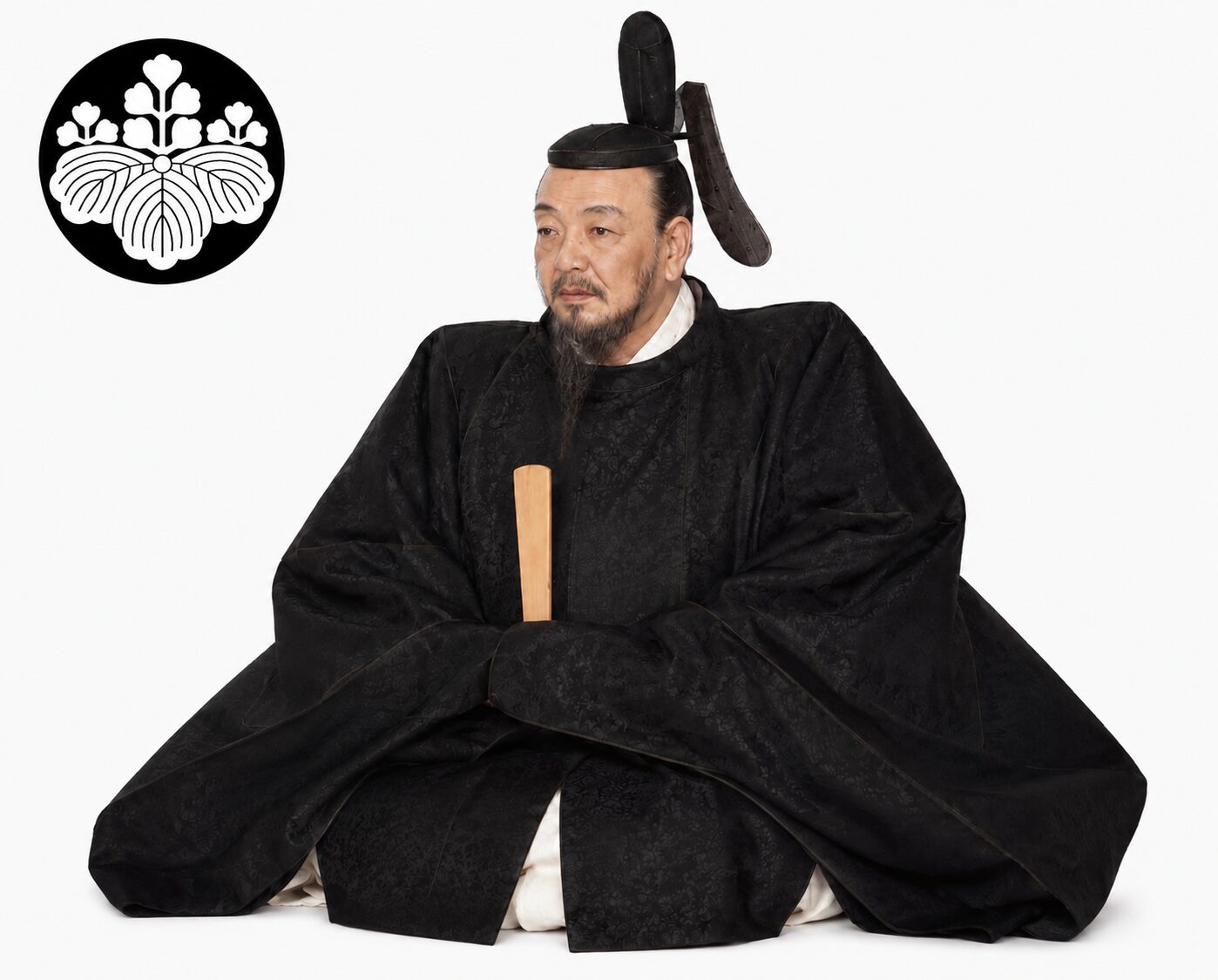
Hashiba Hidenaga — Chancellor of the Toyotomi Regime and the Yamato Dainagon: The Hidden Driving Force Behind Hideyoshi’s Unification of Japan
- Three Points to Understand Hashiba Hidenaga
- The Mainstream View — A Standard Account Based on the Established Theory
- The Multiple Theories — Exploring Possibilities from Various Angles
- Viewed Strategically — Hidenaga’s Politics, Military Affairs, and Coordination
- Famous Words and Sayings Associated with This Warlord
- A Collection of Anecdotes and Episodes
- Timeline
- Lineage and Personal Relationships
- Related Historic Site Map and Model Travel Courses
- Related Articles
- References
Three Points to Understand Hashiba Hidenaga
- The younger half-brother of Toyotomi Hideyoshi (by one theory, a full younger brother), and the de facto number two of the Toyotomi regime. From the origins of a farmer of Nakamura in Owari, he rose all the way to a great daimyō of 1,000,000 koku across Izumi, Kii, and Yamato.
- While Hideyoshi handled military affairs and diplomacy, Hidenaga single-handedly took on internal administration, mediation, and the governance of the domain, serving as a coordinator among the daimyō. Hideyoshi’s words to Ōtomo Sōrin—“For inner matters, Sōeki; for public matters, the Chancellor”—plainly show his standing.
- He died of illness at Yamato-Kōriyama Castle in 1591 (Tenshō 19) at the age of 52. So important a figure was he that it is assessed that “had Hidenaga lived, the Toyotomi realm would have lasted longer,” and soon after his death the Toyotomi regime began rapidly to waver with the forced suicide of Sen no Rikyū, the forced suicide of Toyotomi Hidetsugu, and the invasion of Korea.
The Mainstream View — A Standard Account Based on the Established Theory
Birth at Nakamura in Owari and His Relationship with His Brother Hideyoshi
Hashiba Hidenaga was born on the second day of the third month of Tenbun 9 (April 8, 1540), at Nakamura in Aichi District, Owari Province (present-day Nakamura Ward, Nagoya City, Aichi Prefecture). His father was Chikuami (by one theory, Kinoshita Yaemon); his mother was “Naka” (later Ōmandokoro), the same mother as Toyotomi Hideyoshi. He is taken to be Hideyoshi’s younger half-brother, three years his junior (by one theory, a full younger brother). His childhood name was Kochiku; his common name was Koichirō.
There is no firm source on when Hidenaga began serving his brother Hideyoshi, but he is said to have entered the service of Oda Nobunaga, led there by Hideyoshi, who had come to be active as Nobunaga’s retainer. If it was after the marriage of Hideyoshi and “Nene” (later Kita-no-mandokoro), it would have been when Hidenaga was around 25. His first name was “Nagahide,” which is said either to have been named after Niwa Nagahide, deeply trusted by Nobunaga, or possibly to have been his own real name. From around 1585 (Tenshō 13) he changed it to “Hidenaga.”
Rising to Prominence as Hideyoshi’s Right Arm
In 1573 (Tenshō 1), when Hideyoshi was given three districts of northern Ōmi by Oda Nobunaga and became lord of Nagahama Castle, Hidenaga served as acting castellan and so took on the important role of holding the castle in Hideyoshi’s absence from early on. Skilled at document affairs and internal administration, Hidenaga was highly valued by Hideyoshi for his abilities.
From 1577 (Tenshō 5) on, Hideyoshi was ordered by Nobunaga to undertake the conquest of the Chūgoku region. Hidenaga was entrusted with the pacification of Tajima Province and the San’indō, and when Takeda Castle in Tajima fell in 1580 (Tenshō 8), he became its acting castellan. Furthermore, in the attack on Miki Castle in Harima (1578–80, Tenshō 6–8), he showed work that changed the course of the battle as a commander on one wing, and became an indispensable warlord to Hideyoshi.
During this period, he coordinated closely with Hideyoshi’s staff officers Takenaka Hanbei (Shigeharu) and Kuroda Kanbei (Yoshitaka). Hanbei died of illness in camp in 1579 (Tenshō 7), but Hidenaga built a deep relationship of trust with Kanbei throughout his life, and they would fight together in the later conquests of Shikoku and Kyushu.
The Honnō-ji Incident and the Establishment of the Toyotomi Regime
The Honnō-ji Incident of the sixth month of 1582 (Tenshō 10), the ensuing Battle of Yamazaki, the Battle of Shizugatake the following year (1583, Tenshō 11), and the Battle of Komaki and Nagakute of 1584 (Tenshō 12)—in every phase as Hideyoshi sped toward seizing the realm, Hidenaga acted alongside him as his right arm. He supported Hideyoshi not so much with martial valor as with the “comprehensive power of the backstage”: command of the forces, logistics, and coordination with the various generals.
Hidenaga’s characteristic was not the type to come to the fore with outstanding martial exploits but a “comprehensive coordinating ability” that supported the whole front. Young fierce generals such as Fukushima Masanori and Katō Kiyomasa also gathered under Hideyoshi, and amid their frequent clashes, Hidenaga functioned as a presence who silently held the whole together.
The Conquest of Kishū and the Conquest of Shikoku — Commander as Hideyoshi’s Deputy
In the third month of 1585 (Tenshō 13), in the conquest of Kishū, Hidenaga pacified Kii Province together with Hideyoshi, and for this achievement was given the 640,000 koku of Kii and Izumi in place of the two provinces of Tajima and Harima.
In the ensuing conquest of Shikoku from the sixth to the eighth month of that year, Hidenaga served as supreme commander, as Hideyoshi’s deputy. Together with Hashiba Hidetsugu (Hidenaga’s nephew, later kanpaku), he led the forces of Yamato, Izumi, and Kii, about 30,000, set sail from Sakai on the sixteenth day of the sixth month, and landed at Tosa-domari in Awa. With Hidetsugu’s 30,000 troops of Settsu, Ōmi, and Tanba, and the separate detachments of Ukita Hideie and Kuroda Kanbei toward Sanuki and of Mōri Terumoto and Kobayakawa Takakage toward Iyo, a great army of more than 100,000 in all surrounded Shikoku.
Chōsokabe Motochika met them with an army of 20,000 to 40,000, centered on the forces of Tosa, but the disparity in forces was decisive, and he surrendered after only a little over a month of fighting. Hidenaga took the substantive command of this battle, reduced the Chōsokabe clan to the single province of Tosa, and made it submit. In Hideyoshi’s enterprise of unifying the realm, this was the moment when Hidenaga was promoted from a mere younger brother and staff officer to a “field-army commander.”
The Yamato Dainagon — Becoming a Great Daimyō of 1,000,000 Koku
For his achievement in the conquest of Shikoku, in the intercalary eighth month of 1585 (Tenshō 13), Hidenaga was given the three provinces of Yamato, Kii, and Izumi, about 1,000,000 koku in total, and made Yamato-Kōriyama Castle his residence. In the tenth month of that year, he was appointed Sangi of Junior Fourth Rank, Lower Grade. In the seventh month of that year, when Hideyoshi became kanpaku and was granted the surname “Toyotomi,” Hidenaga followed suit and took the Toyotomi surname. Thereafter his court rank advanced to Gon-chūnagon in the tenth month of 1586 (Tenshō 14) and to Gon-dainagon of Junior Second Rank in the eighth month of 1587 (Tenshō 15), and he came to be called the “Yamato Dainagon.”
Having entered Kōriyama Castle, Hidenaga devoted himself to developing the castle town and to the growth of commerce and industry. He established a townsmen’s self-government system called the “Hakomoto system,” granted commercial privileges, and made the town prosper. That he governed Yamato—with its many temples and shrines—without causing major disputes suggests the height of his practical ability. After Hidenaga’s death, Kōriyama Castle is said to have held a store of more than 56,000 gold pieces, and silver piled densely to the rafters in a room four ken square, telling of the soundness of his domain management.
The Conquest of Kyushu — Supreme Commander of the Hyūga Front
In 1586 (Tenshō 14), Ōtomo Sōrin of Kyushu, under pressure from the Shimazu clan, went up to Osaka to seek relief from Hideyoshi. Hideyoshi entertained Sōrin at Osaka Castle, and on that occasion is said to have stated, “For inner matters, Sōeki (Sen no Rikyū); for public matters, the Chancellor (Hidenaga); consult them accordingly.” This is an important record showing that Hidenaga was the “public window” for the external affairs of the Toyotomi regime, while Sen no Rikyū was the window for “inner matters” (private coordination).
In the conquest of Kyushu in 1587 (Tenshō 15), Hidenaga took the field as supreme commander of the Hyūga front. In the third month, he faced the forces of Shimazu Iehisa around Takajō in Bungo (Kawaminami-chō, Miyazaki Prefecture). At the Battle of Nejirozaka on the fourteenth of that month, Hidenaga’s army, together with Kuroda Kanbei and others, repelled a surprise attack by the Shimazu army and decided the course of the battle. He then conducted the surrender negotiations with Shimazu Yoshihisa and realized the surrender of the Shimazu clan on the eighth day of the fifth month.
For this achievement, in the eighth month of that year, Hidenaga was promoted to Gon-dainagon of Junior Second Rank together with Tokugawa Ieyasu. A court rank on par with Ieyasu’s symbolizes the height of Hidenaga’s standing in the Toyotomi regime at the time.
As Number Two of the Toyotomi Regime — The Height of His Coordinating Role
The years 1587–89 (Tenshō 15–17) were the height of Hidenaga’s career. While Hideyoshi handled military affairs, external negotiations, and court ceremony at the Jurakudai, Hidenaga bore the center of the regime as coordinator among the daimyō. It is said that tozama daimyō such as Tokugawa Ieyasu, Date Masamune, and Kobayakawa Takakage preferred to ask for mediation through Hidenaga rather than to approach Hideyoshi directly.
The various daimyō trusted Hidenaga’s mild and magnanimous character, and many are said to have been able to protect their standing. Against Hideyoshi’s eloquence and sometimes fierce anger, Hidenaga’s sincere character functioned as a fine buffer. In the improvement of relations between Ieyasu and Hideyoshi too, Hidenaga’s residence became one of the stages. It is recorded that in the tenth month of 1586 (Tenshō 14), on the eve of Ieyasu going up to Osaka, he took Hidenaga’s Osaka residence as his lodging, and Hideyoshi held a banquet there. The next day, Ieyasu pledged his submission to Hideyoshi at Osaka Castle.
Illness and Death — His End at Yamato-Kōriyama Castle
From around 1589 (Tenshō 17), Hidenaga began to fall ill. By around the first month of the following year, 1590 (Tenshō 18), his condition had worsened, and he could not take the field in the Odawara campaign of that year. According to the entry of the second day of the twelfth month of Tenshō 18 in the Tamon-in Nikki, Hidenaga had been suffering recurrent fevers for several days and was having convulsions like epilepsy. It was his retainer band and his adopted heir Toyotomi Hideyasu (Hidenaga’s nephew, Hidetsugu’s younger brother) who entertained the imperial envoy who came to Yamato on the tenth.
In the first month of 1591 (Tenshō 19), Hidenaga, sensing the approach of death, hastily arranged the marriage of his own daughter (4 or 5 years old) and his adopted heir Hideyasu (around 13), in order to secure Hideyasu’s standing as successor to the headship. Having seen to that wedding, Hidenaga passed away within Yamato-Kōriyama Castle on the twenty-second day of the first month, at the age of 52.
His adopted heir Hideyasu inherited the two provinces of Kii and Yamato, but in 1595 (Bunroku 4) died suddenly at only 17. With this, the Yamato Toyotomi house came to an end. The family temple Daikō-in, which Hidenaga had built at Yamato-Kōriyama, was relocated to Daitoku-ji in Kyoto by the hand of Tōdō Takatora, and the memorial tablet was moved to Shungaku-in within Yamato-Kōriyama City. His grave is called the “Dainagon-zuka” (Grand Counselor’s Mound) and remains within Yamato-Kōriyama City to this day.
After Hidenaga’s death, the Toyotomi regime rapidly lost its balance. The forced suicide of Sen no Rikyū in the intercalary first month of that year, the forced-suicide incident of Toyotomi Hidetsugu in 1595 (Bunroku 4), and the Bunroku and Keichō Wars (the invasion of Korea)—all are incidents that, it is pointed out, might have unfolded differently had Hidenaga lived. Having lost the “chancellor of the Toyotomi regime,” the Toyotomi house, by way of Hideyoshi’s death in 1598 (Keichō 3) and the Battle of Sekigahara in 1600 (Keichō 5), would be destroyed at the Summer Campaign of Osaka in 1615 (Keichō 20).
The Multiple Theories — Exploring Possibilities from Various Angles
Theory 1: The Assessment That “Had Hidenaga Lived, the Toyotomi Realm Would Have Lasted”
The most widely known of the historical assessments of Hashiba Hidenaga is the discourse that “had Hidenaga been long-lived, the realm of the Toyotomi house would have lasted longer.” This assessment is widely supported among modern historians, novelists, and history fans, and holds a certain persuasiveness even in contemporary research.
Grounds for supporting it:
- Hidenaga was the only one able to offer opinions to Hideyoshi, and his counsel had the effect of restraining Hideyoshi’s rashness.
- He was deeply trusted by the various daimyō and bore the coordination of relations with tozama daimyō (Ieyasu, Masamune, Takakage, Sōrin, and others).
- Immediately after Hidenaga’s death, destabilizing factors for the regime occurred in succession—the forced suicide of Sen no Rikyū, the forced suicide of Hidetsugu, and the invasion of Korea.
- He was the only person who combined the financial base of Yamato’s 1,000,000 koku with a coordinating ability based on a mild character.
Critical examination: On the other hand, caution is also needed with this assessment.
- Whether, even with Hidenaga alive, the kanpaku-succession problem (Hidetsugu or Hideyori) and the decline of Hideyoshi’s judgment in his later years could have been completely prevented is unknown.
- The invasion of Korea was on the extension of Hideyoshi’s enterprise of unifying the realm, and whether Hidenaga alone could have stopped it is doubtful.
- If one assumes “the Toyotomi realm lasted,” the movements of Tokugawa Ieyasu and the interests of the various daimyō would also become entirely different scenarios, so counterfactual argument does not go beyond conjecture.
- As a historical fact, Hidenaga died of illness at 52, and an argument premised on his longevity is unfalsifiable.
Many contemporary historians, while acknowledging that “Hidenaga’s death was an important factor in the destabilization of the Toyotomi regime,” show the cautious assessment that “whether Hidenaga alone could have prevented the collapse of the regime is a separate question.” Even so, as an anecdote telling of the magnitude of Hidenaga’s presence, this discourse will likely continue to be passed down.
Theory 2: Theories on His Origin-Relationship with Hideyoshi — Half-Brother or Full Brother?
Several theories exist regarding the origin-relationship between Hashiba Hidenaga and Toyotomi Hideyoshi. Because Hideyoshi’s own origins are not clear, the origins of his brother Hidenaga are correspondingly subject to various theories.
The half-brother theory (the received view): Hideyoshi’s father was Kinoshita Yaemon, and after Yaemon died young, his mother “Naka” remarried Chikuami. Hidenaga was born to her and Chikuami, and therefore Hideyoshi and Hidenaga are half-brothers sharing the same mother. It is the received view recorded in Edo-period works such as the Taikō Sosei-ki, and is still the most widely accepted today.
The full-brother theory: The theory that both Hideyoshi and Hidenaga were children of Kinoshita Yaemon, both full brothers sharing the same father. There are also fragments of sources suggesting the possibility that Hideyoshi’s father was long-lived, and in recent years scholars supporting the full-brother theory have been increasing.
The theory that Chikuami was Hideyoshi’s father/stepfather: In addition to the received view that Chikuami was Hideyoshi’s stepfather and Hidenaga’s real father, there are also more complex variations—the theory that Chikuami was actually Hideyoshi’s real father as well, or the theory that Chikuami was another name for Yaemon.
Behind the coexistence of these theories, it is pointed out that Hideyoshi, after becoming ruler of the realm, may have deliberately emphasized his “lowly origins” and made his own origins ambiguous. It is said that, in establishing his authority as Taikō, a “mythologization” was needed precisely because he was not of noble birth, and the trend of current research is that, as a result, the origins of his brother Hidenaga too were transmitted without being made clear.
What is important in considering the relationship between Hideyoshi and Hidenaga is that, more than the sameness or difference of their origins, a “strong bond as brothers” existed as fact. Whether full or half brothers, the relationship of trust between the two formed the foundation of the Toyotomi regime.
Theory 3: Theories on the Cause of Death — A “Shaku” Illness, or Assassination?
Regarding the cause of Hashiba Hidenaga’s death, sources of the time have no clear description of a disease name, and various conjectures have been made. The date of death is the twenty-second day of the first month of 1591 (Tenshō 19), and the place is Yamato-Kōriyama Castle, on both of which the various sources agree.
The “shaku” theory (the contemporary understanding): According to the diaries of court nobles and the records of missionaries of the time, Hidenaga’s cause of death is given as “shaku.” Shaku is a general term for “an illness in which a mass forms within the abdomen,” and may include what modern medicine calls stomach cancer, liver cancer, intestinal tumors, and the like. His symptoms are said to have worsened from about a year before his death, the illness progressing to the point where his lower body became impaired.
The gastrointestinal-disease theory: The medical work Igaku Tenshō-ki, compiled in the early Edo period, conjectures Hidenaga’s cause of death as a “gastrointestinal disease.” With the medical technology of the time, identifying the disease name was difficult, and a definitive diagnosis is impossible even today, but it is highly likely it was a long-term malignant disease of the digestive system.
The cirrhosis/liver-disease theory: Sengoku daimyō had many occasions to drink large amounts of sake at banquets, and Hidenaga too, as the coordinator of the Toyotomi regime, frequently attended diplomatic banquets. The view points out the possibility that long years of drinking burdened his liver and led to cirrhosis or liver cancer.
The death-by-overwork theory: Hidenaga served in succession as supreme commander of large-scale military operations—the conquests of Kishū, Shikoku, and Kyushu—and on top of that single-handedly took on the coordination among daimyō and the domain management of Yamato’s 1,000,000 koku, an extraordinary burden of work. The view holds that chronic stress and overwork worsened his condition and ultimately brought about his death at a young age.
The assassination theory (a popular tale): An assassination theory is also whispered about Hidenaga’s death. Hidenaga in his lifetime is said to have been in conflict with rising forces such as Ishida Mitsunari, and there are theories that a close adviser of Hideyoshi (Mitsunari) poisoned him to seize the regime’s initiative, or that Hideyoshi himself assassinated him for the stability of the regime, or that Tokugawa Ieyasu arranged it to remove a future political rival. However, there is no firm evidence backing this theory, and since multiple sources such as the Tamon-in Nikki record the course of his worsening condition in detail, at present it is treated as a “popular tale.”
The historian Shiba Hiroyuki (in charge of historical supervision for the 2026 NHK taiga drama Toyotomi Brothers!) conjectures, from the course of Hidenaga’s condition, a “composite factor of shaku (a malignant tumor of the digestive system) or kakuran (acute gastrointestinal symptoms) and overwork,” and attempts are also advancing to match the knowledge of modern medicine with the symptom records of the time.
Theory 4: Theories on the Meaning of the “For Public Matters, the Chancellor” Remark
One of the most famous anecdotes in telling of Hashiba Hidenaga is the words Hideyoshi is said to have spoken to Ōtomo Sōrin: “For inner matters, Sōeki; for public matters, the Chancellor; consult them accordingly” (consult Sen no Rikyū on private matters and Hidenaga on public matters). Regarding the standing of Hidenaga that this remark points to, there are several interpretations among researchers.
The “de facto number two” theory (the received view): The interpretation that Hidenaga was the external, public coordinating window of the Toyotomi regime, while Sen no Rikyū was the private, informal coordinating window through the tea ceremony. It holds that Hidenaga and Rikyū supported the regime as the twin wheels of “public” and “private” respectively, while Hideyoshi himself stood above as final decision-maker, in a three-layered structure. This interpretation is the basis for positioning Hidenaga as the chancellor (equivalent to a prime minister) of the Toyotomi regime.
The “window for external daimyō” limited theory: The limited interpretation that “public matters” meant negotiations with the various daimyō, and that Hidenaga was the specialized window for handling tozama daimyō. In this view, Hidenaga’s role was important, but closer to a “minister of diplomacy” than the chancellor of the whole regime.
Examining the credibility of the remark itself: This remark is transmitted in later compilations such as the Ōtomo-ke Monjoroku, and these words are not directly recorded in the original of Sōrin’s own letter. The possibility of later embellishment, or of insertion to emphasize Hidenaga’s standing, is also pointed out. However, content similar to this remark is seen in fragments in multiple sources, and it is influential as corroboration showing Hidenaga’s importance in the Toyotomi regime of the time.
Whichever interpretation one adopts, there is no doubt that Hidenaga was Hideyoshi’s greatest close adviser and a coordinator trusted by the various daimyō. The historian Yamamoto Hirofumi and others express Hidenaga’s role as “a position like a combination of a modern chief cabinet secretary and a party secretary-general,” and the image of Hidenaga as the substantive operator of the regime is becoming established among researchers.
Theory 5: Theories on His Relationship with Sen no Rikyū — Its Influence on the Forced Suicide
The relationship between Hidenaga and Sen no Rikyū is an important point in understanding the Toyotomi regime. The two were often named together as the “chancellor of governance” and the “master of tea” serving close to Hideyoshi.
The cooperative-relationship theory (the received view): Hidenaga and Rikyū were in a cooperative relationship, supporting the Toyotomi regime while complementing each other. Hidenaga handled governance and Rikyū the informal coordination with the various daimyō through tea, and the view holds that the coordination of the two brought stability to the regime. Tozama daimyō frequently gathered at Rikyū’s tea gatherings, and the personal connections and information formed there reinforced Hidenaga’s coordinating function.
The theory linking Hidenaga’s death and Rikyū’s forced suicide: Hidenaga died on the twenty-second day of the first month of 1591 (Tenshō 19), and less than three weeks later, on the thirteenth of the intercalary first month (various theories: a 2/13 theory, a 2/28 theory, and others), Rikyū was ordered by Hideyoshi to come up to Kyoto, and on the twenty-eighth of the second month of that year (various theories) was ordered to commit suicide. This temporal proximity is no coincidence, and the view that “the death of Hidenaga, who had been protecting Rikyū, sealed Rikyū’s fate” is widely supported.
The theory of an alliance between Rikyū and Hidenaga: Hidenaga and Rikyū both oriented toward the stability of the Toyotomi regime, and as Hideyoshi rolled out extreme policies toward the invasion of Korea, the two functioned as “brakes within the regime.” With Hidenaga’s death, Rikyū became isolated and resisted as the last brake, but incurred Hideyoshi’s displeasure and was driven to suicide—so the theory holds.
The theory that the reasons for the forced suicide were separate: On the other hand, there is also the view that the reasons for Rikyū’s forced suicide were composite—his relations with the court, irregularities in the buying and selling of tea utensils, the statue of Rikyū at the Sanmon gate of Daitoku-ji—and that the direct causal relationship with Hidenaga’s death should not be overemphasized. It is the position that Rikyū’s forced suicide was the result of a power struggle within the regime (the conflict between the Ishida Mitsunari faction and the Rikyū faction, and so on), and that Hidenaga was no more than background.
Whichever theory one adopts, it is highly likely that, had Hidenaga lived, he would have functioned as a powerful figure protecting Rikyū, and as a result Rikyū’s forced suicide might have been prevented. The importance of Hidenaga as a guardian of the network of “men of culture” and “tea masters” in the Toyotomi regime can also be glimpsed here.
Theory 6: The Significance of the Kōriyama Castle Town He Built as Yamato Dainagon
The domain management Hashiba Hidenaga realized at Yamato-Kōriyama is highly assessed as a model of the early-modern castle town. Its significance is discussed from several viewpoints.
The commerce-and-industry development model theory: Hidenaga deliberately gathered merchants and artisans to reside in the castle town of Kōriyama Castle and established a townsmen’s self-government system called the “Hakomoto system.” In a mechanism where 13 districts took turns bearing town governance, he realized an exquisite balance that respected the townsmen’s autonomous operation while keeping the lord’s control effective. This system is said to have influenced the development of castle towns in other regions as well.
His skill in controlling temples and shrines: Yamato was a special region that had been ruled since ancient times by powerful religious forces such as Kōfuku-ji and Tōdai-ji, and even Matsunaga Hisahide in Nobunaga’s time struggled with its governance. Yet Hidenaga realized governance without large-scale clashes with the temples and shrines. A flexible method of respecting temple and shrine lands while advancing necessary reforms in stages made coexistence with the religious forces possible.
The financial-base establishment theory: After Hidenaga’s death, Yamato-Kōriyama Castle is said to have held a store of more than 56,000 gold pieces, with silver piled densely to the rafters in a room four ken square. This shows that the domain management of Yamato’s 1,000,000 koku was extremely excellent. It is also pointed out that Hidenaga may have supported part of the main financial resources of the Hideyoshi regime.
The forerunner-of-the-early-modern-castle-town theory: The view that the development of the Kōriyama castle town became one of the models for the development of castle towns in various regions in the later Tokugawa period. It is said that the castle-town development Tōdō Takatora later realized at Tsu, Iga-Ueno, and elsewhere also reflected his experience of serving Hidenaga in his youth.
Yamato-Kōriyama City is still known today as a castle town selected among the “100 Best Cherry-Blossom Sites of Japan,” with its Ōtemon gate and turret restored. The legacy of Hidenaga’s domain management is engraved in the urban structure of Yamato-Kōriyama even now, more than four centuries later.
Viewed Strategically — Hidenaga’s Politics, Military Affairs, and Coordination
The Rare Talent of the “Comprehensive Power of the Backstage”
What makes Hidenaga stand out as a Sengoku warlord is neither outstanding martial valor nor original strategy, but a “comprehensive power that supports the whole front.” In every phase of Hideyoshi’s enterprise of unifying the realm—the conquests of the Chūgoku region, Shikoku, and Kyushu—Hidenaga consistently bore:
- command of the forces (logistics, transport, inter-unit coordination);
- actual battlefield command (the Battle of Nejirozaka and the like);
- surrender negotiations (realizing the peace with Shimazu Yoshihisa);
- stabilization of occupied territory (the governance of Yamato and Kii).
These were individually unflashy, but roles whose absence would certainly have derailed the enterprise of unifying the realm. Hidenaga, who tends to be called “mediocre” in assessments as a warlord, was in contemporary terms an “excellent generalist-type executive,” and from the viewpoint of organizational theory an extremely important talent.
His Distinctiveness as a Coordinator — Why Only Hidenaga Gained the Daimyō’s Trust
The Toyotomi regime had many administrative officials—Ishida Mitsunari, Asano Nagamasa, Maeda Gen’i, and others—but the one the tozama daimyō relied on was outstandingly Hidenaga. Analyzing the reasons, the following points can be cited:
- The only position able to advise Hideyoshi directly: The blood tie of brotherhood was a strength no other retainer had.
- A mild and sincere character: A nature in contrast to the eloquent and sometimes fierce Hideyoshi.
- The independent economic power of Yamato’s 1,000,000 koku: He could single-handedly cover the entertainment and gift-giving needed for daimyō coordination.
- A record accompanied by military experience: The weight of having served as the supreme commander in real combat in the conquests of Shikoku and Kyushu.
- An attitude that did not blatantly show a lust for power: A presence the various daimyō did not need to be wary of.
The last point in particular is important: young bureaucrats like Ishida Mitsunari, however capable, had a lust for power flickering into view and became figures the various daimyō were wary of. Because Hidenaga, while in the position closest to the apex of power, devoted himself to his duties without flaunting it, he was able to monopolize the trust of the various daimyō.
Reassessing His Record on the Military Side
Because the image of a “supporting role” is strong for Hidenaga, his military achievements tend to be somewhat underestimated. But in reality:
- The capture of Takeda Castle in Tajima and his acting castellanship (Tenshō 8) — securing a base for the conquest of the Chūgoku region.
- The attack on Miki Castle (Tenshō 6–8) — making Besshō Nagaharu submit by carrying out a starvation siege.
- The Battle of Shizugatake (Tenshō 11) — leading a detachment to rout the main force of Shibata Katsuie.
- The Battle of Komaki and Nagakute (Tenshō 12) — rear support and responding to the movements of the Negoro-shū of Kii.
- The conquest of Kishū (Tenshō 13) — pacifying the Saika-shū and Negoro-shū.
- The conquest of Shikoku (Tenshō 13) — making Chōsokabe Motochika surrender as supreme commander.
- The Battle of Nejirozaka in the conquest of Kyushu (the 14th of the 3rd month of Tenshō 15) — repelling the surprise attack of Shimazu Iehisa.
These real-combat experiences are abundant enough to rank among the higher tier of Sengoku warlords. That he does not stand out in martial exploits is due to his position of tending to be hidden in Hideyoshi’s shadow, and his military ability itself was by no means low.
His Innovativeness as a Domain Manager
Hidenaga’s domain management was extremely advanced for its time:
- Emphasis on commerce and industry: He deliberately placed merchant districts in the castle town and granted commercial privileges to promote prosperity.
- Townsmen’s self-government: Through the “Hakomoto system,” he recognized the townsmen’s autonomous operation while maintaining the lord’s control.
- Coexistence with temples and shrines: A realistic approach aiming at coexistence rather than heavy-handed suppression of temples and shrines.
- Accumulation of wealth: The soundness of leaving enormous financial reserves while still expending on military and entertainment costs.
These show that he understood the essence of governance—not only winning in battle but “making occupied territory wealthy.” It is thought that the castle-town development Tōdō Takatora later realized at Tsu and Iga-Ueno, and the Tokugawa shogunate’s castle-town model, took Hidenaga’s Kōriyama castle town as one reference point.
Strategic Limits — What Were Hidenaga’s Fetters?
Despite such talent, there were also things Hidenaga could not accomplish:
- The succession problem: He had no biological son, and his adopted heir Hideyasu was young, leaving anxiety about the succession of his own line.
- Health problems: He fell ill from around the age of 50, and the time he could be active at the center of the regime was limited.
- Responding to the invasion of Korea: He died without being able to stop the invasion of Korea, which, had he lived, he would likely have opposed.
- Conflict with rising forces such as Mitsunari: He is said to have had a tense relationship with the magistrate officials such as Ishida Mitsunari, and he left behind a structure of conflict between the Hidenaga faction and the Mitsunari faction.
Famous Words and Sayings Associated with This Warlord
“For inner matters, Sōeki; for public matters, the Chancellor; consult them accordingly”
The words Hideyoshi is said to have spoken to Ōtomo Sōrin when Sōrin of Kyushu visited Osaka Castle in 1586 (Tenshō 14). They are translated as “consult Sen no Rikyū (Sōeki) on private matters, and Hidenaga (the Chancellor) on public matters.” It is widely known as a famous saying that plainly shows Hidenaga’s standing. Source: the Ōtomo-ke Monjoroku and others.
“The Yamato Dainagon”
Hidenaga’s common name from 1587 (Tenshō 15) on, after he became Gon-dainagon of Junior Second Rank. It symbolizes his standing as a central figure of the Toyotomi regime who was both a great daimyō of Yamato’s 1,000,000 koku and the holder of a high court rank. After Hidenaga’s death, his adopted heir Hideyasu too was not called the “Yamato Dainagon,” and it remained in history as a title bound to Hidenaga as an individual.
“As long as Hidenaga exists, Hideyoshi’s realm will not fall into disorder” (paraphrase)
An assessment said to have been spoken among the various daimyō and court nobles. Although the direct source is not clear, similar words are seen in fragments in multiple contemporary records. It shows that the recognition that Hidenaga’s presence was the key to the regime’s stability was widely shared among those involved at the time.
“If the elder brother takes one, the younger governs the nine” (a later assessment)
A later maxim expressing the relationship of the Toyotomi brothers. It means that while Hideyoshi took “one” with brilliant martial exploits and diplomacy, Hidenaga, plain but sure, governed the “nine” of practical affairs. It expresses the complementary relationship of the two—that precisely because Hidenaga supported him in the shade, Hideyoshi could shine.
A Collection of Anecdotes and Episodes
His First Work as Acting Castellan of Nagahama
In 1573 (Tenshō 1), when Hideyoshi became lord of Nagahama Castle, Hidenaga came to often hold the castle in his absence as acting castellan. While Hideyoshi accompanied Nobunaga’s conquest of the Chūgoku region and the battles of the Kinai, Hidenaga single-handedly took on the roles of protecting the domain, commanding the retainer band, and developing the castle town. His later domain management at Yamato-Kōriyama Castle was grounded in this Nagahama-era experience, and the prototype of the “younger brother who supports the elder” who upheld the Hideyoshi regime was formed here.
Breaking the “Cutting-In Detachment” at the Battle of Shizugatake
At the Battle of Shizugatake in the fourth month of 1583 (Tenshō 11), when Sakuma Morimasa of the Shibata Katsuie side launched a “cutting-in” maneuver, Hidenaga played the important role of coordinating as a rear unit to rout the enemy. Hideyoshi’s “Great Return from Mino” is famous as the turning point of the battle, but it was precisely because of the perseverance of the on-site units, including Hidenaga, that Hideyoshi’s swift return bore fruit.
Illness and Appointment as Supreme Commander in the Conquest of Shikoku
In the sixth month of 1585 (Tenshō 13), Hideyoshi had originally planned to cross to Shikoku himself as supreme commander, but fell ill just before setting out. Hidenaga was hastily designated supreme commander and made the Chōsokabe clan surrender after only a little over a month of fighting. This battle, in which he perfectly fulfilled the role of “Hideyoshi’s stand-in,” became an important occasion that impressed on the various daimyō that Hidenaga had the ability to be an independent commander, not a mere supporting figure.
Ieyasu’s Lodging at the Osaka Residence
In the tenth month of 1586 (Tenshō 14), when Tokugawa Ieyasu went up to Osaka to submit to Hideyoshi, Hideyoshi made Hidenaga’s Osaka residence Ieyasu’s lodging. Hideyoshi himself visited Hidenaga’s residence, held a banquet, and entertained Ieyasu. For Ieyasu, taking the house of a “brother” who was not Hideyoshi’s retainer as his lodging was a symbol of being treated nearly as an equal, and a device to make the pledge of submission at Osaka Castle the next day psychologically easier to accept. Hidenaga’s residence became a historic stage just before the seizing of the realm.
Repelling the Shimazu Army at the Battle of Nejirozaka
From late on the fourteenth to early on the fifteenth of the third month of 1587 (Tenshō 15), on the Hyūga front of the conquest of Kyushu, Shimazu Iehisa launched a surprise attack on the main camp of Hidenaga’s army. Hidenaga, coordinating with Kuroda Kanbei, Miyabe Keijun, and others, met and repelled the Shimazu army from a position equipped with moats and palisades. With this, the Shimazu army’s will to fight was decisively broken, leading to Shimazu Yoshihisa’s surrender on the eighth day of the fifth month. It is a representative battle showing Hidenaga’s ability as an on-site field commander.
His Relationship with the Retainer Tōdō Takatora
Tōdō Takatora, later known as a master of castle-building, served Hidenaga in his youth. After the destruction of the Azai clan, Takatora became Hidenaga’s retainer and accompanied the conquests of Kishū, Shikoku, and Kyushu, achieving martial exploits. Hidenaga highly valued Takatora’s ability and promoted him, and although Takatora later became Hideyoshi’s direct vassal after the deaths of Hidenaga and Hideyasu, he never forgot his obligation to Hidenaga throughout his life. It was also by Takatora’s arrangement that Hidenaga’s family temple Daikō-in was relocated to Daitoku-ji in Kyoto and the memorial tablet moved to Shungaku-in.
The Treasures of Yamato-Kōriyama Castle
Immediately after Hidenaga’s death in 1591 (Tenshō 19), an astonishing quantity of treasure was stored at Yamato-Kōriyama Castle. According to records, there were more than 56,000 gold pieces, and silver piled densely to the rafters in a room four ken square. This tells how excellent the domain management of Yamato’s 1,000,000 koku was, and at the same time shows that Hidenaga did not run to personal extravagance but managed the domain’s finances soundly. This treasure was inherited as is by Hideyasu, but after Hideyasu’s sudden death is said to have been absorbed into the main Toyotomi house.
The Voices of the Various Daimyō Who Mourned Hidenaga
When news of Hidenaga’s death spread, many of the various daimyō grieved deeply. Tozama daimyō such as Tokugawa Ieyasu, Kobayakawa Takakage, and Date Masamune reacted especially strongly, and are said to have voiced anxiety at having lost the regime’s coordinator. Rikyū too is said to have deeply mourned Hidenaga’s death, and may have had a premonition of his own fate. An imperial envoy was also dispatched from the court to Hidenaga’s funeral, again showing the height of his standing.
Timeline
| Japanese Era (Western Year) | Age | Event |
|---|---|---|
| Tenbun 9 (1540) | 1 | Born at Nakamura in Aichi District, Owari Province, on the 2nd of the 3rd month (April 8). His father is Chikuami; his mother is Naka (later Ōmandokoro). Hideyoshi’s younger half-brother, three years his junior (by one theory, a full brother). Childhood name Kochiku; common name Koichirō. |
| Around Eiroku 8 (1565) | 25 | Begins serving Hideyoshi (the timing has various theories). Enters Oda Nobunaga’s service; first name “Nagahide.” |
| Tenshō 1 (1573) | 33 | Hideyoshi becomes lord of Nagahama Castle, and Hidenaga serves as acting castellan. Displays his skill in internal administration. |
| Tenshō 5–8 (1577–80) | 37–40 | Accompanies the conquest of the Chūgoku region. Takes charge of the pacification of Tajima and the San’indō. After the fall of Takeda Castle in Tajima in 1580, becomes acting castellan. Active as a commander on one wing in the attack on Miki Castle in Harima. |
| Tenshō 10 (1582) | 42 | In the 6th month, the Honnō-ji Incident. Accompanies the Battle of Yamazaki. |
| Tenshō 11 (1583) | 43 | In the 4th month, takes part in the Battle of Shizugatake, contributing to routing the main force of Shibata Katsuie. |
| Tenshō 12 (1584) | 44 | From the 3rd to the 11th month, the Battle of Komaki and Nagakute. Takes charge of rear support and responding to the Negoro-shū of Kii. |
| Tenshō 13 (1585) | 45 | In the 3rd month, the conquest of Kishū. Granted 640,000 koku of Kii and Izumi. From the 6th to the 8th month, serves as supreme commander, as Hideyoshi’s deputy, in the conquest of Shikoku and makes Chōsokabe Motochika surrender. In the intercalary 8th month, granted 1,000,000 koku of Yamato, Kii, and Izumi and made lord of Yamato-Kōriyama Castle. In the 10th month, Sangi of Junior Fourth Rank, Lower Grade. With Hideyoshi’s appointment as kanpaku, granted the “Toyotomi” surname. Renames himself “Hidenaga.” |
| Tenshō 14 (1586) | 46 | In the 10th month, Gon-chūnagon. In the same month, Tokugawa Ieyasu lodges at Hidenaga’s Osaka residence and the next day pledges submission to Hideyoshi. At Ōtomo Sōrin’s visit, Hideyoshi states, “For inner matters, Sōeki; for public matters, the Chancellor.” |
| Tenshō 15 (1587) | 47 | Supreme commander of the Hyūga front in the conquest of Kyushu. On the 14th of the 3rd month, repels Shimazu Iehisa’s surprise attack at the Battle of Nejirozaka. On the 8th of the 5th month, Shimazu Yoshihisa surrenders. In the 8th month, promoted to Gon-dainagon of Junior Second Rank together with Tokugawa Ieyasu. Comes to be called the “Yamato Dainagon.” |
| Tenshō 16 (1588) | 48 | In the 4th month, attends Emperor Go-Yōzei’s visit to the Jurakudai. The height of his career as the Toyotomi regime’s coordinator. |
| Tenshō 17 (1589) | 49 | Begins to fall ill around this time. |
| Tenshō 18 (1590) | 50 | His condition worsens from around the 1st month. Cannot take the field in the Odawara campaign. In the 12th month, the Tamon-in Nikki records fevers and convulsions. |
| Tenshō 19 (1591) | 52 | In the 1st month, arranges the marriage of his own daughter and his adopted heir Hideyasu. On the 22nd of the 1st month, dies within Yamato-Kōriyama Castle at the age of 52. The cause of death is given as “shaku.” In the intercalary 1st month, Sen no Rikyū is ordered by Hideyoshi to come up to Kyoto and is later made to commit suicide (that year). |
| Bunroku 4 (1595) | — | His adopted heir Hideyasu dies suddenly at 17. The Yamato Toyotomi house comes to an end. The Hidetsugu forced-suicide incident is also this year. |
Lineage and Personal Relationships
The Toyotomi House and Family
| Person | Relationship | Notes |
|---|---|---|
| Toyotomi Hideyoshi | Elder brother | Three years Hidenaga’s senior. Elder half-brother (by one theory, full brother). Hidenaga was active throughout his life as a presence supporting his brother. |
| Naka (Ōmandokoro) | Mother | The common mother of Hideyoshi and Hidenaga. She is said to have shown concern even when Hidenaga’s lower body became impaired before his death. |
| Chikuami | Father (various theories) | Hidenaga’s father. Hideyoshi’s stepfather (a real-father theory also exists). |
| Chiun-in | Principal wife | Hidenaga’s principal wife. Said to have been compassionate and to have enjoyed deep esteem from the retainers. |
| Toyotomi Hideyasu | Adopted heir (nephew) | Hidetsugu’s younger brother. Married Hidenaga’s daughter and inherited the headship, but died suddenly at 17 in 1595 (Bunroku 4). The Yamato Toyotomi house ends. |
| Toyotomi Hidetsugu | Nephew | The eldest son of Hidenaga’s elder sister Tomo (Zuiryūin Nisshū). Fought together with Hidenaga in the conquest of Shikoku. Later became kanpaku but was ordered to commit suicide by Hideyoshi in Bunroku 4. |
Sworn Allies and Fellow Warlords
| Person | Position | Notes |
|---|---|---|
| Takenaka Hanbei | Hideyoshi’s strategist | Fought together in the conquest of the Chūgoku region. Close to Hidenaga as well, but died of illness in camp during the attack on Miki Castle in 1579 (Tenshō 7). |
| Kuroda Kanbei | Hideyoshi’s strategist | A sworn ally from the conquest of the Chūgoku region on. Fought together in the conquests of Shikoku and Kyushu. Coordinated at the Battle of Nejirozaka as well. |
| Tōdō Takatora | Retainer | Served Hidenaga, achieved martial exploits, and was valued. Never forgot his obligation to Hidenaga, arranging the relocation of the family temple and the moving of the memorial tablet of Hidenaga and Hideyasu. |
| Sen no Rikyū | Tea master | Bore the “public and private coordinating role” of the Toyotomi regime together with Hidenaga. Committed suicide the month after Hidenaga’s death. |
Opponents in the Conquests of Shikoku and Kyushu
| Person | Position | Notes |
|---|---|---|
| Chōsokabe Motochika | Sengoku daimyō of Tosa | Surrendered to Hidenaga in the conquest of Shikoku. Reduced to the single province of Tosa and submitted to the Toyotomi regime. |
| Shimazu Yoshihisa | Sengoku daimyō of Satsuma | Submitted through surrender negotiations with Hidenaga in the conquest of Kyushu. |
| Shimazu Iehisa | Yoshihisa’s younger brother | Launched a surprise attack on Hidenaga’s army at the Battle of Nejirozaka but was repelled. |
| Ōtomo Sōrin | Sengoku daimyō of Bungo | Sought relief from Hideyoshi before the conquest of Kyushu. The party to the scene in which Hideyoshi told him “for public matters, the Chancellor.” |
Core Figures of the Toyotomi Regime
| Person | Position | Notes |
|---|---|---|
| Tokugawa Ieyasu | Foremost tozama daimyō | Very close to Hidenaga, took Hidenaga’s residence as his Osaka lodging. Became Gon-dainagon of Junior Second Rank at the same time. |
| Kobayakawa Takakage | Senior retainer of the Mōri | Close to Hidenaga and coordinated as a regime coordinator. Highly valued Hidenaga’s character. |
| Date Masamune | Sengoku daimyō of Ōu | Submitted to Hideyoshi after the Odawara campaign. One of the tozama daimyō who relied on Hidenaga. |
| Ishida Mitsunari | Foremost of the magistrate officials | Said to have had a tense relationship with Hidenaga. The structure of conflict between the Hidenaga faction and the Mitsunari faction is also said to be one remote cause of the later Sekigahara. |
Related Historic Site Map and Model Travel Courses
The journey tracing Hashiba Hidenaga’s footsteps follows, in his brother’s stead, the footsteps of Hideyoshi’s enterprise of unifying the realm—from his birthplace in Owari to Nagahama, Tajima, Miki, Shikoku, Yamato, and Kyushu. The center is Yamato-Kōriyama, where the culmination of Hidenaga’s domain management and his grave are concentrated.
Model Course 1: The Yamato “Castle Town of the Yamato Dainagon” Course (one day)
The most basic course, touring Yamato-Kōriyama, which Hidenaga made the base of his domain management.
- JR / Kintetsu Kōriyama Station → Kōriyama Castle Ruins (the Ōtemon gate, the keep platform, a cherry-blossom spot) → Shungaku-in (Hidenaga’s family temple, where the memorial tablet is enshrined) → the Dainagon-zuka (Hidenaga’s grave, making a wish at the “sand box of wishes”) → a stroll through the castle town (vestiges of the Hakomoto system) → return
Model Course 2: The Toyotomi Brothers “From Birth to Nagahama” Course (two days, one night)
A Tōkai-Ōmi course tracing the starting point of the Toyotomi brothers.
- Day 1: JR Nagoya Station → by subway to Nakamura Park → the birthplace of Lord Toyotomi Hideyoshi (Hidenaga was born here too) → Jōsen-ji (Hideyoshi’s first-bath well) → overnight in Nagoya City
- Day 2: By JR to Nagahama, Shiga Prefecture → the Nagahama Castle History Museum (the place of Hidenaga’s acting-castellan years) → a stroll through Kurokabe Square → return
Model Course 3: The “Footsteps of the Conquest of the Chūgoku Region” Course (three days, two nights)
A course touring the lands where Hidenaga built up his record as a warlord in Tajima and Harima.
- Day 1: JR Himeji Station → Miki Castle Ruins (the site of the attack on Miki Castle) → overnight in Himeji City or Miki City
- Day 2: By the JR Bantan Line to Tajima → Takeda Castle Ruins (the “Castle in the Sky,” the mountain castle where Hidenaga served as acting castellan) → overnight in Asago City
- Day 3: Viewing the sea of clouds at Takeda Castle (early morning, seasonally limited) → return
Model Course 4: The Shikoku-Kyushu “Battlefields of the Supreme Commander” Course (three days, two nights)
A course touring Shikoku and Kyushu, where Hidenaga was active as a field-army commander.
- Day 1: From Kobe, crossing the Great Naruto Bridge to Tokushima → Tosa-domari Castle Ruins (the landing point of the conquest of Shikoku) → overnight in Tokushima City
- Day 2: By air from Tokushima to Miyazaki → the Nejirozaka Old Battlefield (the decisive-battle site of the conquest of Kyushu) → overnight in Takanabe or Kawaminami-chō
- Day 3: Sadowara Castle Ruins (the base of Shimazu Iehisa) → return from Miyazaki Airport
Arrangements by Visitor Type
- History beginners: The Yamato-Kōriyama course (Model 1) is the most accessible. The castle, temple, and grave are gathered within walking distance. With the effect of the 2026 taiga drama Toyotomi Brothers!, tourist information is also well developed.
- Intermediate history fans: Combining Models 1 and 2 to follow “from birth to greatness” at a stretch is recommended. It is the combination that most completes the story of the Toyotomi brothers.
- Castle fans: Many of the castles related to Hidenaga—Takeda Castle, Kōriyama Castle, Miki Castle—are well preserved, letting you learn the history of castle-building from the Sengoku to the early-modern period.
- For enthusiasts: Touring places of high historical importance though plain as tourist sites, such as the Nejirozaka Old Battlefield and the Tosa-domari Castle Ruins, is also enjoyable. Daikō-in at Daitoku-ji in Kyoto (viewable only during special openings) is also not to be missed as a site connected with Hidenaga.
Choose a Base for Exploring Sites Connected with Hashiba Hidenaga
Plan accommodation and local transport around three major stages of Hidenaga’s career: his domain capital at Yamato-Kōriyama, the Toyotomi brothers’ origins in Nagoya, and the Tajima–Harima campaigns that established his reputation as a commander.
Stay in Yamato-Kōriyama or Nara
Use Yamato-Kōriyama as the main base for the castle, Hidenaga’s family temple, his grave, and the historic streets shaped by his domain administration.
Key historic sites
- Kōriyama Castle ruins
- Shungaku-in and Hidenaga’s memorial tablet
- Dainagon-zuka, Hidenaga’s grave
- The castle town and traces of the Hakomoto system
Stay near Nagoya Station for Nakamura
Begin in Nakamura, where Hidenaga and Hideyoshi were born, then continue by JR to Nagahama to visit the castle where Hidenaga served as acting castellan.
Key historic sites and route
- Nakamura Park and the Toyotomi birthplace area
- Jōsen-ji and Hideyoshi’s first-bath well
- Nagahama Castle History Museum
- Kurokabe Square and the old castle town
Stay near Takeda Castle after touring Miki and Himeji
Start from Himeji, visit Miki Castle, and continue north to Takeda Castle, where Hidenaga served as acting castellan. Staying in Asago is best for an early-morning castle visit.
Key historic sites
- Miki Castle ruins
- Himeji and the Harima campaign route
- Takeda Castle ruins
- Ritsuunkyō and the seasonal sea of clouds
This section contains affiliate links. Yamato-Kōriyama is the most compact and accessible Hidenaga itinerary. Nagoya and Nagahama are best linked by JR, while a rental car can be useful for adding sites outside the city centers. The Miki–Takeda route is better suited to a two- or three-day trip by car. The Shikoku and Kyushu battlefields in the article require separate regional journeys and air travel. Check current accommodation availability, rental-car rates, museum opening days, parking rules, shuttle-bus operation, weather, road and mountain-trail conditions, seasonal restrictions, and booking terms on the linked pages.
Related Articles
Related Warlord Articles
- Toyotomi Hideyoshi — Hidenaga’s elder brother, the ruler of the realm who accomplished the unification of the realm together with him.
- Takenaka Hanbei — Hideyoshi’s strategist, who fought together in the conquest of the Chūgoku region.
- Kuroda Kanbei — A sworn ally in the conquests of the Chūgoku region, Shikoku, and Kyushu, who fought together at the Battle of Nejirozaka.
- Chōsokabe Motochika — The hegemon of Tosa who surrendered to Hidenaga in the conquest of Shikoku.
- Ōtomo Sōrin — The party to the “for public matters, the Chancellor” remark, the Sengoku daimyō of Bungo.
- Tokugawa Ieyasu — Close to Hidenaga, promoted to Gon-dainagon of Junior Second Rank at the same time.
- Oda Nobunaga — The first lord Hidenaga served together with his brother Hideyoshi.
Related Battle Articles
- The Battle of Yamazaki (1582) — The succession battle for Nobunaga immediately after the Honnō-ji Incident.
- The Battle of Shizugatake (1583) — Where Hidenaga was active leading a cutting-in detachment.
- The Battle of Komaki and Nagakute (1584) — The battle of Hideyoshi versus Ieyasu and Nobukatsu.
- The Conquest of Shikoku (1585) — The campaign against Chōsokabe Motochika in which Hidenaga served as supreme commander.
- The Conquest of Kyushu (1587) — The battle in which Hidenaga, as supreme commander of the Hyūga front, made the Shimazu clan surrender.
- The Odawara Campaign (1590) — The finishing touch of the Toyotomi unification of the realm, in which Hidenaga could not take the field due to illness.
References
Primary Sources
- Tamon-in Nikki — The diary of Eishun of the Tamon-in cloister at Kōfuku-ji, an important contemporary source recording the course of Hidenaga’s illness and the state of the Kōriyama castle town.
- Tokitsune Kyōki (by Yamashina Tokitsune) — A diary of a court noble of the time, recording Hidenaga’s appointments and his relations with the court.
- Haretomi Sukune-ki (by Mibu Haretomi of the Department of Worship) — Records Hidenaga’s condition.
- The records of imperial envoys — Records of the state of Hidenaga’s reception.
- Shinchō Kōki (by Ōta Gyūichi) — Records Hidenaga’s activities from the conquest of the Chūgoku region on.
- Ōtomo-ke Monjoroku — The source of the “for inner matters, Sōeki; for public matters, the Chancellor” remark at Ōtomo Sōrin’s visit.
- Igaku Tenshō-ki — An early-Edo medical work conjecturing Hidenaga’s cause of death as a “gastrointestinal disease.”
- The body of letters related to Toyotomi Hidenaga (held by Shungaku-in and Daitoku-ji) — Letters concerning domain management and governance.
Compiled Historical Sources
- Dai Nihon Shiryō (compiled by the Historiographical Institute of the University of Tokyo) — Comprehensively covers the various sources related to Hidenaga.
- Sengoku Ibun, various volumes (Tōkyōdō Shuppan) — A systematic collection of documents related to the Toyotomi regime.
Academic and Research Works
- Shiba Hiroyuki, ed., Toyotomi Hidenaga (the Shokuhō Daimyō Research series, Ebisu Kōshō Publication, 2024) — A compilation of the latest Hidenaga research. The author is in charge of historical supervision for the 2026 NHK taiga drama Toyotomi Brothers!
- Hori Shin, Toyotomi Hideyoshi to “Toyotomi-ke” (Toyotomi Hideyoshi and the “Toyotomi House”), Minerva Shobō — The positioning of Hidenaga in the Toyotomi regime.
- Taniguchi Katsuhiro, Nobunaga to Kieta Kashin-tachi (Nobunaga and the Vanished Retainers), Chūkō Shinsho — The image of Hidenaga in Nobunaga’s time.
- Atobe Makoto, Toyotomi Hideyoshi no Tenka Tōitsu (Toyotomi Hideyoshi’s Unification of the Realm), Yoshikawa Kōbunkan — Hidenaga’s military role.
- Yamamoto Hirofumi, Edo no Soshikijin (The Organization Men of Edo), Asahi Shimbun Publications — Reassesses Hidenaga as a “contemporary chief cabinet secretary.”
- Watanabe Daimon, Hideyoshi no Shutsuji to Shusse Densetsu (Hideyoshi’s Origins and the Legends of His Rise), Kashiwa Shobō — Organizes the various theories on the origins of the Toyotomi brothers.
- Tsuno Tomoaki, Chōsokabe-shi to Shikoku (The Chōsokabe Clan and Shikoku), Yoshikawa Kōbunkan — Hidenaga’s role in the conquest of Shikoku.
Public Institutions and Museums
- The Yamato-Kōriyama City Library and Local History Museum — Sources related to Hidenaga and historical materials on the Kōriyama castle town.
- Shungaku-in (Yamato-Kōriyama City) — Hidenaga’s memorial tablet and materials related to it as the family temple.
- The Dainagon-zuka (Yamato-Kōriyama City) — Hidenaga’s grave.
- Daikō-in at Daitoku-ji (Kita Ward, Kyoto City; viewable only during special openings) — Hidenaga’s grave.
- The Nagahama Castle History Museum (Nagahama City, Shiga Prefecture) — Materials related to Hidenaga’s acting-castellan years.
- The Toyotomi Museum Taiga Drama Hall (Nakamura Ward, Nagoya City; during the broadcast period of the 2026 taiga drama) — A comprehensive museum related to the Toyotomi brothers.
Other References
- NHK taiga drama Toyotomi Brothers! (scheduled to air in 2026) — Toyotomi Hidenaga, played by Nakano Taiga, is the protagonist.
- Various issues of Rekishijin and Rekishi Dokuhon — Features on Hidenaga.
- The official website of Yamato-Kōriyama City — Introductions to the history of Hidenaga and the Kōriyama castle town.
This article is based on the state of research as of May 2026. For Hashiba Hidenaga, academic reassessment is advancing, beginning with Shiba Hiroyuki’s edited Toyotomi Hidenaga of 2024, and there is a possibility that new research results will be published especially in connection with the broadcast of the 2026 taiga drama Toyotomi Brothers!
コメント