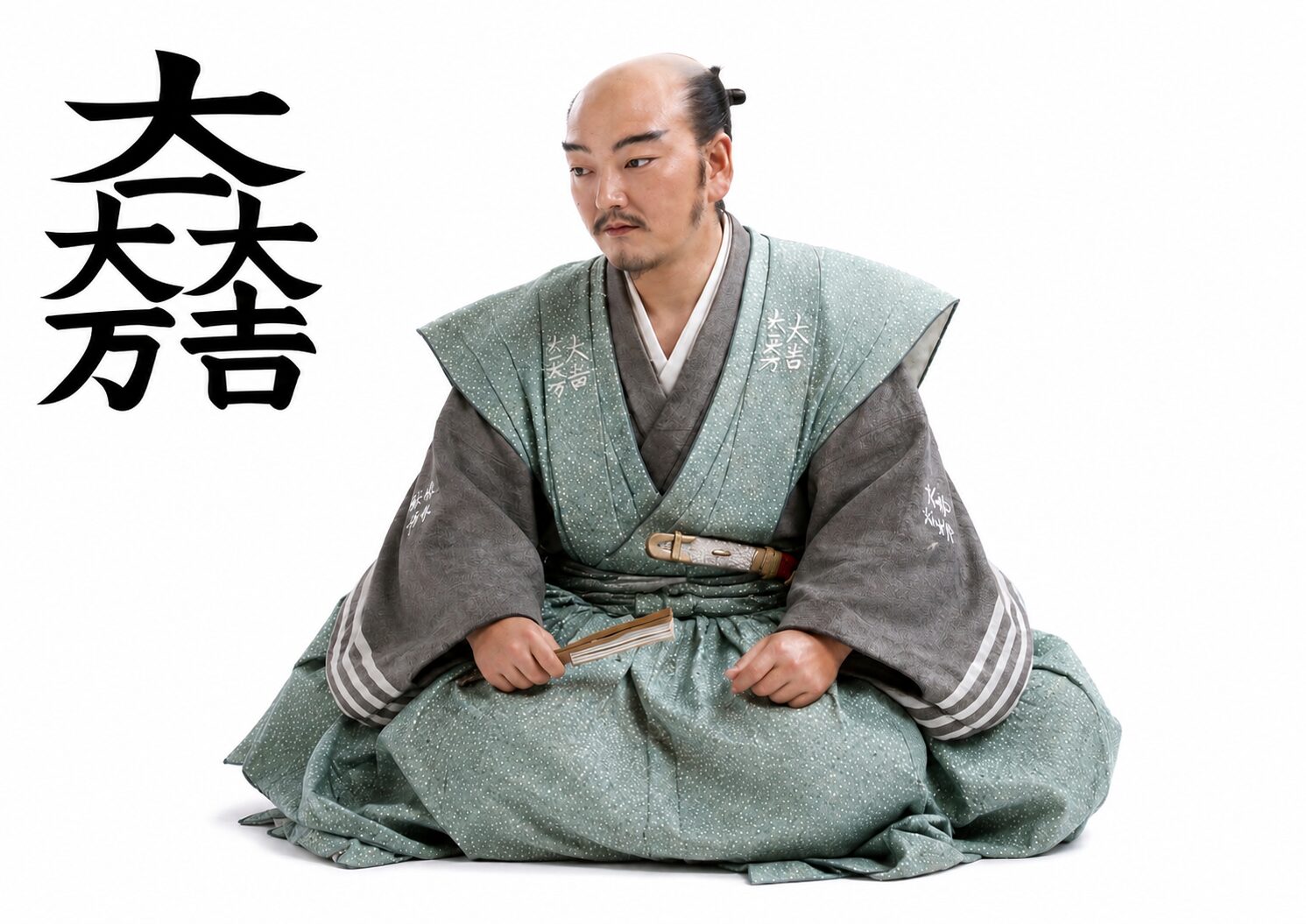
Ishida Mitsunari ― The Brain of the Toyotomi Regime, a Loyal Official Who Fell at Sekigahara
Eiroku 3 (1560) ― Keichō 5, 10th month, 1st day (November 6, 1600) | Died at the age of 41
- This Person in Three Lines
- The Mainstream Account ― The Standard Textbook Explanation
- Various Theories ― Exploring Possibilities from Different Angles
- A Strategic Perspective
- Ishida Mitsunari: Famous Quotes and Death Poem
- Anecdotes and Episodes
- Ishida Mitsunari: Life Timeline
- Ishida Mitsunari: Family and Key Relationships
- Related Historical Sites Map & Model Travel Course
- Related Battle Articles
- References
This Person in Three Lines
- An administrator-type warlord discovered by Toyotomi Hideyoshi, who served at the heart of the Toyotomi regime as one of the Five Commissioners (Go-Bugyō)
- He demonstrated outstanding ability in the Taikō land survey, supply management, and diplomacy, and held Sawayama in Ōmi with a domain of 194,000 koku
- After Hideyoshi’s death he came into conflict with Tokugawa Ieyasu and led the Western Army at the Battle of Sekigahara, but was defeated and beheaded at Rokujō-gawara in Kyoto
The Mainstream Account ― The Standard Textbook Explanation
Birth and Entry into Hideyoshi’s Service (1560–1582)
Ishida Mitsunari was born in Eiroku 3 (1560) in Ishida village, Sakata district, Ōmi Province (present-day Ishida-chō, Nagahama City, Shiga Prefecture), as the second son of Ishida Masatsugu, a retainer of the Azai clan. His childhood name was Sakichi. That same year was, fittingly, the turning point of Sengoku history in which Oda Nobunaga, who would later become Mitsunari’s lord, struck down Imagawa Yoshimoto at the Battle of Okehazama.
In Genki 1 (1570), Azai Nagamasa‘s Odani Castle was attacked and destroyed by Oda Nobunaga, and the lord of the Ishida family changed to Nobunaga’s vassal Hashiba Hideyoshi (later Toyotomi Hideyoshi). There are various theories about when Mitsunari entered Hideyoshi’s service. In the most famous “Three Cups of Tea” anecdote he is said to have been around 15, but according to the Jushōin “Reihai Nikkan” written by Mitsunari’s son Shigeie, it was when he was 18, at Himeji. What can be confirmed from primary sources is that around the 10th month of Genki 2 (1571), his father Masatsugu and second elder brother Masazumi submitted to Hideyoshi, and Mitsunari followed.
The Battle of Shizugatake and Early Achievements (1582–1585)
In Tenshō 10 (1582), Mitsunari begins to appear in reliable sources. After the Honnō-ji Incident, Mitsunari took part in the Battle of Yamazaki, and in the following year, the Battle of Shizugatake in Tenshō 11 (1583), he was active as an intelligence officer. Hideyoshi’s pursuit and victory over Shibata Katsuie was a total effort that committed even his close attendants and personal guard, and Mitsunari distinguished himself through intelligence activities recorded in the Shōmyō-ji documents. During this period Mitsunari accompanied Hideyoshi in one large-scale military operation after another ― the Chūgoku campaign, the water siege of Takamatsu Castle in Bitchū, the Battle of Yamazaki, and the Battle of Shizugatake ― acquiring a feel for the realities of the battlefield.
In Tenshō 13 (1585), when Hideyoshi became Kanpaku (Imperial Regent), Mitsunari was appointed Junior Fifth Rank, Lower Grade, Jibu-no-shō. From then on, “Jibu-no-shō” became Mitsunari’s common title. Around the same time he is said to have received a domain of 40,000 koku at Minakuchi in Ōmi (with various theories about the timing). Under Hideyoshi’s regime, Mitsunari rapidly came to prominence as a young ace handling practical affairs in the fields of diplomacy, administration, and military matters.
The Kyushu Pacification and the Water Siege of Oshi Castle (1587–1590)
In Tenshō 15 (1587), he took part in Hideyoshi’s pacification of Kyushu. Against an army said to total 250,000, he was put in charge of supply and provision management, and his practical ability was highly valued. He was also deeply involved in postwar matters such as the rapid transport of troops using the navy and the reconstruction of Hakata. The reorganization of the streets of Hakata after the Kyushu pacification is said to have been carried out chiefly by Mitsunari, and his urban planning became the foundation of early-modern Hakata.
In Tenshō 18 (1590), taking part in the Odawara campaign, Mitsunari was assigned to capture Oshi Castle (Musashi Province, present-day Gyōda City, Saitama Prefecture), a branch castle of the Hōjō side. Against Oshi Castle, where the castellan Narita Nagachika (the “Nobō-sama” of “Nobō no Shiro”) and about 2,700 people including foot soldiers, peasants, and townspeople were holed up, Mitsunari carried out a water siege on Hideyoshi’s orders. He raised the 28-kilometer “Ishida Embankment” in five days, but could not submerge the main keep, and Oshi Castle held out as a “floating castle” until July 16, after Odawara Castle had surrendered. This “failure” of the water siege would later become the basis for the label that “Mitsunari was poor at warfare.”
Worth noting is that the army for this attack on Oshi Castle included many lords who would later become Mitsunari’s allies and supporters ― Ōtani Yoshitsugu, Natsuka Masaie, Sanada Masayuki, Naoe Kanetsugu, Satake Yoshinobu, Utsunomiya Kunitsuna, and others. It was on the front lines of this siege of Oshi Castle that Mitsunari built relationships with them. That the supposedly failed attack on Oshi Castle became, as a result, the occasion for forming Mitsunari’s network of connections can be called one of history’s ironies.
The Korean Campaigns and Becoming Lord of Sawayama (1592–1598)
In the Korean campaigns (the Bunroku and Keichō wars) that began in Bunroku 1 (1592), Mitsunari crossed over to Korea as a commissioner and was deeply involved in the peace negotiations between Japan and Ming China. In Bunroku 4 (1595), the Hidetsugu Incident occurred, in which Toyotomi Hidetsugu was made to commit seppuku at Mount Kōya, and 70,000 koku within Ōmi from his former domain became Mitsunari’s stewardship land. That same year, he was granted Sawayama in Ōmi with 194,000 koku by Hideyoshi and formally became lord of Sawayama Castle.
Sawayama Castle was a strategic point connecting the Kinai region with the eastern provinces, an important base in both military and political terms. Mitsunari’s position joined the very core of the Toyotomi regime in name and reality. Incidentally, in Keichō 3 (1598), Hideyoshi at one point intended to grant Mitsunari Kobayakawa Hideaki’s former domain, but as no one suitable could be found to govern Sawayama Castle in Mitsunari’s place, and because he wished to make use of Mitsunari’s ability at the center of government, he ultimately decided not to move Mitsunari from Sawayama (Utsuki Documents). It is an episode that shows just how important Mitsunari’s position as lord of Sawayama was regarded.
From the Keichō campaign that began in Keichō 2 (1597), the friction with the military faction generals such as Katō Kiyomasa and Kuroda Nagamasa became decisive over the reporting of the situation at the Battle of Ulsan Castle. From Fukuhara Nagataka (Mitsunari’s brother-in-law), an army inspector closely tied to Mitsunari, the movements of Kuroda Nagamasa, Hachisuka Iemasa, Katō Kiyomasa, Tōdō Takatora, and others considering a reduction of the front lines were reported to Hideyoshi, and an enraged Hideyoshi severely reprimanded them. This became a strong grudge by the military faction against Mitsunari and laid the groundwork for the later Seven Generals Incident.
Hideyoshi’s Death and the Seven Generals Incident (1598–1599)
In the 8th month of Keichō 3 (1598), Toyotomi Hideyoshi died. The Toyotomi regime shifted to a council system composed of the Five Elders (Go-Tairō) ― Tokugawa Ieyasu, Mōri Terumoto, Uesugi Kagekatsu, Maeda Toshiie, and Ukita Hideie ― and the Five Commissioners (Go-Bugyō) ― Asano Nagamasa, Maeda Gen’i, Mitsunari, Mashita Nagamori, and Natsuka Masaie. Mitsunari, as the core of the administration, worked tirelessly for loyalty to Hideyori and the survival of the Toyotomi house.
On the 3rd day of the intercalary 3rd month of Keichō 4 (1599), Maeda Toshiie, who had mediated between the civil and military factions, died. The next day, an incident to expel Mitsunari broke out, led by the seven generals of the military faction ― Katō Kiyomasa, Fukushima Masanori, Kuroda Nagamasa, Hosokawa Tadaoki, Asano Yoshinaga, Hachisuka Iemasa, and Tōdō Takatora (the Seven Generals Incident). With the help of Satake Yoshinobu, Mitsunari escaped to his own residence within Fushimi Castle, the Jibu-no-shō Enclosure. In the end, through the mediation of Ieyasu and Kōdai-in (Kita-no-mandokoro), his retirement from government and seclusion at Sawayama were decided. The civil faction of the Toyotomi regime effectively collapsed, and Ieyasu came to seize power as the leading Elder.
The Battle of Sekigahara and the End (1600)
In the 6th month of Keichō 5 (1600), Ieyasu set out under the pretext of subjugating Uesugi Kagekatsu of Aizu. Seizing this opportunity, Mitsunari resolved to raise an army together with Ōtani Yoshitsugu and others. In the 7th month, he welcomed Mōri Terumoto into Osaka Castle as supreme commander of the Western Army, and together with three of the Five Commissioners (Mashita Nagamori, Natsuka Masaie, Maeda Gen’i) and three Elders (Mōri Terumoto, Ukita Hideie, Maeda Toshinaga) issued the “Articles of the Naifu’s Misconduct” (Naifu-chigai no Jōjō). It enumerated Ieyasu’s offenses and proclaimed the legitimacy of the Western Army.
Mitsunari’s initial strategy was to pin Ieyasu’s Eastern Army down at Aizu and, in the meantime, seize control of the Kinai and its surroundings. However, Ieyasu decided on the spot to march west at the Oyama Council on July 25. Mitsunari’s plan broke down early. From August into September, preliminary battles unfolded over Fushimi Castle, Gifu Castle, Ōgaki Castle, and others, and the Eastern Army continued its westward march at astonishing speed.
On September 15, the Eastern and Western armies clashed at Sekigahara. Mitsunari placed his headquarters at Sasao-yama and commanded the roughly 75,000-strong Western Army, but due to the betrayal of Kobayakawa Hideaki, the non-combat stance of Mōri and Kikkawa Hiroie, and the seppuku of Ōtani Yoshitsugu, the Western Army suffered a crushing defeat in a single day. Mitsunari fled into the Ibuki mountains, and around September 21 was captured by the pursuers of Tanaka Yoshimasa at Furuhashi village in Ika district. During his flight, there remains a tradition that Mitsunari was sheltered by the villagers of Furuhashi village, said to be his mother’s hometown.
On October 1, Mitsunari, together with Konishi Yukinaga and Ankokuji Ekei, was paraded through Osaka and Sakai and then beheaded at Rokujō-gawara in Kyoto. He was 41. The anecdote that, just before execution, he refused the dried persimmon offered by a guard, calling it “harmful to phlegm,” and said, “A man who thinks of a great cause cherishes his life to the very end,” is still passed down as an episode symbolizing Mitsunari’s indomitable spirit. After Mitsunari’s head was exposed at Sanjō-gawara, it was buried at Sangen-in, a sub-temple of Daitoku-ji in Kyoto, by the hands of his friends Shun’oku Sōen and Takuan Sōhō.
→ For details, see the battle article “Battle of Sekigahara“
Various Theories ― Exploring Possibilities from Different Angles
[Theory 1] Are the “Three Cups of Tea” Fact or Fiction?
The all-too-famous anecdote that tells of the meeting between Ishida Mitsunari and Toyotomi Hideyoshi is the “Three Cups of Tea.” On his way back from falconry, Hideyoshi, then lord of Nagahama Castle, is said to have stopped at a temple and asked for tea, whereupon Mitsunari, a young acolyte at the temple, served him tea in three stages, varying the temperature and amount. Impressed by this attentiveness, Hideyoshi is said to have taken Mitsunari into his service.
However, the sources of this anecdote are Edo-period compilations such as “Shishi Seidan,” “Meishō Genkōroku,” and “Bushō Kanjōki (Saigyokuwa),” and it does not exist in contemporary Sengoku-era sources. The historian Watanabe Daimon points out that this anecdote is “highly likely to have been created in later ages.” One important piece of evidence supporting the fabrication theory is the Jushōin “Reihai Nikkan” written by Mitsunari’s son Shigeie. According to it, Mitsunari entered Hideyoshi’s service at the age of 18, at Himeji, which does not match the setting of the “Three Cups of Tea” (a boyhood Mitsunari meeting Hideyoshi at a temple in Ōmi).
Nor is there a single fixed candidate for the setting of the anecdote. The most famous is Ōhara Kannon-ji in Asahi, Maibara City, Shiga Prefecture, where a “well from which Mitsunari drew water” is said to remain. On the other hand, there is also a theory placing it at Hokke-ji Sanju-in (now a former site) in Furuhashi, Kinomoto-chō, Nagahama City, Shiga Prefecture, said to be Mitsunari’s mother’s hometown. The very fact that multiple candidate sites coexist in tradition suggests that this anecdote is a later creation.
That said, the fact that the “Three Cups of Tea” is fiction does not mean Mitsunari was mediocre. It is a fact that Hideyoshi saw through Mitsunari’s talent at an early stage and entrusted him with important practical affairs such as land surveys, supply, and diplomacy. The people of the Edo period simply distilled the reason for that talent into an easy-to-understand episode about “hospitality with tea.”
So where, then, lay the historical starting point of Mitsunari’s rise? What can be confirmed from primary sources is that Mitsunari’s father Masatsugu and second elder brother Masazumi appear to have submitted to Hashiba Hideyoshi, a vassal of Oda Nobunaga, and that Mitsunari then followed in serving Hideyoshi. Mitsunari appears in reliable sources from Tenshō 10 (1582) onward. Through the Honnō-ji Incident of the 6th month of that year, the subsequent Battle of Yamazaki, and the Battle of Shizugatake the following year, Mitsunari came to prominence as Hideyoshi’s close attendant. The true starting point of Mitsunari’s rise was not “hospitality with tea,” but the steady close service from his late teens into his early twenties, and the administrative ability and judgment that Hideyoshi discerned within it.
[Theory 2] A “Pale Intellectual” or a “Decisive Warrior”?
When it comes to Ishida Mitsunari’s image, the picture of a “shrewd intellectual bureaucrat,” “the representative of the civil faction,” and “a desk worker without military merit” has long been entrenched. Beginning with Shiba Ryōtarō’s novel “Sekigahara,” this image has been reproduced in many popular works.
However, Nakano Hitoshi, a professor at Kyushu University, in his “Biography of Ishida Mitsunari” (Yoshikawa Kōbunkan, 2017), thoroughly analyzed contemporary primary sources and flatly rejected this “pale intellectual” image. The Mitsunari that Nakano drew was a life-sized warrior who “decisively pushed matters forward, bold and stout-hearted.” One of the stepping stones for Mitsunari’s climb up the ladder of advancement was his activity as an intelligence officer at the Battle of Shizugatake, and Nakano points out that going to the field for the Taikō land survey was effectively like entering enemy territory.
He was also skilled in diplomacy. There remain letters showing his close ties with Uesugi Kagekatsu and Naoe Kanetsugu, and actions showing his relationship of trust with Satake Yoshinobu ― records of his activity as a diplomatic window with many daimyo families. Contrary to the conventional image of being “unsociable and unapproachable,” he was a person regarded with respect by the daimyo as someone worthy of trust.
The “pale intellectual” image created in the Edo period was a fictional construct born of the need to denigrate the defeated Mitsunari as “unwarrior-like” and a “cunning schemer,” in order to emphasize the legitimacy of the victor, Tokugawa Ieyasu. The Mitsunari that primary sources tell of was a person of high ability in both the martial and civil spheres, befitting the center of the Toyotomi regime.
Mitsunari’s work as a diplomat is also not to be overlooked. Looking at the surviving letters from Mitsunari to Uesugi Kagekatsu, there are many of quite a friendly tone. On the occasion of Kagekatsu’s visit to the capital in Tenshō 14 (1586), Mitsunari attended to receive him. Mitsunari’s diplomatic dealings were not limited to the Uesugi house; records remain of his activity as a diplomatic window with many other daimyo families as well. It is hard to imagine that a person entrusted with important diplomatic negotiations was truly unsociable and unapproachable; rather, he likely possessed a side capable of fine attentiveness ― this is the view of recent researchers.
[Theory 3] Was the Water Siege of Oshi Castle Mitsunari’s Idea or Hideyoshi’s Order?
What has long been cited as the greatest basis for Mitsunari being called “poor at warfare” is the water siege of Oshi Castle during the Odawara campaign of Tenshō 18 (1590). The general account holds that Mitsunari, “imitating Hideyoshi,” fixated on a water siege and, as a result, suffered heavy losses and failed.
However, recent primary-source research has completely overturned this account. The driving force behind the water siege was Hideyoshi himself, and Mitsunari was, on the contrary, critical of it. The decisive evidence is a letter by Mitsunari dated the 12th day of the 6th month of Tenshō 18. In this letter Mitsunari laments, “the various forces are absorbed in preparing the water siege, and there is no move to attack the castle.” Further, in a letter dated the 13th of the 6th month addressed to Asano Nagamasa and Kimura Shigekore, Mitsunari proposes a direct assault, asking “should we first close in and attack?”
In response, Hideyoshi sent Mitsunari letter after letter, instructing him in fine detail on the method of the water siege, diagrams of the embankment, and points of caution. In other words, Mitsunari was merely carrying out the water siege following Hideyoshi’s instructions, and he ended up leaving his name in history bearing the responsibility for its failure himself.
The reason Hideyoshi fixated on a water siege is said to have been not simply to take the castle, but to display the wealth and power of the Toyotomi regime to the eastern lords by showing them a water siege carried out at enormous cost. It was an idea typical of Hideyoshi, who built the Ishigakiyama “one-night castle” overlooking Odawara Castle. The 28-kilometer embankment was more than four times the length of the water siege of Takamatsu Castle in Bitchū. Mitsunari, as the official in charge of such a “war meant to be seen,” played the role of perfectly embodying Hideyoshi’s intentions. It was Mitsunari who was labeled “poor at warfare,” but the reality was the figure of a practical official faithfully carrying out his lord’s orders.
Worth noting is the fact that, on June 18, an unexpected heavy rain breached the embankment, causing many drowning deaths among the besieging army. Mitsunari’s army surrounded the castle with a large force exceeding 20,000, but Oshi Castle stood in low wetlands sandwiched between the Tone and Ara rivers, a natural fortress that even Uesugi Kenshin and Hōjō Ujiyasu could not take. This battle, in which the castellan Narita Nagachika (the “Nobō-sama” of “Nobō no Shiro”) and about 2,700 people including foot soldiers, peasants, townspeople, women, and children held out, has gained popular fame in recent years as a “heroic tale of the defenders” through the novel and film adaptation of “Nobō no Shiro.” Yet when reexamined from the perspective of the besieger Mitsunari, a different image of history comes into view.
[Theory 4] The Truth of the Seven Generals Incident ― “Fleeing into Ieyasu’s Residence” Is Fiction
The greatest received account of the Seven Generals Incident ― that “a cornered Mitsunari cleverly dashed into the Fushimi residence of his enemy Tokugawa Ieyasu and escaped danger” ― is now considered entirely mistaken.
According to the detailed examination by the historian Kasaya Kazuhiko in “Sekigahara: The Four-Hundred-Year Mystery,” the place Mitsunari fled to was not Ieyasu’s residence but his own residence within Fushimi Castle, the Jibu-no-shō Enclosure. The source of the dramatic story of “fleeing into Ieyasu’s residence” is the “Japanese Military History: The Sekigahara Campaign” compiled by the Army General Staff in the Meiji period, and Tokutomi Sohō’s “Modern History of the Japanese Nation: The Sekigahara Campaign”; there is nothing in Edo-period primary sources showing that Mitsunari went to Ieyasu’s residence. According to recent research, Mitsunari, who was in the castle town of Osaka, first fled to the residence of Satake Yoshinobu, and Satake himself placed Mitsunari in a palanquin and delivered him to the Ishida residence below Fushimi Castle.
There is a further important point. In his 2018 paper “The Toyotomi Seven Generals Incident (intercalary 3rd month, Keichō 4) Was Not an ‘Armed Attack Incident’ but Merely a ‘Lawsuit Disturbance,'” the historian Shiramine Jun argued that the incident itself was not an “armed attack” but a “lawsuit.” The seven generals merely brought suit over Mitsunari’s past misdeeds (especially the slander during the Korean campaign), and did not intend to attack Mitsunari’s residence and kill him.
What tends to be overlooked in the outcome of the incident is Ieyasu’s move. The “Tamon-in Nikki,” entry for the 14th of the intercalary 3rd month of Keichō 4, states that after the incident Ieyasu entered Fushimi Castle and became “lord of the realm.” The historian Horikoshi Yūichi emphasizes the record that Ieyasu “drove out the caretakers” and points out that Ieyasu seized the authority over the practical management of Fushimi Castle, as stipulated in Hideyoshi’s will, from the Five Commissioners and took over direct management himself. In other words, the Seven Generals Incident was not merely a private feud between the military and civil factions, but a decisive event in political history in which Ieyasu took a great step toward seizing the realm.
Recent research by Mizuno Tomoki also offers a new perspective on the origin of the incident. According to Mizuno, it was not the case that all seven generals sought to expel Mitsunari for the same reason. Certainly, Kuroda Nagamasa, Hachisuka Iemasa, Katō Kiyomasa, Tōdō Takatora, and others were motivated by a grudge over their unjust treatment during the Korean campaign (the affair in which Mitsunari’s brother-in-law Fukuhara Nagataka and others reported them to Hideyoshi as the “front-reduction faction,” for which they were severely reprimanded). However, Hosokawa Tadaoki and Fukushima Masanori had nothing to do with this affair and are said to have joined the attack for other reasons. In other words, the seven generals were not monolithic; their individual grudges and political calculations accumulated into the move to expel Mitsunari.
What tends to be overlooked in the conclusion of this incident is the terms of reconciliation. As a result of the negotiations, in exchange for the seven generals disarming and lifting the siege, Mitsunari’s retirement from government and seclusion at Sawayama were decided. Also, his heir Ishida Shigeie was to serve at Osaka Castle under Toyotomi Hideyori. Incidentally, the seven generals had also demanded the punishment of the commissioner Mashita Nagamori, but this was shelved by Ieyasu’s intention. It can be thought that the groundwork for Mashita Nagamori later defecting to the Eastern Army was laid by Ieyasu at this point.
[Theory 5] Was Sekigahara Mitsunari’s Battle? ― The Mōri Terumoto Mastermind Theory
When it comes to the Battle of Sekigahara, it is conventionally told in the framework of “Tokugawa Ieyasu vs. Ishida Mitsunari.” The standard understanding for over 400 years is that Mitsunari, as the ringleader of the Western Army, challenged Ieyasu, was defeated, and executed. In recent years, however, this very “Mitsunari ringleader theory” is being reconsidered.
The historian Andō Yūichirō, in “Ieyasu, General of the Rebel Army: The Unknown Truth of Sekigahara,” points out, “Mitsunari is portrayed as the ringleader, but that is wrong. The ambitious Mōri Terumoto has been written out of the story.” His view is that Terumoto was the true leader of the Western Army, and Mitsunari was no more than its practical core.
Looking at Terumoto’s actions, his initiative stands out. In response to Mitsunari’s request, he entered the western enceinte of Osaka Castle in only a few days. This speed would have been utterly impossible without prior preparation, suggesting that there was a detailed plan in advance among Terumoto, Mitsunari, Ōtani Yoshitsugu, and Ankokuji Ekei. Terumoto was also active during the main battle at Sekigahara, sending letters to many daimyo to join the Western Army and dispatching Mōri forces to Shikoku and Kyushu to expand his power. The “Articles of the Naifu’s Misconduct” (the proclamation of the Western Army’s legitimacy listing Ieyasu’s offenses) was issued under the joint signatures of three Elders (Mōri Terumoto, Ukita Hideie, Maeda Toshinaga) and three Commissioners (Mashita Nagamori, Natsuka Masaie, Maeda Gen’i). It was an official document of impeachment against Ieyasu by the center of the regime, not by Mitsunari as an individual.
So why did history come to remember Mitsunari as the “ringleader”? One important reason is the postwar settlement. Through the prior secret negotiations of Kikkawa Hiroie, Terumoto obtained from Ieyasu the interpretation that he had “been unwillingly made supreme commander of the Western Army by rebels such as Ankokuji Ekei,” and, promised the security of his domain, withdrew from Osaka Castle (and though later greatly reduced, the Mōri clan survived). Mitsunari, on the other hand, was executed and came to bear the stigma of defeat alone. The historical narrative that placed sole responsibility on Mitsunari as the “ringleader” was a story convenient for the victor, the Tokugawa shogunate, and a political fiction that made Mōri Terumoto’s active involvement “never to have happened.”
There is another important point. On the 15th of the 7th month of Keichō 5, Shimazu Yoshihiro sent a letter to Uesugi Kagekatsu, conveying that “Terumoto and Hideie, together with the Osaka elders (Natsuka Masaie, Mashita Nagamori, Maeda Gen’i), Ōtani Yoshitsugu, and Ishida Mitsunari have consulted together and wish to join with Kagekatsu for the sake of Hideyori” (“Satsuhan Kyūki Zatsuroku Kyūhen”). In other words, the overthrow of Ieyasu was not Mitsunari’s individual ambition but a collective decision by the core of the Toyotomi regime. In the end, Sekigahara was not the simple confrontation of “Ieyasu vs. Mitsunari,” but of “Ieyasu vs. the core of the Toyotomi regime” ― this is the image that recent research presents.
[Theory 6] “Lord and Vassal Sharing the Stipend” ― The Truth of Recruiting Shima Sakon
The most famous of Mitsunari’s retainers is Shima Sakon (Kiyooki), feared as “Sakon the Demon.” Mitsunari is said to have recruited this brave general ― celebrated in the verse “Two things too good for Jibu-no-shō (Mitsunari): Shima no Sakon and the castle of Sawayama” ― by giving up half of his own domain. This is the so-called anecdote of “lord and vassal sharing the stipend.”
According to the Edo-period compilation “Jōzan Kidan,” when Mitsunari was lord of Minakuchi in Ōmi with 40,000 koku, he offered 20,000 koku, half of his own domain, and, no matter how many times he was refused, did not give up, recruiting Shima Sakon with three respectful visits. The unprecedented treatment of having lord and vassal hold nearly the same stipend was without precedent even in the Sengoku period.
However, this famous anecdote too has come under question in recent years. As the historian Watanabe Daimon points out, during the period when Mitsunari held Minakuchi’s 40,000 koku, Shima Sakon was most likely still serving the Tsutsui family. Sakon is said to have left the Tsutsui family in the 2nd month of Tenshō 16 (1588), after which he lodged at Jihō-in, a sub-temple of Kōfuku-ji in Nara, and then served Gamō Ujisato. It is surmised that Mitsunari recruited Sakon, who had become a rōnin again after Gamō Ujisato’s transfer to Aizu, after Mitsunari became lord of Sawayama with 190,000 koku in Bunroku 4 (1595). Since Mitsunari’s stipend at that time was 190,000 koku, the premise of “giving up half” collapses.
There is a further interesting point. There is another anecdote that, when Mitsunari was a page, he gave up his entire fief of 500 koku to recruit the warrior Watanabe Kanbei, whom Shibata Katsuie and his lord Toyotomi Hideyoshi had tried to recruit for 12,000 koku. There is also a theory that the “lord and vassal sharing the stipend” story is a reworking based on this Watanabe Kanbei story. That said, in the Ishida Mitsunari handan (signed document) discovered in 2008, Sakon’s name is clearly recorded, confirming that Sakon served as a senior retainer of Mitsunari and was also engaged in domestic administration. Whatever the details of the anecdote, the fact that Mitsunari acquired Shima Sakon on extraordinary terms is certain.
What should rather be noted is Mitsunari’s tenacity in recruiting talent. Whether or not he offered half his stipend, the fact that the much-sought-after Sakon (said to have had an offer even from Tokugawa Ieyasu) chose Mitsunari shows Mitsunari’s personal appeal and the sharpness of the strategic eye to reinforce his own military strength. Mitsunari himself was not the type to wield a spear, but he coldly grasped what he lacked and secured the necessary talent on extraordinary terms ― this, perhaps, was Mitsunari’s true ability, one that resonates even with modern managers.
Shima Sakon’s fighting at Sekigahara was ferocious, said in “Jōzan Kidan” to have terrified the Tokugawa side, who recalled, “truly our hair stood on end and we broke into sweat.” In the early Edo period, old warriors at Fukuoka Castle who had fought at Sekigahara talked together about Sakon’s attire, but their memories differed down to the standard, war surcoat, and armor; the reason was that “the sheer terror made their memories vague.” The lord-vassal relationship of Mitsunari and Sakon continues to shine on the boundary line between legend and historical fact, as one of the finest pairings in Sengoku history.
A Strategic Perspective
When Ishida Mitsunari is compared with other figures of the Sengoku period, three points stand out: “practical execution ability,” “diplomatic skill,” and “the perseverance of loyalty.”
First, practical execution ability. The Taikō land survey, which Mitsunari led, grasped the national koku yield by a unified standard and established the financial foundation of the Toyotomi regime ― a landmark tax reform. In modern terms, this corresponds to a large-scale land survey and tax reform that stabilizes national revenue. That he kept the supply flowing for an army totaling 250,000 in the Kyushu pacification was, for the time, an astonishing achievement. In the Bunroku and Keichō wars, he was ordered by Hideyoshi to carry out an invasion that could not actually succeed, and, caught between the angry voices of the field and Hideyoshi’s ideal, he bore the harsh task of getting by through false peace negotiations.
Second, diplomatic skill. He exchanged letters with many daimyo such as Uesugi Kagekatsu, Satake Yoshinobu, and Shimazu Yoshihiro, building relationships of trust. That Satake Yoshinobu shielded Mitsunari at the risk of himself in the Seven Generals Incident was the result of years of accumulated trust ― the very opposite of the conventional image of being “unsociable and unapproachable.” That he was able to gather over 80,000 troops for the Western Army at Sekigahara is also proof of the breadth of Mitsunari’s diplomatic network.
Third, the perseverance of loyalty. Mitsunari’s banner motto “Dai-Ichi Dai-Man Dai-Kichi” is said to mean “if one person works for all, and all work for one, the people of the realm will become fortunate” (though this banner motto itself does not appear in sources before the early Edo period, and there is a theory that it is a later creation). After Hideyoshi’s death, Mitsunari upheld his loyalty to the Toyotomi house to the end and was one of the few daimyo to resist head-on Ieyasu’s usurpation of the realm.
Of course, there were limits as well. Mitsunari is said to have committed three strategic errors. First, his initial plan to pin Ieyasu’s Eastern Army down at Aizu broke down when the Eastern Army reversed and marched west. Second, though he repeatedly requested Mōri Terumoto to sortie from Osaka, he was unable to make him leave Osaka due to suspicions of Mashita Nagamori’s betrayal. Third, the decision on September 14 to leave Ōgaki Castle and advance to Sekigahara ― a strategic error said to have fallen for Ieyasu’s lure toward a decisive battle. These were less a matter of Mitsunari’s individual lack of ability than the result of complex factors: insufficient coordination within the Western Army, Terumoto’s cautious stance, and the secret defections of Kobayakawa Hideaki and Kikkawa Hiroie.
If Ieyasu embodied realism, Mitsunari embodied idealism. The ideal of “Dai-Ichi Dai-Man Dai-Kichi” ― one person for all, and all for one ― has continued to resonate in the hearts of many people from the Meiji era onward to the present day, even if it was concealed by the Edo shogunate. Rather than a “treacherous vassal,” the image of Mitsunari that comes closest, in light of recent research, is “a practical official who tried to embody the ideals of the Toyotomi regime to the very end, in the transitional period from the Sengoku age to the early-modern era.”
Another important perspective is that Mitsunari was, at the same time as being a “man of loyalty,” also a “master of recruiting talent.” The anecdotes that he recruited Shima Sakon on extraordinary terms and acquired Watanabe Kanbei by giving up his entire stipend show that Mitsunari burned with a tenacity to secure “talent that reinforces his own power.” This is an idea that resonates with modern managers, and perhaps Mitsunari’s true originality lay here. Indeed, the greatest reason the Western Army collapsed in a single day at Sekigahara was the inaction and betrayal of great lords such as Mōri, Kobayakawa, and Kikkawa, while Mitsunari’s own force ― the elite 6,000-man unit including Shima Sakon, Gamō Sat’oie, and Mai Hyōgo ― fought hard to the end. The retainers Mitsunari chose upheld their loyalty to their lord to the very last.
Ishida Mitsunari: Famous Quotes and Death Poem
“Like the bonfire lit among the reeds at Chikuma Bay, my life, too, is one that fades away.”
The death poem Mitsunari composed just before his execution. It means, “Like the bonfire that fishermen light among the reeds at Chikuma Bay (a region on the eastern shore of Lake Biwa) in my homeland, my life is one that fades away fleetingly.” It expresses Mitsunari’s longing for his homeland of Ōmi and his state of mind in accepting his fate with detachment. It is a swan song that overlaid the 41 years of his life, devoted to the Toyotomi house, onto a watch fire that goes out at dawn.
“A man who thinks of a great cause will, even to the very moment his head is to be struck off, cherish his life and seek by any means to fulfill his true purpose.”
Just before his execution, when he asked the guards for water and was instead offered a dried persimmon, Mitsunari refused it, saying “persimmon is harmful to phlegm.” These were the words he flung at the guards who mocked him. It means, “One who harbors a great ambition will, even to the moment his head is struck off, cherish his life and seek by any means to fulfill his true wish.” It is known as a famous saying showing the resolve of a warrior who never gives up to the end.
― Source: “Meishō Genkōroku,” Volume 36
“Dai-Ichi Dai-Man Dai-Kichi”
A slogan said to have been used by Mitsunari as his banner motto. It is said to mean, “If one person works for all, and all work for one, the people of the realm will become fortunate (kichi).” It is an ideal akin to rugby’s “One for all, all for one.” However, this device appears reliably in sources only from the late Edo period onward, and its use during Mitsunari’s lifetime is not confirmed. There is a theory that it was concealed through information manipulation by the Tokugawa shogunate, and the possibility that it is a later creation cannot be denied either.
“Two things too good for Jibu-no-shō (Mitsunari): Shima no Sakon and the castle of Sawayama.”
Not Mitsunari’s own words, but a satirical verse (rakushu) of the time. It means: there are two things too good (excessive) for Mitsunari ― namely his retainer Shima Sakon and his stronghold Sawayama Castle. It is passed down to the present day as a contemporary appraisal of Mitsunari’s personal appeal and his ability to recruit talent, as well as the splendor of his castle.
Anecdotes and Episodes
The “Cup of Pus” with Ōtani Yoshitsugu
There is a famous anecdote that, at a tea gathering hosted by Toyotomi Hideyoshi, pus that fell from the face of Ōtani Yoshitsugu, who suffered from leprosy, dropped into a tea bowl. While the other participants would not take the bowl, Mitsunari said, “I am thirsty,” took the bowl, calmly drank it dry, and asked for another cup. Moved by this kindness, Yoshitsugu resolved, “I will follow this man,” and shared his fate with Mitsunari to the end at Sekigahara.
That said, the source of this anecdote is an Edo-period compilation, and its historicity is debated. Even so, it is passed down to the present day as a story symbolizing the deep bond between Mitsunari and Yoshitsugu.
― Source: “Jōzan Kidan” and others
“Persimmon Is Harmful to Phlegm” Just Before Execution
After his defeat at Sekigahara, Mitsunari fled into the Ibuki mountains, was captured by the pursuers of Tanaka Yoshimasa, and was to be executed at Rokujō-gawara in Kyoto. Just before the execution, when Mitsunari, feeling thirsty, asked the guards for water, he was told “there is no water, eat a persimmon instead” and handed a dried persimmon. To this Mitsunari refused, saying “persimmon is harmful to phlegm. I will not eat it.” When the guards mocked him, saying “what use is avoiding harmful food for one about to die?”, Mitsunari replied, “A man who harbors a great ambition cherishes his life even to the moment his head is struck off, and seeks to fulfill his true purpose.”
The sources are Edo-period compilations such as “Meishō Genkōroku” and “Meiryō Kōhan,” and its historicity cannot be confirmed, but it is the most famous anecdote symbolizing Mitsunari’s indomitable spirit. Incidentally, there are also records that Mitsunari loved persimmons, with letters showing persimmons sent to him by various warlords, and an anecdote of him bringing persimmons to the residence of Hosokawa Tadaoki, with whom he was on bad terms.
― Source: “Meishō Genkōroku,” “Meiryō Kōhan”
Consideration for His Heir Shigeie
At the resolution of the Seven Generals Incident, while Mitsunari accepted retirement from government and seclusion at Sawayama, his heir Ishida Shigeie was allowed to serve at Osaka Castle under Toyotomi Hideyori. For Mitsunari, this was an important negotiation that, in exchange for his own political downfall, secured the survival of the Ishida house and the continuation of loyalty to the Toyotomi house.
Shigeie subsequently survived the Battle of Sekigahara, became a monk, and lived to the age of 86 at Myōshin-ji. Mitsunari’s other children also largely survived, such as his daughter Tatsuhime marrying Tsugaru Nobuhira. In the Sengoku period, when it was normal for the families of “rebels” to be put to death, this was exceptional, and it is also evidence that Mitsunari received a certain degree of esteem from the daimyo.
The Gift of “Ishida Masamune” to Yūki Hideyasu
After the Seven Generals Incident, the one entrusted with the duty of delivering Mitsunari to Sawayama Castle was Tokugawa Ieyasu’s second son, Yūki Hideyasu. Mitsunari was moved by Hideyasu’s escort and gentlemanly treatment, and at parting is said to have given him his treasured sword “Ishida Masamune.”
This sword is the work of the master smith Masamune of the Kamakura period, and because there are two cut marks (defensive wounds) on the ridge of the blade and one on the tang, it is also called “Ishida Kirikomi Masamune.” It has a provenance of being held by Mōri Wakasa-no-kami → bought by Ukita Hideie → presented to Mitsunari, and is now held by the Tokyo National Museum as an Important Cultural Property. It is an episode showing Mitsunari’s character in extending courtesy even to the son of his enemy Ieyasu.
The Plot to Assassinate Ieyasu ― The Conspiracy at Minakuchi
In Keichō 5 (1600), Shima Sakon, who regarded Tokugawa Ieyasu as dangerous, is said to have proposed a plan to assassinate Ieyasu to Mitsunari. Mitsunari, too, was already proceeding with a plan together with Natsuka Masaie, lord of Minakuchi Okayama Castle in Ōmi: the scheme was to have Ieyasu, on his way east for the Aizu subjugation, be entertained at Minakuchi and cut down within the castle. However, Ieyasu had sensed this scheme and departed Minakuchi during the night. The plan is said to have ended in failure.
The source is the “Tokugawa Jikki,” but it is known as an anecdote suggesting that, in the tense political situation just before Sekigahara, the Mitsunari side was considering every means of removing Ieyasu.
― Source: “Tokugawa Jikki”
A Lord of Sawayama Beloved by His People
Throughout the Edo period Mitsunari was disparaged as a “treacherous vassal” and a “cold intellectual,” but recent analysis of high-quality primary sources has revealed that, as the lord governing the Sawayama domain, he was respected by his people. Achievements remain such as reforms to the levy on reeds and the repair of the Yodo River embankment, showing that Mitsunari was not merely a central bureaucrat but a locally engaged lord.
Even the Edo-period popular book “Ishida Gunki” could not help but say that Mitsunari’s end was admirable ― so strongly did the impression of his pure, intense character remain in people’s hearts. That the villagers who sheltered the fleeing Mitsunari were later not punished may also be an expression of the fact that Ieyasu and the Tokugawa shogunate could not completely deny Mitsunari’s personal virtue.
The Battle of Kuise-gawa on the Eve of Sekigahara
On the day before the Battle of Sekigahara, when the Western Army was shaken by news of Ieyasu’s arrival, Shima Sakon led 500 troops and challenged the Eastern Army units of Nakamura Kazue and Arima Toyouji, winning a victory together with the unit of Akashi Teruzumi, a retainer of Ukita Hideie (the Battle of Kuise-gawa). Riding the momentum, Sakon proposed a night attack together with Shimazu Yoshihiro and Konishi Yukinaga, but Mitsunari rejected it.
Some researchers cite this rejection of the night attack as one cause of the defeat in the main battle of Sekigahara. While there is an assessment that Mitsunari’s caution backfired as a strategic error, there is also a defense that, given the situation at the time, a night attack carried the risk of breaking down coordination within the Western Army.
Facial Reconstruction from the Skull
In the Meiji era, an excavation was carried out at Mitsunari’s gravesite at Sangen-in, a sub-temple of Daitoku-ji in Kyoto, and a skull was unearthed. This skull was analyzed forensically, and Mitsunari’s living face has been reconstructed. According to the reconstruction, Mitsunari was a person with a fair complexion and a gentle countenance, which also matches the image of the “beautiful youth” and “fair-skinned, intelligent warrior” spoken of in paintings and anecdotes.
The reconstructed image is now exhibited at the Ishida Hall, and is a precious resource as the closest thing to the living Mitsunari’s appearance. It is a rare opportunity to meet, across 400 years, the true face of the defeated Mitsunari.
Ishida Mitsunari: Life Timeline
| Year | Age | Event |
|---|---|---|
| 1560 | 0 | Born in Ishida village, Sakata district, Ōmi Province, as the second son of Ishida Masatsugu. Childhood name Sakichi. The Battle of Okehazama in the same year |
| 1570 | 10 | Fall of the Azai clan (Battle of Odani Castle). His father Masatsugu enters Hashiba Hideyoshi’s service (estimated) |
| c. 1574 | c. 14 | Enters service as Hideyoshi’s page (the “Three Cups of Tea” anecdote). However, his son’s record gives age 18, at Himeji |
| 1582 | 22 | Honnō-ji Incident and Battle of Yamazaki: begins to appear in reliable sources. Serves with Hideyoshi |
| 1583 | 23 | Battle of Shizugatake: active as an intelligence officer. Becomes a foothold for advancement |
| 1585 | 25 | Appointed Junior Fifth Rank, Lower Grade, Jibu-no-shō upon Hideyoshi becoming Kanpaku |
| 1587 | 27 | Kyushu pacification: in charge of supply for the 250,000-strong army. Also involved in the reconstruction of Hakata |
| 1590 | 30 | Odawara campaign / water siege of Oshi Castle: carries out the water siege on Hideyoshi’s orders. Shima Sakon’s name is confirmed |
| 1592 | 32 | Bunroku War (Korean campaign) begins. Mitsunari crosses to Korea as commissioner |
| 1595 | 35 | Hidetsugu Incident. Granted Sawayama in Ōmi with 194,000 koku, becomes lord of Sawayama Castle |
| 1597 | 37 | Keichō War. Friction with the military faction deepens over reporting of the situation at Ulsan Castle |
| 1598/8 | 38 | Toyotomi Hideyoshi dies. Handles government under the Five Elders / Five Commissioners system |
| 1599/intercalary 3 | 39 | Seven Generals Incident: the day after Maeda Toshiie’s death, escapes to his residence in Fushimi Castle with Satake Yoshinobu’s help. Ordered into seclusion, goes to Sawayama |
| 1600/7 | 40 | Raises an army upon Ieyasu’s sortie for the Aizu subjugation. Issues the “Articles of the Naifu’s Misconduct” |
| 1600/9/15 | 40 | Battle of Sekigahara: the Western Army is crushed by the betrayal of Kobayakawa Hideaki and others. Flees into the Ibuki mountains |
| c. 1600/9/21 | 40 | Captured by the pursuers of Tanaka Yoshimasa at Furuhashi village in the Ibuki mountains |
| 1600/10/1 | 41 | Execution: beheaded at Rokujō-gawara in Kyoto together with Konishi Yukinaga and Ankokuji Ekei. Died at 41 |
※ Ages are counted ages (kazoedoshi). Background colors: yellow = major battles/events, red = events related to his death.
Ishida Mitsunari: Family and Key Relationships
Family
| Relation | Person | Summary |
|---|---|---|
| Father | Ishida Masatsugu | A local magnate who governed Ishida village as a retainer of the Azai clan. Later entered Hashiba Hideyoshi’s service |
| Mother | Zuigaku-in | Daughter of an Azai retainer. Also said to be from the Iwata family. Tradition holds Furuhashi in Kinomoto-chō as her hometown |
| Elder brother | Ishida Masazumi | Mitsunari’s second elder brother. Became a warrior in Hideyoshi’s service. At Sekigahara he defended Sawayama Castle and took his own life when it fell |
| Wife | Kōgetsu-in (Uta) | Daughter of Uda Yoritada. Was in Sawayama Castle at the time of Sekigahara. Various theories about her end at the castle’s fall |
| Heir | Ishida Shigeie | Became a monk after Sekigahara, lived to age 86 at Myōshin-ji in Kyoto |
| Second son | Ishida Shigenari | After Sekigahara, fled to Ōshū relying on Tsugaru Nobuhira and left descendants |
| Daughter | Tatsuhime | Married into the Hirosaki domain lord’s house as the concubine of Tsugaru Nobuhira and left descendants |
Key Retainers, Allies, and Adversaries
| Relation | Person | Summary |
|---|---|---|
| Lord | Toyotomi Hideyoshi | The unifier who discovered Mitsunari and elevated him to the Five Commissioners. Mitsunari upheld his loyalty to Hideyoshi to the end of his life |
| Ally (Western Army) | Ōtani Yoshitsugu | Mitsunari’s ally. Known for the “cup of pus” anecdote. Fought hard at Sekigahara, took his own life upon Kobayakawa’s betrayal |
| Retainer (right-hand man) | Shima Sakon | Mitsunari’s right-hand man. Known for the “lord and vassal sharing the stipend” anecdote. Fought hard at Sekigahara, killed in battle |
| Supreme commander, Western Army | Mōri Terumoto | Supreme commander of the Western Army. Recently also seen as the “true ringleader.” Did not take the field at the main battle of Sekigahara; survived with a greatly reduced domain after the war |
| Fellow Commissioners | Asano Nagamasa, Maeda Gen’i, Mashita Nagamori, Natsuka Masaie | Administrative officials who supported the core of the Toyotomi regime. At Sekigahara, Natsuka was Western Army; Mashita Nagamori was suspected of defecting to the East |
| Supporter (Western Army) | Satake Yoshinobu | The daimyo who sheltered Mitsunari in the Seven Generals Incident. Took a neutral stance at Sekigahara, reduced in domain after the war |
| Greatest adversary | Tokugawa Ieyasu | Leading Elder. After Hideyoshi’s death pursued seizure of the realm, defeated Mitsunari at Sekigahara. Opened the Edo shogunate after the war |
| Head of the military faction | Katō Kiyomasa | Central figure in the Seven Generals attack. Came into conflict with Mitsunari over friction during the Korean campaign. As the Eastern Army, subdued Kyushu |
| Leader of the Seven Generals | Fukushima Masanori | Central figure in the Seven Generals attack. At Sekigahara, fought a fierce battle with the Ukita unit as the Eastern Army’s vanguard |
| Military faction | Kuroda Nagamasa | Son of Kuroda Kanbei. Central figure in the Seven Generals Incident. At Sekigahara, led the internal-defection maneuvering of Kikkawa Hiroie |
| Traitor (West → East) | Kobayakawa Hideaki | The figure who charged the Ōtani unit from Matsuo-yama at Sekigahara, becoming the decisive blow in the Western Army’s collapse |
Related Historical Sites Map & Model Travel Course
Related Historical Sites Map ― Ishida Mitsunari
Spots on the map:
- Ishida Mitsunari Birthplace / Ishida Hall (birthplace) ― Mitsunari’s birthplace. Exhibits armor, old documents, and the facial reconstruction image made from the skull
- Ishida Shrine (shrine) ― A shrine enshrining the Ishida clan. After Sekigahara, locals secretly buried the gravestones that had been destroyed
- Ōhara Kannon-ji (temple) ― A candidate setting for the “Three Cups of Tea” anecdote. The “well from which Mitsunari drew water” still exists
- Sawayama Castle Ruins (castle) ― Mitsunari’s stronghold (194,000 koku). One of the “things too good for Mitsunari”
- Ishida Embankment Historic Park (historic site) ― Part of the 28 km embankment built for the water siege of Oshi Castle still remains
- Oshi Castle Ruins (Gosankai Yagura) (castle) ― The setting of “Nobō no Shiro.” The “floating castle” that did not sink even in the water siege
- Fushimi Castle (castle) ― The setting of the Seven Generals Incident. Mitsunari fled to the Jibu-no-shō Enclosure within the castle
- Minakuchi Okayama Castle Ruins (castle) ― Natsuka Masaie’s castle, said to be the setting of the plot to assassinate Ieyasu
- Sekigahara Battlefield, Ishida Mitsunari Camp Site (Sasao-yama) (battlefield) ― Mitsunari’s headquarters site. A strategic vantage overlooking the Sekigahara basin
- Ōtani Yoshitsugu’s Grave (gravesite) ― Grave of Mitsunari’s ally Ōtani Yoshitsugu. Near where he took his own life in the main battle of Sekigahara
- Rokujō-gawara Execution Ground Site (execution site) ― The place where Mitsunari was executed. Now a promenade along the Kamo River
- Sangen-in (sub-temple of Daitoku-ji) (family temple) ― Mitsunari’s gravesite. Founded by Mitsunari together with Asano Yoshinaga and Mori Tadamasa
※ The map is a reference display based on modern roads. It differs from the roads and terrain of the Sengoku period.
Model Travel Course ― Tracing Mitsunari’s Life in Two Days
Conditions
- Time required: 2 days (by car)
- Day 1: Ōmi (places associated with Mitsunari)
- Day 2: Sekigahara and Kyoto (Mitsunari’s end)
Day 1: Visiting Places Associated with Mitsunari
① Ishida Mitsunari Birthplace / Ishida Hall (stay: about 40 min)
Mitsunari’s birthplace. Exhibits armor, old documents, and the facial reconstruction image made from the skull.
– By car: about 10 min from JR Nagahama Station
② Ishida Shrine (stay: about 15 min)
Right next to the Ishida Hall. Enshrines the Ishida clan.
– On foot: about 2 min from the Ishida Hall
③ Ōhara Kannon-ji (stay: about 30 min)
A candidate setting for the “Three Cups of Tea.” The “well from which Mitsunari drew water” remains.
– By car: about 15 min from Ishida Shrine
④ Sawayama Castle Ruins (stay: about 60 min)
Site of Mitsunari’s stronghold. About 20 min on foot to the summit. A sweeping view of the Hikone basin.
– By car: about 30 min from Ōhara Kannon-ji
⑤ Minakuchi Okayama Castle Ruins (stay: about 40 min)
Natsuka Masaie’s castle, said to be the setting of the plot to assassinate Ieyasu.
– By car: about 50 min from Sawayama Castle Ruins
Day 2: Tracing Sekigahara and the End in Kyoto
⑥ Sekigahara Battlefield, Ishida Mitsunari Camp Site (Sasao-yama) (stay: about 60 min)
Mitsunari’s headquarters site. A reconstructed horse-stockade and a sweeping view of the Sekigahara basin.
– By car: about 20 min from central Ōgaki City
⑦ Ōtani Yoshitsugu’s Grave (stay: about 40 min)
Grave of Mitsunari’s ally Yoshitsugu. About 10 min on foot from Sekigahara town.
– By car: about 15 min from Sasao-yama
⑧ Rokujō-gawara Execution Ground Site (stay: about 20 min)
The place where Mitsunari was executed. A promenade along the Kamo River.
– By car: about 2 hours from Sekigahara
⑨ Sangen-in (sub-temple of Daitoku-ji) (stay: about 30 min)
Mitsunari’s gravesite. Normally closed to the public, but viewable during special openings.
– By car: about 30 min from Rokujō-gawara
Arrangements by Type of Visitor
- For the energetic: Also visit the Mitsunari sites in the Kantō region (Oshi Castle Ruins, Ishida Embankment Historic Park), for a 3–4 day course
- For the relaxed: A day trip focused on three sites ― Ishida Hall, Ōhara Kannon-ji, and Sawayama Castle Ruins
- For the Sekigahara-focused: A half-day to one-day course touring Mitsunari’s camp at Sasao-yama, Ōtani Yoshitsugu’s grave, and the Sekigahara Town History and Folklore Museum
※ This plan is a reference model based on general travel speeds and stay times. Operating hours, transport schedules, and crowding vary by season and day. When you go, please check the latest information on the official websites of each facility and transport service.
※ Admission and entry fees are reference prices as of writing. They may have changed.
※ For mountain-castle ruins (Sawayama Castle Ruins, Minakuchi Okayama Castle Ruins), please make plans within your ability according to weather and fitness.
Related Battle Articles
- Battle of Shizugatake (1583) ― Where Mitsunari was active as an intelligence officer, becoming a foothold for advancement
- Battle of Sekigahara (1600) ― The realm-dividing battle where Mitsunari led the Western Army and clashed with Ieyasu
- Battle of Yamazaki (1582) ― The starting point of Hideyoshi’s seizure of the realm, in which Mitsunari served early on
- Honnō-ji Incident (1582) ― The grave event around the time Mitsunari begins to appear in reliable sources
References
Primary Sources
- “Tamon-in Nikki” ― Diary of the Kōfuku-ji monk Eishun. A contemporary record of the Seven Generals Incident
- “Keichō Kenmonsho” ― Records events around the time of the Battle of Sekigahara
- “Kanyōroku” ― The Korean Confucian scholar Kang Hang’s record of his observations in Japan, also mentioning the Seven Generals Incident
- “Satsuhan Kyūki Zatsuroku Kyūhen” ― Shimazu family records. Includes letters showing Mitsunari’s coordination with the Western Army generals
- “Kikkawa-ke Monjo” ― A group of letters showing the movements of Mōri and Kikkawa at the time of Sekigahara
- “Jōzan Kidan” ― A mid-Edo compilation. Source of the “lord and vassal sharing the stipend” anecdote
- “Meishō Genkōroku,” “Meiryō Kōhan” ― Edo-period compilations. Sources of the persimmon anecdote and others
Academic Works
- Nakano Hitoshi, “Biography of Ishida Mitsunari,” Yoshikawa Kōbunkan, 2017 ― The definitive image of Mitsunari based on primary sources
- Ōta Hiroshi, “The Wise General Born of Ōmi: Ishida Mitsunari,” Sunrise Publishing, 2009
- Tani Tetsuya, “Ishida Mitsunari,” Ebisu Kōshō Publishing (Series: Studies of Shokuhō Daimyo, Vol. 7), 2018
- Watanabe Daimon, “Was the Battle of Sekigahara a ‘Made-Up Story’?,” PHP Shinsho, 2024
- Watanabe Daimon, “The Toyotomi Five Commissioners and Ieyasu: The Power Struggle over the Battle of Sekigahara,” Kashiwa Shobō
- Watanabe Daimon (ed.), “Overturning the Popular Myths of Sengoku History,” Kashiwa Shobō, 2016
- Andō Yūichirō, “Ieyasu, General of the Rebel Army: The Unknown Truth of Sekigahara,” Nikkei Business Bunko
- Kasaya Kazuhiko, “Sekigahara: The Four-Hundred-Year Mystery,” Shin-Jinbutsu-Ōraisha
- Horikoshi Yūichi, “The Power Structure of the Toyotomi Regime,” Yoshikawa Kōbunkan, 2016
- Imai Rintarō, “Ishida Mitsunari,” Yoshikawa Kōbunkan (Jinbutsu Sōsho), 1988 (original 1961)
Public Papers and Materials
- Shiramine Jun, “The Toyotomi Seven Generals Incident (intercalary 3rd month, Keichō 4) Was Not an ‘Armed Attack Incident’ but Merely a ‘Lawsuit Disturbance,'” “Shigaku Ronsō” No. 48, 2018
- Shiramine Jun, “A Chronological Database of the Documents Issued by the Ishida–Mōri Coalition Government (Supplement),” “Bulletin of Beppu University” Vol. 60, 2019
- Kasaya Kazuhiko, “The Toyotomi Seven Generals’ Attack on Ishida Mitsunari ― The Mechanism of Historical Perception Formation and Its Pitfalls,” “Nihon Kenkyū” Vol. 22, 2000
- Mizuno Tomoki, “The Death of Maeda Toshiie and the Ishida Mitsunari Attack Incident,” “Seiji Keizai Shigaku” No. 557, 2013
- Shiga Prefecture official website, “Ishida Mitsunari: What Kind of Person Was He?”
- National Diet Library Digital Collection, “Meiryō Kōhan,” “Meishō Genkōroku”
※ This article is composed based on the above sources, research works, and papers, as well as multiple sources on the web. Interpretations of history differ even among researchers, and the established account may change with the discovery of new sources or the advance of research.
コメント