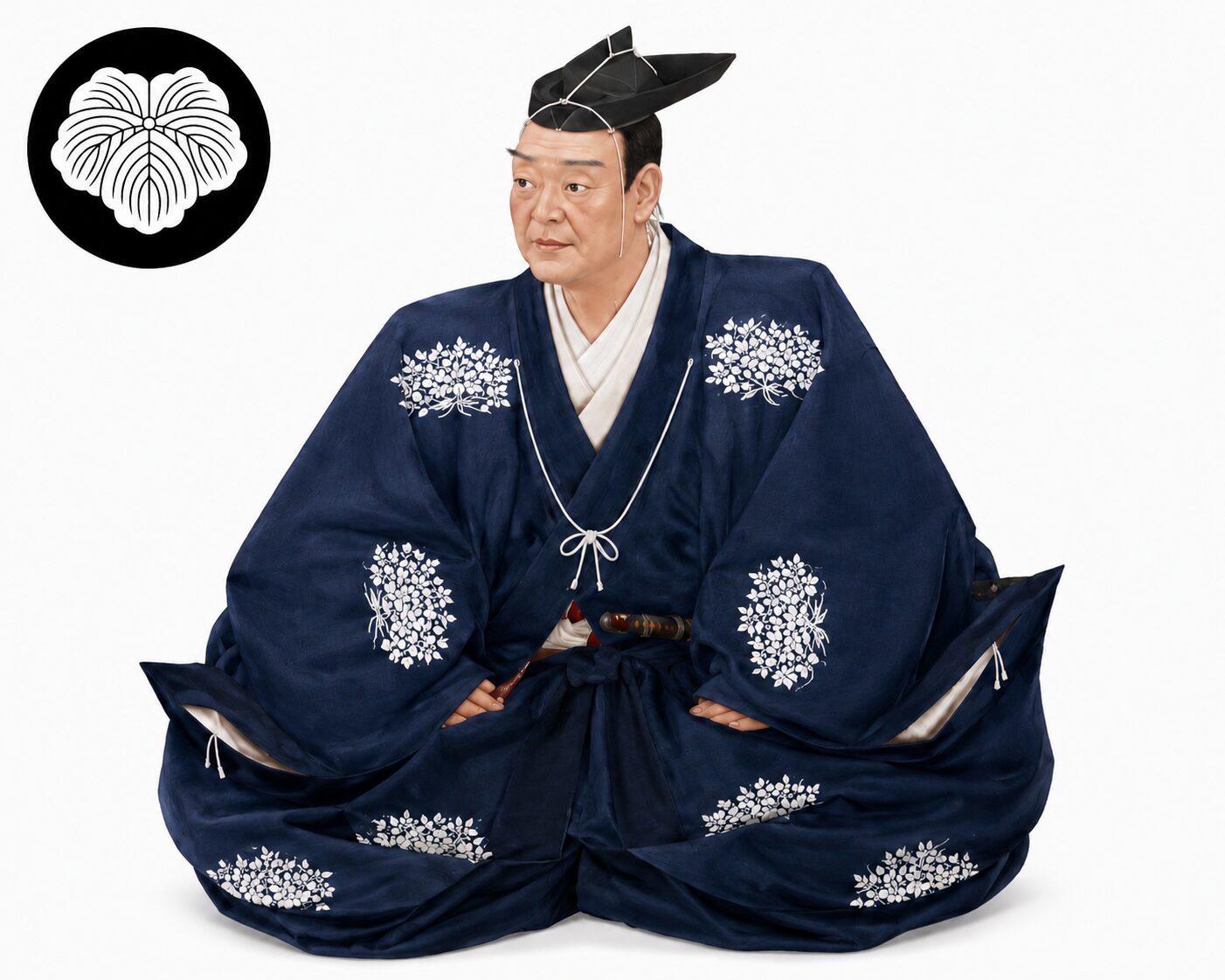
Matsunaga Hisahide — A Villain of the Sengoku, or an Exaggerated False Charge? The Truth of the Master of Yamato and Innovator of Castle-Building
- Three Points to Understand Matsunaga Hisahide
- The Mainstream View — A Standard Account Based on the Established Theory
- The Multiple Theories — Exploring Possibilities from Various Angles
- Viewed Strategically — Hisahide’s Politics, Military Affairs, and Culture
- Famous Words and Sayings Associated with This Warlord
- A Collection of Anecdotes and Episodes
- Timeline
- Lineage and Personal Relationships
- Related Historic Site Map and Model Travel Courses
- Related Articles
- References
Three Points to Understand Matsunaga Hisahide
- A warlord who rose from being the secretary (yūhitsu) of Miyoshi Nagayoshi in the Kinai region of the Sengoku period and came to rule the whole province of Yamato. As a master of castle-building, he constructed Tamonyama Castle and Shigisan Castle and built a “keep” (tenshu) that was a forerunner of the early-modern castle.
- From the Edo period on, he was regarded—as a villain (kyōyū) who had committed the “three evils” of killing his lord, killing the shogun, and burning the Great Buddha Hall—a representative evildoer ranking with Saitō Dōsan and Ukita Naoie. But in recent research, the factual basis of all three evils has been reexamined, and a reassessment is advancing.
- He rebelled twice against Oda Nobunaga and took his own life at Shigisan Castle in 1577 (Tenshō 5). He is widely known by the legend that he died in an explosion together with the famous tea utensil the “Hiragumo” (flat-spider) tea kettle, but this too is highly likely a later embellishment.
The Mainstream View — A Standard Account Based on the Established Theory
Origins Shrouded in Mystery and His Early Life
Matsunaga Hisahide’s early life is poor in sources, and both his origins and year of birth are uncertain, with various theories. The received view gives his year of birth as 1510 (Eishō 7), but there is no firm proof. As for his origins, there are several theories—Awa, Nishioka in Yamashiro, Yosumi in Settsu, Kaga, Chikuzen, Bungo, Ōmi, and others—and in recent years the theory of origin in Nishioka in Yamashiro or Yosumi in Settsu (present-day Takatsuki City, Osaka Prefecture) is regarded as influential.
At first he styled himself of the Fujiwara clan, and from 1561 (Eiroku 4) onward of the Minamoto clan. Around 1533–34 (Tenbun 2–3), amid the turmoil of the Kyoto-Kinai region, he served Miyoshi Nagayoshi, who had risen to prominence, as secretary (yūhitsu), and made his mark as an administrative official skilled at litigation liaison and document affairs. By 1542 (Tenbun 11), he was already in a position to lead a unit and was stationed in southern Yamashiro.
His younger brother Matsunaga Nagayori made a name in the Miyoshi household earlier than his elder brother through his talent for military command, and was entrusted with the military and civil administration of Yamashiro and Tanba. The picture was one in which the brothers supported the Miyoshi house by a division of roles—Hisahide in document affairs, Nagayori in military matters. Nagayori’s son is known as Naitō Joan, who later became a Christian.
Rising to Prominence as an Administrative Official of the Miyoshi Regime
In 1553 (Tenbun 22), Hisahide was appointed castellan of Takiyama Castle in Settsu (present-day Fukiai-chō, Chūō Ward, Kobe City) and took charge of the military administration of western Settsu and the Harima direction. However, he himself resided in the capital and managed litigation affairs, and Hisahide’s chief role was still administrative work.
In 1559 (Eiroku 2), to pacify Yamato, he moved as castellan to Shigisan Castle in Yamato (present-day Heguri-chō, Ikoma District, Nara Prefecture). After accompanying the expedition into Kawachi Province in the fifth month of that year, on Nagayoshi’s orders he entered Yamato on the sixth day of the eighth month and, in just a single day, took the base of Tsutsui Junkei, Tsutsui Castle. With this, the curtain rose on the long struggle with the Tsutsui clan over Yamato.
In 1560 (Eiroku 3), he broke Kōfuku-ji and unified the whole province of Yamato. On the twentieth day of the first month, together with Nagayoshi’s heir Miyoshi Yoshioki, he was appointed otomoshū (shogunal attendant) by Shogun Ashikaga Yoshiteru and was appointed to the office of Danjō-no-shōhitsu. From then on, he came to be known by the byname “Matsunaga Danjō.” In the eleventh month of that year, he moved his residence from Takiyama Castle to Shigisan Castle in northwestern Yamato and later built a keep there.
A Master of Castle-Building — Tamonyama Castle and Shigisan Castle
In the eighth month of 1562 (Eiroku 5), Hisahide began construction of Tamonyama Castle in Nara (present-day Hōren-chō, Nara City, near Wakakusa Junior High School). Built on Mt. Mikenji, about 115 meters in elevation and about 30 meters in relative height, this castle was called “Tamonyama Castle” because it enshrined Tamonten (Vaiśravaṇa), and it was an extremely advanced castle for its time.
According to the Kōfuku-ji Kyūki and the Kyōroku Tenbun no Ki, around 8:00 a.m. on the twelfth day of the eighth month of Eiroku 5, there was a ridgepole-raising ceremony for the “four-story turret” of Tamonyama Castle, and the residents of Nara were invited. This is said to have been a demonstration of his rule over Yamato, and it was an epoch that shifted the conception of the castle from a “castle to defend” to a “castle to display.” The long-house-like architecture of Tamonyama Castle’s “tamon turret” became the standard for later castle architecture, and it is assessed as a forerunner of the early-modern castle.
Shigisan Castle too underwent large-scale repair and expansion, and was reborn as a mountain castle equipped with a four-story keep. Hisahide divided his operations—his administrative base at Tamonyama Castle, his military base at Shigisan Castle—and completed his rule over Yamato with the two castles. Hisahide’s castle-building technology is said to have influenced Oda Nobunaga’s construction of Azuchi Castle as well.
The Death of Miyoshi Nagayoshi and the Power Struggle
In the eighth month of 1563 (Eiroku 6), Nagayoshi’s heir Miyoshi Yoshioki died of illness. Furthermore, in the seventh month of the following year, 1564 (Eiroku 7), Nagayoshi himself died of illness at Iimoriyama Castle. The Miyoshi house, having lost Hisahide’s greatest protectors in succession, made Miyoshi Yoshitsugu (the son of Nagayoshi’s younger brother Sogō Kazumasa), who had been adopted by Nagayoshi, its head; but Yoshitsugu was young, and the real power of the Miyoshi house came to be contested between the Miyoshi Three (Miyoshi Nagayasu, Miyoshi Masayasu, and Iwanari Tomomichi) and Hisahide.
In military chronicles from the Edo period on, the popular tale spread that “Hisahide poisoned Yoshioki and killed Nagayoshi by a curse,” but these are later inventions and lack any basis in the sources. Nagayoshi suffered from a long illness in his later years, and Yoshioki’s death of illness while young was not unusual at the time.
The Eiroku Incident — The Assassination of the 13th Shogun Ashikaga Yoshiteru
On the nineteenth day of the fifth month of 1565 (Eiroku 8), the forces of Miyoshi Yoshitsugu, the Miyoshi Three, and Matsunaga Hisamichi (Hisahide’s heir) attacked the Nijō Palace in Kyoto and killed the thirteenth shogun, Ashikaga Yoshiteru. This is what is called the “Eiroku Incident.” Yoshiteru’s mother Keijuin and younger brother Shūkō were also killed. Yoshiteru’s other younger brother, Kakukei (later Ashikaga Yoshiaki), was at the Ichijōin cloister of Kōfuku-ji in Nara and so escaped harm, and he later began the movement to restore the shogunate.
Conventionally, this incident has been related as “the crime of Matsunaga Hisahide,” but in recent research it has become clear that the one who took part in carrying it out was his son Hisamichi, while Hisahide himself was in Yamato that day and not directly involved. Whether Hisahide approved of the incident, opposed it, or tacitly consented is debated by various theories and is not settled.
Conflict with the Miyoshi Three and the Burning of the Great Buddha Hall of Tōdai-ji
After the Eiroku Incident, the conflict between Hisahide and the Miyoshi Three deepened. The Three, backed by the great Shikoku army of the Awa Miyoshi house led by Shinohara Nagafusa, threatened Hisahide’s power. In 1566 (Eiroku 9), Hisahide was driven into an inferior position, and his allies were limited to some forces—Hatakeyama Takamasa, the Negoro-shū, Hashio Takaharu, and others.
On the tenth day of the tenth month of 1567 (Eiroku 10), the forces of the Miyoshi Three and Hisahide clashed in Nara. The Three had pitched camp at Tōdai-ji, and as a result of Hisahide attacking it, the Great Buddha Hall of Tōdai-ji went up in flames. This is one of the incidents counted among “Hisahide’s three evils,” the “burning of the Great Buddha Hall.” However, there are various theories about who set the fire—a theory of an accidental fire from the aftermath of combat, a theory of an accidental fire from the Miyoshi camp—and sources that can establish it as Hisahide’s deliberate act are scarce.
Submission to Nobunaga and the Recapture of Yamato
On the twenty-ninth day of the sixth month of 1568 (Eiroku 11), Shigisan Castle was taken by the Miyoshi Three, and Hisahide fell into a hard plight, holed up in Tamonyama Castle. The one Hisahide relied on as a way out was Oda Nobunaga, who had pacified Mino. Hisahide, who had been in communication with Nobunaga from as early as 1566 (Eiroku 9), placed his hopes on Nobunaga’s entry into Kyoto.
In the ninth month of that year, Nobunaga entered Kyoto championing Ashikaga Yoshiaki. Hisahide responded by submitting to Nobunaga and pledged his loyalty by presenting the famous tea caddy the “Tsukumo-nasu.” Gaining Nobunaga’s support, Hisahide recaptured Shigisan Castle and again restored his rule over Yamato.
Nobunaga highly valued Hisahide and entrusted him with rule over the whole province of Yamato. In 1570, Hisahide again moved his base from Tamonyama Castle to Shigisan Castle and acted as the ruler of Yamato under Nobunaga.
The First Rebellion — Joining the Encirclement of Nobunaga
In 1571 (Genki 2), Hisahide, responding to Ashikaga Yoshiaki’s encirclement of Nobunaga, raised his first rebellion against Nobunaga. He coordinated with Miyoshi Yoshitsugu, the Hongan-ji, Takeda Shingen, Azai Nagamasa, Asakura Yoshikage, and others, and added to the pressure on Nobunaga.
But with Takeda Shingen’s death in the fourth month of 1573 (Genki 4 / Tenshō 1), the banishment of Yoshiaki in the seventh month of that year, the destruction of the Asakura and Azai clans in the eighth month, and Miyoshi Yoshitsugu’s suicide at Wakae Castle in the eleventh month, the encirclement collapsed one after another. Hisahide too became isolated and surrendered to Nobunaga between the end of 1573 (Tenshō 1) and the following year. Hisahide handed over Tamonyama Castle, and Nobunaga forgave Hisahide and again entrusted him with rule over Yamato.
The Second Rebellion — The Battle of Shigisan Castle and His End
In the eighth month of 1577 (Tenshō 5), Hisahide made the decision to turn against Nobunaga once more. This is the second rebellion. In the background, it is said, was the circumstance that Nobunaga’s appointment of Tsutsui Junkei as military governor of Yamato threatened Hisahide’s right to rule Yamato. Hisahide sought to coordinate with Ishiyama Hongan-ji and Uesugi Kenshin, but no clear encirclement was formed.
Nobunaga sent a great army of about 40,000 against Shigisan Castle, with his heir Oda Nobutada as supreme commander, including Tsutsui Junkei, Akechi Mitsuhide, Hosokawa Fujitaka, Sakuma Nobumori, Hashiba Hideyoshi, and Niwa Nagahide. Hisahide met them with a force of about 8,000, but the few could not stand against the many. In the tenth month, Shigisan Castle was surrounded.
Nobunaga conveyed to Hisahide, “If you hand over the famous vessel, the Hiragumo tea kettle, I will spare your life,” but Hisahide refused this. Hisahide’s two grandchildren, who had been sent to Kyoto as hostages, were executed at Rokujō-gawara. On the tenth day of the tenth month of that year, when the general assault by the Oda army began, Hisahide set fire to the keep and took his own life. He was 68 (various theories). In later legend, he smashed the Hiragumo tea kettle and died in an explosion together with gunpowder, but this is highly likely a later embellishment (discussed below).
Thus the life of Matsunaga Hisahide closed, and the Matsunaga house was destroyed as a main line. The Tamonyama Castle he had built was demolished on Nobunaga’s orders, and Shigisan Castle too was abandoned. But the architectural styles Hisahide left behind—the “keep” and the “tamon turret”—became, by way of the later Azuchi Castle and Osaka Castle, the basic form of the early-modern castle, and exerted a decisive influence on the history of Japanese castles.
The Multiple Theories — Exploring Possibilities from Various Angles
Theory 1: The “Three Evils” False-Charge Theory — A Reexamination Holding Them All to Be Later Exaggeration
Matsunaga Hisahide’s notoriety is composed of the so-called “three evils.” Namely:
- Killing his lord (the theory that he killed Miyoshi Nagayoshi by a curse and poisoned Yoshioki).
- Killing the shogun (leading the assassination of Ashikaga Yoshiteru in the Eiroku Incident).
- Burning the Great Buddha Hall (the deliberate arson of the Great Buddha Hall of Tōdai-ji).
These were embellished in Edo-period military chronicles such as the Jōzan Kidan, influenced history education from the Meiji period on, and established the assessment of Hisahide as one of the “three great villains of the Sengoku” (Saitō Dōsan, Ukita Naoie, and Matsunaga Hisahide).
However, in recent research by Sengoku-history scholars such as Amano Tadayuki (Tenri University), it has become clear that all three evils lack a firm evidential basis.
The thinness of the basis for the lord-killing theory: Miyoshi Yoshioki died of illness in the eighth month of 1563 (Eiroku 6), and Nagayoshi too died of illness in the seventh month of the following year, but in both cases a long illness is recorded. The poisoning theory for Yoshioki and the curse-killing theory for Nagayoshi are seen in Edo-period military chronicles, but contemporary sources of the time have no description of “Hisahide killing them.” Rather, the influential view is that Hisahide consistently rendered loyal service to Nagayoshi and Yoshioki.
Examining the shogun-killing theory: The one who carried out the Eiroku Incident was his son Hisamichi, while Hisahide himself was in Yamato (the Tamon-in Nikki and others). There is no clear source as to whether Hisahide planned it in advance, tacitly consented, or opposed it, and to denounce Hisahide as the “leader” is an overestimation.
Reexamining the burning of the Great Buddha Hall: The burning of the Great Buddha Hall of Tōdai-ji occurred during the fighting with the Three in 1567 (Eiroku 10), but contemporary sources do not make clear who set the fire. The possibility of an accidental fire from the confusion of combat, or a fire from the Miyoshi camp, cannot be denied. The grounds for concluding it was Hisahide’s deliberate arson are scarce.
Putting these together, it is highly likely that the “three evils” are a false image formed by narrative embellishment from the Edo period on. The trend of recent research is that Hisahide stayed within the range of average behavior for a Sengoku daimyō of the time and was not a figure who specially embodied “evil.”
Theory 2: Theories on Involvement in the Eiroku Incident — Leading, Tacit Consent, or Opposition
Regarding how Hisahide was involved in the Eiroku Incident (1565), much is unsettled in the sources, and several interpretations are possible.
The leadership theory (the traditional view): The theory spread by military chronicles from the Edo period on, holding that Hisahide conspired with the Miyoshi Three to plan the assassination of Yoshiteru. On this basis, Hisahide has been branded a “shogun-killer.”
The theory of non-involvement in execution (the influential recent theory): According to contemporary sources such as the Tamon-in Nikki, on the day, the nineteenth of the fifth month of Eiroku 8, Hisahide was in Yamato and not at the scene in Kyoto. Those who carried out the execution were his heir Matsunaga Hisamichi and the Miyoshi Three. Therefore Hisahide cannot be condemned as the one responsible for execution.
The tacit-consent theory: Given the power structure of the Miyoshi house at the time, it is hard to think Hisamichi acted alone, so the theory holds that his father Hisahide knew of the plan in advance and tacitly consented. However, there is no direct source proving “tacit consent.”
The opposition theory: Hisahide had built a good relationship with Yoshiteru and was in a position to serve the shogun as an otomoshū. The theory holds that the incident was caused against Hisahide’s will and that he himself strongly opposed it.
The historian Amano Tadayuki analyzes that, against the background of the Miyoshi clan of the time having reached an authority equal to that of the shogunal house (Junior Fourth Rank, Lower Grade; Shōbanshū), Yoshitsugu’s generation strengthened its rivalry toward shogunal authority and caused the incident. In this view, Hisahide’s involvement was limited, and the main cause of the incident lay in the change in the power structure of the Miyoshi house as a whole. In current research, the “leadership theory” is being denied and the “non-involvement-in-execution theory” is becoming established, but whether or not Hisahide knew in advance is still a subject of controversy.
Theory 3: Theories on the Truth of the Burning of the Great Buddha Hall of Tōdai-ji
Regarding the burning of the Great Buddha Hall of Tōdai-ji on the tenth day of the tenth month of 1567 (Eiroku 10), there are several theories about its cause and where responsibility lies.
The Hisahide deliberate-arson theory (the traditional theory): The received view of Edo-period military chronicles. It holds that Hisahide set fire to the Great Buddha Hall to drive out the Miyoshi Three. It is the theory that grounds the image of “the arch-villain who burned the Great Buddha Hall,” but contemporary sources have no such clear description.
The combat-aftermath theory (the accidental-fire theory): On the day, Hisahide’s army made a surprise attack on the Miyoshi Three, who had pitched camp at Tōdai-ji. The theory holds that a fire that broke out amid the fierce fighting spread to the Great Buddha Hall. It is the view that the Great Buddha Hall was lost not by deliberate arson but as an unavoidable result of combat. In recent years this theory is regarded as influential.
The Miyoshi-side accidental-fire theory: The theory that those who had pitched camp were the Miyoshi Three side, and that a fire in their camp may have spread to the Great Buddha Hall. At the time, if forces encamped within the city of Nara were handling fire, the risk of an accidental fire was great, and it is difficult to attribute responsibility one-sidedly to Hisahide alone.
One should also consider how much strategic meaning the act of deliberately burning a religious facility held in 1567, and it is hard to think there was any rationality in Hisahide deliberately burning down the symbol of “the Great Buddha of Tōdai-ji” and turning the people of Nara, the religious world, and the imperial court into enemies. Rather, it is reasonable to see this fire as the Great Buddha Hall being caught up in it as an accidental result of combat.
The Tamon-in Nikki, written by a monk of Kōfuku-ji in Nara, also leaves no clear description of the cause of the fire, and even among the people of Nara at the time, where responsibility lay was ambiguous. The reality is that it was fixed as “Hisahide’s misdeed” from the Edo period on.
Theory 4: Theories on the Hiragumo Tea Kettle and the Truth of His End
Hisahide’s end—especially the legend that he died in an explosion together with the famous tea utensil the “Kotenmyō Hiragumo”—is the most famous episode in telling of him. But this end too has several theories, with historical fact and legend complexly intertwined.
What the Hiragumo tea kettle was: The Hiragumo is a famous tea kettle said to have been made at Kotenmyō (an old casting district in Tochigi Prefecture), characterized by a shallow bottom, a low-bodied trunk, and a wide mouth. It was named “Hiragumo” (flat spider) from its shape, like a spider crouching flat. Hisahide treasured this kettle and would not hand it over even though Oda Nobunaga repeatedly desired it.
The explosion legend: The legend that, at the fall of Shigisan Castle, Hisahide packed the Hiragumo tea kettle with gunpowder and blew it to pieces along with himself. He is said to have boasted, “I do not intend to let Lord Nobunaga set eyes on it. I will smash it to pieces.” It spread widely, linked to Hisahide’s villain image.
The death-by-fire theory (the account of the Shinchō Kōki): Ōta Gyūichi’s Shinchō Kōki records that Hisahide set fire to the keep and died in the flames together with his clansmen and retainers. It does not say he died in an explosion. Likewise, Ōta Gyūichi’s Ōkōsama Gunki no Uchi holds that Hisahide smashed the Hiragumo with his own hand, not by explosion.
Theories on the fate of the tea kettle: There are several theories about the Hiragumo tea kettle’s end:
- The Yamanoue Sōji-ki: it was lost in the fall of Shigisan Castle.
- The Matsuya Meibutsu-shū: Tarao Mitsunobu gathered the fragments from Shigisan Castle after its fall and restored it.
- The Yagyū house’s Gyokuei Shūi: what Hisahide smashed was a fake, and he gave the real one to his friend Yagyū Shōginan.
- A tradition held by the Hamanako Kanzanji Art Museum (closed in 2018): it was excavated from the Shigisan Castle site and passed into Nobunaga’s hands.
These various theories are also evidence that the existence of the Hiragumo tea kettle became legend across the ages. Both the possibility that the real one still survives and the possibility that it has already been lost remain.
The historian Watanabe Daimon and others point out that the explosion legend is highly likely a later invention. The account that he took his own life (death by self-immolation) in the keep of Shigisan Castle is closest to the Shinchō Kōki and is seen as closest to historical fact. The trend of current research is that the explosion theory was formed in the Edo period as a “drama befitting the end of the villain Matsunaga Hisahide.”
Theory 5: Theories on His Origins — Awa, Yamashiro, Settsu, Kaga, Chikuzen
Despite being so great a warlord, Matsunaga Hisahide’s origins and early life are astonishingly poor in sources. His birthplace, year of birth, and lineage are all uncertain, and several theories coexist.
The Awa-origin theory: Because the Miyoshi house’s base was Awa (Tokushima), the theory that Hisahide too may have been of Awa origin. It serves as a rationale for Hisahide’s early activity within the Miyoshi household, but there is no direct basis in the sources.
The Nishioka-in-Yamashiro theory: The theory that he was of local-magnate origin in Nishioka in Yamashiro Province (present-day around Mukō City and Nagaokakyō City, Kyoto Prefecture). Being from a region near Kyoto is said to have been advantageous for Hisahide’s document-administration ability and his building of relations with the court and shogunate. It is becoming regarded as influential in recent years.
The Yosumi-in-Settsu theory: The theory that he was of local-magnate origin in Yosumi in Settsu Province (present-day Takatsuki City, Osaka Prefecture). It is the theory recorded by the Edo-period military chronicle the Intoku Taiheiki and is being reassessed in recent years.
The Kaga, Chikuzen, Bungo, and Ōmi theories: These are scattered through military chronicles and genealogies, but their grounds are thin.
As for the year of birth, the theory of 1510 (Eishō 7) is the received view, but there is no firm proof. If he was born in 1510, he would have been 68 at his suicide at Shigisan Castle in 1577 (Tenshō 5). This was advanced age for a Sengoku daimyō, and he was a conspicuous elder among Nobunaga’s leading warlords (Nobunaga 43, Hideyoshi 41, Ieyasu 35).
The tourist guide of Heguri-chō, Nara Prefecture, also admits about Hisahide’s origins that “it is not well understood,” and at present nothing definitive can be said. Considering his standing as a warlord, one would expect more sources to have survived, but the very vagueness of his career is one factor reinforcing Hisahide’s enigmatic image.
Theory 6: Theories on the Motives for His Two Rebellions against Nobunaga
Matsunaga Hisahide rebelled against Nobunaga twice, in 1571 (Genki 2) and 1577 (Tenshō 5). Both were ultimately disadvantageous actions for Hisahide, and why he chose rebellion has long been debated.
Theories on the motive for the first rebellion (Genki 2):
- The encirclement-coordination theory: As a wing of the encirclement of Nobunaga organized by Ashikaga Yoshiaki (Takeda Shingen, Azai Nagamasa, Asakura Yoshikage, the Hongan-ji, Miyoshi Yoshitsugu, and others), he raised troops in response to Yoshiaki’s gonaisho. In the Kinai situation of the time, with prospects of Nobunaga being at a disadvantage, it was a rational judgment.
- The Miyoshi-coordination-recovery theory: The theory that he sought to recover coordination with Miyoshi Yoshitsugu, his former master’s house, and aim at the revival of the Miyoshi-lineage forces in the Kinai. Yoshitsugu was based at Wakae Castle and allied with the Hongan-ji, Yoshiaki, and others.
- The theory of securing the right to rule Yamato: Even under Nobunaga, Nobunaga did not entrust rule over Yamato to Hisahide alone but took a policy of maintaining a balance with the Tsutsui clan. The theory holds that Hisahide, dissatisfied with this, chose the path of independence from Nobunaga.
Theories on the motive for the second rebellion (Tenshō 5):
- The theory of backlash against Tsutsui Junkei’s appointment as governor (the most influential): In 1576 (Tenshō 4), Nobunaga appointed Tsutsui Junkei as governor of Yamato. This was tantamount to giving hegemony over Yamato to Junkei, a measure that substantively stripped Hisahide of his right to rule Yamato. The theory holds that Hisahide, unable to bear this, rose up.
- The theory of hope for coordination with Uesugi Kenshin: In 1577 (Tenshō 5), Uesugi Kenshin advanced into Noto and defeated the Oda army at the Battle of Tedorigawa in the ninth month. The theory holds that Hisahide hoped for Kenshin’s entry into Kyoto and raised troops in response to it.
- The theory of coordination with the Hongan-ji: The conflict between Ishiyama Hongan-ji and Nobunaga still continued, and the theory holds that Hisahide conceived a plan to pincer Nobunaga in alliance with the Hongan-ji.
- The theory of the pride and resolve of old age: A psychological interpretation that Hisahide, already advanced in age at around 67 (various theories), did not find it honorable to gradually lose his presence under Nobunaga’s rule and raised troops as a last act of will.
These are not mutually exclusive, and it is reasonable to see a composite of motives. Especially important regarding the second rebellion is that Hisahide did not raise troops alone but showed signs of trying to act in concert with Uesugi Kenshin’s movements. With Kenshin’s sudden death the following year after the victory at Tedorigawa, Hisahide’s plan collapsed. The counterfactual of “if the coordination with the Uesugi had succeeded” serves as grounds for reassessing Hisahide’s uprising not as “reckless” but as a “rational gamble.”
Viewed Strategically — Hisahide’s Politics, Military Affairs, and Culture
An Unusual Career Beginning as an Administrative Official
While many Sengoku warlords rose on the strength of military exploits, Matsunaga Hisahide’s career was unusual. He started as Miyoshi Nagayoshi’s secretary (yūhitsu) and made his mark as an administrative official skilled at litigation liaison and document affairs. Hisahide, who made his way by practical ability rather than martial valor, is in a sense the representative of the “bureaucrat-type warlord” of the Sengoku period.
As Miyoshi Nagayoshi spread his rule across the whole Kinai, Hisahide took charge of domain management, court diplomacy in Kyoto, and negotiations with religious forces such as Kōfuku-ji. Within the complex power structure of the Kinai, which could not stand on military force alone, Hisahide’s “administrative-processing ability” became the mainstay of the Miyoshi regime. The division of roles in which his younger brother Nagayori took charge of military matters was also a rational strategy making the fullest use of the brothers’ abilities.
A Revolutionary of Castle-Building Technology
Hisahide’s greatest historical achievement lies not in military or political affairs but in the innovation of castle-building technology. Tamonyama Castle and Shigisan Castle were structures that went beyond the previous conception of the Sengoku mountain castle and flatland castle and anticipated the elements of the early-modern castle—the “keep,” the “tamon turret,” “stone walls,” and the “castle as living space.”
In particular, the “four-story turret” of Tamonyama Castle had extraordinary height and construction for a castle of the time, and the episode of holding a ridgepole-raising ceremony with the residents of Nara invited shows the turning point at which the castle changed from a “military base” to a “symbol of power” and “representation of culture.” The very architectural style of the “tamon turret” became established as a term in later castle architecture, named after him.
When Nobunaga entered Kyoto in 1568 (Eiroku 11), he stayed at Tamonyama Castle and is said to have been strongly impressed by its magnificence. The conception of the keep in his later construction of Azuchi Castle (from 1576, Tenshō 4) is thought to have taken Tamonyama Castle as a direct reference. From Hisahide to Nobunaga, and then to Hideyoshi and Ieyasu, the lineage of the early-modern castle is continuous.
His Face as a Man of the Tea Ceremony and a Man of Culture
Hisahide was not merely a military man but also one of the foremost tea masters and men of culture of his day. He owned famous tea utensils—the Tsukumo-nasu and the Hiragumo tea kettle—and is said to have had exchanges with Takeno Jōō and Sen no Rikyū. Through the tea ceremony he built a wide network with men of culture, court nobles, and religious figures, and this became the foundation of his political diplomacy.
The episode of presenting the Tsukumo-nasu upon submitting to Nobunaga was not a mere offering of treasure but the highest ritual of submission of the time, an “offering in the world of the tea ceremony.” Nobunaga too valued the tea ceremony, and Hisahide’s offering of the tea utensil held decisive meaning in the building of their relationship.
Also, the episode of not handing over the Hiragumo tea kettle to Nobunaga even at the very end suggests that, for Hisahide, the tea utensil was not mere property but a symbol of identity integrated with “his own pride.” His end can also be assessed as one in which he held to his principles not as a military man but as a man of culture.
His Connection with Christianity
Hisahide took a comparatively tolerant attitude toward Christianity as well. Naitō Joan, the son of his younger brother Nagayori (his nephew), became a Christian and in later years was exiled to Manila in the Philippines, where he lived out his life as a Christian. There is no firm record that Hisahide himself was a Christian, but he had exchanges with Christian missionaries and is said to have shown a certain understanding toward Christian missionary work in Nara and the Kinai.
A famous anecdote is the “Christmas truce.” On Christmas of 1564 (Eiroku 7), the Christian soldiers of the Matsunaga army and the enemy army, in the midst of combat, are said to have temporarily halted the fighting for Mass and held a joint service. That Hisahide permitted this is interpreted as prioritizing religious consideration over the rationality of combat, or simply as for maintaining the soldiers’ morale; but in any case it was an extremely advanced response for the time.
Strategic Limits — Why He Was Ultimately Defeated
Despite such talent, Hisahide was ultimately defeated by Nobunaga. Analyzing the reasons strategically, the following factors can be cited:
- The limit of the scale of his own military force: The single province of Yamato was about 300,000 koku in assessed yield, overwhelmingly small compared to Nobunaga, the Uesugi, and the Takeda, and he had no power to oppose Nobunaga alone.
- Geographical isolation: Yamato was a small inland province, without the advantage of sea transport, and there was a limit to its development as an independent power.
- The failure of generational transition: His heir Hisamichi too bore the image of a “shogun-killer” through his involvement in the Eiroku Incident and was in a politically heavy position as successor. Ultimately Hisamichi too was killed around the fall of Shigisan Castle.
- The change of the times: The late Sengoku period was an age of advancing centralization, and the room for a “regional power-holder of the Kinai” like Hisahide to maintain independence was rapidly being lost.
- Bad luck: Uesugi Kenshin’s sudden death at the time of the second rebellion (the third month of 1578) was decisive. Had Kenshin’s entry into Kyoto been realized, Hisahide’s strategy might have succeeded.
Famous Words and Sayings Associated with This Warlord
“I do not intend to let Lord Nobunaga set eyes on the Hiragumo kettle or on our heads; I will smash them to pieces”
Said to be Hisahide’s reply in the tenth month of 1577 (Tenshō 5), at the fall of Shigisan Castle, when he received Nobunaga’s offer of “spare your life if you hand over the Hiragumo.” The source is an Edo-period military chronicle, and as it is not recorded in contemporary sources, it is highly likely a later embellishment. Yet it is widely known as a famous saying symbolizing Hisahide’s villain image and the fierceness of his end.
“Matsunaga Danjō”
The byname that became Hisahide’s after he was appointed Danjō-no-shōhitsu in 1560 (Eiroku 3). “Danjō” derives from the office of the imperial court’s Board of Censors (Danjōdai) and symbolizes the aristocratic court ranks of the time. That Hisahide was called by this byname tells that he was not a mere man of arms but a legitimate authority holding a court rank. Sources: the Kugyō Bunin, the Tokitsugu Kyōki, and other contemporary sources.
“Matsunaga Hisahide served Nobunaga twice and betrayed him twice”
A later assessment based on the Shinchō Kōki. It is famous as an anecdote in which Nobunaga told Tokugawa Ieyasu of Hisahide’s villainy, and it is also said that Nobunaga assessed him as a man who had committed five great crimes, combining “killing his lord, killing the shogun, and burning the Great Buddha Hall” with his “two betrayals of Nobunaga.” However, the credibility of this anecdote too is questioned in recent research.
“Loyalty 1” (the Nobunaga’s Ambition series)
A byname that spread among fans because, in the historical-simulation game series Nobunaga’s Ambition, Hisahide’s loyalty (ease of betrayal) parameter is always set to the lowest value of “1.” This is a popular image in contrast to the “false-charge theory” of Hisahide in recent research, and a good example of how game culture fixes historical perception.
A Collection of Anecdotes and Episodes
The Ridgepole-Raising Ceremony of Tamonyama Castle — A Demonstration of Power Inviting the Populace
Around 8:00 a.m. on the twelfth day of the eighth month of 1562 (Eiroku 5), the ridgepole-raising ceremony of Tamonyama Castle’s four-story turret was held. Hisahide invited the residents of Nara and displayed the castle’s imposing form (the Kōfuku-ji Kyūki). The castles of the Sengoku period at the time were lumps of military secrets, and it was almost unheard of to show their interiors to the populace. Hisahide’s act was an innovative idea positioning the castle as a “symbol of power” and “representation of culture,” an event that foreshadowed the nature of the later early-modern castle.
The Anecdote of the Christmas Truce
On Christmas of 1564 (Eiroku 7), the Christian soldiers of the Matsunaga army and the enemy army, in the midst of combat in Nara, are said to have temporarily halted the fighting for Mass and held a joint service. Related descriptions appear in missionary records such as Luís Fróis’s History of Japan, and it can be inferred that Hisahide showed a certain consideration toward Christian combatants. It was an extremely advanced response for the time.
The Offering of the Tsukumo-nasu
In 1568 (Eiroku 11), upon submitting to Nobunaga, Hisahide presented the famous tea caddy the “Tsukumo-nasu” (a treasure of the realm handed down in the Ashikaga shogunal house). It was the highest-grade offering of a famous vessel of the time, showing his loyalty to Nobunaga in the greatest form. The name of the tea utensil means “a hundred minus one is ninety-nine”—that is, both “the virtue of longevity in living a hundred years” and “high value.” This tea utensil was later lost in the Honnō-ji Incident, but in the present day restoration and reassessment are being attempted.
The Tale of Being a Sword Instructor to Ashikaga Yoshiteru
The thirteenth shogun Ashikaga Yoshiteru was a disciple of Tsukahara Bokuden and known as the “Swordmaster Shogun,” but Hisahide too was versed in swordsmanship, and is said to have had exchanges with Yoshiteru through the sword. It is thought that, behind Hisahide being appointed Yoshiteru’s otomoshū, lay such a personal relationship of trust. If the killing of Yoshiteru in the Eiroku Incident is a fact, this would be a further tragedy of “killing a sword-friend,” but in recent research Hisahide himself is held not to have been directly involved.
The “Assessment of Matsunaga” Nobunaga Is Said to Have Told Ieyasu
According to later military chronicles such as the Jōzan Kidan and the Hoan Shinchōki, when Nobunaga introduced Hisahide to Tokugawa Ieyasu, he is said to have told him, “This old man has accomplished three evils that ordinary people cannot do: he killed his lord, killed the shogun, and burned the Great Buddha Hall.” This anecdote became the source of Hisahide’s “villain” image, but it is not seen in contemporary sources, and it is hard to think it reflects an actual assessment of the person in Nobunaga’s time. It is reasonable to see it as an episode projecting onto a later age the image of Hisahide formed in the Edo period.
The Execution of His Two Grandchildren
At the time of the second rebellion in 1577 (Tenshō 5), Hisahide’s two grandchildren, who had been sent to Kyoto as hostages, were executed by Nobunaga at Rokujō-gawara. Murai Sadakatsu and others pleaded for the lives of the young brothers, but the grandchildren are said to have faced the execution with a dignified bearing. The tragedy reaching even to Hisahide’s family symbolizes the cold-bloodedness of the hostage system of the Sengoku period.
The Magnificence of Tamonyama Castle — The Castle That Captivated Nobunaga
Those who visited Tamonyama Castle are said to have been astonished at its magnificence. The buildings within the castle were decorated with gold leaf, and painters of the Kanō school are said to have plied their skill on the fusuma paintings. The view that Oda Nobunaga, who stayed at Tamonyama Castle when he entered Kyoto in 1568 (Eiroku 11), deeply observed its construction and as a result reflected Tamonyama Castle in his conception of Azuchi Castle, is regarded as influential even in contemporary architectural-history research. Tamonyama Castle, demolished sixteen years after its construction, leaves only faint traces within Nara City, but its influence reaches into every corner of the early-modern castle.
Timeline
| Japanese Era (Western Year) | Age | Event |
|---|---|---|
| Eishō 7 (1510) | 1 | Born (both year of birth and birthplace have various theories). The theory of origin in Nishioka in Yamashiro or Yosumi in Settsu is influential. |
| Around Tenbun 2–3 (1533–34) | 24–25 | Serves Miyoshi Nagayoshi as secretary. Engages in litigation liaison and document affairs. |
| Tenbun 11 (1542) | 33 | Already in a position to lead a unit within the Miyoshi household. Stationed in southern Yamashiro. |
| Tenbun 22 (1553) | 44 | Appointed castellan of Takiyama Castle in Settsu. Takes charge of the military administration of western Settsu and the Harima direction. |
| Eiroku 2 (1559) | 50 | Becomes castellan of Shigisan Castle in Yamato and begins the pacification of Yamato. After the Kawachi expedition in the 5th month, takes Tsutsui Junkei’s Tsutsui Castle in just a single day on the 6th of the 8th month. |
| Eiroku 3 (1560) | 51 | Unifies the whole province of Yamato. On the 20th of the 1st month, appointed otomoshū and to the office of Danjō-no-shōhitsu (thereafter “Matsunaga Danjō”). In the 11th month, makes Shigisan Castle his residence. |
| Eiroku 5 (1562) | 53 | In the 8th month, the ridgepole-raising ceremony of Tamonyama Castle’s four-story turret. Invites the residents of Nara. An innovative castle equipped with a “keep” and a “tamon turret.” |
| Eiroku 6–7 (1563–64) | 54–55 | Miyoshi Yoshioki (8th month of 1563) and Miyoshi Nagayoshi (7th month of 1564) die of illness in succession. The power struggle of the Miyoshi house begins. |
| Eiroku 8 (1565) | 56 | On the 19th of the 5th month, the Eiroku Incident. Miyoshi Yoshitsugu, the Miyoshi Three, Matsunaga Hisamichi, and others kill the 13th shogun Ashikaga Yoshiteru at the Nijō Palace. Hisahide himself is in Yamato. |
| Eiroku 10 (1567) | 58 | On the 10th of the 10th month, the Great Buddha Hall of Tōdai-ji burns during the fighting with the Miyoshi Three. An incident counted among “Hisahide’s three evils.” |
| Eiroku 11 (1568) | 59 | On the 29th of the 6th month, Shigisan Castle is taken by the Three. In the 9th month, submits to Oda Nobunaga. Presents the famous “Tsukumo-nasu.” With Nobunaga’s support, recaptures Shigisan Castle and restores his rule over Yamato. |
| Genki 2 (1571) | 62 | The first rebellion. Responding to Ashikaga Yoshiaki’s encirclement of Nobunaga, coordinates with Miyoshi Yoshitsugu, the Hongan-ji, and others and turns against Nobunaga. |
| Tenshō 1 (1573) | 64 | Takeda Shingen dies, Ashikaga Yoshiaki is banished, the Asakura and Azai clans are destroyed, and Miyoshi Yoshitsugu takes his own life. The encirclement collapses. Hisahide surrenders to Nobunaga and hands over Tamonyama Castle. Forgiven by Nobunaga again. |
| Tenshō 4 (1576) | 67 | Nobunaga appoints Tsutsui Junkei governor of Yamato. Hisahide’s right to rule Yamato is substantively threatened. |
| Tenshō 5 (1577) | 68 | In the 8th month, the second rebellion. Acts in concert with Uesugi Kenshin’s movements. In the 9th month, the Oda army is defeated at the Battle of Tedorigawa. In the 10th month, Shigisan Castle is surrounded by a great army of 40,000 under Oda Nobutada, Tsutsui Junkei, and others. On the 10th of the 10th month, Shigisan Castle falls. Hisahide takes his own life together with the Hiragumo tea kettle (an explosion theory exists). The Matsunaga house is destroyed. |
Lineage and Personal Relationships
The Matsunaga House
| Person | Relationship | Notes |
|---|---|---|
| Matsunaga Hisamichi | Heir | Took part in the killing of Shogun Yoshiteru in the Eiroku Incident as the one responsible for execution. According to the Tamon-in Nikki, he was killed at Yagimoto Castle on the 1st of the 10th month of Tenshō 5, suggesting he may have been a different person from the “father and son” who committed suicide at Shigisan Castle. |
| Matsunaga Nagayori | Younger brother | Made a name in the Miyoshi household early through military talent. Ruled Yamashiro and Tanba. Died in battle, defeated by Akai Naomasa in Eiroku 8 (1565). |
| Naitō Joan | Nephew (son of Nagayori) | Became a Christian and in later years was exiled to Manila in the Philippines. Lived out his life as a Christian. |
| Hisahide’s two grandchildren | Children of Hisamichi | Sent to Kyoto as hostages, but executed at Rokujō-gawara at the time of the second rebellion in Tenshō 5 (1577). |
The Master’s House — the Miyoshi
| Person | Position | Notes |
|---|---|---|
| Miyoshi Nagayoshi | Lord | The hegemon of the Kinai. Promoted Hisahide and placed long trust in him. Died of illness in 1564. |
| Miyoshi Yoshioki | Nagayoshi’s heir | A sworn friend appointed otomoshū together with Hisahide. Died of illness in 1563. A poisoning theory blaming Hisahide spread in the Edo period, but without basis. |
| Miyoshi Yoshitsugu | Nagayoshi’s adopted son (son of his brother Sogō Kazumasa) | Head of the Miyoshi house after Nagayoshi’s death. The nominal figure of the Eiroku Incident. Later coordinated with Hisahide in opposing the Miyoshi Three. Took his own life at Wakae Castle in 1573. |
| The Miyoshi Three | Senior retainers of the Miyoshi house | Miyoshi Nagayasu, Miyoshi Masayasu, and Iwanari Tomomichi. After Nagayoshi’s death, contested hegemony over the Kinai with Hisahide. Also the leaders of the Eiroku Incident. |
Forces over Yamato
| Person | Position | Notes |
|---|---|---|
| Tsutsui Junkei | His sworn enemy in Yamato | Lost Tsutsui Castle to Hisahide in 1559 and was driven from Yamato, but later became governor of Yamato under Nobunaga and took part in subjugating Hisahide. Hisahide’s greatest enemy. |
| Hatakeyama Takamasa | Sengoku daimyō of Kawachi | Had been a force hostile to the Miyoshi house but coordinated with Hisahide in the latter half of the Eiroku era. |
| Kōfuku-ji | Religious power of Nara | A religious power that had ruled Yamato for several centuries. Lost its right to rule Yamato with Hisahide’s appearance. Left valuable contemporary sources such as the Tamon-in Nikki. |
The Shogunal House and Shogunal Retainers
| Person | Position | Notes |
|---|---|---|
| Ashikaga Yoshiteru | 13th shogun | In a relationship of appointing Hisahide otomoshū. Killed in the Eiroku Incident. Hisahide himself was in Yamato that day, but his son Hisamichi took part as one who carried out the killing. |
| Ashikaga Yoshiaki | 15th shogun | Yoshiteru’s younger brother. Hisahide responded to Yoshiaki’s encirclement of Nobunaga in his first rebellion. |
The Oda House
| Person | Position | Notes |
|---|---|---|
| Oda Nobunaga | Ruler of the realm | Hisahide’s last lord and enemy. In communication from Eiroku 9; after entering Kyoto, Hisahide submitted but rebelled twice. Highly valued Hisahide’s castle-building technology. |
| Oda Nobutada | Nobunaga’s heir | Supreme commander at the Battle of Shigisan Castle. Hisahide’s enemy at his end. |
| Akechi Mitsuhide | A warlord under Nobunaga | Took part in the attack on Shigisan Castle. Also served as the garrison commander of Tamonyama Castle. |
Related Historic Site Map and Model Travel Courses
Because Matsunaga Hisahide’s range of activity was comparatively limited, the journey tracing his footsteps can cover the main historic sites in a two-to-three-day course centered on Nara and Yamato. The places one should be sure to visit to learn about Hisahide’s life are summarized below.
Model Course 1: The Yamato “Tour of Matsunaga Hisahide’s Castles” Course (two days, one night)
The most basic course, touring the two residential castles of Hisahide’s base, Yamato.
- Day 1: JR Nara Station → Tamonyama Castle Ruins (the grounds of Wakakusa Junior High School, within Nara City) → the Great Buddha Hall of Tōdai-ji (the site of the burning of the Great Buddha Hall) → Kōfuku-ji (the temple that left the contemporary source the Tamon-in Nikki) → overnight in Nara City
- Day 2: By Kintetsu train toward Ikoma → Shigisanguchi Station → by cable car and bus to Chōgosonshi-ji on Mt. Shigi → Shigisan Castle Ruins (the place of Hisahide’s end) → return
Model Course 2: The Yamato “Sworn-Enemy Showdown of Hisahide and Junkei” Course (one day)
A course tracing the conflict between Hisahide and Tsutsui Junkei geographically.
- JR Nara Station → Tamonyama Castle Ruins (Hisahide’s administrative base) → south by bus or rental car → Tsutsui Castle Ruins (Junkei’s base, present-day Yamatokōriyama City) → Yamatokōriyama Castle (the castle Junkei later built) → return
Model Course 3: The Settsu “Hisahide’s Starting Point” Course (one day)
A course touring Settsu, the starting point of Hisahide’s career.
- JR Takatsuki Station → Yosumi Shrine (one candidate for Hisahide’s birthplace) → by Hankyū train toward Kobe → Takiyama Castle Ruins (Hisahide’s first full-fledged residential castle, Chūō Ward, Kobe City) → return
Arrangements by Visitor Type
- History beginners: Day 1 of the Yamato course (Model 1) (Tamonyama Castle and Tōdai-ji) is the most accessible. It can be toured together with sightseeing in Nara.
- Castle fans: The Shigisan Castle Ruins require about an hour’s climb on a mountain path, but the remains of the earthworks, enclosures, and keep site are well preserved, making it a must-see as a typical example of a Sengoku mountain castle.
- Intermediate history fans: Combining Models 1 and 2 to experience the geographical showdown of Hisahide and Junkei is ideal. The relatively short distance between the two men’s castles lets you grasp the scale of the Sengoku history of Yamato.
- For enthusiasts: It is also possible to compose a course following Hisahide’s side as a man of culture—Yosumi in Settsu, the cultural properties related to Hisahide in Higashiyama, Kyoto, the historic sites related to the network of tea masters in Sakai, and so on.
Related Articles
Related Warlord Articles
- Miyoshi Nagayoshi — The lord Hisahide served for many years, the hegemon of the Kinai.
- Tsutsui Junkei — His sworn enemy over Yamato, who ultimately subjugated Hisahide.
- Oda Nobunaga — Hisahide’s last lord and enemy.
- Ashikaga Yoshiteru — The 13th shogun killed in the Eiroku Incident, who is also said to have had exchanges with Hisahide through the sword.
- Ashikaga Yoshiaki — The 15th shogun who prompted Hisahide’s first rebellion.
- Akechi Mitsuhide — Took part in the attack on Shigisan Castle and also served as the garrison commander of Tamonyama Castle.
- Tokugawa Ieyasu — The one to whom Nobunaga is said to have introduced Hisahide as “a man who committed three great crimes.”
Related Battle Articles
- The Eiroku Incident (1565) — The shogunal assassination in which Hisahide’s son Hisamichi was involved in execution.
- The Battle of the Great Buddha Hall of Tōdai-ji (1567) — The burning of the Great Buddha Hall, counted among “Hisahide’s three evils.”
- The Battle of Shigisan Castle (1577) — Hisahide’s last battle.
- The Battle of Tedorigawa (1577) — Uesugi Kenshin’s victory over the Oda, coordinated with Hisahide’s second rebellion.
References
Primary Sources
- Shinchō Kōki (by Ōta Gyūichi, Azuchi-Momoyama period) — A basic source recording the relationship between Nobunaga and Hisahide and the Battle of Shigisan Castle.
- Tamon-in Nikki — The diary of Eishun of the Tamon-in cloister at Kōfuku-ji, an important contemporary source recording the Eiroku Incident and the burning of the Great Buddha Hall.
- Tokitsugu Kyōki (by Yamashina Tokitsugu) — A diary of a court noble of the time, recording Hisahide’s appointments and his relations with the court.
- Kōfuku-ji Kyūki and Kyōroku Tenbun no Ki — Convey details of the construction of Tamonyama Castle.
- Ōkōsama Gunki no Uchi (by Ōta Gyūichi) — A description concerning the end of the Hiragumo tea kettle.
- Yamanoue Sōji-ki — On the provenance and loss of the Hiragumo tea kettle.
- Intoku Taiheiki (compiled in the early Edo period) — Records the “Yosumi in Settsu” theory of Hisahide’s origins.
- Matsuya Meibutsu-shū — Records the fragment-restoration theory of the Hiragumo tea kettle.
- Gyokuei Shūi (the genealogy of the Yagyū house) — Records the theory of the genuine Hiragumo tea kettle (given to Yagyū Shōginan).
Compiled Historical Sources
- Dai Nihon Shiryō (compiled by the Historiographical Institute of the University of Tokyo) — Comprehensively covers the various sources related to Hisahide.
- Sengoku Ibun, various volumes (Tōkyōdō Shuppan) — A systematic collection of documents related to the Miyoshi clan and the Kinai.
Academic and Research Works
- Amano Tadayuki, Matsunaga Hisahide to Gekokujō: Muromachi no Mibun Chitsujo o Kutsugaesu (Matsunaga Hisahide and Gekokujō: Overturning the Status Order of the Muromachi), Heibonsha — A representative recent study advocating the “three evils” false-charge theory.
- Amano Tadayuki, Miyoshi Nagayoshi, Minerva Shobō — The positioning of Hisahide seen from the Miyoshi house.
- Amano Tadayuki, Miyoshi Ichizoku to Oda Nobunaga (The Miyoshi Clan and Oda Nobunaga), Ebisu Kōshō Publication — Hisahide’s movements in the period of the Miyoshi house’s destruction and the formation of the Oda regime.
- Fukushima Katsuhiko, Kinai-Kingoku no Sengoku Kassen (The Sengoku Battles of the Kinai and Nearby Provinces), Yoshikawa Kōbunkan — Comprehensively covers the Kinai battles in which Hisahide was involved.
- Watanabe Daimon, Sengoku Jidai no Jōkaku to Chikujō (Castles and Castle-Building of the Sengoku Period) and various studies — Critical examination of the Hiragumo tea kettle and the explosion legend.
- Fukushima Katsuhiko and Amano Tadayuki, eds., Matsunaga Hisahide: Yugamerareta Kidai no Kyōyū no Jitsuzō (Matsunaga Hisahide: The True Image of an Unrivaled Villain Distorted), Miyaobi Shuppansha — A collection of the latest results of Hisahide research.
Public Institutions and Museums
- The Archaeological Institute of Kashihara, Nara Prefecture — Survey materials on Sengoku-period sites in Yamato.
- The Nara City Buried Cultural Properties Investigation Center — Excavation survey materials on the Tamonyama Castle site.
- The Heguri-chō Tourism Association — Commentary and guidance on the Shigisan Castle site.
- Tōdai-ji — The history of the burning and rebuilding of the Great Buddha Hall.
- Kōfuku-ji — Materials related to the Sengoku period of Yamato and the Tamon-in Nikki.
Other References
- NHK taiga drama Kirin ga Kuru (2020) — Yoshida Kōtarō gave a passionate performance as Matsunaga Hisahide, and the final Shigisan Castle scene became a topic of conversation.
- The “newly discovered portrait of Matsunaga Hisahide” found in 2020 — Said to convey the appearance of Hisahide in his 50s to 60s.
- Various issues of Rekishijin and Rekishi Dokuhon — Features on Hisahide.
This article is based on the state of research as of May 2026. For Matsunaga Hisahide, “reassessment” research by Amano Tadayuki and others has been especially active in recent years, and assessments may change with the discovery of new sources and the progress of interpretation.
コメント