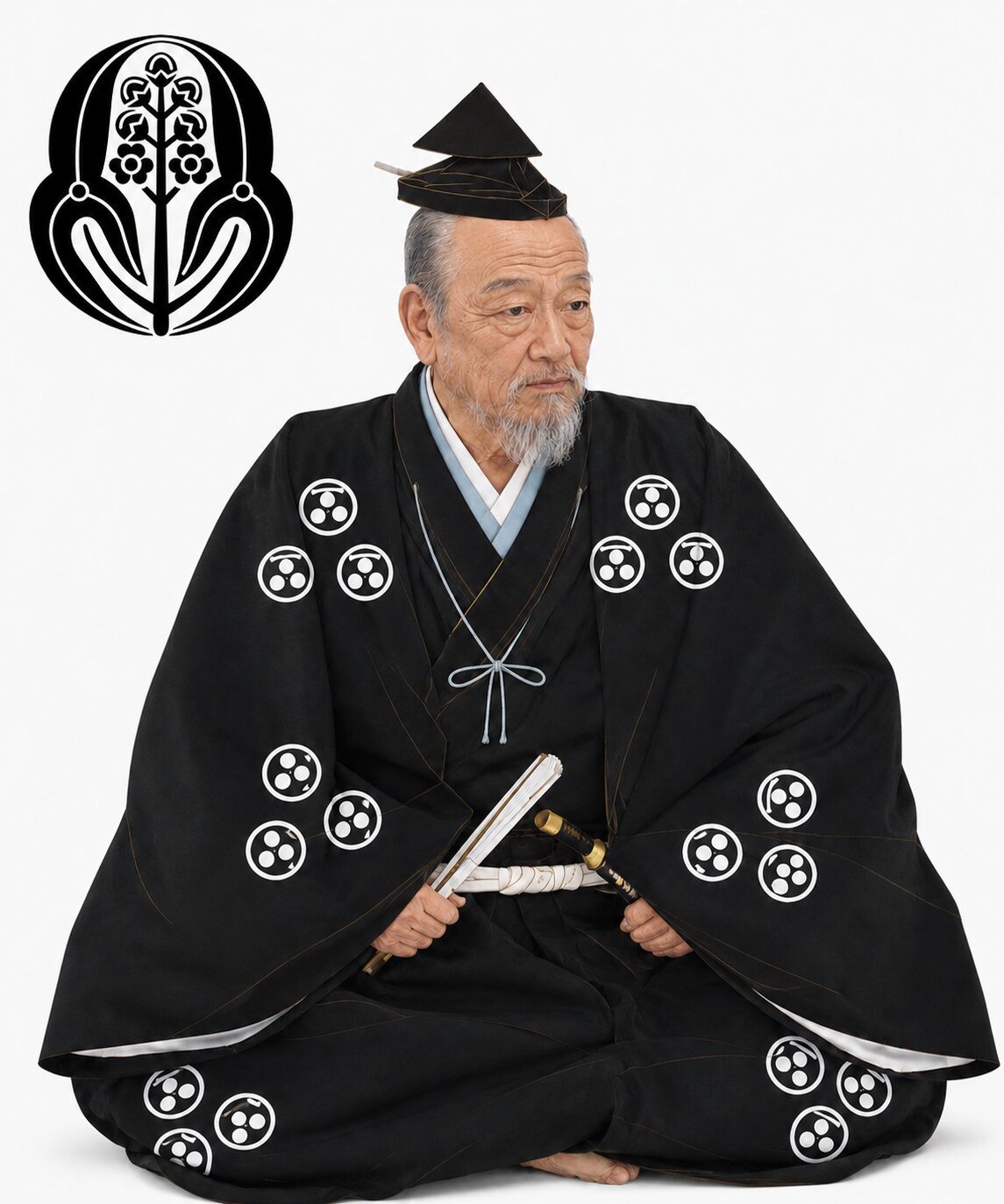
Mōri Motonari — From an Aki Kokujin to the Conqueror of the Chūgoku Region: The Greatest Strategist of the Sengoku Era, Called the “God of Strategy”
- Mōri Motonari in Three Lines
- The Mainstream View — A Textbook-Based Explanation
- Multiple Theories — Exploring Possibilities from Various Angles
- Viewed Strategically — Motonari's Politics, Military Affairs, and Diplomacy
- Famous Words and Sayings of This Warlord
- Anecdotes and Episodes
- Timeline
- Family and Personal Relationships
- Related Historic Site Map / Model Travel Courses
- Related Articles
- References
Mōri Motonari in Three Lines
- Rising from a single kokujin (provincial landholder) lord of Aki Province, in a single generation he became the conqueror of the Chūgoku region, ruling six provinces—Aki, Bingo, Suō, Nagato, Iwami, and Izumo (temporarily reaching a maximum of eight provinces with the addition of Oki and Hōki). He is called the “greatest strategist of the Sengoku era” and the “God of Strategy” (Bōshin).
- Cautiously expanding his power in the gap between two great powers—the Ōuchi and Amago clans—he made his breakthrough at the Battle of Itsukushima in 1555 (Kōji 1), where he defeated Sue Harukata. By sending his second son Kikkawa Motoharu and third son Kobayakawa Takakage as adopted heirs into powerful kokujin houses, he built the “Mōri Ryōsen” (Two Rivers of Mōri) system.
- Though struck by the misfortune of being predeceased by his eldest son Mōri Takamoto, he left a solid foundation to his grandson Mōri Terumoto and died of illness in 1571 (Genki 2) at the age of 75. Widely known for the parable of the “Three Arrows,” this is in fact a later invention; in reality he urged the unity of his sons in a long letter called the “Sanshi Kyōkunjō” (Letter of Instruction to Three Sons).
The Mainstream View — A Textbook-Based Explanation
A Childhood as the “Beggar Young Lord”
Mōri Motonari was born on the 14th day of the 3rd month of 1497 (Meiō 6) in Yoshida-no-shō, Takata District, Aki Province (present-day Yoshida-chō, Akitakata City, Hiroshima Prefecture). His father was Mōri Hiromoto, lord of Yoshida Kōriyama Castle, and his mother was a daughter of Fukuhara Hirotoshi. His childhood name was Shōjumaru. He is said to have been born at his mother’s family home, Suzuo Castle (Fukuhara Castle). Motonari was Hiromoto’s second son; above him was his eldest brother Okimoto, four years his senior.
The Mōri were a distinguished house descended from Mōri Suemitsu, the fourth son of Ōe no Hiromoto, the first Mandokoro bettō (chief administrator) of the Kamakura shogunate; they took the name “Mōri” from holding Mōri-no-shō in Aikō District, Sagami Province, as their home estate. When Motonari received court rank from the imperial court, he too was recorded as “Ōe no Motonari.” The family crest was the “Ichimonji Mitsuboshi” (one horizontal line and three stars). From the Nanbokuchō period they settled permanently in Yoshida-no-shō in Aki Province, maintaining their power as Aki kokujin.
When Motonari was about four, he moved with his father—who had ceded the headship to his elder brother Okimoto—to Tajihi Sarukake Castle. But when his father Hiromoto died when Motonari was ten, Sarukake Castle was seized by a retainer, and Motonari was driven from the castle. Raised by his stepmother Sugi no Ōkata, he lived in poverty, and people of the time reportedly called him the “Beggar Young Lord.” For the boyhood of the future conqueror of the Chūgoku region, it was hardship beyond imagining.
Succession to the Headship — The Purge of His Half-Brother Aiō Mototsuna
In 1516 (Eishō 13), his elder brother Okimoto died suddenly at the age of 24 from excessive drinking. The headship passed to his heir Kōmatsumaru, but at only two years old, his uncle Motonari effectively led the Mōri house as his guardian. Motonari was twenty at the time.
Taking advantage of the confusion over the succession, in 1517 (Eishō 14) Takeda Motoshige, the valiant head of the Aki Takeda clan, attacked Arita Castle. Though it was Motonari’s first battle at the age of twenty, he achieved the great feat of killing Takeda Motoshige at the Battle of Arita-Nakaide. This battle, also called the “Okehazama of the West,” announced the young Motonari’s skill in war to the whole realm.
In the 7th month of 1523 (Daiei 3), Kōmatsumaru died of illness at the age of nine. Motonari formally succeeded to the headship. However, some retainers dissatisfied with this succession plotted to install Motonari’s half-brother Aiō Mototsuna as the new head. Behind this lurked the shadow of Amago Tsunehisa of Izumo. Detecting this movement, Motonari struck first and purged Mototsuna and his faction. This event displayed Motonari’s cold-blooded decisiveness from the very start of his succession.
From Amago to Ōuchi — The Age of “Dual Allegiance Diplomacy”
When Motonari succeeded to the headship, the Chūgoku region was divided between two great powers: the Amago clan of Izumo and the Ōuchi clan of Suō. As an Aki kokujin house, the Mōri were in the harsh position of having to survive by submitting to one side or the other.
At first, the Mōri were subordinate to Amago Tsunehisa, and in the 6th month of 1523 (Daiei 3), before the succession, they had achieved the feat of taking the Ōuchi’s Kagamiyama Castle (Higashihiroshima City) by stratagem as an Amago ally. But after the succession, out of dissatisfaction over the meagerness of their rewards and the circumstances of the succession, they broke with the Amago, and from 1528 (Kyōroku 1) onward came to serve Ōuchi Yoshitaka.
Now in the Ōuchi camp, Motonari expanded his power by attacking the Takahashi clan, kokujin of Iwami Province (Shimane Prefecture) who were on the Amago side. Further forming marriage ties with neighboring provincial lords, he grew into a position of leadership among the Aki kokujin.
The Battle of Yoshida Kōriyama Castle — Clash with the Amago
In the 8th month of 1540 (Tenbun 9), Amago Haruhisa (Akihisa), grandson of Amago Tsunehisa, invaded Aki Province leading an army of 30,000 and besieged Motonari’s base, Yoshida Kōriyama Castle. Motonari’s army numbered only about 8,000—an overwhelming disparity in strength.
Motonari chose to defend the castle. Taking the retainers and people of the castle town into the castle, he prepared for all-out resistance. He further requested reinforcements from Ōuchi Yoshitaka. When 10,000 Ōuchi reinforcements (under Sue Takafusa and others) arrived, the combined Mōri-Ōuchi army turned to the counterattack. In the 1st month of the following year, 1541 (Tenbun 10), they repelled the Amago army and won a decisive victory at the Battle of Aomitsui-yama. This battle, called the “Battle of Yoshida Kōriyama Castle,” became the turning point that spread Motonari’s fame throughout the Chūgoku region.
After the battle, Motonari secured his power within Aki Province by capturing Satō Kanayama Castle, the base of the Aki Takeda clan, among other actions. In the 11th month of that year, Amago Tsunehisa died, and the wind blew in the Mōri’s favor.
The First Siege of Gassan-Toda Castle — A Lesson from Defeat
In the 1st month of 1542 (Tenbun 11), Ōuchi Yoshitaka decided on an expedition to Izumo. Pushed by the insistence of the militarist faction such as Sue Takafusa, he led various commanders, including Mōri Motonari, to attack the Amago base of Gassan-Toda Castle. This was the “First Siege of Gassan-Toda Castle.”
The Ōuchi army advanced smoothly within Izumo Province but struggled against the impregnability of Gassan-Toda Castle. After a long siege, in the 4th month of 1543 (Tenbun 12), the Ōuchi army decided to withdraw. The retreat was extremely brutal, and even Motonari barely escaped with his life. Ōuchi Harumochi, the adopted heir of Ōuchi Yoshitaka, drowned during the flight, and the Ōuchi army suffered a severe blow.
For Motonari this defeat was a bitter lesson. The difficulty of expeditions leading large armies, the importance of supply lines, and the discernment between winnable and unwinnable battles—Motonari’s later cautious military strategy was deeply rooted in this experience of defeat.
Building the “Mōri Ryōsen” System
Around the time of the First Siege of Gassan-Toda Castle, Motonari began laying the groundwork to send his second son Kikkawa Motoharu and third son Kobayakawa Takakage as adopted heirs into the Kikkawa and Kobayakawa clans, powerful kokujin of Aki. This was not mere adoption but a strategy to effectively bring both houses under Mōri control and to reorganize the power structure of Aki Province.
In 1543 (Tenbun 12), Takakage succeeded to the Takehara Kobayakawa house. In 1546 (Tenbun 15), Motoharu became the adopted heir of the Kikkawa house. Then in 1550 (Tenbun 19), Takakage, who had succeeded to the Nuta Kobayakawa house, unified both Kobayakawa houses. That same year, Motonari purged the family of Kikkawa Okitsune (the former head of the Kikkawa house), bringing the Kikkawa fully under Mōri control. With this, the “Mōri Ryōsen” system was completed, centered on the main Mōri house and supported on both wings by the Kikkawa (responsible for the San’in region to the north) and the Kobayakawa (responsible for the San’yō and Setouchi regions to the south).
That same year, Motonari ceded the headship to his eldest son Mōri Takamoto and ostensibly retired, but real power remained firmly in Motonari’s hands. It was a skillful political maneuver that combined “stability through transfer of the headship” with “continuation of effective control.”
The Battle of Itsukushima — The Okehazama of the West
In the 9th month of 1551 (Tenbun 20), the Ōuchi retainer Sue Takafusa (later Sue Harukata) staged a coup against his lord Ōuchi Yoshitaka (the Tainei-ji Incident). Yoshitaka took his own life, and the Ōuchi house became a puppet of the Sue clan.
Though Motonari initially showed a cooperative stance toward the Sue clan, partly because of his marriage ties to Yoshitaka, he eventually came into conflict with them. The Sue held power over Suō, Nagato, Buzen, and Aki, a force incomparably greater than the Mōri. Agonizing over the disparity in strength against the Sue (said to be Sue 30,000 to Mōri 5,000), Motonari advanced cunning preparatory schemes.
First, Motonari spread false information that the Sue senior retainer Era Fusahide was plotting rebellion, leading Sue Harukata to purge Era and weaken the Sue army. Furthermore, he built Miyao Castle on Itsukushima and deliberately had a spy of the Sue overhear a weak-sounding remark—”that castle was a miscalculation; if attacked it would not last a moment”—luring the Sue into a decisive battle at Itsukushima.
Late at night on the 1st day of the 10th month of 1555 (Kōji 1), Motonari crossed over from the shore opposite Itsukushima through a violent storm. He launched a surprise attack on Tō-no-oka on Itsukushima, where the Sue army was encamped. Though the Sue army was said to number 20,000, in the narrow terrain of Itsukushima they could not maneuver, and the Mōri army of 4,000 routed the Sue with their sudden assault. Sue Harukata took his own life while fleeing in defeat. This is the “Battle of Itsukushima,” counted as one of Japan’s three great surprise-attack battles.
The Bōchō Campaign — Conquest of Western Chūgoku
Riding the momentum of victory at Itsukushima, Motonari began his invasion of Suō and Nagato. This is called the “Bōchō Campaign.” Resistance from Sue retainers was strong, but the Mōri army captured castles one after another. On the 3rd day of the 4th month of 1557 (Kōji 3), Ōuchi Yoshinaga (Yoshitaka’s adopted son, the puppet head installed by the Sue) took his own life at Chōfuku-ji near Katsuyama Castle in Nagato, and the Ōuchi clan as a Sengoku daimyō house perished.
Half a year after the fall of the Ōuchi, in the 11th month of that year, former Ōuchi retainers and anti-Mōri commoners raised an uprising across Suō and Nagato. Motonari and his son Takamoto hastily led their army to Suō Province and placed their headquarters at Shōei-ji in Tonda (present-day Tonda, Shūnan City, Yamaguchi Prefecture). Here, on the 25th day of the 11th month, Motonari composed a long letter addressed to his three sons—the “Sanshi Kyōkunjō” (Letter of Instruction to Three Sons).” In this letter, which became the prototype of the “Three Arrows” parable, Motonari strongly urged the unity of his three sons across the Mōri, Kikkawa, and Kobayakawa houses.
The Second Siege of Gassan-Toda Castle — The Fall of the Amago
Having destroyed the Ōuchi, Motonari next aimed to settle accounts with the Amago of Izumo. In the 7th month of 1562 (Eiroku 5), Motonari set out from Yoshida Kōriyama Castle leading an army of about 15,000. He first attacked the Amago-held branch castle of Shiraga Castle. He launched a general assault on the 13th day of the 8th month and forced Shiraga Castle to surrender in late 10th month.
Motonari then besieged the Amago main castle, Gassan-Toda Castle. Leading the Amago house after the death of his grandfather Tsunehisa was Tsunehisa’s grandson, Amago Yoshihisa. Applying the lessons of his defeat at the First Siege of Gassan-Toda Castle, this time Motonari did not rush; he secured the Amago strongpoints one by one and chose a war of attrition, cutting off the supply routes to Gassan-Toda Castle.
After a siege lasting four years, in the 11th month of 1566 (Eiroku 9), Amago Yoshihisa surrendered and Gassan-Toda Castle opened its gates. The Amago clan as a Sengoku daimyō house perished. With this, the Mōri established their position as conquerors of the Chūgoku region. Motonari was seventy at the time.
The Sudden Death of His Eldest Son, Takamoto
In the course of the Mōri conquest of the Chūgoku region, Motonari tasted his greatest sorrow. In the 8th month of 1563 (Eiroku 6), his heir Mōri Takamoto died suddenly at his lodging camp in Sasabe, Aki Province, during the Izumo expedition, at the young age of 41. The cause of death had many suspicious aspects—a poisoning theory was whispered—and remains disputed to this day.
Motonari’s grief was deep, and in his later years he wrote of his feelings for Takamoto again and again in his letters. The headship passed to Takamoto’s heir Mōri Terumoto at the age of eleven, and Motonari once again held real power as his grandson’s guardian. For Motonari, nearly seventy, this was an unexpected heavy burden.
Final Years and Death
After the fall of the Amago, the Mōri house faced new challenges: the struggle over Buzen and Chikuzen with the Ōtomo clan of Kyushu, and the rise of Oda Nobunaga. Motonari kept the “Mōri Ryōsen” system of his grandson Terumoto and his sons Kikkawa Motoharu and Kobayakawa Takakage functioning, working to secure the Mōri house’s stability.
On the 14th day of the 6th month of 1571 (Genki 2), Motonari died of illness at his base, Yoshida Kōriyama Castle. He was 75. The cause of death is presumed to have been esophageal or stomach cancer. A famous parable holds that on his deathbed he gave his sons “Three Arrows” to urge their unity, but this is a later invention; in reality Takamoto had already died (see Theory 1).
After Motonari’s death, the Mōri house was run under Mōri Terumoto by the “Mōri Ryōsen” system, and after the confrontation with Oda Nobunaga, joined the unification of the realm under Toyotomi Hideyoshi. The vast territory Motonari left behind would be preserved until the end of the Sengoku era—until Terumoto, as supreme commander of the Western Army, was defeated at the Battle of Sekigahara in 1600 (Keichō 5).
Multiple Theories — Exploring Possibilities from Various Angles
Theory 1: Theories on the Truth of the “Three Arrows” Parable
The most famous parable in telling of Mōri Motonari is the “Three Arrows” (Sanshi no Oshie), in which on his deathbed he gave arrows to his three sons. Having been featured in moral-education textbooks of the Meiji era, it remains widely known today. Yet on the historical authenticity of this parable, researchers are nearly unanimous: it is a later invention.
[Grounds for the invention theory]:
- At the time of Motonari’s death in 1571 (Genki 2), his eldest son Mōri Takamoto had already died eight years earlier (1563/Eiroku 6). It was physically impossible for the three sons to be present at his deathbed.
- The “Three Arrows” story does not appear at all in contemporary sources (Motonari’s letters, the diaries of those connected to the Mōri house, and so on).
- Its first appearance is in war chronicles compiled in the Edo period; it is not recorded in any earlier literature.
[The theory that the Sanshi Kyōkunjō is the prototype]: On the 25th day of the 11th month of 1557 (Kōji 3), while encamped at Shōei-ji in Tonda, Suō Province (present-day Shūnan City, Yamaguchi Prefecture), Motonari sent a long letter to his three sons (Takamoto, Motoharu, and Takakage). This is the letter of fourteen articles called the “Sanshi Kyōkunjō,” now designated an Important Cultural Property of Japan (held by the Mōri Museum).
The Sanshi Kyōkunjō contains no “arrow” story, but it repeatedly urges that “if the three brothers do not unite, the Mōri house will perish” and that “even Motoharu and Takakage, who have succeeded to other houses, must hold the Mōri to be of foremost importance,” strongly counseling the maintenance of cooperation among the three houses of Mōri, Kikkawa, and Kobayakawa (the “Mōri Ryōsen” system). It is thought that Edo-period war-chronicle authors turned the content of this letter into an easily understood fable and invented the “Three Arrows” episode.
[Connection to overseas parallels]: The motif of “breaking three arrows” has parallels around the world, such as in the medieval Mongol founding myth (the parable of Hö’elün, the mother of Genghis Khan). In Japan too, similar stories appear in pre-medieval literature such as the “Jikkinshō,” and it has been suggested that Edo-period war-chronicle authors may have composed Motonari’s episode using these as a motif.
Though the “Three Arrows” parable is not historical fact, the political strategy behind it—”the unity of brothers” and the “Mōri Ryōsen” system—was an important policy that Motonari actually pursued. Beyond the question of the parable’s authenticity, it will surely continue to be passed down as a story that symbolizes the essence of Motonari’s governance of his house.
Theory 2: Theories on the Formation of the “God of Strategy” Image
Mōri Motonari is called the “God of Strategy” (Bōshin) and the “greatest strategist of the Sengoku era,” but there is room to examine when and how this image was formed.
[Motonari’s image among contemporaries]: Looking at documents contemporary with Motonari, one can indeed see that he was perceived as a commander who made full use of stratagem. The assassination plot against Era Fusahide, the false-information scheme that lured Sue Harukata to Itsukushima, the maneuvering within the Amago house—it is a fact that Motonari made frequent use of information and psychological warfare. It is thought that the image of a “master of stratagem” existed in the perception of his contemporaries.
[Reinforcement of the “God of Strategy” image]: The image of Motonari as the “God of Strategy” was greatly reinforced by Edo-period war chronicles (such as the “Intoku Taiheiki” and “Mōri Motonari-ki”). These works embellished Motonari’s stratagems in narrative form, at times greatly dramatizing historical fact, fixing the image of a “genius daimyō who wielded stratagem.” Modern historical novels, games, and dramas inherit this Edo-period image.
[Criticism of the “sinister schemer” theory]: On the other hand, there are objections to the view that depicts Motonari as a “sinister schemer.” Historians such as Kishida Hiroyuki and Kawai Masaharu point out that most of Motonari’s “stratagems” fell within the range of realistic political judgment in the Sengoku period and were not of a nature to be called especially “sinister” or “cruel.” For example, the purge of his half-brother Aiō Mototsuna was the result of a dispute over the succession and is regarded as an unavoidable choice made to secure the stability of the house.
[Reassessment as a “realistic politician”]: Recent research has moved to reassess Motonari not so much as a “God of Strategy” but as a “realist politician.” The characteristics of Motonari’s strategy were:
- He calmly discerned between winnable and unwinnable battles.
- He made frequent use of non-military means—stratagem, marriage, adoption—rather than military force.
- He valued consensus-building with his house and the kokujin, avoiding rule by violence.
- He gave top priority to the survival of the house with a long-term perspective.
These might more aptly be described as “excellent managerial sense” than as “stratagem.” The view of contemporary research is that Motonari’s “God of Strategy” image is the result of later generations turning his achievements into extreme narrative, and that it is more accurate to see his true figure as a “calm and realistic Sengoku daimyō.”
Theory 3: Theories on the Disparity of Forces and the Surprise Attack at the Battle of Itsukushima
The Battle of Itsukushima (1555) is famous as one of Japan’s three great surprise-attack battles, in which the Mōri overturned the overwhelming disparity of Mōri 4,000 versus Sue 20,000 by surprise attack. But there are several views among researchers regarding these figures and the circumstances of the surprise.
[The possibility of exaggerated troop numbers]: The disparity of “Mōri 4,000 versus Sue 20,000” reported by Edo-period war chronicles is highly likely to include later embellishment. Contemporary sources record no precise troop numbers, and the figures may have been exaggerated to fit the war-chronicle pattern of “great victory from inferiority.” It has been suggested that the actual disparity may have been about two to three times (Mōri 4,000–5,000 versus Sue 10,000–15,000).
[Assessment of the scheme to “lure Sue to Itsukushima”]: The account that Motonari lured Sue to Itsukushima by feigning the “failure” of building Miyao Castle is also said to include some later embellishment. What is certain is:
- That Motonari built Miyao Castle on Itsukushima in advance, giving it the role of “bait” to draw in the Sue army.
- That the Sue army encamped on Tō-no-oka (about 100 m in elevation) on Itsukushima.
- That the Mōri army crossed over from Jigozen on the opposite shore under cover of a stormy night and launched a surprise attack on Tō-no-oka at dawn.
These can be confirmed from contemporary sources. However, the details of the false-information scheme conducted through spies may include inventive elements from later periods.
[Comprehensive analysis of the causes of victory]: The factors behind the Mōri victory that overturned the disparity of forces were complex:
- The disadvantage of a large army in the narrow terrain of Itsukushima (the Sue army could not make use of the terrain).
- The chance bad weather of the storm (which slackened the Sue army’s vigilance).
- The preparatory work of bringing the Murakami navy of the Setouchi over to the Mōri side.
- Motonari’s calm operational planning and the coordination of the Mōri commanders.
- The weakening of the Sue army through the purge of Era Fusahide.
Beyond the dramatic view of a “spectacular surprise victory,” the view of contemporary research is that it was the result of a comprehensive strategy that skillfully combined many elements—preparatory schemes, geography, weather, and naval power.
There is no doubt that the Battle of Itsukushima was the most important turning point in Motonari’s life, by which the Mōri became the lead players in the struggle for supremacy over the Chūgoku region. At the same time, it was through this battle that Motonari’s image as the “God of Strategy” and a “strategist daimyō” was decisively established.
Theory 4: Theories on the Truth of the Purge of His Half-Brother Aiō Mototsuna
At the Mōri succession of 1523 (Daiei 3), there was a movement to install Motonari’s half-brother Aiō Mototsuna, and the incident in which Motonari purged him is known as an event that symbolizes Motonari’s cold-blooded decisiveness. But there are several interpretations of the truth of this incident.
[The succession-dispute theory (traditional view)]: Aiō Mototsuna was Motonari’s half-brother, and retainers such as Watanabe Suguru and Saka Hirohide tried to install Mototsuna as the new head. Detecting this, Motonari struck first and purged Mototsuna, Watanabe Suguru, Saka Hirohide, and their faction. It is understood as a typical internal conflict over succession.
[The Amago intervention theory]: A theory holds that behind the movement to install Mototsuna lay the stratagem of Amago Tsunehisa of Izumo. Because Motonari had shown pro-Ōuchi behavior even before the succession, the Amago sought to install the anti-Motonari Mototsuna and pull the Mōri house back into the Amago camp. In this case, Motonari’s purge was not merely an internal matter but had the aspect of a struggle over the Mōri house’s external strategy.
[The Motonari self-defense theory]: A close examination of sources such as the “Mōri-ke Monjo” suggests the possibility that, rather than Motonari actively initiating the purge, the purge occurred as a counterstrike against the movement of the Mototsuna faction. Seen in light of the customs of the house at the time, the purge was regarded as a legitimate act of self-defense in response to a movement that threatened the successor.
[The later-embellishment theory]: Edo-period war chronicles tend to depict this purge incident as “ruthless intrigue” in order to reinforce Motonari’s “God of Strategy” image. Although the fact that Mototsuna was killed is certain, the dramatization of its “cruelty” may be a later embellishment.
The historian Kishida Hiroyuki analyzes the purge of Aiō Mototsuna as “a standard response in Sengoku-period governance of a house, and not to be regarded as a specially cruel act.” Moreover, at the time the Mōri retainers had strong independence, and internal conflict over succession was a grave matter that threatened the survival of the house. The view of contemporary research is that Motonari’s immediate response was an unavoidable choice for the sake of the house’s stability.
Nonetheless, the fact that Motonari, from the very start of his succession, severed his affection for his half-brother and carried out the purge is an important episode for understanding his character. It was an incident that became one of the grounds on which Motonari’s decisiveness was received with awe by his retainers in the later Mōri house.
Theory 5: How He Survived in the Gap Between the Two Great Powers, Ōuchi and Amago
The first half of Mōri Motonari’s life was a continual process of trial and error in “dual allegiance diplomacy“—how to keep the Mōri house alive in the gap between the two great powers of the Chūgoku region, the Ōuchi and Amago clans. Several assessments of Motonari’s strategy in this period are possible.
[Assessment of the realism of “dual allegiance”]: For Aki kokujin of the Sengoku period, submitting to either the Ōuchi or the Amago was a precondition of survival. Motonari changed his allegiance—first to the Amago, then to the Ōuchi—each time gaining rewards and expanding his territory. This was not “lack of principle” but a realistic survival strategy for a small lord of the Sengoku period, demonstrating Motonari’s high ability to assess situations.
[The strategic nature of choosing the Ōuchi]: That Motonari ultimately chose the Ōuchi was not mere happenstance but the result of strategic judgment. The Ōuchi were shugo daimyō of Suō and Nagato, superior in economic and cultural power, and prospered through trade with Korea and Ming China via Hakata and Yamaguchi. The Amago were a rising power centered on Izumo and Hōki—they had momentum but were inferior to the Ōuchi in the stability of their base. It is said that Motonari, from a long-term perspective, judged the Ōuchi side to be the more stable backer.
[The limits of “dual allegiance”]: The great defeat at the First Siege of Gassan-Toda Castle (1542–43) showed the limits of Motonari’s “dual allegiance diplomacy.” Having placed full trust in Ōuchi Yoshitaka and followed him on the Izumo expedition, the result was a wretched defeat. From this experience, Motonari learned the importance of “acting by his own strategy” rather than “following the strategy of others,” which is said to have led to his more independent action thereafter.
[Growth as the leader of a kokujin coalition]: Rather than opposing the great powers alone, Motonari secured his position as the leader of a kokujin coalition by forming marriage ties, adoptions, and alliances with the neighboring Aki kokujin. This base of a “kokujin coalition” was precisely the important foundation on which the Mōri would later become conquerors of the Chūgoku region. To strengthen his own position within Aki “while using” the power of the Ōuchi and Amago—this was the core of Motonari’s survival strategy.
The death of Ōuchi Yoshitaka (1551), the defeat and death of Sue Harukata (1555), and the fall of the Amago (1566)—the great powers Motonari served and opposed disappeared one after another from the stage of history. Meanwhile, the Mōri, who had begun as the smallest existence, survived to the end and became conquerors of the Chūgoku region. This outcome demonstrates the true worth of Motonari as a “realist politician.”
Theory 6: Theories on the Authenticity of the “Do Not Covet the Realm” Testament
A famous testament of Mōri Motonari holds that he counseled “do not covet the realm” (or, in a contrary theory, “compete for the realm”). There is debate over the authenticity and meaning of this testament.
[The “do not covet the realm” theory (the common view)]: A theory holds that Motonari counseled his grandson Mōri Terumoto, “The Mōri should not covet the realm but should devote themselves to steadily holding the six provinces of Aki, Bingo, Suō, Nagato, Iwami, and Izumo.” Because it accords with Motonari’s cautious character, it is widely believed.
[The “compete for the realm” theory]: Conversely, there is also a minority theory that Motonari counseled “covet the realm.” It is transmitted as a parable showing Motonari’s grand ambition, but the documentary basis is thin.
[The authenticity-unknown / later-invention theory]: These words transmitted as Motonari’s testament all appear in Edo-period war chronicles and are not recorded in contemporary sources. It is impossible to confirm Motonari’s actual words on his deathbed.
[The contradiction with grandson Terumoto as supreme commander of the Western Army at Sekigahara]: A fact that contradicts the “do not covet the realm” testament is that his grandson Terumoto accepted the post of supreme commander of the Western Army at the Battle of Sekigahara in 1600 (Keichō 5). This can be interpreted as an expression of ambition to “seize the realm,” seemingly not inheriting Motonari’s testament. On the other hand, there is a theory that Terumoto’s assumption of the post was a passive choice made to protect the Mōri house (he was overruled by his retainers, or it was the arbitrary act of Ankokuji Ekei), and so it can be interpreted as not necessarily contradicting the “do not covet the realm” testament.
[Consistency with Motonari’s realism]: As seen in Theories 2 and 5, Motonari was throughout a “realist politician” who prioritized the safety of the house over reckless ambition. The “do not covet the realm” testament is consistent with Motonari’s character and political stance, and even if it was not, in a strict sense, his own words, it is understood as expressing the essence of his life.
In the end, it cannot be determined what Motonari told his grandson Terumoto. But it is a fact that Motonari’s life was devoted to “cautiously expanding his power, seeking stability suited to his station,” and that spirit is encapsulated in the words “do not covet the realm.” That the later Mōri house maintained the Chōshū domain of 370,000 koku throughout the Edo period and survived to become the lead players in the Meiji Restoration proves the correctness of the strategy Motonari left behind—”giving top priority to the survival of the house.”
Viewed Strategically — Motonari’s Politics, Military Affairs, and Diplomacy
A Master of Stratagem and Information Warfare
The greatest characteristic of Motonari’s strategy was his use of stratagem and information warfare, embodying “winning without fighting.” Representative examples are:
- The assassination plot against Era Fusahide: Using false information and forged letters, he led Sue Harukata to purge a senior retainer, weakening the enemy’s strength.
- The scheme to lure Sue to Itsukushima: He leaked a weak-sounding remark to a spy, luring the enemy onto a cramped battlefield.
- The psychological warfare in capturing Satō Kanayama Castle: He set fire to 1,000 pairs of straw sandals and floated them down the Ōta River, making the Takeda army mistake them for “a great army on the attack” and drawing them in.
- Internal maneuvering within the Amago house: During the siege of Gassan-Toda Castle, he won over the influential retainers of the Amago house to the Mōri side one after another.
Common to these is the conception of collapsing the enemy from within by manipulating “information” and “psychology” rather than military force. Motonari was the foremost master of information warfare in Sengoku-period Japan.
Territorial Control through Marriage and Adoption
Another pillar of Motonari’s strategy was the construction of a kokujin coalition through marriage and adoption. The “Mōri Ryōsen” system was its greatest result, but beyond that:
- He married his daughters to influential provincial lords within Aki, in Bingo, and in Izumo, building a network of in-laws.
- Through the adoption of his sons and daughters, he infused Mōri blood into the surrounding provincial lords.
- By this, he secured loyalty to the Mōri house through “blood ties” rather than “contract.”
Sengoku-period retainer bands rested on contractual relationships, and if the lord’s house weakened, retainers easily defected. Motonari minimized this risk through a blood-tie network. That the “Mōri Ryōsen” system survived into the Edo period and supported the Chōshū domain was also the result of the strength of this blood-tie foundation.
Characteristics as a “Stratagem-Type” Strategist Daimyō
Motonari was not a commander who made his name through brilliant martial valor like Oda Nobunaga or Takeda Shingen. Rather, he was a “strategist daimyō,” a staff-officer-like, intellect-driven Sengoku daimyō. His characteristics were:
- He avoided frontal decisive battles, securing victory through schemes that closed the gap in strength.
- He calmly discerned between winnable and unwinnable battles, avoiding unreasonable fights.
- He judged matters by long-term strategy (on a scale of five or ten years), not swayed by short-term gain.
- He valued consensus-building with his house and the kokujin, avoiding arbitrary action.
These are also an aspect for which he is criticized as a “schemer,” but they were the rational choice for a small Sengoku lord to rise into a great power. Tokugawa Ieyasu, who likewise came from a kokujin lord background, also seized the realm with the same cautious, realistic approach as Motonari. Motonari and Ieyasu are often compared as representatives of “realist-type successes” of the Sengoku period.
A Sense of Balance Between Expedition and Attrition
Another characteristic of Motonari’s military strategy was his deep understanding of “the limits of expedition and supply,” learned from his great defeat at the First Siege of Gassan-Toda Castle. At the Second Siege of Gassan-Toda Castle, he did not rush; he captured the Amago branch castles one by one, cut their supply lines, and then chose a four-year war of attrition to besiege the main castle. In a sense this conception resembled the expedition strategy of Toyotomi Hideyoshi‘s siege of Odawara and his Korean campaigns, and it influenced the military strategy of later Sengoku daimyō.
Strategic Limits — What Held Motonari Back
Despite such talent, Motonari is said to have held no ambition to seize the realm. Analyzing the reasons:
- Geographic isolation: The Chūgoku region was far from the capital region, and advancing on Kyoto was not easy.
- The wall of age: By the time Motonari became conqueror of the Chūgoku region he was already nearly seventy, with no physical reserves to head toward unifying the realm.
- Priority on the stability of the house: The sudden death of his heir Takamoto, the youth of Terumoto—the stability of the house was always a concern, and he had to restrain outward ambition.
- A cautious character: From his experience of “dual allegiance diplomacy,” he knew in his bones the danger of harboring reckless ambition.
Still, only seven years after Motonari’s death, Oda Nobunaga built Azuchi Castle, and the Mōri were forced into direct confrontation with Nobunaga. The difference in the “sense of scale of unifying the realm” between Motonari’s generation and the generation of Nobunaga and Hideyoshi may also be one reason Motonari did not aim for the realm.
Famous Words and Sayings of This Warlord
“Hyakuman Isshin” (A Million as One Heart)
A phrase derived from the parable that, during repairs to Yoshida Kōriyama Castle, in place of a human pillar he buried a stone inscribed “Hyakuman Isshin” in the ground. When the four characters “hundred,” “ten-thousand,” “one,” and “heart” are broken apart, they can also be read “one day, one strength, one heart,” carrying the meaning “all as one heart, joining strength and uniting together.” It is widely known as a saying that succinctly expresses Motonari’s ideal of governing his house. However, the existence of the “Hyakuman Isshin” stone is a tradition, and the actual object has never been found.
“I Do Not Compete for the Realm” (or “Do Not Covet the Realm”)
Words said to be Motonari’s testament, meaning “The Mōri should not covet the realm but should devote themselves to steadily holding the provinces they possess.” It appears in Edo-period war chronicles, and while there is no certain record in contemporary sources, it is transmitted as words that symbolize Motonari’s cautious, realistic character.
“Singly They Break Easily, but Bound in Three They Are Hard to Break” (The Three Arrows)
A famous parable said to have Motonari give arrows to his three sons on his deathbed to urge their unity, but it is highly likely a later invention (see Theory 1). It spread through Meiji-era moral-education textbooks, and even today the “Three Arrows” are known as a symbol of unity. The name of the J1 football club Sanfrecce Hiroshima also combines the Italian “san” (three) and “frecce” (arrows), deriving from this parable.
“Many Stratagems Win; Few Stratagems Lose”
Words attributed to Motonari that appear in Edo-period war chronicles such as the “Intoku Taiheiki.” Meaning “one who prepares many stratagems wins; one with few loses,” it is a saying that symbolizes Motonari’s “God of Strategy” image. Though it cannot be confirmed in contemporary sources, it is widely cited as an expression of Motonari’s strategic thought.
The “Sanshi Kyōkunjō” (Letter of Instruction to Three Sons)
A long letter Motonari wrote to his three sons (Takamoto, Motoharu, and Takakage) on the 25th day of the 11th month of 1557 (Kōji 3). Consisting of fourteen articles, it records instruction spanning many topics: the unity of the three houses of Mōri, Kikkawa, and Kobayakawa (maintaining the Mōri Ryōsen system), the control of the house, the continuation of devotion to Itsukushima Shrine, and the importance of educating descendants. It is an Important Cultural Property of Japan (held by the Mōri Museum). Said to be the prototype of the later “Three Arrows” parable, it is the culmination of Motonari’s philosophy of governing his house.
Anecdotes and Episodes
The Boyhood as the “Beggar Young Lord”
When Motonari was ten, his father Hiromoto died, his castle was seized by a retainer, and he spent days of poverty together with his stepmother Sugi no Ōkata. The parable that people of the time called him the “Beggar Young Lord” is hardship beyond imagining for the boyhood of the future conqueror of the Chūgoku region. This experience is said to have shaped Motonari’s cautious, realistic character. His stepmother Sugi no Ōkata became Motonari’s spiritual support, and in later years he continued to speak of his deep gratitude to her.
His First Battle at Arita-Nakaide
In 1517 (Eishō 14), the twenty-year-old Motonari killed Takeda Motoshige, head of the Aki Takeda clan, at the Battle of Arita-Nakaide. Takeda Motoshige was at the time a commander renowned for valor in Aki Province, and that the young Motonari killed him is also called the “Okehazama of the West.” It was a great feat 43 years earlier than the Battle of Okehazama, in which Oda Nobunaga killed Imagawa Yoshimoto, and it announced Motonari’s skill in war to the world.
The “Burning Straw Sandals” Tactic at the Capture of Satō Kanayama Castle
In connection with the Battle of Yoshida Kōriyama Castle in 1540 (Tenbun 9), Motonari was pressed to capture the formidable Satō Kanayama Castle of the Aki Takeda clan. Motonari had peasants gather a large quantity of straw sandals, soaked them in oil, set fire to 1,000 pairs, and had them floated down the Ōta River at night. The Takeda army at Satō Kanayama Castle, seeing the countless fires filling the river, mistook them for “a great army bearing down” and fell into a panic. Through this psychological warfare he drew in the Takeda army, and the Mōri army is said to have won.
The Storm on the Eve of the Battle of Itsukushima
On the night of the 30th day of the 9th month of 1555 (Kōji 1), the Mōri army began crossing over from Jigozen on the shore opposite Itsukushima. That night there was a fierce storm, and although there were opinions that the departure should be postponed, Motonari forced the crossing, calling it “an opportunity granted by Heaven.” The Sue army had slackened its vigilance in the bad weather and did not notice the Mōri crossing. Early in the morning of the 1st day of the 10th month, the Mōri army launched a surprise attack on the Sue headquarters at Tō-no-oka and annihilated the Sue army. It was a symbolic battle in which Motonari’s decisiveness and strength of fortune came together.
His Sons, Including Motokiyo
Motonari had many children with various concubines, and had capable sons such as his fourth son Mōri Motokiyo (Hoida Motokiyo) and his ninth son Kobayakawa Hidekane (Mōri Hidekane). They too were active as important figures supporting the Mōri house. In his later years Motonari paid attention to these many sons as well, working to keep his house’s governance stable.
The Sudden Death of Mōri Takamoto and Motonari’s Grief
In the 8th month of 1563 (Eiroku 6), his eldest son Mōri Takamoto died suddenly at his lodging camp in Sasabe, Aki Province, during the Izumo expedition. Motonari’s grief was deep, and his later letters record his feelings for Takamoto again and again. There are various theories about the cause of Takamoto’s death, including poisoning (a theory that poison was in food served at a banquet held by the local kokujin Wachi Masaharu), and it remains undetermined to this day. That Motonari later purged Wachi Masaharu can also be interpreted as an action taken while still unable to dispel the suspicion of Takamoto’s poisoning.
Shōei-ji, Where He Wrote the Sanshi Kyōkunjō
On the 25th day of the 11th month of 1557 (Kōji 3), Motonari composed the Sanshi Kyōkunjō at Shōei-ji in Tonda, Suō Province. At the time it was a camp for suppressing the Bōchō uprising, and that Motonari wrote a long letter in the intervals of war suggests his deep feeling for his house. Shōei-ji (present-day Tonda, Shūnan City, Yamaguchi Prefecture) still survives and is known as a temple connected to the Mōri house. It is said that Toyotomi Hideyoshi too lodged at the same temple on his way to the Kyushu campaign.
The Battle with Esophageal Cancer in His Final Years
Motonari’s later years were troubled by health problems. The direct cause of his death at 75 in 1571 (Genki 2) is presumed to have been esophageal or stomach cancer. Symptoms of loss of appetite and vomiting are recorded, and from the standpoint of modern medical knowledge it was highly likely a malignant tumor of the digestive system. Even so, that Motonari maintained supremacy over the Chūgoku region past the age of seventy and continued to act as his grandson’s guardian shows astonishing mental fortitude.
Deep Devotion to Itsukushima Shrine
Motonari held devotion to Itsukushima Shrine throughout his life. Even in the Sanshi Kyōkunjō he counseled his sons not to neglect reverence for the deity of Itsukushima, and he recorded that his own great achievements were owed to the protection of Itsukushima Shrine. That the victory at the Battle of Itsukushima held decisive meaning was also a factor in deepening his devotion. The Mōri continued to be protectors of Itsukushima Shrine throughout the Edo period, and the form of present-day Itsukushima Shrine as a World Heritage Site is unthinkable without Mōri protection.
Timeline
| Japanese Era (CE) | Age | Event |
|---|---|---|
| Meiō 6 (1497) | 1 | Born on the 14th day of the 3rd month in Yoshida-no-shō, Aki Province. Father is Mōri Hiromoto, mother a daughter of Fukuhara Hirotoshi. Birthplace is his mother’s family home, Suzuo Castle. Childhood name Shōjumaru. |
| c. Meiō 9 (1500) | 4 | Moves to Tajihi Sarukake Castle with his father, who has ceded the headship to his brother Okimoto. |
| Eishō 3 (1506) | 10 | Father Hiromoto dies. Sarukake Castle is seized by a retainer, and he spends days of poverty with his stepmother Sugi no Ōkata. Called the “Beggar Young Lord.” |
| Eishō 14 (1517) | 21 | First battle at Arita-Nakaide, the great feat of killing Takeda Motoshige of the Aki Takeda clan. Called the “Okehazama of the West.” |
| Daiei 3 (1523) | 27 | Kōmatsumaru, son of his brother Okimoto, dies of illness at nine. Motonari succeeds to the Mōri headship. Purges the faction installing his half-brother Aiō Mototsuna. |
| c. Kyōroku 1 (1528) | 32 | Breaks with the Amago, submits to Ōuchi Yoshitaka. |
| Tenbun 9–10 (1540–41) | 44–45 | Battle of Yoshida Kōriyama Castle. Repels Amago Haruhisa’s army of 30,000 in coordination with Ōuchi reinforcements. Captures Satō Kanayama Castle with the “burning straw sandals” tactic. Becomes ruler of Aki. |
| Tenbun 11–12 (1542–43) | 46–47 | First Siege of Gassan-Toda Castle. Attacks the Amago as part of the Ōuchi army but suffers great defeat. Barely escapes with his life. |
| Tenbun 12 (1543) | 47 | Third son Takakage succeeds to the Takehara Kobayakawa house. |
| Tenbun 15 (1546) | 50 | Second son Motoharu becomes adopted heir of the Kikkawa house. Cedes the headship to his heir Takamoto and retires (retains real power). |
| Tenbun 19 (1550) | 54 | Takakage succeeds to the Nuta Kobayakawa house and unifies both Kobayakawa houses. Purges the Kikkawa Okitsune family, bringing the Kikkawa fully under Mōri control. The “Mōri Ryōsen” system is completed. |
| Tenbun 20 (1551) | 55 | The Tainei-ji Incident. Sue Takafusa kills Ōuchi Yoshitaka. Motonari initially cooperates with the Sue but later turns to conflict. |
| Kōji 1 (1555) | 59 | On the 1st day of the 10th month, the Battle of Itsukushima. Crossing over on a stormy night, he surprise-attacks Sue Harukata’s headquarters and annihilates the Sue army. Sue Harukata takes his own life. One of Japan’s three great surprise-attack battles. |
| Kōji 3 (1557) | 61 | On the 3rd day of the 4th month, Ōuchi Yoshinaga takes his own life at Chōfuku-ji; the Ōuchi clan perishes. In the 11th month, while encamped to suppress the Bōchō uprising, writes the “Sanshi Kyōkunjō” at Shōei-ji. |
| Eiroku 5–9 (1562–66) | 66–70 | Second Siege of Gassan-Toda Castle. Destroys the Amago in a four-year war of attrition. Becomes conqueror of the six provinces of the Chūgoku region. |
| Eiroku 6 (1563) | 67 | In the 8th month, his heir Mōri Takamoto dies suddenly at Sasabe on the Izumo expedition (age 41). Motonari again becomes guardian of his grandson Terumoto. |
| Eiroku 10 – Genki 2 (1567–71) | 71–75 | Struggle over Buzen and Chikuzen with the Ōtomo clan of Kyushu. Works to stabilize the house through the “Mōri Ryōsen” system. |
| Genki 2 (1571) | 75 | On the 14th day of the 6th month, dies of illness at Yoshida Kōriyama Castle, age 75. Cause of death presumed esophageal or stomach cancer. His tomb is at the foot of Yoshida Kōriyama Castle. |
Family and Personal Relationships
The Mōri House and Family
| Person | Relation | Relationship |
|---|---|---|
| Mōri Hiromoto | Father | 10th head of the Mōri house. Died when Motonari was ten, ushering in Motonari’s time of poverty. |
| Daughter of Fukuhara Hirotoshi | Mother | Daughter of the Aki kokujin Fukuhara clan. Said to have died young after giving birth to Motonari. |
| Sugi no Ōkata | Stepmother | Motonari’s spiritual support. Raised Motonari in his time of poverty, and he spoke of deep gratitude to her for years. |
| Mōri Okimoto | Elder brother | 11th head of the Mōri house. Died of illness in 1516 at the age of 24. |
| Aiō Mototsuna | Half-brother | Purged by Motonari in the succession dispute. Said to have had Amago intervention behind him. |
| Myōkyū | Principal wife | Daughter of Kikkawa Kunitsune. Mother of Takamoto, Motoharu, and Takakage. A good understanding partner to Motonari; died in 1545. |
| Mōri Takamoto | Eldest son | 13th head of the Mōri house. A cultured man of gentle character. Died suddenly in 1563 at age 41; a poisoning theory exists. |
| Kikkawa Motoharu | Second son | Succeeded to the Kikkawa house. Northern pillar of the “Mōri Ryōsen,” a fierce general renowned for valor. Responsible for the San’in region. |
| Kobayakawa Takakage | Third son | Succeeded to the Kobayakawa house. Southern pillar of the “Mōri Ryōsen,” renowned for strategy. Responsible for the San’yō and Setouchi regions; later one of the Five Elders under the Toyotomi regime. |
| Hoida Motokiyo | Fourth son | Son of a concubine. Succeeded to the Hoida house and supported the Mōri. His descendants succeeded to the main Mōri house. |
| Kobayakawa Hidekane | Ninth son | Son of a concubine. Became Takakage’s adopted son and succeeded to the Kyushu Kobayakawa house. A Christian commander. |
| Mōri Terumoto | Grandson | Heir of Takamoto. Succeeded to the headship at eleven, under Motonari’s guardianship. Later one of the Toyotomi Five Elders and supreme commander of the Western Army at Sekigahara. |
The Two Great Powers of the Chūgoku Region
| Person | Position | Relationship |
|---|---|---|
| Amago Tsunehisa | Sengoku daimyō of Izumo | Called the “Sage of Strategy,” the restorer of the Amago clan. Lived in Motonari’s era and long opposed him. Died in 1541 at age 84. |
| Amago Haruhisa | Grandson of Tsunehisa | 15th head of the Amago clan. Attacked Yoshida Kōriyama Castle but was repelled. Died suddenly in 1560. |
| Amago Yoshihisa | Son of Haruhisa | Last head of the Amago clan. Surrendered to Motonari at the Second Siege of Gassan-Toda Castle; the Amago clan perished. |
| Ōuchi Yoshitaka | Sengoku daimyō of Suō | Motonari’s long-term protector. Famous as a cultural daimyō, but took his own life in Sue Harukata’s coup in 1551. |
| Sue Harukata | Ōuchi retainer → rebel | Killed Ōuchi Yoshitaka and turned the Ōuchi house into a puppet. Defeated and died against Motonari at Itsukushima in 1555. |
| Ōuchi Yoshinaga | Last head of the Ōuchi house | The puppet head installed by the Sue. In 1557, during the Bōchō campaign, took his own life at Chōfuku-ji; the Ōuchi clan perished. |
Retainers and Kokujin
| Person | Position | Relationship |
|---|---|---|
| Shiji Hirokata | Hereditary retainer | Motonari’s right hand. Supported him from the succession through the Bōchō campaign. |
| Fukuhara Sadatoshi | Hereditary retainer | Of Motonari’s maternal blood. His family supported the Mōri house. |
| Katsura Motozumi | Hereditary retainer | An important operative who sent a false letter of inner cooperation to the Sue at the Battle of Itsukushima, ensuring the surprise attack’s success. |
| Shishido Takaie | In-law kokujin | Motonari’s son-in-law. An influential kokujin of Aki who formed an important marriage tie with the Mōri house. |
Figures Connected to the Next Generation of the Mōri House
| Person | Position | Relationship |
|---|---|---|
| Oda Nobunaga | Unifier of the realm | The greatest threat from Motonari’s later years into Terumoto’s time. After Motonari’s death, the Mōri and Oda came into confrontation. |
| Toyotomi Hideyoshi | Unifier of the realm | After the Honnō-ji Incident, made peace with the Mōri. The Mōri later played a central role in the Toyotomi regime. |
| Ashikaga Yoshiaki | 15th shogun | After his expulsion from Kyoto, established the Tomo shogunate under the protection of Mōri Terumoto. He made maximum use of the Mōri authority that Motonari had left behind. |
Related Historic Site Map / Model Travel Courses
A journey tracing the footsteps of Mōri Motonari is a wide-ranging course spanning the whole Chūgoku region, centered on his base of Akitakata City (around Yoshida Kōriyama Castle) and extending to Itsukushima (Hiroshima Prefecture), Gassan-Toda Castle (Shimane Prefecture), and Bōchō (Yamaguchi Prefecture). The major scenes of Motonari’s life are still preserved as historic sites today.
* Please refer to the “Places Connected to Mōri Motonari” layer included in the Sengoku Kassenroku historic site map.
Model Course 1: Akitakata “Birthplace of the Mōri Clan” Course (1 day)
The most basic course, centered on Motonari’s base, Yoshida Kōriyama Castle.
- JR Hiroshima Station → bus to Yoshida-chō, Akitakata City → Yoshida Kōriyama Castle ruins (the base of generations of the Mōri, one of the Continued Top 100 Castles of Japan) → tomb of Mōri Motonari and his family → Akitakata City Museum of History and Folklore → Tajihi Sarukake Castle ruins (the castle of Motonari’s boyhood) → Suzuo Castle ruins (Motonari’s birthplace) → return to Hiroshima City.
Model Course 2: Itsukushima “Stage of the Surprise Battle” Course (1 day)
A course touring the site of the 1555 Battle of Itsukushima.
- JR Hiroshima Station → Miyajimaguchi → ferry to Miyajima → Itsukushima Shrine (World Heritage Site, the famed shrine Motonari worshipped) → Tō-no-oka (site of Sue Harukata’s headquarters, the five-story pagoda and Senjōkaku) → Miyao Castle ruins (the Mōri side’s bait castle) → stay on Miyajima or return to Hiroshima.
Model Course 3: Izumo “Decisive Battle with the Amago” Course (2 days, 1 night)
A course touring the sites of the First and Second Sieges of Gassan-Toda Castle.
- Day 1: JR Matsue Station → Shiraga Castle ruins (site of the 1562 preliminary battle) → stay in Matsue City (can be combined with sightseeing at Matsue Castle).
- Day 2: by JR to Yasugi Station → bus to Gassan-Toda Castle ruins (one of the Top 100 Castles of Japan, the Amago base) → history museum at the foot of Toda Castle → return.
Model Course 4: Bōchō “Fall of the Ōuchi Clan” Course (2 days, 1 night)
A course touring the place where Motonari wrote the “Sanshi Kyōkunjō” and the site of the Ōuchi clan’s fall.
- Day 1: Shin-Yamaguchi Station → Tonda, Shūnan City → Shōei-ji (the place the Sanshi Kyōkunjō was written) → stay in Shūnan City.
- Day 2: by JR toward Shimonoseki → Katsuyama Castle ruins (Chōfuku-ji, the place of Ōuchi Yoshinaga’s suicide) → return.
Arrangements by Type of Traveler
- History beginners: The Akitakata course (Model 1) is the most compact. It can be done as a day trip from Hiroshima City and gives an overview of Mōri history in one day.
- Intermediate history fans: Combining Models 1 and 2 lets you experience, in sequence, from the origins of the Mōri to the turning point of their breakthrough (the Battle of Itsukushima).
- Castle fans: Yoshida Kōriyama Castle and Gassan-Toda Castle are among the largest Sengoku-period mountain castles in the Chūgoku region. Visiting both for comparison gives a good sense of the scale of Mōri versus Amago.
- For enthusiasts: A tour of historically important but touristically minor places—Shōei-ji in Shūnan City, the Katsuyama Castle ruins in Shimonoseki, the Shiraga Castle ruins in Izumo—is also possible.
- World Heritage tours: Itsukushima Shrine is a World Heritage Site worth visiting on its own. Revisiting it from the viewpoint of a place connected to Motonari brings new discoveries.
Related Articles
Related Warlord Articles
- Mōri Takamoto — Motonari’s heir, the eldest son who met an unfortunate sudden death
- Kikkawa Motoharu — Motonari’s second son, northern pillar of the “Mōri Ryōsen,” responsible for the San’in region
- Kobayakawa Takakage — Motonari’s third son, southern pillar of the “Mōri Ryōsen,” later a Toyotomi Five Elder
- Mōri Terumoto — Motonari’s grandson, supreme commander of the Western Army at Sekigahara
- Sue Harukata — the commander who, after killing Ōuchi Yoshitaka, was defeated and died against Motonari at Itsukushima
- Amago Tsunehisa — the “Sage of Strategy” of Izumo, a conqueror of the Chūgoku region in Motonari’s era
- Ōuchi Yoshitaka — the cultural daimyō of Suō, Motonari’s long-term protector
- Oda Nobunaga — the unifier of the realm who confronted the Mōri after Motonari’s death
- Toyotomi Hideyoshi — the unifier who made peace with the Mōri after the Honnō-ji Incident and seized the realm
- Ashikaga Yoshiaki — the last shogun of the Muromachi shogunate, who established the Tomo shogunate under Mōri Terumoto’s protection
Related Battle Articles
- Battle of Yoshida Kōriyama Castle (1540–41) — the battle of Mōri ascendancy that repelled Amago Haruhisa
- Battle of Itsukushima (1555) — one of Japan’s three great surprise-attack battles, defeating Sue Harukata
- Sieges of Gassan-Toda Castle (1542–43, 1565–66) — the first and second sieges, the battles of the Amago clan’s fall
References
Primary Sources
- “Mōri-ke Monjo” — the body of contemporary documents related to the Mōri house. Held by the Mōri Museum and the Historiographical Institute of the University of Tokyo. The most important source for Motonari research.
- “Sanshi Kyōkunjō” (1557/Kōji 3) — Motonari’s letter of fourteen articles addressed to his three sons. An Important Cultural Property of Japan (held by the Mōri Museum).
- “Intoku-ki” and “Intoku Taiheiki” (compiled early Edo period) — war chronicles transmitting the deeds of the Mōri house. Include embellishment but are basic sources.
- “Mōri Motonari Shojō-shū” — a compilation of documents issued by Motonari.
- “Ōuchi Yoshitaka-ki” and “Ōuchi-ki” — Motonari’s movements seen from the Ōuchi side.
- “Un’yō Gunjikki” — records from the side of the Amago of Izumo.
- “Tamon-in Nikki” — the diary of Eishun of Kōfuku-ji, with articles on Motonari seen from the central region.
Compiled Sources
- “Dai Nihon Shiryō” (compiled by the Historiographical Institute, University of Tokyo) — covers the various sources related to Motonari.
- “Sengoku Ibun,” various volumes (Tōkyōdō Shuppan) — systematically collects documents related to the Chūgoku region.
- “Hiroshima Kenshi,” “Yamaguchi Kenshi,” “Shimane Kenshi” — compilations of regional sources.
Academic and Research Works
- Kawai Masaharu, “Mōri Motonari” (Yoshikawa Kōbunkan, Jinbutsu Sōsho) — a basic reference for Motonari research.
- Kishida Hiroyuki, “Mōri Motonari: Bui Tenka Musō, Shimin Meiwaku no Koto” (Minerva Shobō, Minerva Nihon Hyōden Sen) — a representative recent study.
- Ike Susumu, “Sengoku no Chiiki Kokka” (Yamakawa Shuppansha) — the positioning of the Mōri in the Sengoku period.
- Hasegawa Hiroshi, “Ōuchi-shi no Kōbō to Nishi-Nihon Shakai” (Yoshikawa Kōbunkan) — a detailed account of the relationship with the Ōuchi.
- Yoshida Yoshitaka, “Mōri Motonari no Sensō to Gaikō” (Dōseisha) — an analysis of Motonari’s strategy.
- Nakano Hitoshi, “Toyotomi Seiken no Kikōshi: Kobayakawa Hideaki” (Kadokawa Sensho) — on in-law relations such as Motonari’s ninth son Hidekane.
- Watanabe Daimon, “Sengoku no Shinjitsu: Mōri Motonari” (Sōshisha Bunko) — a verification of the historical facts behind the Motonari image.
Public Institutions and Museums
- Mōri Museum (Hōfu City, Yamaguchi Prefecture) — holds many Important Cultural Properties and National Treasures handed down in the Mōri house. Includes the “Sanshi Kyōkunjō.”
- Akitakata City Museum of History and Folklore (Akitakata City, Hiroshima Prefecture) — a comprehensive museum of the Mōri clan’s birthplace.
- Hiroshima Prefectural Museum of History (Fukuyama City) — Sengoku history of the Chūgoku region.
- Shimane Museum of Ancient Izumo (Izumo City) — materials on the relationship with the Amago.
- Yamaguchi Prefectural Museum — materials on the relationship of the Ōuchi and Mōri.
Other References
- NHK Taiga drama “Mōri Motonari” (1997) — starring Nakamura Hashinosuke, a representative drama depicting Motonari’s life.
- Nagai Michiko, “Yamagiri: Mōri Motonari no Tsuma” and “Motonari, soshite Onna-tachi” — historical novels depicting Motonari’s family relationships.
- “Rekishijin” and “Rekishi Dokuhon,” various issues — Motonari features.
- Sanfrecce Hiroshima (J1) — the team name combines “san” (three) and “frecce” (arrows), deriving from Mōri Motonari’s “Three Arrows.”
* This article is based on research findings as of May 2026. Regarding Mōri Motonari, research continues actively in recent years on the reexamination of the “God of Strategy” image, the truth of the purge of Aiō Mototsuna, and the troop numbers at the Battle of Itsukushima, among other topics. Assessments may change with the discovery of new sources or advances in interpretation.

コメント