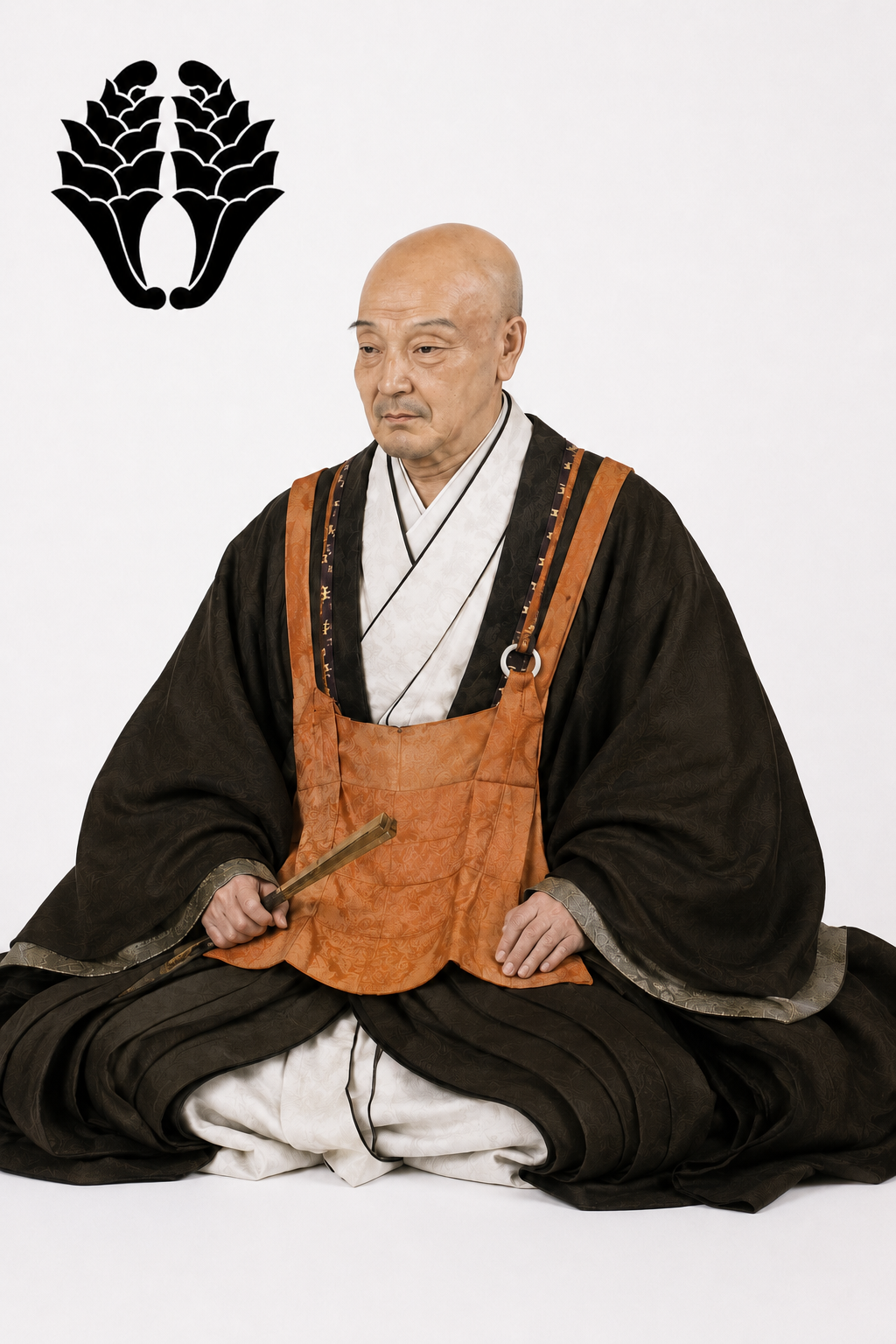
Ōtomo Sōrin — The Life of the “Asian Sengoku Daimyō” and Christian Lord Who Ruled Six Provinces of Northern Kyūshū
- Ōtomo Sōrin in 3 Points
- The Mainstream Account — The Standard Story Found in Textbooks
- The Theories — Exploring the Possibilities from Various Angles
- A Strategic View — Sōrin’s Judgment, Governance and International Outlook
- Famous Words and Sayings of This Warlord
- Anecdotes and Episodes
- Timeline
- Family and Personal Relationships
- Related Historic-Site Map and Travel Model Course
- Related Articles
- Reference Information
Ōtomo Sōrin in 3 Points
- A Sengoku daimyō who governed six provinces of northern Kyūshū from his base in Bungo. Born the son of Ōtomo Yoshiaki, he inherited the headship in the Nikai-kuzure Incident. Holding concurrently the office of provincial protector (shugo) of Bungo, Buzen, Chikuzen, Chikugo, Hizen and Higo, he was the lord of the Ōtomo who built the widest domain in northern Kyūshū during the Sengoku period.
- A Christian daimyō representative of Japanese history. He gave protection to Francis Xavier, who visited Bungo, and provided a base for the activity of the Society of Jesus within his domain. He himself received baptism in his later years and took the baptismal name “Dom Francisco.” He is also known for wide-ranging trade and diplomacy linking Ming China, Korea and Southeast Asia.
- He was crushingly defeated by the Shimazu at the Battle of Mimikawa, drawing out Hideyoshi’s Kyūshū campaign. In Tenshō 6 (1578), he suffered a great defeat against Shimazu Yoshihisa at the Mimikawa (Takajō River) in Hyūga, losing the principal senior retainers of his house. Thereafter, pressed by the northward-advancing Shimazu, his domain shrank rapidly. In his final years he sought aid from Toyotomi Hideyoshi and drew out the order for the Kyūshū campaign, but he died in the midst of that pacification.
The Mainstream Account — The Standard Story Found in Textbooks
The Origins of the Ōtomo House and His Childhood
Ōtomo Sōrin was born in the 1st month of Kyōroku 3 (1530) at the Ōtomo residence in Bungo Funai (present-day Ōita City, Ōita Prefecture), as the heir of the twentieth lord of the Ōtomo clan, Ōtomo Yoshiaki. His personal name was Yoshishige. His mother is said to have been a daughter of Ōuchi Yoshioki, and the blood tie with the distinguished western house of the Ōuchi supported the Ōtomo’s standing. The Ōtomo were a noble house that had been rooted in Kyūshū as protectors of Bungo since the Kamakura period, and one of the foremost families, occasionally appointed Kyūshū Tandai (deputy) in the Muromachi era.
Yoshishige was raised from childhood under his father Yoshiaki, but an undercurrent ran through the Ōtomo house over the father’s favoritism. In his later years, his father Yoshiaki is said to have doted on Shioichimaru, a son by his second wife, and to have tried to exclude Yoshishige from the succession. This tension over the inheritance of the headship would set off an event that changed the fate of the Ōtomo house.
The Nikai-kuzure Incident — A Shocking Succession
In the 2nd month of Tenbun 19 (1550), on the second floor (nikai) of the Ōtomo residence, his father Yoshiaki was attacked by assassins and gravely wounded, and Shioichimaru and his mother were also killed. Yoshiaki died several days later, and the heir Yoshishige (the future Sōrin) came to inherit the headship of the Ōtomo house. This event is called the “Nikai-kuzure Incident,” after the place where it occurred.
As for the truth of the incident, it is held that behind it lay a conflict between the faction of Yoshiaki, who sought to install Shioichimaru as successor, and the retainers who backed the heir Yoshishige. There are traditions that the perpetrators were retainers of the Yoshishige faction, and others that suggest Yoshishige’s own involvement, but the course of the incident diverges greatly among the sources, and points of debate remain even now. In any case, Yoshishige became lord of the Ōtomo at 21 through this event. From immediately after his succession, the heavy duty of quelling the unrest within the house and rebuilding the domain fell upon his shoulders.
The Ōuchi Succession and the Confrontation with the Mōri
In the 9th month of Tenbun 20 (1551), in the Ōuchi house — the main line of Yoshishige’s maternal family — the Tainei-ji Incident occurred, and Ōuchi Yoshitaka took his own life through the revolt of his senior retainer Sue Harukata. Amid the confusion, Harukata sought to welcome Yoshishige’s younger brother Haruhide as the new lord of the Ōuchi house. Yoshishige agreed and sent Haruhide to Yamaguchi, where Haruhide changed his name to Ōuchi Yoshinaga and succeeded to the name of the Ōuchi house. By this, the Ōtomo came to stand as backers of the legitimate Ōuchi successor, raising their authority in northern Kyūshū a further notch.
But that authority did not last long. When Sue Harukata was defeated by Mōri Motonari at the Battle of Itsukushima in Kōji 1 (1555) and took his own life, the Mōri moved to annex the Ōuchi territory. In Kōji 3 (1557), through Mōri Motonari’s conquest of Suō and Nagato, Ōuchi Yoshinaga was driven to suicide, and Yoshishige’s brother too was lost. The Mōri further advanced into Kyūshū, and the confrontation with the Ōtomo intensified along the boundary of Buzen and Chikuzen. At the Battle of Mojigajō in Eiroku 4 (1561), the Battle of Tataragahama in Eiroku 12 (1569) and elsewhere, the two sides fought fiercely over the hegemony of northern Kyūshū.
Kyūshū Tandai and the Domain Governance of His Peak
In Eiroku 2 (1559), Yoshishige was formally appointed Kyūshū Tandai by the Muromachi shogunate. He brought the six provinces of Bungo, Buzen, Chikuzen, Chikugo, Hizen and Higo into his domain and became the daimyō holding the widest territory in Sengoku-period Kyūshū. His base of Bungo Funai (present-day Ōita City) flourished as the political and economic center of northern Kyūshū and became a hub of overseas trade as well.
In domain governance, he kept able senior retainers such as Bekki Akitsura (the future Tachibana Dōsetsu), Takahashi Jōun, Yoshihiro Akimasa and Usuki Akihaya, and maintained the cohesion of the house. These senior retainers are spoken of under several appellations, such as the “Three Elders of Hōshū,” and the names of Dōsetsu and Jōun in particular are widely known from the Edo period to the present. In Eiroku 5 (1562), Yoshishige took the tonsure and the name Sōrin. From this point, this article too mainly uses “Sōrin.”
The Encounter with Christianity and the Nanban Trade
What inscribed the name of Ōtomo Sōrin in world history was his involvement with Christianity. In Tenbun 20 (1551), Francis Xavier of the Society of Jesus visited Bungo and met Sōrin (then Yoshishige). Yoshishige received Xavier courteously and tacitly permitted missionary work within his domain. With this as the occasion, Bungo became in time an important base of Jesuit activity in Kyūshū, and churches, a seminary, a hospital and other facilities were established at Funai.
The Ōtomo’s foreign relations were not limited to receiving missionaries but extended to communication and trade with Ming China, Korea and the countries of Southeast Asia. In the research of Kage Toshio and others, the Ōtomo are called an “Asian daimyō,” and a view is presented that situates them within a wide-ranging trade network including not only Portugal and Spain but the various powers of East Asia. Embassies to the Ming court, communication with Cambodia, the acquisition of Southeast Asian goods — the Ōtomo’s diplomacy was conspicuously international even among the daimyō of Sengoku-period Japan.
Sōrin himself formally received baptism in Tenshō 6 (1578). His baptismal name was “Dom Francisco.” It was a decision grounded in respect for Xavier and in long years of relations with the missionaries within his domain. Around the same time, Sōrin built a castle at Niujima in Usuki as a retirement residence, and from this base he would spend his final years.
The Battle of Mimikawa — A Great Defeat by the Shimazu
In Tenshō 6 (1578), Sōrin set out for Hyūga Province and fought Shimazu Yoshihisa. This was the Battle of Mimikawa, which decided the fate of the Ōtomo house. The Ōtomo, having sheltered Itō Yoshisuke of Hyūga, dispatched a great army to Hyūga under the pretext of recovering the Itō domain, but in the 11th month they were crushingly defeated by the forces of Shimazu Yoshihisa, Shimazu Yoshihiro and others around the Mimikawa (Takajō River). The Ōtomo army, with Tawara Chikakata as commander, suffered a devastating blow, and many senior retainers — Yoshihiro Akimasa’s son Yoshihiro Shigenobu, Usuki Shigetsugu and others — fell in battle.
The great defeat at Mimikawa created a deep fissure in the Ōtomo system of control. The local lords (kokujin) across Kyūshū defected from the Ōtomo one after another; Ryūzōji Takanobu expanded his power in Hizen and Chikugo, and the Shimazu advanced northward through Hyūga and Higo. Loyal retainers such as Tachibana Dōsetsu and Takahashi Jōun desperately held the defensive line of northern Kyūshū, but the domain shrank rapidly. That Sōrin himself received baptism that same year and took the name Dom Francisco is, seen from outside, often spoken of as overlapping with the twilight of his domain.
The Request for Aid to Hideyoshi and the Kyūshū Campaign
In Tenshō 14 (1586), when the forces of Shimazu Yoshihisa invaded as far as Bungo, Sōrin went up to Osaka and asked Toyotomi Hideyoshi directly for aid. Hideyoshi, who had already entered the final stage of unifying the realm, took this as the occasion to issue the order for the Kyūshū campaign. From that year into the next, Hideyoshi’s army invaded Kyūshū in stages and pushed the Shimazu back to the border of Satsuma.
Sōrin himself, however, did not live to see the completion of this war; in the 5th month of Tenshō 15 (1587), he died of illness at Tsukumi in Bungo. He was 58. It was two months later that Hideyoshi’s army made Shimazu Yoshihisa surrender in Satsuma. The headship was inherited by his heir Ōtomo Yoshimune, and the Ōtomo house came to survive as a daimyō under the Toyotomi regime.
His Later Evaluation and the Ōtomo House Afterward
After Sōrin’s death, his heir Ōtomo Yoshimune inherited the headship of the Ōtomo house, but on the grounds of a blunder in the Bunroku Campaign (the invasion of Korea), he was ordered by Hideyoshi to be dispossessed in Bunroku 2 (1593). By this, the Ōtomo — a noble house representative of Sengoku-period Kyūshū — lost their position as daimyō in Bungo. In the Sekigahara period of Keichō 5 (1600), Yoshimune attempted a comeback on the side of the Western Army, but this too ended in failure, and the Ōtomo house did not return as a daimyō throughout the Edo period.
Sōrin’s own character and achievements have been evaluated with a great amplitude by later ages. The aspect of a great daimyō, foremost of the Sengoku period, who ruled northern Kyūshū; the aspect of a defeated general of his final years who brought down his house; and the aspect of a Christian daimyō representative of Japanese history — these are complexly intertwined in the narratives of later ages.
The Theories — Exploring the Possibilities from Various Angles
The life of Ōtomo Sōrin has carried much breadth in the narratives of later ages, from the course of his succession, his involvement with religion, his overseas trade and his military defeat, to the evaluation of his character. Contemporary sources and compiled sources, missionary letters and domestic records each depict Sōrin from a different vantage, and there are many scenes where the points diverge. Below, six especially contested points are taken up.
※ The following are “theories” based on the observations of researchers and on differences among the sources. They are not settled facts but are organized as points on which views diverge.
Theory 1: Theories on the Truth of the Nikai-kuzure Incident
Several views stand side by side on the truth of the Yoshiaki-attack event of the 2nd month of Tenbun 19 (1550), the “Nikai-kuzure Incident.”
[The succession-struggle theory (the common view)]: the view that retainers backing the heir Yoshishige rose against his father Yoshiaki’s attempt to install Shioichimaru, the son of his second wife, as successor, leading to the attack. This is the widely known account.
[The Yoshishige-involvement theory]: the view that the attack was not the independent action of retainers of the Yoshishige faction but reflected Yoshishige’s own will. It reads the account that Yoshiaki bequeathed the headship to Yoshishige as an after-the-fact legitimation.
[The premise-of-house-division theory]: a structural view that the Ōtomo house was already deeply split between the Shioichimaru faction and the Yoshishige faction before the attack, and that the Nikai-kuzure Incident was merely the surfacing of that conflict.
[The limited-external-involvement theory]: the view that the attack was carried out by the hands of a limited number of retainers, and that the involvement of external powers (the Ōuchi, the Mōri and so on) cannot be confirmed. It emphasizes that the event was, to the end, an internal matter of the Ōtomo house.
The course of the event and whether Yoshishige was involved are difficult to settle completely from the limited records of the surviving sources, and the debate continues among researchers even now.
Theory 2: Theories on the Motive for Sōrin’s Christian Baptism
There are multifaceted views on the motive for Sōrin’s receiving baptism in Tenshō 6 (1578) and taking the name Dom Francisco.
[The pure-faith theory]: the view that, within long years of association with the Jesuit missionaries, it was the result of Sōrin himself sincerely accepting the teachings of Christianity. The missionary letters contain several passages conveying the depth of Sōrin’s faith.
[The trade-continuation theory]: the view that baptism was a practical decision to secure the entry of Portuguese ships and the continuation of the nanban trade. It is grounded in the high degree of the Ōtomo’s dependence on overseas trade.
[The house-renewal theory]: the view that grasps the baptism as a symbolic act to renew the old spiritual foundation of the house in the period leading up to the great defeat at Mimikawa.
[The composite-motive theory]: the view that it was the result of a composite motive that cannot be reduced to any one of faith, practical interest or politics. In recent research, this composite understanding is the prevailing one.
Theory 3: Theories on the Course of the Divorce from “Lady Nata”
Lady Nata, known as Sōrin’s principal wife, is said to have come from the family of the head priests of the Nata Hachiman Shrine, of the Usa Shrine line, and to have held a deep Shintō faith. The couple is said to have divorced around the time of Sōrin’s baptism, and there are several views on its course as well.
[The religious-conflict theory]: the view that Lady Nata’s Shintō faith and Sōrin’s Christian baptism could not coexist, leading to divorce. It is the most widely known account, conveyed by the missionary letters.
[The missionary-bias theory]: the view that the missionary letters’ descriptions, depicting Lady Nata as an “obstinate heathen wife,” may contain a bias from the standpoint of the missionizing side.
[The political-background theory]: the view that the relationship with the Nata family was entangled with conflicts within the house and with holding disputes, and that religion was not the only reason for the divorce.
[The uncertain-course theory]: a cautious account holding that the timing and concrete course of the divorce diverge greatly among the sources and are difficult to state conclusively.
Theory 4: Theories on the Cause of Defeat at the Battle of Mimikawa
There are several views — tactics, organization, Sōrin’s own involvement and so on — on the cause of the Ōtomo army’s great defeat at the Battle of Mimikawa of Tenshō 6 (1578).
[The Shimazu “tsuri-nobuse” theory]: the view that the ambush tactic the Shimazu side excelled at, called “tsuri-nobuse” (luring ambush), annihilated the Ōtomo army. It is a tactic often cited in the military history of the Shimazu.
[The absent-commander theory]: the view that, although Sōrin himself was in the camp, the front-line command was entrusted to Tawara Chikakata, and that they went into battle lacking unity of will within the house.
[The house-division theory]: the view that, since before Mimikawa, a clash of opinion between a faction reluctant to march and a faction eager to march had continued within the house, and that there was a fundamental factor of the lack of coordination on the battlefield.
[The logistics-and-terrain theory]: the view that the deep mountainous terrain of Hyūga and the long-distance expedition made the supply and communication of the Ōtomo army difficult.
[The composite-factor theory]: an account holding that it cannot be reduced to any one factor, but was the result of several factors overlapping — tactics, organization, geographic conditions, the high fighting spirit of the Shimazu side and so on.
Theory 5: Theories on the Evaluation of Sōrin’s Character
Ōtomo Sōrin is one of the Sengoku daimyō who has received the evaluation of the greatest amplitude in later ages.
[The foolish-lord / tyrant theory]: the view, current since the Edo period, that emphasizes a tyrannical character — as the lord who brought down his house after the defeat at Mimikawa, and from anecdotes such as the concubine question and the divorce from Lady Nata.
[The enlightened, international-daimyō theory]: the view, emphasized by recent research, that attends to Sōrin’s international character — the protection of Christianity, the nanban trade, and trade with the Ming and Southeast Asia. The “Asian Sengoku daimyō” research of Kage Toshio and others is the representative account of this direction.
[The peak-and-twilight-gap theory]: the view that the source of the amplitude in Sōrin’s evaluation lies between the skill of his peak, when he ruled six provinces of northern Kyūshū, and the precipitous fall after the defeat at Mimikawa.
[The missionary-source-bias theory]: an account holding that, while the missionary letters depict Sōrin as a high-minded believer and protector, the domestic compilations convey a different image, and that the picture of the man changes greatly depending on which sources one relies on.
[The structural-limit theory]: a structural view that finds the essence of the house’s decline less in Sōrin’s personal qualities than in the fragility of the Ōtomo’s structure of control as a confederation of local lords.
Theory 6: Theories on the Request for Hideyoshi’s Kyūshū Campaign and Its Intent
There are several views on Sōrin’s action of going up to Osaka in Tenshō 14 (1586) to ask Hideyoshi for aid, and on the course by which it drew out the Kyūshū campaign.
[The survival-strategy theory]: the view that it was a desperate choice taken by the Ōtomo, cornered by the Shimazu, for the sake of survival.
[The acceptance-of-the-Toyotomi-order theory]: the view that Sōrin saw through, at an early stage, the current of the Toyotomi regime’s unification of the realm and chose the path of preserving the Ōtomo house within that order.
[The Hideyoshi-strategic-inducement theory]: the view that emphasizes the aspect in which Sōrin’s visit to the capital was carefully used as a pretext for Hideyoshi’s Kyūshū campaign. It is an account in which the political interests of both the Hideyoshi side and the Sōrin side coincided.
[The result-based-evaluation theory]: a result-based evaluation holding that the request for aid saved the Ōtomo house but, at the same time, effectively ended the Ōtomo’s position as an independent daimyō and became a foreshadowing of the later dispossession.
A Strategic View — Sōrin’s Judgment, Governance and International Outlook
Overseas Trade and the Aspect of an “Asian Sengoku Daimyō”
The distinctiveness of Ōtomo Sōrin as a Sengoku daimyō lay above all in his wide-ranging trade and diplomatic relations with overseas. That he permitted the entry of Portuguese ships and protected the nanban trade is well known, but recent research emphasizes the Ōtomo’s foreign relations extending beyond this to the Ming, Korea, Cambodia and the countries of Southeast Asia. Embassies to the Ming, the export of Kyūshū-produced sulfur, the acquisition of Southeast Asian goods — the Ōtomo’s trade network was conspicuously international even among the daimyō of Sengoku-period Japan. The concept of the “Asian Sengoku daimyō” by Kage Toshio and others is known as an attempt to relocate the reality of the overseas trade of Kyūshū and western daimyō, beginning with Sōrin, within a world-historical context.
The Ōtomo Structure of Control as a Confederation of Local Lords
Even at the peak when they brought Bungo, Buzen, Chikuzen, Chikugo, Hizen and Higo into their domain, the Ōtomo did not establish a strong centralization. The character of a confederation loosely integrating the local lords of each region was strong, and it was a structure of control supported by the charisma of the lord and the ability of powerful senior retainers. By having able retainers such as Tachibana Dōsetsu, Takahashi Jōun, Yoshihiro Akimasa and Usuki Akihaya take charge of each direction of the domain, the Ōtomo’s vast territory was barely maintained. That they lost many senior retainers at the Battle of Mimikawa was not merely a military loss but an event that shook this very structure of control as a confederation.
The Strategic Significance and Cost of the Christian Policy
The protection of Christianity held a two-sided meaning for Sōrin’s domain governance. On the one hand, it secured the entry of Portuguese ships and the continuation of the nanban trade, bringing benefits directly tied to the economy and military of the domain. On the other hand, it generated tension with his standing as a traditional lord who had protected shrines and temples, and it carried political costs — the divorce from Lady Nata, friction with old powers within the domain and so on. Sōrin’s baptism was a declaration of faith and, at the same time, a strategic choice selecting the direction of the domain’s governance, and the weight of that judgment has been handed down to later ages as inseparable from the fate of the house.
“The Twilight of Bungo” — From the Defeat at Mimikawa to Incorporation into the Toyotomi Order
The roughly eight years from the Battle of Mimikawa to Hideyoshi’s Kyūshū campaign were the period in which the history of the Ōtomo as a Sengoku daimyō effectively closed. With the great defeat at Mimikawa he lost the principal senior retainers of his house, and unable to check the growth of the Ryūzōji and the Shimazu, his domain shrank rapidly. In the end, rather than being cornered into the Shimazu home base, Sōrin took the choice of going up to Osaka himself to ask Hideyoshi for aid — a judgment that meant, at one and the same time, the end of his independence as a Sengoku daimyō and the beginning of incorporation into the Toyotomi order. A request for aid to preserve the house resulted in redefining the Ōtomo as a single daimyō under the Toyotomi regime. To what extent Sōrin consciously chose this turning point is an important point on which the theories still diverge.
Famous Words and Sayings of This Warlord
※ For Ōtomo Sōrin, reliable recorded sayings based on contemporary primary sources are scarce, and the words center on those transmitted in missionary letters and Edo-period compilations. The following are introduced as words connected with his life and character. Please note that they are not necessarily settled historical fact.
“The affairs of the realm are as the gods and Buddhas will” — Sōrin and the Discourse of Gods and Buddhas
“The affairs of the realm are as the gods and Buddhas will.”
A passage transmitted in an Edo-period compilation as words symbolizing the character of Ōtomo Sōrin. It is spoken of overlapping with Sōrin’s life, which swung between war and prayer ever since his succession. It is not a statement based on a reliable contemporary source but is positioned as words by which later ages summarized Sōrin’s way of living.
“I wish to be called Dom Francisco” — Words at His Baptism
“I wish to be called Dom Francisco.”
Words transmitted in a missionary letter as Sōrin’s statement when, baptized in Tenshō 6 (1578), he chose Francisco as his baptismal name. It is said to have expressed respect for Francis Xavier, who first permitted missionary work among the Ōtomo. It is handed down to later ages as a symbolic moment showing Sōrin’s stance of stepping deeply into Christianity.
A General Account of Sōrin and “Words”
With reliable recorded sayings of Sōrin scarce, what has shaped the picture of the man are the statements of Sōrin preserved in the missionary letters and the words within the anecdotes conveyed by Edo-period compilations. The missionary sources, beginning with Luís Fróis’s Historia de Japam, record several words Sōrin is said to have spoken about faith, and these strongly shaped the image of Sōrin as “Dom Francisco.” On the other hand, the Edo-period war chronicles and compilations depict Sōrin’s statements within the house from a different angle and have conveyed a sometimes contradictory image of the man.
The words of a Sengoku daimyō are shaped not as a record of the moment they were uttered from his own mouth, but within the context in which later ages sought to summarize his life. Sōrin’s life — from hegemon of northern Kyūshū to the defeat at Mimikawa, the aid of the Toyotomi, and his baptism as Dom Francisco — has continued to invite narratives in which opposing aspects coexist, and his words too have remained to later ages with room to accept many interpretations.
Anecdotes and Episodes
The Nikai-kuzure Incident — Surviving the Succession
In the 2nd month of Tenbun 19 (1550), on the second floor of the Ōtomo residence, his father Yoshiaki was attacked by assassins, and his half-brother Shioichimaru, regarded as a candidate for the succession, was killed. Yoshiaki died several days later, and the heir Yoshishige (the future Sōrin) inherited the headship of the Ōtomo house. The gruesome family tragedy that occurred in the shadow of the succession was the first trial of Sōrin’s life, and it also consolidated his base of power at a stroke. Theories still divide over the course of the succession, but starting from this event, Sōrin began his career as lord of the Ōtomo at 21.
The Meeting with Xavier — The First Contact with the West
In Tenbun 20 (1551), Francis Xavier, having carried out missionary work in Yamaguchi, visited Bungo and met Sōrin (then Yoshishige). Yoshishige received Xavier courteously and tacitly permitted missionary work within his domain. According to the records of the missionaries, Yoshishige eagerly sought the knowledge of the West, and the long relationship between the Ōtomo house and the Society of Jesus is said to have begun here. Among the relationships between Japanese Sengoku daimyō and Western missionaries, one of the most sustained and deep was formed at this point.
His Brother Haruhide’s Entry into the Ōuchi House — Inheriting a Noble Name
After the Tainei-ji Incident of Tenbun 20 (1551), in response to Sue Harukata’s request, Sōrin sent his brother Haruhide as successor to the Ōuchi house. Haruhide changed his name to Ōuchi Yoshinaga and succeeded to the name of the Ōuchi house. This was a great event in terms of family standing, by which the Ōtomo came to stand as backers of the legitimate Ōuchi successor. But that glory was short, and in Kōji 3 (1557), Yoshinaga was driven to suicide by Mōri Motonari’s conquest of Suō and Nagato, and Sōrin lost his own brother as well.
Tachibana Dōsetsu — The Famed General Who Supported Sōrin
The retainer Bekki Akitsura, of the Bekki clan by original surname, was Sōrin’s foremost famed general, later called Tachibana Dōsetsu. Though his legs were crippled after being struck by lightning, he is said to have ridden a palanquin to stand at the front line and to have faced several dozen battles in his life. Even in the harsh period after the defeat at Mimikawa, he desperately held the defensive line of northern Kyūshū and fought on as the last banner of the Ōtomo house. Tachibana Muneshige, who was raised with Dōsetsu as his pillar, would go on through Sekigahara and the Siege of Osaka to revive the house as an early-modern daimyō.
“Kunikuzushi” — The Arrival of the Cannon
Through trade with Portuguese ships, Ōtomo Sōrin obtained a cannon, rare in Sengoku-period Japan. This cannon, commonly called “Kunikuzushi” (Country-Breaker), is said to have been mounted at Niujima Castle in Usuki, his retirement residence, and to have been used against the invasion of the Shimazu army as well. The cannon itself is now preserved at the Yūshūkan of Yasukuni Shrine and elsewhere. The adoption of advanced weaponry through the nanban trade is often taken up as an anecdote that plainly shows Sōrin’s international character.
Baptism and Dom Francisco — The Moment of His Baptism
In Tenshō 6 (1578), Sōrin formally received baptism and took the baptismal name “Dom Francisco.” It was a decision grounded in long years of association with the missionaries and in the existence of the Christian community within his domain. It was also a baptism amid an ironic coincidence — in the 11th month of the same year, he suffered a great defeat against the Shimazu at the Mimikawa in Hyūga. After his baptism, Sōrin would spend his final years between faith and government, with his retirement residence of Niujima Castle in Usuki as his base.
The Great Defeat at Mimikawa — The Beginning of the Twilight
In the 11th month of Tenshō 6 (1578), around the Mimikawa (Takajō River) in Hyūga, the Ōtomo army was crushingly defeated by the forces of Shimazu Yoshihisa, Shimazu Yoshihiro and others. The Ōtomo army, with Tawara Chikakata as commander, fell into the tactics of the Shimazu side and suffered a devastating blow, and many senior retainers — Yoshihiro Shigenobu, Usuki Shigetsugu and others — fell in battle. The Ōtomo’s control of northern Kyūshū began to waver rapidly with this single battle as its turning point, and they became unable to check the growth of the Ryūzōji and the Shimazu. The Battle of Mimikawa is remembered as the single battle that symbolizes the beginning of the Ōtomo’s twilight.
The Audience with Hideyoshi at Osaka Castle — The Request for Aid
In Tenshō 14 (1586), when the forces of Shimazu Yoshihisa invaded as far as Bungo, Sōrin went up to Osaka himself and asked Toyotomi Hideyoshi directly for aid. Hideyoshi, who had already entered the final stage of unifying the realm, took this as the occasion to issue the order for the Kyūshū campaign. The sight of a Sengoku daimyō who had ruled northern Kyūshū going up to Osaka Castle himself to beg for reinforcements left a strong impression on later ages, as a scene symbolizing the end of the age of the Sengoku daimyō and the establishment of the Toyotomi order.
Timeline
| Japanese Era (Western Year) | Age | Event |
|---|---|---|
| Kyōroku 3 (1530) | 1 | In the 1st month, born as the heir of Ōtomo Yoshiaki at Bungo Funai. Personal name Yoshishige. |
| Tenbun 19 (1550) | 21 | In the 2nd month, the Nikai-kuzure Incident. His father Yoshiaki and half-brother Shioichimaru are killed, and Yoshishige inherits the headship. |
| Tenbun 20 (1551) | 22 | Francis Xavier visits Bungo. Yoshishige tacitly permits missionary work within his domain. In the Tainei-ji Incident, Ōuchi Yoshitaka takes his own life, and Yoshishige sends his brother Haruhide as the Ōuchi successor. |
| Kōji 1 (1555) | 26 | At the Battle of Itsukushima, Sue Harukata is defeated by Mōri Motonari and takes his own life. The Ōuchi succession question reaches a turning point. |
| Kōji 3 (1557) | 28 | In Mōri Motonari’s conquest of Suō and Nagato, Ōuchi Yoshinaga (his brother Haruhide) takes his own life, and the Ōuchi house falls. |
| Eiroku 2 (1559) | 30 | Appointed Kyūshū Tandai by the Muromachi shogunate. Brings the six provinces of Bungo, Buzen, Chikuzen, Chikugo, Hizen and Higo into his domain, reaching his peak. |
| Eiroku 4 (1561) | 32 | The Battle of Mojigajō. Confronts the Mōri over the hegemony of northern Kyūshū. |
| Eiroku 5 (1562) | 33 | Takes the tonsure and the name Sōrin. |
| Eiroku 12 (1569) | 40 | The Battle of Tataragahama. The struggle with the Mōri over northern Kyūshū continues. |
| Tenshō 6 (1578) | 49 | Formally receives baptism and takes the name Dom Francisco. In the 11th month, suffers a great defeat against Shimazu Yoshihisa at the Battle of Mimikawa in Hyūga, losing many powerful senior retainers. |
| Tenshō 8 (1580) | 51 | Cedes the headship to his heir Ōtomo Yoshimune and retires himself, with Niujima Castle in Usuki as his base. |
| Tenshō 14 (1586) | 57 | Against Shimazu Yoshihisa’s invasion of Bungo, goes up to Osaka and asks Hideyoshi for aid. Hideyoshi issues the order for the Kyūshū campaign. |
| Tenshō 15 (1587) | 58 | In the 5th month, dies of illness at Tsukumi in Bungo, at 58. In the 7th month of the same year, Hideyoshi’s army makes Shimazu Yoshihisa surrender in Satsuma, ending the Kyūshū campaign. |
| Bunroku 2 (1593) | — | His heir Ōtomo Yoshimune is ordered dispossessed by Hideyoshi on the grounds of a blunder in the Bunroku Campaign, and the Ōtomo lose Bungo. |
Family and Personal Relationships
The Ōtomo House and Family
| Person | Relation | Relationship |
|---|---|---|
| Ōtomo Yoshiaki | Father | The twentieth lord of the Ōtomo clan. Attacked and killed in the Nikai-kuzure Incident of Tenbun 19 (1550). |
| Daughter of Ōuchi Yoshioki | Mother | The blood tie with the distinguished western house of the Ōuchi supported the standing of the Ōtomo. |
| Shioichimaru | Half-brother | The second son whom his father Yoshiaki sought to install as successor. Killed together with his mother in the Nikai-kuzure Incident. |
| Ōuchi Yoshinaga (Haruhide) | Full brother | Sent as successor to the Ōuchi house after the Tainei-ji Incident. Took his own life in Mōri Motonari’s conquest of Suō and Nagato in Kōji 3 (1557). |
| Lady Nata | Principal wife | From the family of the head priests of the Nata Hachiman Shrine. Held a deep Shintō faith and is said to have divorced Sōrin around the time of his baptism. |
| Julia | Later wife | Transmitted as a woman of deep Christian faith. Sōrin’s companion after his baptism. |
| Ōtomo Yoshimune | Heir | The twenty-second lord of the Ōtomo house, who inherited the headship. Ordered dispossessed by Hideyoshi in Bunroku 2 (1593). |
Senior Retainers and Retainers
| Person | Position | Relationship |
|---|---|---|
| Bekki Akitsura (Tachibana Dōsetsu) | Senior retainer | A famed general representative of the Ōtomo army. Stood at the front line riding a palanquin and held the defensive line of northern Kyūshū even after the defeat at Mimikawa. |
| Takahashi Jōun | Senior retainer | A loyal retainer ranking with Tachibana Dōsetsu. Fought for the Ōtomo house even after the defeat at Mimikawa and fell in fierce battle against the Shimazu army at the Battle of Iwaya Castle. |
| Yoshihiro Akimasa | Senior retainer | A powerful retainer of Bungo. His son Yoshihiro Shigenobu fell at the Battle of Mimikawa. |
| Usuki Akihaya | Senior retainer | A senior retainer of Sōrin’s era ranking with Bekki Akitsura. One of those called the “Three Elders of Hōshū.” |
| Tawara Chikakata | Retainer | Served as commander of the Ōtomo army at the Battle of Mimikawa. |
| Tachibana Muneshige | Retainer (successor generation) | Carried on the blood of Dōsetsu and Jōun. Revived the house as an early-modern daimyō through Sekigahara and the Siege of Osaka. |
Lords, Main Houses and Foreign Relations
| Person / Power | Position | Relationship |
|---|---|---|
| The Ashikaga shogunal house | Main house (Muromachi shogunate) | The Ōtomo were a noble house since the Kamakura period, of a standing appointed Kyūshū Tandai in the Muromachi era. Sōrin too was appointed Kyūshū Tandai in Eiroku 2 (1559). |
| The Society of Jesus (Francis Xavier) | Foreign relations | Formed a long relationship ever since Xavier, who visited Bungo in Tenbun 20 (1551). The starting point of the Ōtomo’s Christian policy. |
| Toyotomi Hideyoshi | Unifier | Asked directly for aid by Sōrin in Tenshō 14 (1586). Hideyoshi issued the order for the Kyūshū campaign and pacified Kyūshū after Sōrin’s death. |
| Oda Nobunaga | Hegemon of the central region | Held diplomatic relations with the Ōtomo house, and there is said to have been an exchange of information during the period of confrontation with the Mōri. |
Allied and Hostile Powers
| Person / Power | Position | Relationship |
|---|---|---|
| Ōuchi Yoshitaka | Maternal main house / relation | The distinguished house of Sōrin’s maternal line. After taking his own life in the Tainei-ji Incident, Sōrin sent his brother Haruhide as the Ōuchi successor. |
| Sue Harukata | Ōuchi retainer (later rebel) | Struck down Ōuchi Yoshitaka in the Tainei-ji Incident and asked Sōrin to install Haruhide (Ōuchi Yoshinaga). |
| Mōri Motonari | Hostile (northern Kyūshū) | Defeated Sue Harukata at the Battle of Itsukushima, and after destroying the Ōuchi house in the conquest of Suō and Nagato, advanced into northern Kyūshū. Long contested the hegemony of northern Kyūshū with Sōrin. |
| Shimazu Yoshihisa | Hostile (southern Kyūshū) | Won a great victory over Sōrin at the Battle of Mimikawa and thereafter continued his northward advance with the unification of Kyūshū in view. In the end pushed back to Satsuma by Hideyoshi’s Kyūshū campaign. |
| Ryūzōji Takanobu | Hostile (Hizen) | Originally a local lord of Hizen who received a character of his name from Ōuchi Yoshitaka. After the defeat at Mimikawa, expanded his power and opposed the Ōtomo in Hizen and Chikugo. |
| Akizuki Tanezane | Hostile / defector | Originally an Ōtomo retainer but, after the defeat at Mimikawa, defected and became a banner of the anti-Ōtomo cause, a powerful local lord of Chikuzen. |
Related Historic-Site Map and Travel Model Course
The places connected with Ōtomo Sōrin extend, centered on his base of Bungo Funai (present-day Ōita City), to Usuki, which became his retirement residence, to Tsukumi, the place of his death, and as far as Fukuoka and Miyazaki Prefectures, the stages of the Ōtomo’s battles. The Funai Ōtomo residence ruins in Ōita City are coming to light in full through recent excavation and have become an important historic site where one can experience Sengoku-period Kyūshū.
Model Course 1: Bungo Funai, the Center of the Ōtomo Clan Course (1 day)
A course touring the center of Sōrin’s domain governance, centered on Bungo Funai, the base of the Ōtomo’s peak.
- JR Ōita Station → Ōtomo Residence Ruins (Kentoku-chō) (the central residence ruins of the Ōtomo, where excavation and maintenance are advancing) → Uehara Residence Ruins (one of the residence ruins of the successive Ōtomo lords) → Ōita City History Museum (a comprehensive exhibit related to the Ōtomo) → return.
Model Course 2: Usuki, Sōrin’s Retirement Residence Course (half day to 1 day)
A course tracing Sōrin in his final years, centered on Niujima Castle in Usuki, which Sōrin made his base after his baptism.
- JR Usuki Station → Usuki Castle Ruins (Niujima Castle Ruins) (Sōrin’s retirement residence; the place where “Kunikuzushi” is said to have been mounted) → a stroll through the castle town of Usuki → return.
Model Course 3: Tsukumi, the Place of His Death, and Sōrin’s Grave Course (1 day)
A course visiting Tsukumi, where Sōrin met his end, and reflecting on the close of his life.
- JR Tsukumi Station → The Grave of Lord Ōtomo Sōrin (the grave site maintained at Tsukumi, where Sōrin died) → a stroll through the nearby Sōrin-related historic sites → return.
Model Course 4: The Battlefields and the Ōtomo’s Front Lines Course (2 days, 1 night or more)
A wide-area course tracing on the ground the battlefields from northern to southern Kyūshū that became the stages of the Ōtomo’s battles.
- Day 1: toward Fukuoka → Tataragahama Old Battlefield (the stage of the war against the Mōri in Eiroku 12) → stay in Fukuoka City.
- Day 2: toward Miyazaki → Mimikawa Old Battlefield (around the Takajō River) (the place of the great defeat against the Shimazu in Tenshō 6) → return.
Arrangements by Visitor Type
- For history beginners: the half-day plan of Model Course 1. You can grasp the whole picture of the Ōtomo at the Ōtomo Residence Ruins and the Ōita City History Museum.
- For Christian-history enthusiasts: a course linking the Xavier-related sites of Bungo Funai with Usuki and Tsukumi. A tour themed on Sōrin after his baptism.
- For castle fans: combining the Usuki Castle Ruins (Niujima Castle Ruins) with the Tsunomure Castle Ruins lets you experience the defensive bases of the Ōtomo side in the late Sengoku period.
- For battle enthusiasts: a plan thoroughly touring the Mimikawa Old Battlefield is recommended. You can confirm on the ground the relationship between the terrain of Hyūga and the deployment of forces.
- For hot-spring lovers: combining Beppu Onsen, Yufuin Onsen, Yunohira Onsen and others lets you reconcile a tour of historic sites with a hot-spring cure.
Related Articles
Related Warlord Articles
- Ōuchi Yoshitaka — the great daimyō of Suō, the main house of Sōrin’s maternal line. After the Tainei-ji Incident, Sōrin sent his brother Haruhide as the Ōuchi successor
- Sue Harukata — the ringleader of the Tainei-ji Incident, who asked Sōrin to install Haruhide
- Mōri Motonari — the lifelong sworn enemy of Sōrin over the hegemony of northern Kyūshū
- Toyotomi Hideyoshi — the unifier who issued the order for the Kyūshū campaign on receiving Sōrin’s request for aid
- Oda Nobunaga — the hegemon of the central region who held diplomatic relations with the Ōtomo house
Related Battle Articles
- The Tainei-ji Incident (1551) — the turning point at which Ōuchi Yoshitaka was struck down by Sue Harukata and Sōrin sent his brother as the Ōuchi successor
- The Battle of Itsukushima (1555) — where Sue Harukata was defeated by Mōri Motonari, the trigger for the fall of the Ōuchi house and the Ōtomo-Mōri confrontation
Reference Information
Primary Sources
- The Ōtomo House Documents — the group of documents issued and received by the Ōtomo clan. Preserved at the Kyushu National Museum, the Historiographical Institute of the University of Tokyo and elsewhere; a fundamental source directly conveying the Ōtomo’s domain governance and diplomacy.
- Luís Fróis, Historia de Japam — a record of sixteenth-century Japan by a Jesuit missionary. An important contemporary source conveying the character of Ōtomo Sōrin and the course of his baptism.
- The collected letters of the Jesuit missionaries — the group of letters that the missionaries active in Bungo, ever since Francis Xavier, addressed to Rome and to their superiors. A precious record concerning Sōrin’s faith and the affairs of his domain.
- Documents relating to the Ming dynasty and the Joseon dynasty — various records conveying the Ōtomo’s embassies and communication. Their international character is coming to light through the research of Kage Toshio and others.
Compiled Sources
- Ōtomo-ke Monjoroku and Ōtomo-ki — compiled sources of Edo-period origin concerning the Ōtomo clan. They convey the deeds of Sōrin and the Ōtomo but contain embellishment as war chronicles.
- Intoku Taiheiki — a war chronicle of mid-Edo origin. Records the Mōri-Ōtomo confrontation in northern Kyūshū, the Battle of Itsukushima and the like.
- Dai Nihon Shiryō (compiled by the Historiographical Institute of the University of Tokyo) — collects the various sources related to the Ōtomo in chronological order.
Academic and Research Books
- Toyama Mikio, Ōtomo Sōrin (Jinbutsu Sōsho 172, Yoshikawa Kōbunkan, 1975; new edition 1988) — the classic basic biography of Ōtomo Sōrin research. A representative work organizing his structure of domain control and his turbulent life.
- Kage Toshio, A Study of the Asian Sengoku Daimyō, the Ōtomo Clan (Yoshikawa Kōbunkan, 2011) — a representative study recasting the Ōtomo around their trade and diplomacy with East Asia.
- Kage Toshio, Ōtomo Yoshishige (Minerva Japanese Biographical Selections) — a critical biography re-examining the life of Sōrin (Yoshishige) from recent research findings.
- Kage Toshio, Sengoku Daimyō within Asia: The Heroes of the West and Their Management Strategy (Yoshikawa Kōbunkan, History and Culture Library 409, 2015) — a study re-evaluating the western daimyō, including the Ōtomo, from an international perspective.
- Kage Toshio, Asia in the Age of Great Voyages and Ōtomo Sōrin (Kaichōsha, 2013) — a general-readership study discussing Ōtomo Sōrin’s position in the Age of Great Voyages.
- Yagi Naoki, ed., The Bungo Ōtomo Clan (Ebisu Kōshō Publication, Series: Studies of Medieval Western Warriors 2, 2014) — a collection of research papers on the Ōtomo clan.
- Kage Toshio and Tsubone Shin’ya, eds., The Residence and Power of the Sengoku Daimyō Ōtomo Clan (Yoshikawa Kōbunkan, 2018) — a recent research collection including the excavation findings of the Ōtomo Residence Ruins.
- Okada Akio, Christian Daimyō — a classic work of Christian-daimyō research, including Ōtomo Sōrin.
Public-Institution Materials and Museums
- The Ōita City History Museum (Kokubu, Ōita City, Ōita Prefecture) — exhibits the excavation findings of the Ōtomo Residence Ruins and Ōtomo-related materials.
- The Ōita Prefectural Archives of Eminent Persons (Buyō, Ōita City, Ōita Prefecture) — a public holding institution for Ōita-related sources, including Ōtomo documents.
- The Kyushu National Museum (Dazaifu City, Fukuoka Prefecture) — holds the major cultural objects of Sengoku-period Kyūshū, including the Ōtomo House Documents.
- Tsukumi City (Ōita Prefecture) — the municipality that maintains and explains the Grave of Lord Ōtomo Sōrin and related historic sites.
- Usuki City (Ōita Prefecture) — maintains the Usuki Castle Ruins (Niujima Castle Ruins) and historic sites related to the period of the Ōtomo’s retirement.
- The Ōita City Tourism Association and the “Funai Ōtomo Clan Ruins” related sites — information on the historic sites of Bungo Funai, beginning with the Ōtomo Residence Ruins.
Other Reference Materials
- The “Ōtomo Sōrin,” “Ōtomo Yoshishige,” “Nikai-kuzure Incident,” “Battle of Mimikawa” and “Christian daimyō” entries of various encyclopedias and databases (Kokushi Daijiten, Nihonshi Kōjiten and others).
- Nihon Rekishi Chimei Taikei, the volumes for Ōita, Fukuoka and Miyazaki Prefectures — explanations of the place names and historic sites connected with the Ōtomo.
- NHK New Year period drama Ōtomo Sōrin: In Search of the Kingdom of the Heart (2004, starring Matsudaira Ken, historical supervision by Kage Toshio) — a filmed work treating the life of Ōtomo Sōrin.
- Historical reading material and feature articles on Ōtomo Sōrin, the Christian daimyō and the nanban trade.
※ This article is based on the research findings as of May 2026. For Ōtomo Sōrin, the course of the Nikai-kuzure Incident, the motive for his baptism, the causes of the defeat at Mimikawa, and the re-examination of his evaluation are fields in which research has been actively advancing in recent years. In particular, new findings are being accumulated through the “Asian Sengoku daimyō” research of Kage Toshio and others, and the excavation findings of the Ōtomo Residence Ruins. Evaluations may change with the discovery of new sources or the advance of scholarship.
コメント