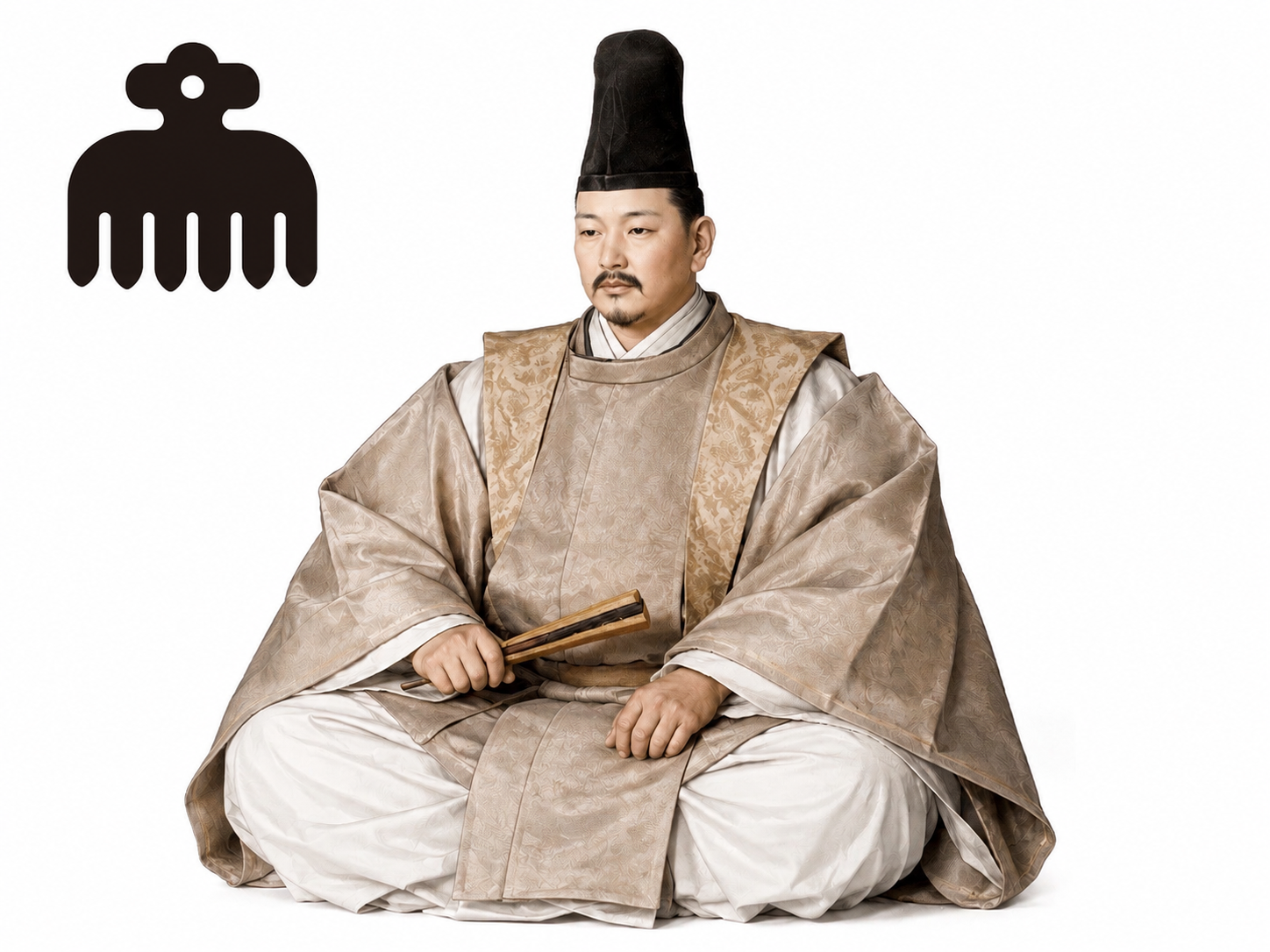
Imagawa Yoshimoto — Was the “Finest Archer of the Tōkaidō” Really an Incompetent General?
Eishō 16 (1519) – 19th day, 5th month of Eiroku 3 (1560) | Died aged 42
- This Figure in 3 Points
- The Mainstream Account — The Standard Story Found in Textbooks
- The Theories — Exploring the Possibilities from Various Angles
- A Strategic View
- Imagawa Yoshimoto — Notable Sayings and Death Poem
- Anecdotes and Episodes
- Imagawa Yoshimoto — Life Timeline
- Imagawa Yoshimoto — Family and Relationships
- Related Historic-Site Map and Travel Model Course
- Related Articles
- Reference Information
This Figure in 3 Points
- The greatest warlord of the Tōkai region, ruler of Suruga, Tōtōmi and Mikawa, praised as the “finest archer of the Tōkaidō.”
- He reinforced the provincial law code his father Ujichika had left behind and built the golden age of the Imagawa house across the three fronts of domestic government, diplomacy and the military.
- He was struck down by Oda Nobunaga at the Battle of Okehazama, aged 42. Long dismissed as a “court-besotted loser,” he is now being re-evaluated as a wise ruler.
The Mainstream Account — The Standard Story Found in Textbooks
Birth and Entry into the Priesthood (1519–1535)
Imagawa Yoshimoto was born in Eishō 16 (1519), the son of the Suruga warlord Imagawa Ujichika. His childhood name was Hōgikumaru. His father Ujichika was a celebrated ruler who enacted the “Imagawa Kana Mokuroku,” the oldest provincial law code in eastern Japan, and is regarded as the man who revived the Imagawa house. His mother was a daughter of the court noble Nakamikado Nobutane, later known as the female warlord Jukeini.
The Imagawa belonged to a cadet branch of the Ashikaga, giving them extremely high lineage. The first Ashikaga shogun, Takauji, is said to have left the instruction that “should the line of the Ashikaga fail, let the Kira succeed it; should the Kira also fail, let the Imagawa succeed” — making the Imagawa a house of the highest pedigree, eligible to inherit the shogunate itself.
Because Yoshimoto was born as Ujichika’s third son (some say fourth or fifth), inheriting the headship was never expected of him. Following custom, he entered the priesthood at age four at Zentoku-ji in Fuji District, Suruga Province, studying under the abbot Kinkei Shōshun. After Shōshun’s death, his disciple Kyūei Shōkiku — the future Taigen Sessai — took over Yoshimoto’s education. Sessai, who came down to Suruga only after Ujichika pleaded with him three times, was one of the foremost intellectuals of the Sengoku period.
Twice, in Daiei 5 (1525) and Tenbun 2 (1533), Yoshimoto and Sessai trained at Kennin-ji and Myōshin-ji in Kyoto. There Yoshimoto took the name Sengaku Shōhō and acquired the highest cultivation of the age — the Four Books and Five Classics, Chinese texts, military treatises, waka and renga poetry. The grounding for his later domain administration and his love of poetry was cultivated in this period.
The Hanagura Rebellion and Inheritance (1536–1537)
On the 17th day of the 3rd month of Tenbun 5 (1536), Yoshimoto’s elder brother Ujiteru, head of the Imagawa house, died suddenly at just 24. Even more mysteriously, his younger brother Hikogorō died on the very same day. The abnormal event of two brothers dying on the same day gave rise to theories of poisoning and assassination, and the truth remains unknown to this day.
The heir Ujiteru had no children of his own, and the succession question developed rapidly. The candidates were Yoshimoto and his half-brother Genkō Etan. Etan was the son of Ujichika’s concubine of the Kushima clan and, like Yoshimoto, had entered a temple as a monk. The Kushima were a powerful local clan in Tōtōmi, and with their backing Etan laid claim to the headship.
Taigen Sessai, on Yoshimoto’s side, moved swiftly on both the diplomatic and military fronts. First he had the Ashikaga shogunal house recognize Yoshimoto as the fitting head, winning over many retainers. He then secured aid from Hōjō Ujitsuna, lord of Izu and Sagami, establishing military superiority. In roughly two weeks Yoshimoto crushed Etan’s faction, and Etan took his own life as Hanagura Castle fell. This was the “Hanagura Rebellion.”
Victorious, Yoshimoto returned to secular life as head of the house and, receiving the character “Yoshi” from the 12th Ashikaga shogun Yoshiharu, took the name Yoshimoto. To pray for the soul of his late brother Ujiteru, he built Rinzai-ji in Sunpu and invited Taigen Sessai to be its abbot. From this base, Sessai went on to support the Imagawa as Yoshimoto’s chief strategist, military advisor and diplomat.
The Katō Rebellion and the Struggle with the Takeda and Hōjō (1537–1554)
Having inherited the headship, Yoshimoto sharply reversed his diplomatic course. In Tenbun 6 (1537), he took as his principal wife Jōkeiin, daughter of Takeda Nobutora (Shingen’s father). Since the Imagawa had until then been hostile to the Takeda, this was a bold change of direction.
This marriage, however, soured relations with the Hōjō, long-standing allies. That same year Hōjō Ujitsuna invaded the Katō region of eastern Suruga (east of the Fuji River) and occupied it. Warlords of Tōtōmi who had opposed Yoshimoto in the Hanagura Rebellion also rose up, and Yoshimoto found himself caught in a pincer from east and west. This was the “First Katō Rebellion.”
In Tenbun 14 (1545), Yoshimoto went on the offensive. He allied with the Kantō Kanrei Uesugi Norimasa, an enemy of the Hōjō, and with reinforcements from the Takeda devised a strategy to catch the Hōjō in a pincer. The Imagawa army defeated the Hōjō in Katō, while in the Kantō an Uesugi coalition of 80,000 besieged Kawagoe Castle. Cornered, Hōjō Ujiyasu asked Takeda Harunobu (Shingen) to mediate, and made peace with Yoshimoto by returning Katō to the Imagawa (the Second Katō Rebellion). The Imagawa won the war against the Hōjō, and relations between the two houses moved toward reconciliation.
From Tenbun 21 (1552) to Tenbun 23 (1554), the Takeda, Hōjō and Imagawa houses concluded marriage ties in stages, and at last the “Kō-Sō-Sun Triple Alliance” was completed:
- Tenbun 21 (1552): Yoshimoto’s daughter Reishōin married Takeda Shingen’s heir Yoshinobu.
- Tenbun 22 (1553): Shingen’s daughter Ōbaiin married Hōjō Ujiyasu’s heir Ujimasa.
- Tenbun 23 (1554): Ujiyasu’s daughter Hayakawa-dono married Yoshimoto’s heir Ujizane.
Popular legend holds that the three lords gathered together at the “Conclave of Zentoku-ji,” but recent research points out that this meeting is not historical fact and is a dramatization invented in later war chronicles. In reality, through diplomatic efforts centered on Sessai, the Triple Alliance came about as a staged marriage alliance. This removed the threats to the north and east, putting Yoshimoto in a position to concentrate on advancing westward.
The Conquest of Mikawa and the Submission of the Matsudaira (1540–1549)
Around the time of the Triple Alliance, Yoshimoto was also moving aggressively on the western Mikawa front. In Tenbun 9 (1540), Oda Nobuhide of Owari invaded Mikawa, seized Anjō Castle and threatened the Matsudaira of Okazaki. The Matsudaira head Matsudaira Hirotada sought relief from Yoshimoto and promised to send his heir Takechiyo (the future Tokugawa Ieyasu) to Sunpu as a hostage.
In Tenbun 16 (1547), the six-year-old Takechiyo was betrayed while being escorted to Sunpu and was seized by the Oda. Takechiyo spent two years as a hostage in Owari. In Tenbun 18 (1549), Sessai stormed the Oda-held Anjō Castle and captured Nobuhide’s natural son Oda Nobuhiro alive. Yoshimoto arranged a prisoner exchange of Nobuhiro for Takechiyo and at last recovered Takechiyo in Sunpu.
That same year, Matsudaira Hirotada was killed by a retainer, and Okazaki Castle effectively fell under Imagawa control. Takechiyo went on to spend twelve years as a hostage in Sunpu, where he is said to have received direct instruction from Sessai. Under Yoshimoto’s generous protection, Takechiyo grew up acquiring a cultivation in both letters and arms.
The Imagawa Kana Mokuroku Supplement and the “Sengoku Warlord” Declaration (1553)
In Tenbun 22 (1553), Yoshimoto added 21 supplementary articles to the “Imagawa Kana Mokuroku” enacted by his father Ujichika. This was not a mere reinforcement of the law but contained an epoch-making declaration revealing Yoshimoto’s political philosophy.
In the 20th supplementary article, Yoshimoto declared the following:
“The world has now changed; the two provinces of Suruga and Tōtōmi are lands that the Imagawa have pacified by their own strength. Therefore, the privilege of immunity from provincial deputies, established by the Muromachi shogunate, is abolished.”
This clearly declared that the Imagawa house was no longer a “shugo lord governing its domain by the authority of the Muromachi shogunate” but a “Sengoku warlord governing its domain by its own strength.” It is regarded as one of the first cases in which an independent Sengoku warlord’s position, free of dependence on the authority of the Muromachi shogunate, was set down in law.
Yoshimoto also advanced progressive domain administration on many fronts: conducting land surveys, organizing his retainer band through the yorioya-yoriko system, enriching commercial policy and developing the castle town of Sunpu. He invited many court nobles and cultural figures from Kyoto, and Sunpu came to form one of the “Three Great Cultures of the Sengoku Period,” alongside those of the Ōuchi of Yamaguchi and the Asakura of Ichijōdani in Echizen. Waka, renga and kemari flourished, and Sunpu came to be called “the Kyoto of the East.”
The Death of Taigen Sessai (1555)
On the 10th day of the intercalary 10th month of Kōji 1 (1555), Taigen Sessai died at the age of 60. Sessai had been Yoshimoto’s tutor from childhood, the greatest architect of victory in the Hanagura succession struggle, the diplomatic leader who realized the Triple Alliance, and a commander who led troops against the Oda.
The Kōyō Gunkan records that the Takeda retainer Yamamoto Kansuke said after Sessai’s death that “the Imagawa is a house that cannot stand without its monk.” Ieyasu, too, is said to have remarked in later years that “because Yoshimoto governed consulting only the monk Sessai, the authority of his senior retainers was light; thus after Sessai’s death, the governance of the realm fell into disorder.” Sessai’s death was a great turning point that foreshadowed the fate of the Imagawa. The tragedy of Okehazama came just five years after Sessai’s death.
The Battle of Okehazama (1560)
In the 5th month of Eiroku 3 (1560), Yoshimoto invaded Owari at the head of an army of some 20,000. He placed Matsudaira Motoyasu (Ieyasu) in the vanguard and himself advanced as far as Kutsukake Castle. In the opening engagements his side captured the Oda forts of Marune and Washizu, and Matsudaira Motoyasu succeeded in delivering provisions into Ōdaka Castle.
Around midday on the 19th, Yoshimoto’s main force was resting men and horses at Okehazama-yama. There a force of merely 2,000 led by Oda Nobunaga approached under cover of a torrential downpour and launched a surprise assault on his headquarters. Yoshimoto at first tried to retreat guarded by 300 mounted attendants, but lost them to the Oda pursuit. He was finally speared by the Oda warrior Hattori Koheita. Yoshimoto struck back and cut Koheita’s knee, but was pinned down by Mōri Shinsuke, who rushed in, and was killed — biting off Shinsuke’s finger at the very end. He was 42.
Yoshimoto’s beloved sword, the “Yoshimoto Samonji,” passed into Nobunaga’s hands and was later handed down to Toyotomi Hideyoshi and Tokugawa Ieyasu, surviving as a treasure of the Tokugawa shogunal house until the Meiji Restoration. Praised as “the sword of the realm-taker,” this single blade conveys to us even now that Yoshimoto was a figure respected by the conquerors of the Sengoku age.
→ For details, see the battle article “The Battle of Okehazama.”
The Imagawa House Afterward
After Yoshimoto’s death, his heir Ujizane inherited the headship but could not fully control a retainer band shaken by the defeat at Okehazama. Matsudaira Motoyasu (Ieyasu) of Mikawa became independent of the Imagawa and concluded the Kiyosu Alliance with Nobunaga in Eiroku 5 (1562). In Eiroku 11 (1568), when Takeda Shingen invaded Suruga, the Triple Alliance with the Hōjō also collapsed, and the Imagawa lost their home province of Suruga.
Ujizane took refuge with the Hōjō, the family of his wife Hayakawa-dono, and later served Tokugawa Ieyasu. In the Edo period the Imagawa were ranked among the shogunal vassals as kōke hatamoto, and the family name survived until the Meiji era. The Imagawa as a Sengoku warlord house effectively ended at Okehazama, but the lineage and culture that Yoshimoto and Ujichika had built up were handed down to later ages in altered form.
The Theories — Exploring the Possibilities from Various Angles
[Theory 1] Who Was Yoshimoto’s Real Mother? — The Rise of the Concubine-Birth Theory
Traditionally, Yoshimoto’s mother was held to be Jukeini, his father Ujichika’s principal wife, and Yoshimoto was considered the legitimate third son. Recent research, however, has proposed a new theory: that Yoshimoto was in fact the son of a concubine, and after the Hanagura Rebellion was adopted by Jukeini to be treated as a legitimate heir.
The historian Kuroda Motoki advances the concubine-birth theory on grounds including the account in the “Imagawa Genealogy” contained in the Tokan-shū Zanpen, thought to have been compiled before Tenbun 20, and the biological difficulty of Jukeini bearing as many as four children in a short span. By this reading, the reason Yoshimoto was placed in a temple at age four was that, not being a legitimate heir, succession was never anticipated for him.
The historian Ōishi Yasufumi shows a similar view. Both theories share the understanding of the relationship between Yoshimoto and Jukeini as one of “adoptive mother and son” rather than “real mother and son.” This is an important perspective for understanding Yoshimoto’s life. The path by which Yoshimoto, placed in a temple, came to inherit the headship through the Hanagura Rebellion was turbulent even as a legitimate heir — but if he was concubine-born, the drama is heightened all the more.
Of course, the view that he was Jukeini’s biological child remains deeply rooted, and the debate is unsettled. The discovery of newly surfaced sources or advances in genealogical research may yet prove decisive.
[Theory 2] Was the Same-Day Death of Ujiteru and Hikogorō a Poisoning?
On the 17th day of the 3rd month of Tenbun 5 (1536), the Imagawa head Ujiteru and his younger brother Hikogorō died on the same day. Ujiteru was just 24, and there is no specific record concerning the cause of death. The abnormal event of two brothers dying on the same day invited much speculation from the time itself.
The poisoning theory
The view that the Taigen Sessai faction, which sought to install Yoshimoto, or Jukeini, lay behind it. If Ujiteru and Hikogorō died, the path opened for Yoshimoto’s succession. A coincidence that brought maximum benefit to Yoshimoto’s side does indeed look unnatural. Fiction and novels often adopt this theory.
The assassination theory by the Genkō Etan faction
The view that the Kushima clan, trying to install Etan, poisoned Ujiteru and his brother to spark a succession dispute. This too carries a certain persuasiveness.
The coincidence / natural death theory
Infectious disease and poisoning were not rare in the Sengoku period, and it is by no means impossible for two people to fall ill at the same time. Ujiteru is said to have been sickly to begin with, and the possibility that some infectious disease spread within the family cannot be denied.
Because no evidence of poisoning whatsoever survives in the primary sources, the moderate position in scholarship today is that “it is suspicious, but there is no material to conclude it was poisoning.” Still, without this same-day death Yoshimoto’s life as a Sengoku warlord would never have begun, and it is without doubt one of the greatest mysteries that determined the fate of the Imagawa house.
[Theory 3] Is the Image of a “Court-Besotted, Effeminate Warrior” Accurate?
When it comes to Yoshimoto’s image, the picture of a “white-painted, blackened-toothed, palanquin-riding, court-besotted, effeminate warrior” long took hold. In the novels of Shiba Ryōtarō and in period dramas, he is often portrayed as a loser swept aside by Nobunaga at Okehazama. Recent research, however, has greatly overturned this image.
On blackened teeth and light makeup
The accounts of blackened teeth, painted eyebrows and light makeup appear in sources from the mid-Edo period onward; there is no such description in contemporary primary sources. Even if it were fact, it was a grooming that signified lineage at the shugo-lord level or above, and a custom of high-ranking warriors of the day. Among contemporary Sengoku warlords too, there are many cases of high-pedigree commanders adopting similar attire.
On riding in a palanquin
The Imagawa, as a cadet branch of the Ashikaga, held the highest class of pedigree, called one of the “Twenty-One Houses of the Muromachi,” and were specially permitted to ride in a palanquin. Ōishi Yasufumi points out that in Owari only the Shiba — likewise a cadet branch of the Ashikaga, and shugo — were qualified to ride a palanquin, and that Yoshimoto’s advance by palanquin was a political performance to display visually to the people of Owari the gap in pedigree with the Oda.
The Shinchō Kōki too records that Yoshimoto “was on horseback” as he retreated from Okehazama-yama, so it is not that he could not ride. The palanquin was a “symbol of pedigree” used on ceremonial occasions, a matter quite separate from his ability as a warrior.
Contemporary evaluation
The senior Asakura retainer of Echizen, Asakura Sōteki, in the Asakura Sōteki Waki, ranked Yoshimoto on the same level as Takeda Shingen, Oda Nobunaga, Miyoshi Nagayoshi, Nagao Kagetora (Uesugi Kenshin) and Mōri Motonari, calling him “a man who should be called a fine model, skilled at holding a province and at using men.” This is an evaluation by a contemporary as one of the finest warlords of the Sengoku age.
The image of a “court-besotted, effeminate warrior” was, in all likelihood, a label applied by later ages, reasoning backward from the outcome of his defeat by Nobunaga at Okehazama. The current evaluation is, rather, that Yoshimoto was one of the finest wise rulers of the Sengoku period.
[Theory 4] Did Yoshimoto’s Final Campaign Aim at Marching on Kyoto?
As for the aim of the Okehazama campaign, the “march on Kyoto” theory — that he intended to enter the capital and command the realm — was long held to be the established view. Shiba Ryōtarō’s novels and the like are based on this theory. Recent research, however, denies the march-on-Kyoto theory as lacking source evidence.
Ōishi Yasufumi holds that no primary source supports a march on Kyoto by Yoshimoto, and classifies the non-march theory into six possibilities:
- Securing control of eastern Owari
- Stabilizing control of Mikawa
- Territorial expansion
- Seizing the Ise Bay trade route linking eastern and western Japan
- Recovering old territory lost in the struggles with his father Ujichika and with Nobuhide
- Intervention in the internal struggle for hegemony within the Oda house
Even had he aimed at Kyoto, beyond defeating the Oda still stood many enemies — the Saitō of Mino, the Azai and Rokkaku of Ōmi, and others. Considering the road to Kyoto, it is more natural to see his realistic operational objective at the time as consolidating his footing in the Tōkai region. The current mainstream view is that Yoshimoto’s Okehazama campaign was part of a strategic action to further expand his influence as “ruler of the Tōkai,” and was not directly tied to an ambition to “take the realm.”
[Theory 5] Did Taigen Sessai’s Death Dull the Imagawa’s Strategic Vision?
Many researchers cite Taigen Sessai’s death as an indirect cause of the Okehazama tragedy. Sessai had been Yoshimoto’s tutor from childhood, the architect of victory in the Hanagura succession struggle, the diplomatic leader who realized the Triple Alliance, and a commander who directed the war against the Oda.
The Kōyō Gunkan relates that after Sessai’s death the Takeda retainer Yamamoto Kansuke said, “the Imagawa is a house that cannot do without its monk (Sessai).” Tokugawa Ieyasu too is said to have remarked in later years that “because Yoshimoto governed consulting only the monk Sessai, the authority of his senior retainers was light; thus after Sessai’s death, the governance of the realm fell into disorder.”
The conjecture that, had Sessai lived, it could have been avoided for Yoshimoto to campaign alone at Okehazama and leave the guard of his headquarters thin, carries persuasive force. Sessai had excellent judgment not only in diplomacy but in military matters. It is entirely possible that within five years of his death the strategic judgment of the Imagawa house declined.
On the other hand, some researchers reserve this as an “if” argument. Even after Sessai’s death the Triple Alliance functioned, and the Imagawa governed their domain stably. The view also remains deeply rooted that the defeat at Okehazama was the result of an overlapping of contingent factors — Nobunaga’s exceptional decision and the torrential rain — rather than of Sessai’s absence.
→ For details, see the warlord article “Taigen Sessai.”
[Theory 6] The Concubine-Birth Theory and the True Reason for “Entering the Temple”
The Edo-period tale collection Buke Zakki contains the account that Yoshimoto was “placed in a temple because he was disabled, with short legs and a long torso.” This is clearly thought to be a fabrication meant to disparage Yoshimoto, but the debate over the true reason for his entry into the temple continues to this day.
In the traditional view, placing sons other than the eldest in a temple during the Sengoku period was a common custom “to prevent succession disputes” and “to acquire learning,” and it was natural for Yoshimoto, as a third or fifth son, to be placed in a temple.
If one follows Kuroda Motoki’s concubine-birth theory, however, Yoshimoto was placed in a temple because “not being a legitimate heir, succession was never anticipated for him from the start.” Likewise, Genkō Etan had entered a temple because he too was concubine-born; whereas Jukeini left a legitimate child (Hikogorō), Yoshimoto and Etan were sons of concubines.
Seen this way, the course by which Yoshimoto won the Hanagura Rebellion, inherited the headship and became a Sengoku warlord appears ever more dramatic. The life of a temple monk who rose, through a string of deaths in the family and through diplomatic skill, to become one of the finest warlords of the Sengoku age, is also a symbolic case showing the flexibility of talent-use in the Sengoku period.
A Strategic View
When Yoshimoto is compared with other fine warlords of the Sengoku period, what stands out is his domain administration as a trinity of “domestic government,” “diplomacy” and “culture.”
First, domestic government. He reinforced the “Imagawa Kana Mokuroku” enacted by his father Ujichika with 21 supplementary articles and advanced progressive domain administration on many fronts — conducting land surveys, organizing his retainer band through the yorioya-yoriko system, commercial policy and developing the castle town of Sunpu. His 1553 declaration “abolishing the immunity of provincial deputies” was an epoch-making act that set down in law his position as a Sengoku warlord not dependent on the authority of the Muromachi shogunate, and it is engraved in Sengoku history as a declaration of warlord independence.
Second, diplomacy. The essence of Yoshimoto’s diplomatic strategy lies in his flexible reversals of relations with the Hōjō and the Takeda. Immediately after inheriting the headship he allied with the Takeda and turned hostile to the Hōjō; after overwhelming the Hōjō in the Katō Rebellion, he ultimately concluded the Triple Alliance with the Takeda and Hōjō and removed all threats from the rear. The skill of making enemies and then driving matters to reconciliation, and of building over the long term a structure in which all three houses could each advance in separate directions, can be called a masterpiece of Sengoku diplomacy. These came about with the support of Taigen Sessai, yet they could not have held together without the judgment of Yoshimoto himself, the final decision-maker.
Third, culture. Yoshimoto invited many court nobles and cultural figures from Kyoto and built up Sunpu as “the Kyoto of the East.” This was not mere refinement but also a political strategy to establish “cultural authority” in the Sengoku period. By joining the Imagawa house’s pedigree as a cadet branch of the Ashikaga to the cultural flourishing of Sunpu, Yoshimoto established his standing as the political and cultural center of the Tōkai region. This very cultural policy, mocked as “court-besottedness,” was one of the cores of Yoshimoto’s domain administration.
On the other hand, Yoshimoto’s limits are also noted: that his control of retainers depended heavily on Sessai; that the education of his heir Ujizane was ultimately insufficient; and the laxness of his battlefield judgment at Okehazama. At Okehazama in particular, there were fatal deficiencies in the guard deployment of his headquarters and in intelligence gathering. This may have been an event symbolizing the decline of judgment after Sessai’s death.
Yoshimoto is a complex figure with two faces — “a wise ruler of the Sengoku period” and “the loser of Okehazama.” For a long time the latter image ran ahead, but current research integrates both sides and is bringing into view a more three-dimensional portrait of Yoshimoto. The very fact that the contemporary Asakura Sōteki rated him on the same level as Shingen, Nobunaga, Kenshin and Motonari is the surest testimony to Yoshimoto’s true ability.
Imagawa Yoshimoto — Notable Sayings and Death Poem
“In the way of the warrior, leave fortune to the luck of the moment; victory in battle lies in the working of men.”
Transmitted as Yoshimoto’s words. It means that the fate of a warrior house must be left to heaven’s fortune, but the outcome of battle is decided by the working of men. It is known as a saying expressing Yoshimoto’s emphasis on domain administration and the appointment of talent. That said, strict tracing back to primary sources is difficult, and it may be a later tradition.
— Source: various works
“One must be cautious about handing a temple to a monk without ability.”
Yoshimoto’s words rating Taigen Sessai’s ability highly and stating that one should be cautious in appointing monks. It is a remark characteristic of Yoshimoto, who entered the priesthood in childhood and understood the importance of temples, and shows the difficulty of discovering talent of Sessai’s caliber. It conveys Yoshimoto’s view of talent, which combined cultivation and practical ability.
— Source: various works
“The world has now changed; the two provinces of Suruga and Tōtōmi are lands that Yoshimoto himself has pacified by his own strength.”
A passage from the 20th supplementary article of the Imagawa Kana Mokuroku, issued in Tenbun 22 (1553). Its gist is that “present-day Suruga and Tōtōmi are lands Yoshimoto pacified by his own strength.” Following this, he declared the abolition of the privilege of immunity from provincial deputies established by the Muromachi shogunate. As a declaration of independence as a Sengoku warlord not dependent on the authority of the Muromachi shogunate, it is an extremely important text in Sengoku history.
— Source: Imagawa Kana Mokuroku Tsuika
“A man who should be called a fine model, skilled at holding a province and at using men.”
Words with which the senior Asakura retainer of Echizen, Asakura Sōteki, rated Yoshimoto in the Asakura Sōteki Waki. It means “a person excellent in domain administration, skilled in the use of men, who should be taken as a model among Sengoku warlords.” He placed Yoshimoto on the same level as Takeda Shingen, Oda Nobunaga, Uesugi Kenshin and Mōri Motonari in delivering this evaluation, showing how very high the contemporary estimation of Yoshimoto’s ability was.
— Source: Asakura Sōteki Waki (contained in Zokuzoku Gunsho Ruijū)
Anecdotes and Episodes
Entering the Priesthood at Four — The Road to Sengoku Warlord Was Closed
Yoshimoto was born in Eishō 16 (1519) as a son of Imagawa Ujichika and was sent into the priesthood at just four years old at Zentoku-ji in Fuji District, Suruga Province. At the time, placing a male child with no prospect of inheriting the headship in a temple was a Sengoku-period custom — a common measure to prevent succession disputes and to have him acquire learning. Hōgikumaru (the future Yoshimoto) was no exception.
By rights, Yoshimoto should have spent his whole life as a monk and never left his name in history as a Sengoku warlord. But the coincidence of his elder brother Ujiteru’s sudden death pulled him back from the temple into the world of the Sengoku. The cultivation and political grounding he acquired in over a decade of monastic training would be put to use in his later domain administration. Yoshimoto’s life can be called a symbol of the “reversal of fate” in the Sengoku period.
— Source: Imagawa Yoshimoto, ed. Kuroda Motoki, Ebisu Kōshō Publication, 2019
The Meeting with Taigen Sessai — A Teacher Welcomed with Three Visits of Courtesy
Yoshimoto’s father Imagawa Ujichika sought to welcome Kyūei Shōkiku — of the Ihara clan, senior retainers of Suruga, who was training at Kennin-ji in Kyoto (the future Taigen Sessai) — as Yoshimoto’s tutor. But Sessai, disliking involvement in the secular world, is said to have refused twice. Even so Ujichika did not give up, made a third plea, and at last Sessai came down to Suruga.
When Sessai took on Yoshimoto’s education, Sessai was 27 and Yoshimoto still a child. The two trained together twice in Kyoto, and Sessai imparted to Yoshimoto the highest cultivation of the age — the Four Books and Five Classics, military science, waka and renga. This teacher-pupil bond gave rise to the later prosperity of the Imagawa house, and with Sessai’s death would also bring on its decline.
— Source: various studies of Taigen Sessai; Kōyō Gunkan
The Brothers’ Same-Day Death — One of the Greatest Mysteries in Sengoku History
On the 17th day of the 3rd month of Tenbun 5 (1536), the Imagawa head Ujiteru died suddenly at just 24. Furthermore, on the very same day his younger brother Hikogorō also died. The abnormal event of two brothers dying on the same day invited much speculation from the time itself.
There are various theories — poisoning, assassination, infectious disease — but the primary sources hold no decisive evidence. What is certain is that without this same-day death, Yoshimoto would never have inherited the headship and become a Sengoku warlord. As the greatest mystery that determined the fate of the Imagawa house, it continues to stir the imagination of history fans even now.
— Source: Kōhakusai-ki; various studies
The Hanagura Rebellion — A Succession Struggle of Just Two Weeks
After his elder brother Ujiteru’s death, Yoshimoto was drawn into a succession struggle with his half-brother Genkō Etan. Behind Etan stood the Kushima clan of Tōtōmi, a force not to be taken lightly militarily. But Taigen Sessai, on Yoshimoto’s side, moved swiftly on both the diplomatic and military fronts and crushed Etan’s faction in about two weeks.
Sessai’s strategy was outstanding. First he had the Ashikaga shogunal house recognize Yoshimoto as head, securing political legitimacy. Next he secured the support of Hōjō Ujitsuna, establishing military superiority. He won over many retainers through his own personal connections. Etan holed up in Hanagura Castle but, isolated and without aid, was driven to suicide.
Through this victory Yoshimoto returned to secular life and, receiving the character “Yoshi” from the 12th Ashikaga shogun Yoshiharu, took the name Yoshimoto. It was a dramatic transformation — a young temple monk becoming a Sengoku warlord in just two weeks.
— Source: Imagawa Yoshimoto, ed. Kuroda Motoki
Ieyasu’s Sunpu Hostage Years — A Childhood Under Sessai’s Direct Instruction
From Tenbun 18 (1549) to Eiroku 3 (1560), Matsudaira Takechiyo (the future Tokugawa Ieyasu) stayed as a hostage with the Imagawa in Sunpu. At the time Ieyasu was 8 to 19 — the most impressionable period of his life.
Yoshimoto did not treat Ieyasu shabbily, but had him receive direct instruction from Taigen Sessai, one of the foremost intellectuals of the age. Sessai is said to have given Ieyasu education of the same level Yoshimoto himself had received — the Four Books and Five Classics, military science, waka. Ieyasu is said to have been grateful all his life for Yoshimoto’s generous protection and Sessai’s teaching.
Yoshimoto’s death at Okehazama brought Ieyasu his independence, but the stance of valuing learning, cultivation and governance shown by the Ieyasu who later took the realm was cultivated in his Sunpu hostage years. Ironically, Yoshimoto’s hostage education may be said to have laid the foundation for the 260 years of the later Tokugawa shogunate.
— Source: Shiba Hiroyuki, Tokugawa Ieyasu: From Borderland Lord to Realm-Taker, Heibonsha
Sunpu, “the Kyoto of the East” — One of the Three Great Cultures of the Sengoku Period
Under Yoshimoto’s rule, Sunpu invited many court nobles and cultural figures from Kyoto and reached a peak of cultural prosperity. Waka, renga and kemari flourished, and Yoshimoto himself composed waka and had the aspect of a man of culture. The Sunpu of the day was counted, alongside the Ōuchi of Yamaguchi and the Asakura of Ichijōdani in Echizen, as one of the “Three Great Cultures of the Sengoku Period,” and was called “the Kyoto of the East.”
This cultural policy was not for refinement alone. By joining the high pedigree of the Imagawa house as a cadet branch of the Ashikaga to the cultural flourishing of Sunpu, Yoshimoto established his standing as the political and cultural center of the Tōkai region. While mocked as “court-besottedness,” this was also a strategic policy that made visible his authority as a Sengoku warlord.
After Okehazama, Sunpu was laid waste by Takeda Shingen’s invasion of Suruga, but the cultural legacy Yoshimoto built is said to have influenced even the later prosperity of Sunpu Castle (Ieyasu’s place of retirement).
— Source: Kuroda Motoki, Imagawa Yoshimoto; various studies
Yoshimoto’s End — Drawing His Sword to Fight Back
At the Battle of Okehazama, Yoshimoto was a warrior who fought to the very end. He cut the knee of Hattori Koheita, who first speared him, putting him out of action, and when Mōri Shinsuke rushed in and grappled with him, he bit off Shinsuke’s left finger and resisted to the last. It is also said that Yoshimoto’s head, severed from his body, still held the Mōri retainer’s finger in its mouth.
Contrary to the image of a “court-besotted, effeminate warrior,” Yoshimoto was a commander who drew his sword and fought back to the end. As Asakura Sōteki rated him “skilled at using men,” Yoshimoto was one of the finest of the Sengoku age. He was 42. After his death, Yoshimoto’s beloved sword the “Yoshimoto Samonji” passed into Nobunaga’s hands and was later handed down to Hideyoshi and Ieyasu, praised as “the sword of the realm-taker.”
— Source: Shinchō Kōki; Mizuno Katsunari Oboegaki; Owari-shi; and others
→ For details, see the battle article “The Battle of Okehazama.”
Imagawa Yoshimoto — Life Timeline
| Year | Age | Event |
|---|---|---|
| 1519 | 0 | Born a son of Imagawa Ujichika. Childhood name Hōgikumaru. |
| 1523 | 4 | Enters the priesthood at Zentoku-ji in Fuji District, Suruga. Studies under Kinkei Shōshun. |
| 1526 | 7 | Father Ujichika dies. Eldest brother Ujiteru inherits the headship. |
| c. 1529 | 10 | After Shōshun’s death, Kyūei Shōkiku (the future Taigen Sessai) takes over as tutor. |
| 1530 | 11 | Ordained by Jōan Ryūsū of Kennin-ji. Renamed Sengaku Shōhō. |
| 1533 | 14 | Trains with Sessai at Myōshin-ji in Kyoto. |
| 1536 (3rd mo.) | 17 | Brother Ujiteru and Hikogorō die on the same day. The Hanagura Rebellion breaks out (succession struggle with Genkō Etan). |
| 1536 (6th mo.) | 17 | Wins the Hanagura Rebellion. Returns to secular life and inherits the headship. Renamed Yoshimoto. |
| 1537 | 18 | Takes Takeda Nobutora’s daughter Jōkeiin as principal wife. The First Katō Rebellion breaks out. |
| 1540 | 21 | Oda Nobuhide invades Mikawa and seizes Anjō Castle. |
| 1545 | 26 | The Second Katō Rebellion. Allies with Uesugi Norimasa, catches the Hōjō in a pincer with Takeda reinforcements. Recovers Katō. |
| 1547 | 28 | Matsudaira Hirotada requests relief; Takechiyo (Ieyasu) becomes a hostage but is seized en route. |
| 1548 | 29 | Second Battle of Azukizaka: Sessai defeats the Oda army. |
| 1549 | 30 | Sessai captures Anjō Castle and takes Oda Nobuhiro alive. Recovers Takechiyo (Ieyasu) in a prisoner exchange. |
| 1552 | 33 | Daughter Reishōin marries Takeda Yoshinobu (continuation of the Kō-Sun alliance). |
| 1553 | 34 | Enacts the 21-article supplement to the Imagawa Kana Mokuroku. Abolishes immunity of provincial deputies — a Sengoku warlord declaration. |
| 1554 | 35 | The Kō-Sō-Sun Triple Alliance is formed (Hayakawa-dono marries Ujizane). |
| 1555 | 36 | Taigen Sessai dies (aged 60). The Imagawa lose their chief strategist. |
| 1558 | 39 | Cedes the headship to his heir Ujizane and concentrates on military affairs. |
| 1560 (early 5th mo.) | 42 | Sets out from Sunpu at the head of some 20,000 troops and invades Owari. |
| 1560 (5th mo., 19th day) | 42 | Struck down by Oda Nobunaga at the Battle of Okehazama. Died aged 42. |
※ Ages are reckoned by the traditional count (kazoe-doshi). Cell shading: yellow = major turning point; red = events relating to his end.
Imagawa Yoshimoto — Family and Relationships
Family
| Relation | Person | Summary |
|---|---|---|
| Father | Imagawa Ujichika | Reviver of the Imagawa house. Enacted the “Imagawa Kana Mokuroku” and pacified Suruga and Tōtōmi. |
| Mother | Jukeini | Daughter of the court noble Nakamikado Nobutane. Ujichika’s principal wife. Long held to be Yoshimoto’s mother, but recently regarded by the concubine-birth theory as his adoptive mother. |
| Brother | Imagawa Ujiteru | Yoshimoto’s eldest brother. Died suddenly at 24 on the 17th day, 3rd month of 1536, sparking the succession problem. |
| Brother | Imagawa Hikogorō | Ujiteru’s younger brother. Died on the same day as Ujiteru. The same-day death is one of the greatest mysteries of the Imagawa house. |
| Half-brother | Genkō Etan | Yoshimoto’s half-brother. Contested the headship with Yoshimoto in the Hanagura Rebellion, was defeated and took his own life. |
| Principal wife | Jōkeiin | Daughter of Takeda Nobutora, elder sister of Takeda Shingen. Married Yoshimoto in 1537, died of illness in 1550. |
| Heir | Imagawa Ujizane | Inherited the headship after Yoshimoto’s death. The head at the fall of the Imagawa. Later served Tokugawa Ieyasu; the family name survived into the Edo period. |
| Daughter | Reishōin | Married Takeda Shingen’s heir Yoshinobu. Returned to Suruga after Yoshinobu’s suicide. |
| Daughter-in-law | Hayakawa-dono | Daughter of Hōjō Ujiyasu. Principal wife of Imagawa Ujizane. Symbol of the Triple Alliance. |
Principal Retainers, Allies and Adversaries
| Relation | Person | Summary |
|---|---|---|
| Strategist / Tutor | Taigen Sessai | The “black-robed chancellor.” Yoshimoto’s teacher from childhood, later his supreme advisor in diplomacy and the military. Died 1555. |
| Senior retainer | Asahina Yasutomo | Senior Imagawa retainer. Captured the Washizu fort at Okehazama. |
| Senior retainer | Okabe Motonobu | Held Narumi Castle even after Okehazama, surrendering it in exchange for Yoshimoto’s head. |
| Hostage → retainer | Matsudaira Motoyasu (Ieyasu) | A hostage in Sunpu for 12 years. Became independent after Okehazama; the future Tokugawa Ieyasu. |
| Ally (later) | Takeda Shingen | Yoshimoto’s brother-in-law. A pillar of the Triple Alliance; destroyed the Imagawa with his invasion of Suruga after Yoshimoto’s death. |
| Ally (later) | Hōjō Ujiyasu | Opponent in the Katō Rebellion, later a pillar of the Triple Alliance. |
| Enemy → father-in-law | Takeda Nobutora | Shingen’s father. Initially hostile to the Imagawa, later father of Yoshimoto’s principal wife. Banished by Shingen in 1541. |
| Succession backer → enemy | Hōjō Ujitsuna | Ujiyasu’s father. Backed Yoshimoto in the Hanagura Rebellion but turned hostile in the Katō Rebellion. |
| Enemy | Oda Nobuhide | Nobunaga’s father. Contested control of Mikawa for years. |
| Enemy | Oda Nobunaga | Nobuhide’s son. Struck down Yoshimoto at Okehazama. |
Related Historic-Site Map and Travel Model Course
Related Historic-Site Map — Imagawa Yoshimoto
Spots on the map:
- Site of the Imagawa Residence (Sunpu Castle Park) (residence site) — Yoshimoto’s base, the center of Sengoku-period Sunpu.
- Rinzai-ji (family temple) — Built by Yoshimoto to pray for his brother Ujiteru’s soul; the temple where Sessai served as abbot.
- Fushun-in (shrine / memorial tower) — Has a memorial tower for Imagawa Yoshimoto.
- Okehazama Old Battlefield Park (old battlefield) — The site of Yoshimoto’s end (Nagoya City theory).
- Okehazama Old Battlefield Legend Site (old battlefield) — The site of Yoshimoto’s end (Toyoake City theory); Yoshimoto’s grave.
- Imagawa Yoshimoto’s Torso Mound (Toyokawa City) — Yoshimoto’s torso mound.
- Imagawa Yoshimoto’s Head Mound (Tōkō-ji) (Nishio City) — Yoshimoto’s head mound.
- Site of Hanagura Castle (Fujieda City) — The castle where Genkō Etan holed up in the Hanagura Rebellion.
※ The map is a reference display based on modern roads. It differs from the roads and terrain of the Sengoku period.
Travel Model Course — A Two-Day Trail of Imagawa Yoshimoto’s Footsteps
Conditions
- Duration: 2 days (by car)
- Day 1: Around Sunpu (Yoshimoto’s home base)
- Day 2: Nagoya / Toyoake (the site of Yoshimoto’s end)
Day 1: Sunpu — The Center of Yoshimoto’s Domain
① Sunpu Castle Park (Site of the Imagawa Residence) (stay: approx. 90 min)
Yoshimoto’s home base. The Sengoku-period Imagawa residence stood on this site.
– By car: about 15 min from Shizuoka IC on the Tōmei Expressway
② Rinzai-ji (stay: approx. 60 min)
The Imagawa family temple Yoshimoto built and to which he invited Sessai as abbot. A wooden statue of Yoshimoto remains (normally not open to the public).
– By car: about 15 min from Sunpu Castle Park
③ Fushun-in (Imagawa Yoshimoto Memorial Tower) (stay: approx. 30 min)
A temple with a memorial tower for Yoshimoto.
– By car: about 10 min from Rinzai-ji
④ Site of Hanagura Castle (stay: approx. 60 min)
The site of the castle where Genkō Etan holed up in the Hanagura Rebellion. The stage of Yoshimoto’s succession.
– By car: about 40 min from Sunpu (Fujieda City)
Day 2: Okehazama — The Site of Yoshimoto’s End
⑤ Okehazama Old Battlefield Park (stay: approx. 40 min)
The old battlefield on the Nagoya City side. Has statues of Nobunaga and Yoshimoto and explanatory monuments.
– By car: about 3 hours from Sunpu
⑥ Okehazama Old Battlefield Legend Site / Grave of Imagawa Yoshimoto (stay: approx. 60 min)
The old battlefield on the Toyoake City side. Has Yoshimoto’s grave.
– By car: about 5 min from the Old Battlefield Park
⑦ Imagawa Yoshimoto’s Torso Mound (Daishō-ji) (stay: approx. 30 min)
Yoshimoto’s torso mound in Toyokawa City.
– By car: about 60 min from Toyoake
⑧ Imagawa Yoshimoto’s Head Mound (Tōkō-ji) (stay: approx. 30 min)
Yoshimoto’s head mound in Nishio City.
– By car: about 40 min from Toyokawa
Arrangements by Visitor Type
- For the strong of leg: Also tour the sites of Ōdaka Castle and Narumi Castle to grasp the full picture of the Okehazama campaign.
- For a relaxed pace: A half-day course of just Sunpu Castle Park and Rinzai-ji.
- For history enthusiasts: A 3-day course also visiting Kennin-ji and Myōshin-ji in Kyoto (where Yoshimoto trained).
※ This plan is a reference model based on general travel speeds and stay times. Opening hours, transport schedules and crowding vary by season and day of the week. Please check the latest information on the official websites of each facility and transport operator before setting out.
※ Admission and entry fees are reference prices at the time of writing and may have changed.
※ For mountain-castle sites, please plan within your limits according to the weather and your physical condition.
Related Articles
Battle Articles
- The Battle of Okehazama (1560) — Yoshimoto’s final battle
Warlord Articles
- Taigen Sessai — Yoshimoto’s teacher and strategist from childhood
- Imagawa Ujichika — Yoshimoto’s father, reviver of the Imagawa house
- Jukeini — Yoshimoto’s mother (or adoptive mother), a female warlord
- Oda Nobunaga — The young warlord who struck Yoshimoto down at Okehazama
- Oda Nobuhide — Nobunaga’s father, who contested control of Mikawa with Yoshimoto
- Tokugawa Ieyasu — From Yoshimoto’s hostage to the later realm-taker
- Takeda Shingen — Yoshimoto’s brother-in-law, a pillar of the Triple Alliance
- Takeda Nobutora — Shingen’s father, father of Yoshimoto’s principal wife
- Hōjō Ujiyasu — Clashed in the Katō Rebellion, later a pillar of the Triple Alliance
- Hōjō Ujitsuna — Ujiyasu’s father; backed Yoshimoto in the Hanagura Rebellion, later turned enemy
- Asakura Sōteki — The veteran Echizen commander who rated Yoshimoto highly in his own time
Reference Information
Primary Sources
- Ōta Gyūichi, Shinchō Kōki — A highly reliable record covering the Battle of Okehazama and more
- Kōhakusai-ki — Diary of a Takeda retainer, recording the same-day death of Ujiteru and Hikogorō
- Imagawa Kana Mokuroku Tsuika — Enacted 1553, containing Yoshimoto’s Sengoku warlord declaration
- Asakura Sōteki Waki — A contemporary source rating Yoshimoto highly
- “Gokoku Zenji Sanjūsan Kaiki Nenkō Setsugo narabini Jo” — Record of Sessai’s 33rd memorial, noting the place of Yoshimoto’s death as “Dengaku-kubo”
Academic Works
- Kuroda Motoki, ed., Imagawa Yoshimoto and His Age (Series: New Studies of Sengoku Warlords, vol. 1), Ebisu Kōshō Publication, 2019 — The definitive volume of the latest research, including the concubine-birth theory
- Ōishi Yasufumi, ed., Imagawa Yoshimoto (Series: Studies of Medieval Kantō Warriors, vol. 27), Ebisu Kōshō Publication, 2019 — Latest points of debate, including the rejection of the march-on-Kyoto theory
- Kuroda Motoki, ed., Imagawa Ujichika (Series: Studies of Medieval Kantō Warriors, vol. 26), Ebisu Kōshō Publication, 2019 — A study of Yoshimoto’s father
- Arimitsu Tomoyuki, Imagawa Yoshimoto (Jinbutsu Sōsho), Yoshikawa Kōbunkan, 2008 — A basic work covering Yoshimoto’s life
- Shiba Hiroyuki, Tokugawa Ieyasu: From Borderland Lord to Realm-Taker (From the Medieval to the Early Modern), Heibonsha, 2017 — On Ieyasu’s Sunpu hostage years
- Fujimoto Masayuki, The Battle of Okehazama: Nobunaga’s Decision, Yoshimoto’s Miscalculation, Yōsensha, 2010 — The definitive study of Okehazama
Public Papers and Materials
- Endō Hideya, “The Mikawa Domainization of the Imagawa and Taigen Sōfu,” Komazawa University Graduate School Historical Essays, no. 38, 2008
- Kubota Masaki, “A Re-examination of the Battle of Okehazama,” in The Sengoku Warlord Imagawa Clan and Its Domain Rule, Yoshikawa Kōbunkan, 2005
- Shizuoka Prefectural Central Library, “Imagawa Kana Mokuroku” materials
- Mishima City Local Museum, “Imagawa Yoshimoto of Suruga”
※ This article is composed on the basis of the above sources, research works, papers and multiple sources on the web. Interpretations of history differ even among researchers, and the established view may change with the discovery of new sources or the advance of research.
コメント