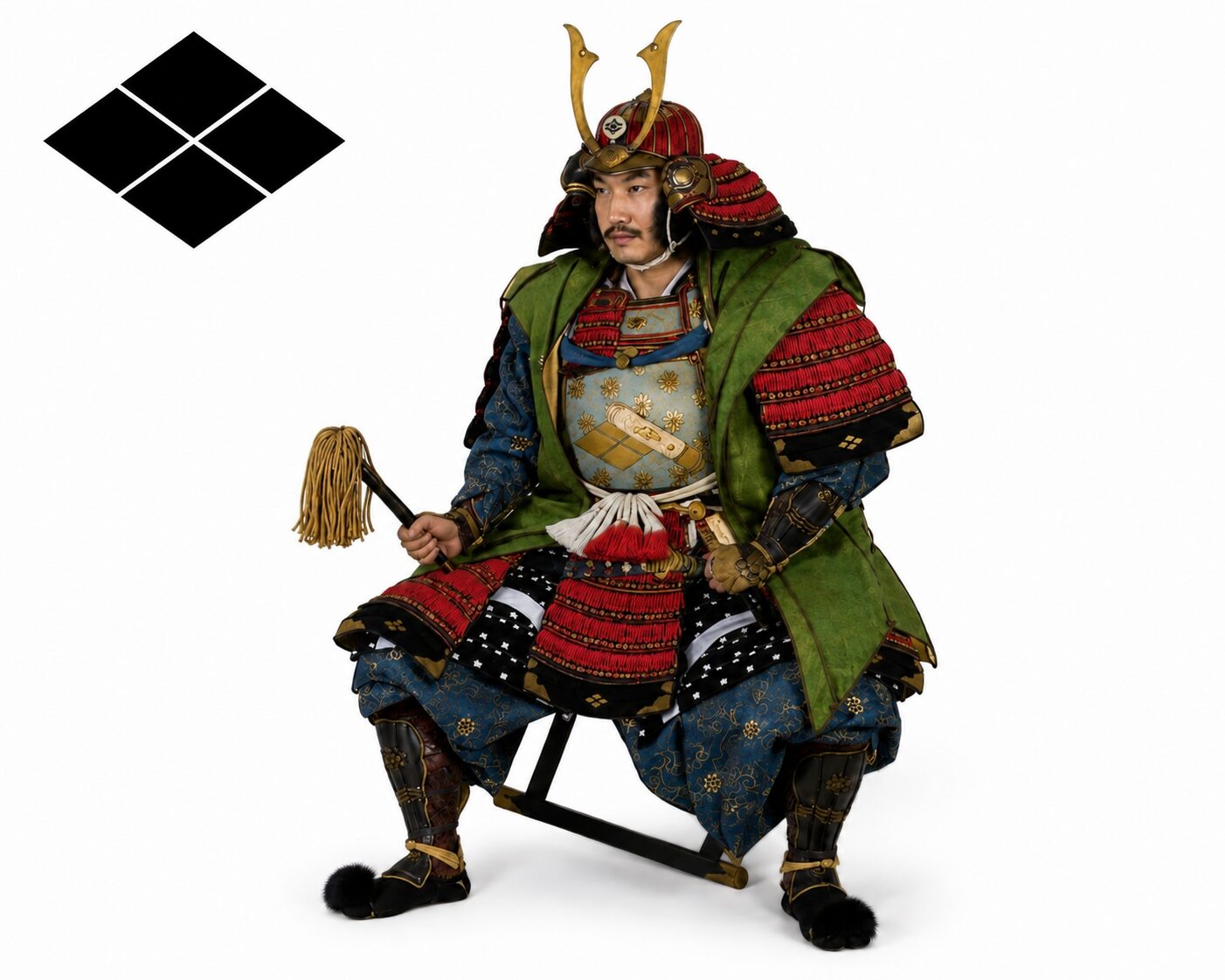
Takeda Katsuyori — The Last Head of the House, Who Bore the Shadow of His Great Father and Defied a Fate of Ruin
Tenbun 15 (1546) – 11th day of the 3rd month, Tenshō 10 (1582) | Died at age 37
- This Figure in 3 Lines
- The Mainstream View — The Established Account Found in Textbooks
- Multiple Theories — Exploring Possibilities from Various Angles
- Viewed Strategically
- Takeda Katsuyori — Famous Words and Death Poem
- Anecdotes and Episodes
- Takeda Katsuyori — Life Timeline
- Takeda Katsuyori — Family and Personal Relationships
- Related Historic Site Map / Model Travel Courses
- Related Articles
- References
This Figure in 3 Lines
- The fourth son of Takeda Shingen and the last head of the Takeda house, a tragic warlord who witnessed the end of the Sengoku age for his family.
- After the death of his father Shingen, he achieved the largest domain in Takeda history, surpassing even Shingen — yet lost many of his main commanders at the Battle of Nagashino.
- Through the Otate Disturbance and the fall of Takatenjin Castle, the defection of his retainers advanced, and he took his own life at Tenmokuzan. The Takeda house was destroyed.
The Mainstream View — The Established Account Found in Textbooks
The Fourth Son, of Suwa Blood (1546–1561)
Takeda Katsuyori was born in Tenbun 15 (1546) as the fourth son of Takeda Shingen. His mother was the Suwa Goryōnin, a daughter of Suwa Yorishige, lord of the Suwa District of Shinano. Tracing his mother’s line reveals a complicated situation for the Takeda house. His father Shingen had attacked Suwa Yorishige in Tenbun 11 (1542), driven him to suicide, and destroyed the head family of the Suwa. He then took Yorishige’s daughter as a concubine, and the child born of her was Katsuyori.
Within the Takeda house there was resistance to making the daughter of an enemy general a concubine, and records of Katsuyori’s childhood are scant. The Kōhakusai Ki contains accounts of the heir Takeda Yoshinobu and others, but almost no mention of Katsuyori or the Suwa Goryōnin can be found. About all that is known is that Katsuyori seems to have spent time with his mother at the Tsutsujigasaki Residence.
Around Eiroku 4 (1561), Katsuyori came of age and took the name Suwa Shirō Katsuyori. He succeeded to the name of the Suwa house, not the Takeda. In Eiroku 5 (1562), Katsuyori was appointed lord of Takatō Castle in Shinano. This was a strategic judgment by Shingen: making Katsuyori the bulwark of the Suwa–Ina front, with a plan to make him independent in the future as head of the Suwa house.
At this point, Katsuyori was not the heir of the Takeda house. The one to succeed the Takeda was the heir Yoshinobu, and Katsuyori was expected to remain a regional lord as Suwa Shirō. At his coming of age he did not receive a granted character of a name (henki) from the shogun. This shows he was not treated as the heir.
The Yoshinobu Affair and His Rise as Successor (1565–1567)
In Eiroku 8 (1565), an affair occurred in which Shingen’s heir Yoshinobu was confined on suspicion of rebellion (the Yoshinobu Affair). Yoshinobu had a daughter of Imagawa Yoshimoto as his legal wife and strongly opposed Shingen’s line of invading Suruga. In the 10th month of Eiroku 10 (1567), Yoshinobu committed suicide at Tōkō-ji. He was 30.
With Yoshinobu’s death, Katsuyori rose as a candidate for heir of the Takeda house. But Katsuyori’s position was extremely complicated. In Genki 1 (1570), Shingen took an adopted daughter of Oda Nobunaga, Lady Tōyama, as Katsuyori’s legal wife. This was meant to strengthen the Takeda–Oda alliance. In Genki 2 (1571), Lady Tōyama died just after giving birth to the heir Nobukatsu.
Shingen did not recognize Katsuyori as a full successor. Shingen’s design was that Katsuyori’s heir Nobukatsu would formally inherit the Takeda house once grown, and Katsuyori would govern the clan as his “jindai” (deputy/guardian). Katsuyori was placed in the unstable position not of lord of the Takeda house, but merely of “a stand-in until the next generation.” This became a remote cause of his later lack of cohesive authority within the Takeda house.
The Death of Shingen and the Realization of the Largest Domain (1573–1574)
On the 12th day of the 4th month of Genki 4 / Tenshō 1 (1573), Takeda Shingen died of illness at Komaba in the Ina District of Shinano Province, in the midst of his westward campaign. He was 53. Just before his death, Shingen is said to have left Katsuyori the following testament:
- Conceal my death for three years.
- For three years, refrain from foreign war and build up the strength of the realm.
- Endure until the situation turns favorable.
Following Shingen’s testament, Katsuyori announced that “Shingen has retired and Katsuyori has inherited the headship,” striving to conceal the death. However, Oda Nobunaga and Tokugawa Ieyasu quickly sensed Shingen’s death and began a counterattack into Takeda territory.
Katsuyori answered this crisis with an aggressive offensive. In the 2nd month of Tenshō 2 (1574), he invaded Mino Province in Oda territory and in just a month and a half captured eighteen castles, including Akechi Castle and Iibama Castle. Then in the 6th month, he took Takatenjin Castle, a stronghold of Tōtōmi that even Shingen had been unable to capture. The Takeda domain reached its largest extent in Katsuyori’s generation.
Nobunaga heightened his wariness at this aggressive offensive by Katsuyori. At the time, Nobunaga rated Katsuyori as “not to be taken lightly,” and in later years too spoke of him as “a bowman without equal in Japan (a peerless warrior)” (Mikawa Monogatari). The contemporary evaluation of Katsuyori was by no means low.
The Battle of Nagashino — The Decisive Battle That Changed His Fate (1575)
In the 4th month of Tenshō 3 (1575), Katsuyori invaded Mikawa at the head of a great army of 15,000. The target was Ieyasu’s home base, Okazaki Castle. There were those within the Tokugawa house seeking to collude with the Takeda, and Katsuyori tried to make use of this. But the collusion plan was exposed, and he changed his plan to the conquest of the Oku-Mikawa region.
In the 5th month, Katsuyori besieged the Tokugawa-held Nagashino Castle. Nagashino Castle was defended by the Tokugawa retainer Okudaira Nobumasa with only about 500 men. Ieyasu requested relief for Nagashino Castle from Nobunaga, and Nobunaga dispatched a relief force of over 30,000. The Oda–Tokugawa allied army numbered about 38,000, against the Takeda army’s 15,000 — a difference of about 2.5 times.
On the 18th day of the 5th month, the Nobunaga–Ieyasu allied army arrived at Shitaragahara, west of Nagashino Castle. Across the Rengo River, they faced off against the Takeda army. The allied army set up triple horse-stopping palisades before their lines and held their gun corps ready, waiting for the Takeda army’s charge.
Katsuyori resolved on a decisive battle. Among his senior retainers were some who advised retreat, but Katsuyori ordered the charge. Early on the morning of the 21st day of the 5th month, the Takeda army crossed the Rengo River and began the attack. Yamagata Masakage, Takeda Nobukado, Oyamada Nobushige, Naitō Masatoyo, Baba Nobuharu and others charged from various directions, but were blocked by the horse-stopping palisades and, taking concentrated gunfire, suffered devastating losses.
The fighting lasted about eight hours, and the Takeda army was crushingly defeated. Three of the Four Famous Retainers of the Takeda — Yamagata Masakage, Baba Nobuharu, and Naitō Masatoyo — were killed in action. Further, the Takeda lost many of their main commanders, including Tsuchiya Masatsugu, Hara Masatane, Sanada Nobutsuna (eldest son of Sanada Yukitaka), Sanada Masateru, Takeda Nobuzane (Shingen’s younger brother), and a younger brother of Takeda Nobukado. The Takeda army’s dead numbered about 10,000; Katsuyori himself, guarded by senior retainers such as Baba Nobuharu, barely withdrew to Kai.
The Battle of Nagashino was a decisive blow for the Takeda house. Losing in a single day the core of the body of retainers that Shingen had raised, the Takeda’s military strength greatly declined. At the same time, Katsuyori’s prestige was wounded. The retainers’ trust in Katsuyori, who had forced the decisive battle, began to waver.
→ For details, see the battle article “Battle of Nagashino.”
The Hard Struggle After Nagashino (1575–1578)
Even after the defeat at Nagashino, Katsuyori did not give up. To fill the holes left by the lost commanders, he appointed new retainers and pushed forward with military reform. In Tenshō 4 (1576), he took a daughter of Hōjō Ujiyasu, Lady Hōjō, as his second wife and further strengthened the Kai–Sagami alliance. This was an effort to make up for the disadvantage after Nagashino through diplomacy.
Katsuyori also put effort into domestic government. To recover the Takeda prestige lost at Nagashino, he planned the construction of a new base, “Shinpu Castle,” to replace the Tsutsujigasaki Residence. Completed in Tenshō 9 (1581), Shinpu Castle was a modern castle with strengthened functions as a military base.
However, the offensive of the Oda–Tokugawa allied army continued. After Nagashino, Tokugawa Ieyasu recaptured the Takeda territories of Tōtōmi and Mikawa one after another. The Takeda domain gradually shrank.
The Otate Disturbance and the Collapse of the Kai–Sagami Alliance (1578–1579)
In the 3rd month of Tenshō 6 (1578), Uesugi Kenshin of Echigo died suddenly. Because he died without naming a successor, a succession dispute broke out in the Uesugi house. There were two candidates: Kenshin’s adopted son Uesugi Kagekatsu (Kenshin’s nephew), and Uesugi Kagetora (the seventh son of Hōjō Ujiyasu and an adopted son of Kenshin). This became the internal war called the “Otate Disturbance.”
Katsuyori’s younger sister was Kagetora’s legal wife, and Kagetora was a man who had entered as an adopted son from the Hōjō house. Since the Takeda were then bound to the Hōjō in the Kai–Sagami alliance, it was naturally expected that Katsuyori would support Kagetora. At first, Katsuyori sent troops to Echigo to support Kagetora.
But as he gauged the course of the war, Katsuyori changed his policy. He agreed to make peace with the Kagekatsu side and approved Kagekatsu’s succession to the headship. There were several circumstances behind this:
- Geographically in Echigo, the Kagekatsu side was at an advantage.
- A large sum of money and goods (in some accounts, as much as 10,000 ryō) was offered by Kagekatsu as a peace payment.
- He judged it a chance to put an end to the long-standing Takeda–Uesugi conflict.
- If it became a prolonged war, the relationship with the Hōjō might also worsen.
Katsuyori’s judgment was, in the short term, rational for the Takeda. But Hōjō Ujimasa was enraged that his younger brother Kagetora had been left to die. Kagetora was ultimately defeated and killed, and the Kai–Sagami alliance completely collapsed. The Hōjō house thereafter allied with the Oda and Tokugawa, and the Takeda were left in a structure of encirclement from east and west.
The judgment in the Otate Disturbance is often evaluated by later ages as “Katsuyori’s greatest blunder.” But the recent evaluation is that, under the circumstances of the time, it was not necessarily an irrational choice. This is discussed in the Multiple Theories below.
The Fall of Takatenjin Castle — The Collapse of Prestige (1580–1581)
With the collapse of the alliance with the Hōjō, Katsuyori was forced into a two-front operation: the Hōjō to the east, and the Oda and Tokugawa to the west. As the shrinking of the Takeda domain continued, Tokugawa Ieyasu strengthened the encirclement of Takatenjin Castle in Tōtōmi. Takatenjin Castle was a symbol of valor — a stronghold even Shingen could not take, which Katsuyori had captured — and the most important front-line base for the Takeda.
From Tenshō 8 (1580), the Tokugawa army completely encircled Takatenjin Castle, adopting the tactic of waiting for the castle’s provisions to run out. Many of the soldiers within the castle had been dispatched from the Takeda body of retainers, and their families were in Kai and Shinano. If Takatenjin Castle were abandoned, the trust of the body of retainers in the Takeda house would be completely lost.
Katsuyori could not send relief. At the time, he was advancing peace negotiations with Nobunaga (the Kai–Oda peace, Kōkō Wayo), trying to create a mood of reconciliation by returning Nobunaga’s fifth son Oda Nobufusa (a Takeda hostage) and the like. To dispatch a great army to Takatenjin Castle here would break off the peace. On the other hand, to abandon the castle would lose the trust of the clan. Katsuyori had fallen into a hopeless dilemma in which either choice would wound the Takeda house.
In the end, Katsuyori sent no relief. In the 3rd month of Tenshō 9 (1581), the provisioned-out Takatenjin Castle offered to surrender, but Ieyasu, on Nobunaga’s instructions, refused the surrender and ordered a thorough attack. The castle troops carried out a final charge, and all died in battle.
The fall of Takatenjin Castle dealt a fatal blow to Katsuyori’s prestige. The image of “a lord who abandons his own people” spread through the Takeda house, and the defection of retainers accelerated. It was the event that became the decisive turning point toward the destruction of the Takeda.
The Destruction of the Takeda House — The End at Tenmokuzan (1582)
In the first month of Tenshō 10 (1582), Katsuyori’s brother-in-law Kiso Yoshimasa (Shingen’s son-in-law) colluded with Nobunaga. Using this as a pretext, Nobunaga began a full-scale Kōshū campaign. Oda Nobutada (Nobunaga’s heir) from the Mino–Shinano direction, Tokugawa Ieyasu from Suruga, and Hōjō Ujinao from Kantō invaded the Takeda domain from all four sides.
On the 14th day of the 2nd month, Mount Asama erupted greatly. The volcanic ash covering the Takeda domain was taken by the people as “an omen of the end of the Takeda house.” The retainers’ agitation grew severe, and the Takeda-side castles across the land surrendered and opened their gates one after another.
At the end of the 2nd month, Anayama Baisetsu (Nobukimi), who could be called Katsuyori’s right arm, colluded with Tokugawa Ieyasu and defected. Anayama was also a son-in-law of Shingen and the senior-most of the Takeda house’s senior retainers. His defection had a great influence on the other retainers as well. The castles of Shinano fell rapidly, and the only one to continue resistance was Takatō Castle.
On the 3rd day of the 3rd month, Katsuyori burned down the newly completed Shinpu Castle himself and withdrew. At first he aimed for Iwadono Castle in the Gunnai region, held by his senior retainer Oyamada Nobushige. But when Katsuyori’s party approached Iwadono Castle, Oyamada Nobushige suddenly betrayed him, shut the castle gates, and fired arrows and guns at them.
In despair, Katsuyori changed course and headed toward Tenmokuzan. Tenmokuzan was a place of fateful significance for the Takeda house: in Ōei 24 (1417), Takeda Nobumitsu (a head of the house about nine generations before Katsuyori) had been defeated in the Uesugi Zenshū Rebellion and taken his own life there.
On the 11th day of the 3rd month, Katsuyori’s party was overtaken by the Oda pursuit force at Tano on Tenmokuzan. Katsuyori, his heir Nobukatsu, his second wife Lady Hōjō, and the women accompanying them took their own lives one after another. Katsuyori is said to have fought to the last, wielding his sword in resistance, but in the end he took his own life. He was 37. His heir Nobukatsu also took his own life the same day, at 16.
Thus the distinguished Takeda house — descended from the Seiwa Genji and continuing since the late Heian period — was destroyed. It was only nine years after Shingen’s death.
On hearing of Katsuyori’s death, Nobunaga is said to have remarked:
“A bowman without equal in all Japan — yet when fortune runs out, does it come to this?”
Even Nobunaga, his greatest enemy of the time, rated Katsuyori as “a warrior without peer in Japan.” The recent evaluation is that the destruction of the Takeda house was less a matter of Katsuyori’s personal ability than a historical inevitability arising from compound factors.
Multiple Theories — Exploring Possibilities from Various Angles
[Theory 1] Was Katsuyori Really a “Foolish General”?
The image of “the foolish general who destroyed the Takeda house” has been repeatedly depicted in postwar historical novels and dramas and is widely current to this day. In Shiba Ryōtarō’s works and in numerous Taiga dramas, Katsuyori was often depicted as a mediocre successor compared with the greatness of his father Shingen.
In recent research, however, this conventional view has been greatly overturned. The series of studies by the historian Hirayama Yū (The Battle of Nagashino and Takeda Katsuyori, Takeda Katsuyori, etc.) shows Katsuyori’s true image as follows:
- Territorial expansion: After Shingen’s death, Katsuyori captured the eighteen castles of Mino and Takatenjin Castle, achieving the largest domain in Takeda history.
- Contemporary evaluation: Nobunaga himself was wary, calling him “not to be taken lightly,” and even after his death rated him as “a bowman without equal in Japan.”
- Military ability: Apart from the Battle of Nagashino, Katsuyori won numerous battles.
- Diplomatic skill: He realized complex diplomacy — maintaining and strengthening the Kai–Sagami alliance with the Hōjō, the alliance with the Uesugi, and more.
- Domestic ability: He continued active governance even after Nagashino — building Shinpu Castle, military reform, the reorganization of the body of retainers.
The “foolish general” image is likely a later label calculated backward from the result of the Takeda’s destruction. The current mainstream view is that Katsuyori was by no means foolish — rather, he was a warlord of ability ranking among the finest of the Sengoku period, who was crushed by compound misfortunes.
Of course, Katsuyori too made judgment errors. The choice of decisive battle at Nagashino, the change of policy in the Otate Disturbance, the failure to relieve Takatenjin Castle — each, as a result, weakened the Takeda house. But these judgments too were likely rational choices under their respective circumstances, and it is not fair to lump them together and evaluate them as “failures due to foolishness.”
[Theory 2] Were the Nagashino “Three-Stage Gun Volley” and “Cavalry Charge” Historical Fact?
The Battle of Nagashino is widely known through the dramatic image that “Oda Nobunaga’s three-stage gun volley smashed the Takeda cavalry.” This conventional view, however, has been greatly reexamined in recent research.
The problem of the “three-stage gun volley”
The “three-stage gun volley” is a rotational-fire tactic in which 3,000 guns are arrayed in three rows; when the first row fires it falls back, the second row fires and falls back, and the third row fires. This is said to have overwhelmed the Takeda cavalry — the conventional view.
However, this tactic is likely an embellishment of Edo-period war chronicles such as the Hoan Nobunaga Ki. In Ōta Gyūichi’s autograph manuscript of the Shinchō Kōki, close to a primary source, it is recorded as “about a thousand guns,” and the figure of 3,000 is held to be an inflation in later copies. Moreover, considering the structure of the matchlock of the time and the procedure for loading powder and shot, precise continuous fire like a “three-stage volley” was not practical.
The problem of the “Takeda cavalry charge”
Similarly, the image that “the Takeda cavalry charged” has been reexamined. The Takeda army of the time did not organize a “cavalry corps” with mounted warriors as its main force. Takeda mounted warriors commonly fought dismounted, and horses were mainly a means of movement. At Nagashino too, the Takeda army is said to have attacked in an ordinary combat formation combining foot soldiers and mounted warriors.
Recent evaluation
The historian Hirayama Yū holds that the Battle of Nagashino was not a simple “guns vs. cavalry” structure, but a structure in which the Takeda army’s attack on a firm defensive position of horse-stopping palisades and a multi-arms formation failed. Guns were one decisive factor, but Nobunaga’s true cause of victory lay in the comprehensive advantage of terrain, position-building, troop-number difference, and multi-arms coordination.
The dramatic structure of “three-stage gun volley vs. cavalry charge” is a modern-and-later image created to explain Sengoku history in an easy-to-understand way. By simplifying the Takeda’s defeat into “old tactics defeated by new tactics,” it became possible to depict Katsuyori as an “outdated foolish general.” But the actual Battle of Nagashino was a battle entangled with much more complex factors.
[Theory 3] The Reasons Katsuyori Decided on a Decisive Battle at Nagashino
That Katsuyori chose a decisive battle rather than retreat at Nagashino has often been criticized as a “reckless judgment.” The general view was that, while his senior retainers advised retreat, the young Katsuyori forced the decisive battle out of an ambition for glory in trying to surpass his father Shingen.
In recent research, however, it has been pointed out that there were also several rational reasons for Katsuyori’s choice of decisive battle:
First reason: He could not abandon Nagashino Castle
While the Takeda army was besieging Nagashino Castle, Nobunaga and Ieyasu arrived as a relief force. If the Takeda retreated here, Nagashino Castle would fall. Nagashino Castle was defended by the Tokugawa retainer Okudaira Nobumasa, and if Katsuyori abandoned Nagashino, it would be proclaimed across the provinces that “he could not relieve the Tokugawa,” and the Takeda’s prestige would be wounded.
Second reason: A miscalculation of Nobunaga and Ieyasu’s movements
Katsuyori likely thought the relief force of Nobunaga and Ieyasu was smaller than expected. At the time, Nobunaga had his hands full with the attack on the Honganji and the situation in the capital region, and it was hard to predict that he could dispatch a great army of over 30,000. The scale of the allied army actually dispatched may have been beyond Katsuyori’s expectation.
Third reason: The difficulty of retreat
If the Takeda army began to retreat, the Nobunaga–Ieyasu allied army would pursue from behind. A retreating battle is one of the most dangerous in Sengoku combat, and a retreat pursued by a great army in particular carried the risk of devastating losses. He may have judged that settling the contest by decisive battle was safer than an uncertain retreating battle.
Fourth reason: Circumstances within the Takeda house
Katsuyori was in the unstable position of Shingen’s “jindai” and needed to raise his cohesive authority within the clan. It cannot be denied that there may have been a psychology of trying to make his position secure by achieving a result that surpassed Shingen.
As a result of these factors acting in combination, Katsuyori chose the decisive battle. Rather than a “reckless charge,” it is more apt to evaluate it as “an agonizing choice under unfavorable circumstances.”
[Theory 4] Was the Judgment in the Otate Disturbance Really a “Mistake”?
Katsuyori’s judgment to support Uesugi Kagekatsu rather than Kagetora in the Otate Disturbance has been criticized by later ages as “the greatest cause of the Takeda’s destruction.” But this judgment too had several rational aspects.
Reasons it is criticized
- Kagetora was a man who had entered as an adopted son from the Hōjō house, and was the option for strengthening the alliance with the Hōjō.
- By supporting Kagekatsu, the Kai–Sagami alliance collapsed, and the Takeda fell into a structure of being attacked on both flanks from east and west.
- As a result, it likely hastened the Takeda’s destruction.
Aspects that were rational
Among historians, there are opinions that it is not fair to condemn Katsuyori’s judgment as “an outright blunder”:
- Gauging the course of the war: From the geographical and political situation in Echigo, the Kagekatsu side had a high probability of ultimately winning. It is not wise to back a losing horse.
- Resolving the long Takeda–Uesugi conflict: It was a prime opportunity to end the Takeda–Uesugi conflict — represented by the five Battles of Kawanakajima — through peace with Kagekatsu.
- The original instability of the relationship with the Hōjō: Kuroda Motoki points out that the Kai–Sagami alliance was originally unstable, and that even before the Otate Disturbance the Hōjō were advancing negotiations with the Tokugawa. Even had Katsuyori supported Kagetora, the alliance would likely not have lasted.
- The large peace payment: The peace payment offered by Kagekatsu (10,000 ryō in some accounts) was extremely attractive for the cash-strapped Takeda.
Of course, as a result this judgment backfired for the Takeda. The collapse of the alliance with the Hōjō was a fatal blow, and the Takeda were isolated. But under the circumstances of the time, there is a strengthening view that to condemn Katsuyori’s choice as a “mistake” is a results-based evaluation and unfair.
[Theory 5] The True Reason He Let Takatenjin Castle Fall
The fall of Takatenjin Castle in Tenshō 9 (1581) is known as the decisive event that lost the trust of the Takeda retainers all at once. Because Katsuyori sent no relief, the castle troops all died in battle. This “abandonment” is criticized as a symbol of Katsuyori’s coldness.
But there were complex circumstances behind Katsuyori’s inability to send relief.
Peace negotiations with Nobunaga (the Kai–Oda peace)
At the time, Katsuyori was advancing peace negotiations with Nobunaga. If peace were concluded, the Takeda could remove the threat from the Oda and concentrate on the fight with the Tokugawa and Hōjō. This was the Takeda house’s only path to survival.
Katsuyori was sending signals of reconciliation, such as returning Nobunaga’s fifth son Oda Nobufusa (a Takeda hostage). To send relief to Takatenjin Castle here would provoke Nobunaga and break off the peace. Katsuyori prioritized peace and resolved to forgo the relief.
Military difficulty
Even had he sent relief, the prospect of victory was low. The Tokugawa army had completely encircled Takatenjin Castle and lay in wait for a relief force. With the Takeda’s military strength reduced by the defeat at Nagashino, to mount a head-on decisive battle against the Tokugawa–Oda allied army was reckless.
The relationship with the body of retainers
The families and subordinates of the Takeda body of retainers had been placed in Takatenjin Castle as garrison troops. Katsuyori understood that to abandon them would lose the trust of the clan. That he nevertheless could not send relief was because of the dilemma that “to send relief would ruin the entire Takeda house.”
In the end, Nobunaga unilaterally broke off the peace negotiations and had Takatenjin Castle thoroughly attacked. Katsuyori’s “abandonment” was likely not intentional but “an agonizing choice under circumstances where sending relief was impossible.” This too is criticized in hindsight as a “cold judgment,” but for Katsuyori, the party concerned, there was almost no room to choose the best option.
[Theory 6] What Was the Greatest Cause of the Takeda’s Destruction?
How to evaluate the causes of the Takeda house’s destruction is still debated among historical researchers. Here are several representative theories.
First theory: Katsuyori’s personal judgment errors
The theory that Katsuyori’s judgment errors — the decisive battle at Nagashino, the Otate Disturbance, the abandonment of Takatenjin Castle — destroyed the Takeda house. The traditional interpretation from the Edo period onward.
Second theory: Shingen’s legacy
The theory that the Takeda house’s structural weakness was something Shingen left behind. Losing his heir in the Yoshinobu Affair and leaving Katsuyori as a “jindai” under the Suwa-clan name invited a decline in the Takeda house’s cohesive authority. Katsuyori was tormented by the “complex succession structure his father left behind.”
Third theory: Nobunaga’s overwhelming superiority
The theory that, from the late 1570s onward, Oda Nobunaga rapidly expanded his power, subdued the capital region, and acquired overwhelming military strength. The Takeda were no longer an opponent who could resist alone, and destruction was unavoidable in any case.
Fourth theory: Structural weakness of the body of retainers
The Takeda body of retainers was united by Shingen’s personality, but after Shingen’s death it lacked cohesive authority. Losing many main commanders at Nagashino accelerated the collapse of the body of retainers. The defections of Anayama Baisetsu, Oyamada Nobushige, and others were the extreme of this.
Fifth theory: Compound-factors theory (the recent mainstream)
The recent mainstream view is that the Takeda’s destruction was the result of these factors acting in combination. To attribute it to Katsuyori alone, or to blame Shingen’s legacy alone, or to absolutize Nobunaga’s overwhelming superiority — all are too one-sided. The Takeda’s destruction was the result of the inevitability of the Sengoku-period transfer of power intersecting with individual historical events.
The image of Katsuyori as a “foolish general” is no more than a later evaluation calculated backward from the result of the Takeda house’s destruction. He was an able warlord who temporarily acquired a domain surpassing Shingen’s, and the apt evaluation is simply that he could not overcome the great current of history and the structural factors that placed him at a disadvantage.
Viewed Strategically
When Katsuyori is compared with Shingen, Nobunaga, and Ieyasu, what stands out is the “mismatch between ability and fate.”
Katsuyori’s own ability was by no means low. Rather, there are many aspects for which he should be rated among the finest warlords of the Sengoku period: the offensive power that captured the eighteen castles of Mino and Takatenjin Castle in just one or two years after Shingen’s death; the tenacity to push forward with building Shinpu Castle and military reform even after the defeat at Nagashino; the political judgment to handle complex diplomacy with the Hōjō and Uesugi; the valor to stand at the head of his troops himself to keep his retainers’ trust. These were things a mediocre warlord could by no means do. That Nobunaga himself rated him as “a bowman without equal in Japan” was an honest assessment of Katsuyori’s real ability.
But Katsuyori was placed within a decisively disadvantageous structure. First, the instability of his position as successor. In the ambiguous standing of Shingen’s “jindai,” it was hard to establish absolute authority over the body of retainers. Even while being called “lord,” the structure in which the true master was the heir Nobukatsu and Katsuyori was his guardian produced a subtle sense of distance in the retainers’ psychology. That the Takeda body of retainers, while boasting of its cohesion, saw Anayama Baisetsu, Oyamada Nobushige, Kiso Yoshimasa, and others defect one after another in the final phase shows that loyalty to Katsuyori was not as absolute as to Shingen.
Second, the dramatic worsening of the strategic environment surrounding the Takeda house. The year 1573, when Shingen died, was the turning point at which the anti-Nobunaga encirclement collapsed and Nobunaga’s hegemony was established. After this, Nobunaga destroyed the Azai and Asakura, dismantled the Muromachi shogunate, fought a decisive battle with the Honganji, and completely subdued the capital region. Nobunaga’s expansion of power in the late 1570s was something the strength of a single province like the Takeda could by no means resist. Whoever had been head of the Takeda, it would have been extremely difficult to preserve the Takeda house amid the three-way encirclement by the Oda, Tokugawa, and Hōjō.
Third, the chain blow of the defeat at Nagashino. Losing in a single day the senior retainers who had supported the Takeda house since Shingen’s time — Yamagata Masakage, Baba Nobuharu, Naitō Masatoyo, and others — was an irrecoverable wound in both military strength and clan cohesion. These senior retainers were, for Katsuyori, both tactical mentors and important figures who governed the body of retainers. Their loss isolated Katsuyori.
If we are to evaluate Katsuyori, the reality is closer to “an excellent warlord crushed by multiple structural disadvantages and individual misfortunes” than to “a weak warlord swept away by the change of the times.” Katsuyori’s tragedy lay in the mismatch between ability and fate.
Still, Katsuyori too had blunders. The judgment to choose a decisive battle at Nagashino, even if it had rationality at the time, as a result ruined the Takeda house. As for the Otate Disturbance judgment too, there is debate over whether it was necessary to switch to Kagekatsu even at the cost of the alliance with the Hōjō. The forgoing of relief for Takatenjin Castle also brought the result of losing the clan’s trust all at once. These were “correct judgments,” but not “successful judgments.” The true worth of a Sengoku daimyō rests not on making correct judgments but on whether he can make successful ones. In that sense, Katsuyori was ultimately a “warlord who could not succeed.”
But it is not fair to evaluate him as “foolish” or “a mediocre general.” Whether Shingen, placed in the same position, would certainly have won is doubtful. Even Ieyasu was in a plight of successive defeats up to Nagashino, and without the luck of Okehazama it is uncertain whether he could have survived the Sengoku age. Katsuyori is a defeated man worthy of sympathy, a tragic warlord with ability among the finest of the Sengoku period, who deserves reappraisal.
Takeda Katsuyori — Famous Words and Death Poem
“The hazy moon, faint too, amid cloud and mist; clearing, the way ahead leads to the rim of the western hills.”
— Katsuyori’s death poem
The death poem said to have been composed just before he took his own life at Tenmokuzan. The hazy moon hidden in cloud and mist; the destination, clearing, is the rim of the western hills — a serene verse sensing the end of the Takeda house and his own death. The state of mind of a Katsuyori who lived through the fierce Sengoku age and accepted at the last the fate of taking his own life together with his wife and child seeps through. A deep resignation drifts through it, hard to believe it was composed at the youthful age of 37.
— Source: various works
“In a world disordered like black hair, endless are the thoughts; my life’s thread vanishes like a bead of dew.”
The death poem of Katsuyori’s second wife, Lady Hōjō. A daughter of Hōjō Ujiyasu who married Katsuyori, she shared her fate with her husband. In the darkness — like black hair — of a turbulent age, the thread of her own life vanishes like dew. It is handed down alongside Katsuyori’s poem as the sorrowful death poem of Lady Hōjō, who took her own life at the young age of 19.
— Source: various works
“A bowman without equal in all Japan — yet when fortune runs out, does it come to this?”
— Nobunaga’s evaluation of Katsuyori
Said to be the words of Oda Nobunaga on learning of Katsuyori’s death. It means, “He was a warrior without peer in Japan, but when fortune runs out, does it come to this?” A precious contemporary evaluation showing that Nobunaga himself, his greatest enemy, rated Katsuyori’s valor highly. It is an honest perception by a contemporary, the very opposite of the later “foolish general” image.
— Source: Mikawa Monogatari
Anecdotes and Episodes
Suwa Blood — The Complexity of His Birth
Katsuyori’s mother, the Suwa Goryōnin, was a daughter of Suwa Yorishige, whom Shingen had destroyed. The child born when the father destroyed the daughter’s lineage and took the daughter as a concubine was Katsuyori. Within the Takeda house there was deep-rooted resistance to making the daughter of an enemy general a concubine, and almost no records of Katsuyori’s childhood remain.
It was after the Yoshinobu Affair, from Eiroku 10 (1567) onward, that Katsuyori rose as a candidate for heir. Shingen had at first intended to raise Katsuyori not as the heir of the Takeda house but as an independent lord succeeding to the name of the Suwa house. His name at coming of age too was “Suwa Shirō Katsuyori,” and he did not receive the Takeda character “Nobu” as a granted name. This origin of “Suwa blood” later became one cause of Katsuyori’s inability to hold complete authority within the Takeda house.
In Inoue Yasushi’s novel Fūrin Kazan, Katsuyori’s mother the Suwa Goryōnin is depicted as the heroine, and the story unfolds centering on the tragic love between Shingen and the Suwa Goryōnin. Katsuyori himself is a supporting figure, but appears as a presence foreshadowing his fate.
— Sources: Kōhakusai Ki; Hirayama Yū, Takeda Katsuyori
The Ambiguous Position of “Jindai”
Katsuyori became Shingen’s successor, but his position was extremely ambiguous. In Shingen’s design, Katsuyori was not the formal head of the Takeda house but a “jindai” (guardian) until Katsuyori’s heir Nobukatsu grew up. The retainers, while calling him “lord,” held in their clan consciousness the structure that the true master was Nobukatsu and Katsuyori was his stand-in.
This produced a subtle sense of distance in the retainers’ psychology. The retainers’ loyalty to Shingen was absolute, but their loyalty to Katsuyori was mixed with the recognition that it was “a temporary thing until the next generation.” In later years, that Anayama Baisetsu, Oyamada Nobushige, Kiso Yoshimasa, and others betrayed Katsuyori one after another is said to have had this structural fragility as its background.
The “complex succession structure” his father Shingen left behind was Katsuyori’s greatest fetter. Even an able warlord, in a position where he could not obtain the absolute loyalty of his retainers, could not avoid breaking down in the final phase.
— Source: Hirayama Yū, Takeda Katsuyori
The Largest Domain, Surpassing Shingen
After his father Shingen’s death, Katsuyori took an aggressive offensive. In the 2nd month of Tenshō 2 (1574), he invaded Mino Province in Oda territory and in just a month and a half captured eighteen castles, including Akechi Castle and Iibama Castle. Then in the 6th month, he took Takatenjin Castle, a stronghold of Tōtōmi that even Shingen could not bring down.
The Takeda domain reached its largest extent in Katsuyori’s generation — an achievement his father Shingen too had failed to attain. Nobunaga of the time rated Katsuyori as “not to be taken lightly” and heightened his wariness. To his contemporaries, Katsuyori was clearly “a young Sengoku daimyō with momentum surpassing his father.”
The later image of “a mediocre general inferior to his father Shingen” is no more than an evaluation calculated backward from the result of the Takeda’s destruction. Katsuyori’s real ability was highly rated by the greatest enemies of the time, Nobunaga and Ieyasu.
— Sources: Shinchō Kōki; Hirayama Yū, Takeda Katsuyori
The Decisive Battle at Nagashino — Rejecting His Senior Retainers’ Advice
The Kōyō Gunkan relates that just before the Battle of Nagashino, in the 5th month of Tenshō 3 (1575), Katsuyori’s senior retainers advised avoiding the decisive battle and retreating. Yamagata Masakage, Baba Nobuharu, and others sensed that the Nobunaga–Ieyasu allied army was larger than expected and urged the necessity of retreat.
But Katsuyori chose the decisive battle. There were said to be several reasons: “if we retreat here, it will mean abandoning Nagashino Castle, and the Takeda’s prestige will fall to the ground”; “results are needed to raise cohesive authority within the clan”; “a retreating battle is too dangerous”; and so on.
The result is well known. The Takeda army suffered a crushing defeat, and the very senior retainers who had given the advice died on the battlefield. Yamagata Masakage fought hard at the front line and was killed; Baba Nobuharu died serving as the rear guard to let Katsuyori escape. Katsuyori escaped the battlefield in exchange for their lives, but the cost of losing the core of the Shingen-era Takeda body of retainers in a single day was immeasurable.
As a drama, “the tragedy of a young head who rejected his senior retainers’ advice” is dramatic, but there is debate about the reliability of the sources. The actual military council is recorded only in the Kōyō Gunkan, and the possibility that it was embellished to criticize Katsuyori cannot be denied.
— Sources: Kōyō Gunkan; Hirayama Yū, The Battle of Nagashino and Takeda Katsuyori
→ For details, see the battle article “Battle of Nagashino.”
The Tragedy of Takatenjin Castle — The Lord Who Could Not Relieve It
In the 3rd month of Tenshō 9 (1581), Takatenjin Castle, under the encirclement of Tokugawa Ieyasu, fell. The castle troops were refused surrender to the last and all died in battle. The families of the garrison troops dispatched from the Takeda body of retainers — under the castle commander Okabe Motonobu and others — were in Kai and Shinano. From their point of view, their lord Katsuyori had abandoned their families to death.
Katsuyori’s inability to send relief is said to have been because he was in the midst of peace negotiations with Nobunaga. To send relief here would break off the negotiations and leave the Takeda house completely isolated. Katsuyori prioritized peace and handed down the agonizing decision to forgo relief.
But this decision was fatal. The image of “a lord who abandons his own people” spread through the Takeda house, and the defection of retainers accelerated. That Anayama Baisetsu, Oyamada Nobushige, Kiso Yoshimasa, and others betrayed Katsuyori the following year had this fall of Takatenjin Castle as its foreshadowing.
Ironically, Nobunaga unilaterally broke off the peace negotiations with Katsuyori. Katsuyori sacrificed Takatenjin Castle in the belief in peace, but the peace itself was a phantom. This became the decisive stroke of Katsuyori’s strategic isolation.
— Sources: Shinchō Kōki; various studies
The Betrayal of Anayama Baisetsu
At the end of the 2nd month of Tenshō 10 (1582), Anayama Baisetsu (Nobukimi), the senior-most of the Takeda house’s senior retainers, colluded with Tokugawa Ieyasu and defected. Anayama was a son-in-law of Shingen (husband of Shingen’s daughter Kenshōin) and a senior retainer holding a standing equivalent to a member of the Takeda main family. His defection gave a great shock to the other retainers as well.
There was foreshadowing to Anayama’s betrayal. His territory adjoined Tokugawa Ieyasu’s, and, seeing the Takeda’s disadvantage, he prioritized the survival of his own house. Anayama tried to preserve his own territory by joining with the Tokugawa. In fact, Anayama survived under Tokugawa protection even after the Takeda’s destruction, lasting until the Honnō-ji Incident (he died during the crossing of Iga).
Anayama’s betrayal was a symbolic event showing that the Takeda house’s body of retainers had transformed into a group that prioritized “the survival of the house” over “absolute loyalty to the lord.” The cohesion of Shingen’s time may have been an illusion maintained by Shingen’s personal authority.
— Sources: Shinchō Kōki; various studies
The End at Tenmokuzan — Suicide on a Fateful Ground
On the 11th day of the 3rd month of Tenshō 10 (1582), Katsuyori took his own life at Tano on Tenmokuzan. He was 37. His heir Nobukatsu also took his own life the same day, at 16. His second wife Lady Hōjō (19) too took her own life together with her husband.
Tenmokuzan, which Katsuyori chose as his final ground, was a place of fateful significance for the Takeda house. It was the place where, in Ōei 24 (1417), Takeda Nobumitsu (a head of the house about nine generations before Katsuyori) had been defeated in the Uesugi Zenshū Rebellion and taken his own life. That Katsuyori headed for Tenmokuzan is said to be either because, although he had at first aimed for Iwadono Castle, his way was blocked by Oyamada Nobushige’s betrayal, or because he had resolved on suicide at a ground symbolizing the end of the Takeda house.
Katsuyori fought to the last. He is said to have resisted, wielding his sword and cutting down his pursuers. But there was no longer any room for counterattack, and in the end he took his own life. His wife and child, retainers, and ladies-in-waiting ended their lives one after another, witnessing the end of the Takeda house.
The distinguished Takeda house — descended from the Seiwa Genji and continuing since the late Heian period — was destroyed with Katsuyori’s death. It was only nine years after Shingen’s death, and seven years after the Battle of Nagashino.
— Sources: Shinchō Kōki; Hirayama Yū, The Destruction of the Takeda Clan
Takeda Katsuyori — Life Timeline
| Year | Age | Event |
|---|---|---|
| 1546 | 0 | Born as the fourth son of Takeda Shingen. Mother is the Suwa Goryōnin, daughter of Suwa Yorishige. |
| c. 1561 | 16 | Comes of age. Takes the name Suwa Shirō Katsuyori. |
| 1562 | 17 | Appointed lord of Takatō Castle in Shinano. |
| 10th month 1567 | 22 | Takeda Yoshinobu takes his own life in the Yoshinobu Affair. Katsuyori rises as a candidate for heir. |
| 1570 | 25 | Takes Lady Tōyama, adopted daughter of Oda Nobunaga, as legal wife. |
| 1571 | 26 | Heir Nobukatsu born. Lady Tōyama dies just after. |
| 12th day, 4th month 1573 | 28 | Father Takeda Shingen dies. Katsuyori inherits the headship (as jindai). |
| 2nd month 1574 | 29 | Captures eighteen castles of Mino in a month and a half. |
| 6th month 1574 | 29 | Captures Takatenjin Castle (realizing the largest Takeda domain). |
| 21st day, 5th month 1575 | 30 | Crushing defeat at the Battle of Nagashino. Yamagata Masakage, Baba Nobuharu, Naitō Masatoyo, and others killed. |
| 1577 | 32 | Takes a daughter of Hōjō Ujiyasu, Lady Hōjō, as second wife, strengthening the Kai–Sagami alliance. |
| 3rd month 1578 | 33 | Sudden death of Uesugi Kenshin; the Otate Disturbance breaks out. Katsuyori at first supports Kagetora, later switches to supporting Kagekatsu. |
| 1579 | 34 | The Otate Disturbance ends. The Kai–Sagami alliance collapses; the Hōjō ally with the Oda and Tokugawa. |
| 3rd month 1581 | 36 | Fall of Takatenjin Castle. The castle troops all die in battle. Katsuyori’s prestige falls to the ground. |
| 1581 | 36 | Begins building Shinpu Castle; completed within the year. |
| 1st month 1582 | 37 | Brother-in-law Kiso Yoshimasa colludes with Nobunaga. |
| 2nd month 1582 | 37 | The Kōshū campaign by the Oda, Tokugawa, and Hōjō begins. Great eruption of Mount Asama. |
| end of 2nd month 1582 | 37 | Anayama Baisetsu colludes with the Tokugawa and defects. |
| 3rd day, 3rd month 1582 | 37 | Burns down Shinpu Castle himself and withdraws, heading for Iwadono Castle. |
| 11th day, 3rd month 1582 | 37 | Takes his own life at Tano on Tenmokuzan. His heir Nobukatsu, second wife Lady Hōjō, and others also take their own lives. The Takeda house is destroyed. |
* Ages are by the East Asian count. Highlighting: bold = a major turning point or an event connected to the end.
Takeda Katsuyori — Family and Personal Relationships
Family
| Relation | Person | Summary |
|---|---|---|
| Father | Takeda Shingen | A famed general among the finest of the Sengoku period, called “the Tiger of Kai.” Died of illness in 1573. |
| Mother | Suwa Goryōnin | Daughter of Suwa Yorishige. The heroine of Inoue Yasushi’s Fūrin Kazan. Died young after giving birth to Katsuyori. |
| Maternal grandfather | Suwa Yorishige | Lord of Suwa in Shinano. Destroyed by Shingen. |
| Half-brother | Takeda Yoshinobu | Shingen’s heir. Took his own life in 1567 in the Yoshinobu Affair, at 30. |
| First legal wife | Lady Tōyama | Adopted daughter of Oda Nobunaga. Died in 1571 after giving birth to Nobukatsu. |
| Second wife | Lady Hōjō | Daughter of Hōjō Ujiyasu. Took her own life with Katsuyori at Tenmokuzan, at 19. |
| Heir | Takeda Nobukatsu | Raised as the true legitimate successor of the Takeda house. Took his own life at Tenmokuzan, at 16. |
Main Retainers, Allies, and Adversaries
| Relation | Person | Summary |
|---|---|---|
| Retainer (killed at Nagashino) | Yamagata Masakage | Foremost of the Four Famous Retainers of the Takeda, the fierce general of the “Red Brigade.” Killed at the front line of Nagashino. |
| Retainer (killed at Nagashino) | Baba Nobuharu | “The undying Baba Mino-no-kami.” Killed at Nagashino serving as rear guard to let Katsuyori escape. |
| Retainer (killed at Nagashino) | Naitō Masatoyo | One of the Four Famous Retainers of the Takeda, in charge of diplomacy. Killed at Nagashino. |
| Retainer (killed at Nagashino) | Sanada Nobutsuna | Eldest son of Sanada Yukitaka. Killed at Nagashino. |
| Retainer → betrayal | Anayama Baisetsu | Son-in-law of Shingen, a senior retainer of the Takeda main family. Colluded with the Tokugawa and defected in 1582. |
| Retainer → betrayal | Oyamada Nobushige | Senior retainer of the Gunnai region. Betrayed Katsuyori at the last and refused to receive him at Iwadono Castle. |
| Brother-in-law → betrayal | Kiso Yoshimasa | Son-in-law of Shingen. Colluded with Nobunaga in 1582, creating the trigger for the Takeda’s destruction. |
| Ally (earlier period) | Hōjō Ujiyasu → Ujimasa | The partner of the Kai–Sagami alliance. The alliance collapsed in the Otate Disturbance. |
| Ally (later period) | Uesugi Kagekatsu | The ally after the Otate Disturbance. At the end, could send no relief. |
| Greatest enemy | Oda Nobunaga | Defeated the Takeda at Nagashino and ultimately destroyed the Takeda house. |
| Enemy of nine years | Tokugawa Ieyasu | After nine years of a desperate struggle with Katsuyori, drove the Takeda into a corner. |
Related Historic Site Map / Model Travel Courses
Related Historic Site Map — Takeda Katsuyori
Spots on the map:
- Takatō Castle ruins (castle) — the Shinano base where Katsuyori served as lord from age 17
- Shinpu Castle ruins (castle) — the last base of the Takeda house, built by Katsuyori
- Nagashino battlefield (old battlefield) — the decisive battle of the Takeda house’s decline
- Takatenjin Castle ruins (castle) — the stronghold even Shingen could not take, which Katsuyori captured
- Keitoku-in (family temple) — the family temple at Tano on Tenmokuzan, where Katsuyori took his own life
- Grave of Takeda Katsuyori (grave) — within the precincts of Keitoku-in
- Erin-ji (Takeda family temple) — where both Shingen and Katsuyori are enshrined
- Iwadonosan Castle ruins (castle) — the castle Katsuyori headed for but was refused by Oyamada
* The map is a reference display based on modern roads. It differs from the roads and terrain of the Sengoku period.
Model Travel Course — Two Days Tracing Katsuyori’s Struggle and End
Preconditions
- Time required: 2 days (by car)
- Day 1: Kai and Shinano (Katsuyori’s base and castles)
- Day 2: the Tenmokuzan area (the ground of Katsuyori’s end)
Day 1: Kai and Shinano — Bases of Katsuyori’s Battles
(1) Takatō Castle ruins (stay: about 60 min)
The Shinano base where Katsuyori served as lord from age 17. Known as a famous spot for cherry blossoms.
– By car: about 30 min from the Ina IC on the Chūō Expressway
(2) Shinpu Castle ruins (stay: about 90 min)
The last base of the Takeda house, built by Katsuyori. A tragic castle burned down by his own hand just months after completion.
– By car: about 2 hours from Takatō Castle
(3) Erin-ji (stay: about 60 min)
The Takeda family temple. A famous temple where both Shingen and Katsuyori are enshrined.
– By car: about 40 min from Shinpu Castle
Day 2: Tenmokuzan — The Ground of Katsuyori’s End
(4) Keitoku-in (stay: about 60 min)
The family temple built at Tano on Tenmokuzan, where Katsuyori took his own life. It holds the graves of Katsuyori, Nobukatsu, and Lady Hōjō.
– By car: about 30 min from Erin-ji
(5) Grave of Takeda Katsuyori (stay: about 30 min)
Katsuyori’s grave within the precincts of Keitoku-in. The ground of the Takeda house’s end.
– Within the grounds of Keitoku-in
(6) Iwadonosan Castle ruins (stay: about 60 min)
The castle Katsuyori headed for but was refused by Oyamada Nobushige. A symbolic place where his last hope was cut off.
– By car: about 40 min from Keitoku-in
Arrangements by Type of Visitor
- For the strong of leg: a 4-day course also visiting the Nagashino battlefield (Aichi) and the Takatenjin Castle ruins (Shizuoka).
- For the leisurely: a half-day course of Erin-ji plus Keitoku-in.
- For history enthusiasts: adding the ruins of Takeda Shingen’s Tsutsujigasaki Residence (Takeda Shrine) to trace the family line from Shingen to Katsuyori.
* This plan is a reference model created on the basis of general travel speeds and stay times. Facility hours, transport schedules, and crowding vary by season and day of the week. When you go out, please confirm the latest information on the official websites of each facility and transport operator.
* Entry and admission fees are reference prices as of the time of writing. They may have changed.
* For climbing mountain-castle ruins, please make a reasonable plan according to the weather and your physical condition.
Related Articles
Battle Articles
- Battle of Nagashino (1575) — Katsuyori’s greatest defeat
- Battle of Takatenjin Castle — the decisive event of the Takeda house’s decline
Warlord Articles
- Takeda Shingen — Katsuyori’s father, who built the Takeda house’s golden age
- Takeda Yoshinobu — Katsuyori’s half-brother, who took his own life in the Yoshinobu Affair
- Anayama Baisetsu — the senior-most retainer who betrayed Katsuyori
- Yamagata Masakage — killed at Nagashino to let Katsuyori escape
- Sanada Yukitaka — the founder of the Sanada house, which remained active in Katsuyori’s era too
- Uesugi Kagekatsu — supported by Katsuyori in the Otate Disturbance, his later ally
- Oda Nobunaga — Katsuyori’s greatest enemy, who destroyed the Takeda house
- Tokugawa Ieyasu — the opponent of a nine-year desperate struggle
- Hōjō Ujiyasu — the partner of the Kai–Sagami alliance, which later collapsed
References
Primary and Semi-Primary Sources
- Kōyō Gunkan — records from within the Takeda house (compiled in the early Edo period; requires source criticism).
- Ōta Gyūichi, Shinchō Kōki — records related to the Takeda house from Nobunaga’s viewpoint.
- Ōkubo Hikozaemon Tadataka, Mikawa Monogatari — precious records from the Tokugawa viewpoint.
- The body of Takeda-house documents — documents issued by Katsuyori, remaining in various places.
Academic Books
- Hirayama Yū, Takeda Katsuyori, Ebisu Kōshō Shuppan (Series: Studies of Medieval Kantō Warriors, vol. 39), 2025 — the latest definitive work.
- Hirayama Yū, The Battle of Nagashino and Takeda Katsuyori, Yoshikawa Kōbunkan (The Japanese History of the Defeated), 2014.
- Hirayama Yū, Tokugawa Ieyasu and Takeda Katsuyori, Gentosha, 2023.
- Hirayama Yū, The Destruction of the Takeda Clan, KADOKAWA (Kadokawa Sensho), 2017.
- Shibatsuji Shunroku, Takeda Katsuyori: The “Capacity” of a Sengoku Daimyō Put to the Test, Heibonsha, 2003.
- Kamogawa Tatsuo, Takeda Shingen and Katsuyori, Iwanami Shinsho, 2007.
- Kuroda Motoki, Ieyasu’s Legal Wife, Lady Tsukiyama: Tracing a Tragic Life, Heibonsha Shinsho, 2022.
- Shibatsuji Shunroku, Hirayama Yū, Kuroda Motoki, et al. (eds.), Biographical Dictionary of the Takeda House Retainers, Tōkyōdō Shuppan, 2015.
Public Materials
- Yamanashi Prefectural Museum, “Takeda Katsuyori”–related exhibits.
- Rekishijin, various issues, “Takeda Katsuyori” features.
- Nagano City, “Shinshū Fūrin Kazan” special site.
- Yamanashi Prefectural History.
* This article is composed on the basis of the above sources, research books, and papers, as well as multiple information sources on the web. There are parts of historical interpretation on which views differ even among researchers, and the established view may change with the discovery of new sources and the progress of research in the future.

コメント