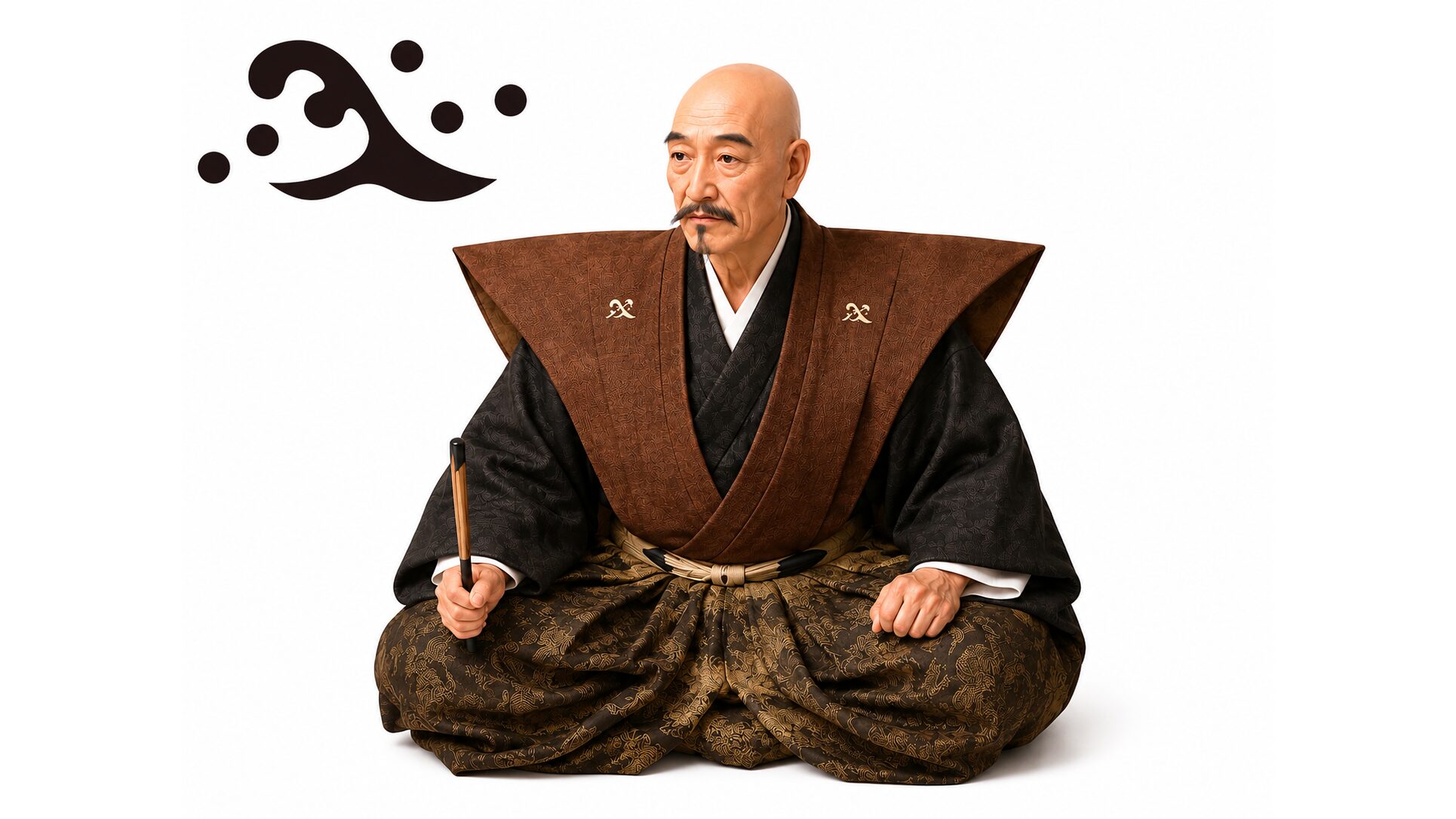
Saitō Dōsan — The Embodiment of Gekokujō: How the “Viper of Mino” Prepared the Age of Nobunaga
c. Eishō 11 (1514) – 20th day, 4th month of Kōji 2 (1556) | Died aged 63 (theories vary)
- This Figure in 3 Points
- The Mainstream Account — The Standard Story Found in Textbooks
- The Theories — Exploring the Possibilities from Various Angles
- A Strategic View
- Saitō Dōsan — Notable Sayings and Death Poem
- Anecdotes and Episodes
- Saitō Dōsan — Life Timeline
- Saitō Dōsan — Family and Relationships
- Related Historic-Site Map and Travel Model Course
- Related Articles
- Reference Information
This Figure in 3 Points
- One of the foremost ruthless heroes of the Sengoku period, called the “Viper of Mino,” and a representative figure of gekokujō (the low overthrowing the high).
- Recent research has established that the rise from oil peddler to provincial lord was accomplished over two generations, by father and son.
- He married his daughter Kichō to Oda Nobunaga and built the foundation for Nobunaga’s bid for the realm — yet in the end he was struck down by his own son.
The Mainstream Account — The Standard Story Found in Textbooks
His Father Nagai Shinzaemon-no-jō and the “Two-Generation Conquest of a Province”
Traditionally, Saitō Dōsan has been told of as “the very model of gekokujō, a mere oil peddler who rose in a single generation to become lord of Mino Province.” This image, repeatedly depicted in Shiba Ryōtarō’s novel Kunitori Monogatari, in storytelling and in historical fiction, remains widely current to this day.
Recent research, however, has greatly overturned this received view. The “Rokkaku Jōtei Jōsho Utsushi,” written in Eiroku 3 (1560), records that the Ōmi shugo Rokkaku Yoshikata wrote that “the grandfather Shinzaemon-no-jō took this province, his son Sakon-no-tayū (Dōsan) threw it into turmoil, and Yoshitatsu is the third generation.” A contemporary source clearly recorded “two generations, father and son.”
Through the research of the historian Yokoyama Sumio (Saitō Dōsan and Yoshitatsu, Tatsuoki, Ebisu Kōshō Publication, 2015), it became clear that the story of advancement from oil peddler to Nagai retainer — long treated as “the first half of Dōsan’s life” — was in fact the life of his father Nagai Shinzaemon-no-jō (Shōgorō).
The father, Shinzaemon-no-jō, trained as a monk under the name “Hōrenbō” at Myōkaku-ji in Kyoto, then returned to secular life around age 20. Taking the name Matsunami Shōgorō, he became the son-in-law of the Naraya house and entered Mino as an oil peddler. He won renown with a showman’s trick — “pouring oil through the hole of a single coin without using a funnel” — and took service with Nagai Nagahiro of Mino. Honing his martial skill and accumulating battle merit, he came to prominence and at last usurped the headship of the Nagai house. He died of illness in Tenbun 2 (1533), said to be around 70.
Dōsan himself, having inherited this position of his father, rose further still to become provincial lord. It was not “a single-generation conquest” but “a planned usurpation spanning two generations.” This is the prevailing view of the historical profession today.
Behind the merging of the father’s and son’s achievements into one person lay the loss of sources in the chaos of the Sengoku period and the fictionalization in Edo-period war chronicles (such as the Mino no Kuni Shokyūki). Because “an exceptional rise in a single generation” was the more dramatic story, later generations preferred to pass that version down.
Dōsan’s Birth and Inheritance (c. 1514–1533)
Saitō Dōsan himself is said to have been born around Eishō 11 (1514). His real name was Minemaru, and he later called himself Shinkurō Toshimasa. His mother is unknown. From childhood he trained in the ways of a warrior house under his father Shinzaemon-no-jō.
When his father died of illness in Tenbun 2 (1533), Dōsan inherited his father’s position within the Nagai house. The network within Mino his father had built, the power base within the Nagai house, the relations with the Toki retainer band — all of these became Dōsan’s starting point. It was not “a conquest from zero” but “a further leap upon the foundation his father had built.”
The Usurpation of the Nagai and Saitō Houses (1533–1540)
After his father’s death, Dōsan steadily expanded his power within the Nagai house. Around Tenbun 7 (1538), he removed his lord Nagai Nagahiro and took complete control of the headship of the Nagai house. He further inherited the name of the Saitō, then the deputy shugo of Mino, and renamed himself “Saitō Toshimasa.” Whereas his father had risen as a Nagai retainer, Dōsan now succeeded to the Saitō, the ruling class of Mino.
The shugo of Mino at the time was Toki Yorinari. Yorinari was absorbed in power struggles within Mino, and Dōsan exploited those rivalries to come to prominence. In the succession dispute with Yorinari’s elder brother Yoritake, Dōsan supported Yorinari. By eliminating the Yoritake faction, he established himself as Yorinari’s foremost supporter.
Dōsan’s methods were cold-blooded. He used collaborators thoroughly and, when they were no longer needed, removed them without mercy. When Toki Yorimitsu (Yorinari’s adopted heir) died young in Tenbun 16 (1547), rumors of poisoning arose. Making many enemies as he went, Dōsan continued to hold real power in Mino.
The Banishment of Toki Yorinari and the Road to Provincial Lordship (1542–1552)
Around Tenbun 10 (1541), the relationship between Dōsan and Yorinari soured decisively. Dōsan, who had been supporting Yorinari, at last sought to remove his very lord.
The next year, Tenbun 11 (1542), Dōsan attacked Yorinari’s stronghold Ōga Castle and banished Yorinari and his son Yoritsugu to Owari. With this, Dōsan became the effective lord of Mino. But Yorinari was still alive and repeatedly schemed to return home, and Dōsan’s rule continued to carry the conflict with the old Toki retainers of the Yorinari faction.
It was in Tenbun 21 (1552) that Dōsan completely banished Yorinari and took full control of Mino Province. Counting from his father’s generation, this was the moment the “two-generation conquest of a province,” spanning some 60 years, was completed.
As lord of Mino, Dōsan carried out progressive domain administration: pioneering free-market and free-guild policies, abolishing barrier checkpoints, and developing the castle town of Inokuchi (later Gifu). When his son-in-law Nobunaga later brought Mino under his control, he would develop these policies further and spread them nationwide as the “Rakuichi-Rakuza edict” and “abolition of checkpoints.”
The Alliance with Oda Nobunaga and the Shōtoku-ji Meeting (1548–1553)
For Dōsan, who had seized Mino, the greatest concern was the Oda to the west. Oda Nobuhide of Owari repeatedly invaded Mino, and the two provinces had become enemies for generations. At the Battle of Kanōguchi in Tenbun 13 (1544), Dōsan defeated the Oda army.
But Nobuhide’s invasions did not stop, and both houses grew exhausted. In Tenbun 17 (1548) the two houses reached a settlement, and as its token they agreed to marry Dōsan’s daughter Kichō (later Nōhime) to Nobuhide’s heir Nobunaga. It was a political marriage of Nobunaga, 16, and Kichō, 15.
At the time, Nobunaga was no more than the heir of a minor Owari warlord, rumored to be a “fool.” The world rated him low, but Dōsan saw it differently. In the 4th month of Tenbun 22 (1553), Dōsan met Nobunaga at Shōtoku-ji (present-day Ichinomiya City, Aichi Prefecture).
Before the meeting, Dōsan hid along the road by which Nobunaga’s party would come and observed them. The Nobunaga who appeared was not in the eccentric “fool” style but clad in formal dress, leading an orderly corps of gunners — the figure of a young Sengoku warlord. After the meeting, the Shinchō Kōki relates, Dōsan told his retainers, “My sons will end up tying their horses at that man’s gate” — meaning “my children (Yoshitatsu and the rest) will become Nobunaga’s retainers in the future.”
Unlike the world, which saw Nobunaga as a “fool,” Dōsan saw through to his true nature. The tradition that Dōsan later issued Nobunaga a “deed ceding Mino Province” is also an expression of this discernment.
→ For details, see the warlord article “Oda Nobunaga.”
The Cession of the Headship and Conflict with Yoshitatsu (1554–1555)
In Tenbun 23 (1554), Dōsan ceded the headship to his eldest son Saitō Yoshitatsu, took Buddhist vows and styled himself “Dōsan.” Retiring to Sagiyama Castle, he was, on the surface, to begin a peaceful old age.
But the relationship between Dōsan and Yoshitatsu rapidly deteriorated. There were several causes.
First cause: favoritism toward the younger brothers
Dōsan doted on Magoshirō and Kiheiji, born to his principal wife Omi-no-kata (of the Akechi clan, an aunt of Akechi Mitsuhide). He had the third son Kiheiji take the prestigious surname “Isshiki,” connected to the Ashikaga, styling him “Isshiki Uhyōe-no-tayū.” This was treatment that slighted the eldest, Yoshitatsu, who came to fear that he would be disinherited.
Second cause: Yoshitatsu’s parentage
Yoshitatsu’s mother Miyoshino was formerly a concubine of Toki Yorinari, a woman handed down to Dōsan. Edo-period war chronicles record that Yoshitatsu believed “I am in fact Yorinari’s son, and Dōsan is not my father.” This is held to be one of the motives for Yoshitatsu’s uprising. This theory, however, has no basis in contemporary sources and is very likely a later embellishment.
Third cause: dissatisfaction with Dōsan’s policies
The historian Katsumata Shizuo analyzes this conflict from another angle. Noting how very few documents Dōsan issued during his time as lord, he argues that Yoshitatsu’s inheritance may not have been Dōsan’s own will but “a forced change of head (shukun oshikome) by senior retainers who criticized Dōsan’s policies for neglecting domestic governance.” In other words, the view is that Dōsan did not retire peacefully but was half-banished by opposition within the house.
In the 11th month of Kōji 1 (1555), Yoshitatsu lured out his younger brothers Magoshirō and Kiheiji and killed them, making his banner of revolt against his father Dōsan clear. The Akechi clan and other pro-Dōsan retainers supported Dōsan, but many of the old Toki retainers sided with Yoshitatsu.
The Battle of Nagaragawa — The Father-Son Showdown (1556)
On the 20th day of the 4th month of Kōji 2 (1556), Yoshitatsu attacked Dōsan at the head of a great army of 17,500. Against this, Dōsan’s force was about 2,500 — a difference of fully seven to one. The reason for this overwhelming gap was that almost none of the old Toki retainers sided with Dōsan. The political connections cultivated over two generations, from his father Shinzaemon-no-jō, had slipped from Dōsan’s hands in the final phase.
Dōsan sought relief from his son-in-law Oda Nobunaga. Nobunaga set out at once and advanced as far as Daira-guchi. But the matter was decided before Nobunaga’s army arrived.
In the fierce fighting on the banks of the Nagara River, Dōsan’s outnumbered army was overwhelmed despite a brave struggle. Dōsan was grappled by Nagai Chūzaemon and had his head taken by Komaki Genta. He was 63. Nagai Chūzaemon, it is said, sliced off Dōsan’s nose and carried it away as proof of his battle merit.
The Ōkōsama Gunki no Uchi contains an interesting account. Dōsan had until then rated Yoshitatsu as “incompetent” and “a doddering old fool,” but on seeing Yoshitatsu’s splendid command at Nagaragawa he revised his estimate, saying “truly Dōsan’s son after all,” and regretted his misjudgment. In the final confrontation of father and son, Dōsan acknowledged his son’s ability for the first time.
Riding the momentum of victory at Nagaragawa, Yoshitatsu’s army also attacked Nobunaga’s force, but Nobunaga, making full use of guns, served as rearguard and barely managed to withdraw to Owari. The last support Dōsan sent his son-in-law may have taken the form of saving Nobunaga’s life.
Dōsan’s Will — The Deed Ceding the Province to Nobunaga
Just before the Battle of Nagaragawa, Dōsan is said to have written a will addressed to Nobunaga. Dated the 19th day of the 4th month of Kōji 2 (1556), its content was “I cede Mino Province to Nobunaga.” All three surviving copies are transcriptions; no original remains. There is a theory that it is a forgery, but it is highly likely Nobunaga later used it as just cause for his conquest of Mino.
That Dōsan ceded Mino to his son-in-law Nobunaga rather than to Yoshitatsu is held to reflect his estimation of Nobunaga since the Shōtoku-ji meeting and his disappointment in Yoshitatsu. The prophecy that “my children will end up tying their horses at that man’s gate” was something Dōsan left at the very end in documentary form.
Indeed, eleven years after Dōsan’s death, in Eiroku 10 (1567), Nobunaga captured Inabayama Castle and subdued Mino. On that occasion Nobunaga renamed the castle town “Gifu” and began using the seal “Tenka Fubu.” The “Gi” of “Gifu” is said to derive from “Mount Qi (Gizan),” where the ancient Chinese Zhou dynasty unified the realm, showing that Nobunaga aimed to take the realm, carrying on Dōsan’s will.
After Dōsan’s death, Yoshitatsu consolidated his standing as lord of Mino, but died of illness just five years later, in Eiroku 4 (1561), aged 35. Yoshitatsu’s son Tatsuoki, who inherited the headship, was too young to hold the house together and allowed Nobunaga’s conquest of Mino. The Mino Saitō house, built over two generations of father and son, vanished completely eleven years after Dōsan’s death.
→ For details, see the battle article “The Battle of Inabayama Castle.”
The Theories — Exploring the Possibilities from Various Angles
[Theory 1] When Did the Name “Viper of Mino” Come Into Use?
When it comes to Dōsan, the nickname “Viper of Mino” is widely known. The image of a cold-blooded, tenacious, venomous-serpent-like ruthless hero has been used repeatedly in modern novels, dramas and historical manga.
Astonishingly, however, the names “Viper of Mino” and “Saitō Viper” never appear in contemporary Sengoku-period sources. The origin of this name is, in fact, traced to the novel Nobunaga by Sakaguchi Ango, published in 1947 (Shōwa 22). Sakaguchi coined the nickname “viper” to express Dōsan’s cruelty; Shiba Ryōtarō took it up in Kunitori Monogatari (1963), and it spread decisively.
In short, “Viper of Mino” was not what the people of the time called Dōsan but merely a literary invention by a postwar novelist. Contemporaries called Dōsan “Saitō Yamashiro(-no-kami),” “Saitō Nyūdō,” “the monk Dōsan,” and the like.
This is a fine example of how the image of a historical figure is shaped by later invention. Just as the name “Viper of Mino” is itself not historical fact, the image of a “cold-blooded ruthless hero” the name implies is very likely different from the historical Dōsan.
The historian Kinoshita Satoshi points to both an aspect of Dōsan as a “schemer” and an aspect of him as “a man of refinement, fond of the tea ceremony and waka.” He certainly had the cold-bloodedness to eliminate political enemies, but that was not unusual for a Sengoku warlord of the period. There is no denying that the label “viper” has flattened the portrait of Dōsan into one dimension.
[Theory 2] The Two-Generation Theory — Was the Conquest One Generation or Two? (The Greatest Point of Debate)
The greatest point of debate in Dōsan research is the “two-generation theory.” This has been disputed even in the postwar historical profession, but in recent years the two-generation theory has become mainstream.
The traditional single-generation theory
The framing that Shiba Ryōtarō’s Kunitori Monogatari and others depicted, based on the Edo-period Mino no Kuni Shokyūki. It has been widely loved as a dramatic single-generation rise — “from oil peddler to warrior, and then lord of Mino.”
The decisive grounds for the two-generation theory
The historian Yokoyama Sumio brought to light the “Rokkaku Jōtei Jōsho Utsushi” of Eiroku 3 (1560). The Ōmi shugo Rokkaku Yoshikata records the following about Yoshitatsu:
“The grandfather Shinzaemon-no-jō took this province, his son Sakon-no-tayū threw it into turmoil, and Yoshitatsu is the third generation.”
That is, it records that not Dōsan’s grandfather but his father, Shinzaemon-no-jō, entered Mino; that his son (Dōsan = Sakon-no-tayū) “threw the province into turmoil”; and that Yoshitatsu is the third generation. A contemporary source clearly recorded “two generations, father and son.”
With this, the episodes long treated as “the first half of Dōsan’s life” turned out to be the life of his father Nagai Shinzaemon-no-jō:
- Training as “Hōrenbō” at Myōkaku-ji in Kyoto → the father’s life
- Returning to secular life and becoming an oil peddler → the father’s life
- Taking service with the Nagai house → the father’s life
- Being granted the Nagai surname → the father’s life
Dōsan’s own life begins with his father’s death (1533). Having inherited his father’s position, he usurped the Nagai and Saitō houses and at last became lord of Mino. It was not “a conquest from zero” but “a leap upon the foundation his father had built.”
The significance of the two-generation theory
This discovery greatly changes the understanding of Sengoku-period “gekokujō.” It shows that not “an exceptional rise in a single generation” but “a planned usurpation across generations” was possible. At the same time, it suggests that the social mobility of the Sengoku period was not as dramatic as the later image. It was precisely because of the standing (samurai status) his father had built within the Nagai house that Dōsan’s conquest too became possible.
Of course, there are objections to this two-generation theory. There is also a view that the “grandfather Shinzaemon-no-jō” wording in the “Rokkaku Jōtei Jōsho Utsushi” is an error and that Shinzaemon-no-jō and Dōsan are the same person. A definitive settlement must await future research, but the current mainstream of the historical profession is the two-generation theory.
[Theory 3] Was Yoshitatsu Really the Illegitimate Son of Toki Yorinari?
Often told as Yoshitatsu’s motive for striking down Dōsan is the theory that “Yoshitatsu was the illegitimate son of Toki Yorinari.” Yoshitatsu’s mother Miyoshino was formerly a concubine of Toki Yorinari, a woman handed down from Yorinari to Dōsan. The story is that Yoshitatsu learned this fact and resolved that “I should strike down Dōsan, the enemy of my true father Yorinari.”
This theory is dramatic and rich in narrative, and has been depicted repeatedly in Edo-period war chronicles and modern novels. Shiba Ryōtarō’s Kunitori Monogatari too adopts this framing.
Recent research, however, points out that this theory has no decisive source basis. No record is found in contemporary sources of Yoshitatsu publicly declaring “I am Yorinari’s illegitimate son.” This is very likely an embellishment from the Edo period onward.
What, then, was the true motive for Yoshitatsu’s uprising against Dōsan? The main theories are as follows:
- Fear of disinheritance through favoritism toward the younger brothers: a preemptive strike against Dōsan’s doting on Magoshirō and Kiheiji and his scheme to disinherit Yoshitatsu.
- Support of the retainer band: senior retainers dissatisfied with Dōsan’s despotism tried to install Yoshitatsu and remove Dōsan.
- The political situation within Mino: forces centered on the old Toki retainers sought to put an end to Dōsan’s rule.
That the troops who sided with Yoshitatsu at Nagaragawa reached seven times Dōsan’s force shows that this was less an uprising by Yoshitatsu personally than a rallying of broad anti-Dōsan forces within Mino. The current view is that “political inevitability,” not “the private grudge of an illegitimate son,” underlay Yoshitatsu’s uprising.
[Theory 4] Was Yoshitatsu’s Inheritance Dōsan’s Will, or a “Forced Removal of the Lord”?
Traditionally, Dōsan’s cession of the headship (1554) has been seen as a peaceful retirement by Dōsan’s own will. That he chose Sagiyama Castle as his retirement seat, took Buddhist vows and called himself “Dōsan” is the received view.
The historian Katsumata Shizuo, however, analyzes this cession from another angle. From the fact that very few documents were issued by Dōsan during his time as lord, and that the circumstances of the cession are unclear in the sources, Katsumata advanced the following hypothesis:
“Yoshitatsu’s inheritance may have been a forced change of head (shukun oshikome) by senior retainers who criticized Dōsan’s policies for neglecting domestic governance.”
In other words, the view that Dōsan did not retire peacefully but was half-banished by opposition within the house. Katsumata further interprets the next year’s Battle of Nagaragawa as “a banished Dōsan rising up in arms to recover the headship.”
This theory is at the hypothesis stage, but it can account for several circumstantial points:
- The scarcity of documents Dōsan issued as lord (suggesting he may not have held real power).
- The father-son conflict within just two years from the cession to Yoshitatsu to the Battle of Nagaragawa.
- The fact that the great majority of the old Toki retainers sided with Yoshitatsu (reflecting deep-rooted dissatisfaction with Dōsan).
- Dōsan’s isolation within the house (the cold reaction of the retainer band to the killing of his two younger sons).
Of course, there are objections. The record that Dōsan rated Yoshitatsu “incompetent” may show that Dōsan retained a degree of influence even after retirement. The existence of the will Dōsan issued to Nobunaga also suggests that Dōsan acted by his own will to the very end.
The “forced-removal theory” has not been completely proven, but the current state of research is that a question mark has been placed over the traditional image of a “peaceful retirement.”
[Theory 5] The Truth of the Shōtoku-ji Meeting with Nobunaga
The story of Dōsan and Nobunaga meeting at Shōtoku-ji in Owari in the 4th month of Tenbun 22 (1553) is one of the most famous episodes in Sengoku history. The dramatic framing — that Dōsan saw through the rumored “fool” Nobunaga to find an excellent commander leading gunners in formal dress, and prophesied “my children will end up tying their horses at that man’s gate” — has been depicted repeatedly in storytelling, novels and Taiga dramas.
This meeting is also recorded in the Shinchō Kōki, and there is virtually no doubt it was historical fact. The details, however, are pointed out as possibly embellished.
The hidden observation before the meeting
The depiction of Dōsan hiding along the road by which Nobunaga’s party would come and observing them is in the Shinchō Kōki. This is a dramatic episode, but a Sengoku warlord furtively hiding to observe before a meeting with his son-in-law is somewhat unnatural. The possibility of embellishment cannot be denied.
The “my children will tie their horses at Nobunaga’s gate” prophecy
This prophecy is recorded in the Shinchō Kōki and may reflect fact to some degree. But rather than a “prophecy,” it is also possible that words by which Dōsan looked back in later years on “the prophecy coming true” were recorded as a prophecy from the start. Because Dōsan’s son Yoshitatsu was in fact destroyed by Nobunaga, and his grandson Tatsuoki was driven out by Nobunaga, the prophecy did, in the end, “hit the mark.”
The true significance of the meeting
The essence of the Shōtoku-ji meeting was not a dramatic episode but “confirmation of the alliance between the Mino Saitō and the Owari Oda.” The two houses had only just reconciled and needed to confirm the trust of the political marriage. By Dōsan and Nobunaga meeting officially, the alliance between the two houses became firm.
Whether or not Dōsan thought Nobunaga a “fool,” it was surely a fact that, after the meeting, Dōsan rated Nobunaga highly. That is precisely why he sought in his later will to cede Mino to Nobunaga. The Shōtoku-ji meeting was indeed an important event in Sengoku history as the starting point of the Dōsan-Nobunaga relationship.
[Theory 6] Is Dōsan’s “Deed Ceding Mino Province” to Nobunaga Genuine?
There is a tradition that, just before the Battle of Nagaragawa, Dōsan wrote a will addressed to Nobunaga ceding Mino. Three documents survive, all transcriptions. They are kept at Myōkaku-ji in Kyoto and at the Osaka Castle keep, and the cession is also recorded in the Kōnōki.
The authenticity of this “Dōsan will” (deed ceding the province to Nobunaga) is still debated today.
The genuine theory
Given that Dōsan rated Nobunaga highly (since the Shōtoku-ji meeting), his disappointment in Yoshitatsu, and his affection for his daughter Kichō, it was a natural course for Dōsan to seek to cede Mino to his son-in-law. There is no obvious contradiction in the document’s style or wording, and the view is that it is likely genuine.
The forgery theory
The point that no original survives and only transcriptions remain is treated with suspicion. There is also the view that, since Nobunaga very likely used “Dōsan’s will” as just cause for his later conquest of Mino, it may be a forgery conveniently produced on the Oda side.
The intermediate “genuine transcription” theory
The theory that an original existed but was lost in the wars, and that an accurate transcription made on the Oda side remained. A moderate view holding that a genuine will did exist, but that the possibility of alterations in the surviving transcriptions should also be considered.
No decisive conclusion has been reached in the historical profession. It is certain, however, that the existence of the document itself functioned as an important tool reinforcing the legitimacy of Nobunaga’s conquest of Mino. By claiming “I am the legitimate successor who inherits Mino in accordance with Dōsan’s will,” Nobunaga could criticize the rule of Yoshitatsu and Tatsuoki as “usurpation.”
Whether or not Dōsan truly wished to cede Mino to Nobunaga, in the end Nobunaga subdued Mino in a form that carried on Dōsan’s will and realized his ambition of “Tenka Fubu.” The relationship of Dōsan and Nobunaga can be called one of the greatest “spiritual inheritances” in Sengoku history, beyond the frame of father-in-law and son-in-law.
A Strategic View
When Dōsan is compared with other ruthless heroes of the Sengoku period, three points stand out: “generational strategy,” “an eye for men,” and “pragmatism.”
First, generational strategy. Dōsan’s greatest characteristic is that he completed the conquest of a province over two generations together with his father Shinzaemon-no-jō. This is an extremely rare form even among the gekokujō of the Sengoku period. Hōjō Sōun, Mōri Motonari, Oda Nobunaga and others also achieved gekokujō, but in each case it was the work of a single generation, or at most a span of a few years. The Dōsan father and son, over nearly 60 years, realized control of Mino by design. A son leaping further upon the foundation a father built — this “strategy spanning generations” is distinctive as a mode of Sengoku warlordship. Ironically, Dōsan too dies betrayed by his son. The province inherited from a father is seized by a son — this symbolizes the difficulty of bloodline inheritance in the Sengoku period.
Second, an eye for men. Dōsan’s greatest legacy was marrying his daughter Kichō to Nobunaga. At the time, Nobunaga was rated a “fool,” no more than a young warlord with a poor reputation. His father-in-law Dōsan too was at first so wary that he hid to observe him. But after the Shōtoku-ji meeting, Dōsan saw through to Nobunaga’s true ability and prophesied, “my children will end up tying their horses at that man’s gate.” The sharpness of this eye for men was among the finest of the Sengoku period. Indeed, as Dōsan prophesied, Nobunaga came to subdue Mino and walk the road to the unification of the realm. Without Dōsan’s eye for men, Oda Nobunaga’s bid for the realm might never have begun. As a figure who possessed an “eye for people” that moved history, Dōsan deserves re-evaluation.
Third, pragmatism. A consistent stance runs through Dōsan’s policies — denying the “medieval authority” of the Sengoku period and building a system based on “ability first.” Just as his father Shinzaemon-no-jō turned from oil peddler to warrior, Dōsan too lived across status boundaries, from monk to warrior. His progressive policies as lord of Mino — free markets and free guilds, the abolition of checkpoints — are expressions of a pragmatism that valued commerce and distribution. These policies were inherited by his son-in-law Nobunaga and became the economic foundation supporting Nobunaga’s “Tenka Fubu.” Contrary to the image of the “Viper of Mino,” the essence of Dōsan may be said to have been less a ruthless hero of scheming intrigue than a rational economic reformer.
That said, Dōsan too had a fatal weakness: “making too many enemies.” The historian Kinoshita Satoshi has remarked: “As a result, he came to make many enemies. It was a bad move that he worsened relations with the surrounding warlords in particular and did not try to improve them.” As a result of banishing Toki Yorinari and removing the Yorinari faction’s old retainers, deep-rooted opposition to Dōsan remained within Mino. This is why so vast a force gathered on Yoshitatsu’s side at the Battle of Nagaragawa. Dōsan was extraordinary in ability but lacked the generosity to tolerate enemies. This decided his end.
Another limit was the raising of a successor. Dōsan looked down on his eldest son Yoshitatsu as “incompetent” and “a doddering fool” and doted on his second and third sons. This invited division within the house and united Yoshitatsu as the standard-bearer of the anti-Dōsan forces. It is a structure similar to that of Takeda Shingen — who banished his own father Nobutora — later driving his own heir Yoshinobu to suicide. The difficulty of “father-son inheritance” was a problem common to Sengoku warlords.
To rate Dōsan as the “Viper of Mino,” a “cold-blooded ruthless hero,” is too one-sided. He was not especially cruel compared with the Asakura Sōteki, Hōjō Ujitsuna and Takeda Nobutora who lived in the same age. Rather, he should be re-evaluated as a rational realist who lived faithful to the logic of the Sengoku period. His greatest achievement lies in marrying his daughter Kichō to Nobunaga, seeing through Nobunaga’s true worth at the Shōtoku-ji meeting, and finally ceding Mino to Nobunaga — thereby laying the path to the unification of the realm. Dōsan’s death meant the end of the Mino Saitō house, but by the son-in-law he discovered, Nobunaga, a great step toward the end of the Sengoku age would be taken.
Saitō Dōsan — Notable Sayings and Death Poem
“If this hard-to-cast-off floating world is but a dream to be cast off, then let me fix my heart upon the joyful side.”
— Dōsan’s death poem (by tradition)
A death poem meaning, “If this floating world, hard to cast off, is but a dream that ought to be cast off, then let me at least fix my heart upon the joyful side as I die.” It is said to have been composed by Dōsan, resolved to die, when surrounded by Yoshitatsu’s great army at the Battle of Nagaragawa. Together with the anecdote of his revising his estimate to “truly my son” on seeing Yoshitatsu’s command, it shows the state of mind of a Dōsan who reached a transcendent serenity at the end. That said, it is not firmly established as Dōsan’s own composition, and may be a later embellishment.
— Source: various works
“My children will end up tying their horses at that man’s gate.”
Words Dōsan is said to have let slip to his retainers after the Shōtoku-ji meeting, having seen Nobunaga’s gunner corps and command. Meaning “my children (Yoshitatsu and the rest) will become that man’s (Nobunaga’s) retainers in the future,” it is famous in Sengoku history as a prophecy that saw through to Nobunaga’s vessel for greatness. Indeed, after Dōsan’s death, his son Yoshitatsu came to confront Nobunaga, and his grandson Tatsuoki was destroyed by Nobunaga. An anecdote showing the sharpness of Dōsan’s eye for men.
— Source: Ōta Gyūichi, Shinchō Kōki
“Truly Dōsan’s son after all.”
Words Dōsan is said to have let slip on witnessing Yoshitatsu’s splendid command at the Battle of Nagaragawa. It is famous as the moment when Dōsan, who had until then looked down on Yoshitatsu as “incompetent” and “a doddering fool,” at the end acknowledged his son’s ability for the first time. There was no longer any room for reconciliation in the father-son showdown, but it is a moving anecdote showing that Dōsan, as a father, recognized his son’s growth.
— Source: Ōkōsama Gunki no Uchi
“This may be a merchant’s skill, but if turned to the martial arts, even taking the realm is not beyond a dream.”
Said to be words spoken to the father Shinzaemon-no-jō in his oil-peddler days by Yano, a warrior of the Toki house. Seeing the showman’s trick of “pouring oil through the hole of a single coin without using a funnel,” Yano suggested that with such concentration and technique he would succeed as a warrior. Shinzaemon-no-jō is said to have given up commerce and turned to the martial arts on this occasion. An anecdote showing the beginning of the two-generation conquest story.
— Source: Mino no Kuni Shokyūki
Anecdotes and Episodes
The Surprising Origin of the Nickname “Viper of Mino”
When it comes to Dōsan, the nickname “Viper of Mino” is widely known. This name, succinctly expressing the image of a cold-blooded, tenacious ruthless hero, has been used many times in modern dramas and novels.
And yet this nickname “Viper of Mino” did not exist in the Sengoku period. No instance of calling him “viper” can be confirmed in contemporary sources, and Sakaguchi Ango’s novel Nobunaga (1947) is thought to be its first appearance. The nickname Sakaguchi coined as literature was inherited by Shiba Ryōtarō’s Kunitori Monogatari and spread in postwar historical fiction and Taiga dramas, with the result that the image took hold as if he had been so called from the time itself.
Sengoku-period contemporaries called Dōsan “Saitō Yamashiro(-no-kami),” “Saitō Nyūdō,” “the monk Dōsan,” and the like. “Viper of Mino” was a literary nickname applied nearly 400 years after Dōsan’s death. It can be called a fine example of how the portrait of a historical figure is shaped by later invention.
— Source: Sakaguchi Ango, Nobunaga; various studies
The Two-Generation Conquest — Sixty Years from the Father’s Oil-Peddling
“From a mere oil peddler to provincial lord in a single generation” is Dōsan’s traditional image, but recent research shows this was an enterprise accomplished over two generations by his father Nagai Shinzaemon-no-jō and Dōsan.
The father, Shinzaemon-no-jō, trained as a monk under the name “Hōrenbō” at Myōkaku-ji in Kyoto, then returned to secular life, took the name Matsunami Shōgorō, and entered Mino as an oil peddler. Winning renown with the showman’s trick of “pouring oil through the hole of a single coin without using a funnel,” he took service with Nagai Nagahiro, a retainer of the Toki house. Honing his martial skill and coming to prominence, he rose within the Nagai house.
After his father’s death, Dōsan inherited that position, usurped the Nagai and Saitō houses, and at last became lord of Mino. It was a “planned conquest spanning generations,” taking nearly 60 years between father and son.
As a result of Edo-period war chronicles merging the achievements of father and son into one person, the dramatic story of “an exceptional rise in a single generation” spread. Shiba Ryōtarō’s Kunitori Monogatari too adopts this single-generation theory. In the recent historical profession, however, the two-generation theory has become mainstream, and the portrait of Dōsan is being greatly rewritten.
— Source: Yokoyama Sumio, Saitō Dōsan and Yoshitatsu, Tatsuoki, Ebisu Kōshō Publication
The Shōtoku-ji Meeting — The Moment He Saw Through to Nobunaga’s True Worth
In the 4th month of Tenbun 22 (1553), Dōsan met Oda Nobunaga, who had become his son-in-law, at Shōtoku-ji in Owari. The world rumored Nobunaga to be a “fool,” and Dōsan is said to have been wary even before the meeting.
According to the Shinchō Kōki, before the meeting Dōsan hid along the road by which Nobunaga’s party would come and observed them. The one who appeared was not the Nobunaga of eccentric “fool” style but a Nobunaga as a young Sengoku warlord, clad in formal dress and leading a retainer band orderly equipped with long spears and guns. Dōsan was astonished and, it is said, revised his view to “this is not a man to be taken lightly.”
After the meeting, Dōsan is said to have told his retainers, “my children will end up tying their horses at that man’s gate.” It is a prophecy meaning “my children will become that Nobunaga’s retainers in the future.” Indeed, after Dōsan’s death, his son Yoshitatsu opposed Nobunaga, and his grandson Tatsuoki was driven out of Mino by Nobunaga. Dōsan’s eye for men, in the end, hit the mark.
— Source: Ōta Gyūichi, Shinchō Kōki
The Anecdote of the Dagger Given to His Daughter Kichō
There is a famous anecdote that when Dōsan married his daughter Kichō to Nobunaga, he secretly handed her a dagger. He ordered her: “If Nobunaga is the true fool the rumors say, cut his throat in his sleep with this dagger and return.”
To this, Kichō is said to have given a spirited reply: “Father, it may be with this dagger that I come to stab you.” If Nobunaga proved a fine man, she might side with him and stab her father — that was her meaning.
Dōsan is said to have been relieved by this reply. A spirited daughter would, if Nobunaga were truly a fool, stab him to death; and if he were a fine man, would support him. Either way, Dōsan calculated, it would profit Mino.
That said, this anecdote appears in Edo-period war chronicles such as the Ehon Taikōki, and whether it is historical fact is doubtful. Still, as an episode succinctly expressing the essence of Sengoku-period parent-child relations and political marriage, it remains beloved to this day.
— Source: Ehon Taikōki and others
The Feud with Yoshitatsu — Tragedy Brought On by Favoritism Toward the Younger Brothers
The feud between Dōsan and his eldest son Saitō Yoshitatsu is said to have originated in Dōsan’s doting on his second son Magoshirō and third son Kiheiji. He had the third son Kiheiji take the prestigious surname “Isshiki,” connected to the Ashikaga, styling him “Isshiki Uhyōe-no-tayū.” This was treatment that slighted the eldest, Yoshitatsu.
Yoshitatsu came to fear that he would be disinherited. In the 11th month of Kōji 1 (1555), Yoshitatsu lured out his two younger brothers and killed them, making clear his banner of revolt against his father Dōsan.
Just as Takeda Shingen, who banished his father Takeda Nobutora, later drove his own heir Yoshinobu to suicide, Dōsan too came to repeat the discord with his own father in a new form. The difficulty of parent-child relations among Sengoku warlords appears here as well.
There is also a tradition that Yoshitatsu believed “I am the illegitimate son of Toki Yorinari,” but this is very likely an embellishment from the Edo period onward. The cause of the actual conflict is held to be a power struggle within the house over the succession.
— Source: various works and studies
The End at Nagaragawa — The Humiliation of Having His Nose Sliced Off
On the 20th day of the 4th month of Kōji 2 (1556), Dōsan was defeated by Yoshitatsu’s army on the banks of the Nagara River. The difference in force was seven to one; many of the old Toki retainers did not side with Dōsan, and the defeat of Dōsan’s side was decisive.
Dōsan was grappled by Nagai Chūzaemon and had his head taken by Komaki Genta. He was 63. Nagai Chūzaemon, it is said, sliced off Dōsan’s nose and carried it away as proof of his battle merit. In the Sengoku period, taking an enemy general’s head was a great achievement, but slicing off the nose and carrying it home was an exceptionally humiliating treatment. It shows how the Yoshitatsu side had built up its hatred of Dōsan.
Dōsan’s body was buried at Nagara-Fukumitsu in Gifu City, where the “Dōsan Mound” remains today. Originally at Sōfuku-ji, it is said to have been moved to its present site by the priest Nichichin of Jōzai-ji. The end of the man feared as the “Viper of Mino” was a wretched one — his head taken by his own son, and even his nose sliced off. The Mino Saitō house, built over two generations from his father Shinzaemon-no-jō, would be destroyed by Nobunaga eleven years after Dōsan’s death, in Eiroku 10 (1567).
— Source: Shinchō Kōki; Kōnōki
Dōsan’s Will — Ceding the Province to Nobunaga
Just before the Battle of Nagaragawa, Dōsan is said to have written a will addressed to Nobunaga. Dated the 19th day of the 4th month of Kōji 2 (1556), its content was “I cede Mino Province to Nobunaga.” Three documents survive, all transcriptions. They are kept at Myōkaku-ji in Kyoto and at the Osaka Castle keep, and the cession is also recorded in the Kōnōki.
Because no original survives there is also a forgery theory, but it is highly likely Nobunaga used it as just cause for his later conquest of Mino. That Dōsan ceded Mino to his son-in-law Nobunaga rather than to Yoshitatsu is held to reflect his estimation of Nobunaga since the Shōtoku-ji meeting and his disappointment in Yoshitatsu.
Indeed, eleven years after Dōsan’s death, in Eiroku 10 (1567), Nobunaga captured Inabayama Castle and subdued Mino. On that occasion Nobunaga renamed the castle town “Gifu” and began using the seal “Tenka Fubu.” The “Gi” of “Gifu” is said to derive from “Mount Qi (Gizan),” where the ancient Chinese Zhou dynasty unified the realm, showing that Nobunaga aimed to take the realm, carrying on Dōsan’s will.
Dōsan’s death meant the end of the Mino Saitō house, but by the son-in-law he discovered, Nobunaga, a great step toward the end of the Sengoku age would be taken.
— Source: Kōnōki; various studies
Saitō Dōsan — Life Timeline
| Year | Age | Event |
|---|---|---|
| c. 1514 | 0 | Born a son of Nagai Shinzaemon-no-jō. Real name Shinkurō Toshimasa. |
| 1533 | c. 19 | Father Nagai Shinzaemon-no-jō dies of illness. Inherits his father’s position. |
| c. 1538 | c. 24 | Removes Nagai Nagahiro and usurps the headship of the Nagai house. Succeeds to the name of the Saitō. |
| 1542 | c. 28 | Banishes Toki Yorinari to Owari. Becomes the effective lord of Mino. |
| 1544 | c. 30 | Defeats Oda Nobuhide’s army at the Battle of Kanōguchi. |
| 1548 | c. 34 | Reconciles with Oda Nobuhide. Marries his daughter Kichō to Oda Nobunaga. |
| 1552 | c. 38 | Completely banishes Toki Yorinari and takes full control of Mino. The two-generation conquest is complete. |
| 1553 (4th mo.) | c. 39 | Meets Oda Nobunaga at Shōtoku-ji. Prophesies, “my children will tie their horses at that man’s gate.” |
| 1554 | c. 40 | Cedes the headship to his eldest son Yoshitatsu, takes vows and styles himself “Dōsan.” Retires to Sagiyama Castle. |
| 1555 (11th mo.) | c. 41 | Yoshitatsu kills his brothers Magoshirō and Kiheiji and rises in arms against Dōsan. |
| 1556 (4th mo., 19th) | c. 42 | Dōsan writes the “deed ceding Mino Province” addressed to Nobunaga. |
| 1556 (4th mo., 20th) | c. 42 | Defeated by Yoshitatsu’s army at the Battle of Nagaragawa. Dōsan killed, aged 63 (theories vary). |
| 1561 | — | Yoshitatsu dies of illness at 35. His son Tatsuoki inherits the headship. |
| 1567 | — | Nobunaga captures Inabayama Castle; Tatsuoki is banished from Mino. The Mino Saitō house falls. |
※ Ages are reckoned by the traditional count (kazoe-doshi). There are various theories on the year of birth (such as 1494) and on his age at death. Cell shading: yellow = major turning point; red = events relating to his end.
Saitō Dōsan — Family and Relationships
Family
| Relation | Person | Summary |
|---|---|---|
| Father | Nagai Shinzaemon-no-jō | From Kyoto monk to oil peddler to Nagai retainer. The figure who built the foundation of the Mino Saitō house. |
| Principal wife | Omi-no-kata | Of the Akechi clan, an aunt of Akechi Mitsuhide. Mother of Kichō, Magoshirō and Kiheiji. |
| Concubine | Miyoshino | Formerly a concubine of Toki Yorinari. Mother of Yoshitatsu. |
| Eldest son | Saitō Yoshitatsu | Strikes Dōsan down at Nagaragawa. Dies of illness in 1561 at 35. |
| Second son | Magoshirō | Doted on by Dōsan. Killed by Yoshitatsu in 1555. |
| Third son | Kiheiji (Isshiki Uhyōe-no-tayū) | Doted on by Dōsan and granted the Isshiki surname. Killed by Yoshitatsu in 1555. |
| Daughter | Kichō (Nōhime) | Principal wife of Oda Nobunaga. Also called “Sagiyama-dono.” |
| Grandson | Saitō Tatsuoki | Yoshitatsu’s son. Driven out by Nobunaga in 1567; the Mino Saitō house falls. |
Principal Figures and Associates
| Relation | Person | Summary |
|---|---|---|
| Banished lord | Toki Yorinari | Shugo of Mino. Banished by Dōsan, wandered various provinces. Tried to return to Mino after Dōsan’s death. |
| Son-in-law | Oda Nobunaga | Kichō’s husband. The figure Dōsan rated most highly. Later subdued Mino. |
| Adversary | Oda Nobuhide | Nobunaga’s father. Contested Mino with Dōsan for years, later reconciled. |
| Kin / retainer | Akechi Mitsuhide | Nephew of Omi-no-kata (son of Dōsan’s niece), cousin of Kichō. Said to have been Dōsan’s retainer. |
| Contemporary enemy | Asakura Sōteki | Senior retainer of the Echizen Asakura. Also intervened in the political struggles of Mino. |
Related Historic-Site Map and Travel Model Course
Related Historic-Site Map — Saitō Dōsan
Spots on the map:
- Inabayama Castle (Gifu Castle) (castle) — The main castle of Mino, Dōsan’s base.
- Site of Sagiyama Castle (castle) — Dōsan’s retirement seat; the castle from which Kichō married into the Oda.
- Nagaragawa Old Battlefield (near the Naka-no-watashi crossing) (old battlefield) — The site of the showdown between Dōsan and Yoshitatsu.
- Dōsan Mound (grave) — In a residential district of Nagara-Fukumitsu, Gifu City.
- Jōzai-ji (family temple) — The family temple of the Saitō; Dōsan’s grave is also here.
- Site of Shōtoku-ji (meeting place) — Where Dōsan and Nobunaga met.
- Nōhime Hair Mound (Gifu City) — Said to be where a lock of Kichō’s hair is buried.
- Site of Ōga Castle (castle) — The castle Dōsan attacked to banish Toki Yorinari.
※ The map is a reference display based on modern roads. It differs from the roads and terrain of the Sengoku period.
Travel Model Course — A One-Day Trail of Dōsan and the Conquest of Mino
Conditions
- Duration: 1 day (by car)
- Touring sites connected to Dōsan, centered on Gifu City
A Day Touring Sites Connected to Dōsan
① Gifu Castle (former Inabayama Castle) (stay: approx. 120 min)
The main castle of Mino, Dōsan’s base. From the keep on the summit you can take in the Nagara River and the city of Gifu at a glance, and experience the view Dōsan looked out on.
– By car: about 20 min from Gifu-Kakamigahara IC on the Meishin Expressway
② Jōzai-ji (stay: approx. 60 min)
The family temple of the Saitō. Dōsan’s grave and a portrait (an Important Cultural Property) remain.
– By car: about 15 min from Gifu Castle
③ Dōsan Mound (stay: approx. 30 min)
A memorial mound for Dōsan in a corner of a residential district. The gravestone “Tomb of Lord Saitō Dōsan” stands quietly.
– By car: about 10 min from Jōzai-ji
④ Nagaragawa Old Battlefield (near the Naka-no-watashi crossing) (stay: approx. 60 min)
The site of the showdown between Dōsan and Yoshitatsu. Now the Gifu Memorial Center, where you can look up at Mount Kinka (Gifu Castle) from the riverbank.
– By car: about 10 min from the Dōsan Mound
⑤ Site of Sagiyama Castle (stay: approx. 60 min)
Dōsan’s retirement seat. As the castle from which Kichō married into the Oda, it is the origin of her alternate name “Sagiyama-dono.”
– By car: about 15 min from the Nagaragawa Old Battlefield
Arrangements by Visitor Type
- For the strong of leg: A 2-day course also adding the site of Ōga Castle (where Dōsan banished Yorinari) and the site of Shōtoku-ji (the meeting place, Ichinomiya City, Aichi Prefecture).
- For a relaxed pace: A half-day course of Gifu Castle plus Jōzai-ji.
- For history enthusiasts: Also tour the Nōhime Hair Mound, tracing all three of Dōsan, Kichō and Nobunaga.
※ This plan is a reference model based on general travel speeds and stay times. Opening hours, transport schedules and crowding vary by season and day of the week. Please check the latest information on the official websites of each facility and transport operator before setting out.
※ Admission and entry fees are reference prices at the time of writing and may have changed.
※ For mountain-castle sites, please plan within your limits according to the weather and your physical condition.
Related Articles
Battle Articles
- The Battle of Inabayama Castle (1567) — Nobunaga subdues Mino, carrying on Dōsan’s will
Warlord Articles
- Nagai Shinzaemon-no-jō — Dōsan’s father, the starting point of the two-generation conquest
- Saitō Yoshitatsu — Dōsan’s eldest son, who struck him down at Nagaragawa
- Toki Yorinari — The shugo of Mino whom Dōsan banished
- Oda Nobunaga — Dōsan’s son-in-law, the conqueror who inherited Mino
- Oda Nobuhide — Nobunaga’s father, Dōsan’s former enemy
- Akechi Mitsuhide — Dōsan’s retainer, Kichō’s cousin
Reference Information
Primary and Quasi-Primary Sources
- Ōta Gyūichi, Shinchō Kōki — The Shōtoku-ji meeting of Dōsan and Nobunaga, and more
- Kōnōki — Records Dōsan’s will (the deed ceding the province to Nobunaga)
- Mino no Kuni Shokyūki — Compiled in the Edo period; the basis for forming the traditional portrait of Dōsan
- “Rokkaku Jōtei Jōsho Utsushi” (Eiroku 3) — The decisive grounds for the two-generation theory
- “Dōsan’s will” — Addressed to Nobunaga, dated the 19th day, 4th month of Kōji 2 (three copies survive; authenticity debated)
Academic Works
- Yokoyama Sumio, Saitō Dōsan and Yoshitatsu, Tatsuoki: The Local Order of Sengoku Mino, Ebisu Kōshō Publication, 2015 — The definitive work on the two-generation theory
- Kinoshita Satoshi, Four Generations of the Saitō, Minerva Shobō, 2020 — Treats Dōsan, Yoshitatsu and Tatsuoki as a continuous history
- Yokoyama Sumio, Saitō Dōsan, Overlord of Sengoku Mino, Ebisu Kōshō Publication
- Katsumata Shizuo, “The Rise and Fall of the Mino Saitō,” in History of Gifu Prefecture, Narrative Volume: Prehistory, Ancient, Medieval, 1980 — The forced-removal theory
- Owada Tetsuo, Saitō Dōsan: The Truth of the Conquest of a Province, Shinjinbutsu Bunko, 2010
- Historiographical Institute, University of Tokyo, Dai Nihon Shiryō — A compilation of sources relating to Dōsan
Literary Works (Reference)
- Shiba Ryōtarō, Kunitori Monogatari — The representative historical novel based on the single-generation theory
- Sakaguchi Ango, Nobunaga (1947) — The origin of the name “Viper of Mino”
Public Materials
- Gifu City Museum of History
- Gifu Castle Museum
- Gifu Shimbun Digital, “‘The Viper Falls’: Saitō Dōsan and Yoshitatsu, the Father-Son Clash, the Battle of Nagaragawa”
※ This article is composed on the basis of the above sources, research works, papers and multiple sources on the web. Interpretations of history differ even among researchers, and the established view may change with the discovery of new sources or the advance of research.
コメント