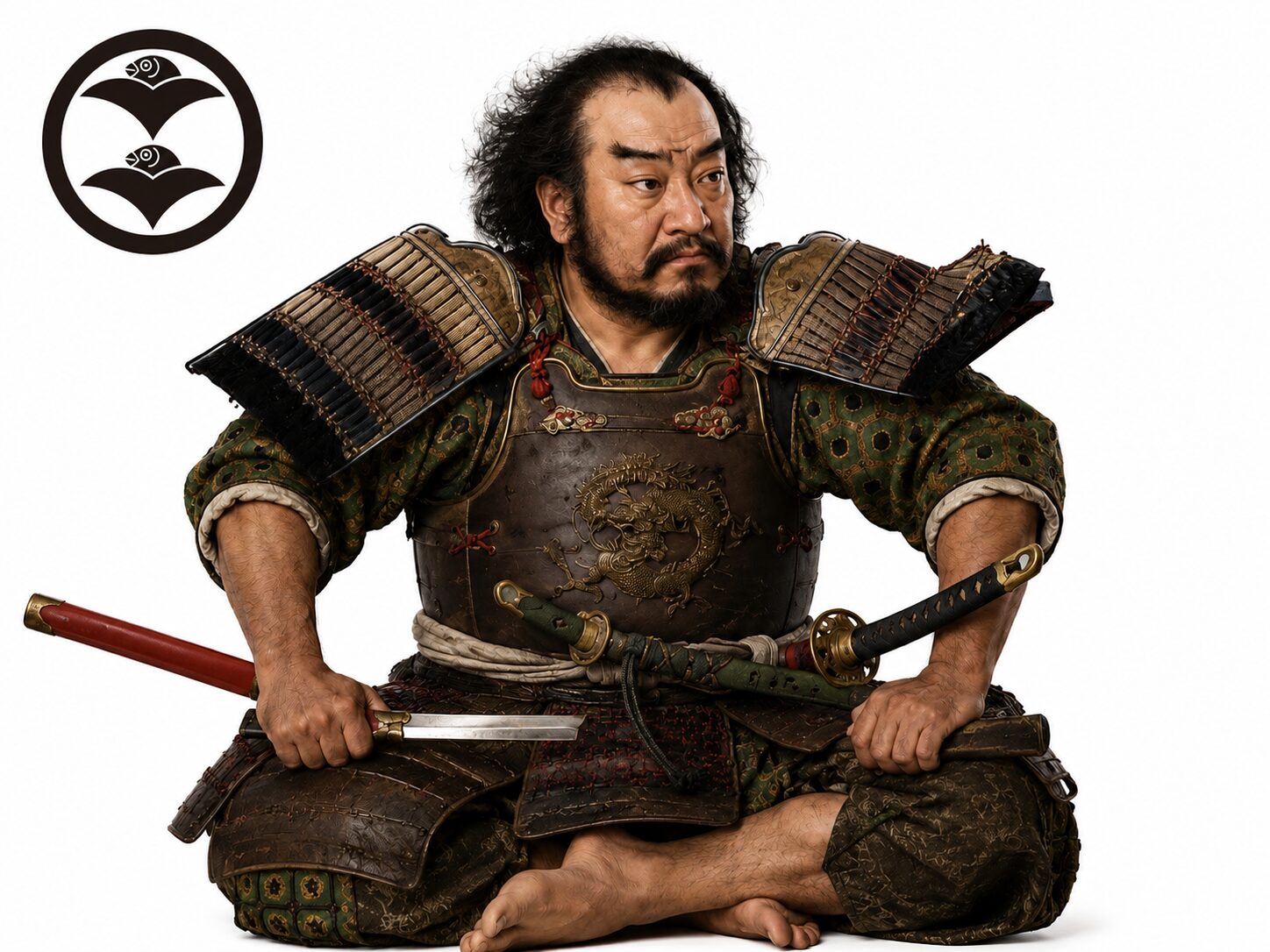
Shibata Katsuie ― “Oni Shibata,” the Oda Chief Retainer, Until He Fell at Kita-no-shō
- This Person in Three Lines
- The Mainstream Account ― The Standard Textbook Explanation
- Various Theories ― Exploring Possibilities from Different Angles
- A Strategic Perspective
- Shibata Katsuie: Famous Quotes and Death Poem
- Anecdotes and Episodes
- Shibata Katsuie: Life Timeline
- Shibata Katsuie: Family and Key Relationships
- Related Historical Sites Map & Model Travel Course
- Related Battle Articles
- References
This Person in Three Lines
- The chief retainer of Oda Nobunaga, feared by the bynames “Oni Shibata” (Demon Shibata) and “Kamewari Shibata” (Jar-Breaker Shibata). At first he served Nobunaga’s younger brother Nobuyuki and opposed Nobunaga, but after being pardoned he served Nobunaga single-mindedly as a fierce general
- As commander of the Hokuriku regional army, he pacified Echizen, Kaga, and Noto, and was praised by Luís Fróis as “the most valiant and intrepid warrior in Japan” ― an organization-type leader
- In the power struggle after Nobunaga’s death he clashed with Toyotomi Hideyoshi and was defeated at the Battle of Shizugatake. He took his own life at Kita-no-shō Castle together with his wife Oichi, embodying the aesthetics of the Sengoku warrior
The Mainstream Account ― The Standard Textbook Explanation
Birth and Entry into Oda Nobuhide’s Service (c. 1522–1551)
Shibata Katsuie’s year of birth is not fixed. The theory of Daiei 2 (1522) is widely known, but there are also theories of Daiei 6 (1526) and Daiei 7 (1527), and his age at death is variously given as between 57 and 62. His birthplace was Kamiyashiro village, Aichi district, Owari Province (present-day Meitō Ward, Nagoya City), and the present Shimoyashiro Castle ruins (Meitoku-ji) are said to be his birthplace. His origins are unclear as well; his father is said to have been Shibata Katsuyoshi, but there is no reliable source. While he is surmised to have come from a family of the local-magnate class, there are also genealogies that make him a branch of the Shiba clan.
His childhood name was Gonroku, and his common title was Shuri-no-suke. From a young age he served as a retainer of Oda Nobuhide (Nobunaga’s father) and is said to have held Shimoyashiro village, Aichi district, Owari Province. By the time of Nobunaga’s succession to the headship, he was one of the senior figures of the Oda house.
In Tenbun 20 (1551), when Nobuhide died, Katsuie became the chief retainer (karō) of Nobunaga’s younger brother Oda Nobukatsu (Nobuyuki). At the time, Nobunaga was called a “fool” (utsuke), and his standing within the house was by no means high. Nobuyuki, on the other hand, was courteous, and many retainers wished to install Nobuyuki as the heir. Katsuie was one of them.
The Battle of Inō and Submission to Nobunaga (1552–1556)
In Tenbun 21 (1552), Katsuie, together with Nakajō Ietada, achieved the military feat of cutting down the enemy karō Sakai Jinsuke at the Battle of Kayazu against Oda Nobutomo, lord of Kiyosu Castle. In the attack on Kiyosu Castle the following year, he again sortied as a commander-level figure and cut down 30 riders. By this time, Katsuie had already established a reputation for valor within the Oda house.
In the 8th month of Kōji 2 (1556), Katsuie and Hayashi Hidesada, as karō of Nobuyuki, planned to raise arms against Nobunaga. It was a march to seize Shinoki-sangō, part of Nobunaga’s directly controlled lands, and a confrontation with Nobunaga became unavoidable. This was the “Battle of Inō.” On August 24, the two armies clashed at Inō-hara (present-day Nishi Ward, Nagoya City). Against the 1,700 men of Nobuyuki’s army led by Shibata Katsuie, Nobunaga’s army numbered only 700. From the difference in strength alone, the advantage of Katsuie’s side was clear.
Through the activity of the battle-skilled Katsuie, Nobuyuki’s army at first overwhelmed the enemy. Nobunaga’s principal retainers were struck down one after another. But when Katsuie’s army closed in on Nobunaga’s headquarters, Nobunaga rebuked Katsuie’s soldiers in a thunderous voice. Because it was a quarrel among kinsmen, the soldiers of Katsuie’s army were shaken and fled. The tide reversed in an instant, and Nobunaga’s army won a come-from-behind victory. The volume of Nobunaga’s voice was so striking that it is recorded even in Luís Fróis’s “History of Japan.”
After the battle, Katsuie and Hayashi Hidesada were spared the death penalty through the intercession of Nobunaga’s mother, Dota Gozen, and came to submit to Nobunaga. Nobunaga pardoned the two and received them as retainers. However, Nobuyuki, undeterred, again planned a revolt. Katsuie sensed Nobuyuki’s movements and this time informed Nobunaga. In the 11th month of Eiroku 1 (1558), Nobunaga lured Nobuyuki to Kiyosu Castle and had him killed by Ikeda Tsuneoki and others. Katsuie’s submission to Nobunaga became decisive through this cooperation in the killing of Nobuyuki.
His Path as a Nobunaga Retainer (1557–1568)
Having become Nobunaga’s retainer, Katsuie came to prominence through his valor and organizational ability. In the Battle of Okehazama of Eiroku 3 (1560), although concrete descriptions of Katsuie are scarce in the sources, he is said to have participated as a member of Nobunaga’s army. In the Battle of Inabayama Castle of Eiroku 10 (1567), he served in Nobunaga’s conquest of Mino, and in Nobunaga’s march to the capital in Eiroku 11 (1568) he was active as the vanguard.
In the campaigns to pacify the Kinai after entering the capital, Katsuie participated in combat and administration in the Kinai and nearby provinces as one of Nobunaga’s commissioners (bugyō-nin). He also carried out adjudications of water disputes (irrigation conflicts), and records remain that he demonstrated administrative ability and not only valor. This shows Katsuie’s many-sided capability, different from the image of an “old general of valor alone.”
Chōkō-ji Castle and “Kamewari Shibata” (1570)
In Genki 1 (1570), against the uprising of Rokkaku Shōtei and his son Yoshiharu in Ōmi, Katsuie was dispatched to Chōkō-ji Castle (present-day Ōmihachiman City, Shiga Prefecture). Surrounded by the Rokkaku army and cut off from the castle’s drinking water, in a desperate situation, Katsuie gave rise to the legend of “Kamewari” (jar-breaking). The anecdote holds that he himself smashed the water jars left in the castle and, saying “there is no longer any place to return to; resolve to die and break the enemy,” raised the morale of the garrison, sortied, and repelled the Rokkaku army. From this battle Katsuie earned the byname “Kamewari Shibata.” Chōkō-ji Castle also came to be called “Kamewari Castle.”
That said, this “Kamewari” anecdote first appears in Edo-period military chronicles and is not recorded in contemporary sources. While the possibility of later embellishment is pointed out, it has been widely passed down as an anecdote symbolizing Katsuie’s do-or-die spirit. In the Battle of Anegawa in the 6th month of the same year, he also bore a wing of Nobunaga’s army and achieved military merit.
Civil Administration as Lord of Echizen (1573–1582)
In Tenshō 1 (1573), Katsuie was active in Nobunaga’s attacks on the Azai and Asakura. At the Battle of Odani Castle he became a central figure in the campaign that drove Azai Nagamasa, and in the subsequent attack on Ichijōdani drove Asakura Yoshikage, to destruction. Through these victories, Katsuie deepened Nobunaga’s trust all the more.
In the 9th month of Tenshō 3 (1575), after Nobunaga pacified the Echizen Ikkō-ikki in a war of annihilation, he granted Katsuie 490,000 koku in 8 districts of Echizen. Katsuie built a new stronghold at Kita-no-shō (present-day Fukui City). Kita-no-shō Castle was a large-scale fortress with a grand keep, an edifice symbolizing Katsuie’s authority. At this time, the “Three Men of Fuchū” ― Maeda Toshiie, Sassa Narimasa, and Fuwa Mitsuharu ― were placed as inspectors (metsuke) over Katsuie, establishing a system of mutual surveillance. Katsuie’s rule extended over the 4 districts of Nyū, Yoshida, Sakai, and Asuwa; the Three Men of Fuchū held the 2 districts of Imadate and Nanjō, and the remaining 2 districts of Ōno and Tsuruga were apportioned to Kanamori Nagachika and others.
Katsuie’s rule of Echizen fully demonstrated his ability in civil administration as a Sengoku daimyo. In the 3rd month of Tenshō 4 (1576), he issued an ordinance within the domain ordering the return of peasants (the return of farmers who had fled during the wars), prohibiting new lords from taking on retainers, and stipulating that the conscription of laborers required his own seal. He devoted himself to developing Echizen’s economic and distribution infrastructure ― new field development, the implementation of land surveys, and the cutting of a road over Tochinoki Pass connecting the Hokkoku Road to Yanagase in Ōmi. Further, he issued a rakuza (free-market) decree and promoted the development of the castle town. He also carried out a “sword hunt,” collecting swords and spears from the peasants who had joined the Ikkō-ikki and converting them into hoes and plows ― said to be a precursor to Hideyoshi’s later sword-hunt edict. Over the Asuwa River in the Kita-no-shō castle town he built the Tsukumo Bridge, half stone and half wood, and also developed a boat bridge over the Kuzuryū River.
In Tenshō 9 (1581), the Jesuit missionary Luís Fróis, who visited Katsuie’s domain of Echizen, recorded Katsuie’s actual state as follows: “Lord Shibata, in office, status, retainers (in number), splendor, and stipend, is a man equal to a provincial lord of this country,” and “because he is like the lord of half or more of Echizen Province and of all of the conquered Kaga Province, here in his achievements, status, and retainers he is equal to Nobunaga, and people call him ‘Ue-sama’ (His Lordship) and his son ‘Tono-sama.'” Praised by Fróis as “the most valiant and intrepid warrior in Japan,” Katsuie was not merely a man of valor but had reached the position of, in effect, a provincial lord as ruler of the region.
Commander of the Hokuriku Regional Army (1576–1582)
In Tenshō 4 (1576), Katsuie was appointed by Nobunaga as “commander of the Hokuriku regional army.” Within the Oda house’s system of regional army commanders, this was a post entrusting him with the especially important northern front. At the time, when Uesugi Kenshin of Echigo was trying to extend his power as far as Kaga, command of the front against the Uesugi was entrusted to Katsuie.
In Tenshō 5 (1577), Nobunaga ordered Katsuie to relieve Nanao Castle (present-day Nanao City, Ishikawa Prefecture), where Chō Tsugutsura, a senior retainer of the Hatakeyama with whom Nobunaga had close ties, was holed up. However, when Katsuie arrived on the scene, Nanao Castle had already fallen to the Uesugi. Katsuie decided to retreat and, at the treacherous Tedori River, was pursued by the Uesugi army and suffered a crushing defeat with many casualties. This was the “Battle of Tedorigawa.” This was the one and only great defeat that can be said to have occurred in Katsuie’s life, but Nobunaga did not punish Katsuie and continued to entrust him with the Hokuriku front.
In the 3rd month of Tenshō 6 (1578), when Uesugi Kenshin died of illness, Katsuie went on the counteroffensive. Seizing the opening when the Uesugi house fell into internal strife in the Otate Rebellion, Katsuie advanced into Noto and Kaga. By Tenshō 8 (1580) he had largely pacified Noto and Kaga and was eating into Uesugi territory. Through this achievement, Katsuie’s standing within the Oda house rose still further.
That same year, Sakuma Nobumori, who had been the chief retainer of the Oda house, was banished by Nobunaga on grounds of negligence in the attack on the Hongan-ji. This was the famous “nineteen-article letter of reproof” in Sengoku history, by which Sakuma Nobumori and his son were banished to Mount Kōya. As a result, Katsuie obtained the position of de facto chief retainer. It was the moment he rose to be the number-two figure of the Oda house in name and reality.
The Honnō-ji Incident and the Kiyosu Conference (1582)
At the time of the Honnō-ji Incident on June 2 of Tenshō 10 (1582), Katsuie was in the midst of capturing Uozu Castle in Etchū. He is said to have learned of Nobunaga’s death on the night of the fourth day after the incident. Katsuie immediately withdrew his forces and returned to Kita-no-shō Castle to prepare to subjugate Akechi Mitsuhide. However, because Uesugi Kagekatsu sensed the upheaval and launched an attack, Katsuie was unable to move. In the meantime, Hashiba Hideyoshi, having accomplished the “Great Return from Chūgoku,” struck down Akechi Mitsuhide first at the Battle of Yamazaki and avenged Nobunaga. For Katsuie, this was a fatal delay that had the initiative within the Oda house seized by Hideyoshi.
On June 27, the “Kiyosu Conference” was held at Kiyosu Castle in Owari to decide Nobunaga’s successor and the division of his domains. The participants were the four senior elders ― Shibata Katsuie, Niwa Nagahide, Ikeda Tsuneoki, and Hashiba Hideyoshi. The received account holds that Katsuie pushed Nobunaga’s third son Oda Nobutaka as successor, while Hideyoshi pushed Nobunaga’s eldest grandson Sanbōshi (later Oda Hidenobu), the two clashing fiercely, with the matter finally settled by the installation of Sanbōshi. However, in recent research (Shiba Hiroyuki, 2018), the theory that the theme of the Kiyosu Conference was “the proxy for Sanbōshi and the division of the domains,” and that the Katsuie–Hideyoshi succession dispute is an Edo-period creation, has also become influential. In any case, in the distribution of territory after the conference, Katsuie was held to merely Echizen’s 480,000 koku plus the area around Nagahama Castle, while Hideyoshi obtained key Kinai areas such as Yamashiro and Kawachi.
After the Kiyosu Conference, Katsuie remarried Nobunaga’s younger sister Oichi. Oichi had been the principal wife of Azai Nagamasa, but after Nagamasa took his own life at the fall of Odani Castle she had returned to the Oda house. The conventional account has long held that it was through the mediation of Kanbe Nobutaka, but there is a letter by Katsuie stating that “having consulted with Hideyoshi… I obtained everyone’s consent for marriage with a person of the lord’s lineage,” and in recent years a theory has also been presented that it was a marriage arranged in advance between Katsuie and Hideyoshi. The wedding was held on August 20 at Nobutaka’s castle, Gifu Castle. Katsuie is said to have been single until age 59, and the marriage with Oichi was the start of his domestic life in his later years. Around the same time, at Katsuie’s urging, the hundredth-day memorial service for Nobunaga was also held at Myōshin-ji in Kyoto.
The Battle of Shizugatake and the End (1583)
After the Kiyosu Conference, the conflict between Katsuie and Hideyoshi rapidly deepened. Hideyoshi hosted Nobunaga’s funeral on his own authority, enraging Katsuie. In the 10th month, Katsuie sent a memorandum to Hori Hidemasa criticizing Hideyoshi’s violation of the Kiyosu Conference pledge, his unjust redistribution of territory, and his construction of Hōshō Castle (Yamazaki Castle) (“Nankō Zatsuroku”). The conflict between the two became decisive, and in the 12th month Hideyoshi attacked Nagahama Castle, defended by Katsuie’s adopted son Shibata Katsutoyo. Snowbound, Katsuie could not send reinforcements, and Katsutoyo surrendered.
On the 9th of the 3rd month of Tenshō 11 (1583), with the thaw, Katsuie set out from Kita-no-shō in Echizen leading a large army of about 30,000 and advanced to Yanagase in northern Ōmi. He set up his headquarters at Genbao Castle. Hideyoshi also turned back from his attack on Ise and on March 17 entered Nagahama Castle leading about 50,000 troops. The two armies faced off over the Shizugatake area for about a month. In advance, Katsuie had urged the Mōri army to send troops through Ashikaga Yoshiaki, who was under the protection of Mōri Terumoto, and had also worked on Mount Kōya, but neither bore fruit.
On April 16, when Oda Nobutaka joined with Takigawa Kazumasu of Ise and again raised arms, Hideyoshi headed for Gifu. Not letting this opportunity slip, on April 19 Katsuie ordered his nephew Sakuma Morimasa to sortie. Morimasa achieved a great feat, taking the Hideyoshi side’s Ōiwayama fort and cutting down Nakagawa Kiyohide. However, Morimasa ignored Katsuie’s order to withdraw and remained on the battlefield. This became a fatal error of judgment. On April 20, Hideyoshi carried out the “Great Return from Mino,” racing the roughly 52 km from Ōgaki to Shizugatake in five hours. On April 21 the main battle of Shizugatake began, and when his ally Maeda Toshiie withdrew from the front line during the fighting, Katsuie’s army collapsed. Katsuie fled toward Kita-no-shō Castle.
On the way to retreat to Kita-no-shō, Katsuie stopped at Fuchū Castle and met with Maeda Toshiie. Although Toshiie had just withdrawn from the front line, he warmly received Katsuie and provided hot rice broth and a fresh horse. Katsuie did not reproach Toshiie, and is said to have told him, “You are on good terms with Hideyoshi, so be sure to surrender to Hideyoshi. Do not, out of regard for me, err on the path again” (“Kaga Kanazawa Maeda-ke Fu”). Katsuie’s figure, showing not hatred for the ally who had defected but consideration to preserve the other’s house, was passed down to later ages as an ideal image of the Sengoku warrior.
On April 23, Hideyoshi’s army surrounded Kita-no-shō Castle. Katsuie had only 3,000 troops to defend the castle, against Hideyoshi’s army of 18,000. Sensing death, Katsuie held a final drinking party with his clan, close retainers, and female attendants in the main keep. Oichi entrusted her three daughters (Chacha, Hatsu, and Gō) to a warrior named Tominaga Shinrokurō to deliver them to Hideyoshi, while she herself chose to share Katsuie’s fate. In a letter accompanying the three sisters, Oichi asked Hideyoshi to protect them, citing that they were “of the lord’s lineage.”
On April 24, Katsuie took his own life together with his wife Oichi. His age at death is variously given as 57 to 62, and Oichi was 37. It is said that more than 80 people, including clan members, direct retainers, and female attendants, took their own lives together with them. Katsuie is said to have committed seppuku in the formal “cross-cut” manner, and Kita-no-shō Castle burned down in the fire set to the keep. Katsuie’s end came to be told and retold in later ages as a typical example of how a Sengoku-period warrior should die. Fróis’s “Reports from Japan” conveys the warm-hearted character of Katsuie, who told the retainers who followed him to the end that he “rejoiced in their living on.”
→ For details, see the battle article “Battle of Shizugatake“
Various Theories ― Exploring Possibilities from Different Angles
[Theory 1] Is the “Hideyoshi’s Foil” Image Correct?
When it comes to Shibata Katsuie, the image of “Hideyoshi’s foil” and “the defeated veteran karō” is entrenched. His end ― taking his own life after being defeated by Hideyoshi at Shizugatake, and the dramatic conclusion of falling at Kita-no-shō Castle with his wife Oichi ― has reinforced the image of “the loser defeated by Hideyoshi.”
The “Hideyoshi’s foil” theory (the received account since the Edo period)
In the Edo-period Taikōki-type works, novels, and dramas, Katsuie was often portrayed as a supporting character in Hideyoshi’s rise-to-success story. The image of “a veteran excellent in valor but inferior to Hideyoshi in cunning” and “an old general who could not keep up with the changing times” was reproduced again and again. This tendency is strong even in Shiba Ryōtarō’s novels and has been inherited by modern Sengoku dramas.
The “supreme commander of the Oda army” theory (recent reappraisal)
Against this, recent research has greatly reconsidered the appraisal of Katsuie. Wada Yasuhiro’s “Shibata Katsuie: The ‘Supreme Commander’ of the Oda Army” (Chūōkōron-Shinsha, Chūkō Shinsho, 2020) positioned Katsuie as “the warrior with effectively the highest standing within the Oda house.” The records left by Fróis show that Katsuie was not merely a “karō” but an existence that could be called a “quasi-provincial lord” within the Oda house. The scale of Katsuie’s rule of Echizen, his authority as commander of the Hokuriku regional army, and his de facto position as chief retainer after Sakuma Nobumori’s banishment ― taken together, these show that Katsuie was a man of ability not inferior even compared with Hideyoshi or Akechi Mitsuhide. While Hideyoshi was entrusted with the Chūgoku region as “commander of the Chūgoku regional army,” Katsuie was entrusted with the Hokuriku as “commander of the Hokuriku regional army”; the two were the twin pillars of the Oda house.
The defeat at Shizugatake was not a “difference in ability”
The reason Katsuie was defeated at Shizugatake was not a lack of individual ability on Katsuie’s part, but the result of compound factors. His inability to move due to the Uesugi army’s attack immediately after the Honnō-ji Incident; his inferiority in strength to Hideyoshi in the territorial distribution after the Kiyosu Conference; Sakuma Morimasa’s arbitrary battlefield judgment; Maeda Toshiie’s withdrawal from the front ― the defeat was the result of these overlapping, not the simple framework that “Hideyoshi was the more able.” In modern Sengoku-history research, the view of reappraising Katsuie as “the most senior figure of the Oda house” and a “de facto quasi-provincial lord” has become mainstream.
[Theory 2] The Uncertainty of Katsuie’s Origins and Year of Birth
Shibata Katsuie’s origins and year of birth are especially uncertain even among Sengoku daimyo. This has become one of the mysteries in Sengoku-history research.
On his year of birth
There are mainly the following three theories about Katsuie’s year of birth.
- The Daiei 2 (1522) theory: the most widely known. By this, his age at his suicide at Shizugatake would be 62
- The Daiei 6 (1526) theory: by this, his age at death would be 58
- The Daiei 7 (1527) theory: by this, his age at death would be 57
Because there is no reliable primary source, these theories have not been settled. The letters written at Katsuie’s end and contemporary records contain no clear statement of “died at age XX,” and one can only infer from the descriptions in later genealogies and military chronicles.
On his origins
Katsuie’s origins are also subject to various theories, none of them with certain proof.
- Son of Shibata Katsuyoshi theory: there are several genealogies that make his father Shibata Katsuyoshi. However, Katsuyoshi’s career is also unknown, and there is no reliable source
- Local-magnate-class origin theory: a theory surmising, from the unclear careers of his forefathers, that he came from the local-magnate class of Owari
- Shiba clan kinsman theory: there is also a genealogy making him “the son of Shibata Tosa-no-kami, a branch of the Shiba clan.” The Shiba were a distinguished house that served as shugo of Owari, but the relationship with the Shibata clan is uncertain
The meaning of the uncertainty
The uncertainty of Katsuie’s origins and year of birth shows that “the origins of a retainer” in the Sengoku period were not recorded as strictly as today. The Sengoku period was an age of gekokujō, with intense rises in retainers’ status, and records of origins were often created after the fact. It is interesting that, even after rising to the most senior figure within the Oda house, Katsuie did not clearly assert his own origins. This may show that Katsuie was a typical self-made warrior who “gained his position by ability, not by lineage.” Today, at the Shimoyashiro Castle ruins (Meitoku-ji) in Kamiyashiro, Meitō Ward, Nagoya City, said to be Katsuie’s birthplace, a monument to his birthplace stands.
[Theory 3] The Truth of the “Kamewari Shibata” Anecdote
The most famous of Shibata Katsuie’s bynames is “Kamewari Shibata.” It is the legendary anecdote that, while holed up in Chōkō-ji Castle in Genki 1 (1570), he himself smashed the castle’s water jars to raise the garrison’s morale. There is debate among historians about the truth of this anecdote.
The content of the anecdote
In Genki 1 (1570), against the uprising of Rokkaku Shōtei and his son Yoshiharu, Katsuie was dispatched to Chōkō-ji Castle in Ōmi (present-day Ōmihachiman City, Shiga Prefecture). Surrounded by the Rokkaku army and cut off from the castle’s drinking water, in a desperate situation, Katsuie is said to have himself smashed the water jars left in the castle to show his do-or-die resolve. The core of the anecdote is that he appealed to the garrison, “there is no longer any place to return to; resolve to die and break the enemy,” then sortied and repelled the Rokkaku army.
From this battle, Katsuie earned the byname “Kamewari Shibata.” Chōkō-ji Castle also came to be called “Kamewari Castle.”
Source examination
The problem with the “Kamewari” anecdote is that it is not recorded in contemporary sources. In Sengoku-period primary sources such as the “Shinchō Kōki” and “Tamon-in Nikki,” this anecdote is not written. It first appears in Edo-period military chronicles, records from about 100 years after the Sengoku period.
According to the historian Taniguchi Katsuhiro, the very idea, in a Sengoku-period siege, of “breaking water jars to show a do-or-die resolve” is highly likely to be a later military-chronicle embellishment. In an actual Sengoku-period siege, securing water was an absolute condition of a defensive holdout, and the act of throwing away one’s own water is, tactically too, extremely irrational.
Interpretation of the anecdote
So why was such an anecdote born? The most influential interpretation is that it was created in the Edo period as an episode symbolizing Katsuie’s do-or-die spirit. Because Katsuie’s end (his suicide at Kita-no-shō Castle) was highly praised as “the aesthetics of the warrior,” it is thought that the Battle of Chōkō-ji Castle was embellished as an anecdote of “a way of fighting with death resolved” that suited his character. That said, the core of the anecdote ― the fact that “Katsuie fought a death-resolved battle at Chōkō-ji Castle and repelled the Rokkaku army” ― is highly likely to be historical. Even if the dramatic staging of “jar-breaking” is a later embellishment, Katsuie’s do-or-die fighting was certainly a military feat worthy of appraisal.
[Theory 4] His Ability in Civil Administration as Lord of Echizen
When it comes to Shibata Katsuie, the image of “Oni Shibata” and “valor alone” is strong, but recent research highly values Katsuie’s ability in civil administration. Katsuie’s rule as lord of Echizen showed his many-sided ability as a Sengoku daimyo.
The reality of his rule of Echizen
In the 9th month of Tenshō 3 (1575), Katsuie, granted 490,000 koku in 8 districts of Echizen by Nobunaga, made Kita-no-shō (present-day Fukui City) his base. Kita-no-shō Castle was a large-scale fortress with a grand keep, an edifice symbolizing Katsuie’s authority.
The features of Katsuie’s rule of Echizen were the three pillars of postwar reconstruction, economic promotion, and social stabilization. First, he issued an ordinance ordering the return of peasants who had fled during the wars. To rebuild Echizen, devastated by the struggle with the Ikkō-ikki, he urged the return of farmers. Second, he developed the agricultural base through new field development and the implementation of land surveys. Third, he stimulated distribution through the cutting of a road on the Hokkoku Road (via Tochinoki Pass).
The rakuza decree and castle-town development
At Kita-no-shō he issued a rakuza decree promoting the free activity of merchants and artisans. This was a local version of Nobunaga’s rakuichi-rakuza policy, showing that Katsuie understood Nobunaga’s economic policy and faithfully put it into practice. The castle town of Kita-no-shō developed rapidly and established its position as the economic center of Echizen.
Over the Asuwa River he built the Tsukumo Bridge, half stone and half wood. This had the unusual structure of stone on the southern half and wood on the northern half, and it also doubled as a defensive facility against enemy incursion from the south. He also developed a boat bridge over the Kuzuryū River; the place name Funabashi in Fukui City is said to derive from this boat bridge. These infrastructure projects demonstrated Katsuie’s skill in domain management.
A precursor to the sword hunt
Katsuie carried out a “sword hunt,” collecting swords and spears from the peasants who had joined the Ikkō-ikki. This is considered a precursor to the sword-hunt edict after the unification of the realm by Toyotomi Hideyoshi. By disarming the peasants, he sought to maintain order within the domain and stabilize society. The collected iron was converted into hoes and plows, contributing to improved agricultural productivity. The iron chains that connected the “boat bridge” at Funabashi in Fukui City are said to have been repurposed from the swords and spears Katsuie collected from the peasants.
Fróis’s appraisal
In Tenshō 9 (1581), Luís Fróis, who visited Katsuie’s domain of Echizen, left a record highly praising Katsuie’s rule: “Because he is like the lord of half or more of Echizen Province and of all of the conquered Kaga Province, here in his achievements, status, and retainers he is equal to Nobunaga, and people call him ‘Ue-sama’ and his son ‘Tono-sama.'” This is a precious primary source showing the high standing of Katsuie from the objective viewpoint of a foreign missionary. Katsuie was not merely an old general of valor alone but a lord who balanced valor and civil administration, and his intellectual and administrative ability, different from the “Oni Shibata” image, has been reappraised in recent research.
[Theory 5] The Circumstances of His Remarriage to Oichi
On August 20 of Tenshō 10 (1582), Katsuie remarried Oichi. Oichi was the younger sister of Oda Nobunaga and was called the foremost beauty of the Sengoku period. After her first husband, Azai Nagamasa, took his own life at the fall of Odani Castle, she had returned to the Oda house. There are several theories about the circumstances of this remarriage.
The “mediation by Kanbe Nobutaka” theory (the Edo-period received account)
Since the Edo-period military chronicles, this remarriage has been held to be through the mediation of Nobunaga’s third son Kanbe Nobutaka (Oda Nobutaka). The framework is that, from the connection of Katsuie pushing Nobutaka as successor at the Kiyosu Conference, Nobutaka married Oichi to Katsuie. That the wedding was held at Nobutaka’s castle, Gifu Castle, has also been a basis for this theory.
The “advance arrangement between Hideyoshi and Katsuie” theory (an influential recent theory)
In recent years, as a result of reexamining Katsuie’s letters, a new interpretation has been presented. Katsuie’s letter contains the wording “having consulted with Hideyoshi… I obtained everyone’s consent for marriage with a person of the lord’s lineage,” and this is the theory that it was a marriage arranged in advance between Katsuie and Hideyoshi.
The implications of this theory are great. First, the marriage of Katsuie and Oichi was highly likely to have been “Katsuie’s own intention” rather than “led by Nobutaka.” Second, Hideyoshi too was at first cooperative with Katsuie’s intention. Third, the Katsuie–Hideyoshi conflict after the Kiyosu Conference should be thought of as having deepened after, not before or around, the marriage.
Political complement to Katsuie after the Kiyosu Conference
This marriage is thought to have had the meaning of complementing Katsuie’s political standing after the Kiyosu Conference. At the Kiyosu Conference, Katsuie stood inferior to Hideyoshi in territorial distribution. The marriage with Oichi can also be said to have been a means for Katsuie to regain political advantage over Hideyoshi by acquiring the authority of “the warrior closest to the bloodline of the Oda house.” There is ample possibility that, for Katsuie ― called “Ue-sama” in Fróis’s record ― it was a strategic choice to strengthen his position as quasi-provincial lord of the Oda house.
[Theory 6] His Death Poem and the Manner of His End
Shibata Katsuie’s end was told and retold in later ages as the ideal image of how a Sengoku warlord should die. The final drinking party in the keep of Kita-no-shō Castle, the death poem, the cross-cut seppuku ― these are typical examples of the “aesthetics of the warrior” of the Sengoku period.
Death poem
The death poem passed down as Katsuie’s is the following:
“Like the fleeting dream-path of a summer night ― raise my name after death up into the clouds, O mountain cuckoo.”
It means, “My life, as fleeting as a dream on a summer night; let my name after death resound up to the clouds (the heights), O mountain cuckoo.” A record remains in the early-Edo “Taikōki” and elsewhere, but there is also a view that it is a honkadori (allusive variation) of Ashikaga Yoshiteru’s death poem, “Are the early-summer rains dew or tears, cuckoo? Raise my name above the clouds,” so the possibility of a later creation cannot be denied.
Oichi’s death poem is also passed down:
“Even without that, brief is the slumber of a summer night ― and the cuckoo calls as if to lure on the dream-path.”
It means, “Already short is the sleep of a summer night, yet the cuckoo cries as if to further beckon along the dream-path.” It shares the same “summer night” and “cuckoo” with Katsuie’s death poem, evoking the scene of a husband and wife setting out together on the journey of death.
The account in Fróis’s “Reports from Japan”
One of the most reliable contemporary records about Katsuie’s end is that of the Jesuit missionary Luís Fróis’s “Reports from Japan.” Fróis recorded Katsuie’s state at Kita-no-shō Castle after the defeat at Shizugatake as follows: “He spoke no words of resentment toward the retainers who had defected, and toward the retainers who had accompanied him to the end, he conveyed that they should live on ― indeed, that he rejoiced in it ― and lamented that in this life he had no means to repay the affection of his retainers.”
It is a precious account conveying Katsuie’s warm-hearted character. The deep affection for his retainers shown at his end by the valiant warrior called “Oni Shibata” ― this showed Katsuie’s humanity as a Sengoku daimyo. A similar story is also recorded in the memorandum of the Maeda retainer Murai Shigeyori, and Katsuie’s character is conveyed in multiple independent sources.
The cross-cut seppuku
Katsuie is said to have performed the formal seppuku called “cross-cut” (jūmonji-giri). The cross-cut, slicing the belly open lengthwise and crosswise, is considered the most formal manner among Sengoku warlords’ seppuku, and showed Katsuie’s pride as a warrior. It is said that more than 80 people, including clan members, direct retainers, and female attendants, took their own lives together; this large-scale following in death is also held to be an expression of Katsuie’s virtue. Kita-no-shō Castle burned down in the fire set to the keep, and the curtain fell on Katsuie’s life.
The legend of the “headless procession”
After Katsuie’s death, the legend of “Katsuie’s headless procession” was passed down in Fukui until the early Meiji era. It was whispered that on the anniversary of Katsuie’s death (April 24), the headless Katsuie would cross the Tsukumo Bridge astride a white horse, and that anyone who saw him would die within a year. However, it was also said that even if one happened to encounter him, one would be saved by shouting “the realm’s renowned general, Lord Shibata Katsuie.” This is an anecdote of awe for a warlord who, while praised as “the realm’s renowned general,” met a tragic end, transmitted as a ghost story. It can be called an anecdote showing the magnitude of Katsuie’s presence and how deeply his memory was carved into the land of Fukui.
A Strategic Perspective
Surveying Shibata Katsuie’s life strategically, the figure of a Sengoku daimyo with many-sided ability, and of a single warrior tossed about in a transitional period, comes into view. There are four points worth noting.
First, Katsuie’s “balance of valor and civil administration.” While Katsuie was a valiant warrior called “Oni Shibata,” as lord of Echizen he demonstrated excellent ability in civil administration. The order to return peasants by ordinance, new field development, land surveys, the rakuza decree, road maintenance, the building of the castle town ― these policies showed Katsuie’s comprehensive strength as a Sengoku daimyo. The image of “an old general of valor alone” differs greatly from Katsuie’s real image. As Fróis praised him as “the most valiant and intrepid warrior in Japan” and at the same time recorded him as “a man equal to a provincial lord of Echizen,” Katsuie was a typical Sengoku daimyo who combined valor and governing ability.
Second, his standing as a “quasi-provincial lord” within the Oda house. Though a retainer of Nobunaga, Katsuie was called “Ue-sama” by Fróis and was recognized as a provincial lord even by his own retainers. His authority, as commander of the Hokuriku regional army, to oversee Echizen, Kaga, and Noto, stood out even among Nobunaga’s retainers. After Sakuma Nobumori’s banishment he became the de facto chief retainer and built a firm position as the number-two figure of the Oda house. As one of the twin pillars of the Oda house alongside Hideyoshi, Katsuie bore the core of Nobunaga’s regime.
Third, the strategic failure after the Honnō-ji Incident. Katsuie’s greatest strategic failure in his life was the delay in his response after the Honnō-ji Incident. At the time, Katsuie was in the midst of capturing Uozu Castle in Etchū, and learned of Nobunaga’s death four days after the incident. He immediately withdrew his forces, but was unable to move due to the pursuit of Uesugi Kagekatsu, and was outpaced by Hideyoshi’s Great Return from Chūgoku. Because Hideyoshi, who struck down Akechi Mitsuhide at the Battle of Yamazaki, monopolized the merit of “avenging Nobunaga,” Katsuie lost the initiative within the Oda house. His defeat to Hideyoshi in this “battle against time” led to the later defeat at Shizugatake.
Fourth, the structural factors of the defeat at Shizugatake. Katsuie’s defeat at Shizugatake was not a lack of individual ability but the result of compound factors. During the winter, blocked by the Hokuriku snow, Hideyoshi won over Katsuie’s adopted son Shibata Katsutoyo at Nagahama Castle and extended his hand of maneuvering to the Hongan-ji, Uesugi Kagekatsu, Maeda Toshiie, and others. Katsuie had to wait for the thaw in the 3rd month before sortieing, and by that point he was already overwhelmed by Hideyoshi in the “diplomatic war.” Moreover, the tactical failures of Sakuma Morimasa’s arbitrary battlefield judgment and Maeda Toshiie’s withdrawal from the front overlapped. It is said that Sengoku-period battles are “80% diplomacy, 20% combat,” and Katsuie had been utterly defeated in the diplomatic war.
To borrow from Rai San’yō’s “Nihon Gaishi,” one might say, “Katsuie’s life lay not at Shizugatake but immediately after Honnō-ji.” The four-day delay in his response immediately after the Honnō-ji Incident determined Katsuie’s fate. Had Katsuie been able to move at once then, the initiative of the Oda house would likely have gathered to Katsuie rather than Hideyoshi. It can be called the life of a fascinating Sengoku warrior that makes one ponder history’s “what ifs.”
Shibata Katsuie: Famous Quotes and Death Poem
“Like the fleeting dream-path of a summer night ― raise my name after death up into the clouds, O mountain cuckoo.”
The verse passed down as Katsuie’s death poem. It means, “My life, as fleeting as a dream on a summer night; let my name after death resound up to the clouds (the heights), O mountain cuckoo.” It is said to express his state of mind just before taking his own life with his wife Oichi in the keep of Kita-no-shō Castle. A record remains in the early-Edo “Taikōki” and elsewhere, but there is also a view that it is an allusive variation of Ashikaga Yoshiteru’s death poem, so the possibility of a later creation cannot be denied. It has been repeatedly quoted in later ages as a delicate verse composed at his end by a man of valor called “Oni Shibata.”
― Source: “Taikōki” and others
“There is no longer any place to return to; resolve to die and break the enemy.”
Passed down as the words spoken by Katsuie when, holed up in Chōkō-ji Castle in Ōmi in Genki 1 (1570), he himself smashed the water jars to raise the garrison’s morale. Surrounded by the Rokkaku army and cut off from the castle’s drinking water, in a desperate situation, Katsuie is said to have ordered, “there is no longer anyone to seek water; resolve to die and fight,” sortied, and repelled the Rokkaku army. From this battle he earned the byname “Kamewari Shibata.” This anecdote first appears in Edo-period military chronicles and is not recorded in contemporary sources. While the possibility of later embellishment is pointed out, it is widely passed down as words symbolizing Katsuie’s do-or-die spirit.
― Source: “Kokushi Daijiten,” “Seishū Heiki” and others
“Side with Hideyoshi. That is the way to preserve your house.”
Said to be the words Katsuie spoke to Maeda Toshiie, who had withdrawn from the front, when Katsuie stopped at Fuchū Castle on the way to retreat to Kita-no-shō after the defeat at Shizugatake. Although Toshiie had just defected, he warmly received Katsuie and provided hot rice broth and a fresh horse. Katsuie did not reproach the defecting Toshiie and is said to have admonished him, “You are on good terms with Hideyoshi, so be sure to surrender to Hideyoshi” (“Kaga Kanazawa Maeda-ke Fu”). It has become an ideal image of the Sengoku warrior as an anecdote showing Katsuie’s character in showing consideration to a defecting ally.
― Source: “Kaga Kanazawa Maeda-ke Fu,” “Taikōki”
“To the retainers who accompanied me to the end, I rejoice in their living on.”
Recorded in Fróis’s “Reports from Japan” as words Katsuie spoke to the retainers who followed him to the end on the eve of the fall of Kita-no-shō Castle. It records that “he spoke no words of resentment toward the retainers who had defected; toward the retainers who had accompanied him to the end, he conveyed that they should live on ― indeed, that he rejoiced in it ― and lamented that in this life he had no means to repay the affection of his retainers.” It is a precious contemporary record conveying Katsuie’s humanity, as an anecdote showing the deep affection for his retainers shown at his end by the valiant warrior called “Oni Shibata.”
― Source: Luís Fróis, “Reports from Japan”
Anecdotes and Episodes
A Reversal Defeat by Nobunaga’s Thunderous Rebuke ― The Battle of Inō
The Battle of Inō in Kōji 2 (1556) became a major turning point in Katsuie’s life. As karō of Nobunaga’s younger brother Nobuyuki, Katsuie led 1,700 troops against Nobunaga’s 700. From the difference in strength alone, the advantage of Katsuie’s side was clear, and through the activity of the battle-skilled Katsuie, Nobunaga’s principal retainers were at first struck down one after another.
But when Katsuie’s army closed in on Nobunaga’s headquarters, Nobunaga rebuked Katsuie’s soldiers in a thunderous voice. It is said to have been something like, “What are you thinking? To fight among kinsmen of the same Oda house ― what is this?” Because it was a quarrel among kinsmen, the soldiers of Katsuie’s army were shaken and fled. The tide reversed in an instant, and Nobunaga’s army won a come-from-behind victory. The volume of Nobunaga’s voice was so striking that it is recorded even in Luís Fróis’s “History of Japan.” It was the moment when the intimidating leadership of Nobunaga ― praised as “the loudest-voiced man in Japan” ― overturned Katsuie’s advantage.
― Source: Luís Fróis, “History of Japan”; “Shinchō Kōki”
The Great Defeat at Tedorigawa ― Facing Uesugi Kenshin
In the 9th month of Tenshō 5 (1577), Katsuie, on Nobunaga’s orders, headed to relieve Chō Tsugutsura, a senior Hatakeyama retainer holed up in Nanao Castle in Noto. But when Katsuie arrived on the scene, Nanao Castle had already fallen to Uesugi Kenshin. Katsuie decided to retreat and, at the treacherous Tedori River, was pursued by the Uesugi army and suffered a crushing defeat with many casualties. This was the “Battle of Tedorigawa.”
This great defeat was the one and only fatal defeat that can be said to have occurred in Katsuie’s life. Katsuie was utterly toyed with by Uesugi Kenshin’s strategic eye and mobility. After the Battle of Tedorigawa, Kenshin is said to have remarked, “the Oda army is weak.” Before Kenshin, called the “god of war,” even Katsuie was no more than a single warrior.
That said, Nobunaga did not punish Katsuie and continued to entrust him with the Hokuriku front. This showed both the sureness of Nobunaga’s eye for people and the depth of his trust in Katsuie. When Kenshin died of illness in the 3rd month of the following Tenshō 6 (1578), Katsuie went on the counteroffensive. Seizing the opening when the Uesugi house fell into internal strife in the Otate Rebellion, he advanced into Noto and Kaga, showing activity that avenged the humiliation of Tedorigawa.
― Source: “Shinchō Kōki,” “Uesugi-ke Monjo”
The Development of the Kita-no-shō Castle Town ― Oni Shibata’s Surprising Skill in Civil Administration
Granted 490,000 koku in 8 districts of Echizen in Tenshō 3 (1575), Katsuie built a grand castle at Kita-no-shō (present-day Fukui City). Kita-no-shō Castle was a large-scale fortress with a keep, an edifice symbolizing Katsuie’s authority. At the same time, Katsuie also put effort into developing the castle town.
Over the Asuwa River he built the Tsukumo Bridge, half stone and half wood. This had the unusual structure of stone on the southern half and wood on the northern half, and it also doubled as a defensive facility against enemy incursion from the south. He also developed a boat bridge over the Kuzuryū River; the place name Funabashi in Fukui City is said to derive from this boat bridge. The iron chains that connected the “boat bridge” are said to have been repurposed from the iron of swords and spears that Katsuie collected from the peasants in his struggle with the Ikkō-ikki.
Katsuie developed the Hokkoku Road over Tochinoki Pass as a shortcut to Nobunaga’s Azuchi Castle. This became a great artery of distribution connecting Echizen and Ōmi and contributed greatly to Fukui’s economic development. He also moved merchants and artisans from Ichijōdani to Kita-no-shō, promoting the development of the castle town, and issued a rakuza decree permitting the free activity of merchants and artisans. Katsuie’s surprising skill in civil administration, different from the “Oni Shibata” image. The character of Katsuie, called “Ue-sama” by the people of the region, was built through the accumulation of such steady domain management.
― Source: “Kita-no-shō-jō Monogatari,” “Fukui Shishi”
The Conflict with Hideyoshi ― Hosting Nobunaga’s Funeral on His Own Authority
After the Honnō-ji Incident, the conflict between Katsuie and Hideyoshi rapidly deepened. The greatest trigger was Nobunaga’s funeral, hosted by Hideyoshi on his own authority on October 15 of Tenshō 10 (1582). Hideyoshi held Nobunaga’s funeral grandly at Daitoku-ji in Kyoto and appealed to all that he himself was Nobunaga’s legitimate successor.
Katsuie was enraged. Properly, it should have been Katsuie, chief retainer of the Oda house, who hosted the funeral. On October 16, Katsuie sent a memorandum to Hori Hidemasa, criticizing Hideyoshi’s violation of the Kiyosu Conference pledge, his unjust redistribution of territory, and his construction of Hōshō Castle (Yamazaki Castle) (“Nankō Zatsuroku”). Katsuie’s anger that “Hideyoshi has deviated from the proper conduct of a legitimate Oda retainer” remains as a document.
Hideyoshi’s hosting of the funeral is a typical example of a “staging strategy” in the political struggles of the Sengoku period. With the legitimization of “hosting Nobunaga’s funeral” following “avenging Nobunaga” (the Battle of Yamazaki), Hideyoshi established the initiative within the Oda house. The conflict between the two, by way of the attack on Nagahama Castle in the 12th month, led to the Battle of Shizugatake in the 4th month of the following year.
― Source: “Nankō Zatsuroku,” “Shinchō Kōki”
Entrusting the Three Sisters to Hideyoshi ― The Last Night of Kita-no-shō Castle
On April 23 of Tenshō 11 (1583), Katsuie, surrounded at Kita-no-shō Castle by Hideyoshi’s army, held a final drinking party with his clan, close retainers, and female attendants in the main keep. Before Katsuie and Oichi, who were resolved to die, stood the greatest difficulty: the disposition of the three Azai sisters who were Oichi’s children from her previous marriage (Chacha, 11; Hatsu, 10; Gō, 5).
After consultation, Katsuie and Oichi decided to entrust the three sisters to a warrior named Tominaga Shinrokurō and send them to Hideyoshi. Oichi added a letter addressed to Hideyoshi. Its content was a request that “(the three sisters), being of the lord’s lineage, should be cherished.” “Of the lord’s lineage” refers to the three sisters being nieces of Oda Nobunaga. By reminding him that Hideyoshi had been Nobunaga’s retainer, she sought to make the protection of the three sisters certain.
This decision was likely the most difficult choice for Oichi. She was entrusting her own daughters to Hideyoshi, her father’s enemy. But this was the resolve of a mother who wished for the continuation of her bloodline. In fact, the three sisters would each later be active as women who moved history. Chacha (Yododono) became Hideyoshi’s concubine and bore Toyotomi Hideyori; Hatsu became the principal wife of Kyōgoku Takatsugu; and Gō became the principal wife of Tokugawa Hidetada (the second shogun) and the mother of Tokugawa Iemitsu. The bloodlines linking the three houses of Toyotomi, Kyōgoku, and Tokugawa were determined on this last night of Kita-no-shō Castle. Katsuie and Oichi took their own lives in the early morning of April 24, together with more than 80 retainers and female attendants.
― Source: “Taikōki,” “Letter of Oichi,” “Keishin-in Mon”
Shibata Katsuie: Life Timeline
| Period | Event |
|---|---|
| c. Daiei 2 (1522) | Shibata Katsuie born in Kamiyashiro village, Aichi district, Owari Province (various theories; also 1526 and 1527) |
| Tenbun 20 (1551) | Oda Nobuhide dies. Katsuie becomes karō of Nobunaga’s younger brother Nobukatsu (Nobuyuki) |
| Tenbun 21 (1552) | Cuts down Sakai Jinsuke at the Battle of Kayazu. Comes to prominence through military merit |
| Kōji 2 (1556)/8 | Battle of Inō. Defeated by Nobunaga. Submits through the intercession of Dota Gozen |
| Eiroku 1 (1558)/11 | Informs Nobunaga of Nobuyuki’s renewed revolt. Nobuyuki killed at Kiyosu Castle |
| Eiroku 3 (1560)/5 | Participates as part of Nobunaga’s army at the Battle of Okehazama |
| Eiroku 10 (1567) | Battle of Inabayama Castle. Serves in Nobunaga’s conquest of Mino |
| Eiroku 11 (1568) | Participates as vanguard in Nobunaga’s march to the capital |
| Genki 1 (1570) | Battle of Chōkō-ji Castle. Earns the byname “Kamewari Shibata.” Also takes part in the Battle of Anegawa that year |
| Tenshō 1 (1573) | Active in Nobunaga’s attacks on the Azai and Asakura. Fall of Odani Castle, capture of Ichijōdani |
| Tenshō 3 (1575)/9 | Granted 490,000 koku in 8 districts of Echizen. Builds his base at Kita-no-shō |
| Tenshō 4 (1576)/3 | Issues an ordinance within Echizen ordering the return of peasants. Begins civil administration |
| Tenshō 4 (1576) | Appointed commander of the Hokuriku regional army. The Three Men of Fuchū (Maeda Toshiie, Sassa Narimasa, Fuwa Mitsuharu) become inspectors |
| Tenshō 5 (1577)/9 | Battle of Tedorigawa. Great defeat by Uesugi Kenshin |
| Tenshō 6 (1578)/3 | Uesugi Kenshin dies of illness. Katsuie goes on the counteroffensive |
| Tenshō 8 (1580) | Pacifies Noto and Kaga. Becomes de facto chief retainer with Sakuma Nobumori’s banishment |
| Tenshō 9 (1581) | Fróis visits Echizen. Records Katsuie as “Ue-sama” |
| Tenshō 10 (1582)/6/2 | Honnō-ji Incident. Katsuie, in the midst of capturing Uozu Castle in Etchū, learns of Nobunaga’s death four days later |
| Tenshō 10 (1582)/6/27 | Kiyosu Conference. Participates as one of the four senior elders. The conflict with Hideyoshi surfaces |
| Tenshō 10 (1582)/8/20 | Remarries Oichi. Wedding at Gifu Castle |
| Tenshō 10 (1582)/10/15 | Hideyoshi hosts Nobunaga’s funeral on his own authority. Katsuie enraged |
| Tenshō 10 (1582)/12 | Hideyoshi attacks Nagahama Castle. Shibata Katsutoyo (Katsuie’s adopted son) surrenders |
| Tenshō 11 (1583)/3/9 | Battle of Shizugatake begins. Katsuie sets out from Kita-no-shō in Echizen with an army of 30,000 |
| Tenshō 11 (1583)/4/21 | Defeated in the main battle of Shizugatake. Maeda Toshiie withdraws from the front; Sakuma Morimasa’s rashness leads to the rout |
| Tenshō 11 (1583)/4/24 | Takes his own life with Oichi at Kita-no-shō Castle. Age at death variously given (57–62). More than 80 clan members take their own lives together |
※ Dates are by the old (lunar) calendar. Background colors: yellow = major events, red = battle/death-related.
Shibata Katsuie: Family and Key Relationships
Family
| Relation | Person | Summary |
|---|---|---|
| Father (tradition) | Shibata Katsuyoshi | A local magnate of Aichi district, Owari Province. No certain proof of origins. By some genealogies, a kinsman of the Shiba clan |
| Wife | Oichi | Younger sister of Oda Nobunaga. First married to Azai Nagamasa. Remarried Katsuie in Tenshō 10 (1582). Took her own life together with him at Shizugatake. Died at 37 |
| Adopted son | Shibata Katsutoyo | Adopted from a nephew or a kinsman’s son. Was lord of Nagahama Castle but surrendered to Hideyoshi. Died of illness just before the Battle of Shizugatake |
| Adopted son | Shibata Katsumasa | Younger brother of Sakuma Morimasa. Katsuie’s adopted son. Served as rearguard at the Battle of Shizugatake and was cut down by Wakisaka Yasuharu |
| Stepchild (Oichi’s child) | Chacha (Yododono) | Eldest daughter of Azai Nagamasa and Oichi. Raised as Katsuie’s stepchild. Later became Hideyoshi’s concubine and bore Toyotomi Hideyori |
| Stepchild (Oichi’s child) | Hatsu (Jōkō-in) | Second daughter of Azai Nagamasa and Oichi. Later became the principal wife of Kyōgoku Takatsugu |
| Stepchild (Oichi’s child) | Gō (Sūgen-in) | Third daughter of Azai Nagamasa and Oichi. Later became the principal wife of Tokugawa Hidetada and the mother of Tokugawa Iemitsu |
Key Retainers, Allies, and Adversaries
| Relation | Person | Summary |
|---|---|---|
| Lord | Oda Nobunaga | Katsuie’s lifelong lord. At first opposed Nobunaga, but later served as a most senior figure |
| First lord | Oda Nobuhide | Nobunaga’s father. Promoted Katsuie as a retainer |
| Initial lord | Oda Nobukatsu (Nobuyuki) | Nobunaga’s younger brother. Katsuie served him as karō, but he was killed by Nobunaga |
| Nephew | Sakuma Morimasa | “Oni Genba.” At Shizugatake, ignored the order to withdraw and took the Ōiwayama fort, but became a cause of the defeat |
| Subordinate (Three Men of Fuchū) | Maeda Toshiie | Inspector during the rule of Echizen. Withdrew from the front at Shizugatake. Later the founder of the “Million-koku Kaga” |
| Subordinate (Three Men of Fuchū) | Sassa Narimasa | Inspector during the rule of Echizen. Later lord of Toyama Castle in Etchū. Came into conflict with Hideyoshi and surrendered |
| Subordinate (Three Men of Fuchū) | Fuwa Mitsuharu | Inspector during the rule of Echizen. At Shizugatake, his son Katsumitsu sided with Toshiie and retreated |
| Colleague (four senior elders) | Niwa Nagahide | One of the four senior elders at the Kiyosu Conference. At Shizugatake, fought on Hideyoshi’s side |
| Colleague (four senior elders) | Ikeda Tsuneoki | One of the four senior elders at the Kiyosu Conference. Later killed at the Battle of Komaki-Nagakute |
| Rival / adversary | Toyotomi Hideyoshi | A colleague in the Oda house. After the Honnō-ji Incident they vied for the initiative; defeated Katsuie at Shizugatake |
| Banished rival | Sakuma Nobumori | Had been chief retainer of the Oda house, but was banished by Nobunaga in Tenshō 8 (1580). Katsuie took the seat of chief retainer |
| Ally | Oda Nobutaka | Nobunaga’s third son. Katsuie pushed him as successor at the Kiyosu Conference. Raised arms again at Shizugatake but took his own life |
| Ally | Takigawa Kazumasu | A senior Oda retainer. Raised arms in Ise just before Shizugatake but was defeated by Hideyoshi and surrendered |
| Adversary | Uesugi Kenshin | Sengoku daimyo of Echigo. Won a great victory over Katsuie at Tedorigawa. Died of illness in Tenshō 6 (1578) |
| Adversary | Uesugi Kagekatsu | Kenshin’s adopted son. Attacked Katsuie after the Honnō-ji Incident, sealing his movements |
Related Historical Sites Map & Model Travel Course
Related Historical Sites Map ― Shibata Katsuie
Spots on the map:
- Shibata Shrine (shrine) ― Site of the Kita-no-shō Castle keep. Enshrines Katsuie, Oichi, and the three Azai sisters. The center of Fukui City
- Kita-no-shō Castle Ruins (Shibata Park) (castle) ― The place of Katsuie and Oichi’s end. A historic park unified with Shibata Shrine
- Saikō-ji / Shibata Katsuie Family Temple (temple) ― Graves of Katsuie, Oichi, Katsutoyo, and Sakujirō
- Genbao Castle Ruins (castle) ― Katsuie’s headquarters at the Battle of Shizugatake. One of the Continued Top 100 Castles of Japan
- Chōkō-ji Castle Ruins (castle) ― Site of the Genki 1 battle where he earned the byname “Kamewari Shibata.” Also called “Kamewari Castle”
- Shimoyashiro Castle Ruins (Meitoku-ji) (castle/temple) ― Katsuie’s birthplace. Now a temple
- Kiyosu Castle (castle) ― The site of the Kiyosu Conference. Katsuie participated as one of the four senior elders
- Azuchi Castle Ruins (castle) ― The base of Nobunaga, whom Katsuie served
※ The map is a reference display based on modern roads. It differs from the roads and terrain of the Sengoku period.
📍 View the route on Google Maps (car/train switchable)
Model Travel Course ― Tracing Katsuie’s Footsteps in Two Days
Conditions
- Time required: 2 days (by car)
- Walking speed: about 4 km/h; stay at each spot: 30–90 min
- Starting point: Nagoya (Katsuie’s birthplace)
Day 1: Owari and Ōmi ― Katsuie’s Starting Point
① Shimoyashiro Castle Ruins (Meitoku-ji) (stay: about 30 min)
Katsuie’s birthplace. A monument to his birthplace stands within the grounds of Meitoku-ji.
– By car: about 30 min from Nagoya Station
② Kiyosu Castle (stay: about 60 min)
The site of the Kiyosu Conference. A reconstructed keep and historical exhibits.
– By car: about 40 min from Shimoyashiro Castle Ruins
③ Chōkō-ji Castle Ruins (Kamewari Castle) (stay: about 60 min)
Site of the Genki 1 battle where he earned the byname “Kamewari Shibata.” A mountain-castle hike.
– By car: about 90 min from Kiyosu Castle
④ Azuchi Castle Ruins (stay: about 90 min)
The base of Nobunaga, whom Katsuie served. A World Heritage candidate.
– By car: about 20 min from Chōkō-ji Castle Ruins
Day 1 lodging: inn in the Shiga/Fukui direction
Day 2: Shizugatake to Echizen ― Katsuie’s End
⑤ Genbao Castle Ruins (stay: about 90 min, for the energetic)
Katsuie’s headquarters at the Battle of Shizugatake. One of the Continued Top 100 Castles of Japan. The earthworks and dry moats remain in good condition.
– By car: the Shiga–Fukui border
⑥ Shibata Shrine / Kita-no-shō Castle Ruins (Shibata Park) (stay: about 60 min)
Site of the Kita-no-shō Castle keep. A shrine and historic park enshrining Katsuie, Oichi, and the three Azai sisters. A “Shrine of Bonds” for matchmaking.
– By car: about 75 min from Genbao Castle Ruins
⑦ Saikō-ji / Shibata Katsuie Family Temple (stay: about 30 min)
Graves of Katsuie, Oichi, Katsutoyo, and Sakujirō. Pray for the repose of Katsuie and Oichi at the graves.
– By car: about 10 min from Shibata Shrine
Arrangements by Type of Visitor
- For the valor-minded: A “warrior Katsuie” course of the Battle of Inō battlefield + Chōkō-ji Castle (Kamewari Castle) + Tedorigawa (Hakusan City, Ishikawa Prefecture) + Genbao Castle
- For the couple / bond-minded: A “marital love / family bonds” course of Shibata Shrine (Shrine of Bonds) + Three Sisters Shrine + Tokushō-ji (graves of the three generations of Azai) + Odani Castle (the site of Oichi’s first castle-fall)
- For the Echizen-minded: An “Echizen rule” course of Shibata Shrine + Saikō-ji + the Asuwa River Tsukumo Bridge site + Funabashi + Ichijōdani (the site of the Asakura clan’s fall)
- For the relaxed: A half-day course of three sites in Fukui City ― Shibata Shrine + Kita-no-shō Castle Ruins + Saikō-ji
※ This plan is a reference model based on general travel speeds and stay times. Operating hours, transport schedules, and crowding vary by season and day. When you go, please check the latest information on the official websites of each facility and transport service.
※ Admission and entry fees are reference prices as of writing. They may have changed.
※ For mountain-castle ruins (Chōkō-ji Castle, Genbao Castle, etc.), please make plans within your ability according to weather and fitness.
Related Battle Articles
- Battle of Okehazama (1560) ― The battle in which Katsuie participated as part of Oda Nobunaga’s army
- Battle of Anegawa (1570) ― Where Katsuie was active in the subjugation of the Azai and Asakura
- Battle of Kanegasaki (1570) ― The battle known for the anecdote of Oichi’s bag of beans
- Battle of Odani Castle (1573) ― Fall of the Azai house. A turning point in the fate of Oichi and the three sisters
- Honnō-ji Incident (1582) ― Nobunaga’s death. The start of the Katsuie–Hideyoshi struggle for the initiative
- Battle of Yamazaki (1582) ― Hideyoshi strikes down Mitsuhide. Katsuie’s delay seals his fate
- Battle of Shizugatake (1583) ― Katsuie’s last battle. Defeated by Hideyoshi, he takes his own life at Kita-no-shō Castle
- Battle of Komaki-Nagakute (1584) ― The battle of the surviving Oda retainers after Katsuie’s death
References
Primary Sources
- Ōta Gyūichi, “Shinchō Kōki” ― A basic source on Katsuie’s battle career
- Luís Fróis, “History of Japan,” “Reports from Japan” ― Accounts of Katsuie during the Echizen visit and contemporary records conveying his character at his end
- “Nankō Zatsuroku” ― Katsuie’s memorandum to Hori Hidemasa (10th month, Tenshō 10)
- “Kōyō Gunkan,” “Kaga Kanazawa Maeda-ke Fu” ― Katsuie’s movements around the Battle of Shizugatake
- “Koshōmon” ― Katsuie’s letters (overtures to Ashikaga Yoshiaki and the Mōri)
- “Murai Shigeyori Oboegaki” ― A record by a Maeda retainer on Katsuie’s character at his end
Academic Works
- Wada Yasuhiro, “Shibata Katsuie: The ‘Supreme Commander’ of the Oda Army,” Chūōkōron-Shinsha, Chūkō Shinsho, 2020 ― A representative work of the recent reappraisal of Katsuie
- Takayanagi Mitsutoshi, “War History Document: The Battle of Shizugatake,” Gakushū Kenkyūsha, Gakken M Bunko, 2001
- Taniguchi Katsuhiro, “Commanders of the Nobunaga Army: The Promotion Race of the Warriors,” Chūōkōron-Shinsha, Chūkō Shinsho, 2002
- Shibatsuji Shunroku, “The Documents Issued by Shibata Katsuie and His Regional Rule,” in “The Formation of the Oda Regime and Regional Rule,” Ebisu Kōshō Publishing, 2016
- Shiba Hiroyuki, “The Kiyosu Conference,” Ebisu Kōshō Publishing, 2018
Public Papers and Materials
- Usui Susumu, “On Shibata Katsuie’s Rule of Echizen ― Concerning Nobunaga’s Confirmations of Landholding,” “Shisō” No. 51, 1993
- Fukui City Museum of Local History, “Shibata Katsuie ― The Dream and Pride He Staked on Kita-no-shō,” exhibition catalogue
- Shibata Shrine / Kita-no-shō Castle Site official guide
- Fukui City official tourism guide, “Places Associated with Shibata Katsuie and Oichi”
- Continued Top 100 Castles of Japan, Genbao Castle (Tsuruga City / Nagahama City)
※ This article is composed based on the above sources, research works, and papers, as well as multiple sources on the web. Interpretations of history differ even among researchers, and the established account may change with the discovery of new sources or the advance of research.
コメント