Battle of Shizugatake – The Civil War That Decided Nobunaga’s Successor
4th month, 21st day, Tenshō 11 (1583) | Shizugatake, Ika District, Ōmi Province (present-day Kinomoto-chō, Nagahama City, Shiga Prefecture)
- This Battle in Three Lines
- The Established Account - The Textbook Version
- Alternative Theories - Exploring Other Angles
- A Strategic View
- Famous Words from This Battle
- Anecdotes and Episodes
- Battle of Shizugatake - Timeline
- Key Figures of Both Armies
- Historic Sites Map and Model Travel Course
- Related Articles
- References
This Battle in Three Lines
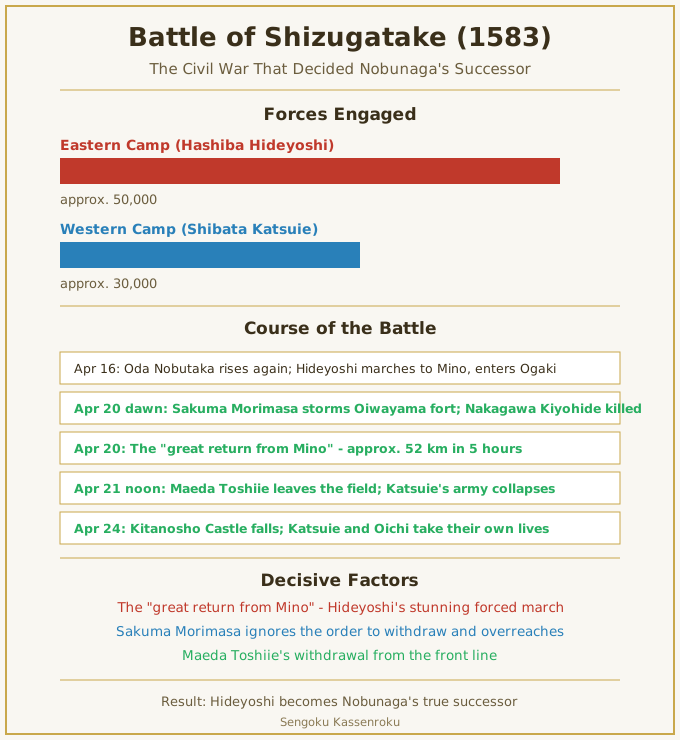
- Toyotomi Hideyoshi and Shibata Katsuie clashed at Shizugatake in Ōmi over the position of successor to the late Oda Nobunaga.
- Hideyoshi’s “great return from Mino,” racing some 52 km from Ōgaki to Shizugatake in five hours, and the withdrawal of Maeda Toshiie from the front line, decided the outcome.
- Katsuie took his own life with his wife Oichi at Kitanoshō Castle. Hideyoshi became Nobunaga’s successor in name and substance and began his march toward unification of the realm.
The Established Account – The Textbook Version
Why the War Broke Out
On the 2nd day of the 6th month of Tenshō 10 (1582), Oda Nobunaga was struck down by Akechi Mitsuhide in the Honnō-ji Incident. On the 13th of that same month, Hashiba Hideyoshi (the later Toyotomi Hideyoshi), having returned to the home provinces in the “great return from the Chūgoku region,” crushed Mitsuhide at the Battle of Yamazaki and avenged Nobunaga. With this, Hideyoshi suddenly rose to prominence within the Oda house.
On the 27th of that month, a conference was held at Kiyosu Castle in Owari to decide the successor of the Oda house and the division of the late lord’s lands (the Kiyosu Conference). Those who took part were the four senior elders of the Oda house: Shibata Katsuie, Niwa Nagahide, Ikeda Tsuneoki, and Hashiba Hideyoshi. In the standard account, Katsuie pushed Nobunaga’s third son Oda Nobutaka while Hideyoshi pushed Nobunaga’s infant grandson Sanbōshi (the later Oda Hidenobu), and they clashed bitterly; in the end the matter was settled with the installation of Sanbōshi (though in recent years there is a movement to revise this standard account, treated in detail in the alternative theories below).
After the Kiyosu Conference, the antagonism between the two deepened further. Hideyoshi hosted Nobunaga’s funeral on his own authority, enraging Katsuie. In the 10th month, Katsuie sent a memorandum to Hori Hidemasa criticizing Hideyoshi for breaking his Kiyosu Conference oath, for an unjust redistribution of lands, and for building Hōshōji Castle (Yamazaki Castle) (Nankō Zatsuroku). A reconciliation was reached for a time, but Hideyoshi nullified it in the 12th month and moved toward a military settlement.
In the 12th month, Hideyoshi attacked Nagahama Castle in Ōmi. The castle’s lord was Katsuie’s adopted son Shibata Katsutoyo. The Hokuriku was already shut in by deep snow, and Katsuie could send no relief from Kitanoshō Castle in Echizen. Katsutoyo surrendered to Hideyoshi within a few days. Hideyoshi then advanced into Mino, and on the 20th of the 12th month forced the surrender of Oda Nobutaka at Gifu Castle as well, sending Sanbōshi to Azuchi. Furthermore, Inaba Ittetsu, Mori Nagayoshi, and others of eastern Mino came over to Hideyoshi, and an encirclement formed around Katsuie’s camp.
In the first month of Tenshō 11 (1583), Takigawa Kazumasu of Nagashima in Ise rose in arms for Katsuie, occupying Kameyama, Mine, and Seki castles by stratagem. Hideyoshi was kept busy responding, but in the 2nd month Maeda Toshiie, an auxiliary commander under Katsuie, visited Hideyoshi to negotiate a settlement, and unease was spreading even within Katsuie’s camp (it has been suggested that a secret pact may have been made at this Toshiie-Hideyoshi meeting, treated in the alternative theories below).
On the 9th of the 3rd month, Katsuie, the thaw having finally come, set out from Kitanoshō in Echizen leading a great army of some 30,000 and advanced to Yanagase in northern Ōmi. Hideyoshi too turned back from his Ise campaign and entered Nagahama Castle on the 17th of the 3rd month leading some 50,000. The two armies faced off across the Shizugatake area of northern Ōmi and entered a standoff lasting about a month. So the Battle of Shizugatake had in effect begun.
The Course of the Battle
Katsuie made his headquarters at Mount Uchinakao (Genbao Castle) north of Yanagase, placed Sakuma Morimasa at the Gyōichiyama fort, and stationed Maeda Toshiie at the Shigeyama fort. Hideyoshi placed his headquarters at Kinomoto and arrayed at the front line the Dōgiyama fort (Kinoshita Kazumoto), the Higashinoyama fort (Hori Hidemasa), and the Shinmeiyama fort (Kimura Shigekore). He further built up a layered defense with the Shizugatake fort (Kuwayama Shigeharu), the Oiwayama fort (Nakagawa Kiyohide), the Iwasakiyama fort (Takayama Ukon), and Tagamiyama (Hashiba Hidenaga).
On the 12th of the 4th month, Hideyoshi wrote in a reply to Kobayakawa Takakage, a senior retainer of the Mōri, that he “held the advantage.” On the 13th, Yamaji Masakuni, a retainer of Shibata Katsutoyo at the Dōgiyama fort, betrayed the Hideyoshi side and fled to the camp of Katsuie’s Sakuma Morimasa – small-scale movements continued along the front.
On the 16th of the 4th month, Oda Nobutaka at Gifu Castle rose against Hideyoshi once more. To respond, Hideyoshi entrusted the Shizugatake position to his younger brother Hashiba Hidenaga and to Nakagawa Kiyohide, Takayama Ukon, Kuroda Kanbei, and others, and set out for Mino leading some 15,000 men, entering Ōgaki Castle.
Learning of Hideyoshi’s departure, Katsuie judged it a good chance. On the 19th of the 4th month he ordered his nephew, the fierce commander Sakuma Morimasa (called the “Demon Genba”), to advance. At dawn on the 20th, Morimasa came south from the Gyōichiyama fort and stormed the front-line Oiwayama fort. Nakagawa Kiyohide (aged 42) fought hard and was killed. Takayama Ukon at the Iwasakiyama fort was then defeated and withdrew toward Tagamiyama. Kuwayama Shigeharu, holding the Shizugatake fort, perceived the disadvantage and began to withdraw.
Katsuie sent messengers again and again to Morimasa, ordering him to “withdraw at once.” He was wary of Hideyoshi’s swift return. But Morimasa, judging victory to be at hand, ignored the order to withdraw and remained on the field. This judgment became the decisive blunder that divided victory from defeat.
On the 20th of the 4th month, Hideyoshi had been unable to move at Ōgaki Castle because heavy rain had swollen the Ibi River. There the word arrived: the Oiwayama fort had fallen and Nakagawa Kiyohide was dead. Hideyoshi at once resolved on a great return. Leaving 10,000 men at Ōgaki Castle, he led the rest and raced the roughly 52 km from Mino to Shizugatake in an astonishing five hours. This was the “great return from Mino.” By one account Hideyoshi changed horses three times along the way, and it is also said that during the march he scattered money among the farmers and had them prepare torches and food.
On the night of the 20th, Hideyoshi returned to his camp at Tagamiyama. Learning of the arrival of Hideyoshi’s army, Morimasa began to withdraw from the dawn of the 21st but came under the pursuit of Hideyoshi’s whole army. The fighting resumed with an attack on Shibata Katsumasa (Morimasa’s younger brother, Katsuie’s adopted son), who held the rear guard, and the two armies fought a fierce battle. In this fighting the young warriors of the Hideyoshi side were active – those later called the “Seven Spears of Shizugatake“: Katō Kiyomasa, Fukushima Masanori, Katō Yoshiaki, Hirano Nagayasu, Wakisaka Yasuharu, Kasuya Takenori, and Katagiri Katsumoto (the reality of the Seven Spears is treated in the alternative theories below).
Around noon, as the fighting deepened into chaos, a fatal event befell Katsuie’s side. The forces of Maeda Toshiie, stationed at the Shigeyama fort, suddenly left the front line. With this the rear of Katsuie’s army collapsed, and the morale of the Sakuma unit plummeted at once. Furthermore the forces of Fuwa Katsumitsu and Kanamori Nagachika also retreated, and Katsuie’s main body was isolated.
Outnumbered and overwhelmed, Katsuie began his retreat to Kitanoshō Castle in Echizen by the Hokkoku Road. An anecdote survives that on the way he stopped at Maeda Toshiie’s Fuchū Castle and asked for rice in hot water and a fresh horse. Despite having defected only moments before, Toshiie is said to have received Katsuie warmly and served him the rice in hot water. Katsuie is said to have told Toshiie, “Side with Hideyoshi. That is the way to preserve your house.”
The Aftermath
On the 23rd of the 4th month, Hideyoshi’s army surrounded Kitanoshō Castle. Katsuie shut himself in the keep with a mere 200 men and put up a defense, but the next day, the 24th, he at last set fire to the keep and took his own life together with his wife Oichi. Katsuie was 62 (his year of birth is disputed); Oichi was 37. The three Azai sisters Oichi had borne – Chacha, Hatsu, and Gō – are said to have been entrusted by Katsuie to Hideyoshi. Chacha later became Hideyoshi’s concubine and, as Yodo-dono, bore Toyotomi Hideyori. Hatsu married Kyōgoku Takatsugu, and Gō became the principal wife of Tokugawa Hidetada (the second shogun) and the mother of Tokugawa Iemitsu. The three sisters would each come to be deeply involved with the very centers of the Toyotomi, Kyōgoku, and Tokugawa.
With Katsuie’s death, the struggle over Nobunaga’s succession reached an effective settlement. Takigawa Kazumasu of Ise surrendered in the 5th month. Oda Nobutaka at Gifu Castle was attacked by his elder brother Nobukatsu and took his own life at Noma Utsumi in Owari on the 2nd of the 5th month. Hideyoshi became the greatest power in the Oda house in name and substance and began his march toward unification of the realm in earnest.
After the war, Hideyoshi increased Maeda Toshiie’s holdings by adding Kaga and treated him as a retainer – a treatment that supports the possibility of a prior secret pact. Katsuie’s former domain of Echizen was given to Niwa Nagahide, and Ikeda Tsuneoki gained Mino. In the awarding of merit, the disposition of the victor Hideyoshi was unshakable, and the power structure of the Oda house was reorganized around him. The young warriors called the Seven Spears of Shizugatake also each received increases of 3,000 to 5,000 koku. Fukushima Masanori obtained the highest among the Seven Spears, 5,000 koku, as the first spear and first head, and Katō Kiyomasa, Katō Yoshiaki, and others likewise gained a foothold for advancement. Hideyoshi raised them as “hand-reared lords” and would employ them heavily in the later Kyushu campaign and the expeditions to Korea.
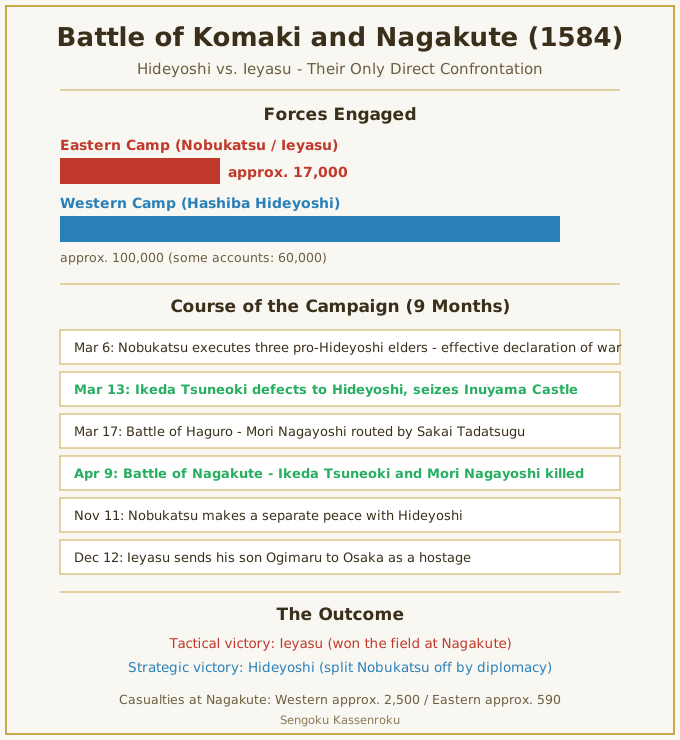
In the 9th month of that year, Hideyoshi began building a castle at Osaka, and the following year, Tenshō 12 (1584), he came to confront Tokugawa Ieyasu at the Battle of Komaki and Nagakute. The victory at Shizugatake was the decisive turning point of Hideyoshi’s enterprise of unifying the realm.
→ For details, see the warlord articles “Toyotomi Hideyoshi” and “Shibata Katsuie.”
Alternative Theories – Exploring Other Angles
[Theory 1] Revising the standard account of the Kiyosu Conference – was Katsuie’s backing of Nobutaka a fabrication of the Kawasumi Taikōki?
Regarding the Kiyosu Conference (the 27th of the 6th month, 1582), which forms the prehistory of the Battle of Shizugatake, a major revision has been advancing among researchers in recent years.
The “Katsuie backs Nobutaka vs. Hideyoshi backs Sanbōshi” view (the standard account since the Edo period)
Since the Edo-period war tales Kawasumi Taikōki and Taikōki, the Kiyosu Conference has been treated as centered on the succession question of “who will inherit the headship of the Oda house,” with Katsuie pushing Nobunaga’s third son Nobutaka and Hideyoshi pushing the infant grandson Sanbōshi in bitter conflict. The dramatic scene in which Hideyoshi finally appears holding Sanbōshi and clinches his installation as Nobunaga’s legitimate successor has been depicted again and again in dramas and novels.
The “unanimous backing of Sanbōshi” view (Shiba Hiroyuki, The Kiyosu Conference, 2018)
Against this, the Sengoku historian Shiba Hiroyuki makes an important point in The Kiyosu Conference (Ebisu Kōshō Shuppan, 2018). According to Shiba, the anecdote that Katsuie tried to install Nobutaka is a fabrication of the Kawasumi Taikōki, and the very reason the conference was held at Kiyosu rather than at Kyoto, Azuchi, or Gifu was to hold it in the presence of Sanbōshi, who had already been decided upon as successor.
In Shiba’s argument, a consensus to “install Nobunaga’s infant grandson Sanbōshi” had already formed within the Oda house immediately after the Honnō-ji Incident, and the agenda of the Kiyosu Conference was rather “who would serve as deputy (acting head) until Sanbōshi came of age” and “how the late lord’s lands would be redistributed.” Katsuie too agreed with the installation of Sanbōshi itself; the points of conflict were the choice of deputy and the allotment of lands.
The funeral and “Hideyoshi’s staging”
If Shiba’s view is correct, then the “dramatic conflict” of the Kiyosu Conference was an after-the-fact embellishment by the Edo-period war tales. The essence of the actual conflict lay in Hideyoshi’s subsequent “hosting of Nobunaga’s funeral on his own authority” and “political staging that brushed aside the lord Sanbōshi.” Even in the memorandum Katsuie sent to Hori Hidemasa in the 10th month (Nankō Zatsuroku), the objects of criticism were “Hideyoshi’s breach of his Kiyosu Conference oath,” “the unjust redistribution of lands,” and “the building of Hōshōji Castle” – not the succession question.
The revision of the standard account of the Kiyosu Conference affects the understanding of the Battle of Shizugatake as well. The conflict between Katsuie and Hideyoshi was not “a struggle over Nobunaga’s successor” but “a struggle over the right to run and govern the Oda regime.” The direction of recent research is to grasp the Battle of Shizugatake as the final phase of the power struggle within the Oda house after the Honnō-ji Incident.
[Theory 2] The reality of the “great return from Mino” – the truth of the legendary 52 km in 5 hours
One of the most famous anecdotes in recounting the Battle of Shizugatake is Hideyoshi’s “great return from Mino.” It is the legendary forced march in which Hideyoshi, receiving word at Ōgaki Castle on the 20th of the 4th month that the Oiwayama fort had fallen, raced the roughly 52 km in an astonishing five hours.
The reality of the great return
Measured on a modern map, the distance from Ōgaki Castle to Shizugatake is about 50-52 km. If this was covered in five hours, the speed was over 10 km/h. It means that soldiers in armor covered a distance longer than a full marathon. By one account, Hideyoshi changed horses three times along the way.
Several reasons have been pointed out for why the great return was possible. First, Hideyoshi had carefully prepared the Ōgaki-Nagahama-Kinomoto route in advance. Second, he scattered money and rice among the farmers to have them ready torches and food. Third, Nagahama Castle was already a Hideyoshi base, so resupply and rest were possible. It was precisely because of this meticulous preparation that the legendary speed was achieved.
The resemblance to the “great return from the Chūgoku region” after Honnō-ji
Immediately after the Honnō-ji Incident, Hideyoshi had achieved the “great return from the Chūgoku region,” racing about 200 km from Bitchū Takamatsu Castle to near Kyoto in about ten days. There is a view that this experience was put to use in the “great return from Mino” at Shizugatake. On the other hand, from the uncanny speed of the great return from the Chūgoku region after the Honnō-ji Incident arose the “Hideyoshi as mastermind” theory, which holds that “Hideyoshi may have known of the Honnō-ji Incident in advance.” The great return from Mino at Shizugatake is another instance of this “abnormal mobility” of Hideyoshi’s.
Luck was on his side too
Behind Hideyoshi’s ability to carry out the great return from Mino was also the great “accident” that heavy rain flooded the Ibi River and made the attack on Nobutaka impossible. Properly, Hideyoshi should have been engaged in attacking Nobutaka on the 20th as well, and a return to Shizugatake would have been impossible. Because of the flooding of the Ibi River, Hideyoshi was forced to remain at Ōgaki Castle, and as a result he was in a position to move immediately on receiving word that the Oiwayama fort had fallen. “Hideyoshi had luck with him” refers to exactly this moment.
Conversely, for Katsuie’s side it was a battle in which “luck was absent.” The timing at which Sakuma Morimasa took the Oiwayama fort, the fact that Hideyoshi was in a position to move, the weather factor of rain – all of these worked against Katsuie. The “great return from Mino” was the most brilliant maneuver warfare in Sengoku history, in which Hideyoshi’s meticulous preparation and good fortune came together.
[Theory 3] The truth of Maeda Toshiie’s defection – the prior secret pact theory vs. the agonized choice theory
Another factor that decided victory at Shizugatake was Maeda Toshiie’s withdrawal from the front line. Toshiie’s forces, stationed at the Shigeyama fort, suddenly withdrew in the midst of the fighting, and the rear of Katsuie’s army collapsed. Several interpretations of this defection exist.
The “prior secret pact theory” (collusion between Hideyoshi and Toshiie)
Toshiie had been on close terms with Hideyoshi since their youth. The two fought together as colleagues under Nobunaga and formed marriage ties down to their children’s generation (Toshiie’s fourth daughter Gō-hime was Hideyoshi’s adopted daughter). Before the war, in the 2nd month of Tenshō 11, Toshiie visited Hideyoshi’s Himeji Castle as an envoy of the Katsuie side and negotiated a settlement. It has been suggested that a secret pact for “withdrawal from the front line at Shizugatake” may have been concluded between Hideyoshi and Toshiie at this time.
As circumstantial evidence reinforcing this view, there is the fact that Hideyoshi increased Toshiie’s holdings with Kaga after the war. By this increase Toshiie became the founder of the later “million-koku of Kaga.” Because Hideyoshi’s award of merit was so generous, not a few argue that there was a prior secret pact.
The “agonized choice theory” (a judgment from reading the battle situation)
Another view is that Toshiie’s defection was not a prior secret pact but an agonized choice made after reading the situation on the field. With Hideyoshi’s unexpected return through the great return from Mino, the disadvantage of Katsuie’s side became clear. The situation in which Sakuma Morimasa had ignored the order to withdraw, pressed too far, and become isolated was also visible. Toshiie, the view holds, judged this situation coolly and chose the survival of the Maeda house over loyalty to Katsuie.
As grounds for this view, there is the fact that Toshiie afterward confined himself for a time at Fuchū Castle and did not entirely cut off his relationship with Katsuie. Indeed, the retreating Katsuie stopped at Fuchū Castle and asked Toshiie for rice in hot water and a fresh horse, and Toshiie complied. There is also an anecdote that Katsuie did not condemn Toshiie as a “traitor” but left him the words, “Side with Hideyoshi. That is the way to preserve your house.”
The “ultimate choice caught between two sides theory”
As a third view, there is the idea that Toshiie was caught between “his lord Katsuie” and “his friend Hideyoshi” and was forced into an ultimate choice. Toshiie was an auxiliary commander under Katsuie yet a close friend of Hideyoshi. Which side to take was a grave decision that would determine the fate of the Maeda house. Whether or not there was a prior secret pact, for Toshiie this battle was “a gamble to preserve his house.”
What can be confirmed as historical fact is the outcome: as a result of Toshiie’s defection Katsuie was defeated, and Toshiie was heavily employed by Hideyoshi and became the founder of the million-koku of Kaga. Some regard Toshiie’s defection as “betrayal,” others as “fence-sitting,” but the sound recent view is to assess it as a realist choice to protect the family, retainers, and lands of a Sengoku warlord.
[Theory 4] The reality of the “Seven Spears of Shizugatake” – an Edo-period fabrication?
Speaking of the Battle of Shizugatake, Hideyoshi’s young warriors the “Seven Spears of Shizugatake” are famous – the seven men Katō Kiyomasa, Fukushima Masanori, Katō Yoshiaki, Hirano Nagayasu, Wakisaka Yasuharu, Kasuya Takenori, and Katagiri Katsumoto. But there is an important source-critical problem with the designation and number of these “Seven Spears.”
The designation “Seven Spears” first appears in the Edo period
The name “Seven Spears of Shizugatake” first appears in a source in the early-Edo Hoan Taikōki. In other words, the first appearance is in a compilation made decades after the battle, and they were not called “Seven Spears” at the time of the battle.
In the “Record of the Shibata Battle” within Ōmura Yūko’s Tenshōki, compiled contemporaneously, nine men are listed as those who received commendations and stipends of several thousand koku – the seven above plus Sakurai Sakichi Ie’ichi and Ishikawa Hyōsuke Kazumitsu. It is sound to see that “nine” was originally correct and was narrowed to “seven” for the pleasing ring of the number.
In the Hitotsuyanagi Kaki, the “Seven Spears of Northern Ōmi”
Another primary source, the Hitotsuyanagi Kaki, depicts the fighting of the vanguard who distinguished themselves – Sakita Gentarō (later Koemon), Katō Magoroku (Katō Yoshiaki), Sakurai Sakichi, Kasuya Sukeemon (Kasuya Takenori), Ishikawa Chōjū, Ishikawa Hyōsuke, Wakisaka Jinnai (Wakisaka Yasuharu) – and records that “the Seven Spears of northern Ōmi refers to the affair of this time.” That is, the expression “Seven Spears of northern Ōmi” existed from the contemporary period, but the membership may have differed from that of the Hoan Taikōki.
Hideyoshi’s “hand-reared commander” publicity strategy
There is also a view that behind the wide transmission of the “Seven Spears” lay Hideyoshi’s political staging. Hideyoshi, who had risen from the rank of foot soldier, had no hereditary retainers as other houses did. By publicizing his hand-reared young commanders as the “Seven Spears,” Hideyoshi advertised the depth of his own house’s pool of talent. This may also be called part of a strategy of self-legitimation within the Oda house after the Kiyosu Conference.
Indeed, among the seven were men like Hirano Nagayasu, who could not even become a daimyō, and Kasuya Takenori, who became a daimyō for a moment but was stripped of his domain at Sekigahara. Not all of the “Seven Spears” carried weight in Hideyoshi’s seizure of the realm. When the Tokugawa age came, Hideyoshi’s hand-reared lords were dismantled one after another, and the only one to survive in the direct line until the Meiji era was the Wakisaka house (Tatsuno domain, 53,000 koku). Even the historically glorious “Seven Spears” were in the end tossed about by the waves of the times.
[Theory 5] On the causes of Katsuie’s defeat – synthesizing the elevation theory, the overreach theory, and the Toshiie defection theory
Why was Shibata Katsuie defeated? Why did the veteran old general called “Demon Shibata” yield to Hideyoshi? Successive researchers and historians have offered several theories.
The “battlefield elevation” defeat theory (Kusudo Yoshiaki)
The historian Kusudo Yoshiaki, a former newspaper reporter, analyzes Katsuie’s defeat in The Battle of Shizugatake as due to “the elevation difference of the battlefield.” Having closely surveyed the terrain of the Shizugatake area on site, Kusudo points out that because Katsuie’s side was deployed at higher elevations, it was difficult for them to repel Hideyoshi’s surprise assault. By the common sense of mountain warfare the high ground is advantageous, but in complex terrain like Shizugatake the paradoxical situation arose that “being on high ground meant losing the mobility to withdraw.”
The “Sakuma Morimasa ignores the withdrawal order” theory
Another leading theory holds that Sakuma Morimasa’s misjudgment was the cause of defeat. After taking the Oiwayama fort, Morimasa received repeated orders to withdraw from Katsuie. But Morimasa, judging “victory to be at hand,” ignored the orders and remained on the field. As a result he could not ready a defense against Hideyoshi’s great return from Mino, and his overreach told, ending in a great defeat.
Katsuie himself was wary of Hideyoshi’s swift return and tried to stop Morimasa’s overreach. But Morimasa, who held the initiative on the field, did not heed Katsuie’s restraint. The valor of Morimasa, who bore the epithet “Demon Genba,” ironically became the cause of defeat.
The “Maeda Toshiie defection” theory
A third leading theory takes Maeda Toshiie’s withdrawal from the front line as the greatest cause of defeat. With Toshiie’s withdrawal, the rear of Katsuie’s army collapsed and the morale of the Sakuma unit plummeted at once. Furthermore, Fuwa Katsumitsu and Kanamori Nagachika also retreated in turn, and Katsuie’s main body was isolated. Had Toshiie fought to the end, the situation might have been different.
The “delayed groundwork due to the snowy Echizen homeland” theory
Another easily overlooked cause of defeat is that Katsuie’s home base was a snow country. Hideyoshi had been advancing stratagems toward the lords of the home provinces, the Tōkai, and the Hokuriku from immediately after the Honnō-ji Incident, but Katsuie was shut in by snow and could not move during the winter. The Shibata domain of the Hokuriku was at a geographically disadvantageous position even for building the encirclement: Uesugi Kagekatsu sided with Hideyoshi, and the Honganji too offered to cooperate with Hideyoshi, with Kaga as security. The constraint that the front had to wait for the thaw greatly delayed Katsuie’s stratagems and groundwork.
In conclusion, Katsuie’s defeat was due to compound factors: terrain disadvantage, a subordinate’s misjudgment, the defection of an ally, and the geographical constraints of the snow country. These overlapped, and even the veteran old general was defeated. It was not a battle won by Hideyoshi’s wits alone, but the result of the accumulation of various factors on Katsuie’s side.
[Theory 6] Kuroda Kanbei’s participation – what the newly discovered 2013 source shows
As a major new discovery concerning the Battle of Shizugatake, there is an old document reported by the Mainichi Shimbun on the 10th of May 2013. It is a letter Hideyoshi addressed to Kuroda Kanbei (Yoshitaka), and it confirmed that Kanbei too had taken part in the Battle of Shizugatake.
The significance of the newly discovered source
Kuroda Kanbei is known as Hideyoshi’s strategist, but his concrete role in the Battle of Shizugatake had previously been little clarified. The 2013 discovery of Hideyoshi’s old document confirmed that Kanbei had taken part as an important operational planner of Hideyoshi’s army. This is an important source showing that behind Hideyoshi’s military strategy and stratagem warfare lay Kanbei’s wits.
Around the time of the Battle of Shizugatake, Hideyoshi developed a remarkable campaign of stratagems. Cooperation with the Honganji, alliance with Uesugi Kagekatsu, the breaking-apart of Katsuie’s camp (including the secret pact with Maeda Toshiie), the response to Takigawa Kazumasu of Ise – work in spheres other than combat decided the outcome. It is highly likely that Kuroda Kanbei supported these “behind-the-scenes battles.”
Hideyoshi and Kanbei after Honnō-ji
It is said that immediately after the Honnō-ji Incident, Kanbei advised Hideyoshi of “a good chance to seize the realm” (“the season for your fortune to open has come”). Behind Hideyoshi’s ability to bring down Shibata Katsuie in only a year after succeeding in the great return from the Chūgoku region was Kanbei’s strategic eye. The Battle of Shizugatake may also be called the battle in which the “golden duo” of Hideyoshi and Kanbei was completed.
The newly discovered source offers a perspective that recasts the Battle of Shizugatake not as “a victory by the genius of Hideyoshi as an individual” but as “an organized victory by the corps of Hideyoshi, Kanbei, Hachisuka Masakatsu, and others.” With further source discoveries to come, the reality of the battle will be elucidated ever more precisely.
→ For details, see the warlord article “Kuroda Kanbei.”
A Strategic View
Surveying the Battle of Shizugatake strategically, one sees that it was a battle in which Hideyoshi’s “total capability” stood out. There are four points worth noting.
First, the thoroughness of Hideyoshi’s “diplomacy and stratagem.” In the roughly ten months from the Honnō-ji Incident to Shizugatake, Hideyoshi thoroughly advanced stratagems toward the Oda house, the Honganji, Uesugi Kagekatsu, Maeda Toshiie, and others. While Katsuie was shut in by snow and unable to move during the winter, Hideyoshi completed his “encirclement.” The Honganji’s offer to mobilize the Kaga Ikkō league and cooperate with Hideyoshi, Uesugi Kagekatsu’s sending of a written oath to Hideyoshi, and the possibility of a secret pact with Maeda Toshiie – all of these were fruits of Hideyoshi’s stratagems. Before the fighting on the field began, the contest was all but decided.
Second, the brilliance of maneuver warfare symbolized by the “great return from Mino.” As he had shown in the great return from the Chūgoku region, Hideyoshi possessed the organizational power to execute long-distance marches at high speed. This was not merely a matter of the soldiers’ stamina but the capacity of the corps as a whole – route preparation, securing supply bases, requesting the cooperation of farmers, gathering weather intelligence. The greatest reason Hideyoshi could win at Shizugatake was this “organizational power of maneuver warfare.” Whereas Katsuie took a “strategy of waiting,” Hideyoshi took the initiative with a “strategy of movement.”
Third, the strategy of “promoting young men within the Oda house.” The young warriors called the Seven Spears of Shizugatake were all Hideyoshi’s hand-reared men. Hideyoshi compensated for the disadvantage of having no hereditary retainers in the Oda house through the active promotion of young men and staging such as the “Seven Spears.” Katsuie, by contrast, had not fully escaped the old constitution of depending on nephews and adopted sons like Sakuma Morimasa. Whether or not one could ride the wave of generational change divided the fates of the two.
Fourth, Katsuie’s “limits as a man of arms.” Katsuie was a veteran old general called “Demon Shibata,” and his ability as a man of arms was beyond reproach. But in an age when the unification of the realm had become a total contest of “diplomacy, economy, stratagem, and the winning of hearts,” a purely martial type of leadership could not defeat Hideyoshi. The warrior’s aesthetic of Katsuie’s end, taking his own life accompanied by his wife Oichi, was a scene that symbolized the very end of the Sengoku age.
To borrow from Rai San’yō’s Nihon Gaishi, it would be no exaggeration to say that “Hideyoshi won the realm at Shizugatake.” Hideyoshi, who had gained “a voice within the Oda house” by striking down Mitsuhide at the Battle of Yamazaki, established “absolute power within the Oda house” by defeating Katsuie at Shizugatake. The path of confronting Ieyasu at the Battle of Komaki and Nagakute the following year, and then advancing to the unification of the realm and his appointment as Imperial Regent, all began at Shizugatake.
Famous Words from This Battle
“A fleeting dream-road of a summer’s night – raise my name after I am gone, up into the clouds, O mountain cuckoo.”
A poem held to be the death verse of Shibata Katsuie. Its sense is: “My life, fleeting as a summer night’s dream. Let my name after death resound in the clouds (the heights), O mountain cuckoo.” It is said to express his state of mind just before he took his own life with his wife Oichi in the keep of Kitanoshō Castle. A record survives in the early-Edo Taikōki and elsewhere, but it has been noted that it draws on the death verse of Ashikaga Yoshiteru, and the possibility that it is a later fabrication cannot be ruled out.
— Source: Taikōki and others
“Even without it, the sleep is short on a summer’s night – and the cuckoo calls as if to lure me further down the dream-road.”
A poem held to be the death verse of Oichi. Its sense is: “Already the sleep of a short summer night is brief, and the cuckoo cries as if to lure me yet further down the dream-road.” It is said to express the feelings of Oichi, who had resolved on parting in death from her husband – first Azai Nagamasa, and now a second parting from her husband Shibata Katsuie. Her three daughters (Chacha, Hatsu, and Gō) were entrusted to Hideyoshi. Oichi was 37.
— Source: Taikōki and others
“Side with Hideyoshi. That is the way to preserve your house.”
Words said to have been spoken by Katsuie to Maeda Toshiie when he stopped at Fuchū Castle on his retreat to Kitanoshō after the defeat at Shizugatake. Toshiie, having withdrawn from the front line, was confining himself at Fuchū Castle, but on receiving Katsuie’s visit he provided rice in hot water and a fresh horse. Katsuie did not reproach the defected Toshiie but admonished him that “if you follow Hideyoshi, the Maeda house will survive.” This anecdote may contain later embellishment, but it has been handed down as a scene that symbolizes Katsuie’s aesthetic as a man of arms.
— Source: Taikōki, Maeda Family Documents, and others
“Withdraw at once.”
The order to withdraw that Katsuie conveyed by repeated messengers to Sakuma Morimasa after he had taken the Oiwayama fort on the 20th of the 4th month. Wary of Hideyoshi’s swift return, Katsuie tried to stop the overreach. But Morimasa, judging “victory to be at hand,” ignored the order and remained on the field. This disobedience became the decisive factor in Katsuie’s defeat. It has been discussed again and again in later military history as an anecdote that asks about the weight of a commander’s independent action versus a superior’s order, and of judgment on the field.
— Source: Taikōki, Hitotsuyanagi Kaki, and others
Anecdotes and Episodes
Oichi and the three Azai sisters – through two castle falls
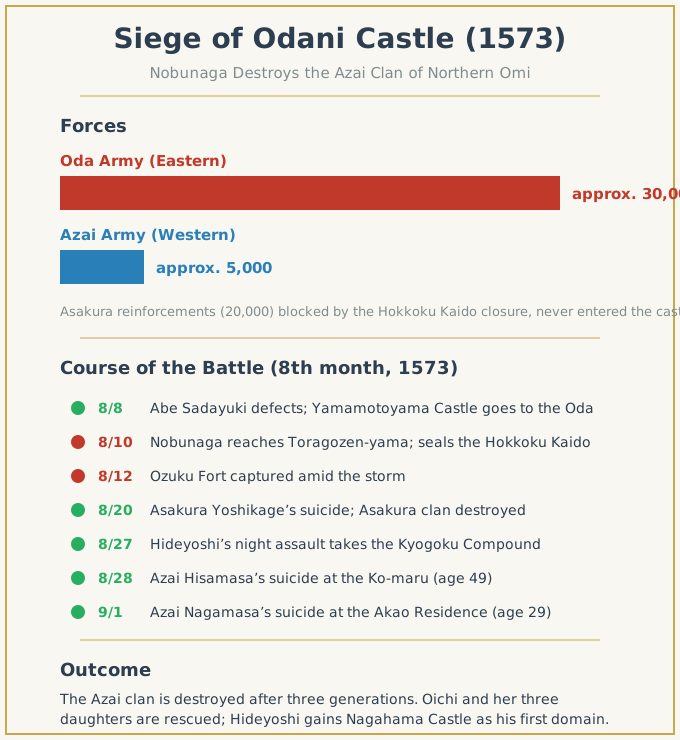
Oichi was the younger sister of Oda Nobunaga and was praised as the foremost beauty of the Sengoku age. Her first husband was the northern Ōmi warlord Azai Nagamasa. At the Battle of Anegawa in Genki 1 (1570), Nagamasa came into conflict with Nobunaga, and at the Battle of Odani Castle in Tenshō 1 (1573) Nagamasa took his own life. Oichi was taken in by Nobunaga.
After the Honnō-ji Incident, in the 8th month of Tenshō 10 (1582), Oichi remarried to Shibata Katsuie. It was a configuration in which the couple Katsuie and Oichi would support the Oda house bereft of Nobunaga. But a mere eight months later, in the 4th month of Tenshō 11, on the fall of Kitanoshō Castle, Oichi shared Katsuie’s fate. The life of Oichi, who passed through “two castle falls,” is still handed down as a story that symbolizes the tragedy of women in the Sengoku age.
The three daughters Oichi bore – Chacha (Yodo-dono), Hatsu (Jōkō-in), and Gō (Sūgen-in) – were entrusted by Katsuie to Hideyoshi. Chacha became Hideyoshi’s concubine and bore Toyotomi Hideyori. Hatsu married Kyōgoku Takatsugu (later lord of Wakasa Obama domain). Gō married first Saji Kazunari, then Toyotomi Hidekatsu, and finally became the principal wife of Tokugawa Hidetada (the second shogun) and the mother of Tokugawa Iemitsu. The three sisters were deeply involved with the three great houses of the time – Toyotomi, Kyōgoku, and Tokugawa – and became figures who moved the history of the late Sengoku and early Edo.
— Source: Taikōki, Shinchō Kōki, Tōshōgū Go-Jikki
The pride and end of the “Demon Genba” Sakuma Morimasa
Sakuma Morimasa was Shibata Katsuie’s nephew and a fierce commander called the “Demon Genba.” At the Battle of Shizugatake, he stormed the Oiwayama fort at the front of Katsuie’s side and won great merit by killing Nakagawa Kiyohide. But despite receiving repeated orders to withdraw from Katsuie, his continued overreach became the cause of defeat.
After the defeat at Shizugatake, Morimasa was captured. Hideyoshi, prizing Morimasa’s valor, tried to take him on as a retainer, but Morimasa refused, saying, “I am a retainer of the Shibata house and have no mind to serve Hideyoshi.” He further requested, it is said, “If I may, let me be paraded through the capital and then killed. That is the pride of a warrior.” Hideyoshi respected Morimasa’s pride, had him paraded through Kyoto, and beheaded him at Makishima on the 3rd of the 7th month. Morimasa was 30.
Morimasa’s end has been handed down as a model of the pride of the Sengoku warrior. As a man of arms who embodied “the aesthetic of the defeated,” his name is engraved in history. On the other hand, his misjudgment in ignoring the order to withdraw was also an object of repeated criticism in later military history as “the runaway of the Demon Genba.”
— Source: Taikōki, Hoan Taikōki
Maeda Toshiie’s “rice in hot water at Fuchū Castle”
After his withdrawal from the front line at Shizugatake, the retreating Shibata Katsuie stopped at Fuchū Castle, where Maeda Toshiie was confining himself. Katsuie was on his retreat to Kitanoshō with only a few attendants. Despite having defected only moments before, Toshiie is said to have received Katsuie warmly and provided rice in hot water and a fresh horse.
Katsuie told Toshiie, “Side with Hideyoshi. That is the way to preserve your house” – words that may be called his last testament to Toshiie. Katsuie did not reproach Toshiie as a “traitor.” Katsuie kept faith with his aesthetic as a man of arms, and with his long bond with Toshiie, to the very end.
This anecdote is recorded in Edo-period war tales such as the Taikōki, and its source-critical rigor is debated. But as an episode symbolizing the relationship between Katsuie and Toshiie and a warrior’s pride, it conveys a representative “aesthetic of the defeated” of the Sengoku age.
— Source: Taikōki, Maeda Family Documents
→ For details, see the warlord article “Maeda Toshiie.”
The end of Nakagawa Kiyohide – a heroic death at the Oiwayama fort
At dawn on the 20th of the 4th month, Nakagawa Kiyohide of the Oiwayama fort, struck by Sakuma Morimasa’s surprise attack, fought hard at the head of 3,000 Settsu Ibaraki men. He is said to have been shot at the slope of the fort’s entrance, and was killed after a fierce battle. Kiyohide was 42.
Kiyohide was lord of Ibaraki Castle in Settsu, and after the Honnō-ji Incident he had followed Hideyoshi and been active at the Battle of Yamazaki as well. At the Battle of Shizugatake he played the important role of holding Hideyoshi’s front line, and his death was a heavy blow to Hideyoshi. It is said that the direct trigger for Hideyoshi’s decision on the great return from Mino was the report of this death of Kiyohide.
There is also a view that the long endurance of the Nakagawa unit in the Battle of the Oiwayama fort made Hideyoshi’s relief possible. By delaying Morimasa’s advance, and Hideyoshi returning from Mino in the meantime, Morimasa ended up isolated after his overreach. Kiyohide’s heroic resistance may also be called a hidden merit that tilted the situation in Hideyoshi’s favor. Today the grave of Nakagawa Kiyohide remains on Mount Oiwa, and worshippers who recall his loyalty are never absent.
— Source: Taikōki, Nakagawa Family Documents
The staging of Hideyoshi’s “great return from Mino”
Various anecdotes about Hideyoshi’s great return from Mino have been handed down. Most famous among them is the story that during the march he scattered money among the farmers and had them prepare torches and food. Hideyoshi is said to have dispatched messengers in advance along the Ōgaki-Nagahama-Kinomoto route to request the farmers’ cooperation; by scattering money he had torches lit along the road and made the night march possible.
It is also said that during the march Hideyoshi changed horses three times. To cover a distance longer than a full marathon in five hours, even the horses’ stamina would not have held. Hideyoshi had fresh horses prepared at the post stations along the way – this too the fruit of meticulous prior preparation.
The truth of such “staging” cannot be fixed from the sources, but it is certain that Hideyoshi achieved a legendary forced march by combining prior preparation with mobility. Hideyoshi’s abnormal mobility, shown also in the great return from the Chūgoku region, has no parallel even in Sengoku history. The combination of the art of winning hearts called being a “charmer of people” with organizational and preparatory power made Hideyoshi “the warlord of miracles.”
— Source: Taikōki, Hoan Taikōki
The end of Katsuie and Oichi – the keep of Kitanoshō Castle
On the 23rd of the 4th month, Hideyoshi’s army surrounded Kitanoshō Castle. The men remaining in the castle were a mere 200. Katsuie shut himself in the keep and attempted a last resistance. His wife Oichi accompanied him. It is said that Hideyoshi, to save Katsuie, secretly sent a messenger urging Oichi and the daughters to escape. But Oichi refused, choosing to share Katsuie’s fate.
The next day, the 24th, Katsuie set fire to the keep and took his own life together with Oichi. Katsuie was 62 (his year of birth is disputed); Oichi was 37. The keep of Kitanoshō Castle was wrapped in flames, and a curtain fell on one act of the Sengoku age.
This scene has been depicted again and again in later ages as the end of Sengoku warlords. It is a scene where Katsuie’s pride as a man of arms and Oichi’s resolve intersect. The three Azai sisters Oichi had borne were entrusted to Hideyoshi as Katsuie’s last wish. The three sisters each lived through the later age and would come to be deeply involved in the history of the late Sengoku and early Edo. The tragedy of Kitanoshō Castle was, in exchange for the deaths of Katsuie and Oichi, also the opening of the curtain on a new history.
— Source: Taikōki, Shinchō Kōki
→ For details, see the warlord article “Shibata Katsuie.”
The end of Oda Nobutaka – “If at Noma of Utsumi, where a lord was slain of old, then await your recompense, Hashiba Chikuzen”
Receiving word of the defeat at Shizugatake, Oda Nobutaka (Nobunaga’s third son) was attacked by his elder brother Nobukatsu at Gifu Castle and surrendered. On the 2nd of the 5th month, he took his own life at Noma Utsumi in Owari. Nobutaka was 26.
The death verse Nobutaka is said to have composed at his suicide is: “If at Noma of Utsumi, where a lord was slain of old, then await your recompense, Hashiba Chikuzen.” It is a curse-poem meaning, “Of old a lord (Minamoto no Yoshitomo) was killed at Noma of Utsumi, and there I too am to be killed. Hideyoshi, await your recompense.” Founded on the precedent of Minamoto no Yoritomo’s father Yoshitomo being betrayed and killed by a retainer at Noma of Utsumi after the Heiji Rebellion, it is known as a poem charged with resentment toward Hideyoshi.
With Nobutaka’s death, of Nobunaga’s sons the only one to remain as a Sengoku warlord was his second son Nobukatsu (who came into conflict with Hideyoshi and went on to the Battle of Komaki and Nagakute). The Battle of Shizugatake was an event that shook the very bloodline of the Oda house.
— Source: Taikōki, Shinchō Kōki
Battle of Shizugatake – Timeline
| Date | Event |
|---|---|
| 6th month, 2nd, Tenshō 10 (1582) | The Honnō-ji Incident. Nobunaga and Nobutada die |
| 6th month, 13th | The Battle of Yamazaki. Hideyoshi strikes down Akechi Mitsuhide |
| 6th month, 27th | The Kiyosu Conference. The installation of Sanbōshi is decided; the conflict between Katsuie and Hideyoshi surfaces |
| 10th month, 15th | Hideyoshi hosts Nobunaga’s funeral on his own authority |
| 10th month, 16th | Katsuie sends a memorandum to Hori Hidemasa denouncing Hideyoshi |
| 12th month, 9th | Hideyoshi attacks Nagahama Castle. The lord Shibata Katsutoyo surrenders |
| 12th month, 20th | Hideyoshi forces the surrender of Oda Nobutaka at Gifu Castle. Sanbōshi is sent to Azuchi |
| 1st month, Tenshō 11 (1583) | Takigawa Kazumasu of Ise rises in arms for Katsuie |
| 2nd month | Maeda Toshiie meets Hideyoshi as an envoy of the Katsuie side (possibility of a secret pact) |
| 3rd month, 9th | Katsuie sets out from Kitanoshō in Echizen leading some 30,000 |
| 3rd month, 12th | Katsuie makes his headquarters at Mount Uchinakao (Genbao Castle) |
| 3rd month, 17th | Hideyoshi enters Nagahama Castle leading some 50,000. Headquarters at Kinomoto |
| 3rd to mid-4th month | A standoff of about a month. Hideyoshi builds up his fort lines and advances various stratagems |
| 4th month, 13th | Yamaji Masakuni of the Dōgiyama fort flees to the Katsuie side |
| 4th month, 16th | Oda Nobutaka rises again at Gifu Castle. Hideyoshi sets out for Mino leading 15,000 and enters Ōgaki Castle |
| 4th month, 19th | Katsuie, seeing Hideyoshi’s departure, orders Sakuma Morimasa to attack |
| Dawn, 4th month, 20th | Battle of the Oiwayama fort: Sakuma Morimasa kills Nakagawa Kiyohide. Takayama Ukon of the Iwasakiyama fort also flees |
| 4th month, 20th | The great return from Mino: Hideyoshi covers about 52 km from Ōgaki to Shizugatake in 5 hours |
| Night, 4th month, 20th | Hideyoshi returns to camp at Tagamiyama. Sakuma Morimasa ignores the withdrawal order and remains on the field |
| Dawn, 4th month, 21st | The main battle of Shizugatake opens: Hideyoshi pursues with his whole army, attacking Shibata Katsumasa (Morimasa’s brother) |
| Around noon, 4th month, 21st | The Seven Spears’ exploits and Maeda Toshiie’s withdrawal from the front line. Katsuie’s army collapses |
| Afternoon, 4th month, 21st | Katsuie begins his retreat to Kitanoshō Castle. On the way he stops at Maeda Toshiie’s Fuchū Castle |
| 4th month, 23rd | Hideyoshi’s army surrounds Kitanoshō Castle |
| 4th month, 24th | Kitanoshō Castle falls. Katsuie and Oichi take their own lives in the keep. Katsuie 62, Oichi 37 |
| 5th month, 2nd | Oda Nobutaka takes his own life at Noma Utsumi in Owari (aged 26) |
| 5th month | Takigawa Kazumasu surrenders |
| 7th month, 3rd | Sakuma Morimasa is paraded through the capital and beheaded at Makishima (aged 30) |
| 9th month | Hideyoshi begins building Osaka Castle |
| 3rd to 11th month, Tenshō 12 (1584) | The Battle of Komaki and Nagakute. Hideyoshi confronts Tokugawa Ieyasu and Oda Nobukatsu |
* Dates are given in the old (lunar) calendar. Row shading: yellow = major events; red = battle- or death-in-battle-related.
Key Figures of Both Armies
Eastern Army (Hideyoshi’s army, approx. 50,000)
| Role | Figure | Summary |
|---|---|---|
| Commander-in-chief | Toyotomi Hideyoshi | Aged 47. Headquarters at Kinomoto. Transformed the situation with the great return from Mino |
| Brother / deputy | Hashiba Hidenaga | Aged 44. Hideyoshi’s younger brother. Stationed at Tagamiyama, supporting the front |
| Oiwayama fort | Nakagawa Kiyohide | Aged 42. Lord of Ibaraki Castle in Settsu. Killed by Sakuma Morimasa’s surprise attack |
| Iwasakiyama fort | Takayama Ukon | Aged 31. A Christian lord. Withdrew toward Tagamiyama under Sakuma Morimasa’s attack |
| Shizugatake fort | Kuwayama Shigeharu | Aged 58. Held the fort but began to withdraw on perceiving the disadvantage |
| Higashinoyama fort | Hori Hidemasa | Aged 30. Held the front-line Higashinoyama fort, fending off Katsuie’s attack |
| Strategist | Kuroda Kanbei | Aged 38. Hideyoshi’s strategist. Active in stratagem and planning (participation confirmed by the newly discovered 2013 source) |
| Seven Spears | Katō Kiyomasa | Aged 22. Killed Yamaji Masakuni. Increase of 3,000 koku. Later 520,000 koku at Kumamoto in Higo |
| Seven Spears | Fukushima Masanori | Aged 22. Killed Haigō Ieyoshi as first spear and first head. Increase of 5,000 koku (highest among the Seven Spears) |
| Seven Spears | Katō Yoshiaki | Aged 20. Increase of 3,000 koku. Later 200,000 koku at Matsuyama in Iyo |
| Seven Spears | Wakisaka Yasuharu | Aged 29. Said to have killed Shibata Katsumasa. Increase of 3,000 koku |
| Seven Spears | Hirano Nagayasu | Aged 25. Increase of 3,000 koku. Ultimately could not become a daimyō |
| Seven Spears | Kasuya Takenori | Aged 22. Increase of 3,000 koku. Later 12,000 koku at Kakogawa; stripped of his domain at Sekigahara |
| Seven Spears | Katagiri Katsumoto | Aged 27. Increase of 3,000 koku. Later an elder of the Toyotomi house; his fate tossed about at the Siege of Osaka |
Western Army (Katsuie’s army, approx. 30,000)
| Role | Figure | Summary |
|---|---|---|
| Commander-in-chief | Shibata Katsuie | Aged 62. “Demon Shibata.” Headquarters at Genbao Castle. Took his own life with Oichi at Kitanoshō Castle |
| Vanguard | Sakuma Morimasa | Aged 30. “Demon Genba.” Katsuie’s nephew. Took the Oiwayama fort but ignored the withdrawal order and was defeated. Later beheaded |
| Auxiliary commander | Maeda Toshiie | Aged 46. Stationed at the Shigeyama fort. Withdrew from the front line mid-battle, deciding the outcome. Gained Kaga after the war |
| Katsuie’s retainer | Shibata Katsumasa | Aged 26. Morimasa’s younger brother, Katsuie’s adopted son. Held the rear guard and was killed by Wakisaka Yasuharu |
| Katsuie’s adopted son | Shibata Katsutoyo | Katsuie’s adopted son. Lord of Nagahama Castle but surrendered to Hideyoshi. Died of illness on the 16th of the 4th month |
| Auxiliary commander | Fuwa Katsumitsu | Retreated in concert with Toshiie’s defection |
| Auxiliary commander | Kanamori Nagachika | Retreated in concert with Toshiie’s defection. Later followed Hideyoshi and became lord of Hida Takayama domain |
| Katsuie’s principal wife | Oichi | Aged 37. Nobunaga’s sister. Took her own life with Katsuie at Kitanoshō Castle. Entrusted the three Azai sisters to Hideyoshi |
| Ally | Oda Nobutaka | Aged 26. Nobunaga’s third son. Rose again at Gifu Castle but failed; took his own life at Noma Utsumi in Owari |
| Ally | Takigawa Kazumasu | Aged 58. Rose in arms at Nagashima in Ise but was defeated by Hideyoshi and surrendered |
| Ally | Yamaji Masakuni | A retainer of Shibata Katsutoyo at the Dōgiyama fort; after Katsutoyo’s surrender, betrayed the Hideyoshi side for the Sakuma unit. Killed by Katō Kiyomasa |
| Neutral position | Niwa Nagahide | Aged 49. One of the four senior elders of the Kiyosu Conference. Took part on the Hideyoshi side; given Echizen after the war |
Historic Sites Map and Model Travel Course
Historic Sites Map – Battle of Shizugatake
Spots on the map:
- Shizugatake lift and summit observation deck (old battlefield) – the center of the main battle of Shizugatake. The lift takes you to the summit
- Genbao Castle ruins (castle) – Shibata Katsuie’s headquarters. One of the Continued 100 Famous Castles of Japan. The earthworks and dry moats remain in good condition
- Lake Yogo (around the old battlefield) – the southern foot of Shizugatake. A scenic lake also called the “Mirror Lake”
- Site of the Seven Spears (old battlefield) – the place commemorating the exploits of the Seven Spears. Also the trailhead for Shizugatake
- Grave of Nakagawa Kiyohide (gravesite) – the grave of Nakagawa Kiyohide, killed at the Oiwayama fort
- Nagahama Castle History Museum (castle / museum) – Hideyoshi’s “castle of advancement.” Rich exhibits on the Battle of Shizugatake
- Ōgaki Castle (castle) – the starting point of the great return from Mino. The castle where Hideyoshi was stationed during the attack on Nobutaka
- Kitanoshō Castle ruins (Shibata Park) (castle) – the place of the end of Katsuie and Oichi. There are statues of Shibata Katsuie and Oichi
* The map is a reference display based on present-day roads. It differs from the roads and terrain of the Sengoku period.
📍 View the route on Google Maps (car / train toggle available)
Model Travel Course – Battle of Shizugatake – A one-day course tracing the road of the great return from Mino
Premises
- Time required: about 7-8 hours (by car)
- Walking speed: about 4 km/h; stay at each spot: 30-60 minutes
- Starting point: Ōgaki Castle (the starting point of the great return from Mino)
The Model Course
(1) Ōgaki Castle (stay: about 45 minutes)
The starting point of the great return from Mino. The castle where Hideyoshi was stationed during the attack on Nobutaka.
– By car: about 10 minutes from JR Ōgaki Station
(2) Nagahama Castle History Museum (stay: about 60 minutes)
Hideyoshi’s “castle of advancement.” Rich exhibits on the Battle of Shizugatake.
– By car: about 60 minutes from Ōgaki Castle (experience part of the great return from Mino)
(3) Site of the Seven Spears (stay: about 30 minutes)
The south shore of Lake Yogo. Also the trailhead for Shizugatake, and the place commemorating the exploits of the Seven Spears.
– By car: about 30 minutes from Nagahama Castle
(4) Shizugatake lift and summit observation deck (stay: about 90 minutes)
The center of the main battle of Shizugatake. From the summit, Lake Biwa and Lake Yogo can be seen at a glance. Note the winter closure.
– By car: about 5 minutes from the Site of the Seven Spears (to the lift station)
(5) Lake Yogo circuit (stay: about 60 minutes)
The southern foot of Shizugatake. Stroll the lakeshore and soak in the lingering air of the battlefield.
– On foot: from the foot of Shizugatake
(6) Genbao Castle ruins (stay: about 90 minutes, for the sure-footed)
The site of Katsuie’s headquarters. One of the Continued 100 Famous Castles of Japan. A climb of about 20 minutes on foot from the parking lot.
– By car: about 30 minutes from Lake Yogo
(7) Kitanoshō Castle ruins (Shibata Park) (stay: about 60 minutes, an overnight stay in Fukui recommended)
The place of the end of Katsuie and Oichi. Shibata Shrine and statues of Oichi and the three sisters as well.
– By car: about 75 minutes from Genbao Castle
Arrangements by Type of Traveler
- Two-day course: Day one for Ōgaki Castle, Nagahama Castle, and the main battlefield of Shizugatake; day two for the “road of the defeated” course of Genbao Castle and Kitanoshō Castle
- For the sure-footed: Take on both the Shizugatake climb and the Genbao Castle climb. Experience “the viewpoints of Hideyoshi and Katsuie”
- For the leisurely: A half-day course at the three sites of Nagahama Castle, the Shizugatake lift, and Lake Yogo
- For fans of Oichi and the three sisters: An “Oichi’s life” course of Kitanoshō Castle (the place of her end), the Odani Castle ruins (her first castle fall), and Azuchi Castle (Nobunaga’s base)
* This plan is a reference model based on general travel speeds and stay times. Facility hours, transport schedules, and crowding vary by season and day of the week. When you set out, please confirm the latest information on the official websites of each facility and transport operator.
* Admission and entry fees are reference prices as of the time of writing. They may have changed.
* The Shizugatake lift is closed in winter (December to March). For climbing mountain-castle ruins, please make a reasonable plan according to the weather and your physical condition.
Related Articles
Battle Articles
- Honnō-ji Incident (1582) – the origin of the conflict between Hideyoshi and Katsuie through Nobunaga’s death
- Battle of Yamazaki (1582) – the battle in which Hideyoshi established his voice within the Oda house
- Battle of Komaki and Nagakute (1584) – the year after Shizugatake, the only direct confrontation of Hideyoshi and Ieyasu
- Battle of Sekigahara (1600) – many of the Seven Spears of Shizugatake were active in the Eastern Army
- Battle of Anegawa (1570) – the battle against Oichi’s first husband, Azai Nagamasa
- Battle of Odani Castle (1573) – the battle in which Oichi experienced her first castle fall
Warlord Articles
- Toyotomi Hideyoshi – established absolute power within the Oda house with the victory at Shizugatake
- Shibata Katsuie – “Demon Shibata.” Defeated at Shizugatake, took his own life at Kitanoshō Castle
- Maeda Toshiie – his withdrawal from the front line decided the outcome. Later founder of the million-koku of Kaga
- Niwa Nagahide – one of the four senior elders of the Kiyosu Conference. Took part on the Hideyoshi side and gained Echizen after the war
- Oda Nobunaga – the central figure of the Honnō-ji Incident that was the premise of the Battle of Shizugatake
- Akechi Mitsuhide – struck down Nobunaga in the Honnō-ji Incident and created the cause of the Hideyoshi-Katsuie conflict
- Katō Kiyomasa – the representative of the Seven Spears of Shizugatake. Later 520,000 koku at Kumamoto in Higo
- Kuroda Kanbei – active at Shizugatake as Hideyoshi’s strategist (the newly discovered 2013 source)
- Azai Nagamasa – Oichi’s first husband. Took his own life at Odani Castle ten years before Shizugatake
References
Primary Sources
- Ōmura Yūko, “Record of the Shibata Battle” within Tenshōki – contemporaneous; lists the nine recipients of commendations
- Hitotsuyanagi Kaki – records the expression “Seven Spears of northern Ōmi”
- Nankō Zatsuroku – Katsuie’s memorandum to Hori Hidemasa (10th month, 16th)
- Tamon-in Nikki – the diary of the Kōfuku-ji monk Eishun. A contemporary record
- Mainichi Shimbun report of 10 May 2013, “Battle of Shizugatake: Kuroda Kanbei also took part” – the new discovery of Hideyoshi’s old document
- Nakagawa Family Documents – sources concerning Nakagawa Kiyohide, killed at the Oiwayama fort
- Maeda Family Documents – primary sources on the movements of Maeda Toshiie
Academic Works
- Shiba Hiroyuki, The Kiyosu Conference, Ebisu Kōshō Shuppan, 2018 – the representative work revising the standard account of the Kiyosu Conference
- Kusudo Yoshiaki, The Battle of Shizugatake – the result of on-site survey taking the battlefield elevation as the cause of defeat
- Taniguchi Katsuhiro, Biographical Dictionary of Nobunaga’s Retainers, Yoshikawa Kōbunkan, 2010
- Taniguchi Katsuhiro, Encyclopedia of the Oda Nobunaga Retainer Corps, Yoshikawa Kōbunkan
- Watanabe Daimon, ed., The Power Structure of the Home Provinces and Nearby Regions in the Sengoku Period, Bensei Shuppan, 2018
- Owada Tetsuo, Toyotomi Hideyoshi, Chūkō Shinsho, 1985
- Fukui City Museum of Local History, ed., Kitanoshō Castle and Shibata Katsuie, 2019
- Fukuo Takeichirō, Ōuchi Yoshitaka, Yoshikawa Kōbunkan (Jinbutsu Sōsho)
Published Papers
- Shiba Hiroyuki, “A Re-examination of the Kiyosu Conference,” Sengoku History Studies, 2018
- Nagahama Castle History Museum, Nagahama City, “Special Exhibition: The Battle of Shizugatake” catalogue
- Fukui City Museum of Local History, “The Battle of Shizugatake and Shibata Katsuie” exhibition commentary
Public Institution Materials
- Nagahama Castle History Museum, Nagahama City, official site
- Nagahama City official tourism guide, “Shizugatake Old Battlefield”
- Lake Yogo Tourism Association, official site
- Shibata Park, Fukui City, official information
- Continued 100 Famous Castles of Japan, Genbao Castle (Tsuruga City and Nagahama City)
* This article is composed on the basis of the sources, research works, and papers above, along with multiple sources on the web. Interpretations of history differ among researchers on some points, and the accepted view may change with the discovery of new sources or the progress of research in the future.
コメント