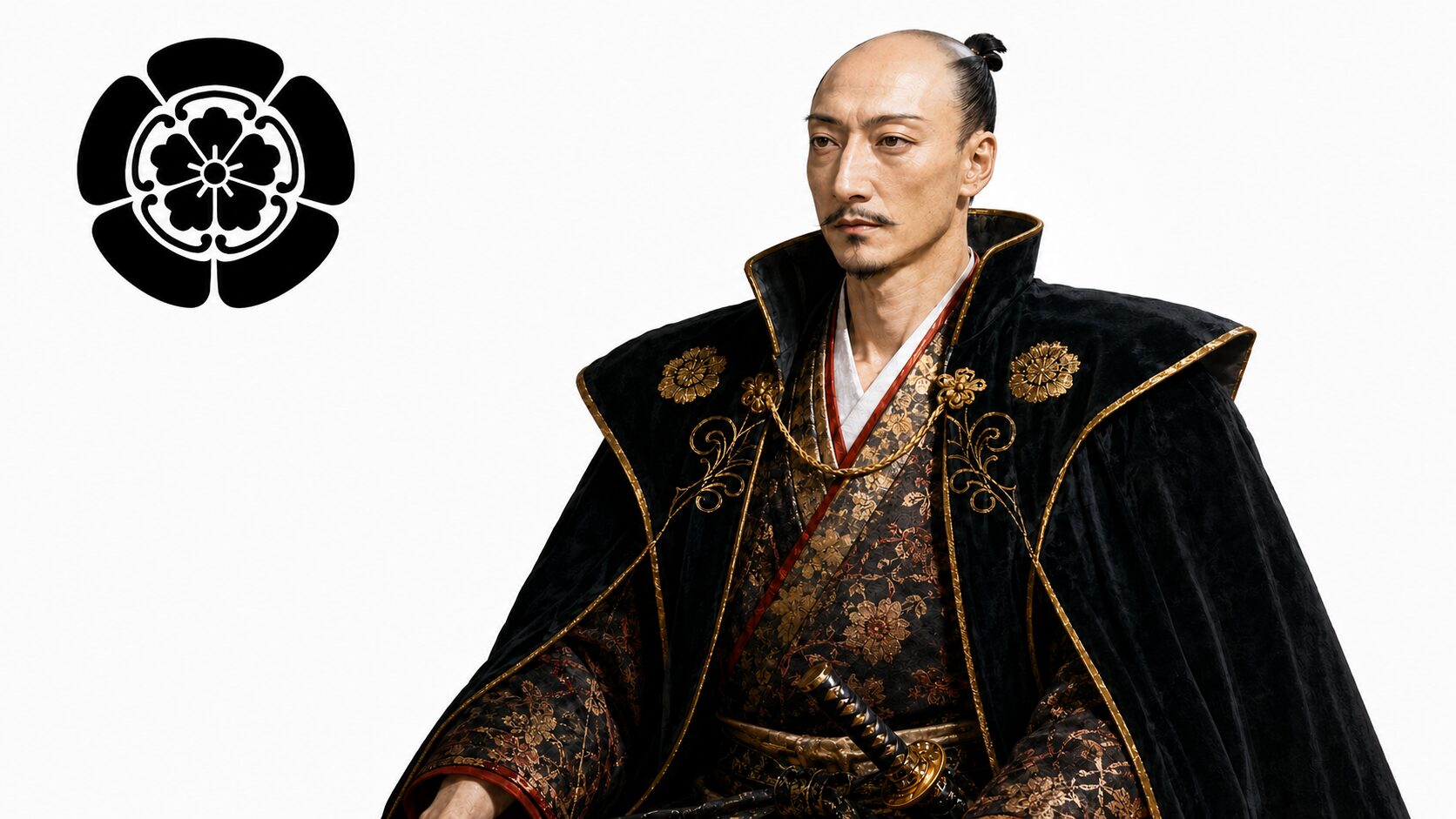
Oda Nobunaga — From the “Great Fool of Owari” to Conqueror of the Realm: 49 Years of a Revolutionary
12th day, 5th month of Tenbun 3 (1534) – 2nd day, 6th month of Tenshō 10 (1582) | Died aged 49
- This Figure in 3 Points
- The Mainstream Account — The Standard Story Found in Textbooks
- The Theories — Exploring the Possibilities from Various Angles
- A Strategic View
- Oda Nobunaga — Notable Sayings and Death Poem
- Anecdotes and Episodes
- Oda Nobunaga — Life Timeline
- Oda Nobunaga — Family and Relationships
- Related Historic-Site Map and Travel Model Course
- Related Battle Articles
- Reference Information
This Figure in 3 Points
- Rising from a minor Owari warlord, he opened the way to the end of the Sengoku period — a conqueror of the realm.
- He struck down Imagawa Yoshimoto at the Battle of Okehazama and, raising the banner of “Tenka Fubu,” subdued the central region.
- He fell to the rebellion of his retainer Akechi Mitsuhide at the Honnō-ji Incident, closing a life of 49 years.
The Mainstream Account — The Standard Story Found in Textbooks
Birth and the “Fool” Years (1534–1551)
Oda Nobunaga was born in Tenbun 3 (1534), the heir of the Owari warlord Oda Nobuhide. His childhood name was Kipphōshi. His father Nobuhide was head of the Oda Danjō-no-jō house, no more than a branch line serving under the Oda Yamato-no-kami house, the deputy shugo of Owari. But by holding economic key points such as Tsushima and Atsuta, he expanded his power, becoming a figure of strength enough to deal with the Imagawa of Suruga and Saitō Dōsan of Mino.
In his boyhood Nobunaga was called the “Great Fool.” It is recorded that he walked the town in an eccentric style — a garment with the sleeves cut off and a half-hakama — and that he galloped his horse while biting into a melon. There is also the famous anecdote that at his father Nobuhide’s funeral he threw incense at the memorial tablet (Shinchō Kōki). His tutor Hirate Masahide, grieved by this conduct, is said to have remonstrated by taking his own life in Tenbun 22 (1553). Nobunaga mourned Masahide’s death and built Seishū-ji to pray for his soul.
That said, recent research points out that this “fool” image holds much later embellishment. From Nobuhide’s generation the Oda house had a cultural and political network with Kyoto, and Nobunaga inherited that grounding. Indeed, in Tenbun 18 (1549) his father Nobuhide reconciled with Saitō Dōsan and, as its token, took Dōsan’s daughter Kichō (Nōhime) as Nobunaga’s principal wife. The one who mediated was Hirate Masahide.
Later, when Dōsan met Nobunaga at Shōtoku-ji, Nobunaga appeared in formal dress leading a corps of gunners, and Dōsan is said to have been struck with admiration, remarking, “my children will end up tying their horses at that man’s gate” (meaning “all my retainers will become Nobunaga’s vassals”). At least in Dōsan’s eyes, Nobunaga appeared not a “fool” but a man with the vessel for greatness.
Inheritance and the Unification of Owari (1551–1559)
In Tenbun 20 (1551), his father Nobuhide died suddenly of illness. Nobunaga inherited the headship at 18, but his standing within the Oda Danjō-no-jō house was not secure. Among the clan and retainers there were forces backing Nobunaga’s younger brother Oda Nobuyuki (Nobukatsu), and Nobunaga came to suffer trouble both within and without.
In Kōji 2 (1556), Nobuyuki, supported by retainers such as Shibata Katsuie, raised a banner of revolt against his elder brother Nobunaga, but was defeated at the Battle of Inō. Pardoned once by Nobunaga, he plotted rebellion again the next year, Kōji 3 (1557); so Nobunaga feigned illness, summoned Nobuyuki to Kiyosu Castle, and killed him. That same year his father-in-law Dōsan too was struck down by his heir Yoshitatsu (the Battle of Nagaragawa), and Nobunaga lost an important backer.
In Eiroku 2 (1559), Nobunaga had largely achieved the unification of Owari, and went up to Kyoto leading some 80 retainers to have an audience with the 13th Ashikaga shogun, Ashikaga Yoshiteru. This was an important action showing that Nobunaga was conscious of a pipeline to the central political world.
The Battle of Okehazama (1560)
In Eiroku 3 (1560), the “finest archer of the Tōkaidō,” Imagawa Yoshimoto, who ruled Suruga, Tōtōmi and Mikawa, invaded Owari at the head of a great army. Yoshimoto’s aim is held to have been the recovery of old territory in eastern Owari once seized by Nobunaga’s father Nobuhide, and the expansion of his power.
On the 19th day of the 5th month, amid the crisis of the fall of the Oda forts of Marune and Washizu, Nobunaga danced the kōwakamai “Atsumori” at Kiyosu Castle and set out with just six horsemen. After praying for victory at Atsuta Shrine, he passed through the Zenshō-ji and Nakajima forts and made a surprise attack on Yoshimoto’s headquarters, deployed at Okehazama-yama. Amid a pouring rain, Nobunaga ordered the charge the instant the rain stopped. Yoshimoto tried to retreat guarded by a few attendants, but was pinned down by the Oda warrior Mōri Shinsuke and killed. He was 42.
By this victory, Nobunaga’s name resounded across the land overnight. At the same time, the Imagawa house, the threat to the east, rapidly declined, and Matsudaira Motoyasu (the future Tokugawa Ieyasu), who had been a hostage of the Imagawa, became independent. After concluding the Kiyosu Alliance with Nobunaga in Eiroku 5 (1562), the two maintained a firm alliance for twenty years.
→ For details, see the battle article “The Battle of Okehazama.”
The Conquest of Mino and “Tenka Fubu” (1561–1567)
Having secured the east with the victory at Okehazama, Nobunaga turned to the conquest of Mino, the old domain of his father-in-law Dōsan. In Eiroku 4 (1561), war began with Saitō Tatsuoki, Dōsan’s grandson, but the Mino campaign proved difficult. Building Sunomata Castle and weaving in stratagems by figures such as Takenaka Hanbei, Nobunaga persistently chipped away at the Mino retainer band.
In Eiroku 10 (1567), Nobunaga at last captured Inabayama Castle and banished Saitō Tatsuoki. He renamed the castle town from “Inokuchi” to “Gifu” and made it his new base. The “Gi” is said to derive from “Mount Qi (Gizan),” where the ancient Chinese Zhou dynasty unified the realm. From around the 11th month of that year, Nobunaga began using a seal (vermilion seal) inscribed “Tenka Fubu.”
The meaning of “Tenka Fubu” is discussed below; it was long interpreted as “aiming to unify the realm by force.” But recent research points out that the “realm” (tenka) of the time did not necessarily refer to all of Japan and often meant “the central region (the Five Home Provinces).”
→ For details, see the battle article “The Battle of Inabayama Castle.”
The March on Kyoto and the Revival of the Shogunate (1568–1573)
In Eiroku 11 (1568), Nobunaga marched on Kyoto bearing Ashikaga Yoshiaki. Yoshiaki was the younger brother of Shogun Yoshiteru and, after Yoshiteru was assassinated by the Miyoshi Triumvirate and others in Eiroku 8 (1565), had wandered various provinces. Nobunaga installed Yoshiaki as the 15th shogun and, taking the form of a deputy shogun, devoted himself to reviving the shogunate.
After the march on Kyoto, Nobunaga defeated Rokkaku Yoshikata of Ōmi and drove out the Miyoshi Triumvirate from the central region. By placing Yoshiaki in the shogunate he revived the Muromachi shogunate. In this period Nobunaga, in coordination with Yoshiaki, behaved as the “protector of the shogunate,” advancing the restoration of order in the central region.
But when Yoshiaki gradually came to dislike Nobunaga’s influence and, conspiring with warlords of various provinces, formed an “anti-Nobunaga encirclement,” the relationship between the two broke down. From Genki 1 (1570) to Genki 3 (1572), Nobunaga fought the allied Azai Nagamasa and Asakura Yoshikage at Anegawa, began the Ishiyama War with Kennyo of the Hongan-ji, and was threatened by Takeda Shingen‘s westward campaign — the fronts rapidly expanded.
→ For details, see the battle articles “The Battle of Anegawa,” “The Retreat at Kanegasaki,” and “The Battle of Mikatagahara.”
In Genki 2 (1571), Nobunaga burned down Enryaku-ji on Mount Hiei, which had sided with the Azai and Asakura. In Genki 4 / Tenshō 1 (1573), the sudden death of Takeda Shingen, followed by the banishment of Ashikaga Yoshiaki and the destruction of the Azai and Asakura, came one after another, and Nobunaga established hegemony over the central region. With this, the Muromachi shogunate effectively fell.
→ For details, see the battle article “The Battle of Odani Castle.”
The Battle of Nagashino and the Building of Azuchi (1574–1578)
In Tenshō 2 (1574), Nobunaga subdued the Ikkō-ikki of Nagashima in Ise. The next year, Tenshō 3 (1575), he clashed with Takeda Katsuyori at Nagashino and, by the effective use of guns, crushed the Takeda cavalry corps. This battle is often positioned as a tactical revolution of the Sengoku period, but recent research holds that part of the received view, such as the “three-rank volley,” is embellishment.
→ For details, see the battle article “The Battle of Nagashino.”
In Tenshō 4 (1576), Nobunaga began building a new castle at Azuchi in Ōmi. The completed Azuchi Castle had a magnificent keep of one basement and six above-ground floors, becoming the culmination of Sengoku-period castle architecture. In the castle town a free-market and free-guild edict was issued, promoting commerce and industry.
In Tenshō 6 (1578), Nobunaga faced the rebellion of his senior retainer Araki Murashige. Murashige was a senior Nobunaga retainer based at the strategic Arioka Castle in Settsu, yet for some reason he suddenly turned against him. The motive remains unsettled, with various theories even now. Murashige’s rebellion was suppressed, but Murashige himself fled and survived.
The Subjugation of the Central Region and the Banishment of Sakuma (1579–1581)
In Tenshō 8 (1580), the Ishiyama War, lasting ten years, at last ended with the surrender of the Hongan-ji. Nobunaga removed his greatest enemy in the central region.
That same year, Nobunaga banished his hereditary senior retainer Sakuma Nobumori. Thrusting before him a letter of reprimand running to 19 articles, he cut off without mercy a “contributor of 30 long years.” This affair is known as an event symbolizing the cold-blooded side of Nobunaga’s control of retainers.
In Tenshō 9 (1581), Nobunaga held a large-scale horse review (military parade) in Kyoto, displaying his might to the emperor, court nobles and warlords. That same year Akechi Mitsuhide pacified Tanba, and Nobunaga praised Mitsuhide in the highest terms as having “brought honor to himself before the realm.”
The Honnō-ji Incident (1582)
In Tenshō 10 (1582), Nobunaga destroyed his old enemy Takeda Katsuyori at Tenmokuzan and swept away the threat in the east. He then had Hashiba Hideyoshi confront the Mōri army in the Chūgoku region and Shibata Katsuie fight Uesugi Kagekatsu in Hokuriku, and the unification of the realm seemed within reach.
In the 6th month, receiving Hideyoshi’s request for reinforcements, Nobunaga entered Honnō-ji in Kyoto with only a small retinue to prepare to set out. His heir Nobutada stayed at the Nijō palace.
Before dawn on the 2nd day of the 6th month, the army of Akechi Mitsuhide, which had set out from Kameyama Castle in Tanba, suddenly turned and made a surprise attack on Honnō-ji. Mitsuhide declared “the enemy is at Honnō-ji” and surrounded the temple with an army of about 13,000. The Oda side fought back with only some 150 men, but, outnumbered, could not hold; Nobunaga fought hard with bow and spear, then set fire to the temple and took his own life. He was 49. His heir Nobutada too was killed at the Nijō palace.
The Honnō-ji Incident became one of the most famous events in Japanese history, and as to Mitsuhide’s motive, dozens of theories have been proposed — the grudge theory, the ambition theory, the Shikoku-policy-change theory, the imperial-court mastermind theory, the Hideyoshi mastermind theory — but all lack a decisive proof. Nobunaga’s remains have not been found to this day.
→ For details, see the battle articles “The Honnō-ji Incident” and “The Battle of Yamazaki.”
The Theories — Exploring the Possibilities from Various Angles
[Theory 1] Is the Image of “Nobunaga the Revolutionary” Correct?
Nobunaga was long told of with the image of “a revolutionary who destroyed the old medieval order and opened the early modern age.” Owing partly to the influence of Shiba Ryōtarō’s novels and historical fiction, an innovative, destructive, progressive portrait spread widely.
In the recent historical profession, however, this image has been greatly revised. Research such as Kanda Chisato’s Oda Nobunaga (Chikuma Shinsho, 2014) and Kaneko Hiraku’s The Real Image of Oda Nobunaga, “Conqueror of the Realm” (Kōdansha Gendai Shinsho, 2014) reveals a figure who in fact cooperated with traditional authority, kept the coexistence of various warlords in view, and was sensitive to public reputation and common sense.
Points of “correction” clarified by recent research:
- Relations with the imperial court: Nobunaga did not oppress the emperor but rather respected and aided his authority.
- Relations with the warlords: he used the “Tenka Fubu” seal even on friendly letters to Uesugi Kenshin and Mōri Motonari — it was not a declaration of war.
- Domain administration: he did not advance centralization but maintained a medieval system, granting territory to commanders and leaving domestic government to them.
- Free markets and guilds: Nobunaga was not the originator; Rokkaku Sadayori of Ōmi had already issued such an edict in 1549. Nobunaga was a spreader and effective user.
- Guns: guns themselves were used by various warlords; they were not Nobunaga’s monopoly.
Shiba Hiroyuki, in Oda Nobunaga: Holding Fast to the “Justice” of the Sengoku Age (Heibonsha, 2020), argues that Nobunaga’s true innovation lay not in “destruction” but in “trying to resolve the chaos of the Sengoku period and hold fast to the justice of a new order.”
[Theory 2] The True Meaning of “Tenka Fubu”
“Tenka Fubu” is widely known as the four characters symbolizing Nobunaga. Beginning to be used after the conquest of Mino in Eiroku 10 (1567), it has been held to be words showing Nobunaga’s conception of the realm. As to its meaning, however, there is great debate in recent years.
First interpretation: nationwide unification (the old view)
The interpretation “to spread martial power over the realm (all of Japan).” Read as a declaration to unify Japan by force, it was long the established view.
Second interpretation: reviving the shogunate in the central region (the Five Home Provinces) (the new view of the 2010s)
Kanda Chisato pointed out that there are many sources in which the “realm” of the Sengoku period referred not to all of Japan but to “the Five Home Provinces including Kyoto.” At the time, Nobunaga’s territory was only the two provinces of Owari and Mino. Amid a crowd of strong enemies — Takeda, Uesugi, Mōri, Azai, Asakura, the Hongan-ji — declaring “nationwide unification” was not realistic. Nobunaga used the “Tenka Fubu” seal even on friendly letters to Uesugi Kenshin and Mōri Motonari, so it cannot be interpreted as a declaration of war. Therefore, this theory holds, “Tenka Fubu” means “to revive the authority of the shogunate in the central region.”
Third interpretation: a motto-like device (a view that has been returning recently)
On the seals of Sengoku warlords there were many self-expressive devices — Takeda Shingen’s dragon, Uesugi Kenshin’s lion, Hōjō Ujiyasu’s tiger. No one interprets each of these as a “declaration of rule over Japan.” There is the view that Nobunaga’s “Tenka Fubu” too should be read as no more than a motto-like statement of resolve, and that excessive deep reading is dangerous. Indeed, Nobunaga’s sons chose seal inscriptions clearly conscious of unifying the realm — “one sword pacifies the realm,” “might extends over the realm” — and Nobunaga’s “Tenka Fubu” was very likely of the same character.
Which interpretation is correct is still debated. At the least, it is certain that there is a depth that cannot be grasped by the textbook-style simple interpretation of “a declaration of nationwide unification.”
[Theory 3] Was the Burning of Mount Hiei Really a “Massacre of All”?
The burning of Mount Hiei in Genki 2 (1571) is known as the event that fixed Nobunaga’s image of “cruelty” and “oppressor of religion.” Sources such as the Tokitsugu-kyō Ki and the Oyudono no Ue no Nikki record that “more than 500 temple-and-shrine buildings and pagodas were reduced to ash without a single one remaining, and 3,000 monks, men and women, were beheaded as the whole mountain became a sea of fire.”
The excavation survey of the archaeologist Kaneyasu Yasuaki (1981), however, cast doubt on this received view. The buildings whose burning can actually be confirmed are only the Konpon Chūdō and the Daikōdō; though burnt-earth layers can be confirmed in other places as well, most had been abandoned before the burning.
Mount Hiei at the time was described as “neglecting study, the whole mountain in a state of ruin” (Tamon’in Nikki), and many monks had come down the mountain to live around Sakamoto. Therefore the attack was very likely combat concentrated around Sakamoto and Hachiōjiyama, rather than a war of annihilation against the whole mountain. The Shinchō Kōki too only records “on the 12th day of the 9th month, he closed in on Mount Hiei,” with no concrete description of a massacre of 3,000.
It is also now the mainstream view that Nobunaga’s true aim was not “religious oppression” but “neutralizing Mount Hiei as an armed force.” Mount Hiei at the time was a great military force hostile to Nobunaga, tied to the Azai and Asakura, and a strategic key point in the northern outskirts of Kyoto. Nobunaga repeatedly asked Mount Hiei for neutrality, but it refused and sided with hostile forces. The burning was an action based on political and military judgment, and as a result Nobunaga himself recognized the later survival of the Tendai sect (Enryaku-ji as a religion).
On the other hand, it is a fact that he finally took harsh means against a Mount Hiei that did not respond even to repeated warnings of disarmament, and that mercilessness is handed down as an episode showing Nobunaga’s cold-blooded character.
[Theory 4] Was the “Fool” Real?
Because the “fool” episodes of Nobunaga’s boyhood (eccentric dress, biting into a melon, throwing incense) are also recorded in the Shinchō Kōki, they are thought to contain a degree of fact. But recent research points out that to interpret these as “foolishness” or “madness” goes too far.
Nobunaga’s father Nobuhide had a cultural and political network with Kyoto, and Nobunaga was strongly influenced by it. His tutor Hirate Masahide served as a pipeline to the capital, and it is very likely Nobunaga was, from a young age, conversant in the culture and political situation of Kyoto. Moreover, the episode that when Nobunaga met Saitō Dōsan he “appeared in formal dress leading a corps of gunners and struck Dōsan with admiration” shows that Nobunaga was a being who could “dress the part” at any time.
It is also pointed out that the “fool” was, rather than natural folly, possibly an “act” to secretly gauge his own strength within the house and to size up friend and foe. Indeed, Nobunaga rode out the difficult period after the inheritance by deceiving with the “fool” image, surely seizing power within the house.
[Theory 5] Why Did the Honnō-ji Incident Happen?
As to the motive for which Akechi Mitsuhide betrayed Nobunaga, dozens of theories have so far been proposed. To list the main ones:
- The grudge theory: Mitsuhide’s private grudge from repeated humiliations by Nobunaga.
- The ambition theory: Mitsuhide himself aimed at the realm.
- The Shikoku-policy-change theory: Nobunaga’s change of diplomatic policy from the Chōsokabe to the Miyoshi collapsed the standing of Mitsuhide, who had been the negotiator with the Chōsokabe (the new view of Kaneko Hiraku and others).
- The imperial-court mastermind theory: court nobles fearing Nobunaga’s pressure on the court moved Mitsuhide.
- The Ashikaga Yoshiaki mastermind theory: on the instruction of the banished Yoshiaki.
- The Jesuit mastermind theory: Christian forces fearing Nobunaga’s autocracy.
- The Hideyoshi mastermind theory: suspected from the abnormally swift response to the incident.
- The Ieyasu mastermind theory: from wariness toward Nobunaga.
Kaneko Hiraku gives weight to the fact that, until just before the incident, Mitsuhide had written that “he summoned me, who had fallen low like rubble, and entrusted me with a vast number of men. My family and retainers, down to their descendants, must never forget their service to Lord Nobunaga,” and argues that a sudden factor (the change of Shikoku policy, the worsening of Mitsuhide’s treatment by Nobunaga, and so on) may have been the trigger.
But no decisive primary source exists, and no final conclusion has been reached even now. The Honnō-ji Incident, as the greatest mystery of Sengoku history, still continues to fascinate many researchers, novelists and history fans.
→ For details, see the battle article “The Honnō-ji Incident.”
[Theory 6] Did Nobunaga Really “Try to Become a God”?
The History of Japan by Luís Fróis contains the account that, in his later years, Nobunaga declared “I am a god,” placed a “Bonsan” enshrining himself at Sōken-ji in the Azuchi castle town, and forced people to worship it. On this basis, Nobunaga has been interpreted as a “deified despot.”
But Fróis was a Christian missionary and had a tendency to exaggerate Nobunaga as an “enemy of Christians.” In fact, Nobunaga maintained relations with the imperial court until just before the Honnō-ji Incident, and no action denying imperial authority can be confirmed. Kanda Chisato argues that Fróis’s account is an exaggeration arising from the missionary’s limits of understanding, and that Nobunaga’s intent was not “to make himself a god” but to stage Azuchi Castle itself as a religious and political symbol.
The image of “the Nobunaga who tried to become a god,” like the revolutionary image, holds much later embellishment — that is the current view.
A Strategic View
When Nobunaga is compared with other fine commanders of the Sengoku period, three points stand out: “economy,” “intelligence,” and “speed of decision.”
First, economic power. From his grandfather’s and father’s generations Nobunaga controlled Tsushima and Atsuta, the economic centers of Owari, and with the wealth based on them he could maintain a separation of soldier from farmer and a standing army. Unlike other Sengoku warlords dependent on rice taxes, Nobunaga obtained funds from trade and from taxing barrier tolls and guilds. This produced a fundamental difference between other warlords, who “mobilized each time they gathered troops,” and Nobunaga, who was “always mobilized.” Free markets and guilds, and the abolition of checkpoints, too, were originally a continuation and development of the policies of Rokkaku Sadayori and his father Nobuhide, not inventions of Nobunaga’s single generation. But it was precisely in making the fullest use of that “idea of linking economy directly to the military” that Nobunaga’s true worth lay.
Second, intelligence. As seen at the Battle of Okehazama, Nobunaga was skilled at accurately grasping the enemy’s situation. His thoroughness — wary of informers within the house, deciding operations without holding a council of war — was unusual for a Sengoku warlord of the time. He also maintained a pipeline to Kyoto from his father’s generation, and made use of an intelligence advantage in every scene of politics, diplomacy and the military — installing Ashikaga Yoshiaki, negotiating with the imperial court, obtaining world information from missionaries.
Third, speed of decision. Nobunaga’s life was a life of “continuing to make the first move.” At Okehazama he decided without hesitation to charge the headquarters; at Anegawa, on learning of the Azai betrayal, he immediately withdrew from Kanegasaki; at Nagashino he challenged the Takeda cavalry corps with a new tactic; and he persistently fought a ten-year war with the Hongan-ji. There were misjudgments too (especially failing to see through Araki Murashige’s rebellion), but there was a speed of decision more than enough to make up for them.
On the other hand, Nobunaga’s limits cannot be ignored. His control of retainers was severe, and as the banishment of Sakuma Nobumori, the rebellion of Araki Murashige, and finally the rebellion of Akechi Mitsuhide show, Nobunaga’s “results-first principle” may not have fully captured the hearts of his retainers. While there were those who adapted, like Shibata Katsuie, called “Demon Shibata,” and the self-made Hashiba Hideyoshi, there were also those who suddenly raised a banner of revolt, like Mitsuhide. It may be said that the greatest cause that Nobunaga’s enterprise of the realm was not completed was not an external enemy but internal personnel tension.
Rather than a “revolutionary,” a portrait close to the Nobunaga drawn from recent research is “a realist who combined the economy, intelligence and decision of the Sengoku period most efficiently and advanced the age one step forward.” His enterprise was inherited by his disciple Hideyoshi and finally completed by Ieyasu.
Oda Nobunaga — Notable Sayings and Death Poem
“The fifty years of man, compared with the span of the lower heaven, are as a dream, an illusion. Once given life, is there any that does not perish?”
A passage from the kōwakamai “Atsumori,” which Nobunaga is said to have danced at Kiyosu Castle before setting out for Okehazama. Its content is that the fifty years of human life are as fleeting as a dream compared with the time of the heavens. Said to be a piece Nobunaga loved throughout his life, it is handed down as a phrase symbolizing his view of life and death. Ironically, Nobunaga fell at Honnō-ji at 49, closing his life just one year short of “the fifty years of man.”
— Source: kōwakamai “Atsumori” / Ōta Gyūichi, Shinchō Kōki
“Tenka Fubu”
The characters on the seal Nobunaga used from after the conquest of Mino, Eiroku 10 (1567). Long held to mean “to unify the realm by force,” it is now strongly interpreted by recent research as “to spread the authority of the shogunate throughout the central region” or “a motto-like statement of resolve.” In any case, it is engraved in Sengoku history as the four characters symbolizing Nobunaga’s conception of the realm.
— Source: Seishū-ji Kiroku and others
“It cannot be helped.”
Words Nobunaga is said to have uttered on the morning of the Honnō-ji Incident, on learning of Akechi Mitsuhide’s rebellion. Meaning “this is no longer the stage to debate right and wrong,” it is interpreted not as resignation but as words by which he resolved at once to fight back. Famous as Nobunaga’s last words as related by the Shinchō Kōki.
— Source: Ōta Gyūichi, Shinchō Kōki
“If you listen to the words of cowardly retainers, you can do nothing.”
Said to be Nobunaga’s words when, on the eve of the Battle of Okehazama, he rejected retainers advising a defensive siege. Told as an episode expressing Nobunaga’s character, which always valued speed of decision.
— Source: various works (no strict confirmation in primary sources)
Anecdotes and Episodes
“Throwing Incense” at His Father’s Funeral
At the funeral of his father Oda Nobuhide, Nobunaga appeared without even wearing mourning, in everyday dress, threw incense at the memorial tablet, and left the place. This anecdote, recorded in the Shinchō Kōki, fixed Nobunaga’s “fool” image. At the same time, it became an occasion for many of the clan and retainers to think his younger brother Nobuyuki, who behaved politely in contrast to Nobunaga, fitter to be head.
By recent interpretation, however, it is also said that Nobunaga may have intentionally played the “fool,” sizing up the true minds of friend and foe. The provocative behavior at the funeral may have been an intentional performance to draw out who, within the Oda house, would follow him and who would side with Nobuyuki.
— Source: Ōta Gyūichi, Shinchō Kōki
The Remonstrating Suicide of Hirate Masahide
Hirate Masahide, Nobunaga’s tutor, grieved by Nobunaga’s “foolishness” and took his own life in Tenbun 22 (1553). Mourning Masahide’s death, Nobunaga built Seishū-ji to pray for his soul and invited the Zen monk Takugen Sōon as founding abbot. It is said that Takugen later chose the seal inscription “Tenka Fubu.”
Masahide was also the one who mediated the marriage of Nobunaga and Saitō Dōsan’s daughter Kichō (Nōhime), giving great influence to Nobunaga’s life. Nobunaga never forgot that kindness throughout his life even after Masahide’s death, treating Masahide’s son Kenmotsu generously. The fact that the supposedly “foolish” Nobunaga mourned so deeply the death of the old retainer who remonstrated with him is an important episode for considering Nobunaga’s character.
— Source: Ōta Gyūichi, Shinchō Kōki
The Shōtoku-ji Meeting with Dōsan — The Truth of the “Fool”
In Tenbun 22 (1553), Nobunaga met his father-in-law Saitō Dōsan at Shōtoku-ji in Owari. At the time, Nobunaga was rumored to be a “fool,” and Dōsan, to ascertain the true figure of his son-in-law, hid along the way and observed Nobunaga’s party.
What Dōsan then saw was not a “fool” of eccentric dress but the figure of a young Sengoku warlord, clad in formal dress, leading a corps of gunners and a long-spear unit in good order. After the meeting, Dōsan is said to have told his retainers, “my children will end up tying their horses at that man’s gate.” It means “my children (Saitō Yoshitatsu and the rest) will become Nobunaga’s retainers in the future.” Indeed, as Dōsan prophesied, Nobunaga later subdued Mino and Dōsan’s lineage was extinguished.
This episode shows that Nobunaga was a being who could “dress the part” at any time, and that Dōsan saw through to Nobunaga’s true nature.
— Source: Ōta Gyūichi, Shinchō Kōki
→ For details, see the warlord article “Saitō Dōsan.”
The Murder of His Brother Nobuyuki
In Kōji 2 (1556), Nobunaga’s younger brother Oda Nobuyuki (Nobukatsu), supported by Shibata Katsuie, Hayashi Hidesada and others, raised a banner of revolt against his elder brother Nobunaga, but was defeated at the Battle of Inō. Through the intercession of their birth mother Dota-gozen, he was pardoned once by Nobunaga. But the next year, Kōji 3 (1557), it came to light that Nobuyuki was plotting rebellion again.
The one who informed on him is said to have been Shibata Katsuie himself, who served as Nobuyuki’s close aide. Katsuie reported Nobuyuki’s second rebellion plan to Nobunaga and chose loyalty to Nobunaga. Nobunaga feigned illness, summoned Nobuyuki to Kiyosu Castle, and killed him.
After removing Nobuyuki, Nobunaga pardoned Katsuie and promoted him as a senior retainer. Katsuie later grew into the foremost commander of the Oda house, called “Demon Shibata.” It is an episode suggesting how Nobunaga’s cold-bloodedness and his flexibility in promoting able men coexisted.
— Source: Ōta Gyūichi, Shinchō Kōki
→ For details, see the warlord article “Shibata Katsuie.”
The Night He Danced Atsumori — Setting Out for Okehazama
Before dawn on the 19th day of the 5th month of Eiroku 3 (1560), receiving word that Imagawa Yoshimoto’s great army was invading Owari, Nobunaga danced the kōwakamai “Atsumori” at Kiyosu Castle. The moment he finished singing “the fifty years of man, compared with the span of the lower heaven, are as a dream, an illusion,” Nobunaga put on his armor and dashed out of Kiyosu Castle with just six horsemen.
On the eve of the battle, Nobunaga rejected his senior retainers’ advice for a defensive siege and did not even hold a council of war. This is held to have been from wariness that “there were informers within the house.” His retainers mocked him, saying “when one’s fortune is exhausted, the mirror of wisdom too clouds over,” but the result was Nobunaga’s historic victory.
— Source: Ōta Gyūichi, Shinchō Kōki
→ For details, see the battle article “The Battle of Okehazama.”
The Head Inspection of the Three Lords
In Genki 4 (1573), the Shinchō Kōki records the anecdote that Nobunaga had the heads of three men — Azai Nagamasa, Asakura Yoshikage and Azai Hisamasa (Nagamasa’s father) — lacquered and decorated with gold dust, and showed them to his retainers as skull cups. This is widely known as an episode showing Nobunaga’s cruelty.
Recent research, however, points out that this was possibly less an “insult to enemy generals” than “a ritual to confirm the death of enemies and celebrate victory with his commanders.” In medieval Japan, carrying enemy generals’ heads to the headquarters for head inspection was a common custom, and lacquering and storing heads was not unusual either. To rate Nobunaga’s action as “cruel” by a modern sensibility may be an interpretation that overlooks the background of the age.
— Source: Ōta Gyūichi, Shinchō Kōki
The Horse Review in Kyoto
On the 28th day of the 2nd month of Tenshō 9 (1581), Nobunaga held a large-scale horse review (military parade) before the east gate of the imperial palace in Kyoto. Under the command of Akechi Mitsuhide, Nobunaga, the Oda clan and his commanders attended in splendid attire, displaying their might to the emperor, court nobles and warlords.
This horse review is one of the scenes symbolizing the height of Nobunaga’s power. At the time Nobunaga had completely subdued the central region; the Takeda and Uesugi too were in decline, and the Mōri were cornered. It was a scene just before “Tenka Fubu” became reality, but a little over a year later Nobunaga would lose his life at Honnō-ji.
— Source: Ōta Gyūichi, Shinchō Kōki
The End at Honnō-ji — “It Cannot Be Helped”
Before dawn on the 2nd day of the 6th month of Tenshō 10 (1582), at Honnō-ji surrounded by Akechi Mitsuhide’s army, Nobunaga, on learning of the Akechi rebellion, said only “it cannot be helped” and, taking up bow and spear himself, fought back. His retinue was only some 150 men, and, overwhelmed by the Akechi army of about 13,000, Nobunaga fought on to the last.
Ōta Gyūichi, author of the Shinchō Kōki, is said to have recorded Nobunaga’s end through interviews with the ladies-in-waiting who survived Honnō-ji. The words “it cannot be helped” became one of the most famous lines in Sengoku history, symbolizing Nobunaga’s resolve and serenity. In the end Nobunaga set fire to the temple and took his own life, closing his 49 years. His remains have not been found to this day.
— Source: Ōta Gyūichi, Shinchō Kōki
→ For details, see the battle article “The Honnō-ji Incident.”
Oda Nobunaga — Life Timeline
| Year | Age | Event |
|---|---|---|
| 1534 | 0 | Born in Owari Province as the heir of Oda Nobuhide. Childhood name Kipphōshi. |
| 1546 | 12 | Comes of age at Furuwatari Castle and styles himself Oda Saburō Nobunaga. |
| 1549 | 15 | Political marriage with Saitō Dōsan’s daughter Kichō (Nōhime), as a token of reconciliation. |
| 1551 | 17 | His father Nobuhide dies suddenly of illness. Inherits the headship. Throws incense at the funeral. |
| 1553 | 19 | His tutor Hirate Masahide takes his own life in remonstrance. Meets Saitō Dōsan at Shōtoku-ji. |
| 1556 | 22 | Battle of Inō: crushes his brother Nobuyuki’s rebellion. His father-in-law Saitō Dōsan is killed at Nagaragawa. |
| 1557 | 23 | Murders his brother Nobuyuki at Kiyosu Castle. |
| 1559 | 25 | Largely achieves the unification of Owari. Goes up to Kyoto with 80 retainers; has audience with Shogun Yoshiteru. |
| 1560 | 26 | Battle of Okehazama: strikes down Imagawa Yoshimoto. His name resounds across the land. |
| 1562 | 28 | Concludes the Kiyosu Alliance with Tokugawa Ieyasu. |
| 1563 | 29 | Moves his base from Kiyosu Castle to Komakiyama Castle. |
| 1567 | 33 | Battle of Inabayama Castle: pacifies Mino. Renames the castle town Gifu; begins using the “Tenka Fubu” seal. |
| 1568 | 34 | Marches on Kyoto bearing Ashikaga Yoshiaki. Installs Yoshiaki as the 15th shogun. |
| 1570 | 36 | The Retreat at Kanegasaki / Battle of Anegawa: Azai Nagamasa’s betrayal. The Ishiyama War (–1580) begins. |
| 1571 | 37 | The burning of Mount Hiei. |
| 1572 | 38 | Battle of Mikatagahara: Takeda Shingen’s westward campaign; Ieyasu is defeated. |
| 1573 | 39 | Takeda Shingen dies. Banishes Ashikaga Yoshiaki (the Muromachi shogunate falls). Destroys the Azai and Asakura (Battle of Odani Castle). |
| 1575 | 41 | Battle of Nagashino: defeats Takeda Katsuyori. Effective use of guns. |
| 1576 | 42 | Begins building Azuchi Castle. |
| 1577 | 43 | Suppresses Matsunaga Hisahide’s rebellion. Free-market and free-guild edict in the Azuchi castle town. |
| 1578 | 44 | Araki Murashige suddenly defects. Holes up in Arioka Castle. |
| 1580 | 46 | The Ishiyama Hongan-ji surrenders (the ten-year war ends). Banishes Sakuma Nobumori. |
| 1581 | 47 | A large horse review at the Kyoto imperial palace. Akechi Mitsuhide pacifies Tanba. |
| 1582 (3rd mo.) | 48 | Destroys Takeda Katsuyori at Tenmokuzan (the Takeda house falls). |
| 1582 (6th mo., 2nd) | 49 | The Honnō-ji Incident. Takes his own life at Honnō-ji in Akechi Mitsuhide’s rebellion. Aged 49. |
※ Ages are reckoned by the traditional count (kazoe-doshi). Cell shading: yellow = major battle; red = events relating to his end.
Oda Nobunaga — Family and Relationships
Family
| Relation | Person | Summary |
|---|---|---|
| Father | Oda Nobuhide | An Owari warlord. Controlled the economy of Tsushima and Atsuta and made the Oda Danjō-no-jō house powerful. |
| Mother | Dota-gozen | Nobuhide’s principal wife. Favored the younger son Nobuyuki; her relationship with Nobunaga is said to have been cold. |
| Principal wife | Kichō (Nōhime) | Daughter of Saitō Dōsan. Married Nobunaga in 1549. A figure of mystery, her birth and death years and end all unknown. |
| Concubines | Kitsuno, Onabe-no-kata, and others | Had many children by several concubines. |
| Brother | Oda Nobuyuki (Nobukatsu) | Contested the headship with Nobunaga; murdered by Nobunaga in 1557. |
| Sister | Oichi-no-kata | Married Azai Nagamasa, later Shibata Katsuie. Said to have been “a peerless beauty.” |
| Heir | Oda Nobutada | Raised as the successor of the Oda house. Killed at the Nijō palace in the Honnō-ji Incident. |
| Second son | Oda Nobukatsu | Succeeded to the Ise Kitabatake house. After Honnō-ji, had complex relations with Hideyoshi and Ieyasu. |
| Third son | Oda Nobutaka | After Honnō-ji, allied with Shibata Katsuie but was defeated by Hideyoshi and took his own life. |
Principal Retainers, Allies and Adversaries
| Relation | Person | Summary |
|---|---|---|
| Ally | Tokugawa Ieyasu | A sworn friend of 20 years, bound by the Kiyosu Alliance. Inherited the realm after Nobunaga’s death. |
| Retainer (foremost) | Shibata Katsuie | The foremost Oda commander, called “Demon Shibata.” Commanded the Hokuriku army. |
| Retainer | Hashiba Hideyoshi | An exceptional retainer risen from sandal-bearer. The Chūgoku army. Took the realm after Nobunaga’s death. |
| Retainer | Hashiba Hidenaga | Hideyoshi’s younger brother. Supported his brother as a calm, level-headed strategist. |
| Retainer → enemy | Akechi Mitsuhide | The central-region army. The most trusted retainer, yet struck Nobunaga down in the Honnō-ji Incident. |
| Retainer | Takenaka Hanbei | Hideyoshi’s strategist. Active in the conquest of Mino. Likened to Zhuge Liang of the Three Kingdoms. |
| Retainer → enemy | Araki Murashige | A senior retainer on the Settsu front. Suddenly rebelled in 1578 and holed up in Arioka Castle. |
| Enemy | Imagawa Yoshimoto | The Tōkai overlord struck down at Okehazama. |
| Enemy | Takeda Shingen | Drove Nobunaga to his greatest crisis in the westward campaign, but died of illness on the march. |
| Enemy | Takeda Katsuyori | Badly defeated at Nagashino; took his own life at Tenmokuzan in 1582. |
| Enemy | Azai Nagamasa | Husband of his sister Oichi-no-kata, yet betrayed Nobunaga. Took his own life at Odani Castle. |
| Enemy | Asakura Yoshikage | A distinguished Echizen house. Joined the anti-Nobunaga encirclement and fell in 1573. |
| Enemy | Ashikaga Yoshiaki | The 15th shogun. At first cooperated with Nobunaga, later became the center of the anti-Nobunaga encirclement. |
| Enemy | Kennyo | Abbot of the Ishiyama Hongan-ji. Tormented Nobunaga in the ten-year Ishiyama War. |
| Enemy | Matsunaga Hisahide | A Miyoshi retainer. Repeated surrender and rebellion; died at last by self-detonation at Shigisan Castle. |
Related Historic-Site Map and Travel Model Course
Related Historic-Site Map — Oda Nobunaga
Spots on the map:
- Kiyosu Castle (castle) — Nobunaga’s early base. The place he set out from for Okehazama.
- Komakiyama Castle (castle) — A base for the conquest of Mino that Nobunaga built.
- Gifu Castle (castle) — His base after pacifying Mino. The place where “Tenka Fubu” began.
- Site of Azuchi Castle (castle) — Nobunaga’s symbol. Known for the grandeur of its keep.
- Site of Honnō-ji (temple / place of his end) — The site of Nobunaga’s end.
- Daitoku-ji Sōken-in (family temple) — Built by Hideyoshi to mourn Nobunaga.
- Kenkun Shrine (shrine) — A shrine enshrining Nobunaga on Funaokayama in Kyoto.
- Seishū-ji (temple) — Built by Nobunaga to mourn Hirate Masahide.
※ The map is a reference display based on modern roads. It differs from the roads and terrain of the Sengoku period.
Travel Model Course — A Two-Day Trail of Nobunaga’s Footsteps
Conditions
- Duration: 2 days (by car)
- Day 1: Owari and Mino (Nobunaga’s starting point)
- Day 2: Ōmi and Kyoto (Nobunaga’s height and his end)
Day 1: Visiting Nobunaga’s Starting Point
① Kiyosu Castle (stay: approx. 60 min)
The residence castle where Nobunaga inherited the headship at 17, the stage of his setting out for Okehazama.
– By car: about 5 min from the Kiyosu exit of the Nagoya Expressway
② Okehazama Old Battlefield Park (stay: approx. 40 min)
The site of Nobunaga’s once-in-a-lifetime great reversal.
– By car: about 40 min from Kiyosu Castle
③ Komakiyama Castle (stay: approx. 60 min)
The front-line base for the conquest of Mino that Nobunaga built.
– By car: about 50 min from Okehazama
④ Gifu Castle (stay: approx. 90 min)
The starting point of Nobunaga’s ambition, where he raised “Tenka Fubu.” The view from the summit of Mount Kinka is superb.
– By car: about 40 min from Komakiyama Castle
Day 2: Tracing Nobunaga’s Height and His End
⑤ Site of Azuchi Castle (stay: approx. 120 min)
The height of Nobunaga’s power. Walk the keep-base ruins and recall its grandeur.
– By car: about 90 min from Gifu Castle
⑥ Site of Honnō-ji (the old Honnō-ji site) (stay: approx. 30 min)
The site of Nobunaga’s end. The present Honnō-ji is the relocation site; the original place is at Aburanokōji-dōri Takoyakushi.
– By car: about 60 min from Azuchi
⑦ Kenkun Shrine (stay: approx. 40 min)
A shrine enshrining Nobunaga as deity. The view of the city of Kyoto from Funaokayama is splendid.
– By car: about 20 min from the site of Honnō-ji
⑧ Daitoku-ji Sōken-in (stay: approx. 40 min)
The temple Hideyoshi built to mourn Nobunaga. Enshrines a seated statue of Lord Nobunaga.
– By car: about 10 min from Kenkun Shrine
Arrangements by Visitor Type
- For the strong of leg: Also visit Seishū-ji (the family temple of Nobunaga’s tutor Hirate Masahide).
- For a relaxed pace: Shorten to a 1-day course of Kiyosu Castle plus Gifu Castle.
- For those focusing on Kyoto: A half-day course of the site of Honnō-ji, Kenkun Shrine, Daitoku-ji Sōken-in and Myōkaku-ji (the place of Nobutada’s end).
※ This plan is a reference model based on general travel speeds and stay times. Opening hours, transport schedules and crowding vary by season and day of the week. Please check the latest information on the official websites of each facility and transport operator before setting out.
※ Admission and entry fees are reference prices at the time of writing and may have changed.
※ For mountain-castle sites, please plan within your limits according to the weather and your physical condition.
Related Battle Articles
- The Battle of Okehazama (1560) — The great reversal that became Nobunaga’s starting point
- The Battle of Inabayama Castle (1567) — The pacification of Mino and the start of “Tenka Fubu”
- The Battle of Anegawa (1570) — A fierce battle with the allied Azai-Asakura army
- The Retreat at Kanegasaki (1570) — The withdrawal battle caused by the Azai betrayal
- The Battle of Mikatagahara (1572) — Ieyasu’s defeat in Takeda Shingen’s westward campaign
- The Battle of Odani Castle (1573) — The fall of the Azai house
- The Battle of Nagashino (1575) — The tactical revolution that defeated Takeda Katsuyori
- The Battle of Takatenjin Castle (1581) — The decisive battle of the Takeda house’s decline
- The Honnō-ji Incident (1582) — Nobunaga’s last battle
Reference Information
Primary Sources
- Ōta Gyūichi, Shinchō Kōki — The most reliable record, by a Nobunaga retainer
- Oze Hoan, Hoan Shinchō-ki — A secondary source compiled in the early Edo period (contains invented elements)
- Tamon’in Nikki — A record from the time of the burning of Mount Hiei
- Tokitsugu-kyō Ki — Diary of the court noble Yamashina Tokitsugu
Academic Works
- Kanda Chisato, Oda Nobunaga, Chikuma Shinsho, 2014 — A representative work revising the image of “Nobunaga the revolutionary”
- Kaneko Hiraku, The Real Image of Oda Nobunaga, “Conqueror of the Realm”, Kōdansha Gendai Shinsho, 2014 — A re-examination of the meaning of Tenka Fubu
- Kaneko Hiraku, A Theory of Oda Nobunaga’s Power, Yoshikawa Kōbunkan, 2015
- Kaneko Hiraku, Oda Nobunaga: The Too-Clumsy Conqueror of the Realm, Kawade Shobō Shinsha, 2017
- Shiba Hiroyuki, Oda Nobunaga: Holding Fast to the “Justice” of the Sengoku Age, Heibonsha (From the Medieval to the Early Modern), 2020
- Ikegami Hiroko, Oda Nobunaga (Jinbutsu Sōsho), Yoshikawa Kōbunkan, 2012
- Taniguchi Katsuhiro, Nobunaga’s Road to Tenka Fubu, Yoshikawa Kōbunkan, 2006
- Taniguchi Katsuhiro, Biographical Dictionary of Oda Nobunaga’s Retainers, Yoshikawa Kōbunkan, 1995
Public Papers and Materials
- Kaneyasu Yasuaki, “An Archaeological Re-examination of Oda Nobunaga’s Burning of Mount Hiei,” Shiga Archaeology Essays, vol. 1, 1981
- National Diet Library Digital Collection, Shinchō Kōki
※ This article is composed on the basis of the above sources, research works, papers and multiple sources on the web. Interpretations of history differ even among researchers, and the established view may change with the discovery of new sources or the advance of research.
コメント