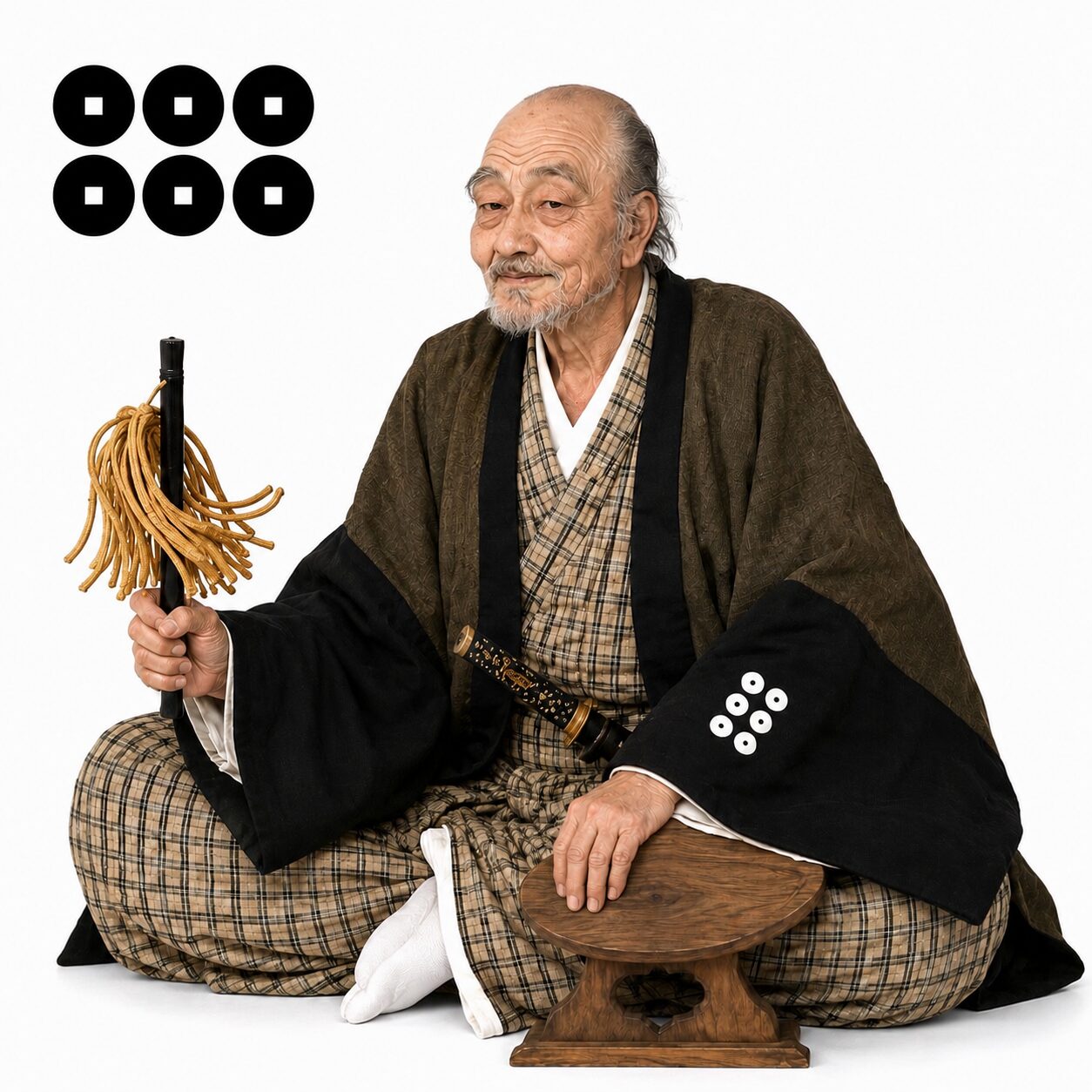
Sanada Masayuki — The Cunning Strategist of Double-Dealing, the Provincial Lord’s Pride That Broke Tokugawa Ieyasu Twice
- Sanada Masayuki in 3 Points
- The Mainstream View — The Established Account Found in Textbooks
- Multiple Theories — Exploring Possibilities from Various Angles
- Viewed Strategically
- Famous Words and Sayings of This Warlord
- Anecdotes and Episodes
- Timeline
- Family and Personal Relationships
- Related Historic Site Map / Model Travel Courses
- Related Articles
- References
Sanada Masayuki in 3 Points
- Serving Takeda Shingen as the third son of Sanada Yukitaka, he was one of the Twenty-Four Generals of Takeda, called “my eyes” by Shingen.
- After the fall of the Takeda, he survived amid the Oda, Hōjō, Tokugawa, Uesugi, and Toyotomi, and was evaluated by Hideyoshi as “a man of double-dealing cunning.”
- He repelled the Tokugawa army twice at the First and Second Battles of Ueda, and after Sekigahara was confined at Kudoyama, dying while still continuing his campaign for pardon to Ieyasu.
The Mainstream View — The Established Account Found in Textbooks
Birth and Hostage to the Takeda House (1547–1561)
Sanada Masayuki was born in Tenbun 16 (1547) at Sanada-gō in Chiisagata District, Shinano Province (present-day Sanada-machi, Ueda, Nagano Prefecture), the third son of Takeda Shingen’s retainer Sanada Yukitaka. His childhood name was Gengorō, and he later styled himself Kihei.
The Sanada house was originally a branch of the Unno clan of Shinano, drawing the line of a noble house that traced its origin to Emperor Seiwa. However, in Tenbun 10 (1541), attacked by the allied army of Takeda Nobutora, Suwa Yorishige, and Murakami Yoshikiyo, they were driven out of Sanada-gō and went into exile in Kōzuke Province. It was around the time of Masayuki’s birth that his father Yukitaka came to the fore by serving Takeda Shingen and grew the house into a power straddling both Shinano and Kōzuke.
Around age 7, Masayuki was sent as a hostage to the Takeda house of Kai. Rather than being treated as an ordinary hostage, he was selected for Shingen’s exceptional inner attendant corps and raised at Shingen’s side. He then entered the Mutō house, a relative house of the Takeda, as an adopted son, and took the name Mutō Kihei. By this Masayuki became an exceptional figure of provincial-lord origin treated as a “Kai retainer” within the Takeda house.
In Eiroku 4 (1561), the 15-year-old Masayuki had his first battle at the Fourth Battle of Kawanakajima. It was the greatest fierce battle of the Sengoku period, in which Takeda Shingen and Uesugi Kenshin clashed. Shingen highly valued Masayuki’s talent, and in later years is said to have called him “my eyes.” This means that Shingen regarded Masayuki as a presence able to survey the whole battlefield as his own eyes — an evaluation symbolizing Masayuki’s standing within the Takeda house.
Succession to the Sanada Headship and Becoming a Takeda Chief Retainer (1575)
Masayuki had an eldest brother, Sanada Nobutsuna, and a second brother, Sanada Masateru, who were in the position to succeed their father’s headship. Masayuki himself, as the third son, was not originally in the position to succeed the Sanada house, and walked the path of an independent warlord as the adopted son of the Mutō house.
However, on the 21st day of the 5th month of Tenshō 3 (1575), the army of Takeda Katsuyori suffered a great defeat against the Oda-Tokugawa allied army at the Battle of Nagashino. In this battle, the brothers Nobutsuna and Masateru both fell. It was a battle in which the three-rank volley fire of firearms of Oda Nobunaga is said to have crushed the Takeda cavalry corps, but what was most tragic for the Takeda house was the loss of many renowned warlords of the clan.
Katsuyori called Masayuki back to succeed the headship of the Sanada house, restoring him from the Mutō surname to the Sanada surname. By this Masayuki became head of the Sanada house at 29 and took the position of rebuilding the old territory straddling both Shinano and Kōzuke. For the Takeda house too, setting Masayuki — deeply trusted since Shingen’s time — as head of the Sanada house was a strategic judgment to secure an important base point in the Shinano-Kōzuke direction.
The Fall of the Takeda and the Opening of “Double-Dealing” (1582)
In Tenshō 10 (1582), the Takeda house was attacked by the allied army of Oda Nobunaga, Tokugawa Ieyasu, and Hōjō Ujimasa, and was destroyed. In the 3rd month, Katsuyori abandoned Shinpu Castle and fled through the mountains with his retainers. Masayuki recommended to Katsuyori that he take refuge at his own Iwabitsu Castle (present-day Higashiagatsuma-machi, Gunma Prefecture). Iwabitsu Castle was a natural stronghold, a strong castle that could hold out for several months in a siege.
However, Katsuyori, wary that Masayuki’s becoming a hereditary retainer of the Takeda was comparatively recent, chose to go to Iwadono Castle (present-day Ōtsuki, Yamanashi Prefecture), recommended by another retainer, Oyamada Nobushige. As a result, Oyamada Nobushige betrayed Katsuyori along the way, and Katsuyori took his own life on the 11th day of the 3rd month at Tenmokuzan (present-day Kōshū, Yamanashi Prefecture), and the Takeda house was destroyed (the Battle of Tenmokuzan).
It has long been held that “Masayuki was a loyal retainer who upheld loyalty to his lord’s house to the last,” but in recent research it is pointed out that Masayuki, even before the fall of the Takeda, had been sending envoys to Hōjō Ujikuni to seek the road of submission, and that his loyalty was not pure (see Theory 2).
After the fall of the Takeda, Masayuki first submitted to Oda Nobunaga. But Nobunaga too died a violent death in the Honnō-ji Incident on the 2nd day of the 6th month of the same year. From this moment, the old Takeda territory of Shinano, Kōzuke, and Kai became the battlefield of the Tenshō-Jingo War, in which Tokugawa Ieyasu, Hōjō Ujimasa, and Uesugi Kagekatsu fought to seize it. Masayuki was in the very midst of that violent upheaval.
The Survival of a Sengoku Provincial Lord Who Changed Lords Five Times (1582–1585)
From immediately after the Honnō-ji Incident, over several years, Masayuki changed lords at a dizzying pace. In a short period he repeatedly submitted to five great powers — the Oda, Hōjō, Tokugawa, Uesugi, and Toyotomi houses. This was less an unprincipled betrayal than a typical example of the “provincial-lord survival” by which a minor lord of Shinano survived amid the contention of great powers.
At first, Masayuki submitted to Hōjō Ujimasa in the confusion after the Honnō-ji Incident. Next, through the reconciliation of the Hōjō and Tokugawa, he came under Tokugawa Ieyasu’s umbrella. But during his Tokugawa period, Ieyasu, as a condition of reconciliation with the Hōjō, came to demand that Masayuki hand over his Kōzuke Numata territory to the Hōjō clan.
Masayuki firmly refused this. “Numata is not territory granted by the Tokugawa. It is territory I seized by my own strength.” By this logic, he did not obey Ieyasu’s order. The Numata territory was a long-cherished land that the Sanada house had pacified by their own strength in the Takeda era, and the logic was that there was no reason to let it go for Ieyasu’s convenience.
In Tenshō 13 (1585), Masayuki broke with the Tokugawa and submitted to Uesugi Kagekatsu. He sent his second son Sanada Yukimura (Nobushige) to Echigo as a hostage and obtained the Uesugi’s backing. The enraged Ieyasu finally dispatched an army to subdue Masayuki.
The First Battle of Ueda (1585)
In the intercalary 8th month of Tenshō 13 (1585), Tokugawa Ieyasu dispatched to Ueda an army of about 7,000 led by Torii Mototada, Ōkubo Tadayo, and Hiraiwa Chikayoshi. Against this, the Sanada army was about 2,000. Despite the overwhelming difference in strength, Masayuki toyed with the Tokugawa army through the advantage of terrain and clever ambush tactics.
Masayuki placed 500 in the honmaru of the unfinished Ueda Castle, and attached 800 to his eldest son Sanada Nobuyuki (later Sanada Nobuyuki), placing him in the branch castle of Toishi Castle. On the east side of Ueda Castle he set a staggered palisade called the “plover-stagger palisade,” and concealed 3,000 peasant soldiers in the town and the hills and fields as ambushers.
When the Tokugawa army closed in on Ueda Castle, Masayuki deliberately let them attack as far as the ninomaru, then deployed the ambushers all at once. He pushed the confused Tokugawa army back to the Kangawa. With the rise of the Kangawa compounding it, the Tokugawa side suffered great losses and fled. The branch castle of Maruko Castle too withstood the Tokugawa side’s attack, and the First Battle of Ueda ended in a dramatic Sanada victory.
Behind this battle, a political incident also occurred in which the Tokugawa chief retainer Ishikawa Kazumasa suddenly fled to Hideyoshi, and Ieyasu decided on a complete withdrawal from Shinano. The result that “the 2,000 of the Sanada broke the 7,000 of the Tokugawa” made Masayuki’s name resound across the realm at a stroke.
→ For details, see the battle article “Battle of Ueda.”
Submission to Toyotomi Hideyoshi and the “Man of Double-Dealing Cunning” Evaluation (1586–1589)
After the victory of the First Battle of Ueda, Masayuki sent an envoy to Toyotomi Hideyoshi and offered submission. Hideyoshi pardoned Masayuki and sought to settle the Numata problem by positioning him as a supporting daimyō of Tokugawa Ieyasu.
In Tenshō 14 (1586), Masayuki sent his second son Yukimura (Nobushige) to Osaka Castle as a hostage to Hideyoshi, and himself went up to the capital and had an audience with Hideyoshi. Hideyoshi, taking a single look at Masayuki, is said to have evaluated him as “a man of double-dealing cunning.” The word “hikyō” is the same word as “cowardice,” but in the Sengoku period it rather had a strong nuance of “shrewd, cunning, not to be caught off guard,” and was also a word in which Hideyoshi, in his own way, valued Masayuki’s resourcefulness (see Theory 1).
In Tenshō 17 (1589), Hideyoshi handed down the final ruling on the Numata problem. It was a division by which the area around Numata Castle went to the Hōjō clan, and the area around Nagurumi Castle to the Sanada clan. For Masayuki it was a ruling that left dissatisfaction, but he accepted it for the time being as the decision of the ruler of the realm.
However, in the 10th month of the same year, an incident occurred in which the Hōjō retainer Inomata Kuninori seized Nagurumi Castle. Hideyoshi, as a violation of the Sōbuji Order by the Hōjō, launched the Odawara Campaign the next year, Tenshō 18 (1590). The Nagurumi Incident became the trigger of the Hōjō’s destruction. Masayuki mustered in the Odawara Campaign as a member of Hideyoshi’s army, and as a result both his Shinano Ueda and Kōzuke Numata territories, including the Numata and Agatsuma territories, were confirmed.
The Korean Campaign and the Dozen-odd Years Under the Toyotomi Regime (1592–1600)
Masayuki too served in the Korean campaign (the Bunroku and Keichō campaigns) from Bunroku 1 (1592). He was stationed at Nagoya Castle in Kyushu and kept in touch with his home province of Shinano by letter. Many of Masayuki’s autograph letters of this period survive, and through them his daily judgments as a Sengoku daimyō and his attentiveness toward family and retainers can be glimpsed.
During this time, Masayuki devoted himself, within the stable order of the Toyotomi regime, to the management of his territories of Shinano Ueda and Kōzuke Numata. His eldest son Nobuyuki married Komatsuhime (the natural daughter of Honda Tadakatsu), the adopted daughter of Tokugawa Ieyasu, forming a marriage tie with the Tokugawa house. His second son Yukimura married Chikurin-in, daughter of Ōtani Yoshitsugu, deepening his connection with the central Toyotomi regime. The structure of the elder brother on the Tokugawa side and the younger brother on the Toyotomi side became the foreshadowing of the Sanada house’s split in two at the later Sekigahara and Siege of Osaka.
The Parting at Inubushi and the Second Battle of Ueda (1600)
When Hideyoshi died in Keichō 3 (1598), the Toyotomi regime was shaken by the conflict between Tokugawa Ieyasu and Ishida Mitsunari. In the 7th month of Keichō 5 (1600), while Ieyasu was campaigning in the east to subdue Uesugi Kagekatsu of Aizu, Mitsunari raised his army. The curtain rose on the Battle of Sekigahara.
The three Sanada — father and sons — who were heading toward Aizu in Ieyasu’s train received Mitsunari’s secret letter on the 21st day of the 7th month at Inubushi in Shimotsuke Province (present-day Sano, Tochigi Prefecture). As a result of the secret council of the three — father Masayuki, eldest son Nobuyuki, and second son Yukimura — they decided that Masayuki and Yukimura would join the Western Army, and Nobuyuki the Eastern Army. This is the “Parting at Inubushi.”
Regarding Masayuki’s reason for choosing the Western Army, several motives are pointed out: (1) the promise of an increase from Mitsunari (a whole province of Shinano and Kai Province), (2) the ambition to recover the old Takeda territory, and (3) a private grudge against Ieyasu (see Theory 5). The Chōkoku-ji-dono Goji-seki-kō has a description that Masayuki “wished to retire in Kai Province,” and it is highly likely that an ambition to recover a power rivaling the Takeda clan was the background.
Masayuki and Yukimura, returning to Ueda, holed up in Ueda Castle. The army of Tokugawa Hidetada, 38,000 strong, was advancing west along the Nakasendō, intending to join the main battle at Sekigahara. But along the way at Ueda it met the resistance of the Sanada father and son, and Hidetada’s army, taking too long over the assault, failed to make the main battle. This is the Second Battle of Ueda (9th month of 1600).
That a mere 3,000 of the Sanada army pinned down Hidetada’s army of 38,000 is the traditional established view, but in recent research it is pointed out that no full-scale general assault was carried out and that it may have been only skirmishes over the rice harvest (see Theory 4). Even so, the fact that Hidetada arrived late at the main battle of Sekigahara does not change, and it incurred Ieyasu’s anger.
Confinement at Kudoyama and the Dream of Rising Again (1600–1611)
The main battle of Sekigahara ended in a single day in an Eastern Army victory. It was settled on the 15th day of the 9th month. Masayuki, in Shinano, did not doubt his victory, but upon receiving the news of the Western Army’s defeat, he was dumbfounded. Masayuki holed up in Ueda Castle and argued for thoroughgoing resistance, but through the pleas for clemency of his eldest son Nobuyuki and his father-in-law Honda Tadakatsu, he escaped the death penalty.
In the winter of Keichō 5 (1600), Masayuki was 55, Yukimura 34. The father and son were sentenced to confinement at Kudoyama at the foot of Mount Kōya in Kishū (present-day Kudoyama-chō, Ito District, Wakayama Prefecture). The main territory of Shinano Ueda was stripped away, and the eldest son Nobuyuki came to inherit the Shinano Ueda Domain at 95,000 koku (later transferred to the Matsushiro Domain at 100,000 koku).
The Masayuki of the Kudoyama period continued his campaign for pardon to Ieyasu. Relying on connections with Tokugawa chief retainers such as Honda Masanobu, he went on waiting in belief of a return, but Ieyasu’s wariness never relaxed. He depended on remittances from Nobuyuki for living expenses, passing his days in poverty.
Masayuki is said to have continued to hold the pride that “given the chance, I will break Ieyasu again.” The Edo-period war chronicle Shinbu Naiden has a description that Masayuki left Yukimura detailed tactical instruction, “if you should fight Ieyasu again, break him with such-and-such a stratagem.” Its historicity cannot be confirmed, but it is widely known as something conveying the state of mind of Masayuki in his late years.
On the 4th day of the 6th month of Keichō 16 (1611), Masayuki died at the Sanada residence in Kudoyama. He was 65. At his deathbed are said to have been his second son Yukimura and a few retainers. He is said to have spoken the words, “My one regret is that my remains cannot be buried in the land of Shinshū” (see Theory 6). His grave was built at Sanada-an (Zenmyōshō-in) in Kudoyama.
After Death — The Siege of Osaka and the Succession of the Sanada House
Three years after Masayuki’s death, in Keichō 19 (1614), the Siege of Osaka broke out. Yukimura escaped Kudoyama, entered Osaka Castle, and mustered as a member of the Toyotomi side. The next year, on the 7th day of the 5th month of Keichō 20 (1615), at the Summer Siege of Osaka, he charged Ieyasu’s command post three times and fell at Yasui Shrine. The historical “what-if” of “had Masayuki lived and mustered at the Siege of Osaka” has been repeatedly told in later ages (see Theory 6).
Meanwhile, the eldest son Nobuyuki succeeded the Sanada house under the Tokugawa shogunate as first lord of the Shinano Matsushiro Domain at 100,000 koku. For about 250 years until the Meiji Restoration, the Sanada house continued to preserve its house name as an outside lord, greeting Meiji as a noble house of Shinano. Masayuki’s strategy of splitting the house in two at the “Parting at Inubushi” realized, as a result, the survival of the Sanada house name.
Multiple Theories — Exploring Possibilities from Various Angles
Theory 1: The True Meaning of the “Man of Double-Dealing Cunning” Evaluation — Coward or Cunning Strategist
What is invariably brought up when speaking of Sanada Masayuki is the word “a man of double-dealing cunning,” said to be Toyotomi Hideyoshi’s evaluation of Masayuki. This single phrase has determined the image of Masayuki. However, there is a great gap between its original meaning and the modern interpretation.
The meaning of “hikyō”:
“Hikyō” is an archaic word with a nuance different from the modern Japanese “cowardice.” In Sengoku-period usage, it mainly had the following meanings:
- Shrewd, cunning, not to be caught off guard.
- Skilled in stratagem, out of the ordinary.
- Contemptuously, “cowardly, base.”
That is, “double-dealing cunning” means “a person who has two faces, is shrewd, and is not to be caught off guard.” In modern terms, rather than a simple “coward,” it is closer to the nuance of “a wily fellow,” “a shrewd schemer.”
Hideyoshi himself was a schemer:
To begin with, Hideyoshi, who made this evaluation, was himself a genius schemer and a master of stratagem. The Great Return from the Chūgoku region just after the Honnō-ji Incident, the Great Return from Mino at the Battle of Shizugatake, the diplomatic maneuvering after the Battle of Komaki and Nagakute — in all of them he was a figure who won through stratagem and political power more than through straightforward valor.
That such a Hideyoshi called Masayuki “a man of double-dealing cunning” can be interpreted not as a simple criticism but as an expression of holding him in some regard as a fellow schemer. In fact, Hideyoshi did not put Masayuki to death, but treated him as a supporting daimyō of Tokugawa Ieyasu. Hideyoshi’s letters also contain much language showing consideration for Masayuki, and the relationship of the two was unexpectedly good.
Reinterpretation through the Tokugawa view of history:
That “double-dealing cunning” became established with the image of “an unprincipled traitor” owes much to the influence of the Edo-period Tokugawa view of history. For the Tokugawa shogunate, Masayuki was a hateful enemy who had broken Ieyasu twice, a figure who had wounded Ieyasu’s authority. For that reason, official Tokugawa sources had a strong tone of disparaging Masayuki, and “double-dealing cunning” too tended to be interpreted in the sense of “coward.”
In recent research, Masayuki’s changing of lords is evaluated not as a mere betrayal but as a rational “provincial-lord survival” by which a minor lord of Shinano survived amid the contention of great powers. Other provincial lords of the same time behaved similarly, and it was not that Masayuki was especially “cowardly.” Rather, the speed and accuracy of his judgment was precisely Masayuki’s true worth.
Theory 2: Loyalty to Takeda Katsuyori — The Reality of the Iwabitsu Castle Invitation
At the fall of the Takeda house in Tenshō 10 (1582), Masayuki recommended to Katsuyori that he take refuge at his own Iwabitsu Castle, but Katsuyori rejected it and chose Iwadono Castle, recommended by Oyamada Nobushige, and as a result was betrayed by Oyamada and took his own life at Tenmokuzan — this established account has been widely told as a fine tale making Masayuki “a loyal retainer who upheld loyalty to his lord’s house to the last.”
The grounds of the established account:
In Sanada-line sources such as the Genealogy of the Sanada Family and the Ueda Gunki, Masayuki’s Iwabitsu Castle invitation is emphasized, and it is told with the storyline that had Katsuyori trusted Masayuki and fled to Iwabitsu Castle, the Takeda house would not have perished. Iwabitsu Castle was a natural stronghold surrounded on three sides by steep mountains, a strong castle that could hold out for several months in a siege.
Recent research: secret communication with Hōjō Ujikuni
However, in recent research it has become clear that Masayuki, even before the fall of the Takeda, had been sending envoys to Hōjō Ujikuni to seek the road of submission. Hōjō Ujikuni was Hōjō Ujimasa’s younger brother and the supreme commander of the Hōjō side in Kōzuke Province, in a position adjacent to Masayuki’s Numata territory.
From surviving letters, it is known that Masayuki, already at the stage of the start of 1582, had conveyed the intention that “if the Takeda perish, I will submit to the Hōjō.” At the same time, he also began to show movements as an independent power, such as distributing territories to former Takeda retainers of the Numata territory without Katsuyori’s permission. This is proof of independence as a Sengoku daimyō — “granting territory without the lord’s permission.”
So was the Iwabitsu Castle invitation a lie?
It is highly likely not a complete lie. The reality was likely that Masayuki, while inviting Katsuyori with “come to my territory,” at the same time was preparing for Hōjō submission as his course after the Takeda’s fall — a dual preparation. This too is the reason Masayuki is “double-dealing cunning.”
The reason Katsuyori rejected Masayuki’s invitation is said to be that Masayuki was a provincial lord whose becoming a hereditary retainer of the Takeda was comparatively recent, and whose degree of trust was not completely fixed. Ironically, Katsuyori’s judgment was not completely off the mark, and it can be said that there was a certain basis for his wariness of Masayuki.
That said, it is not appropriate to condemn Masayuki as a “disloyal man” on the basis of this fact. For a Sengoku provincial lord, preparing multiple options for the sake of survival was a natural survival strategy, and Masayuki was merely carrying it out.
Theory 3: The Tactics of the First Battle of Ueda — The Kangawa Breach Legend
The legend that, at the First Battle of Ueda of Tenshō 13 (1585), Masayuki breached the embankment of the Kangawa and swept away the Tokugawa army is a famous anecdote repeatedly depicted in storytelling and Taiga dramas. However, strong doubt has recently been raised as to whether this “Kangawa breach” was historical fact.
The content of the legend:
In the final phase of the First Battle of Ueda, when the Tokugawa army tried to cross the Kangawa and withdraw, Masayuki cut at once the embankment of the Kangawa that he had dammed in advance, and swept away the Tokugawa army with the swollen muddy current. The Tokugawa side produced many drowned, and this decided Masayuki’s victory — such is the storyline.
Confirmation in primary sources:
However, no description of the “Kangawa breach” is found in the primary sources of the time. Even the Mikawa Monogatari, a Tokugawa-side record, has a description of the defeat, but no story of Masayuki breaching the Kangawa appears. The rise of the Kangawa itself is recorded, but it was highly likely a natural rise from seasonal heavy rain.
In the research of the historian Owada Yasutsune and others, the “Kangawa breach” is thought to have been a creation and embellishment in Edo-period war chronicles such as the Shinbu Naiden and the Sanada Sandaiki. It is highly likely a later narrative embellishment to emphasize Masayuki’s resourcefulness.
The actual factors of the Tokugawa army’s withdrawal:
The main causes of the Tokugawa army’s defeat at the First Battle of Ueda are thought to be not the Kangawa breach but the following compound factors:
- The Sanada side’s clever ambush tactics and advantage of terrain.
- The defensive works laid out, such as the “plover-stagger palisade” below Ueda Castle.
- The flanking attacks through the coordination of branch castles (Toishi Castle and Yazawa Castle).
- The existence of reinforcements from Uesugi Kagekatsu.
- The political incident of the flight of the Tokugawa chief retainer Ishikawa Kazumasa.
In particular, the flight of Ishikawa Kazumasa created the risk of confidential information of the Tokugawa house leaking to the Hideyoshi side, becoming a decisive factor in making Ieyasu hasten his withdrawal from Shinano. The reality was that not only Masayuki’s tactical victory but a change in the whole strategic environment brought about the Tokugawa withdrawal.
That said, the fact itself that the 2,000 Sanada army repelled the 7,000 Tokugawa army does not change, and there is no doubt that it was a battle in which Masayuki’s tactical ability stood out. Even if the Kangawa breach is a legend, the Sanada victory of the First Battle of Ueda is historical fact.
Theory 4: The Scale of the Second Battle of Ueda — A Great Defeat or a Skirmish
The Second Battle of Ueda of Keichō 5 (1600) is, by the established view, a battle in which Tokugawa Hidetada’s army of 38,000 was toyed with by the Sanada father and son’s 3,000 troops and committed the fatal blunder of arriving late at the main battle of Sekigahara. However, in recent research, this image of “Tokugawa great defeat” is being significantly revised.
The grounds of the established account:
The Edo-period Resso Seiseki records that “our army was greatly defeated, the killed and wounded beyond counting,” emphasizing that Hidetada’s army suffered a great defeat. Many war chronicles, historical novels, and Taiga dramas adopted this storyline, and it spread as a dramatic tale of “the Sanada father and son pinned down 38,000” and “Ieyasu’s eldest son (heir) Hidetada got a severe scolding from his father.”
Recent research: there was no full-scale general assault
However, when the primary sources of the time are scrutinized, no record of a full-scale general assault is found. What is recorded in the genealogies and the like is only skirmishes over the rice harvest below Ueda Castle, and corroboration that Hidetada’s army attacked Ueda Castle on a large scale and suffered a great defeat cannot be obtained.
On the 6th day of the 9th month, after Hidetada’s army seized Toishi Castle, the Makino Yasunari corps began harvesting the rice below Ueda Castle. Several hundred of the Sanada side came out of the castle to stop this but were defeated and fled back to Ueda Castle. The Tokugawa side pursued and pressed to the front of the great gate, but here Hidetada gave the order to withdraw — such is the reality of the fighting that can be reconstructed from primary sources.
The true cause of Hidetada’s late arrival:
The main cause of Hidetada’s late arrival at the main battle of Sekigahara was an order to change the operation from Ieyasu. On the 8th day of the 9th month, an urgent order from Ieyasu reached Hidetada to “arrive at Akasaka in Mino by the 9th day of the 9th month.” From Shinano Ueda to Akasaka in Mino is more than 250 km, and to march leading a great army over mountain roads required at least 10 days. It was an order that physically could not have been met to begin with.
That is, the reality is that Hidetada did not arrive late through failing in the Ueda attack, but rather suddenly lost the temporal leeway to concentrate on the Ueda attack. By the historians’ pointing-out, had Hidetada continued the Ueda attack, it is highly likely that Ueda Castle would have fallen. The “Sanada great victory” of the Second Battle of Ueda is strongly likely an exaggeration by Edo-period war chronicles.
So was there no war merit for Masayuki?
It is not that there was none at all. The fact that he pinned down Hidetada’s army in Shinano for a certain period is itself true, and the non-participation of the Tokugawa main force (38,000) in the main battle of Sekigahara was indeed a great blow to the Eastern Army. Had Hidetada’s army participated in the main battle, the situation might have become more one-sided.
However, the point reached by current research is that to depict the Second Battle of Ueda as a “great victory in which the Sanada father and son completely toyed with 38,000” is excessive exaggeration. The reality is exaggerated, but the strategic significance was indeed there — that is likely the truth of the Second Battle of Ueda.
Theory 5: The Motive for Joining the Western Army at Sekigahara — Calculation of Gain and Loss, or the Dream of Reviving the Takeda
Regarding Masayuki’s motive for choosing the Western Army at the Parting at Inubushi in the 7th month of Keichō 5 (1600), there are still several interpretations.
Theory A: the “dispersal strategy to preserve the house” theory
The most commonly told interpretation. The father and sons split east and west so that, whichever won, the Sanada bloodline and house name would survive. It has been the established view ever since the Edo-period war chronicles, and from the fact that, as a matter of outcome, the eldest son Nobuyuki succeeded the Sanada house as the Matsushiro Domain at 100,000 koku, it was evaluated as a “successful dispersal strategy.”
However, this interpretation has recently been reexamined. Masayuki himself, even after being confined at Kudoyama after the war, continued his campaign for pardon to Ieyasu, and rather than being convinced of the “success of a dispersal strategy,” there is a strong sign that he did not doubt that his own choice was correct. If “preserving the house” had been the purpose, his mortified death at Kudoyama is hard to explain.
Theory B: the “personal network with Ishida Mitsunari” theory
Masayuki had been active for many years under the Hideyoshi regime, and had a deep network with the magistrates such as Mitsunari and Ōtani Yoshitsugu. That his second son Yukimura had married Ōtani Yoshitsugu’s daughter was also a factor inclining Masayuki toward the Western Army. That Masayuki decided on participation in the Western Army the moment he received Mitsunari’s secret letter is said to have had such personal relationships as a background.
Theory C: the “ambition to recover the old Takeda territory” theory
What has drawn attention in recent years is Masayuki’s dream of “reviving the Takeda.” The Chōkoku-ji-dono Goji-seki-kō records that Masayuki “wished to retire in Kai Province.” Kai was the base of the old Takeda house, and to hold both Shinano and Kai would be to become a power rivaling the former lord’s house, the Takeda clan.
In a letter from Ishida Mitsunari to Masayuki (dated the 5th day of the 8th month of Keichō 5), it is written, “if you side with us, I will grant you a whole province of Shinano (Komoro, Fukashi, Kawanakajima, Suwa).” In the next day’s letter, the 6th, it is further added, “I will grant Kai Province too.” This is evidence of the political maneuvering by which Mitsunari, knowing Masayuki’s ambition of “reviving the Takeda,” sought to make his participation in the Western Army certain by adding Shinano + Kai.
For Masayuki, the conflict between Mitsunari and Ieyasu was an excellent opportunity to recover the old territory lost in the Takeda era. The interpretation of Theory C is that, rather than ending his life in Shinano Ueda while remaining submissive to Ieyasu, he chose to bet on the dream of reviving the Takeda.
Theory D: the “private grudge against Ieyasu” theory
Masayuki, who had a record of repelling Ieyasu’s army at the First Battle of Ueda (1585), held a deep-rooted spirit of rivalry against Ieyasu. It is the view that, after Hideyoshi’s death, his strong revulsion against Ieyasu’s drift toward autocracy was the main cause of his joining the Western Army.
These theories are not mutually exclusive, and they likely acted in compound. “Preserving the house,” “personal networks,” “the ambition to revive the Takeda,” and “antipathy toward Ieyasu” intertwined, and as a result led to the dramatic decision of the Sanada house’s division — this is the point reached by modern historiography.
Theory 6: Masayuki in the Kudoyama Period — The Campaign for Pardon and “Rising Again”
For the 11 years after Sekigahara, Masayuki lived in confinement at Kudoyama in Kishū. Until his death at 65 in Keichō 16 (1611), what Masayuki was thinking and what he wished for — this is an interesting theme of Sengoku history.
The reality of the campaign for pardon:
Masayuki persistently continued his campaign for pardon to Tokugawa chief retainers such as Honda Masanobu. Looking at surviving letters, there is a sign that Masayuki did not doubt that he would surely be pardoned. When he had broken Ieyasu’s chief retainer Ōkubo Tadayo at the First Battle of Ueda, he was later reconciled and pardoned, and perhaps he thought this time would follow the same course.
But Ieyasu’s wariness never relaxed. For Ieyasu, Masayuki was “the man who broke me twice,” a figure not worth keeping alive. The poverty of Masayuki in the Kudoyama period is recorded as a life entirely dependent on remittances from his eldest son Nobuyuki, telling that Ieyasu had completely abandoned Masayuki.
The dream of “rising again”:
In his late years, Masayuki is said to have given his second son Yukimura detailed instruction in tactics for the day when it came to fight Ieyasu again. The Edo-period war chronicle Shinbu Naiden has the following description (in summary):
“If you should fight Ieyasu again, drop the bridges of Uji and Seta and secure the imperial court of Kyoto. Organize a death-defying corps to strike directly at Ieyasu’s command post, and aim for Ieyasu’s head alone. This is the only road to overturn the realm.”
This description is difficult to confirm for historicity, but it agrees with the tactic of the “charge on Ieyasu’s command post” that Yukimura carried out at the Summer Siege of Osaka, suggesting the possibility that the testament of the father Masayuki was conveyed to Yukimura. At least, the people of the Edo period believed so.
The words at his death:
On the 4th day of the 6th month of Keichō 16 (1611), Masayuki died at the Sanada residence in Kudoyama. At his deathbed are said to have been his second son Yukimura and a few retainers. The following are among the deathbed words conveyed by various traditions:
- “My one regret is that my remains cannot be buried in the land of Shinshū.“
- “Though I defeated Ieyasu twice, why am I not pardoned?“
- “Yukimura, fight Ieyasu once more. In my stead, overturn the realm.“
Whether these words are historical fact cannot be confirmed. But that later generations imagined Masayuki’s final feelings in this way — the mortification of being exiled to Kudoyama, the chagrin toward Ieyasu, the expectation toward his son — is certain.
“Had Masayuki mustered at the Siege of Osaka”:
Three years after Masayuki’s death, the Siege of Osaka broke out. Yukimura escaped Kudoyama, entered Osaka Castle, and mustered as a member of the Toyotomi side. He charged Ieyasu’s command post three times and fell in battle. In later ages, the what-if of “had Masayuki lived and mustered at the Siege of Osaka, Ieyasu might really have been slain” has been repeatedly told.
Historically, it is hard to think that, even had Masayuki entered Osaka, he could have overturned the Toyotomi side’s defeat. But it is fact that the tactics Masayuki is said to have imparted to Yukimura made Ieyasu twice resolve on seppuku at the Summer Siege of Osaka. In the sense that a son carried out his father’s will, the story of the Sanada father and son calls forth a singular emotion even within Sengoku history.
Viewed Strategically
When Sanada Masayuki is compared with other Sengoku daimyō, three points stand out: his “speed of judging the situation,” his “genius for the use of terrain,” and his “strength of orientation toward independence.“
First, the speed of judging the situation. Looking at Masayuki’s life, one notices that his changes of lord were extremely swift and accurate. Even before the fall of the Takeda he sent a letter of secret communication to Hōjō Ujikuni, and just after the Honnō-ji Incident he switched his submission target in a short period from Hōjō to Tokugawa to Uesugi to Toyotomi. This was not an unprincipled betrayal but a succession of judgments that coolly observed the balance of power among the great forces and rode the winning horse. While other provincial lords of the same time perished, that Masayuki continued to hold the territories of Shinano Ueda and Kōzuke Numata was a result of this speed of judgment.
Second, the genius for the use of terrain. Masayuki was thoroughly familiar with the steep mountainous terrain of Shinano and Kōzuke, and devised tactics that made the maximum use of it. The “plover-stagger palisade” and ambush tactics of the First Battle of Ueda, the delaying tactics using the castle town of the Second Battle of Ueda — all were genius conceptions combining terrain and the advantage of ground. This was a tradition of the Shinano warriors inherited from his father Yukitaka, and also something that carried on the tactical thought of Takeda Shingen. Masayuki, evaluated by Shingen as “my eyes,” can be said to be the warlord who most faithfully inherited Shingen’s eye for tactics.
Third, the strength of orientation toward independence. What runs through Masayuki’s life is the intense will that “I wish to be no one’s retainer, but an independent presence as the Sanada house.” That he firmly refused the order to hand over the Numata territory to Ieyasu was also an expression of this orientation toward independence: “territory seized by my own strength I give to no one.” Even when made a supporting daimyō of Tokugawa Ieyasu under the Hideyoshi regime, while formally under the Tokugawa umbrella, he acted in substance as an independent presence.
On the other hand, Masayuki’s limits also cannot be ignored. He could not fully read the larger situation. His participation in the Western Army at Sekigahara was the greatest gamble of Masayuki’s life, but the result was the unexpected settlement of an Eastern Army victory in a single day. Even with judgment of the situation as keen as Masayuki’s, he could not predict that the main battle of Sekigahara would end in a single day. Masayuki’s reckoning — that if he pinned down Hidetada’s army in Shinano, the main battle would last several days to several weeks, and in the meantime Mitsunari would win — went wrong.
Also, the ambition to revive the Takeda was, as a matter of result, an unrealizable dream. Even had he recovered Kai and Shinano, the old territory of the Takeda house, the realm was already becoming Tokugawa Ieyasu’s, and Masayuki alone could not overturn the larger situation. The taking of the realm, which not even Takeda Shingen could accomplish, could hardly have been achieved by Masayuki.
Even so, the reason Masayuki is remembered as a special presence in Sengoku history is surely that his way of life embodies the “pride of a provincial lord who does not submit to great powers.” The 11 years (around 1582–1593) in which a minor lord of Shinano kept his house’s independence amid the giant powers of the Oda, Hōjō, Tokugawa, Uesugi, and Toyotomi. Including his mortified death at Kudoyama thereafter, Masayuki’s life has been handed down to the present as a story symbolizing “the aesthetic of the defeated” and “the will of orientation toward independence.”
That his son Yukimura became the last hero of the Sengoku as “the greatest warrior in Japan” was also the fruit of his father Masayuki’s genes and education. The two generations of Sanada resistance to the Tokugawa were the most dramatic expression of “the pride of the provinces” in the transitional period from the Sengoku age to the Edo period.
Famous Words and Sayings of This Warlord
“Numata is not territory granted by the Tokugawa. It is territory I seized by my own strength.”
Handed down as Masayuki’s words when, in Tenshō 13 (1585), he was demanded by Ieyasu to “hand over the Numata territory to the Hōjō clan.” For the Sanada house, which was under the Tokugawa umbrella, to refuse the order of a superior lord was an act risking one’s life. But Masayuki upheld the orientation toward independence that “territory seized by my own strength I give to no one.” This refusal became the trigger of the First Battle of Ueda. It is known as a famous saying showing the pride of a Sengoku provincial lord.
— Source: The Attack on Shinshū Ueda Castle, Mikawa Monogatari, etc.
“My one regret is that my remains cannot be buried in the land of Shinshū.”
Handed down as Masayuki’s words at his death at the Sanada residence in Kudoyama on the 4th day of the 6th month of Keichō 16 (1611). Masayuki, a Shinshū warrior called “my eyes” by Takeda Shingen, while continuing his campaign for pardon to Ieyasu, in the end perished in the land of Kishū without returning to his home of Shinano Ueda. It is widely known as the final words that closed out a turbulent life of 65 years amid mortification. However, the source is an Edo-period war chronicle, and confirmation of its historicity is difficult.
— Source: Shinbu Naiden, Sanada Sandaiki, etc. (later war chronicles)
“Though I defeated Ieyasu twice, why am I not pardoned?”
Recorded in several war chronicles as words conveying Masayuki’s feelings in the Kudoyama period. The interpretation is that, precisely because he had the pride of having repelled Ieyasu twice at the First and Second Battles of Ueda, the mortification of not being pardoned by Ieyasu continued to gnaw at Masayuki. It has often been quoted in later ages as a passage symbolizing the absurdity of the Sengoku period that “having won becomes the reason for not being pardoned.” Whether it is historical fact is unknown, but it spread widely as words expressing Masayuki’s state of mind.
— Source: Sanada Sandaiki, etc. (later war chronicles)
“Yukimura, fight Ieyasu once more. In my stead, overturn the realm.”
A testament said to have been left by Masayuki to his second son Yukimura, recorded in the Edo-period war chronicle Shinbu Naiden. It is said to have included concrete tactical instruction in preparation for the day when it came to fight Ieyasu again — drop the bridges of Uji and Seta and secure the imperial court of Kyoto, and organize a death-defying corps to strike directly at Ieyasu’s command post. It became the source of the narrative interpretation that the charge on Ieyasu’s command post that Yukimura carried out at the Summer Siege of Osaka was just as his father Masayuki’s testament had it. Its historicity cannot be confirmed, but it is known as a famous saying conveying the heart of the story of the Sanada father and son.
— Source: Shinbu Naiden, etc. (later war chronicles)
No reliable death poem survives.
Though death poems survive for many Sengoku warlords, no reliable death poem for Sanada Masayuki remains in the sources. His autograph letters of the Kudoyama period leave much that laments his aging and shows attentiveness toward family and retainers, but no poem or words clearly inscribed as a “death poem” have been confirmed. There is a sign that Masayuki himself did not doubt “the day he would be pardoned” to the last, and perhaps he was not in a state of mind to compose a death poem. That he closed out a life of 65 years while still holding resistance to Ieyasu and the dream of rising again was Masayuki’s end.
— Source: Documents of the Sanada Family, etc.
Anecdotes and Episodes
The Boyhood Evaluated by Shingen as “My Eyes”
Masayuki, sent to the Takeda house as a hostage at age 7, was selected for Shingen’s exceptional inner attendant corps. Ordinarily a hostage is placed under surveillance, but Masayuki was raised at Shingen’s side and later, becoming the adopted son of the Mutō house, was treated as a Kai retainer. This means that Shingen saw through the talent of the young Masayuki and gave him special treatment. Shingen is said to have later called Masayuki “my eyes.” Shingen was a genius of politics and the military, with the power to survey the whole of a battlefield. That such a Shingen called him “my own eyes” means that Masayuki was a figure who could accurately grasp the situation of the battlefield and make accurate judgments. It is often quoted as an episode symbolizing Masayuki’s standing within the Takeda house.
— Source: Genealogy of the Sanada Family, Kōyō Gunkan
The Death of His Brothers at the Battle of Nagashino and the Succession to the Headship
On the 21st day of the 5th month of Tenshō 3 (1575), the army of Takeda Katsuyori suffered a great defeat against the Oda-Tokugawa allied army at the Battle of Nagashino. In this battle, the eldest brother Nobutsuna and the second brother Masateru of the Sanada house both fell. Nobutsuna is said to have fought hard wielding a long spear, and at the last to have been shot by firearms. Receiving the death of both brothers, the 29-year-old Masayuki came to succeed the headship of the Sanada house. Masayuki himself had walked the path of an independent warlord as the adopted son of the Mutō house, but by Katsuyori’s order he was restored from the Mutō surname to the Sanada surname and abruptly became head of the Sanada house. For the Takeda house too, setting Masayuki — deeply trusted since Shingen’s time — as head of the Sanada house was a strategic judgment to secure an important base point in the Shinano-Kōzuke direction. A family tragedy pushed Masayuki up to the main stage of the Sanada house.
— Source: Genealogy of the Sanada Family, Kōyō Gunkan
The Iwabitsu Castle Invitation to Takeda Katsuyori and the Hidden Communication with the Hōjō
In the 3rd month of Tenshō 10 (1582), when Takeda Katsuyori abandoned Shinpu Castle and fled, Masayuki recommended refuge at his own Iwabitsu Castle. Iwabitsu Castle was a natural stronghold surrounded on three sides by steep mountains, a strong castle that could hold out for several months in a siege. But Katsuyori, wary that Masayuki’s becoming a hereditary retainer was comparatively recent, chose Iwadono Castle, recommended by another retainer, Oyamada Nobushige. As a result he was betrayed by Oyamada, and Katsuyori took his own life at Tenmokuzan. Masayuki has long been held to be “a loyal retainer who upheld loyalty to his lord’s house to the last.” But in recent research it has become clear that Masayuki, at this time, had already been sending envoys to Hōjō Ujikuni to seek the road of submission. As his course after the Takeda’s fall, he was preparing multiple options. “While upholding loyalty to the lord’s house, also taking out insurance for after its fall” — this is precisely the reason Masayuki is “double-dealing cunning,” and it was a rational survival strategy as a Sengoku provincial lord.
— Source: a letter of Sanada Masayuki to Hōjō Ujikuni (contemporary source)
The Conflict over the Numata Territory — A Bold Refusal to Ieyasu
In Tenshō 13 (1585), in the course of the reconciliation negotiations between Tokugawa Ieyasu and Hōjō Ujinao, Ieyasu demanded that Masayuki hand over his Kōzuke Numata territory to the Hōjō clan. The Masayuki of the time was under the Tokugawa umbrella, and to refuse the order of a superior lord was an act risking one’s life. But Masayuki dismissed it with “Numata is not territory granted by the Tokugawa. It is territory I seized by my own strength.” The logic was that there was no reason to give to the Hōjō a territory he had placed under his control by his own strength before even obtaining Ieyasu’s firm promise. The negotiation with Ieyasu broke down, and Masayuki immediately approached Uesugi Kagekatsu and took out insurance. This became the trigger of the First Battle of Ueda. It is widely known as an episode showing the pride of a Sengoku provincial lord.
— Source: The Attack on Shinshū Ueda Castle, Mikawa Monogatari
The First Battle of Ueda — The Brilliance of Tactics That Broke 7,000 with 2,000
In the intercalary 8th month of Tenshō 13 (1585), the Tokugawa army of 7,000 attacked Ueda Castle. Against it, the Sanada army was a mere 2,000 or so. Despite the overwhelming difference in strength, Masayuki toyed with the Tokugawa army through the advantage of terrain and clever ambush tactics. Masayuki placed 500 in the honmaru of the unfinished Ueda Castle and attached 800 to his eldest son Nobuyuki, placing him in Toishi Castle. On the east side of Ueda Castle he set a staggered palisade called the “plover-stagger palisade,” and concealed 3,000 peasant soldiers in the town and the hills and fields as ambushers. When the Tokugawa army approached the castle, he deployed the ambushers all at once, pushing the Tokugawa side back to the Kangawa and inflicting great losses. The result “broke 7,000 with 2,000” made Masayuki’s name resound across the realm at a stroke. With the political incident of the Tokugawa chief retainer Ishikawa Kazumasa suddenly fleeing to Hideyoshi compounding it, Ieyasu decided on a complete withdrawal from Shinano. It is a famous battle remaining in Sengoku history, in which Masayuki’s tactical victory and a change in the strategic environment compounded.
— Source: Mikawa Monogatari, Genealogy of the Sanada Family
Evaluated by Hideyoshi as a “Man of Double-Dealing Cunning”
In Tenshō 14 (1586), after the victory of the First Battle of Ueda, Masayuki sent an envoy to Hideyoshi and offered submission. Hideyoshi pardoned Masayuki and ordered him to come up to the capital and have an audience. When Masayuki met Hideyoshi face to face, his resourcefulness was seen through at a glance, and he was evaluated as “a man of double-dealing cunning.” This word, meaning “a person who has two faces, is shrewd, and is not to be caught off guard,” has a nuance different from the modern “coward.” Hideyoshi himself was a genius schemer, and rather than criticism it was an evaluation holding Masayuki in some regard as a fellow schemer. In fact, Hideyoshi did not put Masayuki to death, but treated him as a supporting daimyō of Tokugawa Ieyasu and preserved his territory. Afterward Hideyoshi and Masayuki built an unexpectedly good relationship, and in the Keichō campaign too Masayuki acted under Hideyoshi’s command. The modern sense of interpreting “double-dealing cunning” as “coward” owes much to the later influence of the Tokugawa view of history.
— Source: Taikōki, Genealogy of the Sanada Family, etc.
The Parting at Inubushi — The Night of the Decision of Father and Brothers
On the 21st day of the 7th month of Keichō 5 (1600), at Inubushi in Shimotsuke Province along the way to Aizu in Ieyasu’s train, the three Sanada received Ishida Mitsunari’s secret letter. That night, the three — Masayuki, Nobuyuki, and Yukimura — held a council behind closed doors. The father Masayuki argued for joining the Western Army; the eldest son Nobuyuki argued for remaining with the Eastern Army. The debate is said to have continued into the dead of night. In the end, Masayuki and the second son Yukimura joined the Western Army, and the eldest son Nobuyuki the Eastern Army. The father and second son turned back toward Ueda Castle in Shinano, and the eldest son remained with the army subduing Aizu — this is the “Parting at Inubushi.” Mitsunari’s letter (dated the 5th of the 8th month) recorded, “if you side with us, I will grant you a whole province of Shinano.” The next day, the 6th, it added, “I will grant Kai Province too.” This is evidence that Mitsunari, knowing Masayuki’s ambition of “reviving the Takeda,” sought to make his participation in the Western Army certain by adding Shinano + Kai. For Masayuki, this was an excellent opportunity to recover the old territory of his former lord’s house, the Takeda clan.
— Source: Genealogy of the Sanada Family, Chōkoku-ji-dono Goji-seki-kō, a letter of Ishida Mitsunari
The Second Battle of Ueda — Buying Time at the Shinano Kokubun-ji
In the 9th month of Keichō 5 (1600), Tokugawa Hidetada’s army of 38,000 was advancing west along the Nakasendō, intending to join the main battle at Sekigahara. Hidetada, on the way at Ueda, demanded that Masayuki surrender Ueda Castle. Masayuki entertained the envoy at the Shinano Kokubun-ji and answered, “I would like to reply after persuading my retainers.” This was a stratagem to buy time. While dragging out the reply, Masayuki hurriedly advanced the repair of Ueda Castle and preparations for defense. When Masayuki finally declared participation in the Western Army, Hidetada flew into a rage and began an attack on Ueda Castle, but the Sanada army toyed with Hidetada’s army through clever resistance. In recent research, it is pointed out that the reality of the Second Battle of Ueda may not have been a full-scale general assault but skirmishes over the rice harvest. Even so, the fact that he pinned down Hidetada’s army in Shinano for a certain period and prevented the participation of the Tokugawa main force in the main battle of Sekigahara is true, and Masayuki’s strategic judgment is to be valued.
— Source: Ueda Gunki, Genealogy of the Sanada Family
The Poverty of the Kudoyama Period — Days Relying on Remittances from His Brother
After the Sekigahara campaign, Masayuki, together with his second son Yukimura, was sentenced to confinement at Kudoyama in Kishū. The main territory of Shinano Ueda was stripped away, and the eldest son Nobuyuki succeeded the Sanada house as the Matsushiro Domain at 100,000 koku. The Sanada father and son at Kudoyama lived relying on remittances from Nobuyuki. Masayuki’s surviving autograph letters show much gratitude to Nobuyuki, attentiveness toward family and retainers, and lines lamenting his aging. The economic privation was severe, and only a few retainers remained around Masayuki. Even so, Masayuki continued his campaign for pardon to Tokugawa chief retainers such as Honda Masanobu, and went on waiting in belief of a return. Through the 11 years of confined life, in Masayuki’s heart “chagrin toward Ieyasu” and “the dream of reviving the Takeda” are said to have coexisted. There is also a tradition that, through his exchanges with local residents, he began the manufacture of a woven braid called the Sanada braid. This is said to have become an economic support for the Sanada house and to have spread to Kishū and Shikoku (though corroboration in primary sources is scarce).
— Source: Documents of the Sanada Family, tradition of Kudoyama-chō
Tactical Instruction to Yukimura and the “Rising Again” Testament
In his late years in the Kudoyama period, Masayuki is said to have given his second son Yukimura detailed instruction in tactics for the day when it came to fight Ieyasu again. The Edo-period war chronicle Shinbu Naiden records even a concrete theory of tactics — drop the bridges of Uji and Seta and secure the imperial court, and organize a death-defying corps to strike directly at Ieyasu’s command post. These descriptions are difficult to confirm for historicity. But the “three charges on Ieyasu’s command post” that Yukimura carried out at the Summer Siege of Osaka were tactics just as his father Masayuki’s testament had it. The narrative interpretation that a son faithfully carried out his father’s will has been repeatedly told in later ages. On the 4th day of the 6th month of Keichō 16 (1611), Masayuki died at the Sanada residence in Kudoyama. He was 65. The Siege of Osaka broke out 3 years after his death, but Masayuki perished in the land of Kishū amid mortification without seeing it. His grave is built at Sanada-an (Zenmyōshō-in) in Kudoyama.
— Source: Shinbu Naiden, Documents of the Sanada Family
Timeline
| Year | Age | Event |
|---|---|---|
| 1547 | 0 | Born at Sanada-gō in Chiisagata District, Shinano, the third son of Sanada Yukitaka. Childhood name Gengorō. |
| c. 1553 | 7 | Sent to Kai as a hostage to the Takeda house. Later selected for Takeda Shingen’s inner attendant corps. |
| 1561 | 15 | First battle at the Fourth Battle of Kawanakajima. Becomes the adopted son of the Mutō house and takes the name Mutō Kihei. |
| 1575 | 29 | Both brothers (Nobutsuna and Masateru) fall at the Battle of Nagashino. Succeeds the Sanada headship and is restored to the Sanada surname. |
| 3rd month, 1582 | 36 | The Takeda house falls. Invites Katsuyori to Iwabitsu Castle but is rejected; Katsuyori takes his life at Tenmokuzan. |
| 6th month, 1582 | 36 | The Honnō-ji Incident. The Tenshō-Jingo War begins; he changes submission targets one after another among the Oda, Hōjō, Tokugawa, and Uesugi. |
| 1583 | 37 | Begins the building of Ueda Castle. Contends with the Hōjō clan over the Numata territory. |
| Intercalary 8th month, 1585 | 39 | First Battle of Ueda. Repels the Tokugawa army of 7,000 with 2,000 troops. Makes the Sanada martial name resound across the realm. |
| 1586 | 40 | Submits to Toyotomi Hideyoshi. Evaluated as “a man of double-dealing cunning.” Becomes a supporting daimyō of Tokugawa Ieyasu. |
| 1589 | 43 | The Numata problem is settled by Hideyoshi’s ruling. The Nagurumi Castle Incident occurs, becoming the trigger of the Hōjō subjugation. |
| 1590 | 44 | Musters in the Odawara Campaign. After the Hōjō’s destruction, the territories of Shinano Ueda and Kōzuke Numata are confirmed. |
| 1592– | 46– | Stationed at Nagoya Castle in the Korean campaign (Bunroku and Keichō campaigns). |
| 7th month, 1600 | 54 | Parting at Inubushi. Father Masayuki and second son Yukimura join the Western Army, eldest son Nobuyuki the Eastern Army. |
| 9th month, 1600 | 54 | Second Battle of Ueda. Toys with Tokugawa Hidetada’s army of 38,000 and causes its late arrival at the main battle of Sekigahara. |
| Winter 1600 | 54 | Confinement at Kudoyama. Exiled to Kudoyama at the foot of Mount Kōya in Kishū with his second son Yukimura. |
| 1601– | 55– | Continues his campaign for pardon to Ieyasu, in vain. Lives on remittances from Nobuyuki. |
| 5th month 4, 1611 | 65 | Dies at Kudoyama. Age 65. His grave is built at Sanada-an (Zenmyōshō-in). |
| 1614 | — | The Winter Siege of Osaka breaks out. Yukimura escapes Kudoyama and, carrying on his father’s will, heads to Osaka Castle. |
| 5th month 7, 1615 | — | At the Summer Siege of Osaka, Yukimura charges Ieyasu’s command post three times and falls at Yasui Shrine. |
Family and Personal Relationships
Family
| Relation | Person | Overview |
|---|---|---|
| Father | Sanada Yukitaka | The reviver of the Sanada house. Served Takeda Shingen and built a power straddling both Shinano and Kōzuke. Byname “Attacking Danjō.” |
| Mother | Daughter of Kawahara Takamasa (Kyōun-in) | Yukitaka’s legal wife. Daughter of the Kawahara clan connected to the Takeda house. |
| Eldest brother | Sanada Nobutsuna | The heir to the Sanada headship. Fell after fighting hard at the Battle of Nagashino. |
| Second brother | Sanada Masateru | Likewise fell with his brother at the Battle of Nagashino. |
| Legal wife | Yamate-dono (Kanshō-in) | Her origins are debated. After Sekigahara, relied on Nobuyuki and went to Matsushiro. |
| Eldest son | Sanada Nobuyuki | Sided with the Eastern Army at Sekigahara; after the war succeeded the Sanada house and became first lord of the Matsushiro Domain at 100,000 koku. Died at 93. |
| Second son | Sanada Yukimura (Nobushige) | The warlord called “the greatest warrior in Japan” at the Siege of Osaka. Charged Ieyasu’s command post three times and fell. |
| Daughter-in-law (eldest son’s wife) | Komatsuhime | Daughter of Honda Tadakatsu, adopted daughter of Ieyasu. Nobuyuki’s legal wife. Spirited and skilled in stratagem, she supported the Sanada house. |
| Daughter-in-law (second son’s wife) | Chikurin-in | Daughter of Ōtani Yoshitsugu. Yukimura’s legal wife. |
Lords, Sworn Allies, and Adversaries
| Relation | Person | Overview |
|---|---|---|
| Lord (1) | Takeda Shingen | The first lord he served from age 7. Called Masayuki “my eyes.” Died in 1573. |
| Lord (2) | Takeda Katsuyori | Shingen’s fourth son, heir to the Takeda headship. Took his life at Tenmokuzan in 1582; the Takeda house fell. |
| Lord (3) | Oda Nobunaga | Submitted to after the Takeda’s fall. Died a violent death in the Honnō-ji Incident in a short time. |
| Lord (4) | Uesugi Kagekatsu | Submitted to during the period of conflict with the Tokugawa. Became the place of hostage for the second son Yukimura. |
| Lord (5) | Toyotomi Hideyoshi | His final lord. While evaluating him as “a man of double-dealing cunning,” preserved his territory. |
| Ally / relative | Ōtani Yoshitsugu | The father-in-law of the second son Yukimura. Took his life as a member of the Western Army at Sekigahara. |
| Western Army ally | Ishida Mitsunari | The central figure of the Western Army at Sekigahara. Created the occasion of the Parting at Inubushi and promised the increase of Shinano + Kai. |
| Greatest enemy | Tokugawa Ieyasu | Repelled twice at the First and Second Battles of Ueda, but defeated at Sekigahara and sentenced to confinement at Kudoyama. |
| Enemy of the Ueda battles | Tokugawa Hidetada | Toyed with by the Sanada father and son at the Second Battle of Ueda; arrived late at the main battle of Sekigahara. |
| Enemy of the Numata problem | Hōjō Ujimasa | At odds for many years over the Numata territory. Destroyed in the Odawara Campaign, triggered by the Nagurumi Castle Incident. |
Related Historic Site Map / Model Travel Courses
Related Historic Site Map — Sanada Masayuki
Spots on the map:
- Sanada Clan Residence ruins (Oyashiki Park) (historic site) — The center of Sanada-gō, the birthplace of the Sanada clan. Sanada-machi, Ueda, Nagano Prefecture.
- Sanada Clan History Museum (museum) — A museum where you can systematically learn the history of the Sanada clan. Sanada-machi, Ueda, Nagano Prefecture.
- Ueda Castle ruins (castle ruins) — The famed castle that Masayuki built and that became the stage of the First and Second Battles of Ueda. Ueda, Nagano Prefecture.
- Toishi Castle ruins (castle ruins) — The branch castle in which the eldest son Nobuyuki holed up at the First Battle of Ueda. Ueda, Nagano Prefecture.
- Chōkoku-ji (family temple) — The family temple of the Sanada house. The burial site of his father Yukitaka and Masayuki. Sanada-machi, Ueda, Nagano Prefecture.
- Iwabitsu Castle ruins (castle ruins) — The natural stronghold to which he recommended Takeda Katsuyori take refuge. Higashiagatsuma-machi, Gunma Prefecture.
- Numata Castle ruins (castle ruins) — An important Kōzuke base point that the Sanada house controlled for many years. Numata, Gunma Prefecture.
- Sanada-an (Zenmyōshō-in) (family temple) — The site of the Sanada father and son’s confinement in the Kudoyama period. Masayuki’s grave. Kudoyama-chō, Wakayama Prefecture.
- Kudoyama / Sanada Museum (museum) — A museum conveying the life of the Sanada father and son in the Kudoyama period. Kudoyama-chō, Wakayama Prefecture.
* The map is a reference display based on present-day roads. It differs from the roads and terrain of the Sengoku period.
Model Travel Course — Two Days Tracing Masayuki’s Footsteps
Premises
- Time required: 2 days (by car)
- Day 1: Shinshū / Ueda (the base of the Sanada house and the stage of the Battle of Ueda)
- Day 2: Gunma / Kōzuke (the Numata territory), or Wakayama / Kudoyama (the place of confinement)
Day 1: Shinshū / Ueda — Homeland and Base of the Sanada House
(1) Sanada Clan Residence ruins (Oyashiki Park) (stay: about 45 min.)
The center of Sanada-gō, the birthplace of the Sanada clan. The earthworks and dry moat are well preserved, and you can feel the residence ruins of the Sengoku period.
– By car: about 20 min. from the Ueda-Sugadaira I.C. on the Jōshin-etsu Expressway.
(2) Sanada Clan History Museum (stay: about 60 min.)
A museum where you can systematically learn the history of the Sanada clan. Precious exhibits of armor, letters, genealogies, and the like.
– By car: within walking distance of the Sanada Clan Residence ruins.
(3) Chōkoku-ji (stay: about 40 min.)
The family temple of the Sanada house. The burial site of his father Yukitaka and Masayuki. A quiet old temple in a mountain valley.
– By car: about 10 min. from the Sanada Clan History Museum.
(4) Ueda Castle ruins (stay: about 90 min.)
The famed castle that Masayuki built and that became the stage of the two Battles of Ueda. The restored turrets and the city museum can be visited. One of Japan’s Top 100 Castles.
– By car: about 25 min. from Chōkoku-ji.
(5) Toishi Castle ruins (stay: about 60 min.)
The branch castle in which the eldest son Nobuyuki holed up at the First Battle of Ueda. Climbing is required, but the view commands the Ueda basin.
– By car: about 15 min. from Ueda Castle.
Day 2 (Option A): Gunma / Kōzuke — Touring the Numata Territory
(6) Iwabitsu Castle ruins (stay: about 90 min.)
The natural stronghold to which he recommended Takeda Katsuyori take refuge. A mountain castle built on a rocky peak of 802 m elevation, with maintained climbing paths.
– By car: about 2 hours from Ueda.
(7) Numata Castle ruins (stay: about 60 min.)
An important Kōzuke base point that the Sanada house controlled for many years. Now maintained as Numata Park.
– By car: about 60 min. from Iwabitsu Castle.
Day 2 (Option B): Wakayama / Kudoyama — The Place of Confinement and the End
(8) Sanada-an (Zenmyōshō-in) (stay: about 60 min.)
A temple built on the site of the Sanada father and son’s confinement in the Kudoyama period. Masayuki’s grave is in the precincts.
– By car: from Ueda to Osaka is about 4 hours by Shinkansen + limited express. By rental car to Kudoyama Station on the Nankai Kōya Line.
(9) Kudoyama / Sanada Museum (stay: about 60 min.)
A museum conveying the life of the Sanada father and son in the Kudoyama period. Exhibits of the Sanada braid and the like as well.
– Within walking distance of Sanada-an.
Arrangements by Type of Visitor
- For history fans: a 3-day course also visiting Inubushi-juku (Sano, Tochigi Prefecture), the site of the Parting at Inubushi.
- For battle fans: also visiting the Kangawa old battlefield of the First Battle of Ueda, and the Nagashino old battlefield in Shinshiro, Aichi Prefecture, where his brothers fell at the Battle of Nagashino.
- For the leisurely: a half-day course within Ueda City (Sanada Clan Residence ruins, History Museum, Ueda Castle).
- The Takeda-fall route: combining Tenmokuzan (Kōshū, Yamanashi Prefecture), the place of Katsuyori’s end, with Iwabitsu Castle, to trace the situation of the Sanada house at the fall of the Takeda.
* This plan is a reference model created on the basis of general travel speeds and stay times. Facility opening hours, transport timetables, and congestion vary by season and day of the week. When you go out, please confirm the latest information on the official sites of each facility and transport operator.
* Entry and admission fees and the like are reference prices at the time of writing. They may have been changed.
* Iwabitsu Castle and Toishi Castle are mountain castles, so climbing requires appropriate equipment and stamina. Please make a plan without strain according to the weather and your stamina.
Choose a Base for Exploring Sites Connected with Sanada Masayuki
Select accommodation and a rental car for three practical routes: the Sanada homeland and Ueda Castle, the Iwabitsu–Numata territory in Kōzuke, and Masayuki’s final years in Kudoyama.
Stay near Ueda and Sanada-gō
Use Ueda as the main base for the Sanada Clan Residence ruins, the history museum, Chōkoku-ji, Ueda Castle, and Toishi Castle.
Key historic sites
- Sanada Clan Residence ruins
- Sanada Clan History Museum
- Chōkoku-ji and the Sanada family graves
- Ueda Castle and Toishi Castle
Stay near Iwabitsu and Numata
Follow the article’s Gunma route from Iwabitsu Castle, where Masayuki invited Takeda Katsuyori to take refuge, to Numata Castle, a vital Sanada stronghold.
Key historic sites
- Iwabitsu Castle ruins
- Iwabitsu mountain and the Hirasawa trailhead
- Numata Castle ruins and Numata Park
- Sanada-related sites in northern Gunma
Stay near Kudoyama and Sanada-an
Explore Sanada-an, Masayuki’s grave, and the Kudoyama Sanada Museum, which preserve the memory of the Sanada father and son’s years of confinement.
Key historic sites
- Sanada-an (Zenmyōshō-in)
- Sanada Masayuki’s grave
- Kudoyama Sanada Museum
- Kudoyama town and Sanada-related sites
Ueda, northern Gunma, and Kudoyama are far apart. Plan them as separate regional trips, or follow the article’s route by choosing either Gunma or Kudoyama for Day 2. Iwabitsu Castle and Toishi Castle require climbing, so allow sufficient time and wear suitable footwear. Check current accommodation prices, availability, rental-car rates, and conditions on the linked Rakuten Travel pages.
Related Articles
- Battle of Ueda (1585 / 1600) — The famed battles in which Masayuki repelled the Tokugawa army twice.
- Battle of Sekigahara (1600) — The occasion of the Parting at Inubushi and the confinement at Kudoyama.
- Siege of Osaka (1614–1615) — The last battle of the second son Yukimura, who carried on Masayuki’s will.
- Battle of Tenmokuzan (1582) — The end of Takeda Katsuyori, the story of Masayuki’s Iwabitsu Castle invitation.
- Honnō-ji Incident (1582) — The occasion at which Masayuki’s changing of lords began after Nobunaga’s violent death.
- Battle of Nagashino (1575) — The occasion at which Masayuki’s brothers fell and Masayuki succeeded the Sanada house.
- Sanada Yukitaka — Masayuki’s father. The reviver of the Sanada house, a chief retainer of Takeda Shingen.
- Sanada Nobuyuki — Masayuki’s eldest son. Preserved the Sanada house as a member of the Tokugawa side and inherited the Matsushiro Domain at 100,000 koku.
- Sanada Yukimura — Masayuki’s second son. The hero of the Siege of Osaka called “the greatest warrior in Japan.”
- Takeda Shingen — The first lord who called Masayuki “my eyes.”
- Takeda Katsuyori — The last head of the Takeda house, who rejected Masayuki’s Iwabitsu Castle invitation.
- Tokugawa Ieyasu — The arch-enemy who, though repelled twice, in the end drove the Sanada house to Kudoyama.
References
Primary Sources
- Documents of the Sanada Family — The body of Sanada-house documents including Masayuki’s autograph letters. Conveys his state of mind in the Kudoyama period.
- Genealogy of the Sanada Family, Chōkoku-ji-dono Goji-seki-kō — The official history of the Sanada house compiled in the Shinshū Matsushiro Domain.
- Mikawa Monogatari — A record of the Tokugawa house by Ōkubo Hikozaemon. Mentions the course of the Battle of Ueda.
- A letter of Sanada Masayuki to Hōjō Ujikuni — Shows the secret communication with the Hōjō before the fall of the Takeda.
- Letters of Ishida Mitsunari (dated the 5th and 6th of the 8th month of Keichō 5) — The promise of an increase of a whole province of Shinano and Kai Province to Masayuki.
Edo-Period Compilations (Including Embellishment)
- Kōyō Gunkan — A record of the Takeda house by Takeda retainers. Contains descriptions of Masayuki’s boyhood.
- The Attack on Shinshū Ueda Castle — An Edo-period source conveying the course of the Battle of Ueda.
- Ueda Gunki — A Sanada-line war chronicle.
- Sanada Sandaiki — Compiled in the late Edo period. The tale of three Sanada generations: Yukitaka, Masayuki, and Nobushige.
- Shinbu Naiden — An Edo-period war chronicle. Contains the Kangawa breach legend, Masayuki’s testament, and the like.
- Taikōki (by Oze Hoan) — Conveys Masayuki’s movements under the Hideyoshi regime.
Academic Works
- Hirayama Yū, Sanada Masayuki, Yoshikawa Kōbunkan (Jinbutsu Sōsho) — A basic work of postwar Masayuki research.
- Marushima Kazuhiro, Four Generations of the Sanada and Nobushige, Heibonsha Shinsho, 2015 — A general history of the Sanada house.
- Sasamoto Shōji, Three Generations of the Sanada Clan, Minerva Shobō — The Sanada clan as Sengoku daimyō of Shinshū.
- Supervised by Owada Tetsuo, The Sengoku Sanada Clan — A general history for the general reader.
- Owada Yasutsune, “Did Sanada Masayuki, the Foremost Cunning Strategist of the Sengoku, Really Breach the Kangawa?” (JBpress, 2019) — A verification of the Kangawa breach legend.
Related Books (Novels and Popular Works)
- Ikenami Shōtarō, Sanada Taiheiki, Shinchōsha — The representative postwar Sanada-house novel.
- Shiba Ryōtarō, Jōsai, Shinchōsha — A historical novel depicting the Siege of Osaka (also mentions Masayuki’s will).
- NHK Taiga drama Sanada Maru (2016) — Screenplay by Mitani Kōki, with Kusakari Masao playing Masayuki splendidly.
Public Materials and Web
- Ueda City Museum — Exhibits of materials related to the Sanada clan.
- Sanada Clan History Museum (Sanada-machi, Ueda) — Historical exhibits of the three Sanada generations.
- Kudoyama-chō / Sanada Museum — Materials related to Masayuki and Yukimura in the Kudoyama period.
* This article is composed on the basis of the above sources, research works, and papers, and multiple information sources on the Web. There are parts in the interpretation of history on which views differ even among researchers, and established views may change with the discovery of new sources and the progress of research in the future. In particular, please note that debate continues even now on the interpretation of “double-dealing cunning,” the secret communication with the Hōjō at the fall of the Takeda, the Kangawa breach legend, the scale of the Second Battle of Ueda, and the motive for joining the Western Army at Sekigahara.
コメント