The Honnō-ji Incident (1582) ― The Greatest Mystery in Japanese History: Why Did Mitsuhide Strike Down Nobunaga?
Early morning, the 2nd day of the 6th month of Tenshō 10 (June 21, 1582) | Honnō-ji and the Nijō New Palace, Kyoto
- The Honnō-ji Incident in Three Lines
- The Mainstream View ― The Standard Account Found in Textbooks
- Multiple Theories ― Where the Standard Account Wavers in Recent Research
- Viewed Strategically ― What the Honnō-ji Incident Brought to Japanese History
- Famous Words from This Battle
- Anecdotes and Episodes
- Chronology of the Honnō-ji Incident
- Key Figures of Both Sides
- Related Historic Sites Map
- Related Articles and References
The Honnō-ji Incident in Three Lines
- The most famous coup in Japanese history, in which Oda Nobunaga, on the very verge of unifying the realm, was struck down at Honnō-ji in Kyoto by his trusted senior retainer Akechi Mitsuhide.
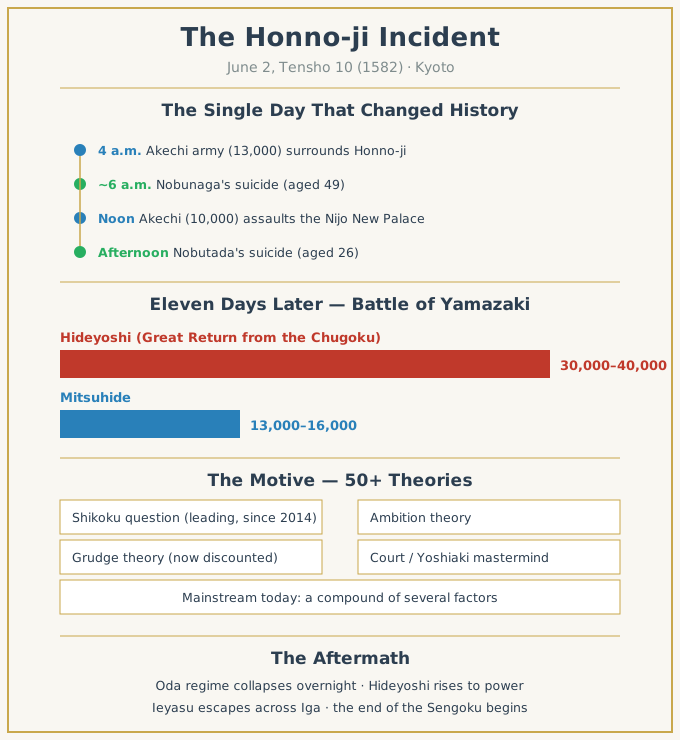
- Mitsuhide’s army of 13,000 surrounded Honnō-ji at dawn; Nobunaga, caught asleep, took his own life. The same day his heir Oda Nobutada also killed himself at the Nijō New Palace, and the Oda regime collapsed in a single night.
- Mitsuhide’s motive is still debated, with more than fifty theories ― the greatest mystery in Japanese history. Through Hashiba Hideyoshi‘s “Great Return from the Chūgoku,” Mitsuhide was defeated and killed eleven days later at the Battle of Yamazaki, and the road to Hideyoshi’s seizure of the realm opened as a result.
The Mainstream View ― The Standard Account Found in Textbooks
The 5th Month of Tenshō 10 ― The Oda Regime on the Verge of Unifying the Realm
In the 3rd month of Tenshō 10 (1582), Nobunaga cornered Takeda Katsuyori and his son Nobukatsu at Mount Tenmoku in the conquest of Kai and drove them to suicide, destroying his old enemy, the Takeda of Kai. In the Chūgoku region, Hashiba Hideyoshi faced the Mōri and was conducting a water attack on Bitchū Takamatsu Castle; in the Hokuriku, Shibata Katsuie was at war with the Uesugi. Akechi Mitsuhide, while governing Tanba and Ōmi, held a position within the Oda house sometimes called “viceroy of the Kinki.” Tokugawa Ieyasu, granted Suruga from the former Takeda lands, was to visit Azuchi Castle as an equal ally to offer congratulations. Nobunaga’s unification of the realm seemed to be only a matter of time.
On the 23rd of the 4th month, Kajūji Harutoyo arrived at Azuchi as an imperial envoy of congratulation. He sounded out the “recommendation to one of three offices” ― that Nobunaga be recommended as chancellor, regent, or shogun ― but Nobunaga gave no clear reply. Meanwhile, on the 7th of the 5th month, Nobunaga ordered the organization of an army to subdue Chōsokabe Motochika, with his third son Kanbe (Oda) Nobutaka as supreme commander, and a crossing to Shikoku was planned for the 2nd of the 6th month. With this, the standing of Mitsuhide, who had served as the go-between with the Chōsokabe, was utterly lost.
On the 15th of the 5th month, Ieyasu’s party, granted Suruga in reward for the Takeda campaign, arrived at Azuchi. Nobunaga assigned Mitsuhide the role of host, but only three days later, on the 17th, a plea for reinforcements arrived from Hideyoshi, who was conducting the water attack on Bitchū Takamatsu Castle: “Mōri Terumoto will soon take the field.” Nobunaga at once removed Mitsuhide from the role of host and ordered him to serve as the vanguard of Hideyoshi’s relief. Mitsuhide left Azuchi on the 17th, returned to Sakamoto Castle, and began preparations for the campaign. Ieyasu was guided on to sightseeing in Kyoto, Osaka, Nara, and Sakai.
The 26th of the 5th Month – the 1st of the 6th ― Mitsuhide’s Ominous Preparations
On the 26th of the 5th month, Mitsuhide left Sakamoto Castle and entered Tanba Kameyama Castle. The next day, the 27th, he climbed Mount Atago, north of Kameyama, worshipped at Atago Gongen, and lodged there in seclusion that day. According to the Shinchō Kōki, Mitsuhide, perhaps with something on his mind, drew a fortune-lot two or three times before the Tarōbō shrine. On the 28th, he held a linked-verse gathering (the Atago Hyakuin) at the Itokuin Saibō and left the famous opening verse, “Now is the time ― in the rainy fifth month, the realm comes under heaven’s rule.” In later ages this was reread as “Toki is now ― in the fifth month, the realm comes under [my] rule,” and is interpreted as Mitsuhide’s declaration of resolve (the word for “now is the time,” toki, being a homophone of the Toki clan from which Mitsuhide claimed descent).
According to the Kawasumi Taikōki, on the 29th Mitsuhide sent a baggage train ahead toward the western provinces, carrying a hundred loads including long chests packed with bows, muskets, arrows, and shot. On that same 29th, Nobunaga entrusted Azuchi Castle to a caretaker guard and went up to the capital accompanied only by his pages, without a guard escort, entering his usual lodging in the capital, Honnō-ji. The reason for Nobunaga’s visit is not clear. Since he had thirty-eight famous utensils brought from Azuchi, it is said that his direct purpose was a “utensil-unveiling tea gathering,” inviting the wealthy Hakata merchant Shimai Sōshitsu to display his prized tea wares. Negotiations with the court ― his reply to the “recommendation to one of three offices,” and the question of adopting the Owari calendar (the authority over calendar-making) ― may also have been on the agenda. In any case, it was a defenseless stay with only a few pages and about a hundred attendants.
On the 1st of the 6th month, a tea gathering was held at Honnō-ji to which Shimai Sōshitsu and others were invited. Many court nobles also attended ― Konoe Sakihisa, Kujō Kanetaka, Ichijō Uchimoto, Nijō Akizane, Takatsukasa Nobufusa ― and Nobunaga’s treasured famous tea wares were displayed. That night Nobunaga shared sake with his heir Nobutada (then lodging at Myōkaku-ji), enjoyed casual talk, and went to bed. Meanwhile, Mitsuhide’s army of 13,000, having left Kameyama Castle, had begun marching toward the capital under cover of darkness. Mitsuhide had told his officers and men that they were “heading to Bitchū as the vanguard of the Chūgoku campaign.”
Early Morning, the 2nd of the 6th Month ― “The Enemy Is at Honnō-ji”
According to the mid-Edo-period Akechi Gunki, early on the 2nd of the 6th month, as they crossed the Katsura River, Mitsuhide declared to his officers and men, “The enemy is at Honnō-ji,” revealing his intent to rebel for the first time. However, “the enemy is at Honnō-ji” does not appear in contemporary sources and is strongly suspected to be a later invention. The actual course of events was closer to this: Mitsuhide’s army quietly closed in and surrounded Honnō-ji, and began the attack at daybreak.
Around four in the morning (the hour of dawn), the Akechi force completed its encirclement of Honnō-ji. As to the number of attackers, the Sofu Monogatari gives somewhat over 3,000 mounted men; not the whole 13,000 were committed to the encirclement of Honnō-ji, and it is possible that a main body of about 2,000 carried out the direct assault. Honnō-ji at the time had a structure close to a fortified temple, ringed with a moat, an earthen rampart, and walls, but once surrounded on all four sides there was no room to resist. According to the recollection of Honjō Sōemon, who broke in from the south gate, there was almost no one to oppose them inside the temple, and the gate stood wide open.
According to the Shinchō Kōki, Nobunaga awoke to war cries and gunfire, and at first asked, “Is it a brawl among the lower servants?” When Mori Naritoshi (Ranmaru) reported, “It is a rebellion. They appear to be Akechi’s men,” Nobunaga uttered a single phrase: “It cannot be helped.” After this, Nobunaga took up a bow and kept shooting, and when his arrows ran out he switched to a spear and fought on, but he received a spear wound to the elbow, withdrew into the inner part of the building, shut the door of a storeroom fast, and took his own life. Whether it was Nobunaga himself, his retainers, or the Akechi force who set the fire is unknown, but Honnō-ji went up in flames.
The three Mori brothers said to have been present at Nobunaga’s end ― Mori Ranmaru (Naritoshi), Mori Bōmaru (Nagataka), and Mori Rikimaru (Nagauji) ― along with the close attendants Sugaya Kakuzō, Yuasa Jinsuke, Yashiro Katsusuke, and Ban Shōrin, all died fighting. Nobunaga’s death is estimated to have come around six in the morning. From the assault to the fall of Honnō-ji, it was the work of a mere one to two hours.
That Morning ― The Fighting at Myōkaku-ji and the Nijō New Palace
At Myōkaku-ji, 1.2 kilometers north-northeast of Honnō-ji, Nobunaga’s heir Nobutada was lodging. Receiving word of Mitsuhide’s rebellion, Nobutada set out to relieve Honnō-ji, but the Kyoto deputy Murai Sadakatsu (Shunchōken) and two of his sons rushed up to stop him, advising: “Honnō-ji has already fallen, and the hall has burned down. The Nijō New Palace is strongly built and would be good to hold.” Nobutada complied and moved to the neighboring Nijō New Palace.
The Nijō New Palace was a residence Nobunaga had originally built as his own and, in Tenshō 7, had presented to Prince Sanehito, the crown prince of Emperor Ōgimachi. Nobutada urged Prince Sanehito and the young prince Kazuhito (the later Emperor Go-Yōzei) to withdraw to the imperial palace. Murai Sadakatsu negotiated a temporary ceasefire, and escape on foot was permitted. When the escaped Prince Sanehito and his family stood at a loss in the street, the townsman and linked-verse master Satomura Jōha is said to have brought a humble palanquin and carried them to the palace.
Having seen Prince Sanehito off, Nobutada held a war council at the Nijō New Palace. Among his close attendants were those who advised, “Withdraw,” urging escape to Azuchi, but Nobutada showed his resolve: “Given a rebellion of this scale, the enemy will surely not let us escape even by chance. To die at the hands of common soldiers would be a dishonor and a bitter regret for all time. Let us cut our bellies here.”
Around noon (the hour of the horse), the Akechi force of 10,000 attacked the Nijō New Palace. Nobutada had some 500 of his own men, and with the addition of Nobunaga’s mounted guards who rushed to join, about 1,000 to 1,500. For over an hour they repeatedly opened the gates and charged out three times, fighting hard, but the Akechi force climbed onto the roof of the neighboring Konoe Sakihisa residence and picked them off with bows and muskets, wearing the Nobutada force down. When the Akechi force broke into the building and set fire, Nobutada ordered Kamata Shinsuke to behead him, instructed that the floor boards be removed and his body hidden beneath the floor, and took his own life. He was twenty-six. Murai Sadakatsu, Sugaya Nagayori, Fukutomi Hidekatsu, Saitō Toshiharu (the youngest son of Dōsan), Oda Nagatoshi (Nobunaga’s brother), and Oda Katsunaga (Nobunaga’s fifth son) also died fighting. Meanwhile, Oda Nagamasu (Urakusai), Maeda Gen’i, and Mizuno Tadashige succeeded in escaping.
Mitsuhide’s Conquest of the Kinki and His Defeat Eleven Days Later
Having brought off the Honnō-ji Incident, Mitsuhide moved at once to take control of the Kinki. That afternoon he went down the Ōtsu road from Awataguchi toward Ōmi, passed Sakamoto Castle, and took over Azuchi Castle. He was also active in maneuvering with the court, and it is said that on the 7th of the 6th month he was informally granted appointment to junior third rank and councillor (per the Akechi Mitsuhide-kō Kafu Oboegaki, of doubtful reliability). Mitsuhide requested reinforcements from his subordinate daimyō ― Hosokawa Fujitaka and his son Tadaoki, and Tsutsui Junkei ― but none responded.
Meanwhile, Hashiba Hideyoshi, in the midst of the water attack on Bitchū Takamatsu Castle, received the urgent report of the incident on the night of the 3rd of the 6th month and immediately made peace with the Mōri. Leaving Takamatsu on the 6th, he carried out the “Great Return from the Chūgoku,” covering some 200 kilometers in ten days. On the 13th of the 6th month the two armies clashed at Yamazaki in Yamashiro Province ― Hideyoshi’s 30,000–40,000 against Mitsuhide’s 13,000–16,000. Hideyoshi concealed the deaths of Nobunaga and his son and spread false information among the commanders, saying, “His Lordship and the young lord have both broken out safely,” to encourage Mitsuhide’s subordinate daimyō to defect. Mitsuhide was defeated at Yamazaki, and that night, while fleeing toward Sakamoto Castle, he was set upon by peasant stragglers-hunters in a bamboo thicket at Ogurusu in Yamashiro Province (present-day Fushimi Ward, Kyoto City), and took his own life after asking his retainer Mizoo Shigetomo to behead him. So ended the “three-day rule” ― in fact the eleven to twelve days from the 2nd to the 13th of the 6th month.
The Honnō-ji Incident was completed in a single day, and its outcome was decided eleven days later. Yet in those twelve days the history of Japan was decisively changed. Oda Nobunaga’s ambition to unify the realm was closed off forever, and in his place Hashiba Hideyoshi raced up the road to seizing the realm. Tokugawa Ieyasu barely escaped with his life across Iga back to Okazaki, and twenty years later would become the final victor. The greatest mystery in Japanese history brought, at one stroke, both the end of the Sengoku period and the dawn of early-modern Japan ― a literal turning point in the nation’s history.
Multiple Theories ― Where the Standard Account Wavers in Recent Research
Theory 1: The Question of Mitsuhide’s Motive ― Where the Fifty Theories Stand Now
It is said that more than fifty theories exist today about the motive for the Honnō-ji Incident. This is why it is called the greatest mystery in Japanese history. Here the major theories are sorted into categories.
1) The grudge theory: The standard view since the Edo period. The humiliation of being removed from the role of host to Ieyasu; the humiliation of being ordered to surrender Tanba and Ōmi and to carve out Izumo and Iwami in their place; the humiliation of nearly having his senior retainer Saitō Toshimitsu forced to commit suicide by Nobunaga; the kicking incident reported by Fróis’s History of Japan, and so on. Since Takayanagi Mitsutoshi’s Akechi Mitsuhide (1958) refuted these one by one, the grudge theory has lost academic support. It survives, however, as one element of the compound-motive theory.
2) The ambition theory (Takayanagi Mitsutoshi, 1958): The theory that Mitsuhide sought to take the realm in Nobunaga’s place. The grounds are Mitsuhide’s high position and mobility, the fact that only Mitsuhide had the chance to assault Honnō-ji, and the vigor of his maneuvering with the court after the incident. There is, however, strong criticism that Mitsuhide’s actions after the incident were “too unplanned for someone aiming at the realm,” and it is weak as a sole explanation of the motive.
3) The court-mastermind theory (Imatani Akira, Tachibana Kyōko): The theory that, because Nobunaga was pressing Emperor Ōgimachi to abdicate and demanding changes to the calendar, putting pressure on the court, the court ordered Mitsuhide to remove Nobunaga. It drew great attention in the 1990s. The grounds include that Konoe Sakihisa fled after the incident under suspicion of involvement, and that the diary of Yoshida Kanemi, the go-between with the court, the Kanemi-kyō Ki, shows traces of tampering around the time of the incident. From the 2000s on, however, the “theory of a combined imperial-warrior sovereignty” advanced by Hori Shin and others became mainstream, and as the understanding spread that Nobunaga and the court were in a relationship of cooperation and mutual dependence rather than confrontation, the court-mastermind theory has declined.
4) The Ashikaga Yoshiaki-mastermind theory (Fujita Tatsuo): Advanced by Professor Fujita Tatsuo of Mie University. It holds that the former shogun Ashikaga Yoshiaki, who had fled to Tomonoura, directed Mitsuhide through the Mōri to remove Nobunaga. In September 2017, a letter in Mitsuhide’s own hand (addressed to Dohashi Shigeharu), discovered at a museum in Gifu Prefecture, can be read as “written to acknowledge Yoshiaki’s entry into the capital,” and drew attention as material reinforcing the Yoshiaki-mastermind theory. However, there is little trace of Yoshiaki acting actively after the incident, and it lacks a decisive blow.
5) The Shikoku (avoiding the campaign) theory ― the leading theory since 2014: Nobunaga had at first given Chōsokabe Motochika of Tosa a vermilion-seal letter granting free conquest of Shikoku, saying, “As for Shikoku, take it as Motochika’s own achievement allows.” It was Mitsuhide who served as the go-between with Motochika, and Mitsuhide’s senior retainer Saitō Toshimitsu was bound by marriage to Motochika’s principal wife (his brother Yoritatsu being the husband of her elder sister). But from around Tenshō 8, Nobunaga reversed his Shikoku policy, and in the first month of Tenshō 10 issued a new vermilion-seal letter ordering that “all but one province of Tosa and two districts of southern Awa be surrendered,” and was about to send a Shikoku subjugation army under Nobutaka across the sea on the day after the Honnō-ji Incident (the 3rd of the 6th month).
In June 2014, the Ishigai Family Documents, made public by the Hayashibara Museum of Art in Okayama Prefecture, revealed a letter dated the 21st of the 5th month of Tenshō 10 ― only eleven days before the Honnō-ji Incident ― in which Chōsokabe Motochika wrote to Saitō Toshimitsu that he would obey Nobunaga’s order. The discovery of this primary source corroborated the situation in which Mitsuhide and Toshimitsu were caught in the middle over the Shikoku question, and at once made the Shikoku theory a leading academic explanation. Highly rated by Fujita Tatsuo, Kirino Sakujin, and others, it is now regarded as the foremost candidate among theories of the Honnō-ji Incident’s motive.
6) The theory of Mitsuhide’s lone “righteous act”: The day after the Honnō-ji Incident, Mitsuhide notified various places by letter that “the wickedness of Nobunaga and his son was an obstacle to the realm, and so I have struck them down.” Taking this at face value, the theory holds that Mitsuhide rose up alone to stop Nobunaga’s tyranny. (1) Nobunaga’s plan to usurp the imperial throne; (2) his interference in the calendar; (3) his desiring the office of shogun despite not being of Minamoto descent; (4) his abusive words toward Konoe Sakihisa; (5) the burning to death of Kaisen Jōki; (6) his building, at Azuchi Castle, a main-bailey hall that looked down upon the emperor ― these are listed as the particulars of the “wickedness.” There is strong criticism, however, that this idealizes Mitsuhide too much.
These theories are not mutually exclusive, and in current research the “compound-motive theory” has become mainstream. The scenario most researchers support runs roughly as follows: “Having lost face as go-between over the Shikoku question, Mitsuhide deepened his distrust of Nobunaga. The hand of punishment was about to reach even his senior retainer Saitō Toshimitsu. There were rumors that Tanba and Ōmi would be confiscated, and a sense of crisis that once Nobunaga’s unification of the realm was complete, his own role might be over. Furthermore, the ‘golden opportunity’ of Nobunaga staying at Honnō-ji with only his pages happened to arrive. With several factors aligning at once, Mitsuhide reached his decision.” Seeing it not as a single motive but as several factors acting in layers is the academic mainstream as of 2026.
Theory 2: The Question of Mitsuhide’s Whereabouts ― The Toba-Waiting Theory
At the time of the Honnō-ji assault, was Mitsuhide really at the scene of the fighting? In fact there is a new theory that Mitsuhide himself did not go to the scene of the assault but waited at Toba, to the south of Kyoto.
In 2020, the Itsuya no Kakimono (completed in Kanbun 12, 1672), written by Sekiya Masaharu, a retainer of the Kaga domain, was reappraised, and Hagiwara Daisuke and others of the Toyama City Local Museum published a detailed analysis. The work is said to be Sekiya Masaharu’s record of what Saitō Toshimune ― the third son of Saitō Toshimitsu, who had served in the Honnō-ji Incident ― told his nephew (Inoue Seizaemon), who had become a retainer of the Kaga domain.
According to the Itsuya no Kakimono, of Mitsuhide’s army of 13,000, an elite 2,000 went to assault Honnō-ji, while the remaining troops were kept waiting at Toba to guard against the Nijō New Palace quarter. And Mitsuhide himself did not join the Honnō-ji assault but directed from Toba, while the one who took field command of the Honnō-ji assault was Saitō Toshimitsu.
As reinforcing material, the diary of the noble Yamashina Tokitsune, the Tokitsune-kyō Ki, records of Saitō Toshimitsu that he was “foremost in this rebellion,” and Toshimitsu’s prominence stands out ― in the post-incident distribution of rewards, and in his deployment at the front (before Mitsuhide’s headquarters at Goboduka) in the Battle of Yamazaki.
This theory rests on a source completed about ninety years after the Honnō-ji Incident, and the possibility of later embellishment cannot be denied. Fukushima Katsuhiko of the Ōyamazaki Town History and Folklore Museum also points out that the “old man” who related the Itsuya no Kakimono may have confused it with the fact that Mitsuhide was at Toba not during the Honnō-ji Incident but just before the Battle of Yamazaki. Even so, the conventional view that Mitsuhide himself was at the scene is not in fact firmly corroborated by contemporary sources. The dramatic staging of “the enemy is at Honnō-ji” may be no more than an image created by later war tales.
If this theory is correct, then the Honnō-ji Incident may be interpreted less as the rebellion of the single individual Mitsuhide than as a coup led by a retainer corps centered on Toshimitsu over the Shikoku question. The recent revival of the “Saitō Toshimitsu prime-mover theory” is the result of such an accumulation of new sources and new interpretations.
Theory 3: The Question of Where Nobunaga’s Body and Head Disappeared To
One of the greatest mysteries of the Honnō-ji Incident is the whereabouts of Nobunaga’s body and head. Mitsuhide needed the body and head as proof that he had struck down Nobunaga, for displaying the head would let him show “the legitimacy of the rebellion” to all. Yet despite Mitsuhide’s desperate search, Nobunaga’s body was not found. Later Hashiba Hideyoshi ordered a renewed search at Honnō-ji, but again it was not found, and at the funeral at Daitoku-ji in the 10th month of that year, lacking a body, they had no choice but to burn a life-sized wooden image.
Researchers note the following: in a fire in a wooden building, a body almost never burns away completely. Identification by the face, by physical features, or by the teeth ought to be possible. Therefore one can only conclude that Nobunaga’s body was carried out of Honnō-ji by someone. Who carried it, and where? Several traditions are handed down.
1) The Amida-ji / Seigyoku Shōnin theory: A theory transmitted in the origin-record of the Jōdo-sect Amida-ji in Kamigyō Ward, Kyoto (the Record of the Origins of Lord Nobunaga’s Amida-ji). Hearing the news of the Honnō-ji Incident, the priest Seigyoku Shōnin (a high monk on close terms with Nobunaga) rushed up with twenty monks. Breaking through the hedge of Honnō-ji and entering, in a thicket behind the graves about ten warriors were burning something. When he asked, they confided: “By Lord Nobunaga’s last will, his remains must not be handed to the enemy. We are now carefully cremating the body and will commit suicide afterward.” Seigyoku Shōnin persuaded them that “cremation is the work of the clergy,” took up the remains, packed the bones into his robe, carried them out, brought them back to Amida-ji, and buried them. The priest is also said to have gathered the remains of Nobutada, who died at the Nijō New Palace, and buried them at Amida-ji.
However, this origin-record claims to have been “remade from memory because the old records had burned” in Kyōhō 16 (1731), and its source value is doubtful. Situational doubts also remain ― “Could they have entered from the rear?” “While burning the body, were they not noticed by the Akechi force?” On the other hand, the “Mausoleum of Lord Oda Nobunaga” still exists at Amida-ji and is revered locally as the most important grave of Nobunaga.
2) The Nishiyama Honmon-ji theory (instructed by Hon’inbō Sansa, carried off by Hara Muneyasu): A theory transmitted at Nishiyama Honmon-ji in Fujinomiya, Shizuoka Prefecture. The day before the Honnō-ji Incident, Nobunaga watched a game of go between the master Hon’inbō Sansa (the priest Nikkai) and Kashio Riken. At this time, a rare phenomenon called sankō (triple kō) is said to have appeared on the board. The triple kō has from of old been considered “an omen of misfortune.” Sansa lodged at Honnō-ji, and in the confusion of the assault and Nobunaga’s suicide the next morning he is said to have ordered Hara Shima-no-kami Muneyasu: “Nobunaga’s head must not be handed to the enemy. Go to Suruga and entrust it to the priest Nichijun of Nishiyama Honmon-ji.” Muneyasu escaped Honnō-ji carrying Nobunaga’s head and, after a long journey, reached Nishiyama Honmon-ji. The priest Nichijun was a disciple of Sansa and a relative of Muneyasu. By temple tradition, Nobunaga’s head was buried and venerated at the root of a great holly behind the main hall.
In 1979 the historian Yamaguchi Minoru, and in 2000 the writer Abe Ryūtarō, each presented this theory, and it came to be widely known among history enthusiasts. One ground is that the death-register written by Nichijun contains the entry “6th month of Tenshō 10, Sōken’in Nobunaga, executed by Akechi.” Abe points out that the word “executed” (chū-suru) is a term for a superior punishing an inferior, and can be read as “Mitsuhide struck down Nobunaga on the order of someone above Nobunaga” (the only such figure at the time being the shogun Ashikaga Yoshiaki, so it is also tied to the Yoshiaki-mastermind theory).
There is, however, a weak point. The Honnō-ji Incident was in early summer (early 6th month of the old calendar = late June of the new), and the head would have rotted on the way to Suruga. There is the precedent that, at the Battle of Okehazama, Imagawa Yoshimoto’s head could not be carried back to Suruga and was buried at Tōkō-ji in Nishio, Mikawa. The very “transport of the head” carries physical difficulty.
3) The Yasuke-carried-it-off theory: A popular theory that Nobunaga’s black page Yasuke carried off Nobunaga’s head when escaping Honnō-ji. Fearing discovery, Yasuke is said to have hidden the head somewhere and carried it off again once he had been freed. The Nishiyama Natural History Museum in Seto, Aichi Prefecture, is said to hold a “death mask of Nobunaga” made from the head Yasuke carried off, and it has been featured on television programs. Its academic credibility is low, but it is a theory that draws attention amid the recent rise of interest in Yasuke.
4) The Fróis “turned to ash” theory: The missionary Luís Fróis’s History of Japan records that Nobunaga’s body “became completely ash, without leaving a single hair.” This, however, is an account compiled from hearsay, and Fróis did not see the scene. Physically, too, it is unnatural for a human body to be wholly reduced to ash in a fire in a wooden building. It also contradicts later secondary sources (Oze Hoan’s Shinchōki, the Tōdaiki) that write, “It was unnatural for the body to have burned away completely, and Mitsuhide, suspicious, searched for it.”
5) The Rinshōdan burnt-remains-found theory: The Rinshōdan contains an account that Mitsuhide found the burnt remnant of a small-sleeved robe with a melon crest, and the body wearing it, and displayed it to his whole army saying, “This is Nobunaga’s body.” But it seems that even at the time this body was not believed to be genuine, and Nobunaga’s body is still considered missing today. The interpretation becomes “Mitsuhide himself did not think it genuine.”
Where is the real body?: Of these theories, the one most consistent with the circumstances is the Amida-ji theory, but it suffers from doubtful source reliability. The Nishiyama Honmon-ji theory is romantic but has a physical problem. In the end, where Nobunaga’s body and head went cannot be identified even today. As one of the greatest mysteries in Japanese history, hopes rest on future discoveries of sources and scientific investigation.
Theory 4: Nobutada’s Fate ― The Fighting at the Nijō New Palace and the Whereabouts of Yasuke
The Honnō-ji Incident was not the tragedy of Nobunaga alone. On the same day, Nobutada ― Nobunaga’s heir and successor, who had already inherited the headship of the Oda house ― was also struck down at the Nijō New Palace. With this the Oda regime was literally “beheaded and gutted at once,” and it collapsed instantly.
Nobutada’s fateful choice: Hearing of the Honnō-ji assault at Myōkaku-ji, Nobutada at first left Myōkaku-ji intending to relieve Honnō-ji. But the Kyoto deputy Murai Sadakatsu and his sons rushed up and told him, “Honnō-ji has already fallen,” advising him to fortify himself in the neighboring Nijō New Palace. Nobutada complied and entered the Nijō New Palace.
Among his close attendants were those who advised escape to Azuchi. In fact, had Nobutada escaped at once, he might, as head of the Oda house, have been able to resist the Akechi force from Azuchi Castle. The contemporary source Tōdaiki comments: “Because Mitsuhide had kept his plan deeply secret, he had laid no scheme on the roads (to prevent Nobutada’s escape). It would have been no trouble to move to Azuchi, but it was the end of his fortune.” That is, had Nobutada only decided, he could have escaped.
But Nobutada resolved to fortify the palace: “Given a rebellion of this scale, the enemy will surely not let us escape even by chance. To die at the hands of common soldiers would be a dishonor and a bitter regret for all time. Let us cut our bellies here.” Nobutada’s choice was coherent for a Sengoku warlord who valued the honor of the warrior house, but politically and strategically it was a fatal decision that hastened the collapse of the Oda regime. Had Nobutada fled to Azuchi and resisted the Akechi force as head of the house, the historical outcome of the Honnō-ji Incident would very likely have been greatly different.
The fighting at the Nijō New Palace: A hopeless disparity of forces ― some 10,000 Akechi against 500 to 1,500 of Nobutada. Even so, the Nobutada force repeatedly opened the gates and charged out three times over more than an hour, repelling the attackers. Through the hard fighting of an elite unit centered on the cloak-bearers, the Akechi force is thought to have taken considerable losses. But the Akechi force climbed onto the roof of the neighboring Konoe Sakihisa residence and picked them off with bows and muskets, wearing the Nobutada force down. In the end the Akechi force broke into the building and set fire, and Nobutada ordered Kamata Shinsuke to behead him and took his own life. He was twenty-six.
Among the commanders who died with him were Murai Sadakatsu (the Kyoto deputy), Sugaya Nagayori, Fukutomi Hidekatsu, Saitō Toshiharu (the youngest son of Dōsan), Oda Nagatoshi (Nobunaga’s brother), Oda Katsunaga (Nobunaga’s fifth son), and Mōri Yoshikatsu. Meanwhile, Oda Nagamasu (Urakusai, Nobunaga’s brother, later active as a tea master), Maeda Gen’i (later one of the Five Commissioners of the Toyotomi), and Mizuno Tadashige succeeded in escaping. The dividing line of fate between those who escaped and those who died greatly affected the later history of the Sengoku.
The whereabouts of Yasuke: The black page Yasuke, who served Nobunaga, also fought in the Honnō-ji Incident. He was originally an African slave whom the Jesuit Visitor Alessandro Valignano had bought in India, and who was presented to Nobunaga in the 2nd month of Tenshō 9 (1581). The Shinchō Kōki records that “a black monk came from a Christian land,” “aged twenty-six or twenty-seven,” “his body black like an ox,” and “strong.” Nobunaga gave Yasuke a stipend, and they stood in a lord-retainer relationship.
Research has recently advanced on where Yasuke fought in the Honnō-ji Incident. A letter of Fróis (the Italian-language edition of the Jesuit correspondence) records: “The black man whom the Visitor had presented to Nobunaga went, after Nobunaga’s death, to the residence of the heir and seems to have fought for quite a long time. Then a retainer of Akechi approached him, and since he said without fear to hand over his sword, the black man meekly gave it up. The retainer asked Mitsuhide how he should treat this black man, and Mitsuhide said, ‘The black slave is an animal and knows nothing, and he is not a Japanese, so do not kill him. Place him at the church of the padres.'”
Conventionally this “residence of the heir” was interpreted as the Nijō New Palace, but in the latest research since 2024 (especially close reading of the original Fróis correspondence), the view that “casa do príncipe” (the prince’s house) refers to Myōkaku-ji has become strong. In Fróis’s letter, Nobutada is described as moving from the “mosteiro” (monastery = Myōkaku-ji) to the “casas do filho da Dayri” (the residence of the son of the Dairi = the Nijō New Palace), and “casa do príncipe” matches the former. That is, it is suggested that Yasuke may have remained at Myōkaku-ji after Nobutada moved to the Nijō New Palace, and there fought as if to protect non-combatants from the Akechi side’s straggler-hunting.
Mitsuhide ordered that “Yasuke, being not a Japanese, is not to be killed,” and handed him over to the Nanban-ji (the Jesuit church) near Honnō-ji. After that, Yasuke’s whereabouts are unknown. A foreigner who happened to be present at the scene of the most dramatic event in Japanese history and survived it. What the Honnō-ji Incident he witnessed was like, no testimony of his own survives to tell.
Theory 5: Nobunaga’s End ― Interpreting the Words “It Cannot Be Helped”
Nobunaga’s last words as transmitted by the Shinchō Kōki, “It cannot be helped,” are among the most famous lines in Japanese history. Long interpreted as “resignation” or “acceptance,” they have in recent years been given a different reading.
The conventional interpretation ― resignation: “It cannot be helped” is a word of resignation meaning “there is nothing more to be done; I can only resolve myself.” It is interpreted as Nobunaga grasping everything in an instant and taking his own life without resistance. The Kyōto-tsū encyclopedia’s statement that “Nobunaga, hearing of Mitsuhide’s break-in, gave up in an instant, set fire, and took his own life” is based on this reading. It was often told in a context emphasizing Mitsuhide’s formidable quality as a strategist ― that even Nobunaga could not resist before so strong an enemy.
The recent interpretation ― a battle order: A reading that takes “it cannot be helped” to mean a battle order: “there is no room for argument; we can only fight,” “no use in dithering ― fight.” In fact, the Shinchō Kōki records that after saying “it cannot be helped,” Nobunaga took up a bow and kept shooting, and when his arrows ran out switched to a spear and fought on. This is inconsistent with “instant resignation.” Rather, Nobunaga showed the will to fight to the end and withdrew to the inner part of the building to take his own life only after receiving a spear wound to the elbow.
This difference of interpretation seems small but in fact bears on the understanding of the whole Honnō-ji Incident. The “resignation theory” emphasizes the perfection of Mitsuhide’s strategy, while the “battle-order theory” depicts Nobunaga’s end as a warrior. Which is closer to historical fact is, in the end, unknown, but recent research tends to support the image of Nobunaga as “a warlord who fought to the end” rather than “a hero of resignation.”
The truth of “the enemy is at Honnō-ji”: Alongside Nobunaga’s end, Mitsuhide’s famous command “the enemy is at Honnō-ji” also does not in fact appear in contemporary sources. It first appears in the mid-Edo-period Akechi Gunki, and is very likely a later literary embellishment. The actual Akechi army is thought to have quietly surrounded Honnō-ji and begun the attack at daybreak. Even if the dramatic line was a later invention, it lives on as a fine phrase that distills the essence of the Honnō-ji Incident.
Theory 6: The Structural Reason the Honnō-ji Incident “Succeeded” While Mitsuhide “Failed”
As a military operation, the Honnō-ji Incident was a perfect success. The aim of striking down Nobunaga and Nobutada at the same time was completely achieved. Yet only eleven days later Mitsuhide was defeated and killed. Why did a “successful rebellion” end in a “failed seizure of power”? Here this structural problem is sorted out.
1) The fatal blunder of the undiscovered body: Mitsuhide’s greatest miscalculation was his failure to find Nobunaga’s body and head. Displaying the head would have proven Nobunaga’s death to all and forced the subordinate daimyō and the court to recognize Mitsuhide’s new regime. But because the body was not found, Hideyoshi was able to spread false information among the commanders: “His Lordship and the young lord have both broken out safely.” Hosokawa Fujitaka and his son Tadaoki, Tsutsui Junkei, Ikeda Tsuneoki, Takayama Ukon, and others, receiving this information, chose neutrality or defection to Hideyoshi. This is the weak point of “a rebellion without a corpse.”
2) The neutralization of allies and relatives: Mitsuhide’s greatest ally was Hosokawa Fujitaka (Yūsai). He had been an ally since the days of installing Yoshiaki, and Mitsuhide’s third daughter Tama (the later Hosokawa Gracia) was married to Fujitaka’s heir Tadaoki. But Fujitaka at once shaved his head and went into mourning after the incident, and Tadaoki confined Tama at Mitono in Tango. Furthermore, the subordinate daimyō Tsutsui Junkei defected to Hideyoshi. The moment the Akechi subordinate-daimyō structure collapsed, Mitsuhide’s mobilizing power fell catastrophically.
3) The plunge in mobilizing power: Mitsuhide’s original mobilizing power, including Tanba at 340,000 koku, the Shiga district of Ōmi at 50,000 koku, and the subordinate daimyō (the Hosokawa, Tsutsui, and the Wakasa and Settsu forces), reached 40,000–50,000. But in the Honnō-ji Incident there was no time for advance preparation against the Great Return from the Chūgoku, and since the subordinate daimyō defected, the number he could mobilize at the Battle of Yamazaki was 13,000–16,000. Because he also had to allot troops to keep order in the capital and to hold the Ōmi quarter, only about 10,000 are said to have been concentrated at the decisive battlefield. The disparity with Hideyoshi’s 30,000–40,000 thus became decisive.
4) Hideyoshi’s abnormal speed: The Great Return from the Chūgoku was so abnormally fast as to invite the suspicion that “it had been prepared in advance.” To cover some 200 kilometers in ten days required that everything ― relays of horses, provisions, rest, and the march route ― be perfectly arranged. Mitsuhide had reckoned Hideyoshi’s return as “a month away at the earliest,” and that estimate collapsed from the root. It is partly because of this abnormal speed that some advance the possibility that Hideyoshi knew of the Honnō-ji Incident in advance (the “Hideyoshi-mastermind theory”).
5) The failure to legitimize the “rebellion”: The day after the incident, Mitsuhide notified various places by letter that “the wickedness of Nobunaga and his son was an obstacle to the realm, and so I have struck them down,” seeking to position his rebellion as a “righteous act.” But the commanders received this as “the excuse of a traitor.” As long as Nobunaga was recognized as “the legitimate ruler advancing the unification of the realm,” his killing was simply processed as “rebellion.” Mitsuhide obtained neither inner legitimacy nor outer recognition.
These five factors compounded, and the militarily perfect Honnō-ji Incident ended as a complete political failure. In the sense of “preventing the unification of the realm” it was a success, but in the sense of “taking the realm himself” it was a failure. Mitsuhide’s tragedy is the irony of history born of the imbalance between military genius and political clumsiness.
Viewed Strategically ― What the Honnō-ji Incident Brought to Japanese History
The Moment the Structural Fragility of the Oda Regime Was Exposed
The Honnō-ji Incident was not the tragedy of Nobunaga as an individual but an event that exposed the structural fragility of the Oda regime itself. Nobunaga appointed people by merit and treated hereditary retainers and outsiders alike. This was an innovative system that gave a chance to men of obscure origin like Mitsuhide, but it was also unstable, because retainers’ loyalty rested not on “house” but on “the assessment of individual ability.” The height of Mitsuhide’s position depended on Nobunaga’s personal estimation, and it was built amid the tension of never knowing when it might be overturned.
When he lost face as go-between over the Shikoku question, when rumors arose of the confiscation of Tanba and Ōmi, and when even the problem of his senior retainer Saitō Toshimitsu’s treatment was added, Mitsuhide’s anxiety was maximized. Nobunaga’s meritocracy, while producing rising stars like Mitsuhide, contained the structural danger of cornering those same retainers and driving them to rebellion. The defection of Araki Murashige (1578), the revolt of Bessho Nagaharu (1578), the expulsion of Sakuma Nobumori and Hayashi Hidesada (1580) ― all these uneasy movements within the Oda house were some kind of reaction to the cold-bloodedness of the Oda regime. The Honnō-ji Incident was the moment when that structural problem of the Oda regime was most dramatically exposed.
Ieyasu’s Crossing of Iga ― The Future Ruler Who Survived by a Hair’s Breadth
At the moment the Honnō-ji Incident occurred, Tokugawa Ieyasu was in the very midst of sightseeing in Sakai. He had only some thirty-odd retainers with him, and had the Akechi force attacked, he would surely have been killed. With the help of Hattori Hanzō and others, Ieyasu carried out the “crossing of Iga” (the route of escaping through the mountains of Iga to Ise and Mikawa) and barely returned to Okazaki with his life. By one account Ieyasu himself was for a time resolved to commit suicide ― it was the greatest crisis of his life.
Had Ieyasu been killed at this time, the subsequent history of Japan would have changed greatly. After Hideyoshi’s unification of the realm, who would have inherited the Tokugawa domain, who versus whom Sekigahara would have been ― all would have become a different, unimaginable history. Ieyasu’s crossing of Iga was another branch point of Japanese history that occurred behind the Honnō-ji Incident.
The Road to Hideyoshi’s Seizure of the Realm
The greatest beneficiary of the Honnō-ji Incident was Hashiba Hideyoshi. He struck down Mitsuhide through the Great Return from the Chūgoku, seized leadership within the Oda house at the Kiyosu council, defeated Shibata Katsuie at the Battle of Shizugatake, brought the Battle of Komaki and Nagakute against Ieyasu to a draw and made him submit, and only eight years later, in 1590, completed the unification of the realm with the Odawara campaign. The gap between the forty years of obscurity in the first half of Hideyoshi’s life and the fifteen years of seizing the realm in the second could not have come about without the Honnō-ji Incident.
Behind the persistence of the “Hideyoshi-mastermind theory” ― that “Hideyoshi was the mastermind of the Honnō-ji Incident” ― lies this relationship of benefit. The abnormal speed of the Great Return from the Chūgoku, the scheming letters disguised as efforts to rescue Mitsuhide’s wife and children, the skillful maneuvering at the Kiyosu council ― all of Hideyoshi’s moves look as if they had been “prepared in advance.” Academically the Hideyoshi-mastermind theory is not supported, but it is a fact that, in terms of outcome, Hideyoshi became the greatest victor.
The Starting Point of the “End of the Sengoku”
The Honnō-ji Incident became, as a result, the starting point of the “end of the Sengoku period.” Had Nobunaga lived, his cold-blooded unification of the realm would probably have succeeded, but the order that followed would very likely have been unstable. Through the three-stage process of the rebellion of the symbolic figure Akechi Mitsuhide, the upheaval within the Oda house, Hideyoshi’s “more flexible unification of the realm,” and Ieyasu’s “final stabilization,” Japan was able to transition to a stable early-modern state.
Had the Honnō-ji Incident not occurred and Nobunaga completed the unification as he was, a regime dependent on Nobunaga’s personal charisma might, after his death (the 49-year-old Nobunaga of 1582 was healthy and very likely had another twenty years to live), have invited great confusion. The Honnō-ji Incident was a tragedy for Nobunaga as an individual, but from the standpoint of the stabilization of Japanese history as a whole, some researchers assess that it functioned, in result, as a “self-correcting mechanism of history.”
The figure of Akechi Mitsuhide reflects the essence of a human being wavering between such opposite poles ― loyalty and rebellion, righteousness and ambition, violence and good government, rationality and emotion. Why the greatest mystery in Japanese history has continued to draw people for more than 440 years ― perhaps it is because the Honnō-ji Incident is not merely a past event but a mirror that reflects the “complexity” that exists within ourselves.
Famous Words from This Battle
“It cannot be helped.”
Nobunaga’s last words as transmitted by the Shinchō Kōki. The single phrase Nobunaga uttered on receiving the report, “It is a rebellion. They appear to be Akechi’s men.” Long interpreted as “resignation,” it has in recent years also been read as a battle order meaning “there is no room for argument; we can only fight.” In fact, the record that Nobunaga fought on with bow and spear after these words conjures the figure of “a warlord who fought to the end.” One of the most famous lines in Japanese history.
“The enemy is at Honnō-ji.”
The command said to have been given to the Akechi army heading for Honnō-ji. It first appears in the mid-Edo-period Akechi Gunki and does not appear in contemporary sources. It is very likely an invention of later war tales, but is still used as a fine phrase that distills the essence of the Honnō-ji Incident. A phrase that symbolizes the themes of “betrayal” and “keeping the true target secret.”
“Now is the time ― in the rainy fifth month, the realm comes under heaven’s rule.”
Mitsuhide’s opening verse at the linked-verse gathering “Atago Hyakuin” at the Saibō of Mount Atago on the 28th of the 5th month of Tenshō 10, just before the Honnō-ji Incident. “Now is the time” (toki wa ima) is read as “Toki is now” ― a declaration of resolve that he, descended from the blood of the Toki clan, would “now be the time to rule the realm.” There is, however, a theory that this interpretation is a hindsight reading made after the Honnō-ji Incident. The most famous literary work as a symbol of Mitsuhide’s resolve to rebel.
“The wickedness of Nobunaga and his son was an obstacle to the realm, and so I have struck them down.”
A passage from the letter Mitsuhide sent to the commanders of the Kinki the day after the Honnō-ji Incident (the 3rd of the 6th month). It is the only statement of motive by Mitsuhide himself, positioning his own rebellion as a “righteous act.” The particulars of the “wickedness” are the plan to usurp the throne, interference in the calendar, abusive words toward Konoe Sakihisa, the burning to death of Kaisen Jōki, and the building of a main-bailey hall at Azuchi Castle that looked down upon the emperor. Some take this at face value to advance the “Mitsuhide-as-righteous-man theory.”
“Given a rebellion of this scale, the enemy will surely not let us escape even by chance. To die at the hands of common soldiers would be a dishonor and a bitter regret for all time. Let us cut our bellies here.”
Nobutada’s declaration of resolve as transmitted by the Shinchō Kōki. The words at the moment he chose to fortify the Nijō New Palace and take his own life, against attendants who urged escape. Whether it was the correct judgment as a successor is open to debate, but it is remembered as a passage that distills the sense of honor of a Sengoku warlord. The last resolve of the 26-year-old Nobutada.
“His Lordship and the young lord have both broken out safely.”
The scheming letter Hideyoshi sent to Mitsuhide’s subordinate daimyō during the Great Return from the Chūgoku. By spreading the false information that “Nobunaga and his son Nobutada escaped safely from Honnō-ji and the Nijō New Palace,” he induced wavering on the Akechi side. A splendid case of information warfare that turned the fact of Nobunaga’s undiscovered body to advantage. Hosokawa Fujitaka, Tsutsui Junkei, and others, receiving this letter, hesitated to side with Mitsuhide.
Anecdotes and Episodes
1. The Atago Hyakuin and “Now Is the Time”
On the 28th of the 5th month of Tenshō 10, Mitsuhide held a linked-verse gathering at the Saibō of Mount Atago. The attendees were nine: Satomura Jōha, Satomura Shōshitsu, Inawashiro Kennyo, Azuma Yukizumi, Mitsuhide’s eldest son Mitsuyoshi, Yūgen, and Gyōyū. Mitsuhide’s opening verse was “Now is the time ― in the rainy fifth month, the realm comes under heaven’s rule.” The second verse followed with Gyōyū’s “the summer mountains rising over the garden where the waters mount,” and the third with Jōha’s “damming the end of the stream where the blossoms fall.” It was completed as a linked verse of a hundred stanzas, known today as the Atago Hyakuin. Mitsuhide’s opening verse is reckoned a masterpiece even in literary terms, but after the Honnō-ji Incident it was reread as “Toki is now ― in the fifth month, the realm comes under [my] rule,” and came to be interpreted as a forewarning of the rebellion. How far Mitsuhide himself was conscious of this is an eternal mystery.
2. The Ill Omen of the Triple Kō ― The Go Game Between Hon’inbō Sansa and Nobunaga
On the night before the Honnō-ji Incident, Nobunaga watched a game of go between the master Hon’inbō Sansa (the priest Nikkai) and Kashio Riken. Sansa was skilled enough that even Nobunaga took instruction from him, and his opponent Riken was a considerable master in his own right. During the game, a rare phenomenon called the “triple kō” appeared on the board. The triple kō is a position in which three kō (a state of repeatedly taking the same point in turn) occur at once and the game has no choice but to be drawn, and it has been considered from of old “an omen that something inauspicious will occur.” The game ended in a draw, and Sansa lodged at Honnō-ji as he was. In the assault the next morning Nobunaga took his own life ― and later people shuddered that the ill omen of the triple kō had come true. Sansa would afterward become the central figure in the tradition that Nobunaga’s head was carried to Nishiyama Honmon-ji.
3. The Tea Gathering and the Thirty-Eight Famous Tea Wares
To the tea gathering held at Honnō-ji on the 1st of the 6th month, the wealthy Hakata merchant Shimai Sōshitsu (a tea master and linked-verse master) was invited. Nobunaga had thirty-eight treasured famous utensils brought from Azuchi Castle, and is said to have been negotiating in particular to have Shimai surrender the famous tea caddy in his possession, the “Narashiba Katatsuki.” The Narashiba Katatsuki was one of the “three great katatsuki of the realm” (Narashiba, Hatsuhana, and Nitta), and Nobunaga had already obtained the other two. The tea gathering was also an occasion to celebrate “the completion of the three katatsuki.” But in the Honnō-ji Incident the next morning, many of these thirty-eight famous utensils turned to ash. It was also the moment when Nobunaga’s ambition ― with “the unification of the realm” and “the completion of his tea-ware collection” both within reach ― was destroyed in a single night.
4. Yasuke’s Fight ― The Honnō-ji Incident as Seen by a Foreign Warrior
Yasuke, an African slave whom the Jesuit Visitor Valignano had bought in India, was presented to Nobunaga in Tenshō 9. The Shinchō Kōki records him as “aged twenty-six or twenty-seven, his body black like an ox, and strong.” Nobunaga gave Yasuke a stipend, and they stood in a lord-retainer relationship. In the Honnō-ji Incident, Yasuke is thought to have fought as part of Nobunaga’s personal guard. According to a letter of Fróis, after Nobunaga’s death he went to “the residence of the heir” (in Fróis’s original, very likely Myōkaku-ji) and fought on, and when Akechi’s retainers told him “hand over your sword, and we guarantee you will not be harmed,” he surrendered. Mitsuhide ordered, “The black slave is an animal and knows nothing, and he is not a Japanese, so do not kill him. Place him at the church of the padres,” and Yasuke was handed over to the Nanban-ji. His whereabouts thereafter are unknown. The only African witness who happened to be present at the scene of the most dramatic event in Japanese history and survived.
5. Prince Sanehito’s Escape and Satomura Jōha’s Palanquin
At the Nijō New Palace lived Prince Sanehito, the crown prince of Emperor Ōgimachi, and the young prince Kazuhito (the later Emperor Go-Yōzei). Nobutada urged them to escape, and Murai Sadakatsu negotiated a temporary ceasefire with the Akechi force. The Akechi force forbade the use of palanquins but permitted escape on foot. Prince Sanehito’s family stood at a loss in the street, but the townsman and linked-verse master Satomura Jōha (who had also attended the Atago Hyakuin) brought a humble palanquin and carried them to the palace. As an instance of a townsman’s quick wit saving an imperial crisis, it became an episode handed down for generations. Jōha, who was also close to Mitsuhide and an attendee at the Atago Hyakuin, is a symbolic figure linking the before and after of the Honnō-ji Incident.
6. The Search for Nobunaga’s Body ― Mitsuhide’s Desperate Hunt
After the assault on Honnō-ji, Mitsuhide had the burnt ruins searched desperately for Nobunaga’s body, with the aim of legitimizing his rebellion by displaying the head. But Nobunaga’s body was not found. This was a fatal miscalculation for Mitsuhide. During the march of the Great Return from the Chūgoku, Hideyoshi spread the false information that “Nobunaga and his son Nobutada escaped safely” and neutralized Mitsuhide’s subordinate daimyō. Had Mitsuhide securely obtained Nobunaga’s head, the defection of the subordinate daimyō could very likely have been prevented. The fatal flaw of “a rebellion without a corpse” led to defeat at the Battle of Yamazaki only eleven days later.
7. Nobunaga’s Funeral at Daitoku-ji Sōken’in and the Life-Sized Wooden Image
In the 10th month of Tenshō 10, Hideyoshi conducted Nobunaga’s funeral at Daitoku-ji in Kyoto. Sōken’in (named from Nobunaga’s posthumous name, “Sōken’in-den”) was built as the temple enshrining Nobunaga. But since there was no body, the funeral became an unusual rite in which a newly made life-sized wooden image of Nobunaga was burned and its ashes placed in an urn. This was also a political performance by which Hideyoshi established his leadership within the Oda house. Shibata Katsuie was not invited (foreshadowing the later Battle of Shizugatake). By gaining the position of “the one who conducted Nobunaga’s funeral,” Hideyoshi made it impossible for the brothers Oda Nobukatsu and Nobutaka to oppose him. The Honnō-ji Incident had, politically as well, prepared a perfect scenario for Hideyoshi’s seizure of the realm.
8. Ieyasu’s Crossing of Iga ― A Survival by a Hair’s Breadth
On the 2nd of the 6th month, when the Honnō-ji Incident occurred, Ieyasu was in the midst of sightseeing in Sakai. His companions were only some thirty-odd men ― Honda Tadakatsu, Sakai Tadatsugu, Ii Naomasa, Sakakibara Yasumasa, Ishikawa Kazumasa, Hattori Masashige, and others. Urged by Nobunaga to “tour Kyoto, Osaka, Nara, and Sakai,” he was in a defenseless state without even weapons. Had the Akechi force attacked, he would surely have been killed ― a desperate crisis. With the help of Hattori Hanzō and others, Ieyasu carried out the crossing of Iga (the route through the mountains of Iga to Ise and on to Mikawa). Suffering from straggler-hunting along the way, he returned to Okazaki Castle about three days later. By one account Ieyasu himself was for a time resolved to commit suicide. It was the greatest crisis in the life of the man who would take the realm twenty years later ― another branch point of Japanese history advancing behind the Honnō-ji Incident.
Chronology of the Honnō-ji Incident
| Year | Date | Event |
|---|---|---|
| Tenshō 10 (1582) | 3/11 | Takeda Katsuyori and his son Nobukatsu take their own lives at Mount Tenmoku; the Takeda of Kai are destroyed (the conquest of Kai) |
| Tenshō 10 (1582) | 4/21 | Nobunaga returns in triumph to Azuchi Castle |
| Tenshō 10 (1582) | 4/23 | Kajūji Harutoyo arrives at Azuchi as imperial envoy of congratulation and sounds out the “recommendation to one of three offices” |
| Tenshō 10 (1582) | 5/7 | Nobunaga orders the organization of a Shikoku subjugation army, with Kanbe (Oda) Nobutaka as supreme commander |
| Tenshō 10 (1582) | 5/15 | Tokugawa Ieyasu visits Azuchi Castle; Mitsuhide is assigned as host |
| Tenshō 10 (1582) | 5/17 | A plea for reinforcements from Hideyoshi; Nobunaga removes Mitsuhide from the role of host to Ieyasu and orders him to the vanguard of the Chūgoku campaign |
| Tenshō 10 (1582) | 5/21 | The date of the letter from Chōsokabe Motochika to Saitō Toshimitsu recorded in the Ishigai Family Documents |
| Tenshō 10 (1582) | 5/26 | Mitsuhide leaves Sakamoto Castle and enters Tanba Kameyama Castle |
| Tenshō 10 (1582) | 5/27 | Mitsuhide lodges in seclusion on Mount Atago and draws a fortune-lot two or three times before the Tarōbō shrine |
| Tenshō 10 (1582) | 5/28 | The Atago Hyakuin; the opening verse “Now is the time ― in the rainy fifth month, the realm comes under heaven’s rule” |
| Tenshō 10 (1582) | 5/29 | Nobunaga leaves Azuchi and enters Honnō-ji in Kyoto; Ieyasu sets out for sightseeing in Sakai |
| Tenshō 10 (1582) | 6/1 day | A tea gathering at Honnō-ji to which Shimai Sōshitsu is invited; the thirty-eight famous tea wares are displayed |
| Tenshō 10 (1582) | 6/1 night | The go game between Hon’inbō Sansa and Kashio Riken; the ill omen of the “triple kō” on the board. Mitsuhide’s army of 13,000 sets out from Kameyama Castle |
| Tenshō 10 (1582) | 6/2, 4 a.m. | Mitsuhide’s army completely surrounds Honnō-ji |
| Tenshō 10 (1582) | 6/2, ~6 a.m. | The assault on Honnō-ji; Nobunaga takes his own life (aged 49), after fighting with bow and spear, saying “It cannot be helped” |
| Tenshō 10 (1582) | 6/2, ~noon | The Akechi force of 10,000 attacks the Nijō New Palace; Prince Sanehito and Prince Kazuhito escape |
| Tenshō 10 (1582) | 6/2, afternoon | The Nijō New Palace falls; Oda Nobutada takes his own life (aged 26). Murai Sadakatsu, Sugaya Nagayori, and others die fighting; Yasuke surrenders at Myōkaku-ji |
| Tenshō 10 (1582) | 6/2, evening | Mitsuhide’s army goes down the Ōtsu road from Awataguchi toward Ōmi; Ieyasu’s party begins the crossing of Iga |
| Tenshō 10 (1582) | 6/3 | Mitsuhide notifies various places by letter that “the wickedness of Nobunaga and his son was an obstacle to the realm.” Hideyoshi receives the urgent report at Takamatsu Castle |
| Tenshō 10 (1582) | 6/4 | Hideyoshi makes peace with the Mōri; Shimizu Muneharu takes his own life. Ieyasu returns to Okazaki in Mikawa |
| Tenshō 10 (1582) | 6/5 | Mitsuhide takes over Azuchi Castle and begins maneuvering with the court |
| Tenshō 10 (1582) | 6/6 | Hideyoshi’s army leaves Takamatsu and begins the Great Return from the Chūgoku |
| Tenshō 10 (1582) | 6/13 | The Battle of Yamazaki; Mitsuhide is defeated and, that night, attacked by peasants at Ogurusu and takes his own life (aged 55?) |
| Tenshō 10 (1582) | 10th month | Hideyoshi conducts Nobunaga’s funeral at Daitoku-ji; lacking a body, a life-sized wooden image is burned |
* Dates are given in the old (lunar) calendar.
Key Figures of Both Sides
The Akechi Side (Attacking Force, 13,000)
| Role | Person | Part Played |
|---|---|---|
| Supreme commander | Akechi Mitsuhide | Number two in the Oda house, Tanba at 340,000 koku. There is a theory he waited at Toba. Defeated and killed at Yamazaki eleven days later |
| Chief elder | Saitō Toshimitsu | Chief elder of the Akechi house, kinsman of Chōsokabe Motochika, field commander of the Honnō-ji assault (per the Itsuya no Kakimono) |
| Son-in-law, senior retainer | Akechi Hidemitsu (Mitsuharu) | Mitsuhide’s son-in-law, lord of Fukuchiyama Castle, served in the Honnō-ji assault. Took his own life at Sakamoto Castle after the defeat at Yamazaki |
| Senior retainer | Akechi Mitsutada | Mitsuhide’s cousin, wounded in the attack on the Nijō New Palace, took his own life at Sakamoto Castle |
| Senior retainers | Fujita Yukimasa, Mizoo Shigetomo | Akechi retainers and close attendants of Mitsuhide. Mizoo was the one who beheaded Mitsuhide at his end |
The Oda Side (Honnō-ji)
| Role | Person | Part Played |
|---|---|---|
| Lord | Oda Nobunaga | Master of the Oda regime on the verge of unifying the realm; took his own life at Honnō-ji (aged 49) |
| Chief page | Mori Naritoshi (Ranmaru) | Nobunaga’s last close attendant, died fighting at Honnō-ji. His brothers Bōmaru and Rikimaru died at the same time |
| Page | Yasuke | Black page; after fighting at Honnō-ji, surrendered at Myōkaku-ji and was spared by Mitsuhide |
The Oda Side (Nijō New Palace)
| Role | Person | Part Played |
|---|---|---|
| Head of the Oda house | Oda Nobutada | Nobunaga’s heir, who had already inherited the headship. Moved from Myōkaku-ji to the Nijō New Palace and took his own life (aged 26) |
| Kyoto deputy | Murai Sadakatsu (Shunchōken) | Advised Nobutada to fortify the Nijō New Palace; died fighting with him |
| Nobutada’s attendants | Sugaya Nagayori, Fukutomi Hidekatsu, Saitō Toshiharu | Died fighting at the Nijō New Palace. Saitō Toshiharu was the youngest son of Saitō Dōsan |
| Escapees | Oda Nagamasu (Urakusai), Maeda Gen’i, Mizuno Tadashige | Escaped the Nijō New Palace and later rose to importance in their respective houses |
Figures Around the Honnō-ji Incident
| Category | Person | Connection |
|---|---|---|
| Greatest beneficiary | Hashiba Hideyoshi | Received the urgent report at Bitchū Takamatsu Castle and made the Great Return from the Chūgoku. Defeated Mitsuhide at the Battle of Yamazaki |
| Survived by a hair’s breadth | Tokugawa Ieyasu | Returned to Okazaki by the crossing of Iga while sightseeing in Sakai. Took the realm twenty years later |
| Key to the motive | Chōsokabe Motochika | Sengoku warlord of Shikoku, central figure of the Shikoku theory. His contact with Mitsuhide was revealed by the Ishigai Family Documents |
| Mastermind candidate | Ashikaga Yoshiaki | The former shogun; the Yoshiaki-mastermind theory holds that he directed Mitsuhide from the “Tomo shogunate” at Tomonoura |
| Neutralized ally | Hosokawa Fujitaka (Yūsai) | Mitsuhide’s ally and father-in-law of his daughter Gracia. Went into mourning and stayed neutral after the incident, not siding with Mitsuhide |
| Court side | Prince Sanehito, Konoe Sakihisa, Yoshida Kanemi | Go-betweens with the court; figures suspected of involvement after the incident |
| Townsman, linked-verse master | Satomura Jōha | Attendee of the Atago Hyakuin; helped Prince Sanehito escape |
| Tea master | Shimai Sōshitsu | Wealthy Hakata merchant, guest of honor at the last tea gathering at Honnō-ji. Owner of the Narashiba Katatsuki |
| Go master | Hon’inbō Sansa (the priest Nikkai) | The player on the eve of the incident, witness of the triple-kō omen. Central figure in the Nishiyama Honmon-ji head-mound tradition |
Related Historic Sites Map
List of Spots on the Map (9 sites)
| Name | Location | Description |
|---|---|---|
| Site of Honnō-ji | Aburakōji, Takoyakushi-dōri, Nakagyō Ward, Kyoto City | The scene of Nobunaga’s suicide on the early morning of June 2, 1582. The present Honnō-ji is at a different location after relocation; the Honnō-ji of the time stood at the position of this stone monument |
| Site of Myōkaku-ji (present Myōkaku-ji) | Kamigyō Ward, Kyoto City | Nobutada’s lodging, the temple where Yasuke may have surrendered. Moved to its present site in Hideyoshi’s reconstruction of Kyoto |
| Site of the Nijō Palace (Nijō New Palace) | Ryōgae-machi, Nakagyō Ward, Kyoto City | The site of the Nijō New Palace where Nobutada fortified himself and took his own life. Near the Kyoto International Manga Museum |
| Amida-ji | Teramachi-dōri, Kamigyō Ward, Kyoto City | The temple where Seigyoku Shōnin is said to have brought back and buried Nobunaga’s remains. The “Mausoleum of Lord Oda Nobunaga” |
| Daitoku-ji Sōken’in | Murasakino, Kita Ward, Kyoto City | Built by Hideyoshi to enshrine Nobunaga; the site of the funeral in the 10th month of 1582, where a life-sized wooden image was burned |
| Nishiyama Honmon-ji | Fujinomiya, Shizuoka Pref. | The temple of the head-mound tradition, where Hara Muneyasu is said to have carried Nobunaga’s head on Hon’inbō Sansa’s instruction. The head-mound is at the root of a great holly behind the main hall |
| Atago Shrine | Ukyō Ward, Kyoto City | The place where Mitsuhide lodged in seclusion and drew a fortune-lot five days before the incident. The stage of the Atago Hyakuin the next day |
| Sakamoto Castle Site Park | Shimosakamoto, Ōtsu, Shiga Pref. | Mitsuhide’s main castle and base for the conquest of the Kinki after the incident. The “second castle of the realm” praised by Fróis |
| Site of Tanba Kameyama Castle | Kameoka, Kyoto Pref. | Mitsuhide’s base in Tanba, the launching point of the Honnō-ji assault. From here 13,000 set out for the capital on the night of June 1 |
* The map is a reference display based on present-day roads. It differs from the routes and terrain of the time.
📍 View the route on Google Maps (car / train switchable)
Related Articles and References
Related Articles in Sengoku Kassenroku
- Battles: The Battle of Yamazaki (eleven days later, Hideyoshi defeats Mitsuhide) / The Battle of Nagashino (accelerated Nobunaga’s unification of the realm) / The Siege of Kozuki Castle (a preceding event that showed Nobunaga’s cold-bloodedness)
- Warlords (Oda side): Oda Nobunaga / Hashiba Hideyoshi / Tokugawa Ieyasu / Saitō Dōsan / Yasuke
- Warlords (Akechi side): Akechi Mitsuhide / Hosokawa Fujitaka (Yūsai)
- Warlords (surrounding): Ashikaga Yoshiaki / Chōsokabe Motochika
Principal References and Sources
- Primary sources: Shinchō Kōki (Ōta Gyūichi), Kanemi-kyō Ki (Yoshida Kanemi), Harutoyo-kō Ki (Kajūji Harutoyo), Tokitsune-kyō Ki (Yamashina Tokitsune), Tōdaiki, Hibi Ki, Ishigai Family Documents (held by the Hayashibara Museum of Art), Luís Fróis’s History of Japan, the Jesuit annual reports from Japan
- Secondary and later sources: Hoan Shinchōki, Kawasumi Taikōki, Taikōki, Akechi Gunki, Sofu Monogatari, Koretō Taiji Ki, Itsuya no Kakimono, Record of the Origins of Lord Nobunaga’s Amida-ji, Rinshōdan
- Recent studies: Takayanagi Mitsutoshi, Akechi Mitsuhide (1958, Yoshikawa Kōbunkan); Taniguchi Katsuhiro, Nobunaga’s Road to Conquest of the Realm; Fujita Tatsuo, The Cast of the Honnō-ji Incident and Testimony: The Honnō-ji Incident; Kirino Sakujin, The Mystery of Nobunaga’s Assassination; Tachibana Kyōko, Nobunaga’s Power and the Court; Hori Shin, Reading the Shinchō Kōki; Fukushima Katsuhiko, Akechi Mitsuhide; Hagiwara Daisuke, The Honnō-ji Incident as Told by the “Itsuya no Kakimono”; Abe Ryūtarō, Why Was Nobunaga Buried?
- Taiga drama and screen works: NHK’s Kirin ga Kuru (2020–2021) ― with historical supervision by Taniguchi Kengo, the first taiga drama to take Mitsuhide as protagonist
* This article is written in light of the state of research as of May 2026. The theory of the motive for the Honnō-ji Incident, the whereabouts of Nobunaga’s body, the place where Yasuke fought, and other matters may be further updated as new sources are discovered and the original Fróis correspondence is closely read.

コメント