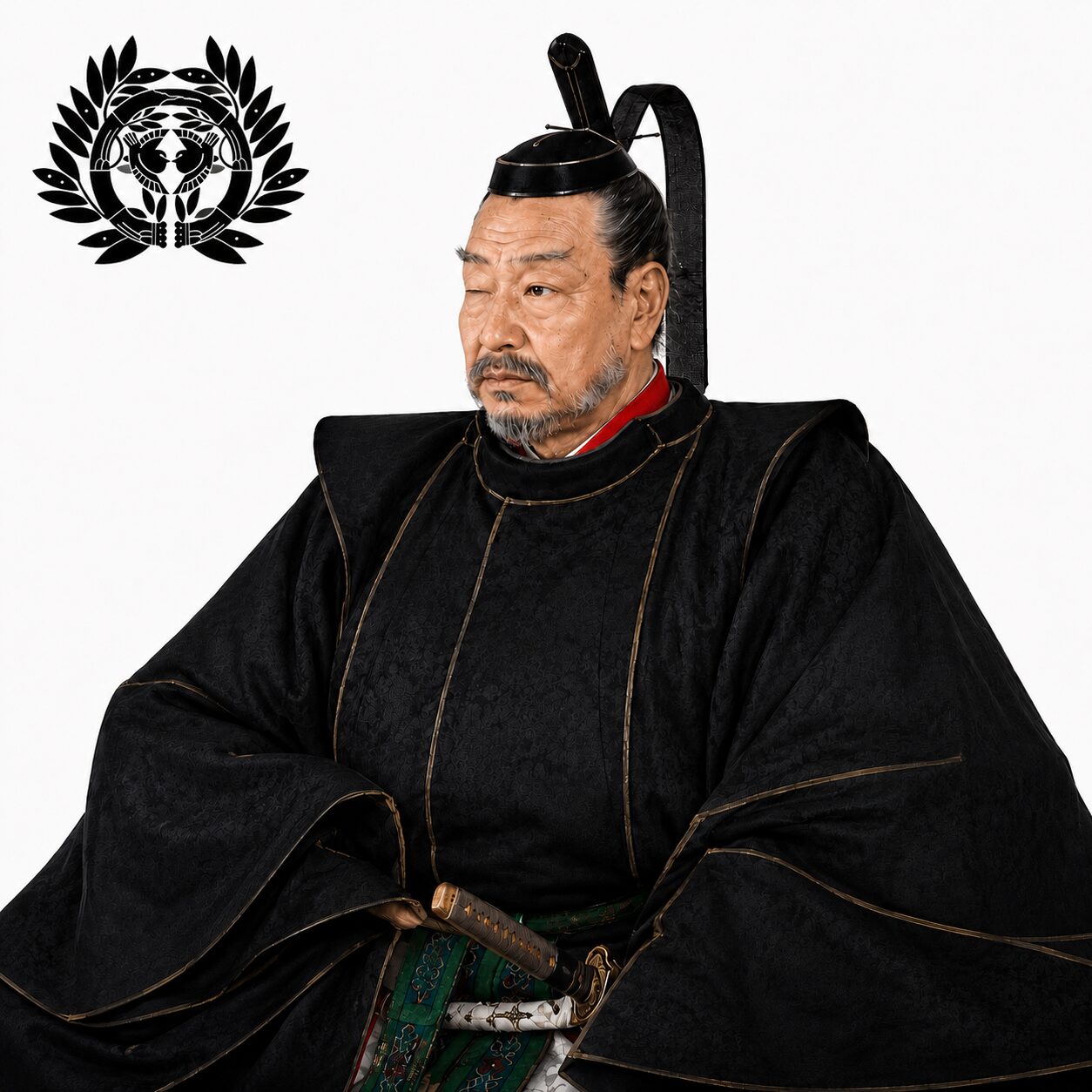
Date Masamune — The Conqueror of Ōshū Called the One-Eyed Dragon: A Life of 70 Years
- Date Masamune in 3 Points
- The Mainstream View — The Established Account Found in Textbooks
- Multiple Theories — Exploring Possibilities from Various Angles
- Viewed Strategically
- Famous Words and Sayings of This Warlord
- Anecdotes and Episodes
- Timeline
- Family and Personal Relationships
- Related Historic Site Map / Model Travel Courses
- Related Articles
- References
Date Masamune in 3 Points
- As the 17th head of the distinguished Date house of Ōshū, he defeated the Ashina clan at the Battle of Suriagehara and brought the 1.14 million koku of southern Ōshū under his control — the last conqueror of the Sengoku age.
- Known by the byname “One-Eyed Dragon,” he was a “datemono” (a man of flamboyant style) with many showy anecdotes, such as his late arrival at the Odawara muster and the embassy to Europe.
- Though he was said to have been “born ten years too late,” as the founder of the Sendai Domain of 620,000 koku he laid the foundation of present-day Miyagi Prefecture.
The Mainstream View — The Established Account Found in Textbooks
Bontenmaru and the Boyhood of Smallpox (1567–1581)
Date Masamune was born on the 3rd day of the 8th month of Eiroku 10 (1567), at Yonezawa Castle in Dewa Province. His father was Date Terumune, the 16th head of the Date house; his mother was Yoshihime, daughter of the Dewa Yamagata castellan Mogami Yoshimori and younger sister of Mogami Yoshiaki. His childhood name was Bontenmaru.
Around age 5 (Genki 2 / 1571), Masamune is said to have contracted smallpox and lost the sight of his right eye. In the 1974 excavation survey of the Zuihōden, it was confirmed that there were no traces of injury in the right eye socket of Masamune’s skull, corroborating that the cause was illness rather than a wound (discussed later in the theories).
His guardians were Kita and Katakura Kagetsuna (later Kojūrō). His teacher in learning was the Zen monk Kosai Sōitsu. Kosai is said to have told Masamune the old tale of Li Keyong of late-Tang China, who, though he lost an eye, was active as a brave and resolute general, planting confidence in the one-eyed boy. The later byname “One-Eyed Dragon” derives from this byname of Li Keyong (see Theory 1).
In Tenshō 5 (1577), at age 11, he came of age and took the name Tōjirō Masamune. The name “Masamune” is said to have been taken after Date Masamune (the Muromachi-period 9th head), who had revived the Date house in the Muromachi period — a name bearing the expectation that he would restore the Date house.
In Tenshō 7 (1579), at age 13, he took as his legal wife Megohime, daughter of Tamura Kiyoaki, the castellan of Miharu of the Tamura clan, who had formed a marriage tie with Hōjō Ujimasa. In Tenshō 9 (1581), at age 15, he had his first battle in a clash with the neighboring Sōma clan.
Succession to the Headship and Ferocious Wars of Conquest (1584–1585)
In the 10th month of Tenshō 12 (1584), his father Terumune retired, and Masamune at 18 succeeded the headship to become the 17th head of the Date house. The Date house of the time was a powerful daimyō of central Ōshū, but around it warring lords were entrenched — the Ashina of Aizu, the Hatakeyama of Nihonmatsu, the Sōma, the Mogami, the Ōsaki, the Kasai, the Satake — and its position was by no means stable.
Masamune began aggressive wars of conquest immediately after succeeding the headship. In Tenshō 13 (1585), when he attacked the defected Otemori Castle, he carried out a “wholesale slaughter,” putting castle troops and inhabitants alike to the sword. This massacre, conveyed variously as 800 or several thousand people, gave the surrounding daimyō an intense terror as a warning to the neighboring provinces.
In the 11th month of the same year, an incident occurred in which the Nihonmatsu castellan Hatakeyama Yoshitsugu abducted the retired father Terumune at a seat of peace talks with the Date house. Masamune, who had been hawking, received the urgent report and rushed over, and against Yoshitsugu, who resisted using Terumune as a shield, made the ferocious decision to have him shot dead with firearms together with Terumune himself. Terumune was 42. There is also a “suspicion of patricide” by Masamune in this incident, but there is no decisive evidence (see Theory 4).
Masamune, who attacked Nihonmatsu Castle in revenge for his father, struggled at the Battle of Hitotoribashi (11th month of the same year) against the allied army of southern-Ōshū daimyō such as the Ashina, Satake, Iwaki, and Ishikawa. For a time Masamune himself fell into a tight spot, but he barely escaped through the withdrawal of Satake Yoshishige to his home province.
The Road to Unifying Ōshū — The Ōsaki Campaign and the Kōriyama Campaign (1588)
In Tenshō 16 (1588), Masamune invaded the Ōsaki territory taking advantage of internal strife within the house of Ōsaki Yoshitaka, but the Ōsaki, who drew the bloodline of the Ōshū Tandai, were formidable, and because his uncle Mogami Yoshiaki supported the Ōsaki side, the Date army was forced into a hard fight (the Ōsaki Campaign).
In the midst of this battle, Masamune’s mother Yoshihime took the action of riding in by palanquin between the two armies and appealing to her brother Yoshiaki for reconciliation. After a ceasefire reaching 80 days, in the end both armies withdrew. This incident is known as an episode showing the strength of the voice of Yoshihime, called the “Demon Princess of Ōu.”
In the 7th month of the same year, Masamune fought the Kōriyama Campaign against the Ashina clan on the southern front. With the Ashina the Date had taken a conciliatory line since the time of his father Terumune, but Masamune had turned to a hard line at the change of headship. As it took on the aspect of a prolonged battle, both armies withdrew through the mediation of Iwaki Tsunetaka and Ishikawa Akimitsu.
The Battle of Suriagehara and the Conquest of Southern Ōshū (1589)
On the 5th day of the 6th month of Tenshō 17 (1589) (17th of July in the new calendar), Date Masamune clashed with Ashina Yoshihiro of Aizu at Suriagehara at the foot of Mount Bandai. This was the “Battle of Suriagehara” that determined the fate of the Date house.
The Ashina clan at the time had taken in as their head Yoshihiro, the second son of Satake Yoshishige, but the house was split into a Date faction and a Satake faction and lacked cohesion. Furthermore, just before the battle, the Ashina chief retainer Inawashiro Morikuni went over to the Date side. By this the situation turned decisively in the Date side’s favor.
Masamune, leading an army of about 25,000, deployed a fish-scale formation with Inawashiro Morikuni in the vanguard and Date Shigezane and Katakura Kagetsuna placed in the second and third lines. The Ashina army too fought well, but the Ashina side’s advantage, favored at first by the wind direction, was suddenly reversed by a change in the wind, and, struck by the Date side’s general assault, it collapsed. Ashina Yoshihiro abandoned Kurokawa Castle in Aizu and fled to the Satake clan of Hitachi.
By this victory the Ashina clan as a Sengoku daimyō was effectively destroyed. Masamune acquired Aizu and the Sendō region, becoming the conqueror of southern Ōshū, said to be 1.14 million koku. It was a great feat at 23, and by it Masamune became a presence standing out among the Date, Gamō, Nanbu, and Mogami of Ōshū.
→ For details, see the battle article “Battle of Suriagehara.”
The Odawara Muster and the “Death Shroud” Late Arrival (1590)
However, Masamune’s rapid expansion of power was a clear violation of the Sōbuji Order (the edict banning private warfare among daimyō) that Toyotomi Hideyoshi, on the verge of unifying the realm, had issued in Tenshō 15 (1587). Hideyoshi had repeatedly urged Masamune to come up to the capital, but Masamune, with his alliance with the Hōjō clan as well, could not make up his mind.
In Tenshō 18 (1590), Hideyoshi began the Odawara Campaign as the final finishing of the unification of the realm, and ordered Masamune too to muster. Within his house, opinion split over whether to cross swords with Hideyoshi or submit. In the end, accepting the advice of his confidant Katakura Kagetsuna that “now is not the time to tread on the tiger’s tail,” Masamune decided to muster at Odawara.
But on the eve of that departure, the 5th day of the 4th month, a legendary incident occurred. His mother Yoshihime offered Masamune a poisoned meal, and Masamune collapsed with stomach pains but barely saved his life with an antidote. Masamune, two days later on the 7th day of the 4th month, put to the sword his younger brother Kojirō and his guardian — such is the storyline conveyed by the Teikaki-roku of the Lord of Teizan. However, in recent years many doubts have been raised about this incident (see Theory 3).
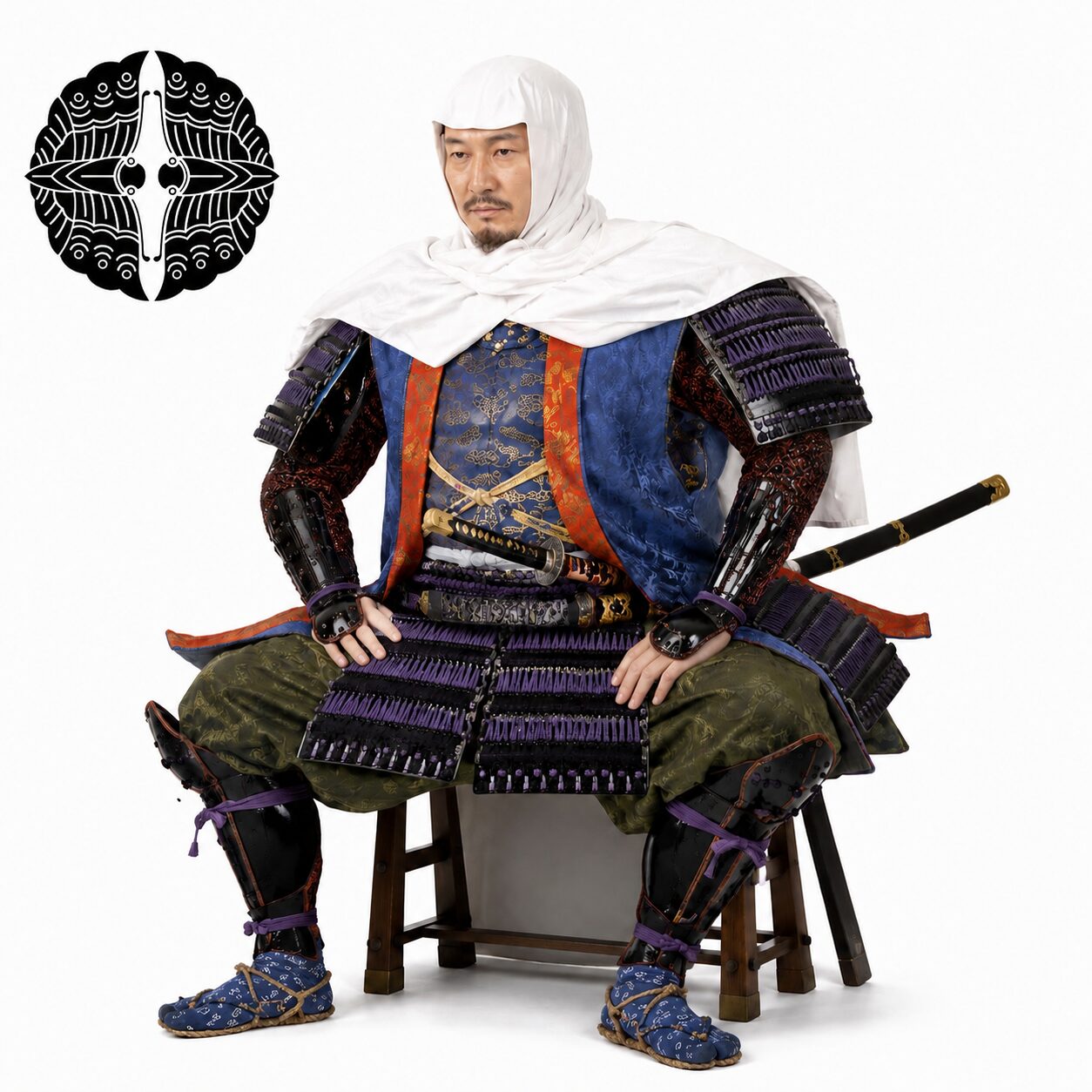
Masamune, arriving late at Odawara, incurred Hideyoshi’s anger. At this time Masamune is said to have clad himself in white robes (a death shroud) and had an audience with Hideyoshi. Hideyoshi, in consideration of Masamune’s quick wit and nerve, pardoned the death penalty, but confiscated the vast holdings including the Aizu territory acquired at the Battle of Suriagehara. The Date house’s holdings were reduced to 580,000 koku, centered on the old territory around Yonezawa. Masamune would keenly feel the complete shift from an age in which a Sengoku daimyō carved out territory by his own strength to an age in which territory was “granted” under the order of the ruler of the realm.
The Kasai-Ōsaki Uprising and the Transfer to Iwadeyama (1590–1591)
In the 10th month of Tenshō 18 (1590), the former retainers of the Kasai and Ōsaki, whose holdings had been confiscated by Hideyoshi in the Ōshū Settlement, raised a large-scale uprising (the Kasai-Ōsaki Uprising). Masamune, ordered to suppress it, found suspicion arising that he himself had been secretly instigating this uprising behind the scenes. Hideyoshi had Masamune come up to the capital and interrogated him. Masamune is said to have weathered it through a showy performance of explanation, presenting himself once more bearing a crucifixion post coated with gold leaf over a death shroud.
As a result Masamune’s explanation was accepted, but as a reproof his main territory of Yonezawa was confiscated, and in Tenshō 19 (1591) he was transferred to Iwadeyama Castle in the old Ōsaki-Kasai territory (present-day Ōsaki, Miyagi Prefecture). The holdings were about 580,000 koku. Hideyoshi’s treatment was severe, but he was spared the destruction of his house.
The Korean Campaign and Flamboyant Attire — The Origin of “Datemono” (1592–)
In Bunroku 1 (1592), Masamune served in the Korean campaign. The army Masamune led at this time, in showy military attire arranging a golden sun-disk and a silver moon on a black ground, is said to have astonished the people of Kyoto. It is the episode said to be one origin of the word “datemono” (a person who favors flamboyant, stylish attire).
In the midst of the Korean campaign, a letter of encouragement and three ryō in cash arrived from his mother Yoshihime. Masamune, deeply moved, records in a letter to Yoshihime that he desperately searched for Korean cotton as a gift for his mother. That such an intimate correspondence existed three years after the poisoning incident is itself one of the grounds casting doubt on the credibility of the incident.
The “Written Guarantee of a Million Koku” and Sekigahara (1600)
When Hideyoshi died in Keichō 3 (1598), the realm was again thrown into turmoil. At the Battle of Sekigahara of Keichō 5 (1600), Masamune chose the road of siding with Tokugawa Ieyasu of the Eastern Army.
On the 22nd day of the 8th month of Keichō 5, just before Sekigahara, Ieyasu granted Masamune the “written guarantee of a million koku.” It was an exceptional promise to add to the 580,000 koku Masamune had been granted by Hideyoshi the seven districts of Katta, Date, Shinobu, Nihonmatsu, Shiomatsu, Tamura, and I (about 500,000 koku). These holdings were all at the time the territory of Uesugi Kagekatsu, and moreover part of it had once been Date territory.
Masamune attacked north into Uesugi territory and was active as a member of the Eastern Army, seizing Shiroishi Castle and the like. But after Sekigahara, suspicion came to light that he had instigated his retainer Rusu Masakage and Waga Tadachika — said also to be Masamune’s half-brother by a different father — to raise an uprising in Nanbu territory (the Iwasaki Uprising). Ieyasu went back on the increase, and in the end Masamune’s holdings were fixed at about 600,000-odd koku with the addition of Katta District. The “written guarantee of a million koku” ended as a phantom (see Theory 6).
The Building of Sendai and the Construction of the Castle Town (1601–)
In Keichō 6 (1601), Masamune obtained Ieyasu’s permission, moved his base from Iwadeyama to Sendai, and began to build a new castle on Mount Aoba. This was Sendai Castle (Aoba Castle). Below the castle a grid-pattern town layout was applied, and warrior residences, townsmen’s quarters, and temple-shrine lands were arranged in a planned way. The urban foundation of present-day Sendai City follows almost faithfully Masamune’s conception of this time.
Masamune displayed talent in domestic administration as well. He advanced the improvement of the Kitakami River and the development of new paddy fields on the Sendai Plain, the construction of the Teizan Canal, the development of salt fields, and the promotion of industries such as lacquerware and Japanese paper. The Sendai Domain became established as the largest domain in the Tōhoku at 620,000 koku.
The Keichō Embassy to Europe and the San Juan Bautista (1611–1620)
In the 12th month of Keichō 16 (1611), a huge tsunami struck the whole of eastern Japan (the Keichō Sanriku earthquake). The Sendai territory too suffered grave damage, but two weeks later Masamune suddenly announced the construction of a large oceangoing ship and the dispatch of an embassy to Europe.
In Keichō 18 (1613), about 180 members of the Keichō Embassy to Europe, with Masamune’s retainer Hasekura Tsunenaga as chief envoy and the Franciscan missionary Luis Sotelo as deputy envoy, set sail from Tsukinoura (present-day Ishinomaki, Miyagi Prefecture) aboard the “San Juan Bautista,” Japan’s first galleon, built in the Sendai Domain.
The embassy, by way of Mexico, had audiences with the Spanish king Felipe III and Pope Paul V. The ostensible purpose was trade negotiations with Mexico and the invitation of missionaries, but there is debate about its true purpose (see Theory 5). Tsunenaga returned home in Genna 6 (1620), but in the meantime the prohibition of Christianity had been strengthened in Japan, and the embassy ended without achieving its purpose.
The Siege of Osaka and the “Clash with Sanada Nobushige” (1614–1615)
Masamune mustered as a member of the Tokugawa side at the Winter Siege of Osaka of Keichō 19 (1614) and the Summer Siege of Osaka the next year, Keichō 20 (1615). At the Summer Siege, at the Battle of Dōmyōji, he defeated Gotō Matabei Mototsugu, one of the Eight Tigers of Kuroda. He then clashed with the army of Sanada Yukimura (Nobushige), and after a hard fight on both sides, withdrew.
Regarding Masamune not pressing the pursuit of the Sanada force at this time, Nobushige is said to have sneered, “Though the Kantō host is said to number a million, it seems there is not one true man among them.” However, this too is an anecdote deriving from later war chronicles, and its historicity is not confirmed.
→ For details, see the battle article “Siege of Osaka.”
Late Years and the End (1620–1636)
With the close of the Siege of Osaka, the age of the Sengoku came completely to an end. Masamune, who is said to have been relied upon by Ieyasu with the words “I entrust Hidetada to you,” was also cherished by the 3rd shogun Tokugawa Iemitsu as “the old man of Date,” and established his position as a pillar of the Tokugawa shogunate.
In his late years, Masamune devoted himself to the maintenance of the Sendai Domain while also being active as a cultured man in many directions — waka, Noh, the tea ceremony, cooking, and the like. He had a friendship as a fellow poet with the waka poet Kinoshita Chōshōshi and left behind many autograph letters and waka. He showed an aesthetic sense that resonates even today, leaving such a theory of cooking as, “To entertain is to bring out seasonal items unaffectedly, and for the host himself to take care in hospitality.“
In the 4th month of Kan’ei 13 (1636), Masamune, who had headed to Edo for alternate attendance, was already advanced in illness. On the 21st day of the 5th month, the shogun Iemitsu paid a visit to the Date residence, and Masamune, arranging his appearance, had an audience. Three days later, on the 24th day of the 5th month, he died at the Date residence in Sakurada, Edo. He was 70. The cause of death is conjectured to be carcinomatous peritonitis, esophageal cancer, and the like.
At Masamune’s death, the Tokugawa shogunate took the exceptional measure of going into mourning for 7 days in Edo and 3 days in Kyoto. That such courtesy was extended for an outside lord who was not even of the Tokugawa Three Houses was exceptional. His body was carried to Sendai and buried at the Zuihōden.
Multiple Theories — Exploring Possibilities from Various Angles
Theory 1: The Byname “One-Eyed Dragon” and the Eyepatch Were Later Fabrications
The trademarks of Date Masamune are the black eyepatch modeled on a sword guard and the byname “One-Eyed Dragon.” The figure that Watanabe Ken played in the 1987 NHK Taiga drama Dokuganryū Masamune still holds an unshakable place as the image of Masamune even today. However, in recent research it has become common to point out that both of these were not things of Masamune’s lifetime.
The origin of the byname “One-Eyed Dragon”:
The oldest documentary basis for the appellation “One-Eyed Dragon” is said to be a Chinese-style poem contained in the San’yō Ikō of Rai San’yō, published in Tenpō 12 (1841), more than 200 years after Masamune’s death. Rai San’yō praised Masamune using the byname “One-Eyed Dragon” of Li Keyong of late-Tang China (a real figure who, though he lost an eye, was active as a brave general). This spread among intellectuals from the end of the Edo period into the Meiji era, and in time became established as Masamune’s epithet.
In other words, there is no contemporary record of Masamune himself being called “One-Eyed Dragon.” There is a description in the Date Teikaki-roku that he was influenced in boyhood by hearing the old tale of Li Keyong from Kosai Sōitsu, but this too is an Edo-period compilation, and its historicity requires reservation.
The origin of the eyepatch image:
No primary source confirming that Masamune wore an eyepatch has been confirmed. In portraits painted in his lifetime (such as those held by Zuigan-ji), there are many that depict him with both eyes open, perhaps following Masamune’s testament (“have me painted as if I have both eyes”).
On the existing record, the image of the eyepatch figure is said to have first become established with the early-Shōwa film Dokuganryū Masamune. What made this a national image was the black-eyepatch figure that Watanabe Ken wore in the 1987 NHK Taiga drama Dokuganryū Masamune. Both the “One-Eyed Dragon” and the “eyepatch” were not Masamune’s own real-time figure.
Theory 2: The Cause of the Right Eye’s Blindness — Smallpox or Another Illness
Regarding the cause of the blindness of Masamune’s right eye, the official history of the Sendai Domain, the Date Teikaki-roku, records that “around age 5 he contracted smallpox, pustules formed on his right eye, and the eye socket swelled up so that it was as if the eye protruded.” This has long been taken as the established view.
Corroboration by skeletal examination:
In 1974, accompanying the reconstruction work of the Zuihōden in Sendai, an excavation survey of Masamune’s burial site was carried out. As a result of examining Masamune’s skull, it was confirmed that there were no traces of injury whatsoever in the right eye socket. By this the theory of “blindness from a wound” was denied, and corroboration was given that the cause was illness.
There was also a popular theory that Masamune was half-foreign (wearing an eyepatch because of heterochromia), but this too has been denied, since the skeletal examination confirmed “skeletal features often seen in Tōhoku people of the time.”
Recent dissent:
In recent years, on medical blogs and the like, a theory has also surfaced that “Masamune’s right eye was not blind, but only that the eyelid did not open (ptosis).” This is because in a few portraits he is depicted with the right eye open. However, this is not an academic theory that has gone through medical verification, and at present it has not gone so far as to overturn the smallpox-contraction theory of the Teikaki-roku.
Whatever the truth, it is certain that Masamune lost the function of his right eye around age 5, and that it became a complex of his early childhood. The present understanding is that, in the process of overcoming that complex, he received the cultivation of Kosai Sōitsu and acquired an intense self-affirmation — this was the formation of Masamune’s character.
Theory 3: Did the Poisoning Attempt by His Mother Yoshihime Really Exist?
One of the most dramatic episodes in Masamune’s life is the poisoning attempt by his mother Yoshihime. The story conveyed by the Teikaki-roku of the Lord of Teizan is as follows.
On the eve of the Odawara muster, the 5th day of the 4th month of Tenshō 18 (1590), Masamune was invited by his mother Yoshihime to a celebration of the campaign array. The moment he set chopsticks to the meal, Masamune developed stomach pains but barely saved his life by drinking an antidote. Yoshihime is said to have administered the poison, incited by her elder brother Mogami Yoshiaki, in order to make her younger son Kojirō the head of the Date house. The enraged Masamune put his younger brother Kojirō to the sword two days later, on the 7th day of the 4th month, and Yoshihime fled to her parental Mogami house.
This storyline was adopted in the 1987 NHK Taiga drama Dokuganryū Masamune as well, and is widely known as the established view. However, in recent years the theory doubting the very incident has become influential.
New theory 1: contradiction from the Kosai Sōitsu letter found in 1999
A letter found in 1999 from Masamune’s teacher Kosai Sōitsu to the priest Daiyū Kōho (dated the 27th day of the 11th month of Bunroku 3 / 1594) records that “Masamune’s mother fled on the night of the 4th of this month.” That is, Yoshihime’s flight to the Mogami house was four years after the incident, in the Iwadeyama Castle period. The Teikaki-roku‘s description of “fleeing immediately after the incident” was therefore mistaken.
New theory 2: the intimate exchange of letters between mother and son
Between Masamune and Yoshihime after the incident, more than seven intimate letters survive. In particular, during the Korean campaign of Bunroku 2 (1593), Yoshihime sent Masamune three ryō in cash and a waka of encouragement, and Masamune, moved by it, desperately searched for Korean cotton and sent it back. There is also a letter in which he wrote, “I wish to return safely to Japan and meet you once more.” It is an intimacy that does not seem like the letters of a mother who tried to poison and a son who was nearly poisoned.
New theory 3: the theory of younger brother Kojirō’s survival
At Daihigan-ji in Akiruno, Tokyo, there survives a document recording, “Hōin Hideo, in secular birth the second son of Date Daizen-no-daibu Terumune (Masamune’s father), the younger brother of Mutsu-no-kami Masamune.” Hideo is said to have died on the 26th day of the 7th month of Kan’ei 19 (1642); if this is Kojirō, then Kojirō was not put to the sword but survived as a head priest. In the tradition of Daihigan-ji, Masamune, by the wishes of his mother Yoshihime, entrusted his brother to Tokugawa Ieyasu, and by way of Kanchi Kokushi of Shiba Zōjō-ji, who was close to Ieyasu, he was sheltered at Daihigan-ji.
New theory 4: the theory of Masamune’s self-staged drama
From these contradictions, in recent years a theory has also surfaced that “the incident itself was a fabrication, or perhaps a self-staged drama by Masamune.” At the time, the Date retainer band was split into a Masamune faction and a Kojirō faction, and the interpretation is that Masamune, in order to sweep away the faction within the house that would set up Kojirō, “put on an act” of having been poisoned by his mother, ostensibly put Kojirō to the sword, and in fact let him escape.
On the other hand, some researchers such as Watanabe Daimon, taking the position that “the incident itself may have happened,” interpret Yoshihime’s motive as “trying, before Masamune — who was hesitating over the Odawara muster — was killed by Hideyoshi, to set up Kojirō as head and avoid the destruction of the Date house.” It is the view that Yoshihime was not a “demon mother” but rather a “tragic mother” who made a bitter decision for the survival of the Date house.
In any case, the point reached by current research is that one cannot take the story of the Teikaki-roku at face value as historical fact.
Theory 4: The Death of His Father Terumune and Masamune’s Involvement
On the 17th day of the 11th month of Tenshō 13 (1585), the Nihonmatsu castellan Hatakeyama Yoshitsugu abducted Masamune’s retired father Terumune at a seat of peace talks with the Date house. Masamune, who had gone out hawking, received the urgent report and rushed over, pursuing Yoshitsugu’s party. Against Yoshitsugu, who resisted using Terumune as a shield, Masamune is said to have had him shot dead with firearms together with Terumune himself. The incident, also called the “Awanosu Incident,” has been handed down as an episode showing Masamune’s ferocious decisiveness.
The “patricide by Masamune” suspicion:
In recent years, a theory has been advanced in some quarters regarding this incident that “Masamune deliberately disposed of his father Terumune.” The grounds cited are the following.
- It is unnatural that Masamune’s party while hawking was fully armed with firearms.
- Masamune and his father Terumune are said to have been at odds over policy toward the Ashina and Hatakeyama, Masamune taking a hard line and Terumune a conciliatory line.
- Losing his father, Masamune would become the complete head and could carry out the hard line.
Counterarguments:
However, none of these grounds have corroboration from primary sources. The surroundings of the Date territory of the time were always exposed to the threats of the Mogami, Ashina, Satake, and so on, and carrying firearms even while hawking cannot be called peculiar. Mogami Yoshiaki was skilled early on in the operation of musket units, and a defense to counter this was essential even within the Date house.
Also, regarding the policy conflict between Masamune and Terumune, the “handover of the headship” itself from Terumune to Masamune was carried out peacefully, and it is pointed out that emphasizing the conflict between the two is no more than a later interpretation. After Terumune was killed, Masamune attacked Nihonmatsu Castle and expelled Yoshitsugu’s surviving son Kokuōmaru, so the revenge for his father was indeed carried out.
The “Masamune conspiracy theory” does not go beyond the realm of conjecture, lacking documentary grounds, and is not supported in the present historical world. Even so, that Masamune could make the cold-blooded judgment of not choosing to become his father’s substitute and having him shot together with his father shows, in itself, his resolve as a Sengoku daimyō.
Theory 5: The True Purpose of the Keichō Embassy to Europe — Trade or Toppling the Shogunate
In Keichō 18 (1613), Masamune dispatched an embassy of 180 people, with his retainer Hasekura Tsunenaga as chief envoy and the missionary Luis Sotelo as deputy envoy, to Mexico, Spain, and Rome aboard the galleon “San Juan Bautista.” This is the Keichō Embassy to Europe. The ostensible purpose was direct trade negotiations with Mexico and the invitation of missionaries from Rome.
However, debate continues even in recent years about its true purpose.
Theory A: the pure trade-purpose theory
In the Sendai territory, grave tsunami damage occurred in the Keichō Sanriku earthquake of the 12th month of 1611. Masamune aimed at economic reconstruction through direct trade with overseas for the sake of recovery. He showed his personal letter to Ieyasu in advance and obtained permission, and Ieyasu himself approved it out of interest in mining technology and the silver trade. It is the theory that it was, to the end, a legal diplomatic enterprise.
Theory B: the toppling-the-shogunate / taking-the-realm conception theory
In a letter that the Jesuit missionary Angelis, who was engaged in proselytizing in the Sendai territory, sent to the Jesuit headquarters, there is a noteworthy description. It states that “at the time of the embassy’s dispatch, Masamune, being before the Winter and Summer Sieges of Osaka, saw that Ieyasu’s power was not perfect. In preparation for a chance to take the realm when Ieyasu was defeated, he sought to conclude a military alliance with Spain.” It is also pointed out that Masamune, having married his daughter Irohahime to Ieyasu’s sixth son Matsudaira Tadateru, may have had a conception of toppling the Hidetada regime and setting up Tadateru.
The problem with this theory is that its grounds rest on the single Angelis letter. From Masamune’s own letters and other primary sources, nothing directly showing this conception has been found.
Theory C: the compound-motive theory
In recent years, the view that the trade purpose and the political conception were compounded is influential. The interpretation is that Masamune, while obtaining Ieyasu’s permission, at the same time sought to secure a connection with Spain as “insurance in case Ieyasu were defeated by the Osaka side.” It is consistent with Masamune’s character and can also be said to show his realism as a Sengoku daimyō.
The embassy returned home in Genna 6 (1620), but in the meantime the shogunate had strengthened the prohibition of Christianity, no results were obtained from negotiations with Spain and Rome, and the original purposes were all frustrated. Masamune distanced the returned Tsunenaga and turned to the position of cracking down on the Christians within the Sendai territory. Masamune’s last “conception of the realm” thus vanished like foam.
Theory 6: The Going-Back on the “Written Guarantee of a Million Koku” and the Limits of Masamune’s Bid for the Realm
The “written guarantee of a million koku” that Ieyasu granted to Masamune on the 22nd day of the 8th month of Keichō 5 (1600), just before Sekigahara, became the greatest phantom of Masamune’s life.
The content of the guarantee:
Ieyasu promised Masamune that, in addition to his current holdings of 580,000 koku, he would add the seven districts of Katta, Date, Shinobu, Nihonmatsu, Shiomatsu, Tamura, and I (about 500,000 koku). These regions were all at the time the territory of Uesugi Kagekatsu, and moreover part of it had once been Date territory. Ieyasu in effect recognized “Masamune invading Uesugi territory as a member of the Eastern Army and seizing it by his own strength.”
The course of the going-back:
Masamune was in fact active, going north and seizing Shiroishi Castle, but because the main battle of Sekigahara ended before Hidetada’s arrival, he did not go so far as a large-scale seizure of Uesugi territory. Furthermore, suspicion came to light that Masamune’s retainer had instigated Waga Tadachika in Nanbu territory to raise the Iwasaki Uprising. Ieyasu doubted Masamune’s double-heartedness, and the increase was gone back on. In the end Masamune’s holdings were limited to an increase of about 20,000-odd koku such as Katta District, and were fixed as the Sendai Domain of about 600,000 koku.
The “if only he had been born ten years earlier” evaluation:
The evaluation that “had Masamune been born ten years earlier, he could have taken the realm” has been repeatedly told in historical novels and storytelling. The spirit of the young victor at Suriagehara, his ambition around Sekigahara, his overseas strategy in the embassy to Europe — all are elements showing the caliber of a ruler of the realm.
However, recent research adds a cool reservation to this evaluation. At the point when Masamune began his activity, Tenshō 13 (1585), Hideyoshi had already pacified Shikoku and assumed the office of kanpaku. Even had Masamune been born ten years earlier and succeeded the headship in 1577, there was no guarantee he would succeed in unifying Ōshū, and to become a ruler of the realm he decisively lacked access to the central political world. The geographical and economic constraints of Ōshū were a wall hard to surmount by any genius.
Rather, Masamune’s true greatness lies not in “not being able to take the realm” but in “achieving the maximum results as a regional daimyō in an age in which one could not take the realm.” The Sendai Domain of 620,000 koku was the third-largest domain in the whole country after the Kaga Maeda house and the Satsuma Shimazu house, and the evaluation also holds that Masamune’s achievement of fundamentally raising up the cities, industries, and culture of the Tōhoku was possible precisely because he did not take the realm.
Viewed Strategically
When Masamune is compared with other famed Sengoku generals, three points stand out: his “thoroughness in gathering information,” his “power of flamboyant stagecraft,” and his “speed of switching over.“
First, the gathering of information. Masamune is known, even among the Sengoku daimyō of his time, for leaving an enormous number of autograph letters. The surviving autograph letters of Masamune are said to exceed 1,000, showing that he placed extreme importance on the gathering and dispatch of information. He maintained a wide-ranging network reaching from retainers, relatives, hostile powers, court nobles, and even missionaries, and grasped comprehensively the trends of the central political world, overseas affairs, and even the war situations of various regions. The flexibility of taking in even information from the Spaniards Vizcaíno and Sotelo, and from Mexico, was outstanding for a Sengoku daimyō.
Second, the power of flamboyant stagecraft. Masamune’s life is full of “staging.” He appeared at the Odawara muster in a death shroud and shook Hideyoshi’s emotions; in his explanation over the Kasai-Ōsaki Uprising he came up to the capital bearing a gold-leaf crucifixion post; in the Korean campaign he captivated the people of Kyoto with showy military attire of a golden sun-disk and a silver moon on a black ground. These were not mere vanity but a high-level political staging that read the opponent’s psychology and manipulated “impressions.” As it also became the origin of the word “datemono,” Masamune’s sense had a foresight that connects to modern “branding.”
Third, the speed of switching over. Masamune’s life faced great turning points many times. The year after conquering southern Ōshū at Suriagehara, he lost most of it at the Odawara muster. The phantom of a million koku on the eve of Sekigahara was gone back on. The conception of the realm in the embassy to Europe was frustrated. But Masamune, each time, showed the switching of casting off attachment to the past and pursuing the maximum under the conditions granted. From the building of Sendai onward, he concentrated on the maintenance of the Sendai Domain rather than on ambition for the realm, and secured a position cherished by Iemitsu within the Tokugawa shogunate as “the old man of Date.” This is in contrast to the figure of the old retainers of the Oda house struggling to adapt under the Toyotomi and Tokugawa regimes.
On the other hand, Masamune’s limits also cannot be ignored. For taking the realm, Masamune’s appearance was too late. His succession to the headship was in Tenshō 12 (1584) at 18, a period when Hideyoshi was already grasping the center as kanpaku. Furthermore, advancing to the center from the geographical frontier of Ōshū had a difficulty that not even Takeda Shingen or Uesugi Kenshin could accomplish. That Masamune could not realize the “written guarantee of a million koku” was largely because the mobilization from Ōshū could not keep up with the speed of the center’s tempo, the main battle of Sekigahara ending before Hidetada’s arrival.
Masamune appeared as the “last runner of the Sengoku period.” He was of the generation after the enterprises of the three Sengoku heroes — Oda Nobunaga, Toyotomi Hideyoshi, and Tokugawa Ieyasu — were nearly complete. That Masamune nevertheless continues to keep overwhelming popularity to the present is because his way of life, transcending the mere frame of a Sengoku daimyō, combined “individuality,” “aesthetic sense,” “power of stagecraft,” and “realism” that appeal to modern people as well. The Masamune who did not take the realm — had he taken it, might have become a figure different from that charming image of Masamune we know.
Famous Words and Sayings of This Warlord
“Leading the way with the unclouded moon of my heart, I go lighting the darkness of this fleeting world.”
The most famous of Masamune’s death poems. Dated the 20th day of the 1st month of Kan’ei 13 (1636), contained in the Teikaki-roku of the Lord of Teizan. It means, “Through a world of darkness in which the way ahead cannot be seen, I have walked relying on the moon of my heart — my conviction — without a single cloud.” The life of Masamune, who lived with one eye, and the pride of having cut open the darkness of the Sengoku, overlap. It is widely loved as a verse that closed out a turbulent life of 70 years with a solitary resolve.
— Source: Teikaki-roku of the Lord of Teizan
“On a dark night, leading the way with the moon of absolute truth, I go clearing away the darkness of this world.”
Another death poem, found in 2022 from the documents of the Ishikawa family of Kakuda. About a month before his death, on the 20th day of the 4th month of Kan’ei 13, it was composed for his eldest daughter Irohahime when he set out for Edo for an audience with the shogun. It means, “On a dark night, with the moon of truth (the Buddhist tathatā, absolute reality) as my guide, I go clearing away the darkness of this world.” It has a stronger Buddhist, resigned coloring than the better-known death poem, and as it was composed as a testament to his daughter, it is a precious verse that affords a glimpse of Masamune as a father.
— Source: “Ishikawa-ke Otome” of the Ishikawa family of Kakuda (found in 2022)
“To entertain is to bring out seasonal items unaffectedly, and for the host himself to take care in hospitality.”
A theory of cooking said to have been left by Masamune. Known as fond of cooking, Masamune is said to have liked to stand in the kitchen himself and entertain guests. The aesthetic that hospitality is not “exhausting luxury” but rather “the host’s attentiveness” has a foresight that connects to modern Japanese-food culture as well. Foods that Masamune encouraged as domestic industries — Sendai miso, freeze-dried tofu, sasa-kamaboko, and the like — still remain as Sendai specialties.
— Source: Sayings of Lord Masamune, etc.
“Excess in benevolence makes one weak. Excess in righteousness makes one rigid. Excess in propriety becomes flattery. Excess in wisdom leads to lies. Excess in faith brings loss.”
A life lesson of Masamune containing his own critique of the Five Constants of Confucianism (benevolence, righteousness, propriety, wisdom, faith). The sense of balance that even virtues “become harmful in excess” symbolizes the realism of Masamune, who survived the ferocious Sengoku world and adapted even under Tokugawa rule. The viewpoint of relativizing textbook moral theory can also be read as a summing-up detachment of the Sengoku period.
— Source: Testamentary Precepts of Lord Date Masamune (traditional)
“Bontenmaru, too, would like to be so.”
The words said to have been wished by the boy Bontenmaru (Masamune) when he heard from his teacher Kosai Sōitsu the anecdote of the one-eyed famed general Li Keyong of late-Tang China, wishing that he too would become a brave warlord in the same way. Used repeatedly in the 1987 NHK Taiga drama Dokuganryū Masamune, it became widely known as a symbol of Masamune’s boyhood. However, the primary-source basis for this line has not been confirmed, and the possibility of later fabrication and embellishment is high.
— Source: a later embellishment based on the Date Teikaki-roku
Anecdotes and Episodes
Smallpox and the Legend of Katakura Kagetsuna’s “Eyeball Removal”
Bontenmaru, who contracted smallpox at age 5 and lost his right eye. There is a dramatic anecdote handed down that, for the sake of Masamune, who worried that his swollen right eye drooped down and made an unsightly figure, his guardian Katakura Kagetsuna cried out, “My lord, forgive me!” and excised the right eye with a small knife. The source of this anecdote is not the Date Teikaki-roku but later war chronicles and storytelling. In fact, since the skeletal examination of Masamune confirmed there were no traces of injury in the right eye socket, the “eyeball removal” is highly likely not historical fact. Even so, its popularity does not wane as an episode symbolizing the bond of lord and retainer with Katakura Kagetsuna.
— Source: later war chronicles (no primary-source basis)
The Battle of Hitotoribashi — The Heroic End of Oniniwa Sagetsusai
In the 11th month of Tenshō 13 (1585), Masamune, who was attacking Nihonmatsu Castle in revenge for his father Terumune, ended up facing the southern-Ōshū allied army of 30,000 — Satake Yoshishige, the Ashina, Iwaki, Ishikawa, and others — with a mere 7,000 troops. This was the Battle of Hitotoribashi. Amid overwhelming inferiority, the Date chief retainer Oniniwa Sagetsusai Yoshinao, despite his advanced age of 73, took on the rearguard, drawing the enemy’s attention by conspicuously waving a golden baton of command, and fell in battle. Through his hard fight, Masamune’s command post escaped its tight spot. It was also fortunate that Satake Yoshishige withdrew upon receiving news of a revolt that had broken out in his home province of Hitachi, and Masamune barely preserved his life. At this time Masamune himself is said to have taken five arrows in his armor and fled with his life. The narrow escape at 19, the year after succeeding the headship, became an unforgettable memory for Masamune for the rest of his life.
— Source: Date Teikaki-roku, Ōu Eikei Gunki
The Moment the Wind Changed at Suriagehara
On the 5th day of the 6th month of Tenshō 17 (1589), the situation of the Battle of Suriagehara at first favored the Ashina army, which had taken the windward. The firearms and arrows of the Ashina side rained down on the Date army, and even Masamune’s command post is said to have wavered. But in the midst of the fighting the wind direction reversed. This time the Date army came to stand windward, and the situation was reversed at a stroke. The Ashina army collapsed, and Yoshihiro abandoned Kurokawa Castle in Aizu and fled to Hitachi. At the moment when “the fortune of heaven” and “the existence of a defector” sided with him at once, the 1.14 million koku of southern Ōshū of the Date house came into being. For the 23-year-old Masamune, this victory was the peak of his life. But the next year at the Odawara muster, the fate awaited of having most of it confiscated by Hideyoshi.
— Source: Date Teikaki-roku, Tōgoku Tōsen Kenmon Shiki
The “Odawara Muster Late Arrival,” Having an Audience with Hideyoshi in a Death Shroud
In Tenshō 18 (1590), Masamune, ordered to muster at Odawara, hesitated in his decision with the alliance with the Hōjō clan as well, and his house too was split in two. Though he decided to muster on the advice of his confidant Katakura Kagetsuna, his departure was delayed to the very last. The arriving Masamune is said to have appeared at the place of audience clad in white robes (a death shroud) and lightly made up, to soften Hideyoshi’s anger. Hideyoshi, in his anger, made the gesture of striking Masamune’s neck with his staff, but because Masamune bowed his head without flinching at all, he pardoned the death penalty in consideration of that nerve — such is the anecdote. However, the vast holdings including the Aizu territory were confiscated. It was a critical situation in which “a little later and his head would have flown.” This event has been handed down as an episode showing that Masamune was a master of “moving the opponent’s psychology through flamboyant staging.“
— Source: Taikōki, Teikaki-roku of the Lord of Teizan
The “Gold-Leaf Crucifixion Post” Explanation of the Kasai-Ōsaki Uprising
In the autumn of Tenshō 18 (1590), the former retainers of the Kasai and Ōsaki, whose holdings had been seized in the Ōshū Settlement, raised a great uprising. Masamune, ordered to suppress it, found suspicion arising that he himself had been secretly instigating this uprising behind the scenes, and was ordered by Hideyoshi to come up to the capital. Masamune resorted again to an unusual stratagem. He is said to have had his own crucifixion post coated with gold leaf and, having it carried by a large number of retainers, entered Kyoto. It was an expression of will: “If I am to be punished, at least do it flamboyantly.” Hideyoshi, the Taikōki conveys, was both dumbfounded and impressed by this thorough staging, and pardoned Masamune. As a result Masamune’s main territory of Yonezawa was confiscated, and he was transferred to Iwadeyama. That he was nonetheless not destroyed can be said to have been a victory of Masamune’s power of stagecraft.
— Source: Taikōki, etc. (later war chronicles)
The “Flamboyant Military Attire of Gold Brocade” in the Korean Campaign
In Bunroku 1 (1592), the army of Masamune, going up to the capital and heading west for the Korean campaign, astonished the people of Kyoto. Showy military attire arranging a golden sun-disk and a silver moon on a black ground, gold-leaf scabbards on the long spears of the mounted warriors — such conspicuous military attire was exceptional by the common sense of the Sengoku daimyō of the time. The word “datemono” (a person who favors flamboyant, stylish attire) is said to have one origin in Masamune’s military attire of this time. In later years it branched into words such as “dateotoko,” “datemaki,” and “date-megane,” and remains to the present. Masamune’s love of the flamboyant had an influence great enough to leave a trace in the Japanese language, beyond a mere personal taste.
— Source: various works, traditions from early-modern times onward
The Building of Sendai and the Design of the Castle Town — The Prototype of Modern Sendai
In Keichō 6 (1601), Masamune began to build Sendai Castle on Mount Aoba. The castle town was divided in a grid pattern, and warrior residences, townsmen’s quarters, and temple-shrine lands were arranged in a planned way. Roadside trees were planted along the central avenue (present-day Aoba-dōri), and a beautiful, verdant city was conceived. The central part of present-day Sendai City follows almost faithfully Masamune’s conception. The prototype of Sendai City being called the “City of Trees” begins with the residence groves, temple-shrine groves, and roadside trees that Masamune had planted. The improvement of the Kitakami River and the construction of the Teizan Canal were also Masamune’s enterprises, and the framework of the largest city in the Tōhoku was all arranged in his time.
— Source: Sendai Sōsho, History of Sendai City
The Construction and Departure of the San Juan Bautista
In Keichō 18 (1613), Masamune built Japan’s first full-scale galleon, the “San Juan Bautista,” within the Sendai territory (present-day Ogatsu Bay, Ishinomaki, Miyagi Prefecture). It was a large oceangoing ship of the 500-ton class, said to have been completed in the astonishingly short period of about 45 days. The construction had the cooperation of the navigational skill of the Mexican envoy Vizcaíno and of the shogunate’s ship magistrate Mukai Shōgen. On the 15th day of the 9th month of the same year, Hasekura Tsunenaga and the embassy of 180 people set sail from Tsukinoura and crossed the Pacific toward Mexico. This was the first organized trans-Pacific voyage by Japanese, a feat showing the height of Japan’s shipbuilding technology and navigational skill of the time. In 1990, a full-scale reconstruction of the San Juan Bautista was built in Ishinomaki, Miyagi Prefecture, and became a tourist attraction, but with deterioration in the 2010s and the influence of the Great East Japan Earthquake, it was dismantled in 2020 (the exhibition hall “San Juan Hall” is now operated).
— Source: Materials Related to the Keichō Embassy to Europe (National Treasure, UNESCO Memory of the World)
The Summer Siege of Osaka — Sanada Nobushige’s Provocation
In the 5th month of Keichō 20 (1615), at the Battle of Dōmyōji in the Summer Siege of Osaka, Masamune clashed as a member of the Tokugawa side with the army of Sanada Nobushige (Yukimura). After a fierce battle, both sides took losses and pulled back, but Nobushige is said to have sneered at Masamune not pressing the pursuit, saying, “Though the Kantō host is said to number a million, it seems there is not one true man among them.” However, this line does not appear in primary sources such as the Documents of the Sanada Family, and is thought to be an anecdote deriving from later war chronicles. In fact, Masamune is said to have judged prudently, fearing further losses. The realism of holding the sacrifice of his retainers to a minimum and looking ahead to the postwar management of the domain was precisely Masamune’s true worth.
— Source: Shinbu Naiden, Nanba Senki (later war chronicles)
→ For details, see the battle article “Siege of Osaka.”
Late Years Cherished by the Shogun Iemitsu as “Father”
In his late years, Masamune was cherished by the 3rd shogun Tokugawa Iemitsu as “the old man of Date” and treated as a pillar of the Tokugawa shogunate. Iemitsu showed Masamune, who was only an outside lord, courtesy beyond that for hereditary vassals. This means that Masamune was not a mere warlord but gathered Iemitsu’s respect as a living witness of the Sengoku. In the 4th month of Kan’ei 13 (1636), Masamune, who had entered Edo for alternate attendance, was already gravely ill. On the 21st day of the 5th month, the shogun Iemitsu went out of his way to visit the Date residence. Masamune, so as not to show his weakened figure, is said to have purified his body with ablutions, arranged his appearance, and had an audience with Iemitsu. Three days later, on the 24th day of the 5th month, Masamune died at his residence in Sakurada, Edo. He was 70. Iemitsu’s grief was deep, and he took the exceptional measure of going into mourning for 7 days in Edo and 3 days in Kyoto. That such courtesy was extended for an outside lord who was not even of the Tokugawa Three Houses was exceptional.
— Source: Tokugawa Jikki, Teikaki-roku of the Lord of Teizan
Timeline
| Year | Age | Event |
|---|---|---|
| 1567 | 0 | Born at Yonezawa Castle in Dewa. Childhood name Bontenmaru. Father Date Terumune, mother Yoshihime, younger sister of Mogami Yoshiaki. |
| 1571 | 5 | Said to have contracted smallpox and lost the sight of his right eye. |
| 1577 | 11 | Comes of age and takes the name Tōjirō Masamune. |
| 1579 | 13 | Marries Megohime, daughter of Tamura Kiyoaki. |
| 1581 | 15 | Has his first battle in a clash with the Sōma clan. |
| 1584 | 18 | Succession to the headship: becomes the 17th head of the Date house upon his father Terumune’s retirement. |
| 1585 | 19 | The wholesale slaughter at Otemori Castle. The death of his father Terumune (the Awanosu Incident). The Battle of Hitotoribashi. |
| 1588 | 22 | The Ōsaki Campaign and the Kōriyama Campaign. His mother Yoshihime rides in by palanquin for the reconciliation of the Ōsaki Campaign. |
| 1589 | 23 | Battle of Suriagehara: defeats Ashina Yoshihiro and becomes the conqueror of southern Ōshū at 1.14 million koku. |
| 1590 | 24 | The poisoning attempt (4/5), the slaying of his brother Kojirō (4/7), the Odawara muster, the confiscation of the Aizu territory. |
| 1591 | 25 | Explanation of the Kasai-Ōsaki Uprising instigation suspicion. Transferred from Yonezawa to Iwadeyama Castle (580,000 koku). |
| 1592 | 26 | Serves in the Korean campaign (Bunroku campaign) in flamboyant military attire. The origin of “datemono.” |
| 1600 | 34 | Battle of Sekigahara: obtains the “written guarantee of a million koku” and joins the Eastern Army. Captures Shiroishi Castle. |
| 1601 | 35 | The promise of a million koku is gone back on. Moves his base to Sendai and begins the building of Sendai Castle and the castle town. |
| 1603 | 37 | Tokugawa Ieyasu opens the Edo shogunate. Masamune becomes first lord of the Sendai Domain of 620,000 koku. |
| 1611 | 45 | Keichō Sanriku earthquake: the Sendai territory suffers grave tsunami damage. The occasion for recovery and an overseas-trade conception. |
| 1613 | 47 | Keichō Embassy to Europe: sets sail from Tsukinoura aboard the San Juan Bautista with Hasekura Tsunenaga as chief envoy. |
| 1614 | 48 | Serves in the Winter Siege of Osaka. |
| 1615 | 49 | Summer Siege of Osaka: defeats Gotō Matabei at the Battle of Dōmyōji and clashes with the army of Sanada Nobushige. |
| 1620 | 54 | Hasekura Tsunenaga returns from the embassy to Europe. The original purpose was not achieved. |
| 1623 | 57 | His mother Yoshihime dies at Yamagata. Masamune builds Hōshun-in for the 13th memorial and mourns her. |
| 1636 | 70 | Dies at the Date residence in Sakurada, Edo (24th day of the 5th month). Buried at the Zuihōden. |
Family and Personal Relationships
Family
| Relation | Person | Overview |
|---|---|---|
| Father | Date Terumune | 16th head of the Date house. Abducted by Hatakeyama Yoshitsugu in 1585 and shot dead by Masamune’s firearms together with Yoshitsugu (age 42). |
| Mother | Yoshihime (Hōshun-in) | Daughter of Mogami Yoshimori and younger sister of Yoshiaki. A spirited woman called the “Demon Princess of Ōu.” Said to be the protagonist of the Masamune poisoning attempt. |
| Legal wife | Megohime (Yōtoku-in) | Daughter of the Miharu castellan Tamura Kiyoaki. Married the 13-year-old Masamune in 1579. Bore three sons. |
| Younger brother | Date Kojirō | Said to have been put to the sword by Masamune in 1590, but there is a theory that he survived as the head priest Hideo at Daihigan-ji in Tokyo. |
| Heir | Date Hidemune | Son of the beloved concubine Lady Shinzō. Became first lord of the Iyo Uwajima Domain of 100,000 koku. |
| Second son (successor) | Date Tadamune | Born of Megohime. Inherited Masamune’s enterprises as the 2nd lord of the Sendai Domain. |
| Eldest daughter | Irohahime | Married Ieyasu’s sixth son Matsudaira Tadateru. Returned to Sendai after Tadateru’s attainder. The daughter to whom Masamune addressed his second death poem. |
Principal Retainers, Relatives, and Adversaries
| Relation | Person | Overview |
|---|---|---|
| Guardian / confidant | Katakura Kagetsuna (Kojūrō) | His guardian from boyhood and his lifelong confidant. Called “Katakura of wisdom,” he supported important decisions such as the Odawara muster. |
| Fierce general of the clan | Date Shigezane | Masamune’s cousin. Active at Suriagehara and Hitotoribashi. Called “Date Shigezane of valor.” |
| Elder retainer | Oniniwa Sagetsusai Yoshinao | At the Battle of Hitotoribashi, despite his advanced age of 73, served as the rearguard and fell saving Masamune’s command post. |
| Embassy envoy | Hasekura Tsunenaga | Chief envoy of the Keichō Embassy to Europe. Traveled to and from Mexico, Spain, and Rome from 1613 to 1620. |
| Uncle / arch-enemy | Mogami Yoshiaki | Yoshihime’s elder brother, Masamune’s uncle. At odds in the Ōsaki Campaign and others; there is also a theory of him as the mastermind of the poisoning attempt. Lord of Dewa Yamagata at 570,000 koku. |
| Adversary | Ashina Yoshihiro | Defeated by Masamune at Suriagehara; the destruction of the Ashina clan as a Sengoku daimyō. Second son of Satake Yoshishige. |
| Adversary | Satake Yoshishige | Sengoku daimyō of Hitachi. A fierce general styled “Demon Yoshishige.” Faced off against Masamune at Hitotoribashi and Suriagehara. |
| Hero of the Osaka side | Sanada Yukimura (Nobushige) | Clashed with Masamune at the Battle of Dōmyōji in the Summer Siege of Osaka. Said to have sneered that Masamune had “not one true man.” |
| Ally (early) | Hōjō Ujimasa | Sengoku daimyō of Sagami. Allied with the Date house since the time of his father Terumune. Shook Masamune’s decision in the Odawara Campaign. |
| Ruler of the realm (1) | Toyotomi Hideyoshi | Though reproved for violating the Sōbuji Order, Masamune escaped the death penalty with his death-shroud audience. Confiscated the Aizu territory. |
| Ruler of the realm (2) | Tokugawa Ieyasu | Masamune sides with the Eastern Army at Sekigahara. Granted the written guarantee of a million koku but went back on it. In his late years, bound by deep trust. |
Related Historic Site Map / Model Travel Courses
Related Historic Site Map — Date Masamune
Spots on the map:
- Yonezawa Castle ruins (Matsugasaki Park) (castle ruins) — Masamune’s birthplace. Yonezawa, Yamagata Prefecture, which was the base of the Date house.
- Sendai Castle ruins (Aoba Castle ruins) (castle ruins) — The base of the Sendai Domain that Masamune built. Famous for the equestrian statue.
- Zuihōden (mausoleum) — The mausoleum where Masamune’s remains rest. His skull was examined in the 1974 excavation.
- Ōsaki Hachimangū (shrine) — The general guardian shrine of Sendai that Masamune built. A National Treasure shrine building.
- Zuigan-ji (family temple) — A famous temple of Matsushima that Masamune rebuilt. One of the family temples of the Date house.
- Iwadeyama Castle ruins (castle ruins) — The base of the Date house after the transfer from Yonezawa (1591–1601).
- Suriagehara old battlefield (old battlefield) — The battlefield where he defeated Ashina Yoshihiro in 1589.
- San Juan Hall (Ishinomaki) (museum) — A memorial hall near Tsukinoura, the place of departure of the Keichō Embassy to Europe.
- Shiroishi Castle ruins (castle ruins) — The castle that Masamune seized at Sekigahara, where the Katakura house served as castellans for generations.
* The map is a reference display based on present-day roads. It differs from the roads and terrain of the Sengoku period.
Model Travel Course — Two Days Tracing Masamune’s Footsteps
Premises
- Time required: 2 days (by car)
- Day 1: Sendai (Masamune’s base and the place of his rest)
- Day 2: Matsushima, Ishinomaki, Yonezawa (the land of his ancestors and the dream of overseas)
Day 1: Sendai — Walking Masamune’s Castle Town
(1) Sendai Castle ruins (Aoba Castle ruins) (stay: about 90 min.)
The base of the Sendai Domain that Masamune built. At the honmaru ruins on the summit is the famous equestrian statue. A superb view overlooking the Sendai cityscape and the Pacific.
– By car: about 10 min. from the Sendai-Miyagi I.C. on the Tōhoku Expressway.
(2) Zuihōden (stay: about 60 min.)
Masamune’s mausoleum. Magnificent, ornate Momoyama-style architecture (rebuilt postwar). An exhibition on the skeletal examination at the adjacent museum as well.
– By car: about 10 min. from the Sendai Castle ruins.
(3) Ōsaki Hachimangū (stay: about 40 min.)
The general guardian shrine of Sendai that Masamune built. The National Treasure shrine building is a masterpiece of Momoyama architecture.
– By car: about 15 min. from the Zuihōden.
Day 2: Tracing Matsushima, Ishinomaki, and Yonezawa
(4) Zuigan-ji (stay: about 90 min.)
A Zen temple of Matsushima that Masamune rebuilt. One of the family temples of the Date house; the main hall and kuri are National Treasures.
– By car: about 60 min. from central Sendai.
(5) San Juan Hall (stay: about 60 min.)
A museum on the Keichō Embassy to Europe and the San Juan Bautista. Near the place of departure at Tsukinoura.
– By car: about 60 min. from Matsushima.
(6) Yonezawa Castle ruins (Matsugasaki Park) / Uesugi Shrine / Date Masamune birthplace monument (stay: about 90 min.)
Masamune’s birthplace. Later it became the base of the Uesugi house, and it is now within the precincts of Uesugi Shrine. Within walking distance of Yonezawa Station.
– By car: about 2 hours from Sendai via the Tōhoku-Chūō Expressway. Yonezawa beef is also a specialty.
Arrangements by Type of Visitor
- For battle fans: a 3-day course also visiting the Suriagehara old battlefield (Bandai-machi and Inawashiro-machi, Fukushima Prefecture) and the Hitotoribashi old battlefield.
- For the leisurely: shortened to a half-day course of Sendai Castle + Zuihōden on Day 1.
- For Matsushima-focused: a one-day course of Zuigan-ji + a Matsushima Bay cruise + San Juan Hall.
- The northern route: tracing the transitional-period Date house at the Iwadeyama Castle ruins (Ōsaki) + Sendai.
* This plan is a reference model created on the basis of general travel speeds and stay times. Facility opening hours, transport timetables, and congestion vary by season and day of the week. When you go out, please confirm the latest information on the official sites of each facility and transport operator.
* Entry and admission fees and the like are reference prices at the time of writing. They may have been changed.
* For climbing mountain-castle ruins, please make a plan without strain according to the weather and your stamina. Note that the approach to the Zuihōden and the precincts of Zuigan-ji have many steps.
Choose a Base for Exploring Sites Connected with Date Masamune
Select accommodation and a rental car for three major stages of Masamune’s life: the castle town he founded in Sendai, the family temple and European-embassy route through Matsushima and Ishinomaki, and his birthplace in Yonezawa.
Stay near Sendai Castle and central Sendai
Use central Sendai as the main base for Aoba Castle, Masamune’s mausoleum at Zuihōden, and the National Treasure shrine building of Ōsaki Hachimangū.
Key historic sites
- Sendai Castle ruins (Aoba Castle)
- Zuihōden
- Ōsaki Hachimangū
- Sendai Castle town and the Hirose River
Stay in Matsushima and continue to Ishinomaki
Visit Zuigan-ji, the temple Masamune rebuilt as a Date family temple, then continue to the San Juan Bautista museum area near the departure point of the Keichō Embassy to Europe.
Key historic sites
- Zuigan-ji
- Matsushima Bay and the temple town
- San Juan Bautista Park and museum area
- Tsukinoura and the embassy departure route
Stay near Yonezawa Castle and Uesugi Shrine
Explore Matsugasaki Park, the site of Yonezawa Castle where Masamune was born, together with the birthplace monument and the surrounding castle-town heritage.
Key historic sites
- Yonezawa Castle ruins
- Date Masamune birthplace monument
- Uesugi Shrine and Matsugasaki Park
- Historic Yonezawa castle town
The article’s two-day route covers Sendai on Day 1 and Matsushima, Ishinomaki, and Yonezawa on Day 2, but adding a third day provides a more realistic pace. The Suriagehara battlefield, Iwadeyama Castle, and Shiroishi Castle are best added as separate extensions. Matsushima is convenient by rail, while a rental car is especially useful for the Ishinomaki coast and the longer route to Yonezawa. Check current accommodation prices, availability, rental-car rates, and conditions on the linked Rakuten Travel pages.
Related Articles
- Battle of Suriagehara (1589) — The decisive battle in which Masamune became the conqueror of southern Ōshū at 1.14 million koku.
- Siege of Osaka (1614–1615) — The last battle in which Masamune clashed with Sanada Nobushige.
- Battle of Sekigahara (1600) — The “written guarantee of a million koku” and his joining the Eastern Army.
- Toyotomi Hideyoshi — The ruler of the realm who confiscated the Aizu territory from Masamune.
- Tokugawa Ieyasu — Masamune’s last lord. In his late years, bound by a relationship of deep trust.
- Mogami Yoshiaki — Masamune’s uncle and arch-enemy. Lord of Dewa Yamagata at 570,000 koku.
- Date Shigezane — Masamune’s cousin, a fierce general called “Date Shigezane of valor.”
- Ashina Yoshihiro — Defeated at Suriagehara, he brought down the Ashina clan as a Sengoku daimyō.
- Sanada Yukimura — The hero who sneered at Masamune as having “not one true man” at the Summer Siege of Osaka.
- Hōjō Ujimasa — An ally since the time of his father Terumune. Made Masamune hesitate over the Odawara muster.
References
Primary Sources
- Documents of the Date Family — The body of Date-house documents including Masamune’s autograph letters.
- Teikaki-roku of the Lord of Teizan (Date Teikaki-roku) — Compiled by the 4th lord of the Sendai Domain, Date Tsunamura, completed in 1703. The official history conveying Masamune’s life, but as a compilation 70 years after his death, some of its descriptions have recently come to bear question marks over their credibility.
- Materials Related to the Keichō Embassy to Europe — Held by the Sendai City Museum. National Treasure, UNESCO Memory of the World.
- Kōshin Taiei, Jinkaishū, and others — Masamune’s waka and autograph documents.
Edo-Period Compilations (Including Embellishment)
- Ōu Eikei Gunki — A war chronicle of the Ōu region compiled in the Edo period.
- Tōgoku Tōsen Kenmon Shiki — Contains depictions of battles such as Suriagehara.
- Taikōki (by Oze Hoan) — The source of the anecdotes of the Odawara muster and the Kasai-Ōsaki Uprising.
- Rai San’yō, San’yō Ikō (1841) — The oldest documentary first appearance of the byname “One-Eyed Dragon.”
Academic Works
- Kobayashi Seiji, Date Masamune, Yoshikawa Kōbunkan (Jinbutsu Sōsho), 1959 — A classic of postwar Date Masamune research.
- Kobayashi Seiji, Studies of Date Masamune, Yoshikawa Kōbunkan, 2008 — A compilation of various treatises.
- Satō Ken’ichi, The True Face of Date Masamune: The Life of a Diligent-Brush Sengoku Daimyō, Yoshikawa Kōbunkan, 2020 — A biography by the foremost authority on Masamune’s letters.
- Satō Ken’ichi, “On the Timing of the Flight of Masamune’s Mother, Yoshihime,” Research Report of the Sendai City Museum No. 15, 1995 — A paper overturning the established view of the poisoning attempt.
- Owada Tetsuo, Historical Biography: Date Masamune — A general-history biography.
- Endō Yuriko, The Society of Southern Ōu in the Sengoku Period, Yoshikawa Kōbunkan — The latest research on Ōshū Sengoku history.
Related Books (Popular Works)
- Yamaoka Sōhachi, Date Masamune, Kōdansha — The historical novel that fixed the postwar popular “One-Eyed Dragon” image.
- NHK Taiga drama Dokuganryū Masamune (1987) — Starring Watanabe Ken, average viewer rating 39.7%. Fixed the eyepatch-figure image nationally.
Public Materials and Web
- Sendai City Museum, “Materials Related to Hasekura Tsunenaga” (commentary on the National Treasure materials related to the Keichō Embassy to Europe).
- Kakuda City Local Museum, “Masamune’s death poem addressed to his daughter found! Ishikawa-ke Otome” (found in 2022, another death poem).
- Watanabe Daimon, “The Family Disturbance of the Date House” series (Fujin Kōron.jp) — The latest arrangement of the poisoning attempt.
* This article is composed on the basis of the above sources, research works, and papers, and multiple information sources on the Web. There are parts in the interpretation of history on which views differ even among researchers, and established views may change with the discovery of new sources and the progress of research in the future. In particular, please note that debate continues even now on the lifetime use of the byname “One-Eyed Dragon,” the reality of the poisoning attempt, the circumstances of the death of his father Terumune, and the true purpose of the embassy to Europe.
コメント